A daily japa routine during Kartik is easier to sustain when the practical arrangements are modest. Decide what you intend to recite, where you will sit and how you will keep track. Then choose a mala that supports that arrangement.

The purchase does not need to come first. If you already have a suitable, sound strand and your practice permits it, there may be nothing to replace.
Check which Kartik calendar you are following
Month names can cause confusion when people compare dates across regions. Drik Panchang's Kartik calendar explanation distinguishes the full-moon-ending Purnimanta and new-moon-ending Amanta month systems. The same period can therefore be described differently around part of a lunar month.
Use the current year and the calendar appropriate to your location and observance. Do not copy a month-long start and finish from a general article without checking its system. This guide concerns choosing and using a strand; it does not prescribe a universal Kartik schedule.
Begin with a manageable session
A regular place and a realistic amount of time are more useful than a new promise you cannot comfortably keep. For example, you might set aside a short, unhurried period before the day's usual activities. That is a planning example, not a religiously prescribed time or duration.
If your practice gives a mantra, count or method, follow that guidance. An online shop should not invent a required number for you. Keep any personal note straightforward: the date, what you intended to recite and what you actually completed.
Choose by the way your hand uses the beads
Try to distinguish individual beads without squeezing hard or pulling the thread. Bead size, surface, spacing and the flexibility of the strand all affect handling. A smaller bead is not automatically more comfortable, and a longer strand is not automatically more useful.
For online selection, request the bead dimensions, counted bead total and finished length. Ask whether the strand has knots or spacers and how the marker is included in the description. The existing bead-count guide explains the common formats without assigning a guaranteed spiritual result to one count.
Material is a separate choice
Rudraksha is one devotional material among several. If a teacher or household tradition specifies another material for the practice you follow, do not replace that instruction with a general seasonal buying suggestion.
When considering the Rudraksha mala collection, examine the actual construction and intended use. A necklace assembled mainly for wearing may handle differently from a strand you want to move through your fingers. The catalogue name alone will not settle that distinction.
Set up the space before the session
Put the strand where it will not fall from your lap or catch on a bag. Keep the book, if you use one, within comfortable reach. A lamp belongs in its own stable position, away from the cord, tassel and pages.
Try the arrangement once without rushing. If the book keeps closing or the strand catches at a knot, fix that practical difficulty before making the routine more elaborate. There is no need to force an uncomfortable posture or buy additional objects to make the session look like a photograph.
After each use
Let any accidental moisture dry before putting the strand into a pouch. Check obvious wear at knots and fittings, and store it away from sharp jewellery. Do not apply an unspecified liquid to the complete assembly as a daily habit.
If you miss a session, note it honestly if you are keeping a record. A tracking note describes practice; it should not become a score of spiritual worth or a claim that a particular count guarantees a result.
What should you ask the seller?
A useful enquiry says what you need: “I want a strand for seated counting; please confirm bead size, spacing, count and finished length.” That gives the seller something concrete to answer. A claim that the costliest option is necessary for Kartik does not.
Kartik month japa: a thoughtful way to choose a mala and keep a steady practice
The month of Kartik (Kartika or Karthika) carries deep devotional meaning in different Hindu traditions. Many Vaishnava households associate it with worship of Sri Krishna, Vishnu and Damodara, lamps, kirtan and the remembrance of Tulsi. Many Shaiva households emphasize Shiva worship, sacred bathing, japa and light offerings; local temple customs may differ. This article is about making that devotion practical: understanding your calendar, choosing a suitable japa mala, using it comfortably, and looking after it through a daily routine. It does not assume that a particular purchase, bead colour or numerical target is required by every tradition.
A mala is a counting aid, devotional object and material artefact at the same time. Those three roles overlap but should not be confused. Beads can help maintain the rhythm of a mantra; a particular material may hold a traditional association; and a strand still needs appropriate dimensions, sound knotting and gentle handling. The most appropriate mala is the one that supports the mantra and practice you actually follow, fits your hands, and is sufficiently well constructed to be used repeatedly.
The practical decision in one table
| Your situation | First decision | Suitable practical starting point | What to verify |
|---|---|---|---|
| Beginning short daily japa | Choose the mantra and a repeatable session | Existing strand or a 27-bead counting mala if permitted | Whether 27 beads are counting beads, plus any separate meru |
| Established personal sadhana | Follow the count and method taught in your tradition | A 54- or 108-count mala suitable for the assigned practice | Material, counted beads, marker, knotting and finished length |
| Shiva or Rudra-oriented practice | Respect the particular mantra and household or guru guidance | Rudraksha is a traditional choice in many Shaiva settings | Genuine bead characteristics, surface, cord and size |
| Krishna, Vishnu or Damodara devotion | Follow the community's authorized mantra practice | Tulsi is preferred in many Vaishnava lineages | Authentic material, smoothness, strand integrity and cleanliness |
| Existing suitable mala | Assess whether anything is actually wrong | Continue using it rather than replacing it for the calendar season | Loose knots, damage, comfort and any lineage requirements |
| Wearing jewellery rather than counting | Clarify that the object is primarily decorative | Necklace or pendant constructed for comfortable wear | Wearable length, clasp, caps and bead spacing |
1. What Kartik means and why month calendars differ
Kartik is a traditional lunar month name. Its religious associations include devotion, lamps and restraint, but its precise beginning and ending in a civil calendar depend on the lunar-month convention and location. A common source of confusion is the difference between Purnimanta and Amanta. In a Purnimanta calendar, the named month ends at the full moon. In an Amanta calendar, the month ends at the new moon. Consequently the waning fortnight can have different month names between the two systems, even though both refer to the same astronomical days. The waxing fortnight of the named Kartik month is often common to both systems.
For a concrete contemporary example, the local Bengaluru panchang on 8 November 2026 identifies the Amanta month as Ashwina and the Purnimanta month as Kartika. A family member using a northern Purnimanta chart and another using a southern Amanta chart can therefore both be reading their almanacs correctly. It would be inaccurate to say that Kartik necessarily starts on the same Gregorian date for everyone, or that a generic online calendar overrides the family's observance. Different regional solar-month traditions can add another layer of naming.
Keep calendar concepts separate
| Term | Meaning | Practical relevance to Kartik japa |
|---|---|---|
| Amanta | Lunar-month system ending at Amavasya | Common in many southern and western regional calendars |
| Purnimanta | Lunar-month system ending at Purnima | Common in many northern regional calendars |
| Krishna Paksha | Waning lunar fortnight | May carry different month name in the two systems |
| Shukla Paksha | Waxing lunar fortnight | Contains important Kartik observances such as Devutthana Ekadashi and Purnima in applicable calendars |
| Tithi | Lunar angular day, not necessarily a 24-hour civil day | Observance dates depend on local timing rules |
| Ekadashi | Eleventh tithi of a lunar fortnight | Some devotees observe specific fasting or Vishnu practices, subject to tradition |
| Kartik Purnima | The full-moon observance concluding Kartik in Purnimanta reckoning | Associated with differing regional Shiva, Vishnu and lamp traditions |
| Damodara | Name of Krishna strongly associated with Kartik in several Vaishnava traditions | Helps explain why some households emphasize Damodara worship |
A sensible calendar workflow has five checks: year, city, Amanta or Purnimanta convention, named festival or vrata, and the family or temple's required timing rule. If you are following a specific Kartik vrata, record its own opening, completion and special days. A calendar entry for a nearby city or a past year is not adequate for a timed observance. You may practise ordinary daily japa without making every session dependent on a calculated muhurta; an initiated observance may have its own rules.
2. The devotional traditions behind Kartik japa
The Sanskrit word japa refers to repetition of a mantra, name or sacred formula according to a given practice. It can be recited audibly, softly or inwardly in different methods. A mala helps with counting and attention; it is not the source of the mantra's authority. Traditional practices give primary importance to one's ishta-devata, guru-parampara, accepted text, initiation when required, and the practitioner's consistent conduct. An article about shopping cannot replace those foundations.
In Shaiva contexts, Om Namah Shivaya is widely known and Rudraksha is strongly associated with Shiva. Some devotees also read or chant the Mahamrityunjaya Mantra, Rudram passages or a personally prescribed mantra; pronunciation, eligibility and count can depend on their tradition. In Vaishnava contexts, devotees may emphasize the divine names of Vishnu, Krishna or Rama; some lineages use Tulsi malas for counting and follow distinct rules about carrying, touching or wearing them. In Shakta practices, deity-specific mantras and the use of crystal, lotus-seed or other materials vary substantially. The existence of these associations does not turn one material into a universally correct choice for all Kartik rituals.
Kartik is also a season of deepa offerings, Tulsi devotion, katha, temple visits and charitable giving in many communities. Japa can be one element of this broader devotional rhythm. A household that lights a lamp, reads a short passage, chants a few names and closes with a prayer is not automatically doing less meaningful worship than one with elaborate supplies. Conversely, a person following a particular vrata should not casually substitute the minimal routine described here for specific instructions.
3. How to set a sustainable daily session
First determine what you will repeat. If your mantra is received from a guru or followed in your family, keep that exact form and pronunciation. If you are learning a public devotional name or simple prayer, choose a credible edition or teacher's recitation to learn from, rather than improvising phonetics from online fragments. Next choose a regular time and place. Dawn and evening are customary in many settings, but shift workers, students and families may need another steady interval. The location should permit attentive sitting or another posture that is comfortable and appropriate to the practice.
Begin with a sankalpa—a simple, sincere statement of intent if this belongs to your tradition. It need not be a theatrical vow. Decide whether you want a time-based practice, a count-based practice or a combination. For a new routine, consistency matters more than announcing a very high count. An achievable daily session leaves room for careful pronunciation, a brief quiet conclusion and sensible adjustment when ordinary obligations intervene.
Three example routines, not religious prescriptions
| Routine | What the session might include | Counting aid | When to reconsider |
|---|---|---|---|
| Short | Prepare the space, recite a short prayer, one 27-count pass, conclude | 27 counting beads, if accepted in your practice | If the session feels hurried or the count distracts from pronunciation |
| Moderate | Quiet preparation, two 27-count passes or one 54-count pass, reflection | 27 or 54 counting beads | If the strand is difficult to handle or concentration repeatedly breaks |
| Established | Preparation, one 108-count circuit and the rest of an existing routine | 108 counting beads, or an equivalent counted sequence | If it conflicts with the prescribed number or creates physical strain |
A simple record may say: date, mantra or devotional reading, planned count, completed count, and a one-line observation. Do not turn it into a score of spiritual worth. If a day is missed, resume in the manner permitted by your observance. A formally undertaken sankalpa can have its own completion rules; follow them rather than inventing a replacement from an internet article.
4. Japa mala bead counts: 108, 54 and 27 explained
A full traditional counting mala commonly has 108 counting beads, with a guru or meru bead serving as a distinct marker when present. Smaller formats with 54 or 27 counting beads are used in many practical settings, often with a different number of circuits to reach 108 repetitions. The arithmetic is straightforward: 54 × 2 = 108 and 27 × 4 = 108. The marker itself is normally not counted as one of these repetitions in the common meru-handling method. Some particular traditions count differently or use counters and wrist malas; verify their convention.
The phrase “108+1” should mean 108 counted beads plus one separate marker, but product descriptions are not always consistent. A strand sold as a “108-bead mala” may list its total beads differently from its counting-bead total. Likewise, a 27-bead bracelet intended mainly for wearing is not necessarily fitted with a workable transition or marker for deliberate japa. Ask the seller to separate counting beads, marker beads, decorative spacers and metal fittings in the specification.
Worked examples for tracking a target
| Actual counting beads per pass | Passes for 108 repetitions | Passes for 216 repetitions | Passes for 324 repetitions |
|---|---|---|---|
| 108 | 1 | 2 | 3 |
| 54 | 2 | 4 | 6 |
| 27 | 4 | 8 | 12 |
| 18 | 6 | 12 | 18 |
These figures assume one repetition per counting bead and no additional counting rule. They are arithmetic examples, not evidence that a larger number is spiritually superior. Some rites specify a number of mala circuits; others prescribe a number of recitations, a duration or a group practice. A personal tracker should state which unit is being counted. Where daily counts are measured as a mala, do not silently substitute a smaller 27-bead pass and call it one 108-count circuit.
5. The guru or meru bead and turning at the end
The guru bead, often called the meru, provides a visible and tactile point where a circuit begins and ends. In many customary methods, the practitioner reaches this bead and then reverses direction rather than crossing over the marker. This matters most when using a single strand for repeated circuits. It keeps a clear start and finish without treating the marker as just another counting bead. Other lineages have specialized instructions on grip, finger use and orientation; those instructions take priority.
Before your first session, inspect the transition between the last counted bead and the marker. It should not be so tight that repeated turning abrades the cord, nor so loosely assembled that the marker is confused with ordinary spacers. If a mala has no meru, agree on a reliable counting method consistent with your tradition: a distinct knot, a separate counter, or an intentionally marked starting position can be used in practical settings. Avoid forcing the thread at the end of a circuit simply to maintain speed.
The meru also matters when buying. A decorative pendant attached to a necklace does not automatically serve as a functional counting marker; jewellery end caps may make it difficult to slide the last bead gently. Verify the finished arrangement, not just the item name “guru mala” or a stylized listing photograph.
6. Rudraksha, Tulsi, Sphatik, sandalwood and lotus-seed malas
Choice of material should arise from devotional context, hand feel, identification and care. In traditional Shaiva worship Rudraksha has a close association with Lord Shiva. In many Vaishnava traditions Tulsi wood is especially valued for Krishna/Vishnu japa; Sphatik is quartz crystal, used in some Shiva, Devi and other traditions; chandan or sandalwood, and kamal gatta or lotus-seed malas, have their own customary contexts. None of these associations can be reduced to a universal online product table assigning a guaranteed outcome to a single bead type.
Material and suitability checklist
| Material | What it is | Frequently encountered devotional context | Physical features to inspect | Important caution |
|---|---|---|---|---|
| Rudraksha | Dried hard fruit stone of an Elaeocarpus species, commonly E. ganitrus | Shiva, Rudra and some broader mantra traditions | Natural mukhi grooves, bead dimensions, drilling, cord condition | Do not judge authenticity from a single photograph or a “power” claim |
| Tulsi | Wood from a Tulsi plant, finished as beads | Krishna and Vishnu worship in many Vaishnava traditions | Consistency of bead shaping, smoothness, grain, knotting | Respect lineage rules for use and handling |
| Sphatik | Quartz crystal, mineral silica | Selected Shiva, Devi and other japa traditions | Chips, finish, transparency, drill holes, bead match | Clear glass and treated beads can imitate natural quartz |
| Sandalwood or chandan | Aromatic wood, depending on species and source | Various devotional practices and forms of worship | Honest species claim, surface wear, scent and string | Fragrance alone does not authenticate species |
| Kamal gatta | Seeds used as devotional counting beads | Traditionally associated with Lakshmi devotion in many households | Cracks, dryness, size consistency, strong thread | Natural seed beads may be irregular; avoid excessive moisture |
| Gemstone mala | Beads of a specified mineral or rock | Chosen according to tradition or personal practice | Exact stone identification, treatment, hole quality, weight | A gemstone name does not guarantee natural origin or untreated status |
A mixed-material mala may be beautiful, but it is not necessarily the right solution for a specific initiated mantra. Ask whether the tradition prescribes one material, whether the strand is for counting or wearing, and whether a metal, tassel or elastic component is appropriate. Buying a new mala for every festival is unnecessary if the existing one is permitted and sound.
7. Understanding Rudraksha beads: mukhi, shape and surface
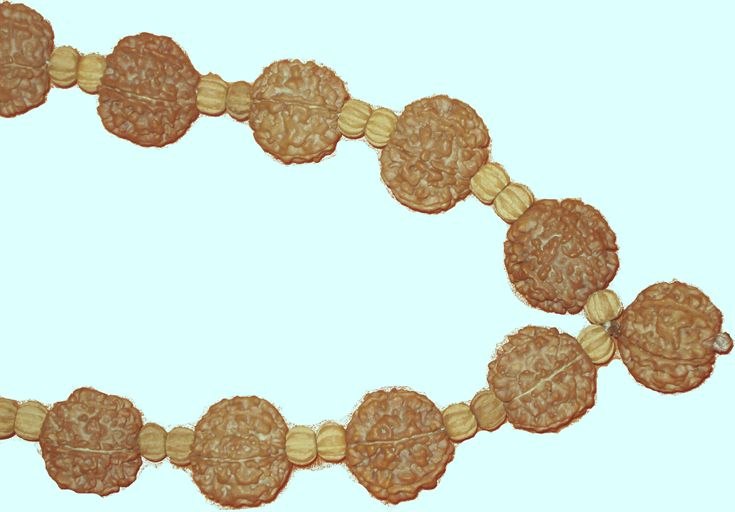
Mukhi refers to the natural longitudinal divisions or lines on a Rudraksha bead. It does not mean the number of beads in a mala. A five-mukhi Rudraksha describes a type of individual bead; a 108-bead mala describes a number of counting units. A typical mala can use 108 individual five-mukhi beads, and those two numbers describe different characteristics. Sellers sometimes write both near each other without explaining the distinction. Ask for an individual bead type, counted total and size range, each as its own field.
Authentic identification requires more than the darkness of the colour, size or roughness visible in a catalogue image. Beads vary naturally, and treatments or alterations can change external appearance. Reputable documentation describes what was actually examined. A laboratory report for one notable bead does not certify every ordinary bead in a full strand unless it explicitly states that scope. A label “Nepal” or “Indonesia” is a provenance claim, not a substitute for verification. For a functional mala, inspect whether beads slide smoothly with moderate space for fingertips and whether the drill holes have sharp edges that cut through the cord.
8. Bead diameter, spacing and comfortable handling
Bead diameter in millimetres is a useful shopping measure but does not tell the whole story. Rudraksha beads are often irregular rather than perfect spheres. Ask for a practical height × width range, the actual counted total and the finished strand length. If comparing two items, note whether the listed measurement includes the cord, knots, guru bead, tassel or metal caps. A 108-bead mala with large beads and knots can be substantially longer and heavier than one made from small, close-set beads.
As an initial mental model, beads alone might occupy roughly 108 × 8 mm = 864 mm along a fully straightened strand using nominal 8-mm diameters. But real finished length is not this simple total: knots and gaps add distance, a loop has two sides, irregular beads affect the measure, and tassels are counted separately. Do not divide a straight strand length by two and present it as an exact neck drop without allowing for the way a loop hangs and its weight. Rather than relying on a guessed formula, request a photo of the specific finished mala laid alongside a ruler, plus measured full-loop or circumference specifications.
What to request in a mala listing
| Specification | Good seller answer | Why it matters |
|---|---|---|
| Bead count | “108 counted beads plus one distinct guru bead” | Avoids ambiguity about markers and decoration |
| Bead dimensions | “Approximately 7–9 mm across the counted beads” | Supports grip, scale and expected weight |
| Material | “Natural Rudraksha, individual beads described; origin claim identified” | Separates botanical material from unexplained claims |
| Stringing | “Hand-knotted cotton/silk/polyester cord with ___ spacing” | Reveals repair needs and handling characteristics |
| Length | “Loop circumference ___ cm; laid-flat length ___ cm; tassel ___ cm” | Helps determine comfortable handling and optional wear |
| Marker | “Separate guru bead, not part of the 108 count” | Establishes when to reverse |
| Photos | “Current product photos, front/back and a clear scale view” | Reveals finish, drilling and construction |
| Documentation | “Report applies to this bead / named batch / item as described” | Prevents overreading a laboratory certificate |
If a particular listing lacks a field, ask before ordering rather than inventing a specification from imagery. The purpose is not to burden a beginner with technical perfection; it is to prevent frustration when a strand proves uncomfortable or unsuitable for a planned practice.
9. Knotting, cord, elastic and stringing durability
A threaded japa mala needs a cord that flexes without binding. Some are knotted between every bead; others use a more continuous running thread with limited spacing. Individual knots can help isolate beads and reduce movement, but a thick knot may catch during repetition. A bracelet on elastic is convenient for wearing but may stretch when used as a counting implement. Metal wires and chains provide a different feel and can abrade a bead's drill hole if poorly fitted. Ask for photos of the actual knots and end connection, particularly near the guru bead.
Beads should move with a light touch, not by hard pulling. A strand that looks attractive when held taut can become difficult in the hand if the beads are too close together. On a cord with a tassel, examine the tassel anchor and any finishing glue. Frequent handling can expose weaknesses at joins. For a mala used daily in a long Kartik routine, simple, inspectable construction is often preferable to elaborate decorative elements that snag on sleeves or books.
Before choosing a purchase, move an existing strand slowly through your fingers and notice where your rhythm breaks. If only one knot is too tight, a repair may be more useful than a replacement. If the thread is fraying, stop pulling and arrange restringing rather than attempting another full-count session under tension.
10. Preparing an uncluttered japa space
Choose an area that is clean, stable, well lit and suitable for the family or temple's tradition. A mat or seat can help with regularity, but an uncomfortable posture does not improve attention. Place any scripture or prayer sheet so that pages do not repeatedly close. Keep a small notebook if you are tracking a count. If a family member assists with the routine, agree beforehand on whether spoken japa or quiet practice is appropriate.
If lighting a diya, set it on a nonflammable, stable surface well away from cotton tassels, loose papers, curtains, packaging and the mala itself. Never leave an open flame unattended. A rechargeable lamp can be a practical substitute where candles or oil lamps are unsafe; do not present the substitute as identical in every ritual prescription. Where formal worship requires a particular lamp or offering, follow the applicable tradition and implement it safely.
Keep water, offerings and incense separate from the japa strand. Incense ash and oil residues can enter bead grooves, while water and aromatic liquids can affect thread and fittings. A separate pouch or small tray is sufficient for many households. Do not assume that a bead must be repeatedly soaked, oiled or scented before each Kartik session.
11. A simple start-to-finish daily workflow
The following is an adaptable preparation sequence, not a universal puja-vidhi. Your own sampradaya, family priest or guru may use a different order.
- Confirm the observance: Is today ordinary daily japa, an Ekadashi, a festival or a specific vrata day? Check the correct local calendar when timing matters.
- Prepare your hands and place: Keep the strand and any sacred book clean; arrange a steady seat or suitable posture.
- Check the strand: Look for broken knots, wet cord, loose fittings or beads that need repair before a long session.
- State the intent: Use a traditional opening prayer or a sincere personal sankalpa where appropriate.
- Begin the assigned mantra: Maintain the pronunciation, pace and finger method taught in your practice; avoid substituting an unverified mantra.
- Count without rushing: Touch one counting bead for each repetition under the chosen counting rule; avoid tugging the cord.
- Recognize the marker: On a usual meru-based strand, do not count the meru; turn the mala for a further circuit if needed.
- Conclude deliberately: Finish with the prayer, silence, reading or offering that belongs to your household custom.
- Inspect and store: Ensure the cord is dry, clear of lamp oil and protected from hard jewellery or sharp objects.
- Record only useful facts: If tracking, note the date, count and one practical observation; do not grade your devotion.
If you must stop before finishing the intended count, the appropriate response depends on your practice. In ordinary personal japa you may simply resume later; a formal prescribed anushthana can have more specific rules. Do not infer that a session is invalid merely because one bead was difficult to handle, but do not replace a prescribed ritual step with an invented shortcut either.
12. Special days: Ekadashi, Tulsi worship and Kartik Purnima
Kartik includes observances associated with Vishnu and Krishna in numerous communities, including Devutthana or Prabodhini Ekadashi, Tulsi Vivah, and events connected with the full moon. Their precise dates can differ by city, tithi rules and sampradaya. Many Shaiva devotees mark Kartik Purnima with worship of Shiva or deepdan and recall legends linked to Tripurari. There are also regional practices around holy baths, processions, singing and public lamps. A daily japa plan can note these occasions without imposing every custom on every family.
On an Ekadashi observed by your tradition, the japa routine may accompany the applicable vrata. Yet an online article should not dictate food restrictions or break-fast timings to people with different households and traditions. For Tulsi Vivah, some communities emphasize ceremonial marriage of Tulsi and Vishnu/Shaligram forms, with family-specific worship methods. For Kartik Purnima, a household may choose prayer, pilgrimage, lamps or charity according to local custom. A practice log can record the named observance and the prescribed rite independently from the basic number of japa repetitions.
Rather than promising that a particular crystal, coral, or expensive multi-mukhi mala is compulsory for these days, choose materials with clear traditional relevance and honestly specified physical properties. For instance, a Rudraksha mala may suit a Shiva-oriented japa practice; that does not mean every Krishna-focused Kartik vrata should automatically replace its Tulsi mala with Rudraksha.
13. What the Sanskrit terms in a japa routine mean
| Term | Working meaning | Common mistake to avoid |
|---|---|---|
| Japa | Repeated recitation or remembrance of a mantra or divine name | Assuming only loud recitation counts in every tradition |
| Nama-japa | Repetition of a divine name | Treating a shop's slogan as a complete authorized mantra |
| Mala | Strand of beads used for counting or wearing | Assuming every necklace is designed for japa |
| Meru or guru bead | Distinct circuit marker on many malas | Counting it as an ordinary bead without checking the method |
| Sankalpa | Deliberate intention or formally stated resolve | Confusing a modest personal goal with a binding ritual vow |
| Nitya | Regular or daily observance | Assuming a festival-only practice is necessarily required every day |
| Vachika, upamshu, manasa | Audible, soft and mental styles of japa as defined by tradition | Assuming all lineages teach identical rules |
| Diksha | Initiation in a tradition or practice | Treating purchase of a mala as equivalent to initiation |
| Ishta-devata | One's chosen or established object of devotion | Changing deity solely to fit a product listing |
| Vrata | Observance or religious undertaking | Copying restrictions without understanding the relevant practice |
This vocabulary helps a shopper describe what the strand is for. It also helps readers interpret a puja guide that assumes knowledge of terms they have not encountered before. Meanings and procedures can be nuanced; use the terminology of the tradition guiding your practice rather than attempting to standardize every school into one rule.
14. Common mistakes in Kartik mala selection
One mistake is buying by bead count alone. A strand with the correct number may be too heavy, poorly knotted, too tightly fitted or unsuitable for the mantra. Another is treating a photographed bead size as measured fact. A close-up magnifies details but does not establish millimetres. A third is confusing high mukhi count with high number of repetitions: those are different specifications. A fourth is changing mala material because a festival advertisement asserts a mandatory association without naming its tradition.
Another mistake is starting with an unrealistic daily target. A 108-count circuit may be manageable for one person and too rushed for another who is learning accurate pronunciation. Smaller circuits may provide a practical introduction when acceptable, without changing the religious requirement of a formally prescribed count. A tracking app can help with totals but may distract; a simple paper note works equally well for many practitioners.
Avoid using aggressive home “authenticity tests” such as burning, puncturing or soaking a bead to prove that it is genuine. Such experiments can damage the object and do not replace botanical or gemological assessment. For crystal mala, clarity alone does not prove natural quartz. For wood or seeds, aroma and colour alone are weak identification methods. An honest seller can explain material identity, size, construction, any report scope and the return or repair policy.
15. How to inspect and care for the mala through Kartik
Inspect the strand before and after use if it is handled daily. Look for exposed thread at holes, stretched elastic, broken tassel binding, unstable caps, an unusually loose meru and grit trapped in bead grooves. Wipe away loose dust gently with a soft, dry cloth or appropriate small soft brush; avoid abrasion. When moisture reaches the cord, allow it to dry naturally before storing it in a pouch. Heat from radiators, direct sunlight for long periods, steam and harsh cleaners can be unsuitable for natural beads, thread, finishes and metal combinations.
Never assume that oiling is a universal daily duty. Rudraksha is organic; Tulsi is wood; Sphatik is crystalline quartz; cords and jewellery fittings are separate materials. A fluid that seems benign for one component may stain another, loosen an adhesive or leave residue around drill holes. Follow the care instructions for the actual assembly and obtain specialist guidance if a costly, unusually constructed or damaged item needs cleaning. If the thread shows significant wear, arrange restringing rather than hoping it will hold until the festival ends.
At the end of Kartik, clean and inspect the strand according to its material, then store it in a dry, breathable and protected place. Keep it separate from hard gemstone jewellery that can scratch softer beads. Retain any product details or laboratory paperwork with the order record, not crumpled inside a damp pouch. A well-kept mala can continue to serve ordinary devotional practice after the festival period; a festival calendar does not give it an automatic expiry date.
16. When to repair, when to replace and when to buy nothing
Replace or restring a mala when the cord is failing, several beads are badly damaged, the count is not what your formal practice requires, or the construction is incompatible with comfortable repeated use. Repair can be reasonable when only the tassel has detached, an end knot is weak or the cord has stretched but the beads remain sound. Ask whether a repair changes the counted total or the separate guru marker. If a valuable bead is involved, preserve before-and-after photographs and item-specific documentation.
If the existing strand is structurally sound, permitted by your lineage and fits your hand, no purchase may be needed. Sometimes a stable prayer space, clearer text of the mantra or a less ambitious daily count is the more valuable improvement. Seasonal marketing should not pressure a devotee to choose the most expensive Rudraksha or a supposedly “higher-power” bead without a clear explanation of the actual item and its traditional significance.
17. A buyer's question list for the OmmRudraksha consultation or product enquiry
Before ordering a mala, write a simple, practical request: “I am choosing a mala for regular seated japa during Kartik. My practice uses [mantra/tradition, if I wish to share]. Please confirm the material, counting beads, whether the meru is separate, typical bead dimensions, finished loop length, string and knots, and the scope of any certificate. I prefer a strand that moves comfortably through the hand.” This allows a useful recommendation without assuming a person's spiritual practice from a purchase category alone.
If the seller suggests a particular item, ask why: is it a devotional tradition, a better size for your hand, a durable construction, a documented material, or simply available stock? That distinction should be visible in the product description. Compare the bead size, count, current product photographs, price and return terms on the same basis. When a seller states a traditional association, distinguish it from a measured property. Neither the highest price nor a claim of a special festival blessing establishes better quality.
Final five-minute checklist
| Check | What to confirm before starting the routine |
|---|---|
| Calendar | Correct year, location and Amanta/Purnimanta or family convention |
| Mantra | Exact practice, accepted pronunciation and relevant instruction |
| Count | Counting beads, meru position and planned number of circuits |
| Comfort | Hand grip, bead dimensions, knots and posture |
| Setting | Clear surface, readable text, safe lamp placement and quiet interval |
| Condition | Dry thread, secure marker, no broken knots and suitable storage |
| Record | Simple date and count; no pressure to turn practice into a competition |
| Purchase | Buy only if the current strand is unsuitable or a requirement is unmet |
18. Frequently asked questions about Kartik japa and malas
1. Do I need a new mala for Kartik every year?
No. If you already own a structurally sound mala permitted by your practice, there is no general need to buy another because the calendar has entered Kartik. Inspect the cord and marker and keep using the strand unless your tradition requires a different material or format.
2. Which mala is best for Shiva japa during Kartik?
Rudraksha has a longstanding Shaiva association and is a common choice for Shiva-oriented japa. Confirm any specific requirement with the tradition guiding the mantra. Practical suitability still depends on bead count, grip, reliable knots and a distinct circuit marker when required.
3. Can I use a Tulsi mala in Kartik?
Many Krishna and Vishnu devotional lineages specifically value Tulsi malas. Follow your community’s method for wearing, handling and counting. A generic online list assigning Tulsi to a festival cannot override a household or guru’s actual instructions.
4. Is Sphatik the same as a Rudraksha mala?
No. Sphatik means quartz crystal, an inorganic mineral; Rudraksha is a botanical hard fruit stone. They differ in weight, surface, appearance, care and customary use. A transparent bead is not automatically genuine natural quartz, and a grooved bead needs its own identification.
5. Does a 108-bead mala always contain 109 physical beads?
Not always. Some have 108 counting beads and one separate meru; other constructions include spacers, multiple markers or count labels that are inconsistent. Request a written breakdown of counting beads, guru bead and decorative parts instead of assuming the total from the listing title.
6. How many circuits of a 54-bead mala equal 108 repetitions?
Two complete counted passes, assuming one repetition per bead and no other rule. If a distinct meru is present, do not include it as a counting bead in the usual meru method. Confirm that “54” means 54 counting beads rather than 54 total components.
7. How many passes of a 27-bead mala equal 108 repetitions?
Four complete counted passes make 108 under the standard one-repetition-per-counting-bead arithmetic. Some traditions have additional counting or turning rules; follow those rules and record whether your note describes passes or total repetitions.
8. Is 27 japa repetitions sufficient?
The relevant question is what your practice prescribes. A personal beginner’s session might use 27 repetitions as a practical example where permitted, but a formally assigned mantra count is not replaced by a convenient smaller target. Consistency and accurate recitation matter more than a sales claim.
9. What is the difference between mala count and mukhi count?
Mala count is the number of beads used for repetitions, such as 108 or 54. Mukhi describes the natural longitudinal divisions on an individual Rudraksha, such as five-mukhi. A 108-count strand can consist of five-mukhi beads; these specifications do not compete.
10. Should I cross the guru or meru bead?
In many common methods, the meru marks the end of a circuit and the practitioner turns the mala to continue in the reverse direction. That is not necessarily the instruction of every lineage. Keep the marker separate from the counting beads and follow the method taught for your mantra.
11. Can I use a Rudraksha bracelet for japa?
A bracelet can function as a counter if its actual counted beads, marker and construction permit it and your practice accepts the format. Many bracelets are primarily designed for wearing: elastic strain, tight spacing or decorative metalwork can make repeated counting awkward.
12. Is a large Rudraksha bead better for chanting?
A larger bead is not automatically superior. It may be easier for some hands to distinguish and heavier or slower for others. Check dimensions and a real scale photo; if possible assess how the beads move between fingertips, how much space the knots give and the entire strand’s weight.
13. Are Nepal Rudraksha malas always better than Indonesian ones?
Origin labels may describe different typical appearance and size ranges, but a broad geographic claim does not authenticate an individual bead or prove it suits your hand. Compare the verified item, bead count, construction, intended use and report scope rather than ranking locations in isolation.
14. May I chant without a mala?
Many devotional practices permit recitation without beads, sometimes using a counter or mental repetition. Others prescribe a specific counting instrument. If you do not have a mala, first check your practice’s rules; the absence of a new product does not automatically prevent devotional remembrance.
15. Is a particular early-morning time compulsory?
Morning and evening are traditionally valued for many forms of practice, but exact time rules depend on the observance and tradition. A practical daily routine should be regular and feasible; a formal vrata or initiation may prescribe timing that should not be changed by a general shopping article.
16. Can children or beginners start with a 27-bead mala?
A shorter strand may be easier to handle, but suitability depends on the child’s age, safe supervision, bead security and the practice being taught. Loose small beads can present a choking hazard for young children. The counting method should be simple and age-appropriate.
17. How do Amanta and Purnimanta calendars change Kartik dates?
Amanta months end at the new moon, while Purnimanta months end at the full moon. The waning fortnight may therefore be named differently between the two systems. For example, the Bengaluru almanac for 8 November 2026 shows Amanta Ashwina but Purnimanta Kartika.
18. Is Kartik Purnima always the last day of everyone’s Kartik?
It is the ending point in Purnimanta month reckoning, but the Amanta named month continues to the following Amavasya. Festival and vrata timing may follow more specific observance rules, so use the relevant local almanac and tradition before recording an end date.
19. Do all devotees perform Tulsi Vivah in Kartik?
No. Tulsi Vivah is especially significant in particular Vaishnava and regional households, but practices vary widely. A Shaiva family may mark the month differently. Follow the observance your household actually keeps rather than copying a festival shopping checklist indiscriminately.
20. Must a Rudraksha mala be soaked or oiled before japa?
No universal soaking or oiling rule applies to every finished strand. Water and oils affect cord, adhesives and metal fittings differently, and repeated soaking can damage mixed materials. Use the seller’s item-specific care advice and favor gentle inspection and dry storage.
21. How can I tell if a mala is durable enough for daily use?
Check the end knots, thread thickness, bead-drill edges, marker attachment, tassel anchor and whether beads slide with a light touch. Ask for close photographs of the joins. A beautiful front-facing product image alone does not demonstrate sound stringing.
22. How should I store a mala between Kartik sessions?
Store it clean and dry in a suitable pouch or dedicated place, away from prolonged heat, moisture, harsh cleaners and hard jewellery that could abrade the beads. Examine string wear periodically. Follow any additional sacred-handling custom of your family or lineage.
23. What should I do if a knot breaks during japa?
Stop pulling on the strand, collect all loose beads and document the original count and marker arrangement. Have the mala restrung with suitable material; after repair, recount the beads. Whether the interrupted devotional count requires a specific response is a matter for your practice.
24. Can I wear the same mala used for counting?
Some traditions allow the same strand to be worn and used for japa; others keep a dedicated counting mala or specify different handling. Decide according to your established practice and the strand’s actual fit. Long loops, tassels and knots can catch in everyday clothing.
25. Does a laboratory certificate guarantee spiritual effects?
No. A competent report can document examined material properties or specific identification findings within its stated scope. It does not measure devotion or establish promised spiritual outcomes. Ask whether a report covers one bead, a sample or the entire item.
26. Is Rudraksha suitable for every Kartik mantra?
Rudraksha has broad traditional Shiva associations, but a specific mantra may be accompanied by a prescribed material or lineage rule. Identify the mantra first, then select the counting instrument. Do not infer universal suitability from the month name alone.
27. How can I remember multiple mala circuits without losing count?
Use a permitted counter, place a small non-sacred tally marker beside your mat, or make a brief pencil mark after each completed circuit. Keep the device separate from the counted beads and ensure it does not interrupt the practice. Confirm whether counters are acceptable in your lineage.
28. What is a simple Kartik japa log?
Record the local date, the name of the chosen practice, planned repetitions or circuits, what you completed, and an optional note such as “cord needs repair.” Use the same units consistently. The log is an organizational aid, not a measure of spiritual worth.
29. Should I buy a very expensive multi-mukhi mala for Kartik?
No universal seasonal rule requires the most expensive option or multiple high-mukhi beads. Compare devotional suitability, authentic identification, bead count, finished size, construction, clear item photos and price. Seek tradition-specific advice if a special mukhi is actually prescribed.
30. What is the most important question before ordering a Kartik mala?
Ask whether the actual strand supports your planned mantra practice and hand movement. Request its counting-bead number, separate meru, material, bead-size range, knotting, measured finished length and documentation scope. If an existing mala already meets those needs, you may not need to order anything.
19. Closing perspective: make the practice primary
Kartik can be a meaningful invitation to a steadier routine of mantra, remembrance, reading and service. Choose an accurate calendar convention, honor your existing devotional tradition, use a count that is genuinely appropriate to the practice, and select a mala because it is usable, well made and materially well described. When the festival season ends, the habits of attention and care may remain. The beads support that work; they do not replace it.