Seeing Rudraksha advertised during Diwali can raise a fair question: is a Rudraksha bead part of Lakshmi Puja, or is it a separate devotional purchase? The answer needs some care because a shop's seasonal collection and a household's ritual requirements are different things.

Some devotees connect particular mukhi beads with Lakshmi in their own practice. That association does not establish a universal instruction that every Lakshmi Puja requires a new bead.
Begin with the puja you actually follow
Read the instructions used by your family or the person conducting the ceremony. A published reference may describe a particular form of worship, including offerings, a lamp, an image and other materials. A more elaborate list can include items that your own arrangement does not use.
Drik Panchang's Lakshmi Puja materials page is one such reference. It does not establish a required Rudraksha purchase. That observation should not be stretched into a claim about every lineage or every family; it simply prevents a retail association from becoming a rule without a source.
What a mukhi association tells you
The existing Rudraksha catalogue presents different devotional associations for different beads. A person may choose a bead because that symbolism matters to them, much as another person may prefer a particular devotional image.
Religious significance and physical identification remain separate. An explanation connecting a bead with Lakshmi does not tell you whether a particular specimen is correctly described, how large it is or what its cap is made from. Those questions still need item-specific answers.
It also does not establish a guaranteed financial outcome. A bead, gemstone or paid preparation should not be represented as a contract for wealth or business success.
A prayer mala has a different role
A mala can help someone keep a count during a prayer routine. The prayer being recited, the material chosen and the observance followed are related decisions within the person's practice. Do not assume every mala material is prescribed for every prayer, or that one listing resolves those religious questions.
If your teacher has specified a material or way of counting, give those details to the seller. If you are simply looking for a comfortable personal strand, examine the construction and length in the mala collection. Be clear which question you are asking.
Keep personal jewellery away from offerings
During puja, a ring, pendant or mala may sit near liquids, food, flowers or a lamp. Its spiritual use does not remove the material's care requirements. Keep it where oil, water and heat will not accidentally affect the strand or its fittings.
A symbolic offering can be arranged separately from an object that cannot safely be immersed. If your observance calls for a particular physical treatment, discuss the exact assembly with the priest and maker beforehand. The article on ritual terms and product care explains why the name of a service is not enough to establish what happens to the item.
If you are choosing a Diwali gift
Ask whether the recipient would welcome a devotional item. A simple question about preference is kinder than assigning a bead to someone's supposed financial difficulty. Do not invent an astrological need from a gift occasion.
Confirm the item, included fittings, applicable documents and delivery expectations. If the gift needs custom work, agree the details before ordering. A festival date does not guarantee that every size or design can be supplied immediately.
Can the celebration stay simple?
Yes. This article establishes no need to add a commercial purchase to a household's existing worship. A meaningful observance can follow the practice you already know, using the items appropriate to it.
If you do choose Rudraksha, let it be an informed, comfortable choice. The association can have personal significance without being turned into a compulsory shopping list or a promise about next year's finances.
Lakshmi Puja and Rudraksha: where devotion, scripture and a personal choice meet
Lakshmi Puja is centred on the worship of Sri Mahalakshmi, the goddess of shri—auspiciousness, prosperity, beauty, well-being and abundance. At Diwali, households may invoke her alongside Sri Ganesha, offer lamps, flowers and naivedya, recite familiar prayers and seek a life sustained by honest work and generosity. A Rudraksha bead, meanwhile, is traditionally identified most strongly with Lord Shiva. A person may bring the two devotional worlds together through private prayer, a mixed household altar, or a particular mukhi association. That connection is meaningful when its tradition and purpose are explained; it is not the same as a rule requiring Rudraksha for every Lakshmi Puja.
This matters especially when seasonal listings describe a bead as a Lakshmi Rudraksha, Mahalakshmi Rudraksha, prosperity Rudraksha or Diwali Rudraksha. Those labels may refer to a seller's presentation, a living devotional interpretation, or a particular lineage's symbolism. They do not, by themselves, tell you the number of natural faces, the botanical material, the bead's condition, a laboratory finding, the metal purity of a cap, or whether the bead belongs on your own puja list. A careful explanation should address each question separately.
The right sequence is therefore: identify the family or temple puja; understand any traditional association you want to follow; decide whether the bead is to be worn, used for counting, gifted or simply kept separately; and inspect its actual specification before buying. If you already possess a suitable object—or do not use Rudraksha in Lakshmi worship—there is no need to manufacture a new requirement for the festival.
At a glance: five questions, five different answers
| Question | What determines the answer | Sensible next step |
|---|---|---|
| Is Rudraksha compulsory for Diwali Lakshmi Puja? | Specific family, temple or guru instructions | Follow the puja vidhi actually used in your household |
| Is a seven-mukhi bead connected with prosperity? | Textual and living devotional interpretations | Understand Sapta Matrikas in the Rudraksha Jabala tradition and later Mahalakshmi associations distinctly |
| Can a Rudraksha mala be used for Lakshmi-name japa? | Mantra tradition and any prescribed counting material | Check your teacher's or household's established practice |
| Does a “Lakshmi” product label verify a bead? | Material identity, natural grooves, specimen inspection and report scope | Request clear photographs, dimensions and relevant documents |
| Should the bead be placed in oil, water or beside the diya? | Actual ritual instructions plus the item's construction | Keep fragile thread, caps and adhesives away from liquids and flame |
1. What Lakshmi Puja traditionally involves
Puja is an act of worship in which the devotee welcomes and honours the deity through avahana (invocation), asana (offering of a seat), appropriate offerings, prayer, and a respectful conclusion. Household forms vary widely. Some people perform a short panchopachara sequence, classically explained as five offerings such as fragrance, flowers, incense, light and food. Others use shodashopachara, a fuller sequence of sixteen honours. A festival booklet may combine those offerings with kalasha, a decorated image, turmeric, kumkum, a clean cloth, sweets, grains and other local items. The order and the exact items should come from the particular vidhi, not from a generic store bundle.
At Diwali, Lakshmi–Ganesha Puja is widespread in northern and western households, while other regions emphasise different forms of Deepavali observance. Account books, ledgers or writing materials may be reverently placed before the deity in some mercantile traditions. Families may also worship Saraswati, Kubera, Kali or their kuladevata according to custom. In Odisha, Karnataka and other regions, the festival calendar and household observances are not necessarily identical to the northern Lakshmi–Ganesha arrangement. The best comparison is between your actual observance and its stated requirements, not between two shopping advertisements.
Published puja-samagri lists are useful as references but are not a universal contract. For example, Drik Panchang's special Diwali Lakshmi Puja list includes a Lakshmi–Ganesha image, lamps, cloth, offerings, flowers and a kalasha, with additional elaborate ingredients depending on the ceremony. It does not turn a new Rudraksha purchase into a standard mandatory component. Conversely, an individual priest or lineage may incorporate a Rudraksha already owned by the devotee; its inclusion should be described accurately as that practice.
Three levels of preparation
| Level | Typical content | What it means for Rudraksha |
|---|---|---|
| Simple household worship | Clean place, image, lamp, flowers or other accepted offerings, prayer and aarti | Not intrinsically required |
| Family or community festival vidhi | Additional kalasha, cloth, naivedya, recitations, account books or regional offerings | Include only if prescribed or personally customary |
| Personal japa or devotional jewellery | A counting mala, single bead or pendant associated with one's preferred practice | Separate decision about mantra, material, size, authenticity and care |
2. Lakshmi, Sri Sukta and the broader meaning of prosperity
The Sanskrit Sri (Śrī) denotes radiance, beauty, fortune and auspicious abundance. Lakshmi is revered not merely as a symbol of coins but as a divine presence linked to flourishing, well-ordered life and graciousness. The Sri Sukta (Śrī Sūktam), transmitted in the Rigvedic khila or supplementary tradition, is a prominent hymn in Lakshmi worship. Its imagery includes the goddess's golden radiance, lotus symbolism, animals, household prosperity, and the aspiration that Alakshmi—misfortune, hunger and want—depart. Different printed recensions and household recitation traditions contain different verse counts and appendices. A person using a formal Sri Sukta chant should follow the recension and pronunciation received from a competent teacher.
The festival's traditional request for prosperity also has a practical and ethical context: maintaining the home, honouring relationships, giving to others, and conducting work responsibly. Devotees may pray for dhana (wealth), dhanya (grain), saubhagya (good fortune) or kshema (welfare). These meanings should not be collapsed into a product claim such as “this bead guarantees money within a specified period.” Nor should the devotional importance of the goddess be reduced to buying the highest-priced jewellery.
Some households invoke Ashta Lakshmi, eight celebrated forms or aspects of Lakshmi such as Adi Lakshmi, Dhana Lakshmi, Dhanya Lakshmi, Gaja Lakshmi, Santana Lakshmi, Veera/Dhairya Lakshmi, Vijaya Lakshmi and Vidya Lakshmi. Names and ordering can vary by devotional presentation. This eightfold symbolism is about the goddess and her forms; it is not a statement that an eight-mukhi Rudraksha automatically represents all eight Lakshmis. Always distinguish a deity's group of forms from the numerical count of lines on a bead.
3. Why Rudraksha is connected primarily with Shiva
Rudraksha means, traditionally, the “eye” or “tear” of Rudra, a form or name of Shiva. The physical bead is the hardened inner structure (endocarp) of a fruit belonging to a relevant Elaeocarpus species, commonly described in Indian literature under Elaeocarpus ganitrus. Its sacred association and botanical structure are different kinds of information. A laboratory can investigate material and morphology; it cannot measure someone's bhakti or determine the outcome of worship.
The Rudraksha Jabala Upanishad, the Shiva Purana and other traditional sources connect particular face counts to forms of Shiva and other divine powers. A five-faced (panchamukhi) Rudraksha is especially familiar in everyday Shaiva japa and wearing. Beads with different counts have their own attributions, and the textual lists are not identical in every source. For example, the Rudraksha Jabala translation identifies the five-faced bead with the fivefold Brahman or Shiva forms. A devotee can respect such an association while also worshipping Lakshmi, Vishnu, Ganesha or Devi in a household containing several devotional streams.
When a shop uses the phrase “Lakshmi Rudraksha,” the label needs clarification: does it mean a specific face count; a special natural configuration; a bead selected for a Lakshmi-related devotional intention; or simply a festive product name? These are not interchangeable. A seven-mukhi bead remains seven-mukhi regardless of which festival occurs when it is purchased. A single ordinary bead does not become a novel botanical category merely because it is placed near a Lakshmi image.
4. Seven-mukhi Rudraksha, Sapta Matrikas and Mahalakshmi
A frequently encountered association is seven-mukhi (saat-mukhi) Rudraksha and Mahalakshmi. It deserves careful treatment because at least two layers of tradition are involved. In the Rudraksha Jabala Upanishad's familiar English translation, a seven-faced bead is associated with the Sapta Matrikas, the seven Mother Goddesses. That passage also uses auspicious language about the welfare of the wearer. The Shiva Purana's seven-faced attribution is Ananga in an often-cited passage. These texts show why a historical explanation should not simply attribute every modern Mahalakshmi phrase to the same ancient verse.
In later and living devotional practice, many devotees and sellers associate seven-mukhi Rudraksha with Mahalakshmi, prosperity and stability. That association may be personally meaningful; name it as a traditional contemporary interpretation rather than incorrectly quoting a specific verse as directly naming Lakshmi if that verse names the seven Mothers. A Vaishnava household following Lakshmi–Narayana worship, a Shaiva devotee following Rudra japa and a Shakta devotee honouring the Matrikas may therefore describe the same bead's meaning differently.
“Seven faces” refers to seven natural divisions or lines extending over the bead, not seven decorative grooves carved into a smooth surface and not seven beads strung together. The face count must be inspected for continuity and workmanship. A seller should identify the individual item precisely and avoid using a devotional epithet as a substitute for its technical description.
Common terms and what each does—and does not—establish
| Term used in a listing | Reasonable meaning | What remains to be verified |
|---|---|---|
| Seven-mukhi Rudraksha | Bead presented as having seven natural faces | Number and continuity of natural mukhis; condition; species or origin claims if made |
| Mahalakshmi Rudraksha | A devotional or marketing association, often applied to seven-mukhi | Actual mukhi count and the source of that attribution |
| Sapta Matrika Rudraksha | A seven-Mothers interpretation linked to classical lists | Which text, recension or lineage is being cited |
| Prosperity Rudraksha | Describes a devotional intention or product positioning | No basis to treat the phrase as an objective financial guarantee |
| Energised Rudraksha | A claimed ritual preparation or blessing | Who performed it, which steps, on what date and how the seller documents it |
| Certified Rudraksha | Some type of material or morphology examination may have been done | Lab identity, report number, item matching, method and exact scope |
5. What does a mukhi count tell the buyer?
The mukhi is a natural surface division on a Rudraksha, commonly examined from one pole of the bead toward the other. Counting must take place on the actual bead, not only on a magnified catalogue graphic. Deep crevices, scars, natural irregularities, drilling and physical damage can make interpretation difficult. Some fake or altered pieces are carved, coloured, glued or assembled. More expensive multi-mukhi specimens warrant more careful scrutiny than a routine purchase because the cost of misidentification is higher.
A sound buying inspection includes unfiltered photographs of all sides, both poles, the drill opening, any cap or mount, and a measurement reference. Ask for bead length and width in millimetres and actual weight if it matters. Distinguish bead dimensions from finished pendant dimensions: a cap, bail or decorative frame changes the total size. If the bead is to be placed on a puja tray rather than worn, the display support should be described separately from the specimen.
A laboratory report may record visible faces, internal structure or other findings. Its usefulness depends on which bead was examined, the methods used and whether the report explicitly supports the statement printed in the product listing. A photo of some other specimen's certificate, a certificate for one bead in a multi-bead mala, or a vague “100% genuine” badge is not the same as an identifiable record for the actual item. A laboratory report also does not prescribe a deity, mantra or promised result.
6. A Rudraksha mala for Lakshmi japa: choose the practice first
A japa mala is a counting instrument. Many Hindu counting malas contain 108 counting beads and a distinct guru or meru bead. Shorter 54- and 27-count strands can be used for repeated circuits in traditions that accept them. In common arithmetic, two passes over 54 counting beads equal 108 repetitions, while four passes over 27 equal 108. The guru bead is generally used as a marker, not counted among the repetitions; in many customary methods, the practitioner reverses direction at that bead. Different lineages can prescribe different techniques, finger positions and suitable materials.
For Lakshmi worship, what matters first is which mantra or stotra is being recited and whether the practice specifies a particular mala. Some Lakshmi-oriented households use Sphatik (clear quartz), lotus seed/Kamal Gatta, or another prescribed material. Others simply recite a Lakshmi prayer without a mala. A devotee who already uses Rudraksha in daily worship may choose it according to family or teacher guidance. It would be inaccurate to say either that Rudraksha is prohibited in all Lakshmi japa or that it is the one compulsory material for all Lakshmi mantras.
A widely known, simple Lakshmi devotional invocation is “Om Shri Mahalakshmyai Namah” (ॐ श्री महालक्ष्म्यै नमः), subject to the pronunciation and form used by one's tradition. Sri Sukta is a different text with a prescribed recitational heritage, and specialized bija or initiated mantras have their own requirements. Do not replace an initiated formula with a commercial “wealth mantra” because a seller included it in a bundle. For non-initiated daily devotion, many households use a familiar name, aarti or short prayer rather than attempting complex Vedic chanting without instruction.
Mala formats for different devotional intentions
| Intention | Material or format to consider | Counting and construction check | Traditional decision point |
|---|---|---|---|
| Family Lakshmi Puja with brief prayers | No mala required unless household vidhi calls for one | None; use the puja supplies you already need | Family prayer sequence |
| Personal Lakshmi-name japa | Existing permitted mala, or prescribed Sphatik/Kamal Gatta/Rudraksha | Actual counting beads, meru and smooth movement | Teacher or lineage guidance |
| Regular Shiva japa during Diwali season | Rudraksha counting mala is a familiar Shaiva option | 108/54/27 counts, knots, beads and cord | Shiva mantra practice |
| A single devotional bead worn daily | Properly inspected bead in a comfortable pendant | Mukhi, bead size, cap, bail and chain | Personal deity symbolism and wearing custom |
| A ceremonial gift | Single bead, strand or non-Rudraksha devotional item | Recipient's preference, documentation and delivery | Whether the recipient actually wants the object |
7. Practical Diwali 2026 example: date and puja planning
For Bengaluru, Lakshmi Puja/Diwali in 2026 falls on Sunday, 8 November. The local Drik Panchang listing gives a Lakshmi Puja muhurta of about 6:17–8:20 p.m. IST, with Pradosha Kaal about 5:51–8:20 p.m. These timings are city-specific and year-specific. The Amavasya tithi begins on 8 November and continues into 9 November. Do not carry those clock times into another city or year; the applicable almanac and household rules determine the observance. For readers using the article in a later season, check the current local Panchang rather than treating the date here as a permanent annual schedule.
A practical household can arrange a clean altar with the correct image, permitted offerings, flowers, lamp and puja book; keep all materials organized before the chosen session; then make a separate optional decision about an already-owned Rudraksha. If one is used for personal japa later in the evening, that activity should not be confused with an obligatory samagri item in the main Lakshmi Puja list. If a guru has assigned a specific Lakshmi sadhana, its count and material instructions remain separate from this general festival example.
Before, during and after the puja
| Stage | Worship preparation | If a Rudraksha object is present |
|---|---|---|
| Before | Confirm local date, family vidhi, image, offerings, diya and a safe surface | Decide whether bead is to be worn, counted or kept separately; inspect cord and fittings |
| During | Follow the invocation, offerings, prayer and aarti practiced by the family | Keep jewellery clear of flame, warm oil, dyes, food and loose water unless its exact construction permits a prescribed action |
| Immediately after | Allow the diya to cool, distribute prasad and tidy offerings | Handle with clean, dry hands; check if the cord became wet or snagged |
| Following days | Store puja items respectfully and reuse suitable supplies | Dry storage, occasional visual inspection, and no unnecessary soaking or harsh cleaning |
8. Can you keep Rudraksha beside a Lakshmi image or on a puja tray?
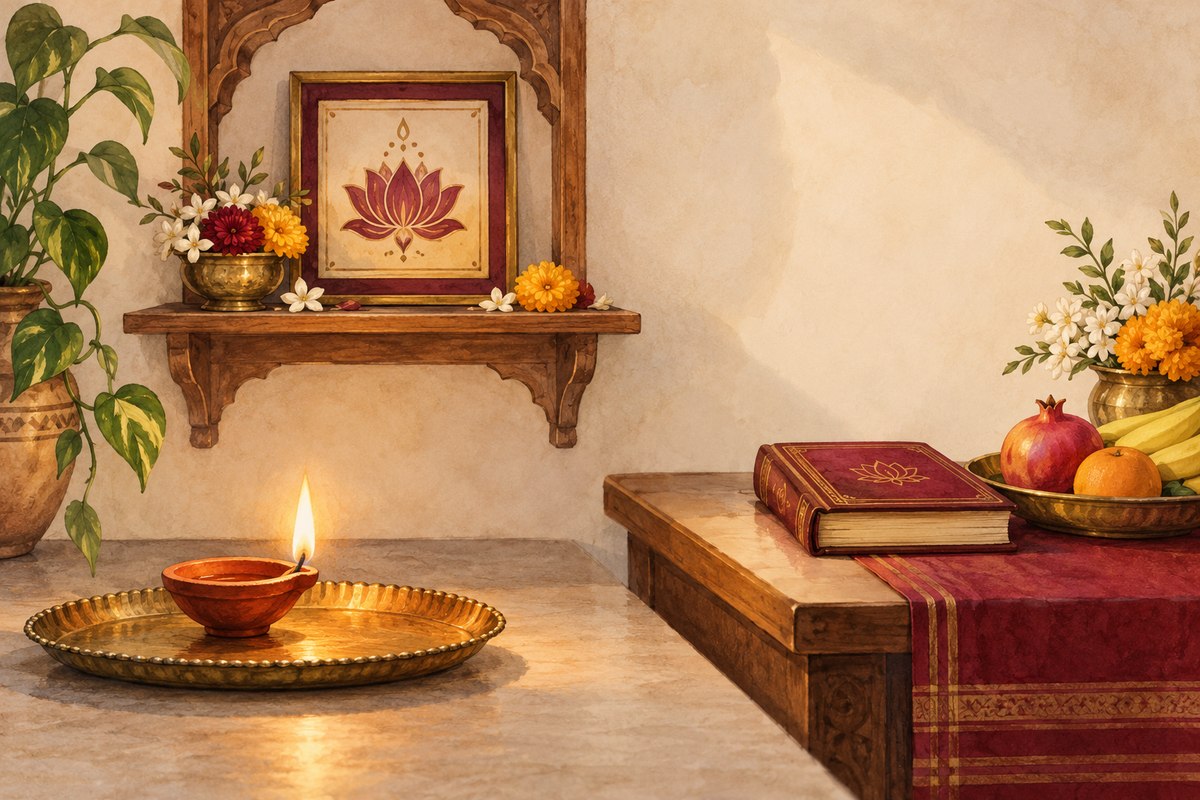
A household shrine can include images and objects from several devotional traditions. In practice, many families worship Shiva, Vishnu, Devi and Ganesha in the same domestic space. Whether a particular Rudraksha is kept at the centre of the Lakshmi Puja arrangement, at the side, in a pouch, or not used at all follows family or teacher instruction. A photograph of a seasonal display is not proof of a religious injunction.
For a bead being used as a symbolic devotional object, keep it on a clean, stable support away from the flame. A cloth-lined small plate, its own pouch or separate stand can be more suitable than placing it directly in sweetened milk, ghee, kumkum or flower water. Do not assume that every finished pendant can tolerate abhisheka. A loose uncapped botanical bead differs materially from one with soldered metal, adhesive, dyed thread, silk tassels, leather, plated chains or gemstones. If the family rite requires immersion, ask the officiant and maker how to accommodate the item safely rather than exposing a delicate piece without preparation.
Do not put a pendant near a diya so that its metal cap becomes hot; avoid placing the string where a flame can touch it. If oil or liquids spill, blot away surface moisture gently, separate the piece from other objects and consult the seller for the actual material's care. A spiritually meaningful object deserves both respectful handling and ordinary material care.
9. Rudraksha, Sphatik and Kamal Gatta: related but different materials
A Rudraksha is an organic botanical bead. Sphatik ordinarily refers to clear quartz, a mineral of composition silicon dioxide; transparent glass and synthetic-looking material can resemble quartz in product photographs. Kamal Gatta generally refers in devotional trade to lotus seeds, although actual commercial materials and naming conventions should be checked. These are not interchangeable physical substances, and neither their appearance nor a mantra-label supplies automatic identification.
Rudraksha is usually chosen for its strong Shiva/Rudra tradition. Sphatik is used in some Devi and Lakshmi practices, and Kamal Gatta in many Lakshmi-related devotional practices. Such associations vary by lineage, and using a particular material does not replace sincere prayer. If someone is comparing the three for a Lakshmi japa routine, the first question is what the teacher, family text or ritual specifies. If there is no prescribed material, the next question is whether the beads are comfortable, correctly identified, durable and easy to count.
Care differs as well. A quartz mala can suffer chipped drill openings or broken strings even though quartz itself is harder than Rudraksha. Lotus-seed and Rudraksha strands can react differently to repeated moisture and environmental changes. Finished jewellery combines beads with thread, metal, adhesives and sometimes dyed components, so the weakest material often determines the safest cleaning method. For most mixed pieces, avoid soaking and aggressive chemical cleaning.
10. Seven-mukhi, five-mukhi or a rare bead: avoid choosing by advertising alone
A prospective buyer may be offered a seven-mukhi bead because of its modern Mahalakshmi association, a five-mukhi strand because of common Shaiva japa practice, or a high-mukhi bead with a dramatic claim about finance. None of these choices is automatic. First identify whether the purpose is Lakshmi worship, an existing Shiva practice, a specific astrologically prescribed remedy, or simply a respectful gift. Where a birth-chart-based recommendation has genuinely been requested, the relevant chart factors, the traditional basis of the recommendation, and the specific bead can be explained separately; the Diwali date by itself is not a birth-chart assessment.
Physical verification also becomes more important as price rises. Ask about natural grooves, any modification, the exact bead offered, origin claims and the report corresponding to that specimen. A low price alone does not prove a low-quality item; an extremely high price does not prove authenticity. Price can reflect perceived rarity, size, workmanship, certification costs, metals, and brand margins. Compare like-for-like descriptions, not merely two labels that both say “Mahalakshmi.”
A thoughtful devotional decision can be quite modest: if your current five-mukhi mala is suited to your practice, continue with it. If you prefer a seven-mukhi pendant for its meaning, ask for a clear, verifiable specimen. If your puja requires only flowers, a lamp and prayer, follow that puja without buying a bead at all.
11. How to compare product listings responsibly
The minimum comparison should make it possible to identify exactly what will arrive. A loose bead requires its own photographs and dimensions; a pendant adds metal and fitting specifications; a full mala requires a counting-bead breakdown and measured finished length. Reported Nepal or Indonesia origin should be treated as a specific sourcing claim, not a conclusion based only on coarse versus fine texture. If the seller cannot substantiate a claimed provenance, they should describe it as unverified rather than changing the country's name to make the item seem more valuable.
Some stores use “energised,” “abhishekam performed,” “prana pratishtha,” or “blessed” as service labels. These are not identical rites. Ask which practice was actually undertaken, by whom, whether it applies to the physical product, and whether it involves liquids or heat. A store's ritual description should not be mistaken for a material laboratory report. Conversely, a lab report establishing an examined characteristic is not a record of a religious service.
A purchase-specification worksheet
| Required detail | Loose bead | Pendant | Japa mala |
|---|---|---|---|
| Item-specific photographs | All sides and both poles | Bead, cap, bail and back | Full strand, marker, close-up of selected beads and joins |
| Face count or material | Mukhi count and bead identity | Same, plus whether covered by cap | Material and any special selected bead |
| Measurements | Height and width in mm | Bead size and total finished drop; bail opening | Bead diameter range and finished loop or end-to-end length |
| Construction | Natural drill hole or modifications | Metal purity, cap type, attachment and chain details | Thread, knotting, spacers, clasp and tassel |
| Documentation | Actual specimen report and scope if claimed | Stone report and metal documentation separately | Clarify whether any report concerns every bead or a sample |
| Order terms | Price, included accessories, return conditions | Sizing/custom work and repair terms | Count verification, repairs, restringing and delivery terms |
12. Matching devotion, jewellery and gifting to the recipient
A person buying for their own practice can usually answer more questions than someone choosing a surprise gift. For the latter, ask whether the recipient wears sacred jewellery, what deity or tradition they follow, whether they prefer a pendant or mala, and whether particular materials are acceptable. If these details are unknown, a devotional book, flowers, a simple lamp or an ordinary gift chosen with care may be more welcome than a costly item advertised as necessary for prosperity.
Avoid claiming that the recipient has a specific planetary affliction, needs a high-mukhi bead, or must conduct an expensive ritual merely because Diwali is approaching. If the recipient has independently requested an astrology-based consultation, handle that as a separate service with complete birth details and clear reasoning. The gift occasion is not a substitute for a chart or consultation.
For jewellery, match chain length, bail opening, skin comfort, bead projection, neckline, daily movement and closure security. For a mala, count the beads and verify the marker. For a display piece, check packaging and how it will be safely kept on a shelf or altar. Confirm delivery expectations early: a festive date is not proof that every custom design or laboratory report can be completed immediately.
13. What a practical home Lakshmi Puja checklist should include
Build a checklist from the family vidhi rather than buying a large preselected kit blindly. Write down the deity image or murti, a clean place, lamp and safe fuel, flowers or suitable alternatives, incense where allowed, water, naivedya, aarti materials, and the specific recitations your family uses. Depending on tradition, the list may include a kalasha, grains, cloth, turmeric, kumkum, betel leaves, account books, coins or other offerings. Some items may already be at home. Certain more elaborate rituals name additional herbs or substances that are not needed for every domestic observance.
Keep a separate line called optional personal devotional object. That line can say “existing Rudraksha,” “counting mala,” “Sphatik mala,” “none,” or whatever is consistent with the household. This avoids a marketing category being accidentally promoted to the same status as an item actually prescribed in a rite.
A compact plan for the household
| When | Practical action | Who should decide |
|---|---|---|
| Several days before | Confirm the local puja date, tradition, family script and required offerings | Household elder or officiating priest |
| One day before | Clean the altar, inspect lamps, prepare dry supplies, check fire safety | Person organizing the home |
| Before the chosen muhurta | Set out appropriate offerings; keep oils and liquids away from jewellery | Family following the chosen vidhi |
| During worship | Follow the recitation and offering order; do not interrupt to assess retail products | Those performing the puja |
| After worship | Allow lamps to cool, distribute prasad and store items properly | Household members |
| Separately, if buying Rudraksha | Confirm mukhi, photographs, measurements, laboratory scope, metal parts, price and delivery | Buyer and seller |
14. Cleaning and handling a Rudraksha after Diwali
No single cleanse-every-bead-with-milk instruction can be applied safely to every Rudraksha product. A natural unmounted bead, a silver-capped pendant and a silk-knotted mala are three distinct assemblies. The outer shell can be damaged by forceful scraping or repeated extremes of heat and moisture; metals, cords, dyes, adhesives and tassels may add further restrictions. A gemstone-set pendant may have yet another care requirement. Ask for the finished object's maintenance method, not only the botanical bead's.
For routine handling, examine the item for dust, wet cord, loosened cap, worn drill edges and weak knots. Keep it away from direct heaters and prolonged intense sunlight. Avoid household bleach, acidic cleaners, abrasive brushes and indiscriminate ultrasonic cleaning. If a genuine ritual requires exposure to water or other offerings, plan a method suitable for the item and dry it appropriately. If the strand fails, collect the beads before restringing, note the original number, and verify the count after repair.
Sacred handling customs also vary: some people keep a dedicated pouch or separate altar compartment, while others wear their mala daily. The shop can explain material care, but devotional rules about purity, initiation and ritual storage should come from the relevant religious tradition. Neither set of considerations needs to cancel the other.
15. Decision tree: what should you do next?
If you are preparing Lakshmi Puja: read your household vidhi and gather those items. Do not add a Rudraksha because of a generic advertisement.
If you already have Rudraksha: decide whether you will keep wearing it, use it for an established japa practice, or place it separately during worship. Handle it according to its construction and your tradition.
If you want the seven-mukhi/Mahalakshmi association: learn the difference between Sapta Matrikas in the Rudraksha Jabala Upanishad and later Mahalakshmi associations. Then request a specific, inspectable seven-mukhi specimen.
If you want a Lakshmi japa mala: confirm the mantra, tradition, permitted material, bead-count convention and meru handling before choosing the strand.
If you want a gift: confirm preference, fit, documentation, customization and delivery. A gift should be welcome—not a newly imposed religious obligation.
If you are concerned about financial success: keep the traditional prayer's devotional meaning separate from any commercial promise of earnings, employment, sales or investment returns. Prayer and ethical action can both be meaningful without treating a bead as a measurable financial instrument.
Frequently asked questions about Lakshmi Puja and Rudraksha
1. Is Rudraksha required for Diwali Lakshmi Puja?
No universal Lakshmi Puja rule requires purchasing Rudraksha. Many household vidhis centre on the goddess's image, a diya, flowers, offerings, recitation and aarti, sometimes alongside Ganesha and an account book. A particular family or priest may include a Rudraksha object for a special reason; in that case, follow that practice. Do not turn a seasonal catalogue listing into a compulsory item.
2. Why do shops connect Rudraksha with Goddess Lakshmi?
Some living traditions associate particular mukhi beads, especially seven-mukhi, with prosperity and Mahalakshmi. Others explain the same bead through older Sapta Matrikas or Ananga attributions. Stores may also use a broad devotional or festive label. Ask whether the claim concerns a classical text, a community practice or the item's marketing name, and then examine the physical specimen on its own merits.
3. Which Rudraksha is most commonly called Mahalakshmi Rudraksha?
In much modern devotional retail usage, seven-mukhi Rudraksha carries the Mahalakshmi label. This does not make every seven-faced bead a different plant species or establish a guaranteed financial result. The actual item still requires clear mukhi identification, dimensions and condition. Where a seller attributes the association to a scripture, ask which passage is meant; classical lists do not all use the same deity name.
4. Does the Rudraksha Jabala Upanishad explicitly call seven-mukhi Mahalakshmi?
A widely available translation identifies the presiding deities of the seven-faced bead as the Sapta Matrikas, the seven Mother Goddesses, rather than naming Mahalakshmi alone in that passage. Later explanatory traditions can connect seven-mukhi to Lakshmi. Both may be discussed, but the wording of a cited passage should be kept distinct from a later interpretation.
5. What is the Sapta Matrika association?
Sapta Matrikas refers to a group of seven divine Mothers in Shakta and related Hindu traditions. Their names and regional representations may vary between texts and temple traditions. In the Rudraksha Jabala's familiar classification, they are associated with the seven-faced Rudraksha. This is a devotional attribution, not a method for counting faces: identification still depends on inspecting the physical bead.
6. Can I use a five-mukhi Rudraksha during Lakshmi Puja?
A five-mukhi Rudraksha is commonly used in Shiva-oriented practice. Whether you wear or keep yours during Lakshmi Puja depends on household custom; the festival does not require exchanging it for a different face count. If you already recite Shiva's names using that mala, you can maintain your established practice separately from the Lakshmi Puja sequence.
7. Is an expensive high-mukhi bead better for Diwali?
Price and mukhi rarity do not determine the sincerity of worship. Higher price may reflect rarity claims, size, condition, mounting, documentation or the seller's margin, and some claims need careful verification. If a specific bead has been recommended through a genuine traditional consultation, assess the stated reasoning and specimen. Otherwise choose on clear devotional and practical grounds rather than festival urgency.
8. Can a Rudraksha mala be used for “Om Shri Mahalakshmyai Namah”?
Practices vary. Some households use Rudraksha for a range of devotional repetitions; others prefer Sphatik, Kamal Gatta or another material for Lakshmi japa. If the mantra comes from your guru or lineage, follow its prescription for a mala and counting method. If you follow a simple public prayer, clarify the form and technique before assuming a product listing can decide them.
9. What is the difference between Sri Sukta and a simple Lakshmi-name mantra?
Sri Sukta is a transmitted hymn with Vedic recitation traditions, multiple printed recensions and particular pronunciation considerations. A short invocation such as Om Shri Mahalakshmyai Namah is a different devotional format. Their ritual use and counting may differ. A buyer should not substitute an abbreviated promotional mantra for the text used by an officiant during the family puja.
10. Do I need 108 Rudraksha beads for Lakshmi worship?
Not if your household Lakshmi Puja does not prescribe a counting mala. For independent japa, 108 is a widely used counting number; 54 and 27 counting-bead strands can reach 108 through two and four passes respectively, where that format is permitted. A separate meru bead is commonly excluded from the count. Always check what the listed number actually includes.
11. What is a guru or meru bead?
A guru/meru bead is a distinct marker that indicates the starting and finishing point of a mala circuit. In a common traditional method, the practitioner reverses direction when reaching it rather than counting across it as an ordinary bead. The construction should allow that movement comfortably. Specific lineages may instruct a different grip, direction or treatment of the marker.
12. How do I know whether a seven-mukhi Rudraksha is genuine?
Ask for clear photographs of the actual bead showing all sides and both poles, with adequate lighting and scale. Examine whether the seven natural surface divisions appear continuous and whether any area shows carving, filling, glue or damage. A competent item-specific examination is useful for high-value pieces, but a generic badge or a certificate for a different bead is not.
13. What should the Rudraksha laboratory report actually say?
A meaningful report should identify the examined item and describe the methods and findings within the laboratory's capabilities. Confirm that its images or identifying details match the bead you will receive. Ask whether the result concerns natural material, face structure, treatment or a narrower observation. A report is not an attestation of a priest's blessing or a guarantee of wealth.
14. Is a bead called “Nepal Rudraksha” automatically more authentic?
No. Origin and authenticity are different questions, and origin claims need evidence appropriate to their scope. Texture, size or colour alone is not a reliable proof of a specific country. A natural bead from a different accepted growing region is not inherently a counterfeit. Compare the actual specimen, credible documentation, dimensions and condition before paying an origin premium.
15. Can I put a Rudraksha pendant in Lakshmi abhisheka liquids?
Do not assume that a finished pendant tolerates immersion. Water, milk, oils, kumkum, perfume and cleaners may affect the bead, adhesive, metal plating, thread or joined stones differently. If a rite requires liquid exposure, discuss the construction and religious requirement before performing it. Keeping the pendant respectfully nearby is a distinct action from physically immersing it.
16. Is it acceptable to keep Rudraksha next to a Lakshmi picture?
Many home shrines contain several divine images and devotional objects. The appropriate arrangement depends on the household's sampradaya, ritual instructions and personal practice. Keep any bead on a stable, clean support away from flames and spills. A display photograph does not establish a universal rule about placement, nor does personal use of Rudraksha require changing the main puja sequence.
17. Must I buy a newly “energised” Rudraksha every Diwali?
There is no universal yearly-replacement requirement. If a store offers ritual preparation, request a precise description of what was performed and how it relates to the actual item. Energising, abhisheka and prana pratishtha are not automatically equivalent services. Reusing a well-maintained sacred object may be entirely consistent with your practice, subject to any specific vow or instruction.
18. Can Rudraksha and Sphatik be kept in the same home shrine?
They can appear in some mixed household arrangements, but traditions differ on specific placements and uses. They are also different materials: Rudraksha is botanical, while Sphatik is quartz. Store them so harder quartz does not scrape delicate surfaces or catches on stringing. Choose any counting mala according to the mantra and tradition rather than treating mixed display as proof of identical use.
19. Is Kamal Gatta a better Lakshmi mala than Rudraksha?
Kamal Gatta has a well-known Lakshmi-related devotional association in many communities; Rudraksha has a strong Shaiva association. “Better” depends on the specific mantra, instruction and personal practice. Also verify whether a product sold as lotus seed actually uses the material described. A carefully made, comfortable, properly identified strand matters more than a label alone.
20. Does wearing Rudraksha ensure financial success?
Traditional devotional descriptions may speak of shri, auspiciousness or prosperity. That is not evidence of a measurable guaranteed income, business profit or investment return. Consider the bead's sacred meaning within the believer's practice while making financial decisions through ordinary planning and judgement. A seller should not use an urgent promise of gain to prevent reasonable questions about the item.
21. Can I gift Rudraksha to someone who worships Lakshmi?
Yes, if the recipient would welcome it. Ask about their preferred deity, family custom, whether they wear sacred jewellery, and whether they need a pendant, loose bead or counting mala. Present it respectfully without claiming that the recipient has financial trouble or a planetary problem. Include the actual item specification, appropriate care guidance and documentation where relevant.
22. How do I choose between a loose bead and a pendant for a Diwali gift?
A loose bead offers flexibility for someone who wants to place or mount it according to their practice. A pendant is ready to wear but requires attention to cap quality, bail opening, chain length and total drop. Confirm the recipient's preference and examine the bead itself; a handsome decorative cap should not hide unverified faces or damage.
23. Does metal purity matter for a Rudraksha pendant?
Yes, as a jewellery specification. A silver-coloured cap is not automatically solid silver, and a gold-coloured finish is not automatically gold. Request the metal type, claimed fineness and relevant hallmark information when applicable. Keep metal documentation separate from the Rudraksha examination. Solder, coating and adhesives can also affect which cleaning or ritual methods are safe.
24. Is a Rudraksha recommended for every Lakshmi-related astrological consultation?
No single Rudraksha follows automatically from a festival, a name, or a general desire for prosperity. A genuine birth-details-based recommendation should explain relevant chart factors, the traditional association, the proposed bead or practice, and how it fits the person's situation. A generic “Diwali wealth bead” label is not a substitute for that analysis.
25. What is the safest way to clean a Rudraksha mala after a festival?
Start with the item's construction: whether beads are loose or capped, how they are threaded, and whether dyes, metals or adhesives are present. Avoid routine soaking, harsh chemicals, aggressive brushing and direct heating. Remove superficial dust gently and store dry. If the strand has been exposed to offerings or liquids, ask for care advice appropriate to its exact materials.
26. What if a bead cracks or the mala string breaks?
Keep all beads and any guru marker together, photograph their order if possible, and avoid pulling on the damaged strand. Have it inspected and restrung appropriately. Recount its counting beads after the repair, and verify knots and drill edges. Questions about how to resume an interrupted vow or consecrated practice belong to the relevant religious adviser.
27. How should I compare two “Mahalakshmi Rudraksha” listings?
Ask both sellers for the face count, item-specific photographs, unmounted bead dimensions, condition, treatment disclosure, origin evidence if claimed, document scope, metal specifications and total price. Note whether the two listings are even selling the same format. Then compare devotional interpretation separately from the physical product. An expensive title is not a substitute for a transparent specification.
28. Which 2026 date should I use for Lakshmi Puja in Bengaluru?
For Bengaluru in 2026, Diwali Lakshmi Puja falls on Sunday, 8 November. Drik Panchang gives the evening puja window at approximately 6:17–8:20 p.m. IST. These details are a historical example specific to that city and year. For another year or place, consult the local panchang and follow the household's intended observance rules.
29. What is the minimum Lakshmi Puja shopping checklist?
Begin with the specific puja vidhi you will perform. A simple household arrangement may involve an image, clean altar, lamp, flowers or suitable offerings, water, aarti and the familiar prayer. More elaborate vidhis have additional items. Write Rudraksha only on a separate optional line if it belongs to your own practice; do not confuse a full commercial hamper with universal ritual requirements.
30. What is the single most useful question to ask before ordering Rudraksha for Lakshmi Puja?
Ask: “What exactly will this bead do in my actual practice?” If it has a clear role—as a personally meaningful seven-mukhi bead, a wearable pendant or a permitted japa aid—then request an inspectable, correctly described item. If the answer is only that Diwali is approaching or that a purchase promises money, reconsider the need and follow the worship you already observe.
Closing perspective: honour Lakshmi without confusing worship and commerce
Lakshmi Puja celebrates the presence of Sri, the goddess's auspicious grace, within home and life. Rudraksha brings a distinct and deeply valued Shaiva heritage; certain bead types also carry later Mahalakshmi and Devi associations for devotees who observe them. There is room for both traditions to matter without inventing a compulsory link between them. Let your puja follow the instruction and devotion you trust; let any Rudraksha purchase rest on a clear purpose, accurate specimen information and respectful care. That distinction is both traditionally thoughtful and practical for the person receiving the item.