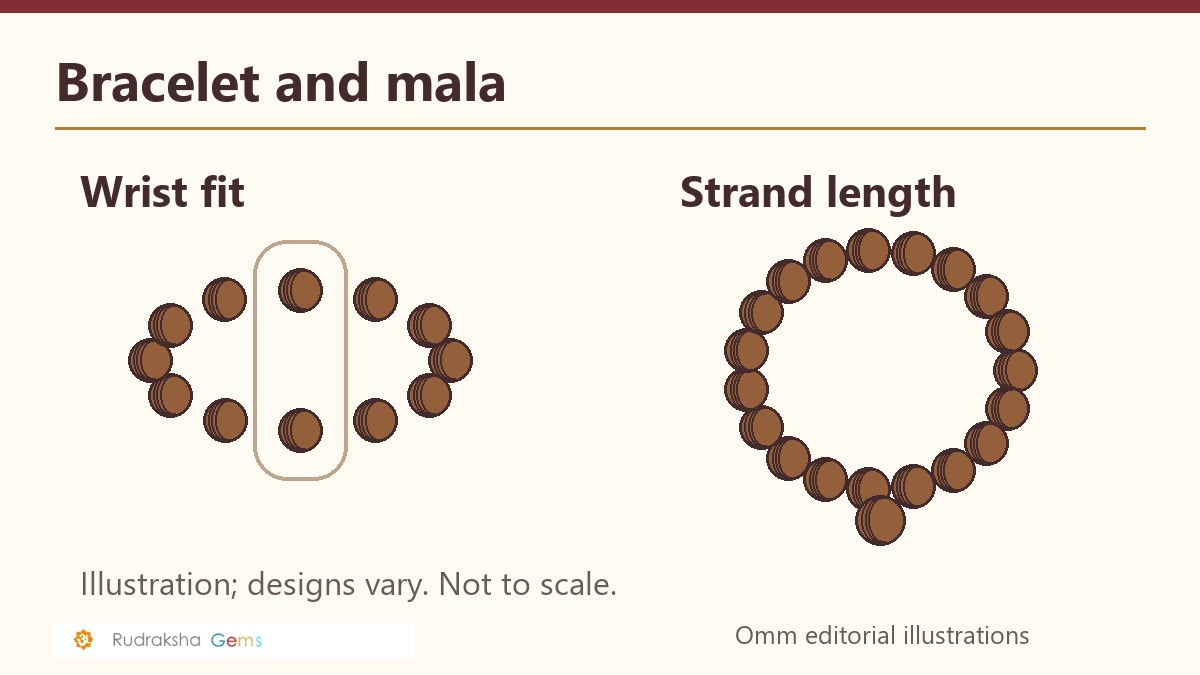
A Rudraksha bracelet and a Rudraksha mala can both be part of personal devotional wear, but they should not be chosen from the same measurements. The first question for a bracelet is whether it fits the wrist securely. For a mala, the first question may be whether it is suitable for japa, neck wear, or both.

Bracelet: start with the wrist
Measure the wrist at the position where the bracelet would sit. Check whether the item uses a fixed cord, adjustable sliding knots, elastic, a chain or a clasp. Each construction has different movement and maintenance needs. A “one size” label does not guarantee the same fit on different wrists. If the listing omits the inner circumference or usable adjustment range, request it before ordering.
Mala: start with bead count and finished length
For a mala, bead count and finished length matter separately. A full japa design may be long and comfortable for counting yet less practical to wear with certain clothing. A shorter mala can be easier to carry, but the correct choice depends on how you use it. Check whether the stated number includes the guru bead and whether additional spacers affect counting.
| Buyer question | Bracelet | Mala |
|---|---|---|
| Key measurement | Inner wrist circumference / adjustable range | Finished length and bead count |
| Construction | Elastic, sliding cord, chain or clasp | Thread, knots, marker bead, optional tassel or metalwork |
| Comfort check | Skin contact, bead size, movement on wrist | Weight, hanging length, handling during japa |
| Wear-and-tear point | Elastic stretch and knot security | Friction near drilled holes and terminal knots |
Does Mukhi count decide the format?
No. Mukhi count is a description of a Rudraksha bead. It does not specify how many beads a bracelet must contain or whether the piece will fit the wearer. Two products described as 5 Mukhi may differ in origin, bead size, number of beads, strand design and price. Always evaluate the assembled product and not just the Mukhi label.
Which is easier to look after?
There is no universal answer. Stretch cords may need replacement after wear; threaded malas should be checked for fraying where the beads rub against the string. For either format, avoid harsh cleaning chemicals and unnecessary soaking. Remove a piece before activity that may catch or pull the string. A damaged bead or loose fitting deserves inspection before continued use.
How to shop the two formats
Use the Rudraksha bracelet collection when wrist fit and a compact piece matter most. Use the Rudraksha Mala collection if you want a longer strand, traditional japa format or necklace. The measurement guide explains why millimetres, bead counts and finished dimensions cannot be treated as interchangeable.
Quick questions to ask the seller
- What are the exact dimensions and current configuration of this item?
- Is the fit fixed or adjustable, and what is its range?
- What kind of string, elastic, metal or clasp is used?
- Does the certificate identify the whole assembly or specific components?
- Can I return the product if alterations were requested?
Religious interpretations differ between communities. This comparison is about identifying an appropriate physical item for the buyer's practice and comfort, not promising particular life outcomes.
Why the same bead size does not produce the same fit
A bracelet circles the wrist, so the space inside the beads matters. A strand's outside measurement or its straight length is not the same as usable wrist clearance. Larger beads also change how a bracelet sits against the wrist. For example, someone measuring a 16 cm wrist should request the finished inner circumference and intended fit of the actual bracelet; “16 cm” in a listing might describe a different measurement. There is no single allowance that works for every bead shape and fastening.
Measure with a flexible tape without pulling it tightly into the skin. Note whether you prefer a close fit or movement, then ask the seller to translate that preference into the particular construction. If the bracelet must stretch over the hand, check that movement too. Avoid repeatedly overstretching an elastic bracelet as a fit test.
Choose for the activity you will actually do
For desk work, think about whether beads press against the wrist or strike the work surface. For handheld counting, try moving a sample strand through your fingers: a comfortable wrist bracelet may offer little space between its beads. For neck wear, consider the finished hanging length and the extra weight of metal components. These are different questions even when the pieces contain the same type of Rudraksha.
A gift needs the recipient's usable measurement or a clearly documented adjustment range. Do not assume adding an elastic cord makes every size interchangeable. If you are uncertain, choose a documented adjustable construction or confirm resizing options before the order is altered.

Rudraksha bracelet versus Rudraksha mala: choose the right object for the right purpose
A Rudraksha bracelet and a Rudraksha mala may be strung from the same botanical material, but they solve different practical problems. A bracelet is a compact circle intended to sit comfortably around the wrist, move with the hand and withstand frequent contact with clothing or work surfaces. A mala is usually a longer strand designed for neck wear, japa (repeated recitation), or both, depending on its construction and the person's devotional tradition. One cannot infer the fit of the second from the dimensions of the first.
The most useful buying question is not simply “Which is more powerful?” It is “What will I actually do with this item, how will it sit on my body, and how will I verify what I am purchasing?” A person who works at a keyboard may value a small secure bracelet; someone who recites a mantra each morning may want a comfortable strand of 108 counting beads; a devotee who wants only visible everyday Shiva symbolism may prefer a different format altogether. There is no single bracelet or mala appropriate for every person.
The identity of Rudraksha also deserves precision. The commonly traded Rudraksha bead is the hard inner fruit structure (endocarp) associated with Elaeocarpus ganitrus. Its natural surface divisions are commonly called mukhi or mukhas. Neither the word “Rudraksha” nor a five-mukhi label gives the circumference of a finished bracelet, the length of a mala, the strength of a cord, or proof that the pictured product is the actual item delivered. Material, devotional use and physical configuration must each be assessed separately.
At-a-glance choice chart
| Your primary goal | Usually examine first | Critical measurement | Ask the seller to confirm |
|---|---|---|---|
| Comfortable everyday wrist wear | Rudraksha bracelet | Finished usable inner circumference and adjustment range | Bead diameter, clasp or elastic construction, wrist-fit guidance |
| Counting 108 mantra repetitions | 108-count japa mala | 108 counting beads excluding any separate guru/meru marker | Actual count, whether meru is counted, knot and strand construction |
| Compact travel japa | 27- or 54-count mala | Count plus handling length | Number of passes needed and ability to turn comfortably |
| Neck wear as a devotional strand | Rudraksha mala or kantha | Total finished loop length and hanging drop | Bead diameter, weight, knot gaps, tassel and closure |
| A gift where size is uncertain | Documented adjustable bracelet or measured mala | Recipient's dimensions or safe adjustment range | Return or resizing terms before customization |
| Both wrist wear and daily japa | Two purpose-specific pieces, or a clearly designed compromise | Bracelet clearance and counting-bead accessibility | Whether the bracelet can be handled one bead at a time |
An adjustable bracelet may be convenient, but it is not automatically a proper japa mala. A long japa strand may be a beautiful necklace, but the hanging length must be verified rather than guessed from its bead count. The exact design—and not a category name—determines usability.
Understand the measurements: four numbers that are often confused
Product listings often use “size” to describe several different quantities. A careful buyer identifies which one is being quoted before making a comparison.
Bead diameter is the approximate size of an individual Rudraksha in millimetres, typically measured across its widest practical dimension. Natural beads are not perfect spheres. For an elongated specimen, height and width should be recorded separately. A nominal 8 mm or 10 mm listing may describe a sorting range rather than every bead being identical.
Wrist circumference is the measurement around the person's wrist at the intended wearing position. Take it with a soft measuring tape or a non-stretch string measured against a ruler. Keep the tape comfortably against the skin without pulling it tightly into the wrist. Record the number in centimetres or millimetres and specify whether you prefer a close or more mobile fit.
Bracelet's finished inner circumference is the usable space inside the assembled bracelet, not necessarily its outer edge or the length of an elastic cord when laid straight. On a rigid circular piece, an inner diameter may be converted mathematically to an inner circumference, but irregular bead shapes and flexible designs do not behave like a perfect rigid circle. Ask for the maker's practical fit assessment of the assembled item.
Mala finished length may be reported as the full loop circumference measured along the centreline of the strand, or as the hanging drop when worn. Those are not interchangeable measurements. If a closed loop hangs evenly, its drop is approximately half its loop length before allowing for tassels, guru beads, asymmetry and the body. Ask for the measurement method rather than relying on a generic picture.
| Measurement on listing | What it normally refers to | What it does not tell you |
|---|---|---|
| Bead size: 8 mm | Approximate dimensions of individual beads | Wrist clearance or a finished mala length |
| Wrist: 16 cm | The wearer's wrist measurement | The exact bracelet inner fit or stretch range |
| Bracelet size: 18 cm | A seller-defined bracelet dimension | Whether 18 cm is inner circumference, cord length or nominal sizing |
| Mala: 108 beads | Counting-bead quantity if accurately described | Necklace drop, bead diameter, total weight or presence of meru |
| Mala: 80 cm | A linear dimension needing a measurement convention | Whether it means full loop or single hanging drop |
| Adjustable | Some mechanism for changing fit | Unlimited range, strong hardware, or suitability for all wrists |
How to measure your wrist without a sizing mistake
Measure the wrist where the bracelet is intended to rest. If the item has large beads, consider the additional volume against the skin. Compare a snug and a relaxed measurement if you already own a comfortable bracelet. If possible, measure at a similar time of day to your normal wear and do not use a metal tape with sharp edges. Write down the measurement with the unit, for example 16.2 cm wrist, prefers moderate movement, rather than ordering “medium.”
There is no universally valid fixed extra allowance for every Rudraksha bracelet. Large, angular beads occupy space differently from tiny round beads; a firm clasped design behaves differently from elastic or sliding cord. A seller may recommend an allowance based on a product family, but that must be treated as a fit recommendation for that construction—not as a law of geometry that applies to all pieces. If a listing gives only the outside diameter, ask for the usable inside size.
For a fixed closed bangle, passing over the hand can be more important than resting around the wrist. For an elastic bead bracelet, the stretch required to pass over the knuckles matters in addition to the resting wrist fit. A person with a narrow wrist and a comparatively broad hand may not find a small elastic bracelet easy to put on. Repeated extreme stretching is not a reliable or gentle sizing technique.
An illustrative example, not a universal formula
Suppose one customer measures a 16 cm wrist. Bracelet A is advertised as an “18 cm bracelet,” but this number describes its laid-out strand length. Bracelet B lists a usable inside circumference and a documented fit range. Bracelet B supplies more actionable information even if the numbers look similar. For either item, the customer should ask for a photograph or measurement of the actual assembled piece and describe the desired snug or relaxed feel. Do not assume two centimetres of numerical difference automatically produces the same clearance in every bead and clasp design.
Mala count and mala length are different decisions
The standard 108 counting beads are widely used for japa. Shorter strings of 54 and 27 counting beads are also common. Their arithmetic is straightforward: a 54-count string requires two complete passes for 108 repetitions; a 27-count string requires four. A 108-count mala requires one. If a strand contains an extra guru or meru bead used as a marker, clarify whether the stated count excludes that bead. A product saying “108+1” usually intends 108 counting beads plus the separate marker; however, the actual construction should still be checked.
A bracelet with 15 or 21 beads is not automatically a “miniature 108 mala.” It can certainly help a person remember a mantra, but completing a specified number of repetitions requires a counting method. If you count on a bracelet with 18 usable beads, six passes would equal 108; if the bracelet has 17, a different plan is needed. The mathematical count is not altered by the Rudraksha mukhi count or the bead colour.
| Counting beads available | Passes to complete 108 repetitions | What to notice |
|---|---|---|
| 108 | 1 | Usually a full japa strand; check whether the guru bead is separate |
| 54 | 2 | Shorter strand; turn at the marker according to your tradition |
| 27 | 4 | Compact option; more frequent direction changes |
| 36 | 3 | A possible counting arrangement, but not every listing follows this convention |
| 18 | 6 | Can work mathematically, but an 18-bead wearable bracelet may be uncomfortable to manipulate |
| 21 | Not a whole number | Five passes produce 105; count three further repetitions by another method |
An individual teacher or lineage may prescribe a specific mala material, bead count, hand position or manner of passing the guru bead. The common instruction in many japa traditions is to reverse at the meru rather than cross over it. Another established practice may have a different interpretation. Do not replace a known initiated instruction with a rule inferred from product marketing.
Why knot spacing changes the length
Imagine 108 round beads each approximately 8 mm along the stringing direction. Their nominal combined bead length alone would be 864 mm, or 86.4 cm. This is only a rough illustrative bead contribution, not the finished measurement of a mala: it ignores actual non-spherical bead dimensions, drilling axes, 107 or more junctions, knots, spacers, a terminal marker, cord tension and possible ornamentation. A mala with knots between beads can be substantially longer than a closely strung piece. Two 108-bead malas with the same nominal bead diameter need not hang at the same height.
Conversely, a 27-bead string made from larger beads is not guaranteed to be one-quarter the physical length of a smaller-bead 108 strand. Count and length are separate purchasing decisions. For neck wear, request a flat-lay photograph beside a ruler and, ideally, the assembled loop length and intended drop. For japa, check whether individual beads move freely enough for your fingers to count without pulling the whole strand taut.
Construction: what to inspect in a bracelet
A Rudraksha bracelet may use elastic, a fixed knotted cord, sliding knots, chain links or a clasp. Each system has an advantage and a predictable maintenance point. Elastic makes dressing convenient but weakens over time, especially when overstretched or exposed to unsuitable chemicals. Sliding knots allow adjustment but may gradually slip or fray. A metal clasp can make removal easier yet requires correct sizing and secure connections. A wire or chain can feel firmer but may create hard pressure points beside natural beads.
| Bracelet construction | Convenience | Important inspection | Typical replacement or service question |
|---|---|---|---|
| Elastic cord | Quick to put on; no separate clasp | Cord wear at drilled holes, stretch recovery, knot concealment | Can it be safely restrung without damaging the beads? |
| Sliding-knotted cord | Adjustable within stated limits | Knot travel, end stops, fraying, excess hanging tails | What is the actual adjustment range? |
| Fixed knotted cord | Stable layout, sometimes lighter than metal | Closure security, cord material, knot abrasion | Is the size fixed, and can it be resized? |
| Metal clasp or chain | Defined closure and adjustable links on some models | Catch, jump rings, edges, metal identity, link strength | Can a jeweller replace the clasp or shorten the chain? |
| Individually mounted beads | Distinct design and spacing | Cap adhesion, loops, joints and bead stress | Is the bead permanently fixed or serviceable? |
When comparing two bracelets, look at their finished build, not just their bead photographs. A larger bead can be comfortable in a loose design but intrusive in a close, rigid one. Knots that lie beneath the wrist may press into the skin during typing. A decorative metal centrepiece can shift the balance and make the bracelet rotate. For somebody working with tools, kitchens or moving machinery, jewellery that can snag should be removed for the relevant task.
Skin comfort and daily activity
Rudraksha has a textured natural surface. Some people enjoy that texture; others find raised ridges noticeable against sensitive skin. Assess the finished stringing and avoid sharp metal edges. A product described as “comfortable for daily use” should still specify size, fastening and the kind of wear for which it was designed. A bracelet that slides beneath a laptop palm rest or catches on a sweater may be inconvenient even if its material and appearance are attractive.
Children should not be given loose small beads, detachable charms or unsecured cord assemblies as play items because small parts can present choking or entanglement hazards. Jewellery around young children calls for adult supervision and a conservative choice of design. For adult wearers, secure finishing and appropriate removal during risky activity are practical considerations, not religious judgments.
Construction: what to inspect in a mala
A mala has other stress points: drilled holes rubbing on the cord, knots between beads, the location of the guru bead, any tassel and the terminal junction. A tightly strung mala may look neat but resist easy finger movement; a loosely strung one can catch on clothing. A heavy stone or metal centerpiece can pull the strand away from the neck and create uneven wear. Check for twisted loops, uneven tension, rough drill-hole edges and poorly secured tassels.
If the mala is for repeated mantra practice, decide whether you prefer each bead isolated by a knot, enough free movement to advance a bead, and a recognizable marker at the end of a round. A small smooth strand may be more convenient in hand than a heavy ornate necklace. A finished neckwear mala may prioritize appearance and drape, which is a different design objective. Neither is inherently superior; suitability depends on what the owner intends to do.
A kantha or short neck strand may have an entirely different bead count from a full 108-bead japa mala. Some necklaces have 32, 36, 54 or other counts for style or custom use. A seller must not imply that every Rudraksha neckpiece is automatically a standard japa mala. Ask how many counting beads there are, whether there is a separate guru bead, and whether ornamental spacers interrupt counting.
Rudraksha identity: material, mukhi count, authenticity and origin
The familiar panchamukhi or five-mukhi Rudraksha is widely used in many contemporary malas and bracelets. Other face counts may appear in individual components or specialized arrangements. The number of mukhis identifies facial divisions on an individual bead; it does not reveal how many beads are in the piece. Five-mukhi and five-bead mean completely different things. The first describes an individual seed; the second describes strand quantity.
Natural Rudraksha varies in shape, colour, groove depth and surface texture. A drilled hole is common on jewellery or japa beads, so drilling alone does not establish whether an item is genuine or altered. However, grooves that appear carved, repairs around holes, unfamiliar surface coatings, unusual uniformity or an unexplained high-mukhi claim warrant careful examination. Simple water-floating, milk-changing or coin tests are not reliable universal authentication tests. Documentation should identify the actual specimens examined and the scope and limitations of the test.
A laboratory report can discuss the identity or observable structure of a bead, but it generally does not certify a wearer's future success or determine the perfect mantra from an image. A seller's metal certificate is a separate document from a Rudraksha-bead report. If several beads have individual identifiers, compare them with the supplied item and invoice; a certificate on one bead does not automatically certify all beads in an entire bracelet or mala.
Nepal, Java and other trade descriptions
Trade descriptions such as Nepal or Java often refer to provenance and bead appearance in Rudraksha commerce. They should not be used as shortcuts for quality. Ask what origin information the seller actually possesses, whether it is documented or merely a trade description, and whether the reported size, mukhi lines and price fit the exact product. Beads from different growing regions may differ visibly, but a picture alone cannot reliably prove geographical origin. Buy on the basis of the whole specification and credible evidence.
Traditional use: Shiva worship, japa and personal practice
Rudraksha has longstanding devotional associations with Bhagavan Shiva. Wearing a bracelet can be a daily symbol of remembrance; using a mala can give a tactile structure to repeated invocation. A common example of Shiva japa is ॐ नमः शिवाय (Om Namah Shivaya). A person may follow household worship, a teacher's mantra, a temple custom or personal daily prayer. The bracelet or mala assists a routine; its format does not establish one exclusive practice for everybody.
A dedicated counting mala is convenient because each repetition can correspond to a physical marker. A wrist bracelet may serve as a reminder, a supplementary counter, or a decorative and devotional wearable. Some traditions separate their primary japa mala from jewellery used for ordinary wear, while others permit multiple uses. Ask about your own practice rather than demanding one rule for every lineage.
A simple routine can begin with a clean, quiet setting, a comfortable seated position and a realistic number of recitations. Start at the first counting bead beside the guru marker, move deliberately, then reverse at the marker if that is the method you follow. If a 27-count mala is used four times, record 108; if a 54-count is used twice, the same total follows. Consistency of practice and careful counting are more meaningful than overstating what a particular piece can achieve.
Which format belongs in a specific situation?
| Situation | Bracelet may suit when… | Mala may suit when… | Additional check |
|---|---|---|---|
| Office or desk work | Small beads and secure fit do not obstruct the wrist | Used separately at prayer time rather than worn during work | Contact with desk and keyboard; snagging |
| Home Shiva japa | You want a short visual reminder or auxiliary counter | You want 27/54/108 tactile counting beads | Meru, count, handling comfort |
| Travel | Adjustable compact design is easy to pack | A short japa strand can be kept in a pouch | Secure storage and avoiding moisture |
| Neckwear | Usually not the intended format | Length and weight are suitable for your clothing | Drop, clasp, neck comfort, tassel |
| Temple or festival observance | A familiar wearable complements personal practice | Japa or ceremonial wearing is intended | Your household's established custom |
| Gift | Wrist measurement and adjustment range are known | Recipient's preferred length and use are understood | Documentation, return and sizing terms |
Someone may own both formats without duplication of purpose: a bracelet for ordinary wear and a separate mala used quietly for counting. Conversely, a single well-chosen item may be entirely sufficient. A large collection is not a necessary measure of devotional commitment.
Before ordering: the exact product questions worth asking
Request the bead count, whether it includes any guru/meru or decorative beads, the approximate bead dimensions, the finished usable fit or loop length, the cord or metal specification, and clear photographs of the actual item. For bracelets, insist on a stated wrist range or a usable inner measurement. For malas, seek a finished loop length, hanging drop and any tassel measurement. If the item is custom made, agree on the final specification before alteration starts.
A sensible quotation should separate the natural beads from custom stringing, metalwork, taxes, shipping and optional laboratory examination. A cheaper bracelet with thin, poorly secured elastic may be less suitable than a simple knotted piece. A more expensive mala with a heavy metal fitting is not automatically better for japa. Match the purchase to the intended daily activity and to the exact product's documented characteristics.
A compact comparison worksheet
| Field | Bracelet quote | Mala quote |
|---|---|---|
| Primary use | Wrist wear / counting / both | Japa / neckwear / both |
| Natural bead identity | Species or commercial description; any testing | Same questions for each bead group |
| Mukhi and bead count | Individual mukhi and total beads separately | Counting beads, guru bead, decorative pieces separately |
| Bead dimensions | Nominal size and actual variance | Nominal size and actual variance |
| Finished size | Inner circumference and adjustment range | Loop length, hanging drop, tassel length |
| Construction | Elastic, sliding cord, clasp or metal | Knots, cord, marker, terminal connection |
| Metal disclosure | Actual alloy, plating, fineness if claimed | Metalwork or spacers if used |
| Service | Restringing, adjustment, replacement closure | Restringing, repair of marker or tassel |
| Final cost | Item + customization + shipping + taxes | Item + customization + shipping + taxes |
| Records | Invoice, item images, report if any, care instructions | Same, including bead-count details |
Wearing and care: protect both the seed and the assembly
Rudraksha is a hard botanical material, not a waterproof synthetic bead. Finished jewellery also contains weaker components: elastic, cotton or silk cord, metal caps, adhesive, plating, knots and clasps. Avoid treating every piece with the same soaking or oiling instructions. Immersion that is harmless for a particular loose bead may damage the actual stringing, change colour or weaken adhesives. Follow the maker's component-specific instructions.
Remove the piece before swimming, chemical cleaning, contact sports, or work where a loop might catch. Wipe ordinary surface dust gently with a soft dry cloth; remove heavy deposits only according to the construction and the seller's advice. Do not boil the bead, use strong detergent, bleach or solvent, or apply a heater to dry a damp mala. Allow accidental moisture to dissipate in a normally ventilated, shaded place without direct heat, then check the cord for weakness.
Inspect elastic for loss of recovery, cords for fraying at holes, sliding knots for slipping, clasps for opening, and beads for cracks around drilled openings. On a japa mala, check the region adjacent to the guru marker and tassel since pulling stresses can concentrate there. Store the item so heavy metal objects do not rub its grooves and avoid keeping a damp strand sealed in a plastic bag. If a cord snaps, collect the beads in order if possible and have a competent person restring the item to its intended count.
Thirty practical questions about Rudraksha bracelets and malas
1. What is the biggest difference between a Rudraksha bracelet and a mala?
A bracelet is primarily sized to surround the wrist; a mala is primarily a strand whose length, bead count and movement may support japa or neckwear. Both can hold genuine Rudraksha beads. The key distinction is the assembled format and how it will be used, not whether one object is inherently more sacred. Ask about fit first for a bracelet and counting construction first for a japa mala.
2. Can I use a Rudraksha bracelet for mantra japa?
Yes, a bracelet can help count or remember recitations, provided you know the number of usable beads and can comfortably move them. A small snug bracelet may be hard to manipulate while being worn. If a fixed count such as 108 matters, calculate the required passes and note any decorative bead that is not counted. A purpose-made mala is often simpler for long repeated sessions.
3. Does a Rudraksha bracelet have to contain 27 beads?
No. Bracelet bead count depends on bead diameter, wrist dimensions, spacers and the design. A compact bracelet might contain a very different number from a counting mala. The numbers 27, 54 and 108 have established uses in japa, but they are not compulsory sizes for every wrist bracelet. A seller should disclose the total bead count and distinguish it from any spiritual or mukhi-related description.
4. Is a 108-bead mala always intended to be worn around the neck?
No. A 108-count mala is commonly designed for japa; whether it is also suitable or permitted for ordinary neckwear varies by construction and tradition. Some strands are long, knotted or heavy. Others are deliberately made for comfortable wearing. Confirm the full loop length, approximate hanging drop and the wearer's custom before assuming that a counting mala is a practical necklace.
5. How many passes of a 54-bead mala equal 108 mantras?
Two complete passes of 54 counting beads produce 108 recitations. Count the guru or meru bead separately if your tradition does not count it. If the strand has decorative spacers, confirm how many actual counting positions remain. A direction change at the marker is commonly used; follow a teacher's specific instructions if you have received them.
6. How many passes of a 27-bead mala equal 108 mantras?
Four full passes of 27 counting beads yield 108 repetitions. The shorter strand is convenient to pack and may be easier to handle in confined space, but it requires more turns. Verify that the advertised 27 refers to countable markers rather than a total that includes a guru bead or ornament. A small counting diary is useful when several passes are involved.
7. Is five-mukhi the same as five beads?
No. Five-mukhi describes the number of natural facial divisions on one Rudraksha. A five-bead bracelet contains five individual pieces, whatever their individual face counts happen to be. A product can have 21 five-mukhi beads or a 108-count mala can use five-mukhi beads throughout. Ask the seller to state the individual mukhi description and the total bead count in separate fields.
8. Is a 16 cm wrist measurement the same as a 16 cm bracelet size?
Not necessarily. The first describes the wearer's body; the second might describe the manufacturer's nominal size, inner circumference or straightened cord length. Beaded bracelets have thickness, knots and different fastening systems. Ask how the 16 cm product number was obtained and whether the completed item has adequate inside clearance for that specific wrist and hand.
9. How do I measure my wrist at home?
Use a soft flexible tape at the point where the bracelet should sit. Keep the tape against the skin without pulling tightly; record the measurement in centimetres. A plain non-stretch string measured on a ruler works if no soft tape is available. Tell the seller whether you prefer a close, standard or loose fit and whether the bracelet must stretch over a broad hand.
10. Should I add a fixed number of centimetres to my wrist size?
A simple allowance can help with some conventional jewellery, but it is not universally reliable for Rudraksha bead bracelets. The size and shape of the beads, elasticity, knot thickness and closure all affect actual clearance. Compare the seller's specific measurement convention and adjustment range. If possible, match a comfortable bracelet you already own rather than relying on a universal formula.
11. Does the diameter of Rudraksha beads affect bracelet comfort?
Yes. Large beads project farther from the cord, can touch one another differently when curved around the wrist and may press more noticeably against a desk or sleeve. Small beads can feel lighter but are not automatically more comfortable if stringing is too tight. A comparison should include actual bead size, finished interior space, number of beads and the position of any metal centrepiece.
12. Can I determine a mala's finished length from 108 beads alone?
No. Finished length depends on the dimension of every bead along its drilled axis, knots or gaps, the terminal bead, the string's tension and any decorative fittings. Two 108-count malas with different beads or knot spacing can have significantly different lengths. Request the complete loop length and hanging drop rather than estimating neck fit from bead count alone.
13. What is the meru or guru bead on a mala?
It is a distinguished marker often positioned at the junction where a japa round begins and ends. In many traditions it is not counted as one of the 108 repeated mantra positions and the practitioner reverses rather than crossing it. Some decorative strands use a different marker or no obvious terminal bead. Ask the seller how the exact piece is arranged, and use the practice prescribed by your lineage.
14. Can a Rudraksha necklace have fewer than 108 beads?
Yes. Short necklaces, kantha designs and personal devotional strands may have 27, 32, 36, 54 or other counts. The number alone does not decide quality or authenticity. If the intention is a standardized japa total, confirm that the number of counting beads supports it. If the intention is neckwear, size and comfort may be more important than conforming to a particular counting convention.
15. Is elastic or a clasp better for a Rudraksha bracelet?
Neither construction is universally better. Elastic can be convenient but stretches and may eventually require restringing. A clasp offers a defined opening and may be secure when correctly engineered, but its metal, links and closure can snag or loosen. Sliding-knot cord offers some adjustability but can fray. Evaluate fit, serviceability, the wearer's activity and the quality of the particular assembly.
16. What should I inspect in an elastic bracelet?
Check that the cord recovers after normal fitting, that there is no exposed fraying beside the bead holes, and that the closing knot is properly secured. Ask whether the bracelet can be restrung and how many beads it contains before repair. Avoid repeated forceful stretching just to demonstrate flexibility. If the elastic shows age or cracking, service it before the cord fails and beads scatter.
17. What should I inspect in a knotted Rudraksha mala?
Look for even knotting, smooth movement of individual beads, adequate strength near drilled holes, and secure finishing at the guru bead and tassel. Knots may increase spacing and therefore length; ask for the finished measurement. A cord that looks attractive in photographs can still be too tight for comfortable counting. If possible, assess the actual strand before purchasing or request close-up images.
18. What is more useful: a loose bracelet or a snug bracelet?
The best choice is one that remains secure while allowing comfortable wrist movement. Excessively loose bracelets can slide, strike surfaces or catch on objects; excessively tight ones can press on the wrist and make removal difficult. Natural bead size changes how both conditions feel. Record your measurement and compare it with the maker's usable fit range rather than choosing based solely on appearance.
19. Can I wear a Rudraksha bracelet while typing or cooking?
It depends on the task and fit. A large bracelet may press against a keyboard wrist rest, while a loose design can catch on utensils or equipment. Remove jewellery whenever it could entangle with moving machinery, hot tools or unsafe work surfaces. If retained for ordinary desk activity, check that the bracelet does not restrict movement and that knots and metalwork do not rub uncomfortably.
20. Can I wear a bracelet and a mala together?
Many people do, using a bracelet for everyday wear and a separate mala for japa, but customs differ. The pair need not be made of identical bead sizes or mukhi combinations. If you want a devotional practice rather than multiple accessories, one item may be sufficient. Avoid treating a purchase combination as a universal requirement for Shiva worship or a substitute for personal guidance.
21. Is Panchamukhi Rudraksha appropriate for Shiva mantra japa?
Panchamukhi is commonly used in contemporary Rudraksha malas and bracelets associated with Shiva devotion. A simple example is Om Namah Shivaya recitation. The actual rule for your practice may depend on family custom, an initiated mantra or a teacher. Bead identification and string quality still matter, because a devotional label on a product cannot verify the material or the item's physical suitability.
22. How can I check whether Rudraksha beads are genuine?
Review the natural surface divisions, overall texture, drilling, condition and any unusual repairs. Do not rely on floating in water or other single home demonstrations as universal tests. For a high-value purchase, request appropriate examination and paperwork identifying the actual bead or lot, with its limitations made clear. A certificate for a metal clasp is not a certificate for the Rudraksha beads themselves.
23. What does “Nepal Rudraksha bracelet” mean on a listing?
It is generally a trade description suggesting geographic origin or bead style, but it should not be accepted as independent proof of provenance. Ask what information supports that claim and inspect the individual beads' specifications. Size and texture can vary naturally. A well-documented bracelet whose fit suits you may be a better purchase than one relying entirely on a prestigious geographic label.
24. Is a heavy Rudraksha mala better for japa?
Not necessarily. The tactile quality of the strand matters, but excessive weight can fatigue the hand or neck during long sessions. Larger beads may be easier for some people to distinguish; smaller, well-spaced beads may be easier for others to move. Consider your planned repetition count, preferred grip, knot spacing and sitting position. The most expensive or heaviest mala is not automatically the most usable.
25. Can I sleep or bathe while wearing Rudraksha jewellery?
Personal religious customs vary, but from a construction standpoint sleep can snag a cord and bathing can expose it to soap, water and repeated humidity changes. A prudent option for many finished designs is to remove them before bathing, swimming, exercise or activity that stresses the assembly. Follow the maker's instructions for your particular cord, metals, adhesive and bead condition rather than assuming all pieces tolerate immersion.
26. Should I oil or soak my bracelet or mala?
Avoid treating oiling or prolonged soaking as a mandatory universal routine. A preparation suitable for one loose bead may stain thread, weaken adhesives or change the appearance of a finished piece. Begin with gentle dry cleaning and the seller's component-specific directions. Never boil the assembly or use strong detergent or solvent. Where metalwork is present, its own care requirements must also be considered.
27. What should I do if my mala cord breaks?
Collect the beads carefully, photograph the existing layout if possible, and record the total counting beads and the position of the guru marker. Do not assume that an improvised repair has maintained the original count or safe stringing tension. A skilled restringing service can inspect drill holes and knots. Some traditions have specific practices for a broken japa mala; a devotee may follow those in addition to dealing with the physical repair.
28. Are Rudraksha bracelets suitable as gifts?
They can be thoughtful gifts when the recipient appreciates Rudraksha and a usable wrist measurement is available. Do not assume a generic “free size” description works for everyone. If the size is unknown, confirm the actual adjustable range, alteration availability and return terms. Include clear bead details, a receipt and basic care instructions. A mala gift should similarly respect the recipient's preferred count and usage.
29. Which records should I keep after purchase?
Keep the invoice, actual-item photos, the bead count, individual mukhi description, usable bracelet measurements or finished mala length, metal or cord specification, reports if supplied, customization approval and return or repair terms. If the seller offers a laboratory document, confirm which specific item it identifies and what was examined. These records help resolve later questions about fit, service, replacement and authenticity.
30. What is the simplest final decision rule?
Choose bracelet first if your priority is compact, secure and measured wrist wear. Choose a mala first if you need a dedicated, countable strand for japa or a documented devotional necklace length. Then verify the actual bead identity, mukhi description, quantity, dimensions, construction and total price. Where you want both functions, check whether one item genuinely performs both before buying extra jewellery. A deliberate choice usually outlasts an impulsive one.
Final recommendation: two formats, two sets of measurements
A Rudraksha bracelet is judged primarily by whether the completed assembly fits and survives the wearer's ordinary activities. A mala is judged primarily by how its beads are counted or how its finished length sits when worn. Both may have rich Shiva-related devotional significance, but sacred material does not replace practical construction. Keep the three numbers—mukhi count, total bead count and finished size—separate, and confirm them on the exact item.
For a buyer, the most reliable checklist remains short: purpose, exact beads, finished measurements, secure stringing, honest documentation, care and total cost. For a practitioner, choose a sustainable japa routine and follow the custom that is meaningful to your household or teacher. That combination of clear physical specifications and steady devotional intention is more useful than treating a bracelet and a mala as interchangeable because both contain Rudraksha.