

How do you mount hanging décor safely at home? Begin with the actual object and the place that will carry it—not with a convenient hook. A lightweight fabric toran above a door, a moving metal wind chime, a string of brass bells and a glass or gemstone hanging create different demands on their supports. The right fixing depends on total weight, movement, wall or ceiling construction, access, weather and whether people could be struck if a connection fails.
This guide explains a practical approach to selecting and checking mounting points for entrances, verandas, balconies, puja spaces and interiors. It covers adhesive and mechanical fixings, timber and masonry, hollow partitions, toran support, wind-chime clearance and seasonal inspection. It is a selection and safety guide, not a substitute for the anchor manufacturer's instructions or a competent installer's assessment of a particular building.
1. Identify the hanging before choosing the hook
Start by distinguishing a mainly stationary decoration from a freely moving object. A fabric toran or bandhanwar may hang across the top of a doorway with several attachment points, while a tubular wind chime swings from an upper ring and uses a wind sail to move its striker. A cluster of metal bells can be comparatively heavy, and a gemstone or glass ornament may contain fragile parts that can break on contact with a wall or floor.
Record the complete weight, not merely the weight of the largest tube, bead or bell. Include the frame, connecting wires, ornaments, ropes and any additional decorations. Measure the full hanging drop from the upper loop to the lowest point and its widest span. For moving objects, allow extra clearance for changing wind direction and accidental contact during normal use.
Ask whether the supplied item is a complete ready-to-hang assembly, or whether its manufacturer requires a separate hook, chain, ceiling anchor or multiple supports. Do not assume that a decorative loop or illustrated nail in a product photograph is a verified load-bearing system.
2. Know what lies behind the visible wall or ceiling
Two surfaces can look identical after painting but require very different fixings. A sturdy timber beam, solid concrete, masonry, plaster over brick, hollow gypsum-board partition, tile over a wall and decorative false-ceiling panel are not interchangeable. The capacity of a fixing depends on the base material, actual anchor, installation method and direction of the applied load, not only the appearance of the hook.
| Mounting surface | Key consideration | Safer decision |
|---|---|---|
| Sound structural timber | Fastener location, sound wood and appropriate embedment | Use a compatible structural fixing following the hardware maker's instructions |
| Concrete or masonry | Anchor type, substrate condition, edge distance, overhead or side loading | Confirm the approved anchor and installation through a competent installer when uncertain |
| Hollow gypsum-board partition | Board alone may not provide a reliable support for moving or heavy objects | Identify framing or another suitable structural mounting point; do not guess the board's capacity |
| False ceiling or decorative trim | Visible panels may not be load-bearing structural supports | Do not hang substantial overhead objects from a panel without a designed support |
| Tile, glass or stone facing | Brittle finish and concealed substrate may be damaged by drilling or unsuitable adhesive | Verify the mounting system and substrate; seek specialist help before drilling |
| Balcony railing or exterior façade | Moving load, building rules, corrosion and potential fall to lower areas | Confirm property permission and a suitable engineered attachment, or choose another location |
Avoid drilling blindly. Plumbing, electrical cables, waterproofing layers, reinforcement and specialised concrete construction may be hidden behind a visible surface. Where services or structure are uncertain, get qualified help rather than following a generic drill-size instruction from a decorative article.
3. Adhesive hooks versus mechanical fixings
Adhesive hooks can be useful for certain lightweight, relatively stationary interior decorations where the adhesive product specifically approves the surface, temperature, weight and orientation. They are not one universal solution for an overhead chime that swings, receives gusts or hangs above a person. The adhesive manufacturer's own instructions and load rating must control the choice.
For example, 3M Command publishes distinct guidance for indoor and outdoor hook products, with surface preparation, installation steps and maximum loads that vary by model. An indoor adhesive hook does not become an outdoor-rated fixing merely because it has held a small garland successfully once. A label indicating that a particular hook can hold a given stationary object does not prove that it is suitable for overhead moving loads or an unsupported ceiling application.
Mechanical fixings—such as approved screws or anchors in suitable structural material—may be appropriate for other installations, but their performance is also design-specific. Anchor manufacturers distinguish substrates, loading conditions, approved orientation and installation requirements. A screw driven into hollow plaster, a masonry anchor placed too near a weak edge and a ceiling fixing inserted into unknown material should not be assumed to have the same resistance.
For heavier objects, outdoor positions, repeated motion or overhead hanging, select a system explicitly suitable for the actual support and use. Where selection is beyond a straightforward documented household installation, a competent installer should assess it.
4. Static weight and moving wind loads are different
A stationary hanging and a wind chime of identical mass do not necessarily load their supports in the same way. A chime swings and may experience repeated changes in force as its parts move in the breeze. Its wind sail can transfer motion to the whole assembly, and collision with nearby structures can produce abrupt impacts. An outdoor hanging is therefore not adequately assessed only by comparing its weight with a number printed on a hook package.
The required safety margin depends on the fixing manufacturer's specifications, the substrate, permitted use and site conditions; overhead or dynamic loads require a fixing system specifically suitable for that use, with competent assessment where needed. No universal “double the weight” or fixed kilogram rule is safe for all applications. Do not invent a wind-load rating for an OmmRudraksha product whose maker has not documented the full assembly and mounting conditions.
Where a manufacturer states a maximum weight for a wall hook, do not treat it as permission to suspend that same weight from a ceiling, swing it repeatedly or attach multiple unrelated items. Choosing a reliable installation means verifying the exact product's permitted loading arrangement.
5. Mount wind chimes with clear space to move
A conventional tubular wind chime needs its suspended tubes, central striker and lower wind sail to move without touching the wall, railing, door or nearby plants. Woodstock Chimes advises hanging its chimes where the sounding parts can move freely, away from branches, walls and railings; its care material also warns against prolonged strong-wind exposure. These maker-specific recommendations support a sensible principle: leave clearance around the complete moving object.
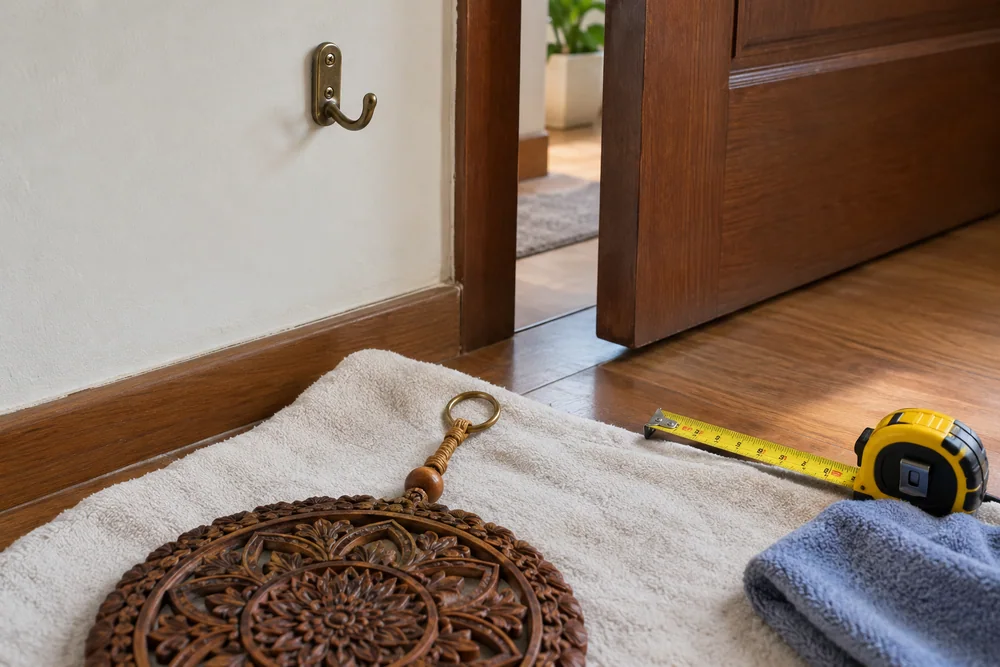
Measure from the actual top ring to the lowest component. Account for side-to-side swing beyond the width visible when the chime hangs straight down. In a veranda or balcony, consider a sudden breeze from a different direction. A chime installed too close to a hard surface may create unintended clanging, damage windows or develop worn suspension points.
Hanging near a doorway requires another test: open the door fully, including its handle and any closer mechanism, and verify that the chime cannot snag. A location that looks clear when the door is closed may be unsafe when visitors open it or during a gust. Avoid mounting directly above busy footpaths, occupied seating or other areas where a falling object could strike someone.
6. Attach torans and bandhanwars without damaging them
A toran, also called a bandhanwar in many North Indian contexts, is commonly displayed across an entrance for festivals, Griha Pravesha and other occasions. Fabric, beadwork, embroidered and fresh botanical versions require different support. A traditional decorative use does not change the physical need for reliable attachments and clear access through the doorway.
Check whether the maker has supplied two end loops, a continuous cord, a fabric header or additional intermediate supports. A wider or heavier design may need several properly positioned attachments, but the actual spacing and fixing should follow the product's structure rather than an arbitrary number. Avoid stretching the header so tightly that seams or bead attachments are pulled apart.
For mango leaf, asopalav, marigold or other fresh plant torans, remember that moisture, wilting and changes in weight can affect their attachment; remove decaying plant material appropriately and keep it away from electrical equipment and exposed flames. Textile torans, mirror-work embroidery and gota patti decoration can also have fragile edges, loose mirrors or small beads that need secure positioning.
If an adhesive hook is used for a genuinely lightweight stationary toran, verify that the selected product is approved for the surface and intended conditions. Do not run a long cord where it can catch a door or hang within reach of small children.
7. Bells, gemstone hangings, glass prisms and sacred motifs
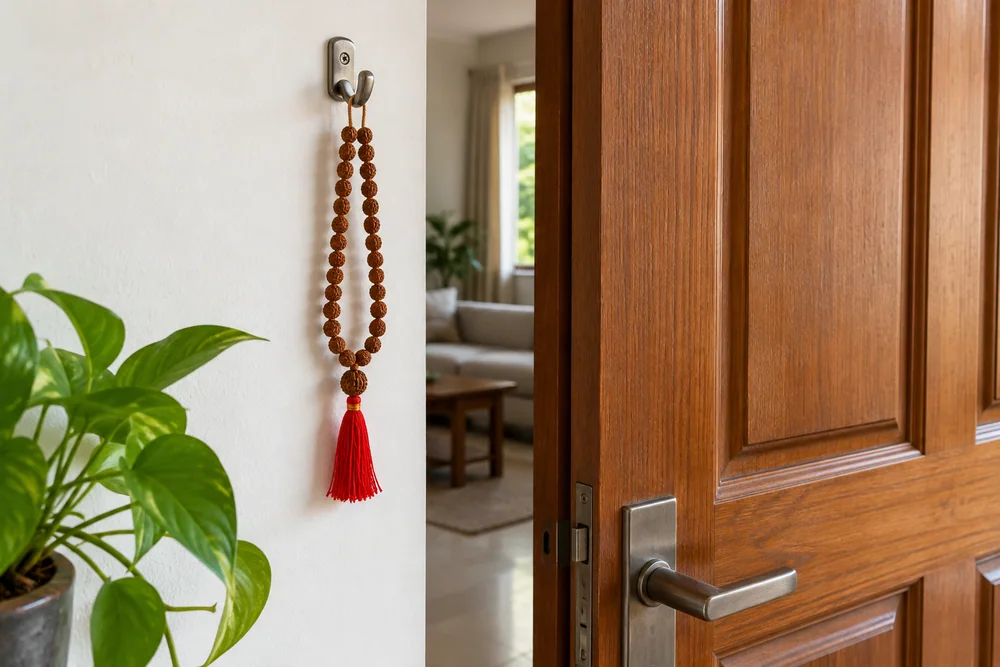
A bell cluster, Rudraksha bead hanging, gemstone ornament or glass-prism suncatcher can look small in a photograph but have considerable weight or fragile points. Verify the actual material and assembly, not just the decorative name. A painted bead is not necessarily natural gemstone, and a symbolic Om hanging is not automatically designed to be struck or rung.
For bells, inspect the metal loop, clapper and every connecting link. A bell that rings when doors are opened or wind moves it may need more clearance than a completely stationary wall ornament. For crystal, glass or reflective ornaments, protect against impact and keep them out of direct sunlight: concentrated sunlight can ignite nearby combustible materials. Never place fragile or heavy hangings above a cot, bed or occupied seat where failure could cause injury.
In a puja setting, keep all hanging décor away from diya flames, incense embers, fans, hot lamps, wires and loose cloth. The devotional significance of an Om, Shubh Labh, Rudraksha or bell motif does not make an unsafe mounting acceptable. Choose a suitable support and the household's preferred placement while respecting access to worship objects.
8. Balcony and outdoor installations in Indian weather
Apartment balconies and covered verandas may experience sun, changing humidity, wind-driven rain and sudden gusts. Even a sheltered position can become exposed during monsoon conditions. In coastal settings, salt can increase corrosion risks for unsuitable metal rings, hooks and fasteners. A robust-sounding tube does not protect a weak cord or a deteriorating overhead support.
Check the property rules before attaching anything to a common railing, external façade or beam. Avoid creating a risk to people below. If a chime is difficult to reach without leaning over the balcony, it may not be a suitable installation even when the hook is strong. Prefer a position that allows safe removal and inspection from within the normal accessible floor area.
Indian disaster-preparedness guidance recommends securing loose outdoor objects in advance of severe storms. Treat a freely moving decoration as an object requiring advance attention: remove or relocate vulnerable hangings before dangerous weather arrives, while access remains safe. Do not climb onto furniture, lean over balcony rails or reach outside during lightning, heavy rain or high winds. Use suitable access equipment only in safe conditions; have a qualified installer handle inaccessible or uncertain overhead locations.
After unusual weather, inspect the entire load path, including the fixing, main loop, knots, cords, ring connections, upper support, ornaments and sounding pieces. Remove a damaged assembly from service until the failed component can be reliably repaired or replaced.
9. Safe installation sequence: nine practical steps
- Confirm the item. Check the real product's weight, top connection, number of supporting points, dimensions, fragile pieces and weather limitations.
- Choose a location. Identify the door swing, walking path, available headroom, wall clearance, wind exposure and who may pass below.
- Identify the substrate. Establish whether the fixing will enter sound structural wood, suitable masonry or concrete, or another system requiring specialist assessment.
- Select appropriate hardware. Follow the exact anchor or adhesive maker's approved surfaces, loads, orientation and installation procedure.
- Check for concealed services. Do not drill into an unknown area that may contain electrical cables, pipes, reinforcement or specialised building elements.
- Prepare the fixing as instructed. Keep the support undamaged and observe any surface-cleaning, cure-time or installation requirement specified by its maker.
- Support the hanging during attachment. Prevent accidental falling, avoid pulling on a fragile sail or bead and ensure the top connection cannot casually slip free.
- Check operation and clearance. Open doors fully; observe the hanging under normal safe movement and check that it clears glass, lamps, people and other decorations.
- Document and reinspect. Keep product and hardware information for later maintenance, inspect after initial use and reassess following impacts or strong weather.
A listed hook rating is only meaningful when its instructions and installed conditions are actually met. If a mounting point is cracked, unstable or uncertain, do not “test” it by suspending a heavy object above people. Use a qualified installer or a different location.
10. Common mounting mistakes
| Mistake | Why it is a problem | Better approach |
|---|---|---|
| Using one decorative adhesive hook for any hanging | Surface, exposure, overhead orientation and moving load may be unsuitable | Check the exact model's approved use and select a compatible fixing |
| Attaching a heavy chime to a false ceiling panel | Decorative panels may not transfer load to structural framing | Locate a designed structural support with qualified help |
| Hanging close to a door or glass | Movement can snag, collide or break fragile parts | Test full door arc and generous movement clearance |
| Ignoring knots and suspension holes | A strong top hook cannot compensate for a frayed line or cracked cap | Inspect every load-bearing part of the assembly |
| Combining extra objects on one hook | Combined weight and movement may exceed the approved configuration | Use separately verified supports or an approved combined arrangement |
| Trying to retrieve a hanging in a storm | Falls and exposure to weather present greater risks than the item | Plan safe removal before severe conditions; do not enter dangerous areas |
11. Inspection, repair and seasonal maintenance
Inspect the upper fixing after initial installation and periodically according to exposure. Strong wind, repeated door impact, changes in surface condition and moisture deserve an extra check. The chime or toran should be taken down if its loop opens, a stitch pulls out, a knot slips, a ring bends or a load-bearing cord frays.
Maintenance of the decorative pieces differs by material. Metal tubes may need gentle dusting, while copper and brass finishes can develop patina that should not be polished away indiscriminately. Glass needs protection from impact; bamboo and wooden supports require attention to cracks and moisture; textiles may fade or tear. An object that looks clean may still have an unsafe hidden connection.
Do not disguise structural weakness with polish, tape or adhesive patches. Where a replacement part is needed, follow the actual manufacturer specification and ensure it restores the intended load path. For a tuned wind chime, preserving the maker's suspension points may also be important to the sound. A securely fixed decoration that has been damaged by weather should not be rehung until all critical supports are sound.
12. Vastu Shastra, torans and the practical importance of a welcoming entrance
Indian entrance decoration has longstanding regional traditions. Toran, bandhanwar and related forms of hanging leaves, flowers and textiles are used in different communities for festivals, auspicious occasions and domestic hospitality. A ghanta may have a purposeful role in worship, while modern wind chimes are primarily decorative objects that sound when air moves them.
Vastu Shastra concerns the organisation of built space, including entrances, orientation, movement and light, with wider ideas such as the Vastu Purusha Mandala. A decorative choice may express cultural or spiritual intention, but it should still leave the doorway accessible and the hanging safely supported. No traditional significance requires placing heavy or fragile material where it can fall onto people.
Popular west or northwest recommendations for some metal wind chimes often derive from Chinese Feng Shui's distinct five-phase system, rather than a universal rule in classical Sanskrit Vastu. A compass association cannot replace attention to load-bearing structure, fire separation or weather. Explore Vastu Shastra for broader traditional context and the Vastu collection for related decorative choices.
Frequently asked questions
Can I hang every wind chime from an adhesive hook?
No. Adhesive hooks are product- and surface-specific. Moving, overhead or exposed installations may be outside their approved conditions; follow the exact manufacturer's instructions.
Is a heavy ceiling hanging safe on a gypsum-board panel?
Do not assume it is. Identify the structural support and suitable fixing method, and have a competent installer assess uncertain overhead applications.
Can I use the same hook for a fabric toran and a metal bell cluster?
Not automatically. Weight, support points, material, movement and location differ. Check the actual item and the fixing's approved use.
How much space should a wind chime have around it?
Enough for the entire assembly, including sail and tubes, to move without touching doors, glass, walls, rails or people. The necessary space depends on the actual model and local airflow.
Where should I hang a toran above a main entrance?
Use the product's intended support points on suitable fixed surfaces so it does not obstruct the door, headroom or passage. Regional customs can guide appearance and position without overriding safe access.
Can I drill through a tiled wall to install a hook?
Only after establishing the substrate and approved fixing and checking for concealed services. Incorrect drilling can damage tile, waterproofing or hidden installations; seek specialist help when uncertain.
What if a child can reach a long hanging cord?
Choose a higher, secured position or another type of décor. Loose cords and detachable small parts should not remain within reach where they create entanglement or choking hazards.
Should an outdoor hanging stay up during severe monsoon winds?
Follow the maker's exposure limits and secure or remove vulnerable pieces before dangerous weather while it is safe. Do not attempt removal from an exposed position during a storm.
Can Vastu recommendations override mounting restrictions?
No. Traditional associations and decorative preferences should be accommodated within safe structural support, clear access and applicable building rules.
Related OmmRudraksha hangings and entrance décor
Explore the Hangings & Chimes collection for different suspended designs, the Metal Wind Chimes category for moving sounding objects and the Door Torans & Herbal Hangings collection for traditional entrance decorations. For broader spatial context, consult the Vastu Shastra guide. Verify the actual stock's mounting, material, dimensions and public listing before ordering.


