

Wind chimes in Vastu are often chosen for their gentle sound, movement and symbolic connection with a welcoming home. Contemporary Vastu advisers and Feng Shui practitioners may recommend particular materials, rod counts or directions, but these are not interchangeable systems. A thoughtful decision begins with the meaning you wish to express, the room or entrance where the chime will hang, and the actual sound and construction of the object.
What is the traditional significance of a wind chime?
Sound has an important place in Indian devotional life. The ghanta (ritual bell) is familiar in puja and temple worship, while the sound of bells, conches and sacred recitation is associated with marking attention and worship. The concept of nada (sound) has also been discussed in Indian philosophical and musical traditions. A decorative wind chime can bring to mind that wider appreciation of sound, but it should not be presented as equivalent to a consecrated temple bell, a mantra practice or an item prescribed by a particular Sanskrit text.
Vastu Shastra is an Indian tradition concerned with the planning and arrangement of built spaces: orientation, proportion, the relationship of rooms to direction, movement, light, the Vastu Purusha Mandala and the Pancha Mahabhuta—Prithvi (earth), Jala (water), Agni (fire), Vayu (air) and Akasha (space). Modern advisers sometimes interpret a moving wind chime through Vayu and Akasha symbolism. This is a contemporary application, not proof that ancient Vastu manuals prescribe a given modern tubular chime.
In many homes, a chime is simply a beautiful object that marks a passage, brings a gentle tone to a veranda and expresses a personal preference for a calm, orderly entrance. That everyday role is worthwhile in its own right.
Vastu Shastra and Feng Shui: related interests, different traditions
People often search for a “Vastu wind chime” and encounter recommendations that actually originate in Chinese Feng Shui. Both traditions discuss the relationship between people and their surroundings, but their underlying systems differ. Indian Vastu discussions commonly refer to the five great elements, directions and the spatial arrangement of a building. Feng Shui uses concepts such as qi, yin–yang, the bagua and the Chinese five phases (wu xing): wood, fire, earth, metal and water.
Because metal is a distinct phase in the Chinese five-phase system but not one of the five Pancha Mahabhuta in the same sense, the familiar instruction “put a metal wind chime in the west or northwest” is best understood as a widely circulated contemporary Feng Shui-oriented or blended Vastu recommendation, rather than a universal scriptural law of Vastu.
Some practitioners follow a compass-school interpretation; others consider the building’s entrance, room function or an individual consultation. If a household follows a specific lineage, the appropriate approach is to respect that tradition rather than mix instructions from several incompatible systems.
Which direction is suitable for a wind chime?
The following table summarizes commonly encountered contemporary suggestions. It is a guide to what readers may see in consultations and product descriptions—not a compulsory placement chart for every house. Do not treat a compass label alone as proof of a beneficial or harmful effect.
| Zone | Often suggested design | How to interpret it |
|---|---|---|
| West or northwest | Metal tubes or small metal bells | Often associated with metal in popular Feng Shui and blended contemporary Vastu advice. Select a gentle sound and safe position. |
| North | Sometimes a metal chime | Some modern guides include north, but guidance varies across schools. Room use and the actual wind path matter. |
| East or southeast | Bamboo or wooden chimes in some systems | Frequently related to the wood phase in Feng Shui. This is not an unqualified classical Vastu rule. |
| Northeast, southwest and centre | No universal prescription | Advice varies considerably; avoid imposing a loud or obstructive hanging where silence, worship, rest or clear movement is preferred. |
Before deciding on any direction, identify it accurately. A rough impression of “the left side of the house” is not a compass reading. Establish whether a guide means the overall building sector, the room sector or a specific doorway. A chime placed merely to satisfy a chart should not block a passage, strike a window or disturb neighbours.
Wind chime materials and their traditional associations
Metal: aluminium, brass, copper and steel
Metal wind chimes are a common choice for verandas, balconies and sheltered entrances. In some popular Feng Shui interpretations, metal designs are preferred in west and northwest sectors. That symbolism should be discussed separately from the object’s real composition: a copper-coloured finish may cover another material, while a brass-coloured tube is not necessarily solid brass.
Sound is shaped by tube length, wall thickness, material, suspension, striker position and wind exposure. Two metal chimes with the same number of tubes can sound quite different. Explore the Metal Wind Chimes collection, including the Aluminium Tube Wind Chime and Brass Tube Wind Chime, for examples of different constructions. Check actual-stock specifications before purchasing.
Bamboo and wood
Bamboo chimes usually make a lower, drier or more percussive sound than many tubular metal designs, although construction determines the result. Bamboo and wood are commonly associated with east and southeast in Feng Shui’s wood-phase framework. In an Indian home they can also be chosen for their natural appearance, craftsmanship and suitability for a shaded garden or veranda. Examine knots, cord condition and finishes; natural materials need protection from prolonged damp.
Terracotta, ceramic and shell
Clay bells and ceramic chimes can evoke handcrafted Indian decorative traditions, while shell arrangements offer a coastal aesthetic and often a lighter sound. Not all hanging shells are functional chimes. A stationary ornament or suncatcher should not be described as a sound-producing wind chime unless it actually has a working striking arrangement. Treat directional claims as practitioner interpretations, not as inherent physical qualities of the material.
Gemstone, Rudraksha and sacred-symbol hangings
Amethyst, clear quartz and Rudraksha hangings may be selected for spiritual symbolism, a devotional setting or visual beauty. Most are silent ornaments, not wind chimes. Rudraksha associations belong to Hindu and Shaiva devotional traditions; gemstone-to-planet correspondences, where applicable, belong to Jyotisha discussions. A seven-colour decorative arrangement does not automatically contain seven identified natural gemstones or constitute a classical chakra remedy. Identify the beads and structural components individually.
How many rods should a Vastu wind chime have?
You may see claims that five, six, seven, eight or nine rods bring specific results. Rod-count symbolism is especially common in retail Feng Shui advice, but sources and schools disagree about which counts belong to which purposes. In some contemporary interpretations a six-rod metal chime is mentioned in connection with a metal-phase adjustment; elsewhere five- or eight-rod models are discussed in different contexts. These are school-specific symbolic conventions, not promises of wealth, protection, marriage, health or a guaranteed correction of Vastu Dosha.
The rod count also has no simple one-to-one relationship with musical quality. The dimensions, striker, tuning and wind conditions matter far more to the sound you will actually hear. Choose the object for its appearance and tone first; if you follow a specific Feng Shui or Vastu consultation, use that practitioner’s clearly explained method instead of combining several internet charts.
Where should you hang a chime at home?
Main entrance and doorway
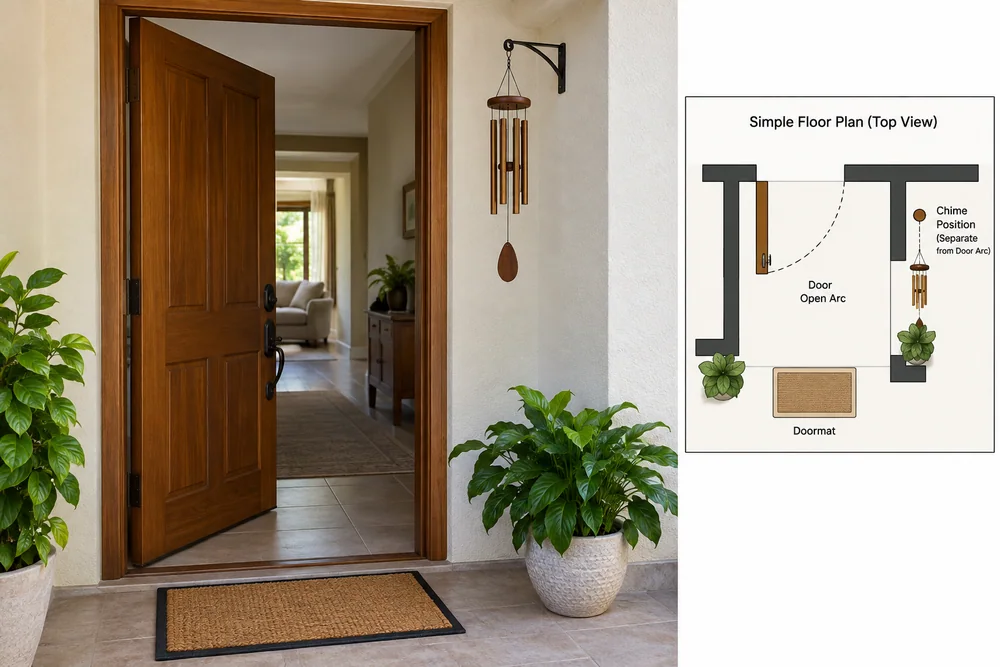
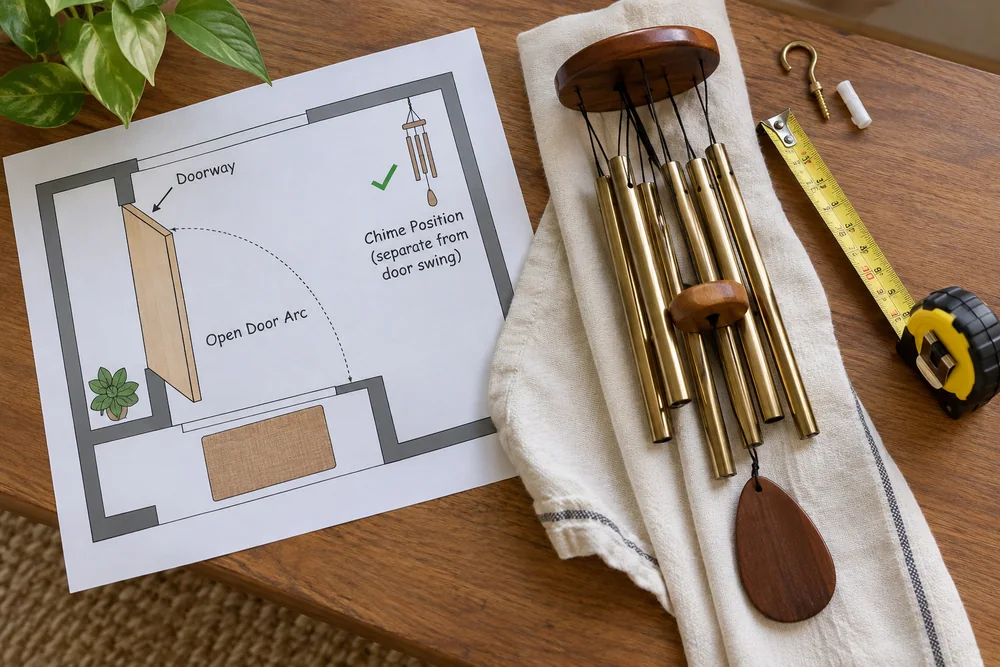
The pravesha dvara, or entrance, is traditionally significant in Indian domestic practice. A decorative toran, bandhanwar, bell or chime can express welcome, depending on household custom. For a chime, allow the door to open fully; leave space for people, packages and emergency exit. Avoid placing a heavy assembly directly above an active threshold unless the support and fixing are demonstrably suitable.
Balcony, veranda and garden
A sheltered balcony with occasional air movement is often more practical than a narrow corridor. Observe it at more than one time of day: wind can change direction, and an attractive afternoon sound can become intrusive at night. Verify that tubes, cords, coatings, wooden parts and fasteners are intended for the actual exposure. Strong wind and storms are reasons to move a delicate hanging indoors.
Puja room and meditation space
A household may enjoy a small chime near a sacred or contemplative space, but a constantly sounding object is not required for worship. During mantra japa, recitation or quiet meditation, silence may be preferable. Keep moving ornaments away from diyas, incense flames, loose cloth and fragile idols. If a ritual bell is used, follow the family’s established practice rather than treating decorative wind chimes as ritual substitutes.
Bedroom, study and shared apartment
Rest, focused work and consideration for neighbours should take priority over directional symbolism. A loud chime beside a bedroom window or shared wall can be disruptive. A quieter chime placed farther away—or a silent gemstone hanging or fabric toran—may suit the space better. Ask those who share the home whether the tone is pleasant before choosing a permanent position.
Placement method: five practical checks
- Define your purpose. Are you seeking a gentle sound, a devotional motif, a welcoming entrance or a specific contemporary Vastu/Feng Shui association?
- Identify the sector correctly. Use a reliable compass reading and clarify whether guidance applies to the whole home or an individual room. Recheck against structural metal that may distort a phone compass.
- Inspect the complete object. Confirm its actual tube material, dimensions, full drop, total weight, suspension and moving parts. Product photographs should represent the supplied item.
- Test the sound and airflow. Hang it temporarily if practical, check the tone from adjoining spaces and avoid repeated collision with doors, windows, walls or other fittings.
- Review safety and care. Use an appropriate structural fixing, inspect cords regularly, provide clearance and move vulnerable materials away from prolonged moisture or extreme wind.
What a wind chime cannot replace
A hanging accessory cannot substitute for repairing unsafe wiring, leaks, inadequate ventilation, structural damage or poor access. Vastu Shastra’s wider concerns with architecture and spatial use should not be reduced to buying a single object. Likewise, Jyotisha-based recommendations—when sought—require their own interpretation rather than a blanket claim that every household needs a particular chime for a planet.
If you are considering a larger spatial review, start with OmmRudraksha’s Vastu Shastra overview and the consultation options. Your choice of chime can then be a considered part of an entrance or room arrangement, not a substitute for understanding the space itself.
Frequently asked questions about wind chimes and Vastu
Are wind chimes originally part of classical Vastu Shastra?
Modern wind chimes are strongly associated with Feng Shui and contemporary decorative practice. They are often incorporated into present-day Vastu advice, but particular metal, direction and rod-count formulas should not be attributed to ancient Sanskrit texts without a reliable textual basis.
Is northwest the best direction for a metal wind chime?
West and northwest are frequently recommended in popular Feng Shui-oriented guidance. Whether that is appropriate in your home depends on the school followed, the actual layout and whether the chime can be hung safely and comfortably.
Can I hang a wind chime at the main door?
Yes, if its sound is welcome and it does not strike the door, obstruct movement or create a falling-object risk. For a narrow doorway, a securely attached fabric toran or silent hanging may be a more suitable choice.
Do five or six rods guarantee good luck?
No. Different traditions assign different symbolic meanings to rod counts; there is no reliable basis to promise a particular life outcome from the number of rods.
Which is better: metal or bamboo?
Metal and bamboo usually sound and age differently. Some Feng Shui systems assign them to different compass sectors, but the more useful first questions are whether you like the tone, whether the actual material is correctly described and whether it suits your exposure conditions.
Can a decorative gemstone hanging replace a wind chime?
It can replace the decorative purpose, especially where silence matters, but most stone hangings do not produce sound. Their material and symbolism should be described on their own terms rather than as if they functioned like a tubular chime.
Should a wind chime ring continuously?
No. Continuous or intrusive sound may be unpleasant and inconsiderate. A sheltered location that catches an occasional gentle breeze is usually easier to live with than an exposed location that produces constant noise.
Explore OmmRudraksha's Vastu collections
For related traditional home-decoration choices, explore the Hangings & Chimes collection, the Metal Wind Chimes category, and the broader Vastu collection. Use a relevant product's material and construction notes alongside this guide before making a choice.


