

Wind chimes, bells and decorative hangings may look similar when suspended above an entrance, but they do not all perform the same function. A wind chime generally uses breeze-driven movement to bring sounding pieces into contact with a striker or one another. A bell is a distinct resonant object that rings when struck, often by a clapper. A decorative toran, bead string, gemstone pendant or suncatcher may be chosen mainly for colour, symbolism and craftsmanship rather than for musical sound.
That distinction matters for an Indian home. A family may want the welcome of a toran without constant ringing, the deliberate sound of a ghanta during puja, or the occasional notes of a chime on a sheltered veranda. This guide compares their construction, sound, cultural context, placement, maintenance and buying information so the chosen object suits both the home's traditions and its practical needs.
1. The simplest way to tell these hanging decorations apart
Look beyond what the item is called in a shop. Ask three questions: What is designed to move? What is designed to make sound? What action causes it? A hollow metal tube can ring when a striker contacts it. A small bell may have an internal clapper that hits the bell wall when someone moves it. A gemstone bead hanging can sway in the same breeze without being made as a sound-producing instrument.
The word hanging only tells us that an object is suspended. It does not prove musical tuning, a particular mineral, devotional consecration, outdoor durability or suitability as a Vastu remedy. A wind-driven decoration can be completely silent; a visually similar one can make frequent sounds in the same location.
| Type | How it works | Primary purpose | What to verify |
|---|---|---|---|
| Tubular wind chime | Moving striker contacts suspended tubes or rods | Wind-driven ringing and decorative form | Sounding material, striker, sail, suspension, size and genuine tuning if claimed |
| Individual hanging bell | Bell body rings after contact with clapper or external striker | Deliberate or movement-triggered bell sound | Bell material, clapper, sound, support and intended use |
| Bell cluster or door-bell hanging | Separate bells sound when touched or moved | Decorative or audible entrance accent | Whether air, door movement or manual contact activates the bells |
| Toran or bandhanwar | Decorative leaves, flowers, fabric or beads hang across an entrance | Welcoming and festive ornament | Material, length, backing, support points and door clearance |
| Gemstone or bead hanging | Beads or pendants are displayed on thread, wire or other support | Visual, symbolic or artisanal decoration | Real bead material, weight, connectors and whether it is meant to ring |
| Glass prism or suncatcher | Glass or other optical material reflects or refracts available light | Light and visual effects, often silent | Optical material, light angle, glass safety and attachment |
2. What makes an object a functioning wind chime?
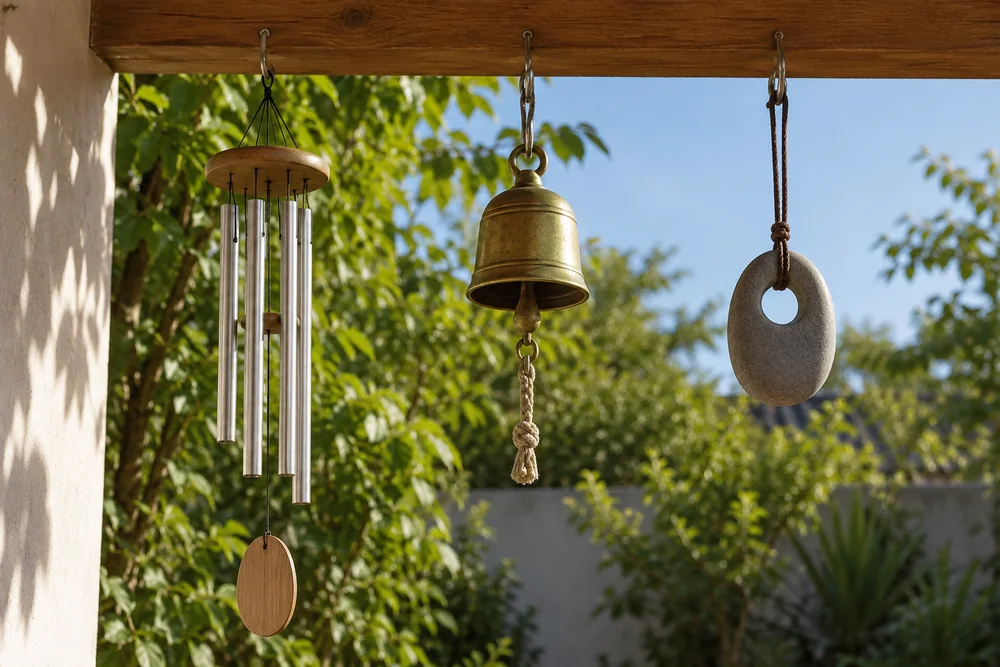
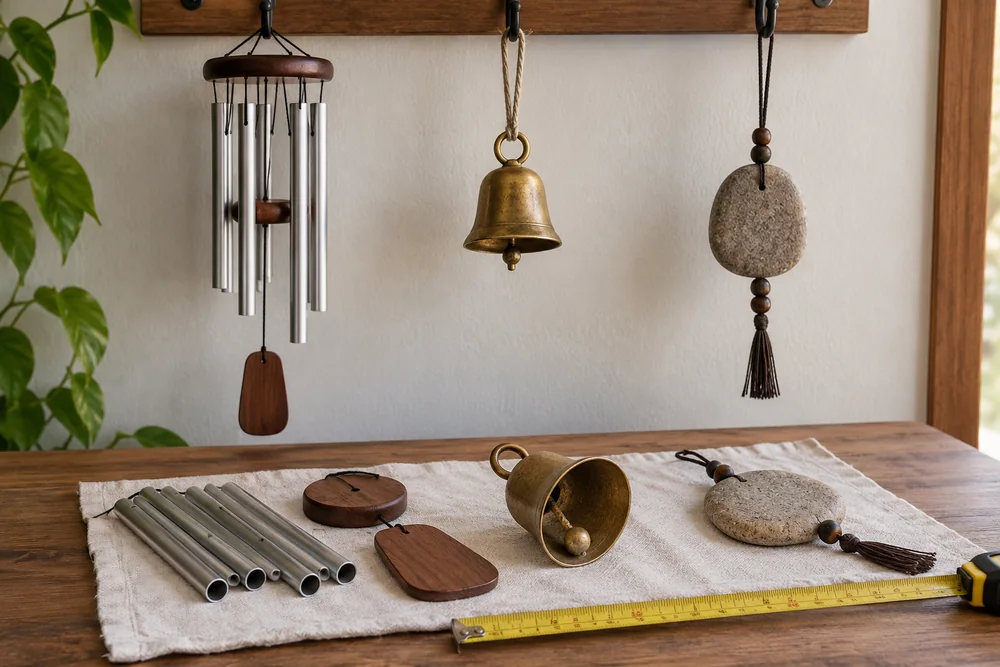
In a familiar tubular chime, several sounding elements hang around a central moving striker. A lower wind sail, sometimes called a windcatcher, receives moving air and helps pull the striker into contact with one or more tubes. A top support holds the elements in position and individual cords allow them to vibrate after each impact. The resulting notes depend on the actual tube geometry, material, striker and suspension.
Woodstock Chimes' published anatomy guide identifies the top piece, chime tubes, central mechanism and windcatcher as functional parts of its common designs. That is a useful reference for the tubular family, although not every wind chime uses the identical arrangement. Some bamboo models employ different support or striker shapes, while shell and ceramic hangings may sound through direct contact among pieces.
A functioning chime should be evaluated by its real mechanism. A metal spiral that rotates without sounding is primarily a spinner; a glass pendant that refracts light is primarily a suncatcher. Some combined products incorporate both light and chime sound, but the listing should distinguish which parts produce which effect.
When evaluating a tubular design, count the components that actually ring, not decorative beads or coloured accents. A seven-bead ornament does not establish seven musical notes, and five tubes do not automatically form a pentatonic scale. Proper musical tuning requires an identifiable set of pitches or a credible maker's specification.
3. Bells and clappers: sound by a different mechanism
A bell is generally a hollow or cup-shaped resonant body that produces ringing sound when struck. A clapper may hang inside and contact the bell wall as it moves, or the object may be struck from outside. The bell body itself vibrates after impact. An individual bell can be used intentionally, while a grouping of small bells can ring through door motion, hand contact or breeze.
This differs from a conventional tubular wind chime in which a central striker commonly contacts several separate tubes. One decorative bell with its own clapper does not automatically become a multi-note wind chime merely because it hangs from a loop. Conversely, a string of tiny bells may become wind-driven and audible if each bell is free to move and has the right clapper or contact mechanism.
For the buyer, the important question is not simply whether the object is labelled a bell but how it is intended to be sounded. Some display bells have fixed or decorative clappers that may not function well outdoors. Others are designed to ring only when deliberately touched. The actual model's metal composition and sound should be verified rather than assumed from its golden, bronze or silver colour.
4. The ghanta and deliberate sound in Indian worship
In many Hindu devotional settings a ghanta, or ritual bell, is rung intentionally during puja. The act belongs to a chosen religious context, often accompanying offerings, prayers and other prescribed elements of worship. Its function is not identical to that of a breeze-operated decorative chime, which may sound spontaneously throughout the day.
The wider Indian appreciation of sound includes the concept of nada and rich musical traditions. These should be discussed with their proper meaning rather than suggesting that every metal tube or household bell produces a special mantra frequency or performs japa automatically. A decorative wind chime can be aesthetically or symbolically meaningful without being described as a consecrated ritual instrument.
If an owner wants a bell specifically for puja, the appropriate question is whether its form and use suit that family's practice. For a living-room entrance or balcony, a decorative bell cluster may instead be chosen for its appearance and occasional ringing. Both can have value without confusing their functions.
5. Torans, bandhanwars and the welcoming doorway
A toran or bandhanwar is a traditional form of entrance decoration used in different Indian regions and communities. Fresh mango or other leaves, marigold flowers, textiles, embroidery, mirror work, wool thread and beads appear in various styles. A toran is frequently displayed for festivals, weddings, Griha Pravesha and other auspicious occasions, but local designs and customs vary.
The Smithsonian's Cooper Hewitt Design Museum describes a Gujarati toran displayed above a doorway as a sign of welcome. The D'Source Indian design documentation similarly records traditional toran making and the use of leaf and textile forms. These references are cultural and craft evidence; they do not imply that one pattern, colour or number of leaves is prescribed for every Indian household.
A toran is generally chosen for its welcoming visual role, not its ability to play notes. Some modern bandhanwars include small bells, beads or metal motifs that can make incidental sound when touched. That makes the individual design a combined decorative object, rather than proof that all torans are wind chimes.
Before purchase, check its width, hanging depth, number of support points, fabric or leaf care, and whether a door can open without catching its tassels. A wide, heavy beadwork toran may need more support than a light fresh-leaf garland. See the proposed Door Torans & Herbal Hangings collection for related styles; the deployed URL must be verified before publication.
6. Gemstone, Rudraksha and other bead hangings
Bead and gemstone hangings can be built from polished stones, coloured glass, ceramic, resin, metal, wooden beads or other components. A suspended bead chain may move in the air, but movement alone is not a musical specification. If its components do not have a deliberate sounding mechanism, it should be described principally as a decorative hanging or mobile.
Material identification is especially important in this category. A blue bead may be natural stone, dyed stone or glass. A transparent prism may be glass rather than natural quartz. A Rudraksha bead may be included for cultural or devotional significance, but its presence does not prove the other stones are natural or that the completed hanging has received ritual consecration.
Customers should be told the verified material, approximate bead size where measured, overall dimensions, weight, threading or wiring method and any special care restrictions. Claims of origin, gemstone certification, energy effects or astrological suitability require an appropriate independent basis; they should not be inferred from a photograph.
A bead hanging that contacts a window or metal frame may make incidental clicking sounds, even if it is primarily decorative. For a quiet apartment, mount such objects so they remain clear of hard surfaces, fans, doors and accessible small-child hazards.
7. Suncatchers, glass prisms and spiral decorations
Some hangings are designed to interact with light. A glass prism or faceted ornament may refract and disperse sunlight into coloured patches when the light and surface geometry permit it. A metallic or crystal-look spinner may offer rotating reflections. Neither function is itself evidence of musical tuning or a working sound mechanism.
Be precise about the material. Glass is not natural quartz simply because it is clear or faceted. A decorative object should not promise rainbow projections in every room or at every time: the effect depends on direct light, angle, glass quality and surrounding surfaces. A prism can also direct concentrated or reflected light and may create glare in unsuitable positions, so assess the actual placement.
For a spiral hanging, the word spiral tells us primarily about geometry. A descending arrangement of metal sounding pieces can create a functioning chime; a fixed metal spiral may be silent. Do not assign a specific yantra, Kundalini meaning or musical scale to a generic spiral silhouette without credible design evidence.
Glass, ceramic and gemstone components need additional clearance from hard surfaces. A visually delicate hanging can still be heavy enough to require a substantial fixing, especially when suspended above people or near a window.
8. Sound, materials and the right expectations
Wind chimes are sometimes advertised as calming, melodic, deep, soft or resonant. These terms can describe how a listener perceives a particular sound, but they are not interchangeable with an objective pitch, measured sound level or scale. Length, diameter, wall thickness, stiffness, mass, suspension and striker affect the tone produced by a typical tubular element.
Aluminium is commonly used for tubular chimes; copper has a reddish appearance; brass is primarily a copper–zinc alloy; and stainless steel is a family of corrosion-resistant iron-based alloys. None of these material names guarantees the most pleasing sound in every design. A copper-coloured aluminium tube remains aluminium, and a silver-coloured tube is not automatically stainless steel.
Some manufacturers offer explicitly tuned wind chimes with documented musical relationships. If a seller claims a specific scale, key or note frequency, request the maker's exact information for that model. A sound demonstration is useful but can be influenced by recording distance, microphones, wind conditions and playback volume.
Explore the Metal Wind Chimes collection or compare the Aluminium Tube Wind Chime for a conventional tubular format. These are candidate internal routes and require storefront verification; an exported catalogue name is not itself a current physical-stock specification.
9. Which hanging works best in each part of the home?
There is no universal decorative ranking. Choose based on whether the household wants sound, movement, symbolism or mostly visual interest; then consider safe support, the extent of airflow, available clearance and neighbours. A sound-producing object may be delightful in a veranda but disruptive near a sleeping room or shared passage.
| Space and preference | Possible fit | Practical concern |
|---|---|---|
| Sheltered veranda; occasional ringing welcomed | Tubular or other functional wind chime | Check airflow, actual model sound, mounting and weather rating |
| Main entrance; traditional welcome | Fabric, leaf or bead toran or bandhanwar | Door swing, width, loose decorations and support points |
| Puja room; deliberate sound for worship | Suitable ritual ghanta according to household custom | Distinct ritual function; avoid accidental ringing and flames |
| Small flat; quiet decoration desired | Stationary textile, bead or gemstone hanging | Avoid hard-surface collisions, loose cords and small parts |
| Window with suitable sunlight | Verified glass prism or suncatcher | Glass safety, sun angle, reflections and secure mounting |
| Exposed balcony or coastal location | Only a fully verified weather-suitable hanging | Complete assembly, fixing, wind load, corrosion and safe removal |
In an apartment, a “quiet” model is not always quieter just because it contains fewer rods or uses bamboo. Ringing frequency and sound level depend on the specific design and breeze. A silent alternative can be more considerate than a chime that requires constant intervention.
10. Installing hanging décor safely
Every hanging places a load on its support. A freely moving chime creates different demands from a stationary toran, and a heavy bell or gemstone ornament should not be treated as a lightweight fabric festoon. Confirm the complete assembled weight and the actual substrate, whether structural wood, sound masonry, an approved ceiling support or another properly specified system.
Adhesive hooks are not universally suitable for overhead, moving or exterior loads. Follow the specific fixing manufacturer's permitted use, surface preparation and rating; an appealing hook design is not proof of structural capacity. Do not drill blindly into a wall or ceiling that may contain hidden electrical wiring, pipes, waterproofing or other services.
For entrance décor, check headroom and the door's full opening arc. A chime should swing clear of windows, walls and railings. Glass, ceramic and metal pieces should not hang directly above a cot, occupied seating area or busy passage where breakage or failure would create an avoidable hazard. Keep long loops and detachable beads out of reach of young children and pets.
Outdoor installations require particular care during monsoon winds and weather changes. If the product is not verified for severe conditions, take it inside before bad weather arrives when access is safe. Never lean over a wet balcony or climb unstable furniture to rescue a decoration during a storm.
11. Care and storage depend on the material
Dust an unknown hanging gently before using liquid cleaners. Bare copper and brass may develop patina that some owners wish to preserve, while lacquered or plated surfaces can be damaged by metal polishes. Stainless steel resists many forms of corrosion but can stain under unsuitable conditions; bamboo, wood, fabric, paper, flowers and shells have different vulnerabilities.
Do not soak a mixed-material assembly merely because one of its parts is metal or glass. Cords, adhesives, wooden caps, coatings, gemstones and natural fibres may require separate care. Inspect rings, knots, hanging holes and load-bearing supports after strong wind or seasonal storage. If the support is frayed, a ring opened or glass cracked, remove the object from service until safely repaired.
For storage, let permitted damp-cleaned parts dry fully. Pad hard or delicate components individually, keep chime tubes from striking one another and avoid knotting all cords together. Preserve the original layout of any maker-tuned instrument rather than cutting or relocating its sounding parts.
12. Vastu Shastra, Feng Shui and cultural meaning
Vastu Shastra is a classical Indian body of thought concerned with the arrangement of built spaces, including orientation, entrances, circulation, proportion, light and ventilation. The Vastu Purusha Mandala and Pancha Mahabhuta are associated with its wider conceptual context. Families may apply traditional and contemporary decorative preferences to their entrances, but there is no single universal rule that every home must have a wind chime, bell, toran or gemstone hanging in order to be auspicious.
A toran's welcoming role is grounded in Indian regional traditions, while a ghanta has a specific place in many devotional practices. These two meanings are distinct from the engineering of a modern tubular wind chime. Likewise, a decorative bead string with a spiritual association is not the same as a consecrated ritual object without further evidence.
Modern Feng Shui often discusses metal chimes through its Chinese five-phase framework, including popular west or northwest placements. That system should not be merged with the Indian Pancha Mahabhuta as if they were identical scriptural categories. A suggested direction also cannot override safe installation, the family's comfort or building rules.
For broader background, read OmmRudraksha's Vastu Shastra guide. Traditional symbolism is most useful when presented accurately alongside the ordinary facts of construction and use, rather than as a guaranteed health, financial or planetary result.
13. Buying checklist: make the listing answer the right questions
- Identify the function. Is the item designed to ring in the wind, ring when deliberately touched, reflect light or remain largely silent?
- Confirm real materials. Separate base metal from colour or plating; distinguish natural gemstone, dyed material, glass, ceramic, wood, textile and other components.
- Verify the sound mechanism. For chimes, inspect tubes, striker, wind sail and support; for bells, identify clapper and actual activation.
- Ask about musical tuning only if claimed. Request maker notes, scale or specific evidence, rather than using tube count as a shortcut.
- Check total dimensions and weight. Measure overall drop, maximum span, tassels or lower ornaments and complete assembled mass.
- Review mounting and clearance. Know the support points, fixing requirements, headroom and door or window movement.
- Match the environment. Verify the entire assembly for indoor, sheltered or exposed outdoor use, including cords, frame and finishes.
- Check the real stocked item. Confirm that photos, hardware, price, stock, packaging and any claimed origin or certification describe what will actually be delivered.
Frequently asked questions
Is a wind chime the same as a bell?
No. A common tubular wind chime uses wind-driven contact among a striker and separate sounding tubes. A bell is a distinct resonant body typically struck by a clapper or external object. Some decorative hangings combine bells and chime-like movement.
Can a hanging bell be used as a wind chime?
It may ring in the wind if its clapper or neighbouring elements are free to make contact. Whether it functions well depends on the actual construction, airflow and safe suspension.
Does every toran make sound?
No. Most traditional leaf, flower and textile torans are primarily welcoming visual decorations. Some modern versions incorporate bells or other sounding ornaments.
Is a clear suncatcher necessarily natural quartz?
No. Many prisms and suncatchers are made from glass or other materials. A clear or faceted appearance does not verify natural gemstone identity.
Does a gemstone hanging need a striker?
Not if its purpose is visual decoration. A sound-producing design needs some means of exciting vibration; a separate striker is not essential if suspended pieces strike one another.
Are more chime tubes always better?
No. Sound depends on geometry, material, striker, suspension and whether the components are tuned to a documented note set. Tube count alone does not prove quality or a musical scale.
Which decoration is better for a quiet apartment entrance?
A securely mounted stationary toran, fabric hanging or other non-sounding ornament may be easier to live with than an active wind chime beside a shared corridor or bedroom.
Is a puja ghanta the same as a decorative door-bell cluster?
No. A ghanta used intentionally in worship has a devotional context. A door-bell cluster may have a purely decorative or incidental audible function.
Does Vastu require a wind chime or bell in every home?
No universal classical Vastu requirement applies to every building. Households may follow specific customs or contemporary consultation methods while prioritising correct placement and physical safety.
Explore OmmRudraksha's Hangings & Chimes collections
Browse Hangings & Chimes for sounding and decorative formats, Metal Wind Chimes for tubular constructions and Door Torans & Herbal Hangings for entrance decoration. Explore the wider Vastu collection for other home-focused items. Before ordering, verify the published product's real material, stock, exact images and the suitability of its mounting arrangement.


