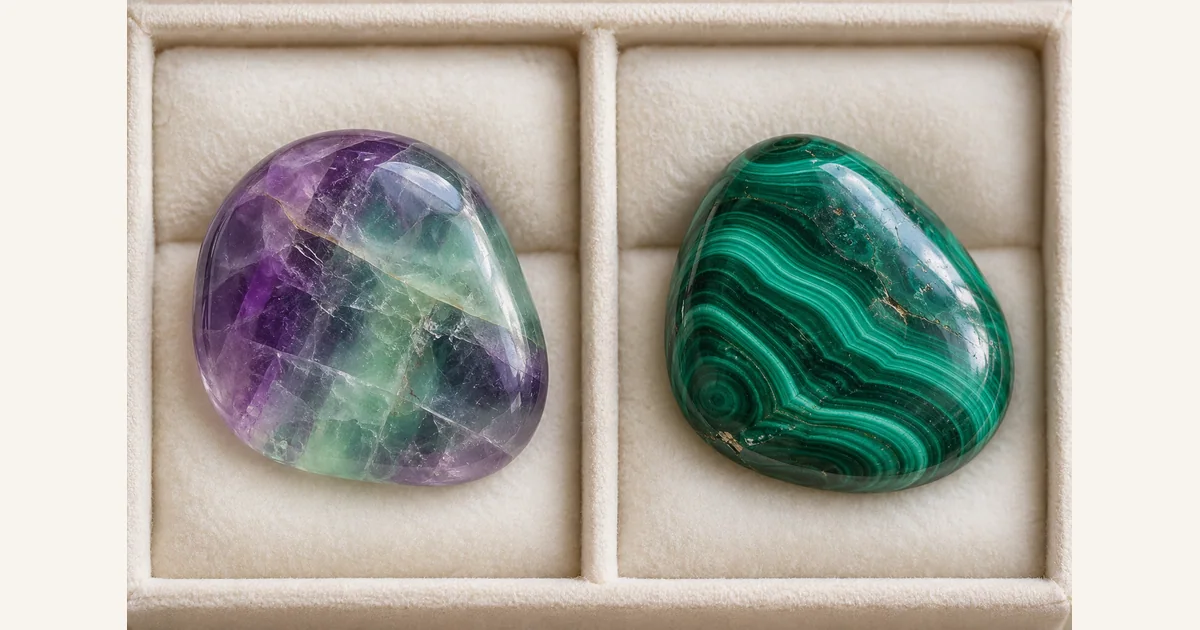
Fluorite and malachite are striking tumbled stones, but a smooth polish does not make either of them as durable as quartz. Fluorite may show bands of violet, green, blue and clear colour; malachite is recognised for its green curves and concentric bands. Both can be chosen for a home altar, Vastu collection, crystal display or mineral study kit. Yet their beauty is best preserved by understanding the mineral beneath the polish: fluorite has pronounced cleavage, while malachite is relatively soft and sensitive to acids and abrasive handling.
The practical question is not simply “Can I keep these stones at home?” It is how will they be handled, displayed, cleaned, packed and described? This guide compares delicate minerals, explains what can go wrong, sets out practical home and professional examples, and places modern coloured-stone Vastu practices alongside the older Indian framework of directions and the five elements.
1. Why a polished tumbled stone may still be delicate
Tumbling rounds sharp edges by abrasion and creates a polished surface. It does not alter the material's fundamental crystal structure. A rounded fluorite pebble still has cleavage planes. A shiny malachite piece still has a softer surface than quartz. A polished gypsum specimen can still be marked very easily. Even a harder stone may be vulnerable to an impact if it has cleavage, natural fractures or an unstable coating.
Four properties matter when selecting and caring for a specimen:
- Hardness: resistance to scratching. The Mohs scale compares minerals by which can scratch which; it does not measure overall strength or impact resistance.
- Toughness: resistance to breaking or chipping. A mineral can be reasonably hard but break along a weak plane.
- Cleavage: tendency to split along crystallographically preferred planes. Fluorite is a classic example of strong, four-direction cleavage.
- Condition and treatment: pre-existing fractures, wax, resin, dye, filler, and the polish itself may change safe-care requirements.
For example, a quartz tumble (Mohs 7) and a fluorite tumble (Mohs 4) may both feel smooth in the hand. Put them loose together in a travelling pouch, however, and the harder quartz can mark fluorite. If the pouch falls, fluorite can also chip. Scratching and fracture are two separate risks that require separate precautions.
2. Delicate tumbled minerals at a glance
| Mineral / material | Approx. Mohs hardness | Main care concern | Recommended collection use |
|---|---|---|---|
| Fluorite | 4 | Perfect cleavage, edge chipping, possible colour fading for some specimens | Individually cushioned study cell or sheltered display |
| Malachite | 3.5–4 | Scratches, acid sensitivity, copper-bearing dust if abraded | Intact polished piece on a padded stand |
| Calcite | 3 | Easy scratching, acid reaction, cleavage | Labelled demonstration piece; avoid water rituals |
| Gypsum / selenite | 2 | Very easy scratching, cleavage, prolonged moisture exposure | Stationary and fully supported specimen |
| Howlite | About 3.5 | Surface scuffs, possible dye or coatings | Separated teaching sample with clear treatment label |
| Feldspars such as moonstone | Usually 6–6.5 | Cleavage and impact vulnerability despite higher hardness | Soft-lined cell; avoid dropping |
| Opal (varies by type) | About 5.5–6.5 | Heat, dehydration and cracking risks vary by specimen | Condition-specific care, away from heat |
| Quartz / amethyst | 7 | Harder benchmark that can scratch softer neighbours | Separate pocket, not loose against delicate minerals |
These are general mineral reference values, not a promise about a particular stone. Composite rocks, stabilised pieces, and treated specimens can behave differently. When a vendor provides no reliable material identification, choose the more protective handling method rather than performing a scratch test on a finished product.
3. Fluorite: colour zoning, cleavage and careful display
Fluorite is calcium fluoride, CaF2, with Mohs hardness 4. It forms in a cubic crystal system and is famous for perfect octahedral cleavage. This means it has preferred directions along which it can break, even when the outside has been tumbled into a rounded shape. Purple and green banded fluorite is especially popular in collections, but fluorite can also be clear, blue, yellow or multicoloured. Different colours do not automatically indicate different gemstone species.
When inspecting a fluorite tumble, turn it under a stable, diffuse light. Look for genuine colour zoning, a continuous polish and clear surfaces without a growing edge crack. Small internal planes or inclusions may occur naturally; they do not by themselves establish that the stone is damaged. What matters for a travelling set is whether an exposed break, sharp point or open fracture could spread under handling.
A buyer may mistake violet fluorite for amethyst. Amethyst is quartz (Mohs 7), so the two materials differ substantially in hardness and cleavage. Their colours alone cannot settle the identification. A clean purchase description should use the supplier's supported mineral name, not merely “purple crystal,” and should not substitute dramatic lighting for material evidence.
Care: keep fluorite out of a pocket with keys or quartz stones. Use a soft dry cloth for dust. For ordinary display, choose a stable indoor location away from a hot window, abrupt temperature changes and prolonged direct sunlight; certain coloured specimens can fade. Avoid ultrasonic or steam cleaning. Do not use fluorite in boiling-water rituals or under a lamp that warms the surface strongly.
4. Malachite: the meaning of its green bands and why surface care matters
Malachite is a copper carbonate hydroxide mineral, commonly written Cu2CO3(OH)2. Its green colour and patterned bands develop as the mineral forms in the oxidised portions of copper deposits. The patterns can appear as circles, flowing bands, irregular clouds or darker and lighter green stripes. A well-polished specimen can be visually dramatic without needing an elaborate setting.
Malachite has a reference hardness of roughly 3.5–4 and is sensitive to acidic chemicals. Its attractive green surface should not be rubbed against quartz, cleaned with vinegar or citrus, or soaked in an unknown cleaning solution. A supplier may also sell stabilised or composite material, which should be accurately labelled. Intact finished pieces are suitable for ordinary display when handled gently; the particular concern increases when the stone is broken, ground, drilled, sanded or starts shedding powder. Those operations can create copper-bearing dust that should not be breathed in or handled casually.
It is useful to distinguish two contexts: admiring an intact, polished malachite pebble on a protected shelf is different from cutting or grinding a rough mineral. There is no reason to create dust merely to check authenticity. Do not place malachite in drinking water, prepare gemstone-infused beverages from it or use it in a soaking vessel. For routine cleaning, first use a soft dry cloth. If a mark does not lift, follow treatment-specific advice from the supplier or a qualified gemstone professional; avoid experimenting with acids, abrasives, ultrasonic units or prolonged immersion.
Malachite's natural appearance should also be distinguished from similarly coloured banded resin or composite decorative objects. Repeatedly uniform printed patterns, a visible joined seam or a very light plastic feel may prompt questions, but none is a standalone conclusive test. Accurate disclosure and credible sourcing matter more than a single visual trick.
5. Other minerals that require special handling
The reason for protection differs by material. An overly simple “soft stones” category misses important distinctions:
- Calcite: approximately Mohs 3, commonly found as orange, honey, white or green polished material. It has strong cleavage and reacts with acids. Avoid vinegar demonstrations, acid-based cleaning and loose packing with quartz.
- Gypsum / selenite: approximately Mohs 2 and easily scratched even during ordinary handling. Keep flat pieces supported along their full length. Avoid using soft gypsum plates as a scraping or rubbing surface for other stones.
- Moonstone and other feldspars: although considerably harder than fluorite, cleavage makes impacts troublesome. A dropped feldspar tumble may chip at an edge. The correct lesson is that higher Mohs hardness does not guarantee toughness.
- Lapis lazuli: a rock made from several minerals rather than one homogeneous crystal. Porosity, colour treatments, waxes or mixed constituents can affect its cleaning needs; do not assume it has the same care instructions as uniform quartz.
- Turquoise: porous specimens and stabilisation treatments complicate moisture and chemical care. A dry, separate display is a conservative default until its treatment is known.
- Opal: care depends on the opal type, including whether it is hydrophane, treated or assembled. Avoid a sudden hot-cold transition, drying heat, ultrasonic cleaning or an improvised soak routine.
- Pyrite: not soft in the same way; it has a different problem profile, especially moisture-related deterioration for susceptible specimens. Keep it dry and separate. See the dedicated Pyrite Tumbled Stones guide linked below.
For a mixed gemstone display, the best grouping is often by handling requirement, not just by colour. A green malachite and a green aventurine may form an attractive pair, but they should not necessarily share the same unlined compartment. An amethyst and a violet fluorite can illustrate colour similarities while requiring different care.
6. Five-element thinking and delicate stones in Vastu displays
In Indian Vastu discussion, the Pancha Mahabhuta—Prithvi (earth), Jala (water), Agni (fire), Vayu (air) and Akasha (space)—provide a traditional language for thinking about a balanced environment. Classical directional frameworks also associate spaces with deities and functions: for example, Ishana with the north-east, Agni with the south-east, Varuna with the west and Vayu with the north-west. These cultural frameworks are older than today's commercially packaged fluorite-and-malachite crystal sets.
Modern gemstone placement advice often maps colour and perceived symbolic qualities onto those directions. Green may be used to suggest nature, renewal and steadiness; violet to suggest contemplation; clear or pale stones to suggest simplicity. These are contemporary symbolic choices, not evidence that an ancient Vastu text prescribed a particular tumbled fluorite in a given corner. Keep that distinction clear in product descriptions and professional consultations.
Likewise, Navaratna traditions refer to established planetary gemstones. Fluorite and malachite are not interchangeable replacements for prescribed planetary gems merely because they share a colour with one. A decorative stone display can complement devotional or contemplative practice without being represented as an astrological prescription.
7. Choosing a suitable place: a practical directional plan
Before choosing a direction, look at how the room actually functions. Will children touch the stones? Is there a hot window, damp wash area or an unstable open shelf? Is the intended use an altar, quiet meditation corner, showroom teaching case or consultation table? The best spiritual arrangement is one that remains orderly and undamaged.
| Area or purpose | Possible symbolic choice | Practical placement decision |
|---|---|---|
| North-east meditation space | Small purple or clear fluorite as an aid to a quiet, uncluttered arrangement | Keep in a felt-lined bowl away from floor traffic and direct sunlight |
| East-facing study shelf | Colour-zoned fluorite as a study specimen representing variety and attentive observation | Use a labelled stationary stand; do not keep beside metal stationery |
| Living-room green display | Malachite as an artistic symbol of plant-like colour and growth | Place an intact polished specimen on a dry, stable pad away from food and water |
| South-east activity zone | A warm-toned, more durable decorative stone may suit the visual theme better | Avoid putting sensitive mineral specimens beside lamps, heat sources or cooking areas |
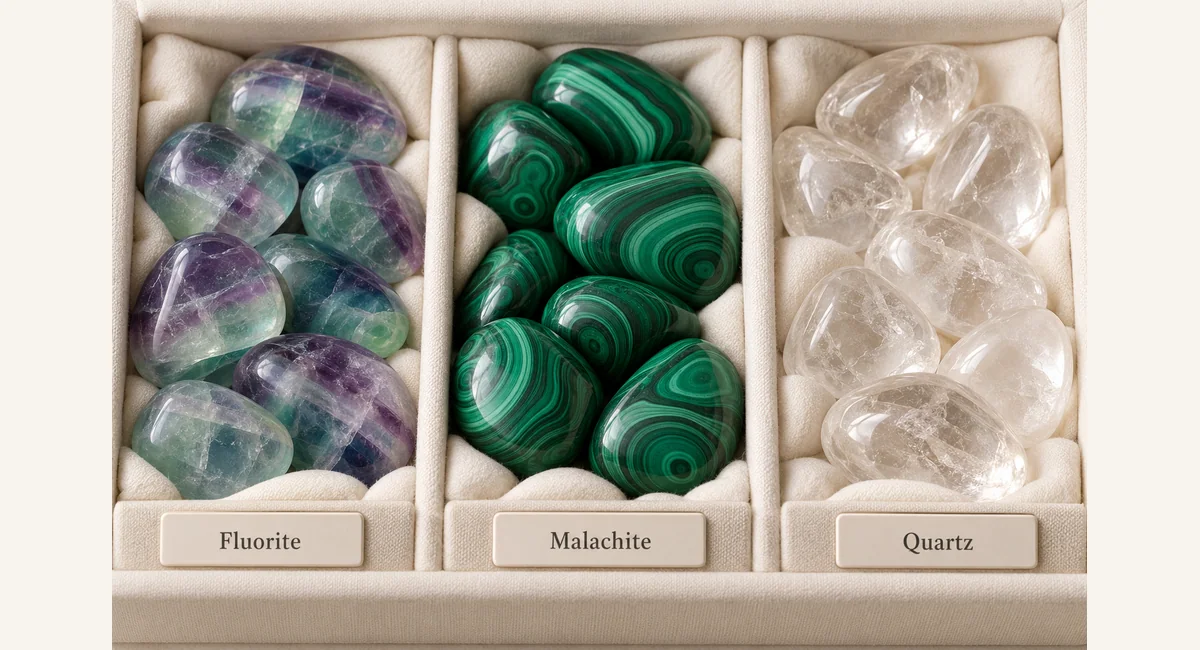
| Showroom consultation counter | Fluorite–malachite–quartz comparison tray | Separate all three in labelled cells and present only one at a time |
| Travelling Vastu demonstration kit | Small, representative specimens selected for teaching | Use fitted partitions, soft sleeves and a lid that never presses directly on stones |
These examples are choices for a coherent display, not fixed compulsory remedies. In a home where the north-east shelf receives strong sunlight, placing fluorite elsewhere in diffuse indoor light makes more sense than following a directional suggestion at the expense of the specimen.
8. A 12-piece delicate-mineral study and Vastu demonstration kit
A professional can teach the differences among stones more effectively with a small kit than with a large decorative heap. The following is a sample inventory of twelve pieces; it is an instructional arrangement, not a twelve-stone religious rule:
| Inventory cells | Specimens | What the pair demonstrates |
|---|---|---|
| 1–2 | Two fluorite tumbles in contrasting colour zones | Same mineral family, different colour; cleavage precautions |
| 3–4 | Two intact malachite tumbles with different bands | Natural pattern variety; copper-mineral handling |
| 5–6 | Two calcite specimens of different colour | Softness, acid sensitivity and careful storage |
| 7–8 | Two howlite specimens (one natural, one disclosed dyed sample) | Material identity versus colour treatment |
| 9–10 | Two feldspar samples (e.g. moonstone and labradorite) | Optical effects and cleavage despite higher hardness |
| 11–12 | Two quartz specimens, such as clear quartz and amethyst | Harder reference materials, kept in their own cells |
Prepare a card for each cell: name, treatment status if known, approximate hardness, specific care instruction, supplier or batch reference and intended teaching use. Handle the stones on a soft mat and return them to their numbered cells immediately. Never demonstrate identification by scratching, dropping, acid-treating or heating valuable finished specimens. A properly explained comparison lets customers appreciate the minerals without creating damage.
If only a Vastu decoration is needed, the kit need not be displayed in full. Select one or two pieces according to appearance, room function and handling requirements. A quieter display with clearly placed stones often looks better than a crowded grid that mixes fragile specimens with hard points.
9. Cleaning and maintaining fluorite, malachite and mixed collections
Start with the least invasive method: lift dust with a soft dry microfibre cloth, or a very soft clean brush for a stationary specimen. Avoid pressing into an edge or existing fracture. Examine the surface under a steady light before deciding that a mark needs removal; a natural inclusion is not dirt.
| Situation | Preferred approach | Avoid |
|---|---|---|
| Ordinary dust | Dry soft cloth; gently lift and return | Rough tissue, gritty brushes and forceful rubbing |
| Unidentified surface mark | Check material identity and any treatment before cleaning | Acid, vinegar, bleach or aggressive polishing |
| Fluorite with a tiny chip | Keep separate and inspect for exposed sharp edges | Ultrasonic tank, steam, repeated impact |
| Malachite with damaged or powdery surface | Isolate and obtain professional or supplier guidance | Sanding, drilling, dry grinding or casual dust handling |
| Dyed or stabilised specimen | Follow disclosed treatment-specific care | Unknown solvents, immersion and untested cleaners |
| Mixed home Vastu tray | Remove one stone at a time, dust, replace in its own cell | Pouring all specimens into water together |
Some gem-care sources allow a carefully dampened cloth or limited mild-soap cleaning for a known, untreated mineral. Because a retail specimen's treatments and fracture history are often uncertain, dry gentle care is the practical default here. If a stone has been exposed to a spill, blot gently, separate it from the collection and ask the seller for guidance on its exact material and finish. Avoid using the same washing ritual for every mineral in a gemstone kit.
10. Example: an apartment prayer corner
Consider a family with a small puja shelf and a decorative bowl of mixed tumbled stones. There is a purple-green fluorite tumble, a polished malachite and several clear quartz pebbles. The family currently tips the contents into a tray every week for cleaning. Instead, choose a shallow lined base with two small individual cells, one for fluorite and one for malachite, and keep quartz in a separate compartment. The arrangement remains aesthetically unified while reducing surface contact.
Use the setting's devotional meaning through the cleanliness, order and intention of the space rather than by claiming that one stone will guarantee a change in family circumstances. If the shelf is immediately beside a bright west-facing window, shift the fluorite away from the glare. If the shelf is accessible to children, move the delicate specimens higher or into a closed case. The intention is preserved, and the collection lasts longer.
11. Example: a Bengaluru jewellery and gemstone showroom
A customer asks to compare green malachite, green aventurine and green fluorite for a decorative gift. The jeweller can place them side by side under consistent neutral lighting, explain that colour is not mineral identity, and make the comparison transparent: malachite offers distinctive copper-mineral banding; aventurine quartz is normally a harder, more robust option for frequent handling; fluorite offers attractive zoning but requires protection from impact.
Offer a separate display stand for the delicate stones rather than packing all three loose in a cloth pouch. Show the buyer the label with mineral name, whether a treatment is known, how to dust the surface and what not to do with water or cleaning chemicals. The buyer's preferred symbolic colour can inform the purchase, while material durability determines the packaging and care instructions.
12. Example: taking specimens to a professional Vastu consultation
A practitioner visits a home or office with the twelve-piece teaching kit. Before the visit, the practitioner checks each cell against the inventory, notes any chipped specimen and confirms that the inner lid will not bear on the stones. On site, a soft mat is placed on a stable table. Only the necessary samples are displayed, never scattered onto a stone or glass tabletop where edges can collide.
When explaining directional symbolism, the consultant discusses the five elements and the client's intended use of the room. A violet fluorite may be shown as a contemporary meditation-themed colour option; a green malachite can be shown as a decorative natural pattern. Neither is presented as a fixed substitute for an astrologically selected Navaratna gem or as a guarantee of wealth, health or examination results. After the meeting, the pieces return to their numbered pockets and the inventory is checked again.
13. Buying checklist: questions worth asking before paying
- What is the mineral name? Avoid a listing that only says “healing crystal” or an attractive colour name.
- Is the piece natural, dyed, resin-treated, stabilised or composite? Ask for disclosure where the seller knows the treatment.
- Can I see the actual piece? Close-up photographs should show the polish, banding, chips and any open fractures, not only a heavily lit product group.
- Is the surface intact? Look for gritty residue, flaking, a sharp fracture edge or a damaged coating.
- How is it packed? Delicate stones should arrive individually separated, not rubbing against quartz or metal accessories.
- What care note will be supplied? For malachite, ask explicitly about water exposure, chemical cleaners and any modification to the material.
- What happens if a sample arrives chipped? Agree on photographic documentation and replacement arrangements.
A premium-looking polish does not prove authenticity or durability. For a collection sold as professional, accuracy of names, consistent condition and care documentation carry more value than exaggerated claims about a stone's effects.
14. Packing a delicate tumbled-stone order
First place each stone in its own non-abrasive sleeve or fitted, padded cavity. Support larger malachite pieces so their weight cannot press into a small fluorite sample. Keep identification cards in an adjacent sleeve, not stuck to the mineral. Fill remaining space so individual cells do not rattle. Close the lid gently and check that it contacts the protective padding, not the specimens.
The outer parcel should have enough cushioning to resist routine transport shocks and should not be so large that the inner box moves. Where multiple products are packed together, separate hard pointed quartz clusters and metal objects from the delicate tumbles. A fragile label can communicate intent, but it does not replace internal cushioning. Photograph the arrangement before sealing if the parcel contains high-value or educational specimens.
On arrival, inspect the parcel over a clean soft surface. Match the labels against the inventory. Record any cracks or damaged finish before repeated handling. For more detailed packaging procedures, the related shipping guide is linked below.
15. Questions customers frequently ask
Can fluorite or malachite be kept in a Vastu bowl?
Yes, as intact decorative or study specimens, provided the bowl has a soft stable lining and separates them from harder stones. Do not use a water-filled bowl or leave them in a dish that is repeatedly shaken or emptied.
Is purple fluorite the same as amethyst?
No. Purple fluorite is a calcium fluoride mineral with Mohs hardness 4 and pronounced cleavage. Amethyst is purple quartz with Mohs hardness 7. Similar colours do not make the materials identical.
Can malachite be washed or soaked for cleansing?
Do not make soaking, acids or chemical baths a routine. For a finished piece of unknown treatment, dust gently and seek material-specific cleaning guidance if necessary. Malachite should never be used to make water intended for drinking.
Why can moonstone chip even though it is harder than fluorite?
Hardness measures scratching, not resistance to blows. Feldspar has cleavage, so an impact at the wrong angle can split or chip a polished piece. That is why padded individual storage matters for more than just the softest minerals.
Which is better for a frequently handled children's teaching tray?
Choose specimens that are more robust, clearly labelled and appropriate for supervised handling; retain delicate fluorite, malachite or gypsum behind a clear case or use photographs when contact is unnecessary. For comparisons, a teacher can explain the meaning of Mohs hardness without scratching or breaking samples.
16. The lasting value of a well-kept mineral collection
Fluorite and malachite bring unusual colours, crystal structures and natural patterns to a Vastu-oriented gemstone collection. Their role is strongest when material facts, traditional context and daily practicality are presented together. The colours can support a thoughtful personal arrangement; the actual mineral properties should determine its care. Choose a stable spot, use clear labels, keep incompatible stones apart and value the condition of each specimen as much as its appearance.
Continue reading
- Cleaning, Storing and Handling Tumbled Gemstones
- Pyrite Tumbled Stones: Identifying Material and Safe Care
- How to Pack and Ship Tumbled Stone Sets Safely
Explore the existing Vastu and gemstone collections for wider context.