Cleaning tumbled gemstones correctly starts with identifying the material, not with choosing a cleaning liquid. A polished clear-quartz pebble, a banded agate, a delicate fluorite tumble, a pyrite specimen and a dyed howlite bead may look equally smooth, but their hardness, fracture behaviour, surface treatment and response to moisture can differ greatly. In a mixed Vastu stone set, a single cleaning method for every piece can cause more damage than the dust it was intended to remove.
This guide gives OmmRudraksha customers, jewellery-shop owners, Vastu consultants and gemstone collectors a complete routine for cleaning, handling, storing, displaying, carrying and maintaining tumbled stones. It also separates physical maintenance from traditional practices such as shuddhi, pavitrikaran and Sankalpa. The goal is a collection whose identity, appearance, labels and spiritual purpose remain clear over many years of use.
1. Three questions to ask before touching a stone
First, what is the material? Quartz, jasper and chalcedony are typically harder than fluorite, howlite or malachite. Second, what is its condition? Open fractures, flaking, powder, a loose coating, drilled holes or a failing adhesive change the appropriate method. Third, has it been treated? Dyeing, wax, polymer filling, surface coating, heat treatment or reconstruction can make the care of two otherwise similar-looking stones different.
Keep identification and disclosure tied to the particular specimen or supplier batch. A product name such as “blue turquoise-look stone” is not evidence that the material is turquoise. A polished surface is not proof that the stone is untreated. If the name or treatment is uncertain, a dry soft-cloth method and separate storage are more appropriate starting points than a long soak.
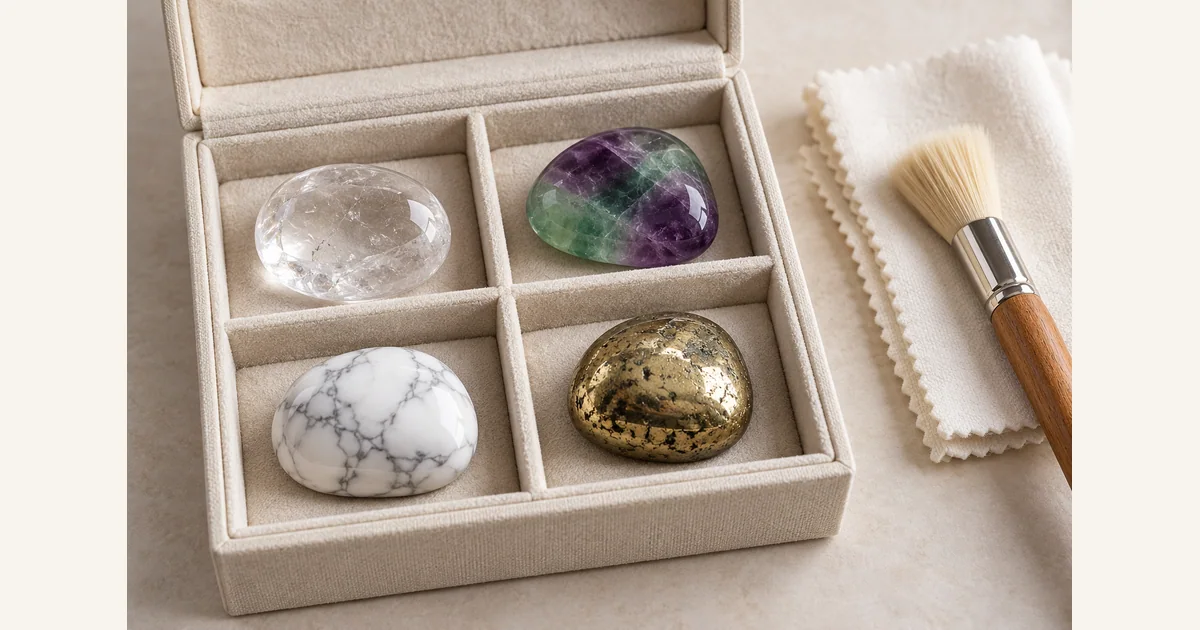
2. A practical cleaning sequence for a mixed gemstone collection
- Prepare a clear work surface. Use a clean, padded mat or folded soft cloth, with small empty trays for each material. Keep drinks, cleaning sprays, cosmetics and loose metal tools away from the workspace. Read the labels before removing stones from numbered pockets.
- Count and inspect the stones. Note chipped edges, cracks, fading, dull coating, deposits, a rough powdery surface or changes since the last inspection. Photograph a questionable piece while its label is visible. Put any deteriorating specimen in a separate container.
- Remove loose grit without pressure. Gently lift dust with a clean soft brush; then use a dry lint-free cloth. Do not rub gritty debris across a polished face. Hold the stone close to the mat so it cannot fall onto ceramic tile or a stone countertop.
- Choose whether any damp cleaning is suitable. Some sound, untreated quartz and chalcedony specimens can generally tolerate a brief wipe with a barely damp cloth followed by thorough drying. A material-specific care instruction always takes priority. For soft, porous, coated, filled, dyed or unidentified material, begin and preferably remain with dry cleaning.
- Dry before storage. After any material-approved moisture contact, remove residual water promptly with a soft cloth and allow the specimen and its compartment to become fully dry. Do not heat a wet stone, sun-bake it, use a hairdryer or place it next to a heater.
- Replace each item in its labelled pocket. Keep softer stones apart from harder ones; confirm that the count matches the record. A large kit is ready for display or travel only after its inventory and care condition have been checked.
This method is designed for ordinary collections and loose polished stones, not for professional restoration of rare mineral specimens. A broken, flaking or actively corroding mineral should be isolated rather than repeatedly scrubbed.
3. Gemstone-by-gemstone cleaning and storage chart
Mohs hardness measures resistance to scratching, not resistance to cracking. A stone can be relatively hard yet vulnerable along cleavage or existing fractures. These are practical care groups, not interchangeable mineral identities.
| Gemstone or group | What to watch | Practical routine |
|---|---|---|
| Clear quartz (Sphatik), rose quartz, amethyst, smoky quartz | Scratches are less likely than with softer stones, but impacts, chips and internal fractures remain possible. Some colour may alter with heat or strong light. | Start with a brush and soft cloth. For confirmed sound untreated pieces, a brief material-approved damp wipe is usually reasonable; dry fully and protect from impacts. |
| Agate, carnelian, jasper, bloodstone and most chalcedony | Hard quartz-family materials, but some coloured stones may be dyed or otherwise treated. Vugs and fractured areas can hold dirt. | Dry brush and wipe; use only modest moisture where treatment and condition permit. Record dye or treatment information with the label. |
| Tiger eye and aventurine | Polished surface can be scratched by loose grit; some batches have additional colour treatments. Tiger eye's silky optical band is part of its appeal. | Soft cloth, gentle handling and separate pockets. Avoid aggressive cleaning or abrasion intended to increase shine. |
| Fluorite | Mohs hardness about 4 and well-developed cleavage; scratches and impacts are significant risks. | Dry cloth and gentle brush. Isolate from quartz or metal items. Do not assume soaking, ultrasonic cleaning or steam is appropriate. |
| Malachite | Relatively soft copper carbonate mineral, sensitive to some cleaners and acids; powder and damaged areas need extra care. | Dry, gentle cleaning. Avoid acidic liquids, household chemicals, immersion, grinding and polishing dust; isolate a damaged specimen. |
| Howlite, dyed howlite and dyed magnesite | Soft or porous material; dye or coating can respond to moisture or solvents. | Dry lint-free cloth. Do not test colour using chemicals or soak to “release” dye; keep treatment notes with the stone. |
| Moonstone, labradorite, sunstone and amazonite | Feldspar minerals: cleavage, chipping and damage from impacts or temperature changes matter. | Gentle surface wipe and padded pockets. Avoid ultrasonic or steam treatment and hard contact with other specimens. |
| Lapis lazuli, turquoise and other porous or treated opaque gems | Composite mineral structure, pores, pigments, waxes or other treatments may be present. | Conservative dry surface care unless specific verified instructions permit a lightly damp cloth. Avoid prolonged wet cleaning and solvents. |
| Black obsidian | Volcanic glass, sometimes with sharp chipped edges despite a smooth tumble polish. | Soft cloth, individual padding and care near chipped points. Do not use abrasive powders. |
| Black tourmaline | Surface striations and fractures can catch debris; impact may chip a piece. | Soft brush, gentle cloth, separate pocket and no hard tools in grooves. |
| Pyrite | Iron sulphide; prolonged humidity can lead to deterioration in susceptible specimens. | Keep dry. Store apart from damp material and inspect for powdering, rust-coloured deposits or deterioration; isolate a suspect piece. |
Individual specimens override broad categories. A cracked quartz piece or dyed agate may require gentler care than a sound untreated example. In a shop or consultation kit, mark unknown or treated material explicitly rather than assuming its behaviour from colour alone.
4. Why soap, salt water, acids and aggressive polishing are not default methods
Many jewellery-care guides describe mild soapy water for particular untreated gemstones. That is different from putting an unidentified mixed mineral collection into one bowl. Water can enter fractures, disturb some surface treatments or remain in porous areas. Soap residues may also remain where a pebble has cavities. Strong household detergents, bleaches, acids, alcohol-based liquids and abrasive powders introduce separate chemical and mechanical risks.
Salt water creates additional issues: crystalline deposits may remain in pores and cracks, metal labels can corrode and some mineral surfaces are vulnerable. A long soak is not a substitute for knowing the material. For a mixed assortment containing pyrite, fluorite, malachite and dyed howlite, no shared immersion step should be used.
Likewise, an ultrasonic cleaner agitates material rather than simply wiping it. Vibration can worsen fractures, loosen filling or damage delicate species. Steam adds heat and moisture. Do not extend the care instructions for untreated hard gems to moonstone, fluorite, malachite, lapis lazuli, dyed material or an unknown specimen.
5. How to inspect a damaged or deteriorating gemstone
A dull surface is not always dirt. It may be a fine scratch network, a changed coating, mineral weathering, trapped polish residue or a naturally different finish. Before trying to “restore shine”, compare the stone with the original photograph and supplier description.
| What you notice | Possible reason | Appropriate next step |
|---|---|---|
| Fine surface lines | Rubbing against harder stones, abrasive dirt or handling damage. | Separate specimens; stop abrasive polishing and review tray materials. |
| Chip at an edge | Drop, collision, cleavage or an older fracture. | Pad the piece, photograph it and check for sharp points or loose fragments. |
| Colour transfer to cloth | Some dyes, coatings or surface contamination. | Stop wiping with moisture or chemicals; record treatment uncertainty and ask the supplier. |
| White, yellowish or brown powder around pyrite | Possible alteration or contamination; appearance alone does not establish the chemical cause. | Isolate and keep the specimen dry; seek specialist advice if deterioration continues. |
| Cloudy, tacky or peeling surface | Coating, resin or old treatment degradation may be involved. | Do not apply solvent; document the condition and request treatment information. |
| Unusual odour or staining in a box | Moisture, packaging materials or an affected specimen. | Separate stone and packing, check humidity and inspect neighbouring pieces. |
A home scratch test can permanently mark a valuable stone and is not a reliable general-purpose identity test. Similarly, vinegar, acetone, flame or hot-needle tests do not belong in ordinary customer handling. Keep scientific identification and commercial disclosure separate from a ritual stone-cleaning routine.
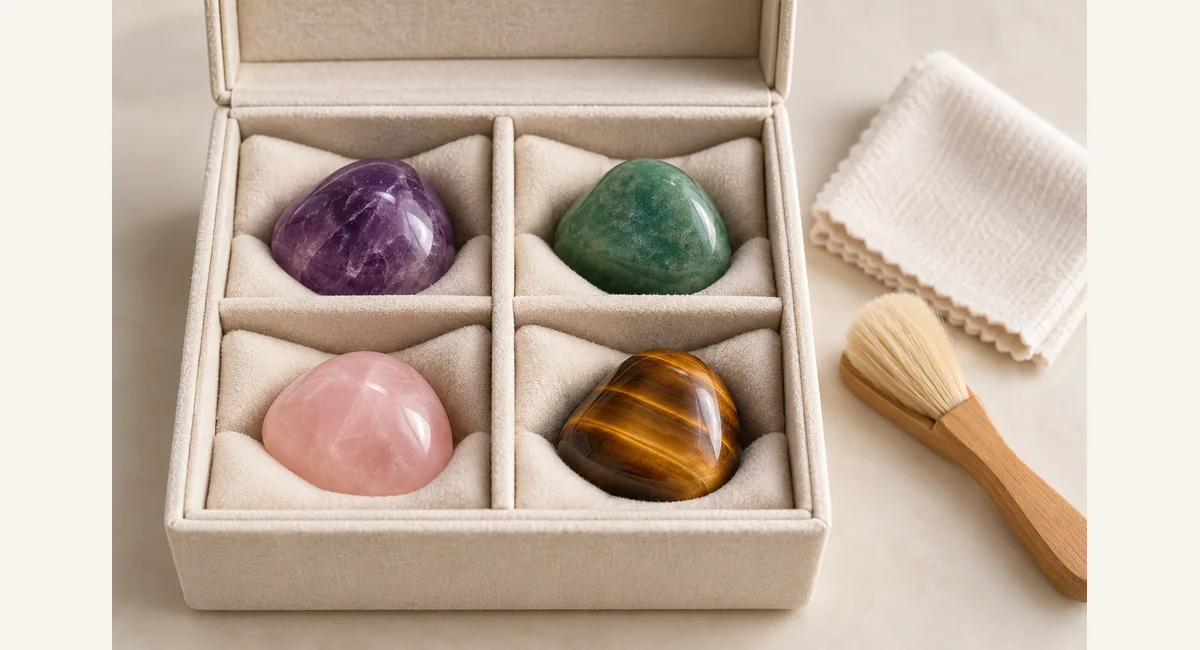
6. Design a storage box that actually protects the collection
Use a rigid box with a well-fitting lid, removable soft inserts and individual labelled cells. A clean neutral interior helps reveal dust, small chips and missing specimens. Do not let gemstones roll in one unpadded compartment: even two stones of the same material may strike each other when the box is moved.
Store by a combination of material, treatment and contact risk, not just by spiritual intention. It can be convenient to group all “prosperity stones” in one tray for display, but it is better to protect a pyrite sample and a soft fluorite sample separately when storing them. Put the direction or purpose on a removable label; do not sacrifice physical protection merely to keep a symbolic layout assembled while travelling.
| Storage zone | Suitable contents | Separation rule |
|---|---|---|
| A. Hard quartz-family tumbles | Quartz, agate, carnelian and jasper | One pocket per piece; prevent repeated collisions and preserve treatment labels. |
| B. Softer and cleavable stones | Fluorite, moonstone, labradorite, howlite | Thicker padding and no contact with quartz, tools or heavy pieces. |
| C. Porous, coloured or treated stones | Dyed howlite, many opaque gems and coated pieces | Keep dry; retain batch details and avoid packaging that stains or sheds dye. |
| D. Moisture-sensitive specimens | Pyrite and any identified sensitive mineral | Dry, separate location; check periodically for deterioration and humidity. |
| E. Display and ritual accessories | Labels, cloths, yantra cards, trays and dividers | Keep incense ash, fragrance, oil, water containers and metallic accessories away from loose stones. |
Use inert, soft packing where possible and change worn foam or dusty fabric. A cotton pouch is useful for one robust stone; for fragile, heavy or many mixed stones, padded rigid cells are more protective. Avoid placing valuable pieces directly against rough wood, jewellery chains, coins or metal bowls during transit.
7. Humidity, sunlight and indoor display: what matters in India
In Bengaluru and other Indian cities, storage conditions can change during the monsoon, air-conditioning cycles and shop cleaning. A closed cupboard is not automatically dry, and a glass-front display is not automatically protected from sunlight. Choose a stable indoor location and inspect after humid periods.
Pyrite needs particular humidity care. Museum-conservation guidance identifies pyrite oxidation as a serious risk at elevated relative humidity and commonly recommends keeping susceptible specimens in a dry environment around or below 45% relative humidity. That number is a preservation benchmark for pyrite—not a universal humidity target for every kind of stone or mineral specimen. A simple humidity indicator can help a professional kit manager spot an unsuitable store room. If a specimen already shows active alteration, separate it and seek appropriate guidance.
Prolonged bright sunlight and sudden heating can also affect some mineral colours, coatings, adhesives and packaging. Keep bright display lights at a sensible distance, use a shaded shelf rather than a hot windowsill, and avoid moving cold stones directly to a heated surface. Re-examine pastel and coloured samples against their original photograph if they have been on display for months.
8. Home Vastu, puja, meditation and physical gemstone care
In Vastu Shastra, the arrangement of an interior may be considered through the directions, Pancha Mahabhuta (five elements), centre or Brahmasthana, function of the room and the household's customary practices. Modern arrangements of coloured tumbled stones often add symbolic associations: Sphatik for clarity, rose quartz for affection, carnelian for activity, and dark stones for grounding. Such colour-based crystal layouts are contemporary applications rather than a single classical prescription for every stone.
Traditional terms such as shuddhi (purification), pavitrikaran (ritual sanctification) and Sankalpa (a consciously stated intention) concern the purpose of worship or practice. They should not be confused with abrasive or chemical cleaning of a mineral surface. Someone may prepare a meditation shelf through tidying, a short prayer, mantra-japa, quiet attention, respectful handling and arranging the appropriate stones, without immersing the objects in liquid.
Where a tradition calls for Ganga jal, milk, flowers, sandal paste, kumkum, incense or another offering, consider the ritual arrangement separately from contact with a sensitive mineral. An offering can be made in a separate vessel or in front of a labelled stone, rather than placing unknown material directly into liquid or ash. The correct form for a specific puja or consecrated object depends on the family's practice and the object, especially if it is a formal Yantra, Vigraha or other worship item rather than a casual gemstone specimen.
Suggested care routine before a Vastu or meditation session
- Choose stones for a stated purpose and check their labelled identities.
- Clean the shelf and place a clean, dry mat or tray in the selected area.
- Dust the stones gently and inspect for changes; keep damaged specimens aside.
- Arrange the stones by direction, element, colour or the practitioner's recorded plan.
- Begin prayer, mantra, breath awareness or Sankalpa according to the personal tradition; keep open flame, burning incense and liquids separate from minerals and labels.
- After use, count the stones and return each to its own protective cell.
9. Worked example: maintenance of a 16-stone Vastu demonstration kit
Consider a professional demonstration kit containing 16 tumbles: two samples for each of the eight directions. The paired stones make it easy to discuss colour symbolism, material diversity and alternative layouts; they do not imply that Vastu requires these exact stones for every house.
| Directional teaching zone | Illustrative pair | Care note for the kit manager |
|---|---|---|
| North (Uttara) | Green aventurine and moss agate | Keep separate labelled pockets, noting any dyed material. |
| North-east (Ishanya) | Clear quartz and amethyst | Pad separately, especially when travelling with softer stones. |
| East (Purva) | Carnelian and sunstone | Inspect feldspar sunstone for chips; do not treat as identical to carnelian. |
| South-east (Agneya) | Red jasper and tiger eye | Dust gently; avoid polishing compounds in the teaching tray. |
| South (Dakshina) | Smoky quartz and garnet | Protect from impact; retain exact gemstone identification. |
| South-west (Nairritya) | Black tourmaline and hematite | Prevent collisions and keep heavy pieces in low, secure pockets. |
| West (Pashchima) | Lapis lazuli and sodalite | Use gentle dry care for opaque composite or treated specimens. |
| North-west (Vayavya) | Moonstone and labradorite | Pad both feldspars against cleavage-related chips. |
Label the cells N1–N2, NE1–NE2 and so on. On the work table place the pairs in a directional diagram with north clearly marked. After discussion, move the stones back from the outer circle to their numbered cells; this prevents the two north-east stones, for example, from being swapped with aesthetically similar pieces from another set. The important lesson is that display position and storage position need not be identical.
10. Worked example: jewellery showroom and retail handling
A showroom may allow customers to examine tumbled stones closely. Use an assisted handling tray so a prospective buyer does not place multiple samples on a hard glass counter. Present one specimen at a time, retain its label nearby and ask visitors to put it back on the pad rather than dropping it into a common bowl.
For a mixed display of amethyst, moonstone, fluorite, obsidian and pyrite, designate a fixed compartment for each. Keep cleaning spray off the gemstones while wiping the glass cabinet, and never spray over the open tray. A staff member should inspect the displayed stones at opening and closing, especially after customers have handled them. Keep treated-gemstone notes accessible so a dyed sample is not described as untreated merely because it resembles a different stone.
If a pebble falls, do not immediately place it back in the sale tray. Check for newly sharp edges and photograph it beside its item code. Replace the sale sample if its appearance has changed; keep a condition note for any stock transfer or customer return. The retail process protects customer confidence as well as mineral surfaces.
11. Worked example: packing a meditation kit for a house visit
Suppose a consultant carries nine stones for a simple meditation discussion: clear quartz, rose quartz, amethyst, carnelian, green aventurine, smoky quartz, tiger eye, moonstone and black tourmaline. A single cloth pouch is convenient but allows rubbing and impacts. A compact nine-cell box, each cell lined and labelled, is more reliable.
Carry the box flat, protect it from rain and avoid leaving it in a parked vehicle in strong heat. At the client's home, lay out one cloth, unpack the nine specimens in order and keep the box below or beside the tray so the labels remain available. Before leaving, count the nine stones, check for chips and return them in the same sequence. This is especially useful when a consultant serves several households in a day or uses stones as educational aids during a Vastu visit.
12. A monthly and seasonal maintenance schedule
| Frequency | Actions | Record to keep |
|---|---|---|
| Before and after each session | Count, inspect, dust and restore each specimen to its compartment. | Number of stones, missing or damaged items, operator. |
| Monthly for active kits | Check for surface changes, unstable labels, foam wear and cabinet moisture. | Condition notes and replacement priorities. |
| After transport or a drop | Look for chips, fractures and damaged packing; isolate affected pieces. | Photographs and incident note. |
| During humid or monsoon periods | Review storage dryness and check pyrite or other sensitive pieces more closely. | Date, observed humidity if monitored, any altered specimens. |
| At annual stock review | Confirm stone names, supplier descriptions, treatments and replacement needs. | Current inventory, label revisions, supplier or batch details. |
A simple condition record might read: “Kit V08; 16 of 16 pieces present; NE2 amethyst intact; NW1 moonstone minor edge nick photographed; pyrite stored separately and dry; reviewed 4 November 2026.” This type of note is more valuable than a vague declaration that all stones have been “cleansed” without checking whether they are still physically sound.
13. Frequently asked questions
Can all tumbled gemstones be washed together?
No. A mixed batch can include moisture-sensitive pyrite, soft fluorite, porous or dyed stones, and quartz-family specimens. Sort and identify the pieces first. Dry dusting is a good baseline; any additional cleaning should follow the material and treatment.
Is keeping a gemstone under running water necessary for Vastu?
There is no universal rule requiring every modern tumbled-stone arrangement to be rinsed in water. A clean shelf, careful handling, prayer or Sankalpa can form part of the chosen practice without exposing vulnerable minerals to moisture.
Can I use salt, incense ash or essential oils to cleanse stones?
These can leave deposits, react with surfaces or affect treatments. Use them as part of a separate ritual setting where appropriate rather than applying them directly to an unknown specimen.
Why did a polished stone become dull?
Possible causes include abrasion, trapped grime, a deteriorating coating or a different appearance under lighting. Identify the cause before attempting polish; repeat rubbing can make the damage worse.
Should I store stones according to Vastu directions?
A decorative or meditation display may follow an intentional directional layout. Long-term storage should prioritise material protection, accurate labelling and a suitable environment; the display can be reassembled for a session.
How do I care for pyrite in the monsoon?
Keep it in a dry, separate container, avoid wet cleaning and monitor for deterioration. A sensitive or visibly changing specimen deserves more attention than an ordinary quartz tumble.
14. Final checklist for a lasting gemstone collection
Identify → inspect → dry-clean → protect → label → record → display with intention → put away individually. For a household, this is a manageable care ritual. For a professional Vastu or gemstone business, it becomes a repeatable quality-control process that protects the specimens and makes consultations more reliable.
Remember the difference between mineral preservation and traditional spiritual observance. Both can be respected without treating a delicate mineral as if it were an ordinary household utensil. The best tumbled-stone collection is one in which the correct stone remains identifiable, its condition is understood and its intended use is clear.
Continue reading
- Fluorite, Malachite and Other Delicate Tumbled Minerals
- Pyrite Tumbled Stones: Identifying Material and Safe Care
- How to Pack and Ship Tumbled Stone Sets Safely
Explore the existing Vastu and gemstone collections for wider context.
Explore the materials and sets
- Meditation Tumbled Stone Set
- Amethyst Tumbled Stone
- Smoky Quartz Tumbled Stone
- Carnelian Tumbled Stone
- Red Jasper Tumbled Stone
- Black Tourmaline Tumbled Stone
- Black Obsidian Tumbled Stone
- Pyrite Tumbled Stone
- Amazonite Tumbled Stone
- Moonstone Tumbled Stone
- Fluorite Tumbled Stone
- Moss Agate Tumbled Stone
- Botswana Agate Tumbled Stone
- Rhodonite Tumbled Stone
- Malachite Tumbled Stone