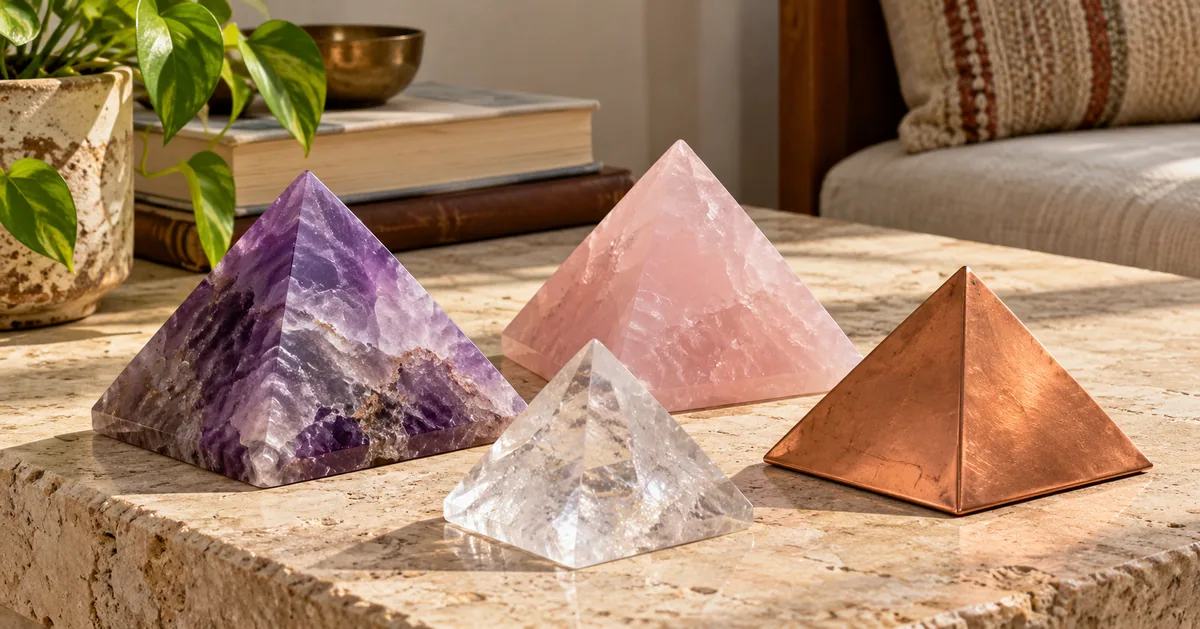
A Vastu pyramid collection may look like one family of objects, but the material inside each carving determines how it should be cleaned and stored. A polished Sphatik (clear quartz) pyramid, a soft satin spar gypsum pyramid, a water-soluble rock salt pyramid, a metallic pyrite pyramid, and a lacquered copper or brass pyramid cannot safely be treated with the same liquid, cloth, polish or ritual washing. The wrong routine can dissolve an edge, dull a surface, loosen a repair, strip a symbol or create corrosion.
This practical guide explains how to clean, handle, store and pack gemstone and metal pyramids, whether you have one decorative piece on a puja shelf, a set of crystals for Vastu, or dozens of samples in a professional consultation kit. It combines material identification, gentle care, protective packaging and the traditional contexts in which these objects are displayed. If you do not know the material, begin with dry, minimal handling and do not experiment with water or chemicals. Appearance alone is not enough to choose a treatment.
1. First identify what the pyramid is actually made from
A retail pyramid describes a shape, not a mineral. It might be carved from a single stone, cut from a mixed rock, cast in resin, assembled from joined sections, fabricated in sheet metal, or made with a glass or painted finish. Some examples have engraved Om symbols, gilded patterns, glues, metal bases or colour treatments. For care purposes, these added layers can be more vulnerable than the underlying stone.
Before cleaning, read the product description and ask three questions: what is the body material, what surface treatments are present, and is the object sound? If the answer is uncertain, do not infer “quartz” from a glossy surface or assume a gold-coloured piece is brass. A seller's trade name such as “onyx”, “selenite” or “jade” can refer to different materials, so a useful label should give a specific composition where known.
| Material or construction | What to confirm before cleaning | Main risk |
|---|---|---|
| Clear quartz, rose quartz, amethyst or smoky quartz | Quartz identity; coatings, fractures, fillings | Chipped points, loosened fillings, heat or light damage to some colours |
| Agate, jasper, carnelian or bloodstone | Chalcedony/rock identity; dyes, repairs | Dyes, weak seams and scratched polish |
| Calcite or fluorite | Mineral identity, cleavage, condition | Acid etching, scratch or cleavage fracture |
| Gypsum (often sold as satin spar or “selenite”) | Fibrous or crystalline gypsum, untreated finish | Scratching, moisture deterioration and fibre damage |
| Rock salt/halite | Salt body, protective coating if any | Dissolution, dampness and surface sweating |
| Pyrite | Solid or composite pyrite-bearing material | Moisture-driven oxidation and powdering |
| Copper or brass | Bare, lacquered, waxed, patinated or plated | Tarnish, corrosion, coating or engraving loss |
| Obsidian and glass | Natural volcanic glass vs manufactured glass | Sharp chips and conchoidal fracture |
| Painted clay, terracotta, resin or joined pieces | Firing, pigments, adhesive and assembly | Porosity, lifting paint, swelling or adhesive failure |
The three physical words worth learning are hardness (resistance to scratching), toughness (resistance to breaking), and stability (resistance to changes caused by heat, light or chemicals). A hard quartz pyramid can still chip at its apex. A soft gypsum carving can look perfectly glossy but scratch during an ordinary wipe. An attractive metal patina may be an intended finish rather than dirt.
2. A safe five-minute inspection before any cleaning
Work over a clean, padded, well-lit table. Photograph all four faces, the top and the underside; those records are especially useful for a shop, a professional kit or an item being prepared for shipping. Inspect without repeatedly rotating a delicate piece in bare hands. Use the base for support and observe edges, grooves, engraved lettering, joints and any metal fittings.
Look for loose grains, flaking paint, cracking, white crystalline deposits, sticky glue, green-blue copper corrosion, rust-coloured patches or fresh powder near pyrite. An enclosed inclusion is not automatically a defect: an open, unstable fracture is a different condition. Do not mistake every natural vein for a crack, or every patina for damaging corrosion. If a surface is already shedding material, stop cleaning and isolate the object for assessment.
| Observation | What it might mean | Immediate action |
|---|---|---|
| Fine dust that lifts without force | Normal settled room dust | Remove gently with a clean, soft dry brush |
| Grit near a polished face | Abrasive particles | Lift grit before wiping; never rub it across a face |
| A loose apex or visible open crack | Impact damage or failed repair | Stop handling and protect fragments |
| White blooms on a salt piece | Surface change from humidity or residues | Keep dry; do not brush aggressively or rinse |
| Powder and cracking on pyrite | Possible active deterioration | Separate from other specimens; seek qualified advice |
| Green deposits on brass or copper | Possibly corrosion or intentional patina | Check origin and activity before any polishing |
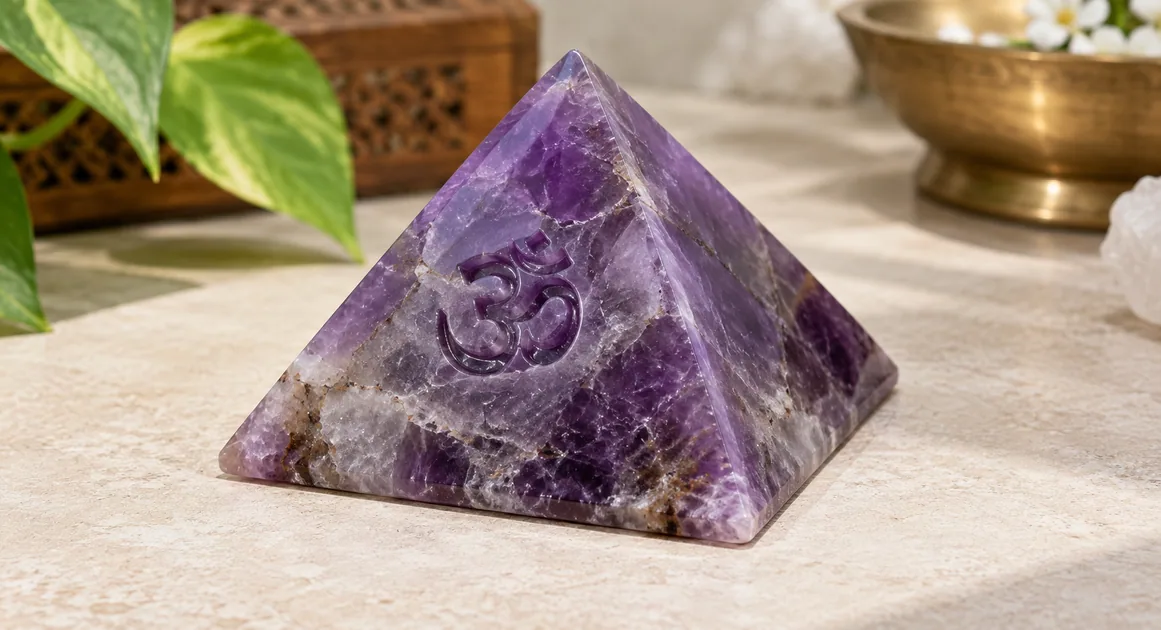
| Paint coming away from Om engraving | Vulnerable decoration or coating | Avoid moisture and friction in the groove |
3. The default cleaning method: remove dust, not surface material
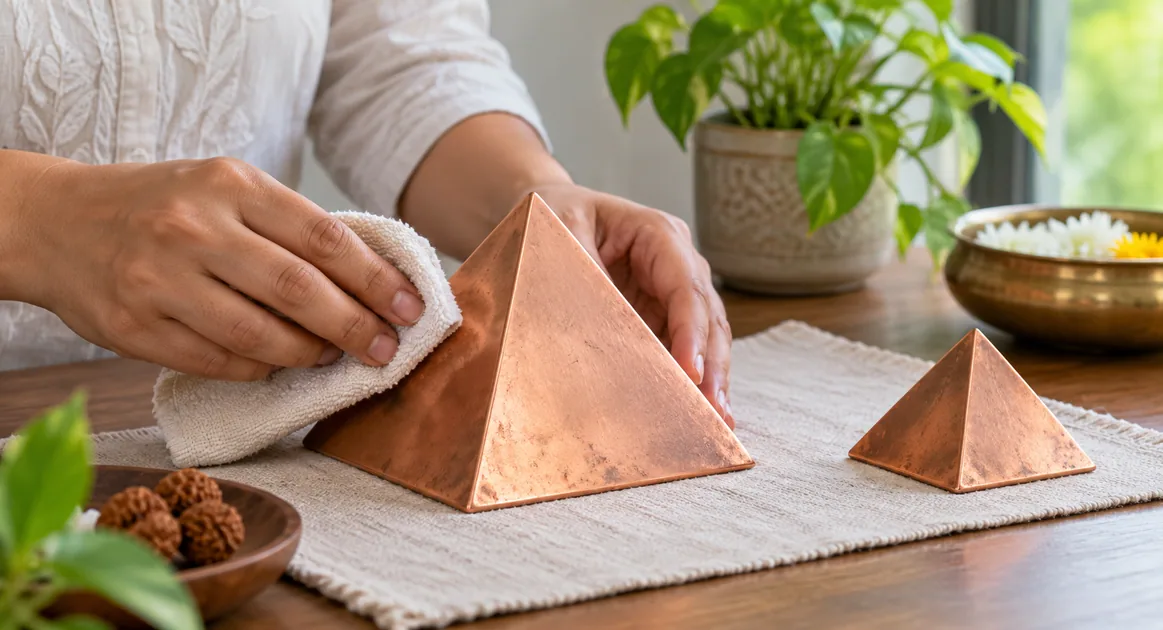
For a stable but unidentified pyramid, a careful dry clean is the best first intervention. Put a clean cloth or inert soft pad under the object; hold it securely by the base. Use a dedicated, clean, very soft brush to lift loose dust away from the apex and engraved recesses. A soft lint-free cloth can then pick up residue from a sound, smooth area with almost no pressure. Replace the cloth when gritty. The objective is not to make every surface look newly polished but to remove loose household dust without changing the finish.
Avoid scrubbing an exposed chipped edge, polishing a coated symbol, or digging into cracks with a metal implement. Do not use a toothbrush merely because it is available: even moderately stiff bristles and trapped grit can scratch delicate gypsum, paint, soft stone or lacquer. A very soft artists' brush used with light pressure is safer for such details. If dust cannot be removed without abrasion, leave it until the material is identified.
A brief damp wipe is not a universal upgrade from dry care. Water can dissolve rock salt, harm the finish of gypsum, promote pyrite deterioration, reach unseen joins or leave spots on metal. Likewise, compressed-air blasts may dislodge weak grains or spread unknown powder. Never use a steam jet, ultrasonic jewellery cleaner, bleach, toilet cleaner, acid, vinegar, lemon, saltwater soak or abrasive kitchen scrub as an all-material ritual.
4. What about water and mild soap on hard quartz?
Sound, untreated quartz varieties—clear quartz or Sphatik, rose quartz, amethyst and smoky quartz—are comparatively resistant to mild cleaning. A short, controlled wipe with a slightly damp soft cloth, sometimes with a little mild soap followed by residue removal and complete drying, may suit a known, solid, uncoated carving. Even here, inspect for resin-filled cracks, painted symbols, adhesives, drilled fittings or unknown surface treatments first. Never assume the entire pyramid can safely be submerged just because quartz itself resists water.
Keep temperature moderate. Avoid sudden hot-to-cold changes, direct heat and steam. Some amethyst or rose-coloured materials may lose colour after strong prolonged light exposure, while treated stones may have their own sensitivities. An amethyst pyramid displayed in a hot glass window should be moved to more suitable lighting before any cleaning routine is planned. A small microfibre cloth is useful only when its fibres are clean; gritty cloths become abrasives.
Sphatik for puja deserves an additional distinction: a polished quartz carving used decoratively beside an altar is not automatically subject to the same bathing procedures as a consecrated Sphatika Lingam or a family murti. Follow the chosen devotional practice, but recognize the actual materials and especially any attached paint, metal or glue. When unsure, a clean dry surface and respectful handling are better than imposing a damaging liquid ritual.
5. Chalcedony, agate, jasper and carnelian: watch the treatments
Agate, carnelian, many jaspers and other chalcedony-rich carvings are commonly durable for ordinary household display. However, the trade name may not identify every component: a mixed rock can include veins or softer patches, while stones may be dyed, sealed, assembled or stabilized. Strongly saturated blue, green or purple agates sometimes owe their colour to treatment, and solvents or vigorous rubbing may affect a particular finish.
A sound, confirmed untreated object usually requires little beyond dry dusting; a minimal damp clean can be considered only after checking the actual item. Do not attempt an acid, heating or scratch test on a saleable pyramid to authenticate a stone. Compare all faces, note exposed joins, and keep the material label with the piece. Bloodstone is a type of green chalcedony with red markings; the red appearance does not make it a metal that needs anti-rust products.
| Quartz-family example | Ordinary display care | Extra consideration |
|---|---|---|
| Clear quartz / Sphatik | Soft dry cloth; controlled mild damp wipe if verified sound | Check internal cracks, engraved paint and joins |
| Rose quartz | Gentle dust removal, shaded stable shelf | Avoid unnecessary strong sunlight or heat |
| Amethyst | Soft cleaning with no heat shock | Some purple material may fade in strong light |
| Smoky quartz | Dust lightly; protect pointed edges | Ask about colour treatment rather than trying household tests |
| Agate or carnelian | Usually dry wipe sufficient | Confirm dyes and coated surfaces |
| Jasper or bloodstone | Gentle clean of a sound surface | Do not assume all coloured veins have identical durability |
6. Calcite, fluorite and other vulnerable stone pyramids
Orange calcite can be mistaken for carnelian by colour, but calcite is much softer than quartz and reacts with acids. Do not use lemon juice or vinegar to “brighten” its faces. A polished calcite point can chip or scratch when pressed against a hard tray or a neighbouring quartz specimen. Choose a soft brush and padded individual storage, and keep wet cleaning to the minimum justified by the identified condition.
Fluorite is also relatively soft and has pronounced cleavage: it may break along crystallographic planes even when the exterior polish seems smooth. Its colourful zones do not protect it against a fall. Avoid ultrasonic vibration, steam, sudden heat and force applied to the point. A fluorite pyramid in a mixed consultation kit belongs in its own compartment; a loose tiger-eye or quartz pyramid beside it can cause scratches or impacts during transport.
For lapis lazuli, turquoise, malachite, jade-like stones and treated mixed-mineral pieces, assess porosity, wax, oil, resin and dye. Some lapis carvings receive wax or colour enhancement. A polished appearance does not justify aggressive solvent cleaning. If you are uncertain whether a decorative carving has been filled or stabilized, use a dry cloth and request appropriate material-care information from the seller.
7. Satin spar gypsum, “selenite” and rock salt: water is the wrong shortcut
White fibrous satin spar gypsum is widely sold as “selenite,” although that trade usage should be distinguished from transparent selenite gypsum. Both are gypsum, a soft calcium-sulfate mineral, and are not equivalent to hard quartz. Fibrous satin spar may acquire scratches or lose edge detail through rough brushing. Long exposure to water or moisture is undesirable; never soak, steam, saltwash or rub the surface with gritty powder.
Rock salt pyramids are usually made from halite, sodium chloride. Halite dissolves in water and may show moisture-related surface change in humid conditions. A rock salt pyramid kept near a bathroom basin, kitchen sink, damp planter or unventilated window can lose crisp edges. Do not try a water wipe to remove its “white bloom.” Move the piece to a dry stable display, avoid direct contact with absorbent papers if sweating is occurring, and seek specialist advice if valuable.
A salt object and a metal object should not share an unprotected storage compartment. Salt residue plus moisture can accelerate corrosion on susceptible metals. Similarly, do not position a gypsum or salt pyramid directly underneath a hanging planter or beside a water-filled ritual vessel. The object can still carry traditional symbolism when it is stored and displayed dry.
8. Pyrite: dry care is a condition-control decision
Pyrite, iron disulfide (FeS₂), is prized for its brassy metallic appearance. It is not gold, and a pyrite-bearing carving may include other minerals, seams or binding material. Certain pyrite specimens oxidize under moist conditions, leading to powdery residues, cracking and acidic by-products. That is why a pyrite pyramid should not be soaked, washed in salt water or parked beside damp decorative arrangements.
Look periodically for fresh powder, flaking, expanding cracks or unusually sharp odours and residues. Do not attempt to polish away suspected active deterioration with kitchen chemicals. Move an affected specimen away from adjacent metal, paper labels, textiles and other mineral pieces; avoid breathing or dispersing loose powder and obtain conservation or mineral-specialist guidance. A sealed container is not automatically safe if moisture becomes trapped inside it. For vulnerable pyrite, humidity control and appropriate monitored storage matter more than making the face shine.
The Canadian Conservation Institute notes that some pyrite specimens can deteriorate when relative humidity is high, and their acidic by-products can damage adjacent objects and labels. This is a mineral-specific precaution, not a claim that every pyrite carving is already unstable. Record how the object looks over time instead of assuming that golden colour alone proves sound condition.
9. Copper and brass pyramids: distinguish tarnish, patina and coating
Copper is a reddish metal; brass is a copper-zinc alloy usually yellowish. Both may be used in hollow, sheet-metal, open-frame, engraved, layered or joined Vastu pyramids. Their surfaces may be polished bright, intentionally darkened, varnished, lacquered, painted, plated or protected with wax. Do not polish away a finish simply because it has changed colour. Tarnish may be stable, while a decorative patina or painted Om may be deliberately applied.
Start with soft dry dusting and minimal bare-hand contact. Clean cloths or gloves reduce fingerprints and transferred salts. If the piece has lacquer, engraving or gold-coloured paint, an all-purpose metal polish may strip or scratch it. Abrasive polishing removes a little surface metal and can soften fine detail. Acids, ammonia-containing products, lemon-salt paste and aggressive commercial polish are particularly poor choices for mixed brass, glued constructions or unknown coatings.
| Metal surface | What to do | What to avoid |
|---|---|---|
| Uncoated polished copper | Lightly dust, support base, follow verified care guidance | Unnecessary repeated abrasive polishing |
| Lacquered copper or brass | Dry soft cloth; protect the lacquer and edges | Solvents, harsh polishes and vigorous rubbing |
| Intentionally patinated metal | Preserve chosen colour and finish | Automatically removing darkening as “dirt” |
| Engraved, printed or gilded Om | Dust the recess carefully | Acids, paste packed into grooves, scrubbing |
| Hollow or multi-layer metal pyramid | Inspect joins and dry the surroundings | Immersion, liquid trapped inside, squeezing thin walls |
| Piece showing active corrosion | Separate and seek appropriate assessment | Casual polishing that conceals ongoing damage |
Copper or brass placed near a diya needs heat and fire clearance. Never put a pyramid in a flame path simply because the object itself is metallic; any lacquer, solder, glue, plastic or wooden base may be heat-sensitive. In a shop, label the metal and its finish so that routine cleaning staff do not unknowingly apply a harsh polish.
10. Obsidian, glass, resin and assembled pyramids
Black, snowflake and mahogany obsidian are varieties of natural volcanic glass; they may form sharp conchoidal chips when broken. A polished obsidian surface is not evidence of a stone that will survive a fall. Carry it from below, inspect any chipped edges, and use separate padding rather than allowing it to knock against another carving. Do not run a finger along a damaged edge to “test” sharpness.
Manufactured glass pyramids can have similar impact hazards. Resin pieces and reconstructed gemstone composites have different vulnerabilities: heat may soften or deform a polymer; solvents can cloud certain finishes; adhesives may fail at seams. A material described as “natural gemstone powder pyramid” can be a composite with a binder, not a solid block of the named mineral. Its cleaning guidance should reflect the binder and any metallic paint as well as the mineral particles.
For a joined copper-crystal pyramid, treat it according to its most vulnerable component. Even if the quartz can tolerate a damp cloth, the adjoining adhesive, brass strip, gilding or painted symbol might not. Do not use mechanical vibration, immersion or heat as a convenient shortcut. If a join is loosening, do not repair it impulsively with an unidentified household adhesive that could stain the adjacent stone.
11. Clay, terracotta, painted symbols and decorative finishes
A fired terracotta pyramid is not identical to unfired or air-dried clay. Porous fired ceramic may absorb water, while unfired material can soften or lose detail when wet. Painted sacred symbols, gold-coloured accents, varnishes and adhesives can introduce additional sensitivities. Dry dusting with a very soft brush is the sensible default until firing and finishes are known.
If a clay pyramid is displayed near a doorway for Vastu-inspired décor, give it a stable, shaded position away from splashes and repeated handling. A glaze may protect part of a ceramic object without making a cracked or unglazed underside water-proof. An incised Om is not the same as a surface-painted Om; brushing into a fragile paint layer can remove the design. Never use acidic descalers to “clean” terracotta mineral deposits.
12. Ritual purification: preserve the practice and the material
In Indian devotional life, Shuddhi, Sankalpa, Puja, Dhyana, Mantra Japa, offering flowers and maintaining a clean altar can all be meaningful parts of a spiritual routine. Yet the idea that every Vastu pyramid must be bathed in salt water, Ganga jal, milk, oil, turmeric or incense smoke is not a universal material-care rule. Different families and teachers follow different practices, and modern gemstone pyramid products are not identical to consecrated temple objects.
When the material is gypsum, salt, pyrite, painted clay, coated metal or a joined composite, pouring water or liquids over it may damage it. A respectful dry cleaning, clean cloth, orderly altar, symbolic offering, or placement beside rather than inside a liquid ritual can preserve both the intention and the object. Keep water vessels and flowers from touching moisture-sensitive pyramids. Avoid letting diya oil, kumkum paste or incense ash accumulate on carved surfaces where they are difficult to remove.
A customer may use a Sankalpa of clarity, harmony, prosperity, disciplined effort or protection according to the tradition followed. Physical condition, material authenticity and suitability for a home or puja shelf should still be described accurately. A polished surface is not proof of spiritual status, and the risks of soaking a rock salt pyramid remain physical facts regardless of the sincerity of the ritual.
13. Vastu placement and Pancha Mahabhuta without damaging the collection
Pancha Mahabhuta—Prithvi, Jala, Agni, Vayu and Akasha—offers a traditional language for reflecting on material and spatial balance. Ashta Dik brings the eight directions and their associations into Vastu discussion. Contemporary practitioners may place Sphatik or amethyst near a quiet Ishanya (north-east) puja or meditation corner, a copper pyramid on a study shelf, or pyrite in a business-oriented display tied to Lakshmi or Kubera symbolism. These are tradition-dependent practices, not an instruction to ignore material care.
Choose a location using two tests. First, does it fit the family's actual purpose—puja, meditation, professional demonstration or décor? Second, is it safe for that material—stable support, no direct splash, controlled light and no heat source? If the desired compass corner is a wet kitchen counter or a sunny window ledge, relocate the item to a safer nearby position instead of accepting damage as part of placement.
Jyotish should remain conceptually distinct. A decorative Navagraha-themed set or a stone selected by colour for a Vastu kit is not automatically the same as an individual prescription based on Kundali, Graha strength, Dasha, Rashi and Lagna. Keep the product label and practical care clear; don't assign a special planet to every mineral just to fill a table. For professional practice, explain whether a correspondence is traditional to a particular school or a modern association.
| Setting | Traditional intention | Material-care decision |
|---|---|---|
| North-east puja shelf | Ishanya, Shanti, Sankalpa | Protect from diya flame, wet vessels and ash |
| Office desk or reception | Focus, disciplined work or auspicious display | Keep away from coffee spills, edges and cable tangles |
| Business display for prosperity | Lakshmi/Kubera symbolism in modern practice | Keep pyrite and metals dry; protect customer-accessible corners |
| Meditation area | Dhyana, contemplation and regular practice | Avoid floor impact and prolonged direct sun |
| Vastu consultant's demonstration kit | Explain materials, directions and comparisons | Use labelled separate compartments and consistent records |
| Gift packaging | Blessing, good wishes and presentation | Include real material name and individual care instructions |
14. Handling: move the base, not the point
A pyramid's apex concentrates pressure. Never lift a heavy carving by its tip, squeeze a hollow metal roof or pull a layered pyramid from a tight box by one triangle. Support the full base with a hand, cloth sling or properly fitted tray. For a large or weighty stone, use both hands and clear the destination surface beforehand. Place each object down gently; even a small drop onto tile may produce a chip that travels through a translucent face.
When working with several pieces, set one object down before picking up the next. Do not let quartz rest against calcite or fluorite, nor stack heavy stone on lightweight sheet metal. For a showroom, provide a mat where the customer may see all four faces without repeated lifting. For children or high-traffic areas, keep pointed stones out of accidental reach and secure any taller displays against tipping.
If a point chips, collect fragments without touching a sharp edge. Photograph the damage, retain loose pieces for a qualified repair assessment and update the item's condition record. An attempt to hide a chipped apex with coloured polish changes the product and can make subsequent care harder.
15. How to pack a single pyramid for storage or courier delivery
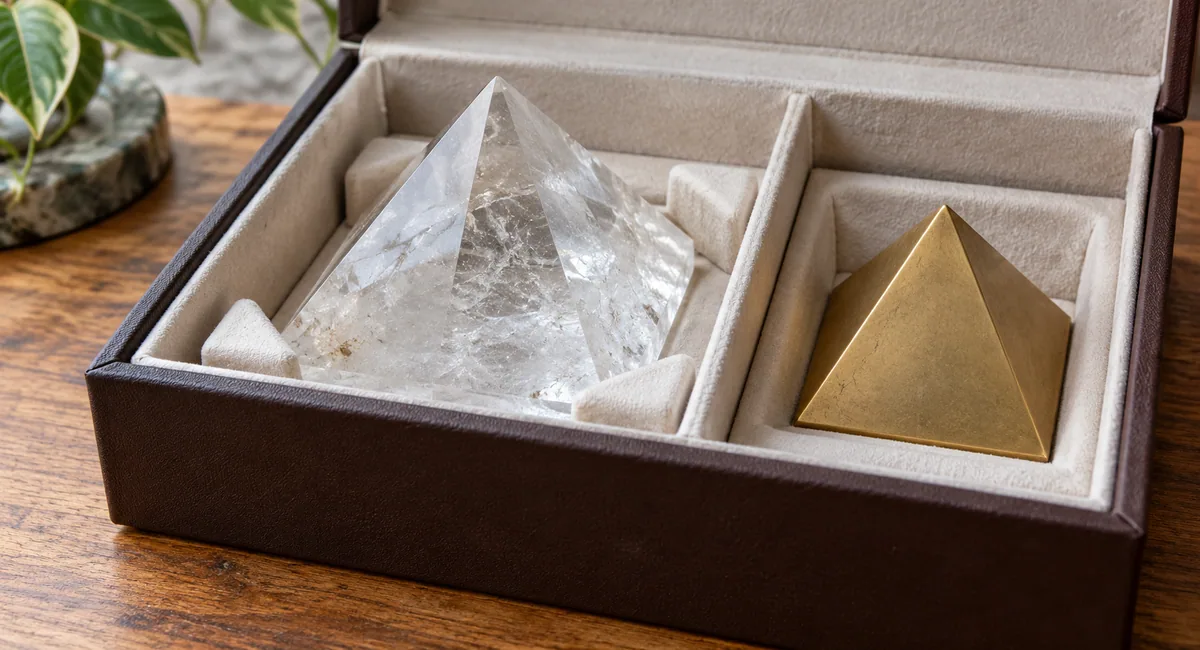
Immobilization and apex protection are the two priorities. Start with a sound, dry object and a clean, suitably sized rigid box. Use soft non-abrasive wrapping or inert cushioning around the base and sides. Make a protective cavity that leaves room around the apex; pressure must transfer through the stronger base and side supports, not through the point. Avoid wrapping thin adhesive tape directly onto a polished mineral, lacquered face or engraved symbol.
The inner box should prevent the piece from rotating or sliding; the outer box needs additional padding against impacts. A heavy pyramid requires cushioning appropriate to its weight and box strength. Very delicate, large or valuable objects may need fitted foam supports, double boxing or professional packing rather than ordinary bubble wrap alone. Loose packing peanuts are unreliable if they allow dense stone pieces to migrate together in transit.
| Packing layer | Preferred function | Common error to avoid |
|---|---|---|
| Clean inner wrap | Prevent surface rubbing or marks | Rough printed paper touching delicate finish |
| Shaped base support | Carry weight without stressing the point | Pushing foam hard against the apex |
| Individual cell or box | Stop movement and object-to-object strikes | Several pyramids rolling together |
| Rigid outer carton | Resist compression and ordinary handling | Oversized weak box with too little support |
| Extra side cushioning | Absorb shocks at corners and faces | Heavy object against the carton wall |
| Material label | Retain care and identity information | Generic “crystal” label for salt, pyrite and gypsum |
| Dry packing state | Limit trapped moisture or staining | Sealing a damp or freshly washed object |
16. A professional Vastu kit: create a numbered care register
A professional set might contain quartz, aventurine, agate, obsidian, hematite, copper, brass, pyrite, gypsum and rock salt. Give each item a distinct number, material name, dimensions, any known treatment, condition and specific cleaning restriction. A small record card can also list the intended Vastu discussion or planetary association without confusing it with a mineral identification report.
Plan compartments by vulnerability, not by colour alone. Keep rock salt away from metals, pyrite from sensitive paper and metal objects if instability develops, soft fluorite from harder quartz, and painted or joined structures away from rubbing surfaces. A display label should not touch a damp salt face or an actively deteriorating pyrite specimen. Use stable supports, and avoid materials that shed foam, stain or release strong odours into closed cases.
| Register field | Example entry | Why it matters |
|---|---|---|
| Item code | KIT-07 | Connects photograph, care note and storage cell |
| Material | Fluorite, not generic “green crystal” | Prevents quartz-style cleaning mistakes |
| Construction | One-piece carving; open edge seam noted | Flags vulnerable areas |
| Surface finish | Polished; treatment not verified | Advises conservative cleaning |
| Condition | Small pre-existing chip near base | Establishes baseline before transport |
| Care rule | Dry brush only; avoid impact and steam | Guides staff and recipients |
| Traditional interpretation | Directional teaching sample | Keeps practice separate from mineral classification |
| Last inspection | Date, condition and responsible person | Reveals emerging deterioration |
17. Bengaluru weather, monsoon storage and high-humidity rooms
In Bengaluru homes and shops, rainy-season conditions can introduce local dampness even when an entire building feels comfortable. Air-conditioned showrooms may be dry during operating hours but more humid when closed; condensation can develop near cold windows, walls or enclosed storage. Rather than relying on a citywide seasonal assumption, use a simple hygrometer near your actual storage unit and check for damp corners after rain.
A moderate, stable environment suits many mixed collections, but vulnerable pyrite and certain metals may need tighter control than ordinary quartz. The Canadian Conservation Institute notes particular RH sensitivity for pyrite and moisture-driven corrosion of metals. Do not turn those collection guidelines into an invented universal target for every retail item. If using silica-gel desiccant, monitor and maintain it properly; a desiccant packet in an unsealed damp box is not automatic protection.
Never pack a freshly wiped object while wet. Keep cartons off damp floors, do not use mouldy cloth or recycled padding with unknown chemical residues, and look for condensation before closing a sealed display. If a box smells musty or shows moisture stains, inspect items individually before placing them back in the same storage conditions.
18. Damage and troubleshooting: when to stop
Home cleaning has limits. Fresh pyrite powder, spreading metal corrosion, missing paint, wet salt, failing adhesive, a chipped point or a rock with unstable cleavage requires a different response from light dust. Do not conceal a condition problem with oil, polish or glue just to restore appearance for a photograph. For an item offered for sale, disclose the condition and decide whether it remains appropriate for sale.
| Problem | First response | Avoid |
|---|---|---|
| Dull surface with loose dust | Brush gently; reassess under neutral light | Abrasive pads or polishing compounds |
| Grease mark on known sound quartz | Consider controlled minimally damp clean after checking treatments | Immersion of a joined/painted carving |
| Salt surface feels wet or tacky | Move to a drier area; check surrounding surfaces | Water rinse or warm air blast |
| Pyrite produces new powder or cracks | Isolate and consult specialist | Washing, acid treatments or mixing with other stock |
| Copper/ brass turns dark | Determine whether tarnish or intended patina | Automatic aggressive polishing |
| Blue-green metal deposit | Assess whether active corrosion | Scraping or coating over it |
| Fluorite/obsidian edge chips | Secure fragments and reclassify condition | Pressing the point, cutting fingertips |
| Painted Om rubs off | Stop contact; protect the design | Repeated wet scrubbing |
| Joined pyramid starts separating | Photograph, support and seek suitable repair | Superglue applied across polished faces without assessment |
19. Three worked examples: home, showroom and consultant
A Bengaluru family puja shelf. The family displays a small Sphatik pyramid and a satin spar gypsum carving near a Shiva image. Weekly altar cleaning includes flowers, diya and a water vessel. The quartz is sound but has a painted base; the gypsum is soft and fibrous. The family removes both pieces from the wet cleaning area, wipes the shelf, lets it dry, then gently dusts each carving. Nothing needs to be immersed. The devotional Sankalpa and orderliness are preserved while the actual materials are protected.
A jewellery showroom with brass and pyrite. A display has a polished brass pyramid with an engraved Om beside a golden pyrite pyramid. An employee proposes lemon-salt paste to brighten both. The manager instead checks whether the brass is lacquered, dry-dusts both, keeps liquids away from the pyrite and records any unusual powder or loose grains. The two objects are separated in storage to reduce rubbing and cross-contamination; the golden look of pyrite is never treated as metallic brass requiring polish.
A professional Vastu consultant travelling with a kit. The consultant packs fluorite, obsidian, rose quartz, lapis lazuli, rock salt and copper pieces for a client visit. Each has a numbered record, a fixed cell and a base-supporting foam cut-out; sharp or delicate apices are not squeezed. Rock salt is kept away from metal, a treated lapis sample remains dry, and the labels explain both material identity and relevant modern Vastu associations. On return the consultant checks for damage, dries any exterior condensation on the travel box and updates the register.
20. Frequently asked questions about pyramid cleaning and packing
1. Can every crystal pyramid be washed under a tap? No. Salt dissolves; gypsum and pyrite are moisture-sensitive; adhesives, dyes, paintings and coatings can be affected even when the underlying mineral is hard.
2. Can I use salt water to purify all Vastu pyramids? No universal physical-care rule supports this. Saltwater may damage metal and some carvings. Choose a material-safe practice consistent with your chosen spiritual tradition.
3. Is a dry cloth enough for daily cleaning? Often yes for light dust on a sound, smooth object. Lift gritty particles before wiping and use a soft brush for delicate textures.
4. Can Sphatik be cleaned with mild soap? A sound, known uncoated quartz carving may tolerate gentle mild cleaning, but check for joined bases, symbols, treatments and cracks first.
5. Should I wash a satin spar gypsum pyramid? Avoid soaking and routine wet cleaning; soft gypsum can deteriorate and scratch easily.
6. How do I clean a rock salt pyramid? Keep it dry, remove loose dust gently and protect it from humidity; water will dissolve halite.
7. Why does my pyrite pyramid look powdery? Powder or cracking can signal deterioration in some pyrite material. Isolate and obtain advice instead of wet-cleaning it.
8. Will lemon juice make brass or copper shiny? Acids can attack finishes and copper alloys, particularly coated or joined objects. Do not treat a finished Vastu pyramid as uncoated kitchenware.
9. Is dark copper always damaged? No. It may be normal tarnish or intentional patina. Inspect before deciding whether any action is needed.
10. Can I clean Om engravings with a toothbrush? Use the softest dry method first. Stiff bristles and cleaning paste can remove fine paint or lodge in grooves.
11. Is an ultrasonic cleaner safe for fluorite or lapis? It is not recommended; these and many treated stones can be vulnerable to vibration, heat or associated treatments.
12. Why does a pyramid chip though the stone is hard? Hardness measures scratch resistance, not immunity from fracture, cleavage or blows at the apex.
13. Can I put obsidian and quartz in the same pouch? Individual padded compartments are safer. Dense pieces knocking together can chip edges, especially on glassy obsidian.
14. Should I protect the pyramid tip by wrapping it tightly? No. A fitted cavity should carry force around the base and sides while leaving clearance for the point.
15. Is bubble wrap alone sufficient for courier shipping? Not always. Heavy or fragile pieces may require fitted inner supports, a rigid box and additional cushioning in an outer carton.
16. Can a desiccant packet solve every humidity problem? No. Its effectiveness depends on enclosure, quantity, condition and monitoring. Fix persistent dampness rather than relying on one packet.
17. Should I keep a metal pyramid beside rock salt? Separate them, especially during storage; salt residue with moisture can promote corrosion of susceptible metals.
18. Do I need an exact Vastu compass direction before caring for a stone? No. First prevent physical damage and choose a functional location, then apply the direction and Sankalpa relevant to your practice.
19. Can a professional kit include different cleaning methods? It should. Record the material and specific care of each sample instead of treating the kit as one uniform category.
20. When should I contact a specialist? For suspected active corrosion, pyrite deterioration, unstable fractures, valuable objects, failing adhesive or damage that cannot be handled safely with gentle dry care.
21. A printable routine for OmmRudraksha customers and staff
Before display: identify the material and finish; inspect the apex; keep the base stable; choose a shaded, dry, uncrowded location. For routine dust: use a clean very soft brush or cloth; support the base; do not apply liquids until the specific material and treatments permit them. Before storage: photograph condition, isolate vulnerable minerals, use individual compartments and label material-specific risks. Before courier shipping: secure the base and sides, protect the apex from pressure, prevent box movement, and pack only dry objects. After arrival: unpack over a padded surface, check all faces and store the care note with the object.
The principle is simple: identify first, disturb as little as necessary, and preserve the finish that belongs to the actual piece. This approach lets a household maintain its puja display, a jewellery retailer protect stock, and a Vastu consultant carry an instructive collection without sacrificing traditional meaning or material integrity.
Research basis for physical-care guidance: Gemological Institute of America (gemstone durability, treatments and cleaning); Canadian Conservation Institute (care of metals, mineral specimens and transport cushioning); and specialist mineralogical references for quartz, fluorite, gypsum, halite and pyrite. These source names are given as references rather than adding repetitive outbound commercial links.
Explore existing OmmRudraksha collections
Browse Vastu for the existing collection, or explore gemstone products for other material forms. Each product’s construction and care information should guide your choice.