What is a Vastu pyramid, which gemstone or metal should you choose, and where should it be used? A Vastu pyramid is a pyramid-shaped object selected for a particular purpose within contemporary Vastu practice: harmonising a zone, supporting an intention, accompanying a Yantra, or forming part of a remedial arrangement for a home, shop or office. Its shape, material, colour, arrangement and placement all contribute to the traditional interpretation. A carved Sphatik pyramid, a copper pyramid, a nine-pyramid plate and a seven-chakra set may look related, but they are chosen and used differently.
The most useful starting question is not simply “Which pyramid is powerful?” It is “What is the purpose, which part of the space is involved, and which traditional association fits that purpose?” This guide explains the pyramid forms sold for Vastu, the meanings of common gemstones and metals, the Pancha Mahabhuta and directional framework, and real examples of choosing an arrangement.
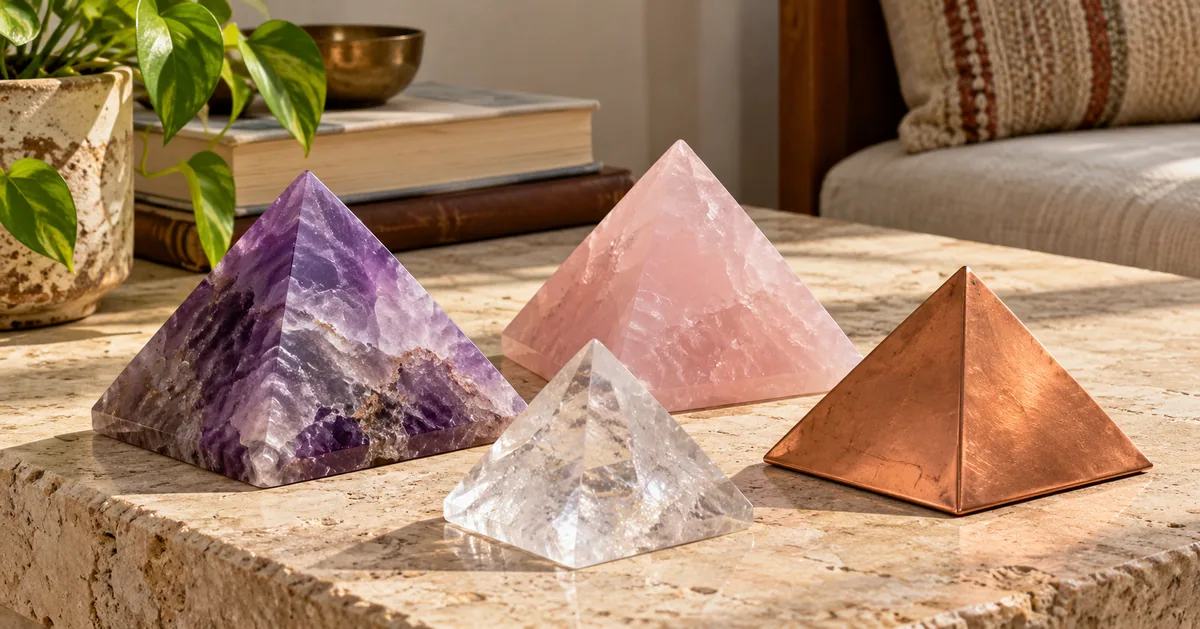
What makes a pyramid significant in Vastu?
Vastu Shastra, or Vastu Vidya, studies the relationship of space, orientation, activity, proportion and the five elements. Its familiar directional vocabulary includes Ishanya (north-east), Agneya (south-east), Nairritya (south-west), Vayavya (north-west) and the Brahmasthan (centre). In present-day Vastu remedy systems, pyramids are placed in these zones to express or support a chosen quality, such as spiritual clarity, constructive activity, stability or harmony.
The pyramid has a broad base rising to a single apex. Contemporary pyramid-Vastu practitioners interpret this geometry as a symbol of concentration, elevation and the bringing together of the energies of a space. Gemstone or metal adds another layer: clear quartz (Sphatik) is associated with clarity, rose quartz with affection, amethyst with contemplation, copper with the Agni or transformative principle in some systems, and multi-pyramid arrangements with repeated geometric emphasis.
It is helpful to know where the traditions meet. The classical Vastu texts, including the Mayamata and Manasara, focus primarily on buildings, sites, directions and measurements. Portable crystal and metal pyramid remedies are especially prominent in contemporary Vastu practice. Their significance lies in how a particular modern school combines Vastu directions, colour, Panchabhuta, sacred geometry and devotional or crystal practice. That distinction makes it possible to understand a modern product without confusing it with a traditional temple's architectural form.
Five common pyramid forms and why they are not interchangeable
| Form | What it is | Common Vastu or spiritual use |
|---|---|---|
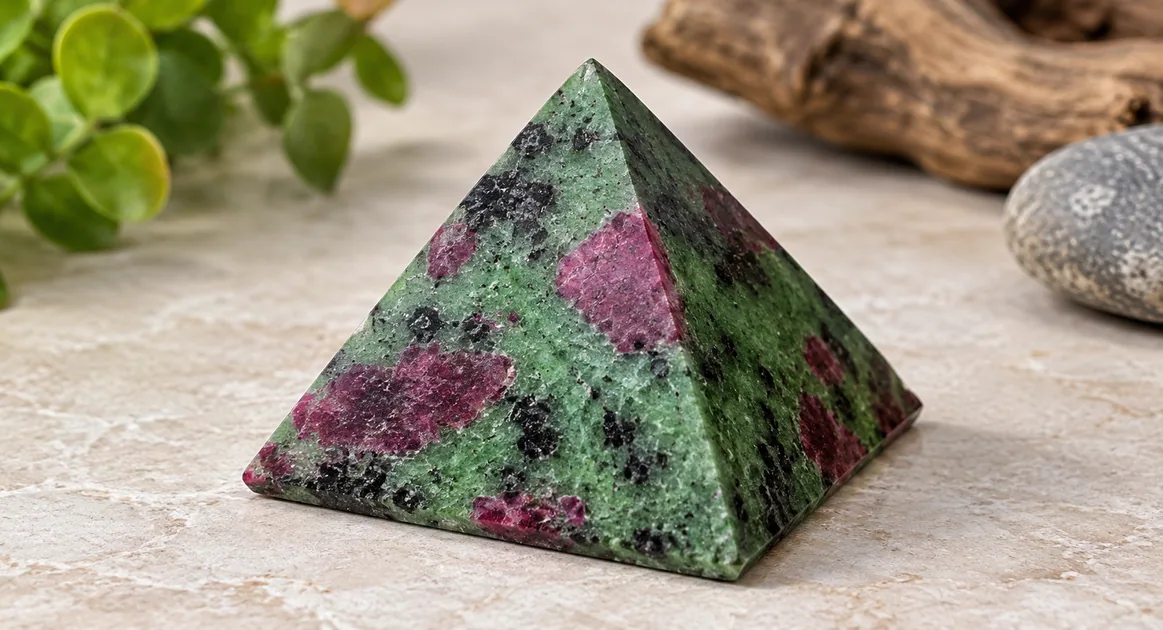
| Single gemstone pyramid | One stone or mineral body, carved and polished to a square-base pyramid | Selection by gemstone symbolism; a personal altar, meditation place or intention-based room zone |
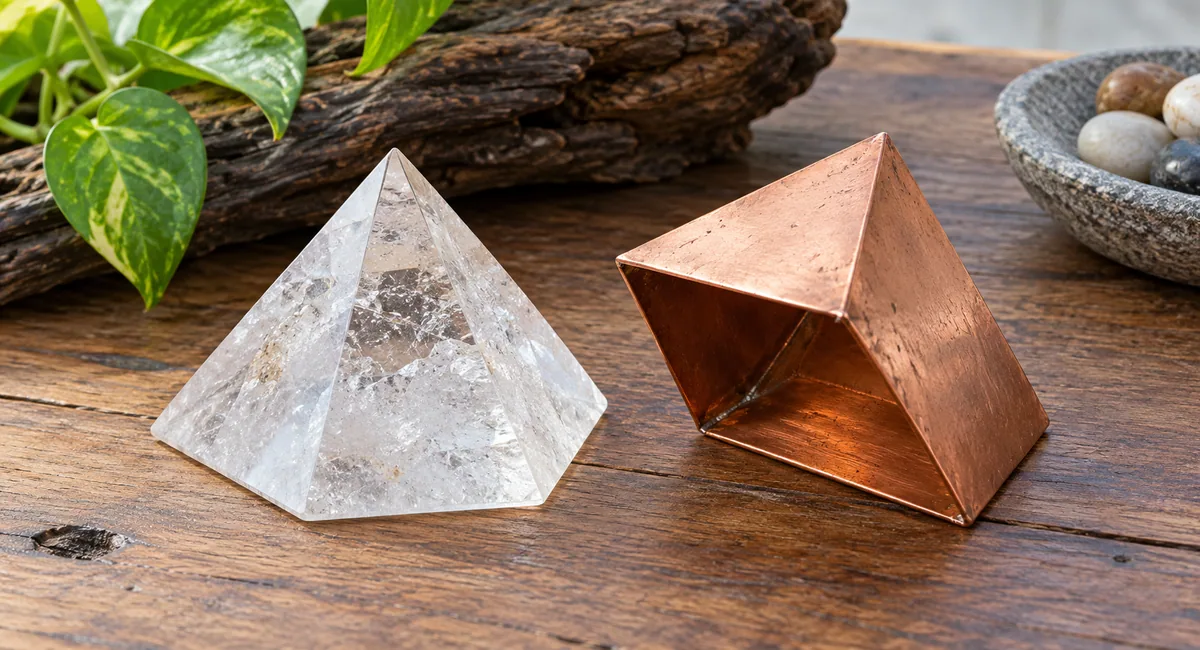
| Hollow copper or brass pyramid | A pyramid shell made from sheet metal, sometimes open underneath | Doorway, wall, desk or zone-based contemporary Vastu remedies; material and placement selected together |
| Open-frame pyramid | Edges made from connected rods, without solid triangular faces | Symbolic geometric focus or a light, suspended arrangement when the design allows it |
| Nine- or 81-pyramid plate | A plate or layered assembly with repeated small pyramid forms | Grid-based Vastu rectification and area-oriented arrangements used by some contemporary systems |
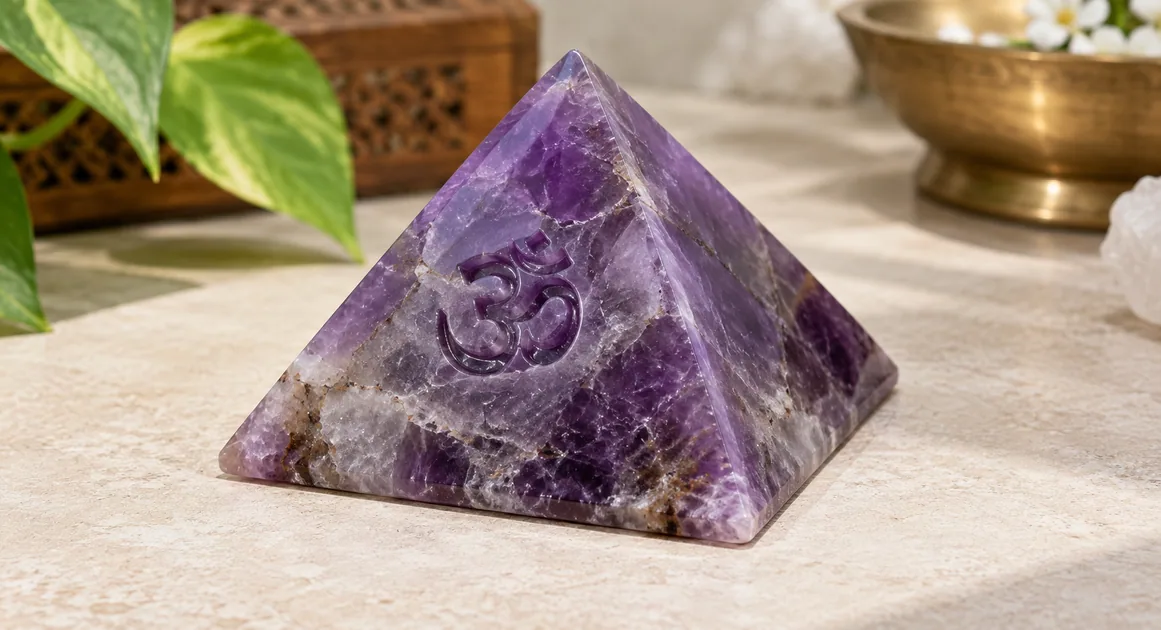
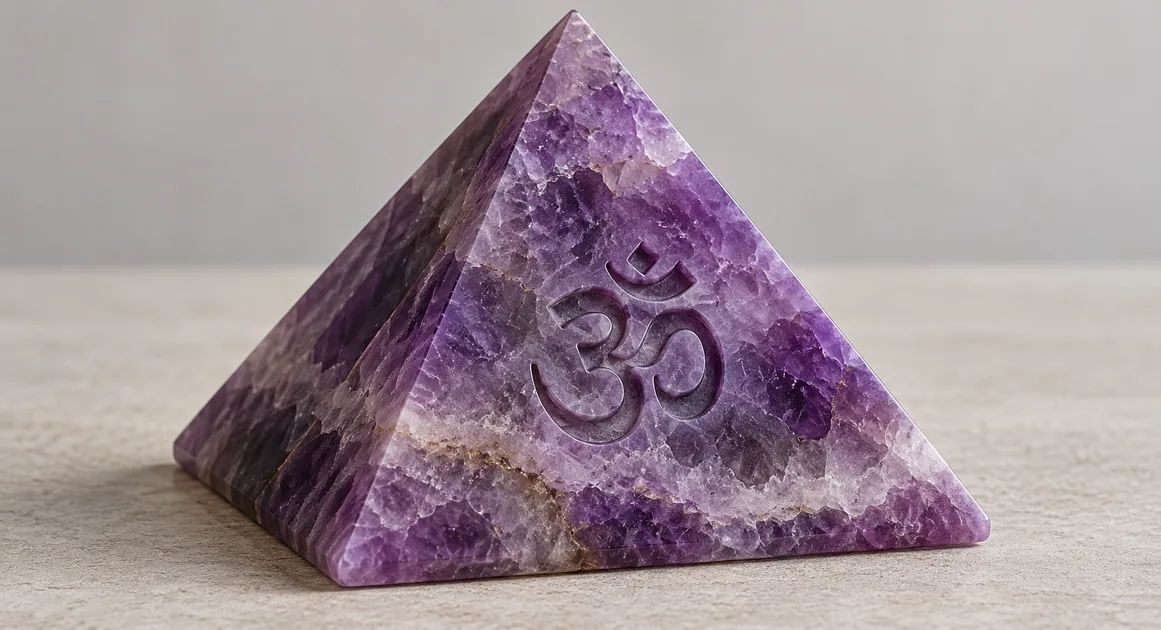
| Engraved or multi-stone set | A pyramid bearing a Yantra or deity symbol, or several identified pyramids supplied together | Specific devotional, Navagraha, chakra or multiple-intention arrangements depending on the exact components |
A nine-pyramid plate is not the same as nine loose pyramids; a hollow copper pyramid is not the same as a solid copper casting; and a carved stone pyramid is not necessarily a natural crystal point. Examine the design before choosing a placement method. See the existing pyramid sets collection for examples of separate pieces and assembled arrangements.
How gemstone material changes the meaning of a pyramid
A gemstone pyramid brings together its geometric form and the customary symbolism of its mineral. The associations below are used in crystal practice and modern Vastu-related selection. They are particularly useful when the question is “Which stone matches the purpose?” rather than “Which object has the prettiest colour?”
| Gemstone or material | Traditional or contemporary association | Example of a suitable intention |
|---|---|---|
| Clear quartz / Sphatik | Clarity, purity, spiritual attention and amplification of intention | Puja room, meditation area or north-east spiritual corner |
| Amethyst | Calm, reflection, intuition and disciplined inner practice | Quiet study, prayer or meditation setting |
| Rose quartz | Affection, compassion, emotional understanding and relationship harmony | Family space or a personal intention relating to relationships |
| Citrine / yellow stones | Abundance, confidence, optimism and enterprising activity | Business desk, new venture or prosperity intention |
| Green aventurine / green jade | Growth, opportunity, renewal and continuing prosperity | Workplace, study or new beginning |
| Tiger eye | Courage, composure, steadiness and decision-making | Professional responsibility or leadership desk |
| Black tourmaline / black obsidian | Protective symbolism, grounding and boundaries | Entrance-related or grounding-focused arrangement |
| Pyrite | Prosperity, resourcefulness and material ambition | Shop, cash-management workspace or business intention |
| Carnelian / orange calcite | Motivation, confidence, creative initiative and the active principle | Creative workspace or energy of a new undertaking |
| Lapis lazuli / sodalite | Wisdom, understanding, learning and expression | Study, communication or teaching space |
| Hematite / jasper | Grounding, order, endurance and stability | South-west stability-oriented arrangement in some systems |
| Smoky quartz | Groundedness, release of distraction and measured action | Quiet workspace or stabilising intention |
These are associations, not interchangeable mineral identities. Pyrite is an iron-sulphide mineral, amethyst and citrine are quartz varieties, rose quartz is a pink form of quartz, and obsidian is natural volcanic glass. A product named “crystal pyramid” should identify the actual material; a nine-stone collection should list all nine stones. Explore the gemstone collection to understand the individual minerals separately from the pyramid form.
Pancha Mahabhuta: choosing with the five elements in mind
The Pancha Mahabhuta—Prithvi (earth), Jala (water), Agni (fire), Vayu (air) and Akasha (space)—provides an interpretive framework for Vastu. These are traditional elemental categories, not just five literal construction materials. A present-day Vastu practitioner may use them to connect the purpose of a zone to colour, object and activity.
- Prithvi / Earth: stability, foundation, patience and support. Brown, ochre or grounding stones may be considered in stability-related arrangements, especially towards the south-west.
- Jala / Water: movement, receptivity, nourishment and flow. A lighter, transparent or gently coloured crystal may be used when the purpose concerns calm and adaptability.
- Agni / Fire: action, transformation, appetite, initiative and vigour. Copper, carnelian and warm colours appear in some south-east or activity-focused pyramid selections.
- Vayu / Air: movement, relationships, circulation and change. Light arrangements and communication-oriented stones can be selected for a north-west discussion.
- Akasha / Space: openness, awareness, prayer and perspective. Clear quartz or other transparent forms are frequently chosen for meditation and the north-east.
Different Vastu schools assign colours, metals and minerals to zones in somewhat different ways. It is best to apply one coherent method to a room rather than combine several contradictory charts collected from the internet.
Vastu directions: where different pyramid traditions commonly place them
Before selecting a direction, identify the centre of the floor plan and determine north with a reliable compass. A north-east corner of the house is not always the same as a north-east corner of an individual room. In a small rented office, for example, you may work with the office zone rather than the entire building plot. The table is a practical introduction, not a substitute for understanding the actual plan.
| Direction or zone | Vastu name / theme | Example pyramid discussion |
|---|---|---|
| North-east | Ishanya; prayer, knowledge, spiritual clarity | Sphatik or amethyst pyramid for a clean meditation or puja setting |
| East | Purva; sunrise, learning, beginnings | Clear quartz or a light-coloured stone in a study-related arrangement |
| South-east | Agneya; Agni, activity and transformation | Copper or a warm-coloured pyramid considered in an Agni-themed remedy |
| South | Dakshina; responsibility, discipline, activity | A selected metal or grounding stone where a practitioner specifies it |
| South-west | Nairritya; foundation, permanence, stability | Jasper, tiger eye or some copper/brass configurations for stability symbolism |
| West | Paschima; consolidation and completion | Stone or metal chosen by the specific purpose and the tradition being followed |
| North-west | Vayavya; movement, interactions and transitions | Lighter metal or selected stone in a communication-oriented arrangement |
| North | Uttara; Kubera, livelihood and commerce | Prosperity-themed pyrite, green aventurine or a selected crystal pyramid |
| Centre | Brahmasthan; openness and balance | Some schools use a central crystal or nine-pyramid layout; first consider how the central space is used |
For instance, a person choosing a pyramid for the north-east may prefer Sphatik pyramids, while a practitioner recommending a south-east metal arrangement may discuss copper pyramids. Neither choice follows from colour alone. The question includes the zone, intention, product type and whether an individual object or a fixed arrangement is intended.
Worked examples: choosing a pyramid for a real space
Example 1: A Bengaluru jewellery showroom seeking prosperity and orderly customer flow
Suppose a shop owner has a north-facing showroom, a billing counter towards the north-west of the sales area, and a small display shelf on the north wall. The owner wants a prosperity-oriented pyramid but also wants the counter to feel calm and organised.
- Define the objective: business growth and stable decision-making, not merely “positive energy everywhere.”
- Read the zone: north is commonly linked with Kubera and commercial opportunity; north-west relates to movement and interaction.
- Choose the association: a pyrite or green aventurine pyramid can express prosperity and growth; tiger eye may be more suitable if the priority is focus at the decision-making desk.
- Choose the object: a single stable pyramid is straightforward for the shelf; a nine-pyramid plate is a different kind of planned arrangement, not automatically a better substitute.
- Finish the arrangement: keep the chosen display clear, legible and away from cash handling, where a pointed object could be knocked over.
The lesson is that one shop can have two different intentions. A prosperity object on the north display and a tiger-eye piece on a manager's desk need not be identical simply because both are in a business premises.
Example 2: A home meditation corner with an unfavourable room layout
Imagine a family whose preferred puja room is not in the north-east of the flat. The available prayer shelf is on the east side of the living room. They want an object that supports a daily mantra or dhyana practice.
The first step is to identify a peaceful, suitable worship area rather than assume every property must be rebuilt. Sphatik is a familiar choice in Indian devotional and crystal traditions for clarity and purity. An amethyst pyramid may be selected where contemplation and calm are the leading intentions. A copper nine-pyramid rectification plate serves a different purpose and should not be chosen simply because it has more pieces. The family can select a stable, modest-sized stone pyramid and keep the puja area clean and accessible.
Example 3: An office with a south-east zone requiring a Vastu discussion
A design studio has a south-east corner that is used for computers and a small service area. Its owner has been advised to work with the Agneya principle. In some contemporary remedial methods, a copper pyramid is chosen for this purpose because copper and the Agni theme are linked in that system. Other practitioners may first review the room's function, colours, fire-safety arrangement and the precise layout.
Here the essential buying question is whether the practitioner means one hollow copper shell, an open frame, a wall-mounted pyramid, or a multi-pyramid plate. These are not interchangeable orders. A copper object placed near computers or a kitchen must remain securely supported and away from electrical connections and hot surfaces.
When are nine-pyramid and 81-pyramid arrangements used?
Repeated-pyramid arrangements are used in various contemporary Vastu dosha rectification systems. A nine-pyramid plate generally means nine raised forms, often in a three-by-three arrangement. Some metal sets incorporate 81 small pyramids, multiple layers or engraved symbols. Practitioners may relate the repeated geometry to zones, grid patterns or the intended spread of a remedial arrangement.
It is easy to confuse several different ideas: a nine-pyramid plate, nine separate gemstone pyramids selected for Navagraha associations, and a Vastu Purusha Mandala divided into squares are three different concepts. A Navagraha collection must identify which stones or symbols are assigned to the nine Grahas; a nine-pyramid copper plate is primarily a repeated metal construction. Similarly, a seven-chakra set follows a chakra-and-colour interpretation rather than a nine-Graha scheme.
Ask for a complete component list and intended placement before choosing. Explore OmmRudraksha pyramid sets and the companion article How to Choose a Pyramid for Home, Office or Meditation Space for a more focused selection process.
Yantra pyramids, Navagraha pyramids and chakra sets
A Yantra pyramid includes an engraved, printed or attached sacred diagram. A Sri Yantra, for example, carries a distinct devotional and geometrical significance; the pyramid becomes one supporting form for that particular Yantra. The inscriptions should be legible and the seller should state which Yantra is actually supplied. A product labelled “prosperity pyramid” does not automatically contain a Sri Yantra, Kubera Yantra or any other specific diagram.
A Navagraha pyramid arrangement may be made from nine different stones or include nine planetary emblems. The Grahas—Surya, Chandra, Mangala, Budha, Guru, Shukra, Shani, Rahu and Ketu—carry distinct meanings in Jyotish. In that approach, the exact stones and the purpose of the arrangement need explanation. It should not be confused with a nine-piece assortment sold only by number.
A seven-chakra pyramid set usually follows a modern colour sequence spanning Muladhara, Svadhishthana, Manipura, Anahata, Vishuddha, Ajna and Sahasrara. It may include carved stones, a layered body or individually coloured parts. The material and order should be specified. This is a different organising framework from directional Vastu, though some modern practices combine them.
What about copper, brass, salt and clay pyramids?
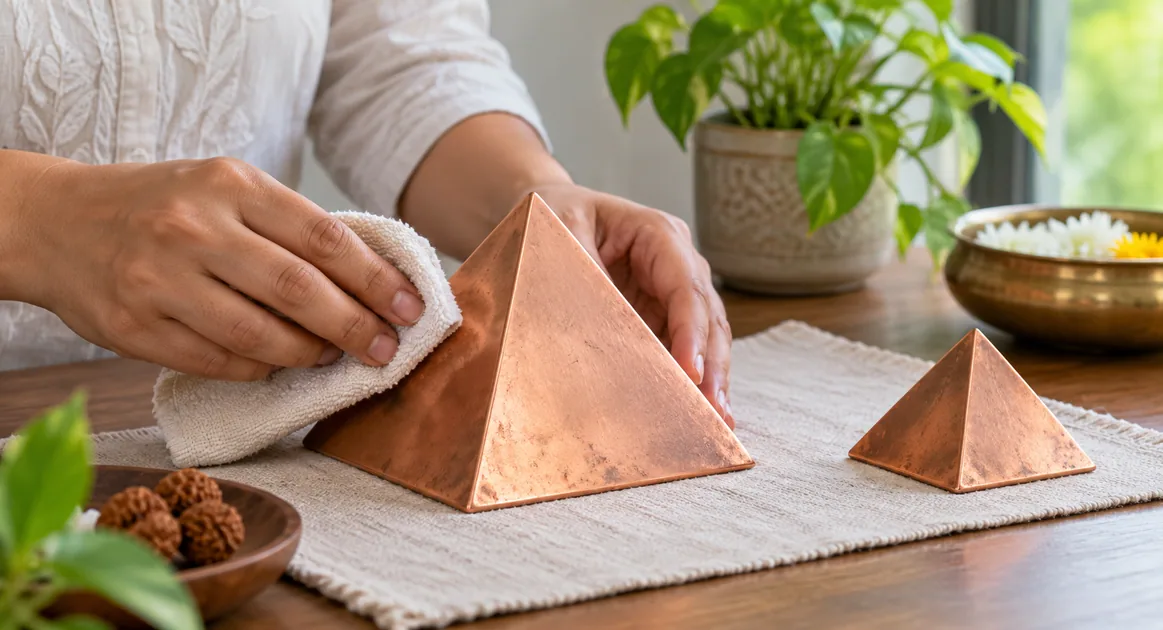
Copper (Tamra) has a long place in Indian ritual objects and Yantra plates, so copper pyramids fit naturally into many modern remedial catalogues. They may be solid, hollow, folded, engraved or assembled in multiple layers. Copper develops patina with time, and protective coatings change how it should be cleaned.
Brass (Pittala) is a copper alloy, not the same metal as pure copper. Its warm yellow colour is familiar from ritual and household objects. Brass pyramid plates and layered assemblies may be selected for a metallic, structured Vastu arrangement, but the precise alloy and included pieces should be stated.
Rock salt pyramids are often connected in contemporary home traditions with purification symbolism. Salt is moisture-sensitive, so a dry position is important. Clay or mud pyramids express the earth principle and may be chosen for a natural-material emphasis; their finish and durability differ from stone or metal. These are distinct categories and should never share one blanket cleaning or installation instruction.
How to select a pyramid: a practical six-point method
- Name the purpose. Is this for a puja space, business intention, emotional harmony, meditation, a particular Vastu zone, a Yantra or a consultant-specified dosha arrangement?
- Identify the zone accurately. Mark north, the centre and the intended placement in the house or room. Do not assume a shelf's corner is the same as the property's corner.
- Choose a coherent tradition. Decide whether you are following directional Vastu, a specific pyramid rectification method, crystal symbolism, Jyotish/Navagraha or chakra practice. Combine them only where the method explains the relationship.
- Choose the exact material and form. A single Sphatik pyramid, a copper hollow pyramid, a nine-plate and an engraved Yantra pyramid are different products.
- Confirm the details. Ask about stone identification, treatments, whether the metal is solid or plated, number of pieces, base dimensions, apex condition and any energization service included.
- Plan the actual placement. Use an even, secure surface; keep the pyramid away from moisture, heat or busy edges as appropriate to its material. Record the intended direction and purpose so that you can follow the chosen practice consistently.
For a separate, detailed room-by-room discussion see Pyramid Placement in Vastu. For mineral identification and treatments, read Natural, Treated and Manufactured Pyramid Materials. For differences between a carved stone and constructed metal form, read Crystal Pyramids vs Metal Pyramids.
Placement, orientation and energization: common questions
Should the apex point upward?
For a conventional tabletop pyramid, yes: the flat base rests on the support and the apex points upward. Purpose-made hanging and wall designs may have a different orientation; follow the intended design rather than trying to suspend a loose tabletop carving.
Should the base align with north, south, east and west?
Some pyramid-Vastu systems align the four base edges with the cardinal directions. Others focus mainly on the zone in which the object is placed. Where alignment is part of the selected method, use a compass and account for nearby metal or electronic interference before marking the position.
Can a pyramid be placed at the entrance?
Entrance pyramids are found in contemporary Vastu practice, especially in copper and Yantra formats. A wall- or door-mounted design must be intended for mounting, securely attached and clear of opening doors. A carved gemstone pyramid is more naturally placed on a stable entrance shelf or console.
Does a pyramid need energization?
Many families and practitioners prefer to begin with a simple shuddhi, prayer, mantra or sankalpa. An example is placing the pyramid on a clean surface, offering a flower or incense according to family custom, and stating the intention for the space. Avoid washing materials that may be affected by water, especially salt, soft stones, coatings and assembled metal pieces. Confirm with the seller which energization service, if any, is included rather than assuming the same ceremony applies to every product.
Can I keep several different pyramids in one room?
Yes, if they serve distinct purposes and the arrangement remains coherent. A Sphatik piece for a prayer shelf and a prosperity-oriented stone on a work desk are not inherently contradictory. However, placing many pieces without understanding their zone, material or intention makes selection harder to interpret. Start with a clear purpose, then add other elements deliberately.
Is a carved crystal pyramid the same as a naturally grown pyramid crystal?
No. Quartz naturally grows in characteristic crystal habits, but a regular square-base retail pyramid is usually cut and polished. The geometric shape is a crafted form. That does not remove its spiritual significance for the person using it; it simply tells you what you are buying.
Explore OmmRudraksha pyramid collections and companion guides
Begin with the full Vastu pyramid collection. You can compare a devotional Sphatik choice in Clear Quartz (Sphatik) Pyramids, a modern rectification-oriented metal form in Copper Pyramids, and multiple-piece arrangements in Pyramid Sets. The wider Vastu collection covers related objects used in spiritual and Vastu practice.
Related product collections
Shop Vastu Pyramids · Sphatik Pyramids · Copper Pyramids · Pyramid Sets
When the purpose is a particular home or business layout, the OmmRudraksha Vastu Consultation can help you share the zone, room orientation and intended use before you choose a pyramid arrangement.
In summary: choose a Vastu pyramid by purpose first, then by zone, traditional meaning, material and exact construction. A gemstone pyramid expresses the character of its stone; a copper or brass pyramid belongs to a metal-based remedy approach; a multi-pyramid plate or Yantra set follows its own design. Understanding those differences turns a general purchase into a considered choice for a home, shop, office or spiritual practice.