Where should a Vastu pyramid be placed in a home, office or shop? The useful answer begins with the purpose of the placement. A Sphatik pyramid for a meditation corner, a copper pyramid selected for an Agneya (south-east) remedy, and a nine-pyramid Vastu plate for a planned arrangement are not necessarily placed in the same zone. In Vastu practice, the position of a pyramid is considered alongside the direction, room function, Panchamahabhuta (five elements), Vastu Purusha Mandala, material and intended Sankalpa. This guide shows how to bring those ideas together, with direction charts and worked examples you can apply to a real floor plan.
1. Understand the Vastu map before placing a pyramid
Vastu Shastra organizes the built environment through directional relationships. The four cardinal directions are Purva (east), Dakshina (south), Paschima (west) and Uttara (north). Between them are the four corners: Ishanya (north-east), Agneya (south-east), Nairritya (south-west) and Vayavya (north-west). The middle is called the Brahmasthan. These are meaningful zones, not merely labels on a compass.
The classical Ashta Dikpala tradition associates the east with Indra, south-east with Agni, south with Yama, south-west with Nirriti, west with Varuna, north-west with Vayu, north with Kubera and north-east with Ishana. A Vastu-oriented placement discussion therefore asks what that direction represents. Contemporary pyramid and crystal practices add choices of material, colour, form and remedy arrangement to this underlying directional framework.
| Zone | Traditional association | Pyramid or gemstone approach often considered | Typical intention |
|---|---|---|---|
| North-east — Ishanya | Ishana/Shiva; spiritual clarity, water-associated corner | Clear quartz (Sphatik), amethyst, a small devotional pyramid | Puja, meditation, contemplation |
| East — Purva | Indra and rising light | Clear quartz, sunstone or a carefully selected copper piece | Learning, openness and a purposeful start |
| South-east — Agneya | Agni; fire and activity | Copper or carnelian-associated pieces; special remedy plates when specified | Work energy and the kitchen/fire zone |
| South — Dakshina | Yama; discipline and order | Selected grounding stones or a practitioner-planned metal pyramid | Steadiness, routines and responsibility |
| South-west — Nairritya | Nirriti; weight, rootedness and stability | Tiger eye, hematite, jasper or an earth-oriented arrangement | Stability and grounding |
| West — Paschima | Varuna; continuity and reflection | Amethyst, sodalite or a purpose-specific metal pyramid | Reflection, study and orderly completion |
| North-west — Vayavya | Vayu; air and movement | Fluorite, lighter crystal arrangements or a portable pyramid | Communication and movement |
| North — Uttara | Kubera; wealth, trade and opportunity | Citrine, pyrite, green aventurine, brass or selected wealth-themed forms | Business planning and prosperity intentions |
| Centre — Brahmasthan | Brahma and Akasha; central openness | In certain contemporary systems, a planned nine-pyramid set; otherwise preserve open circulation | Whole-space harmony and spatial balance |
How to read the chart: It is a selection framework, not a rule that every object of one mineral belongs in one and only one corner. A copper pyramid for a specific Vastu Dosha may be assigned to a different wall or room. A multi-pyramid plate follows the instructions of its own system. Stone, ritual intention and building layout have to be considered together.
2. Find the correct direction in your own floor plan
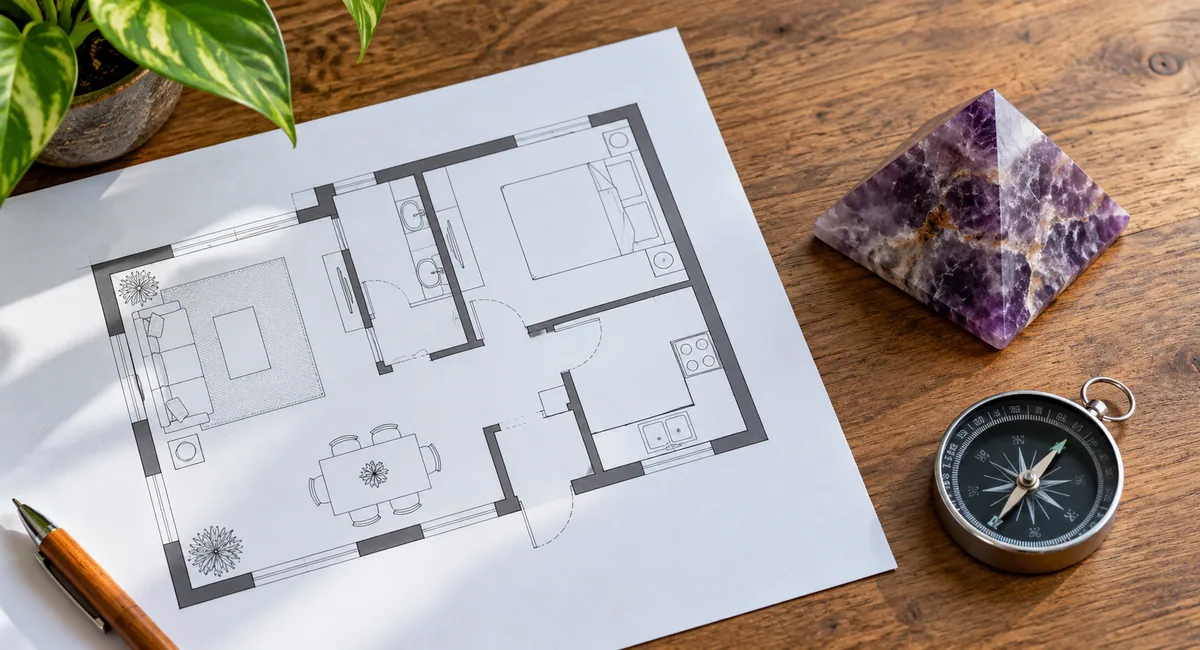
Do not assume that the wall behind your main door is north, or that your apartment's “north-facing entrance” makes the entire drawing north-up. Entrance facing and room location are two different measurements. For an ordinary apartment, first make a simple top-view plan showing the kitchen, bedrooms, puja place, balcony, entrance and office desk.
- Identify north: use a reliable compass, taking readings away from steel cupboards, large electrical equipment and strong magnetic objects. Repeat the observation at more than one point. A measured site survey is preferable for complex properties.
- Mark the building centre: on a reasonably rectangular plan, draw the midpoints of the overall usable footprint. For an L-shaped flat or irregular shop, document its shape instead of guessing a centre by eye.
- Overlay the eight directions: with north at the top, mark north-east at top-right, south-east at bottom-right, south-west at bottom-left and north-west at top-left. Include the central Brahmasthan.
- Locate the activity: identify where prayer, work, money handling, cooking, seating and storage actually occur. That often matters more than a decorative corner chosen at random.
- Match one purpose to one location: decide whether the pyramid is for meditation, a planetary/colour association, prosperity Sankalpa, a zone-specific Vastu remedy or a nine-pyramid arrangement.
Example: Imagine a rectangular flat measuring 9 metres east-west and 6 metres north-south. If you divide the plan into a simple 3 × 3 teaching grid, each column is approximately 3 metres wide and each row 2 metres high. The north-east area lies in the upper-right section; the south-west lies in the lower-left; the centre is the middle section. This quick method is useful for orientation. A professional Vastu assessment may divide the same property more precisely using a Vastu Purusha Mandala or a 16-zone method.
| North-west Vayavya | North Uttara | North-east Ishanya |
|---|---|---|
| West Paschima | Centre Brahmasthan | East Purva |
| South-west Nairritya | South Dakshina | South-east Agneya |
Diagram reading: north is shown at the top; the diagram illustrates orientation rather than prescribing a pyramid in every square. A single room can also be considered in its own directional context, but its zone within the full building remains relevant.
3. Which Vastu pyramid goes where?
Sphatik or clear quartz pyramid: Ishanya, puja and meditation
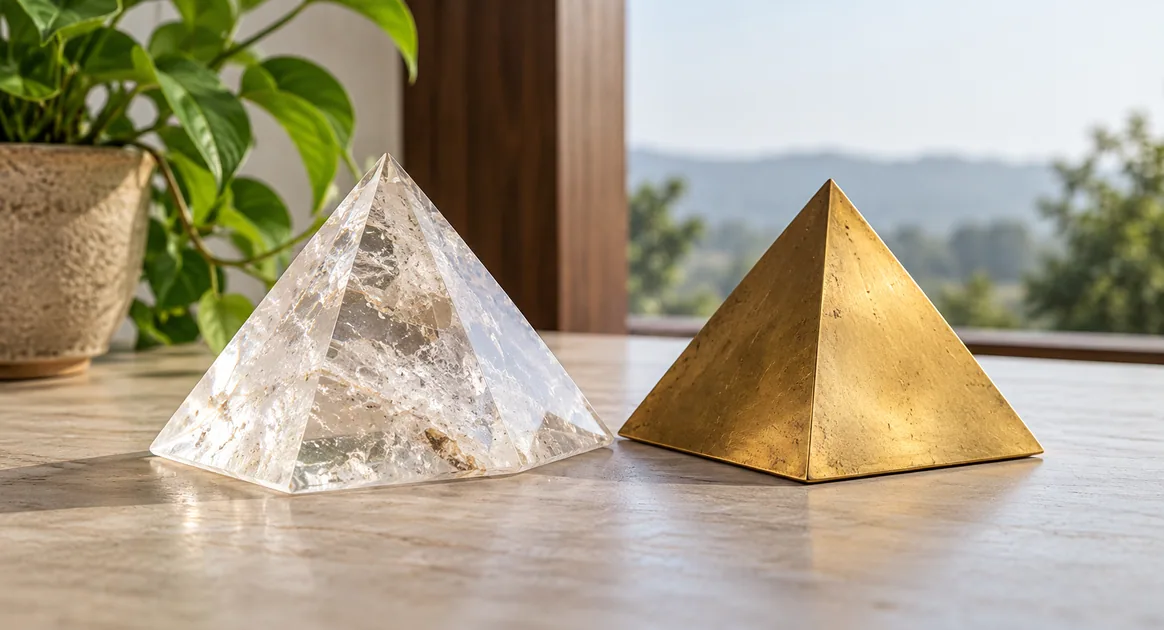
Sphatik is associated in spiritual and contemporary crystal traditions with clarity, purity and concentration. A modest Sphatik pyramid may be selected for a north-east puja shelf, meditation altar or quiet study corner. If the north-east portion of the home is a passage, choose a nearby appropriate shelf rather than obstructing the path. A clear quartz pyramid can also be part of a broader crystal or Yantra arrangement when its intention and place are specified.
Amethyst pyramid: reflection, study and calm
Amethyst is often chosen for contemplative practice, devotional reading and a settled atmosphere. In a study or meditation space, place it where you can see it without crowding books, lamps and daily work. Some contemporary practitioners prefer an east or north-east context for concentration; others use a west-side reflective corner. The purpose of the article is to show the reasoning behind those choices rather than turn a purple gemstone into a fixed compass command.
Citrine, pyrite and green aventurine: north, trade and prosperity intentions
North is associated with Kubera, the guardian of wealth. Contemporary crystal and Vastu-inspired selections often include golden citrine, pyrite and green aventurine for prosperity, trade, opportunity and growth symbolism. A business owner might place a small citrine or pyrite pyramid at a north-side office shelf or near an orderly cash-management area. In a jewellery showroom, the pyramid should not displace documents, payment equipment or valuable inventory: it is part of a purposeful arrangement, not a substitute for business systems.
Copper and brass pyramids: zone-specific remedial arrangements
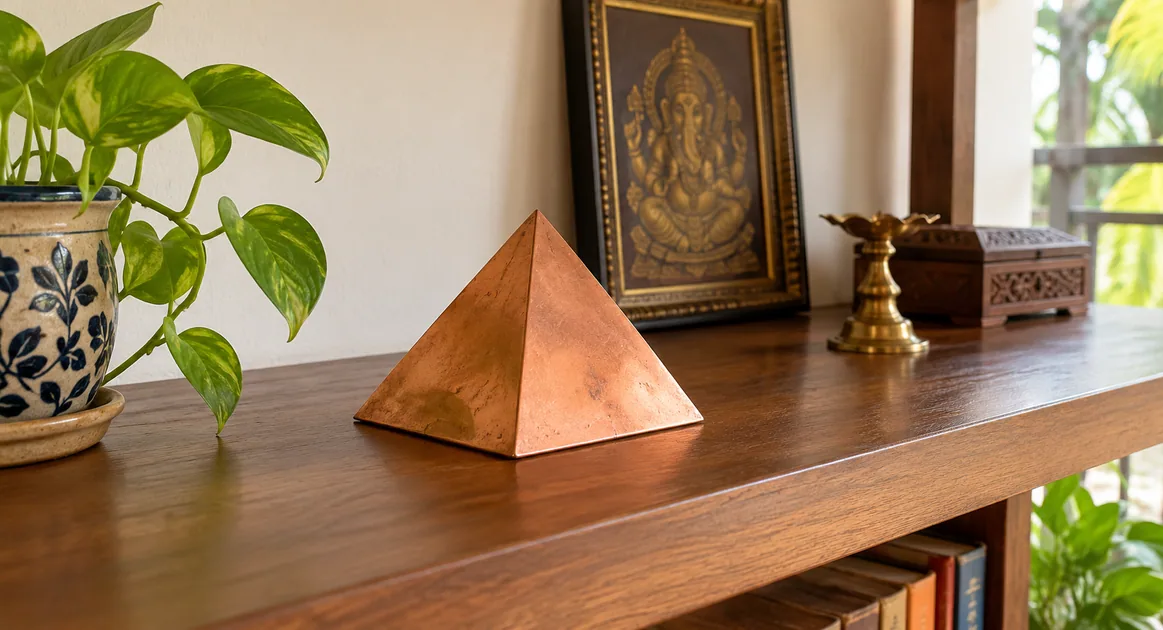
Copper and brass pyramids are widely used in modern Vastu rectification practice. A single folded copper piece, a hollow pyramid, a layered pyramid and a three-by-three nine-pyramid plate are distinct products. Copper is frequently discussed for Agneya/fire-zone applications and for certain plan-specific corrections; brass may be used in selected prosperity and stability arrangements. Their placement depends on the remedy being followed: a copper pyramid prescribed near a door or on a wall is not interchangeable with a loose carved stone on a tabletop.
When a seller describes a plate as a “nine-pyramid remedy”, check whether the nine units represent a whole-space grid, an arrangement for a specific dosha or simply nine repeated geometric forms. Placement, orientation and component count should come from the actual product method. See the pyramid materials and forms guide for those construction differences.
Tiger eye, hematite and jasper: Nairritya and grounding
The south-west is commonly associated with Prithvi (earth), weight and stability. Tiger eye, hematite and brown or red jasper are chosen in modern gemstone practice for grounding, steadiness and determination. A small pyramid on a sturdy south-west shelf may accompany a room already arranged with appropriate heavier furnishings. The pyramid's role is symbolic and ritual; the main Vastu arrangement is still the spatial relationship of the room, its use and its heavier elements.
Rose quartz and relationships
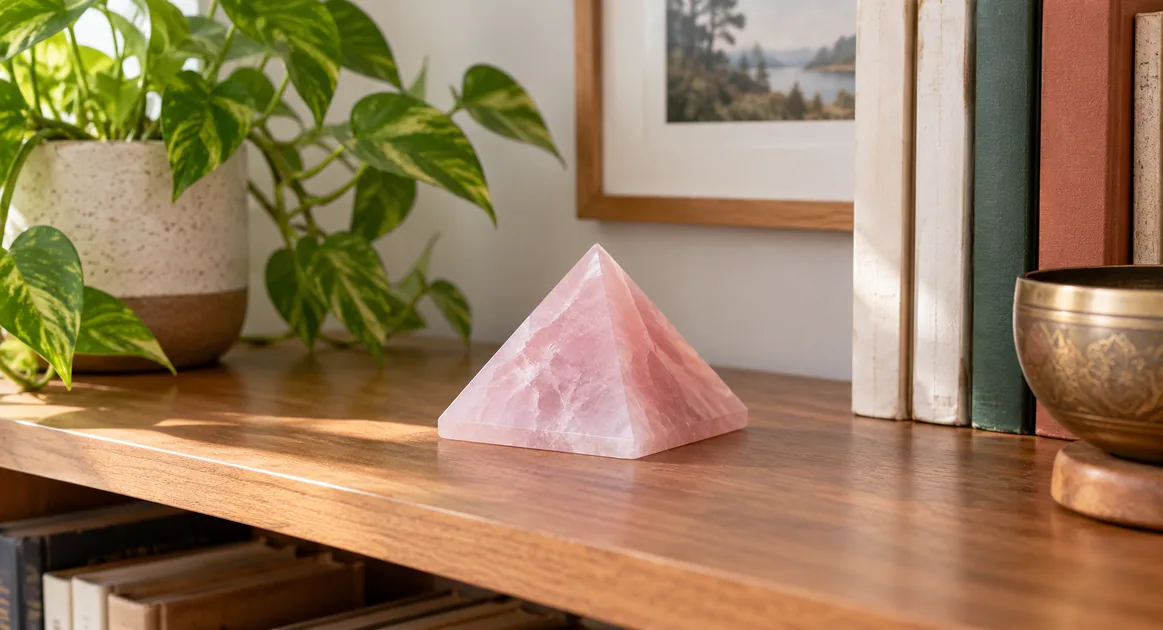
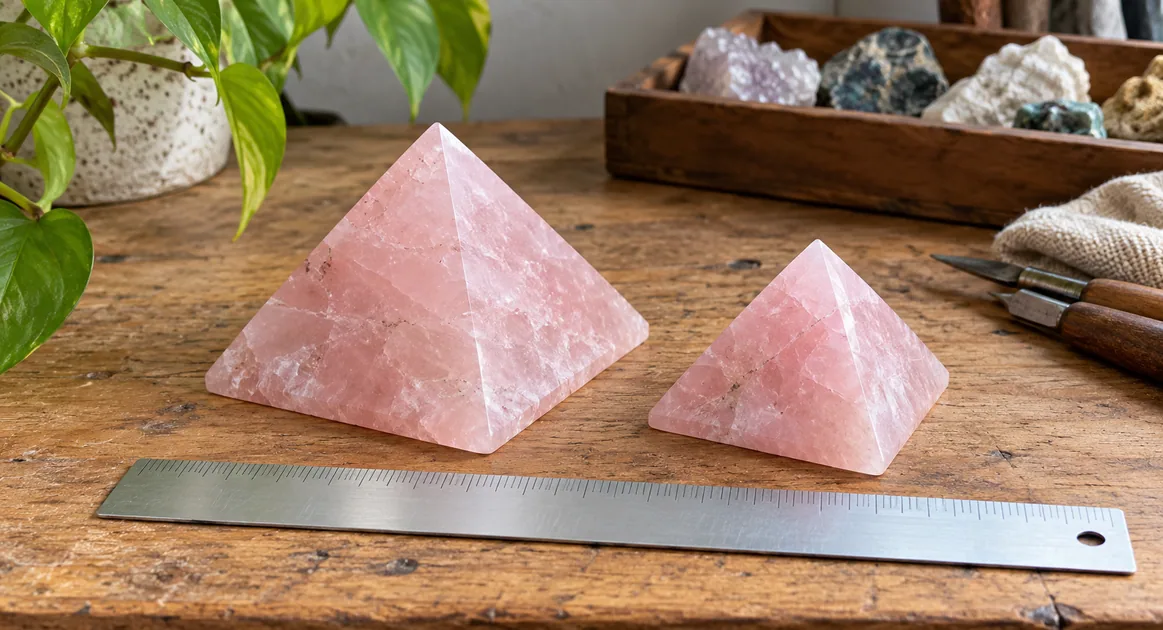
Rose quartz is popularly associated with affection, harmony and relationships. In contemporary crystal-based Vastu and Feng Shui-influenced practice, it is commonly selected for bedrooms or partnership spaces. A south-west bedroom shelf is one possible location when relationship harmony is the intention; other schools favor a dedicated personal corner. Avoid presenting such placement as a single classical prescription. For deeper comparison of the many forms, explore OmmRudraksha's Vastu pyramid collection.
4. Pyramid placements for common Vastu Dosha situations
A Vastu Dosha refers to a perceived mismatch between a building's arrangement and the directional or spatial principles followed by a particular school of Vastu. Contemporary remedies may use pyramids, Yantras, colour, material or ritual placement when a structural alteration is not desired. A practitioner first identifies the affected zone, then chooses the specific remedy—not merely a pyramid with an attractive colour.
| Situation | Traditional Vastu concern | Pyramid approach sometimes suggested | What to verify |
|---|---|---|---|
| Toilet in the north-east | Ishanya is usually preferred for purity and spiritual use | A small Sphatik or copper pyramid in a nearby designated clean zone; sometimes paired with a Yantra | Exact zone, hygiene, location outside wet areas, method followed |
| Kitchen in the north-east | Fire activity situated in a water/spiritual corner | A practitioner-selected copper or Sphatik arrangement rather than random multiple pieces | Cooking orientation, ventilation, actual dimensions and purpose of correction |
| Staircase through the Brahmasthan | Heavy movement affecting a zone traditionally kept open | Some modern systems use a ceiling-mounted or specially placed pyramid grid | Whether the system calls for a centre plate; structure and access must remain safe |
| Missing south-west corner | Reduced weight or support in the stability zone | An earth-associated pyramid, metal plate or zone-specific arrangement | Actual outline, missing area and relation to adjacent zones |
| Commercial counter at an inconvenient position | Mismatch between business activity, direction and money handling | North-oriented wealth-themed gemstone or brass pyramid near the working counter | Counter direction, customer circulation, cash security |
| Study space with no separate north-east corner | Limited devotional or concentration area | A compact Sphatik or amethyst pyramid at a dedicated clean study shelf | Light, desk layout and whether room-level or whole-home zoning is used |
These examples show the choices practitioners discuss; they are not six interchangeable prescriptions. In particular, a small display pyramid does not physically change the location of a staircase, toilet or kitchen. The meaningful Vastu decision is to understand the space, the tradition followed and the intended remedy together.
5. Worked example: a family apartment
Consider a fictional family living in a two-bedroom Bengaluru apartment. The prayer shelf is at the east side of the living room, the kitchen is in the south-east, and the master bedroom occupies the south-west. They want to add a pyramid for morning prayer and a calmer study routine.
- Map the flat: confirm north and locate the east and north-east sections. The south-east kitchen and south-west bedroom already broadly match familiar Vastu functional associations.
- Define the intention: devotional focus and a dedicated daily practice, rather than correcting every zone.
- Choose the material: a small Sphatik pyramid fits the chosen practice; amethyst is an alternative if the family prefers its symbolism.
- Choose a location: place it on a clean shelf at the puja or study station. If a corner is crowded, use the adjoining suitable area rather than putting the pyramid behind household objects.
- Use consistently: the family may begin morning Japa or a short meditation there. A single meaningful piece is sufficient for this example; no nine-piece kit is needed.
The point is that a purpose-led placement tells a more useful story than “put any pyramid in the north-east and expect everything to improve”. The north-east matters because of Ishanya and its ritual associations; the material matters because of the devotional intention; the location matters because the family can actually use it.
6. Worked example: jewellery showroom and cash counter
Consider a fictional gemstone showroom with a north-side billing counter, a west-side display wall and a south-west stock cabinet. The owner wants a prosperity-oriented Vastu display that customers can understand.
First decision: keep the north-side counter neat and functional. Kubera symbolism makes the north a natural place to discuss a citrine, pyrite or brass pyramid. A small pyramid might be placed on a high, stable counter shelf or inside a purpose-designed display niche, with a description of its traditional association.
Second decision: the stock cabinet should continue to serve secure storage; it is not necessary to put a pyramid inside every drawer. If the owner wants a south-west grounding association, tiger eye or hematite could be selected for a nearby display.
Third decision: if a specific entrance or fire-zone dosha has been identified, treat that as a separate consultation. A copper rectification plate and a prosperity-themed citrine pyramid serve different purposes. Their installation instructions should not be mixed simply because both are sold under the word “pyramid”.
This gives the showroom a clear, teachable selection story: north/Kubera for prosperity intention; south-west/Prithvi for stability; specific copper remedies only where the chosen method requires them.
7. Worked example: a small office and work-from-home desk
Suppose a professional works from a compact room with a desk on the east wall, a bookshelf in the south-west corner and a window to the north. They want to associate their work area with concentration, communication and dependable routines.
A clear quartz or fluorite pyramid can be chosen for the study/work corner, while the south-west bookshelf already gives the room a grounded arrangement. If client communication is central to the work, they may also study the north-west/Vayavya association with movement and exchange. Placing several different pyramids in all four corners is not necessary. Start with a specific intention and a stable, reachable location. A simple office often benefits from one thoughtfully selected arrangement more than a cluster of unrelated objects.
8. How many pyramids should you use: one, four or nine?
One pyramid: suitable for a single focus such as a puja shelf, study desk, business counter or selected zone. It is easy to understand and maintain.
Two or four pyramids: some contemporary rectification methods arrange pairs at a doorway, around a beam or at the corners of a defined area. The number and exact orientation belong to that method; simply adding a fourth pyramid to a room does not create a universal Vastu solution.
Nine-pyramid plates and grids: commonly sold as a three-by-three arrangement and sometimes linked symbolically to the nine Grahas, eight directions plus centre, or whole-space balancing. A nine-pyramid plate is not necessarily equivalent to nine loose pyramids, and different products may have different ritual instructions. Confirm what the set is meant to represent before choosing its place.
Direction of the apex: for an ordinary standing pyramid, the apex is normally upright. Some modern arrangements ask that square-base edges be aligned to the cardinal directions; others focus only on the selected zone. A wall-mounted or embedded design has a separate orientation. Follow the actual product-specific method rather than forcing one alignment rule on every item.
9. Placement with a Yantra, mantra and Sankalpa
A pyramid is sometimes paired with a Vastu Purusha Yantra, Shri Yantra, Kubera Yantra or Navagraha-related arrangement. The objects do not become identical merely by being placed together. A Yantra has its own iconography, orientation, devotional context and method of installation. Where the household follows a ritual tradition, the sequence may include cleaning the space, placing the object respectfully, lighting a diya in a suitable location and offering a simple Sankalpa—a clear intention for harmony, prayer, concentration or prosperity.
One commonly used devotional invocation is Om Vastu Purushaya Namah. Families may repeat it according to their custom, or follow a mantra associated with their particular deity or Yantra. Such practice belongs to the devotional approach of the household; it need not be turned into a compulsory step for every small decorative or gemstone pyramid. A practitioner's specific instructions take precedence for a formal Vastu remedy.
10. Installation checklist for a home, shop or office
- Write down the purpose: prayer, prosperity, study, room harmony or a defined dosha.
- Check the direction: mark north, identify the affected room and distinguish building-level zones from desk-level corners.
- Select the right form: gemstone pyramid, copper/brass pyramid, nine-pyramid plate or Yantra-based set.
- Confirm authenticity and construction: check mineral type, actual dimensions, metal thickness and whether a nine-set is a plate or separate units.
- Prepare the place: clean the shelf and arrange adequate space around the object.
- Orient according to the chosen system: upright apex for a standing pyramid; follow product directions for wall plates and grids.
- Perform a simple Sankalpa if desired: connect the installation with a meaningful spiritual or practical intention.
- Review periodically: keep the area orderly and ensure the pyramid still suits the room's use.
For care, minerals and metals behave differently: some carved stones are vulnerable to moisture, direct sun or impact; copper and brass can develop patina. The separate cleaning, handling and storage guide covers these details without mixing them into directional rules.
11. Frequently asked questions about pyramid placement
Should every Vastu pyramid be placed in the north-east?
No. The north-east is especially important in devotional and Ishanya-oriented arrangements, but a pyramid associated with Kubera and trade may be placed toward the north, while a practitioner may use copper in a specific fire-zone or dosha remedy. The intended application determines the location.
Can I place a Vastu pyramid in the centre of the home?
The centre, or Brahmasthan, traditionally relates to openness and spatial balance. Some contemporary systems use a centrally positioned nine-pyramid grid or plate. Others keep the area clear. Do not treat the centre as an instruction to place a large object in the middle of circulation.
Does a copper pyramid belong in the south-east?
Copper is often associated with Agneya and is used in various contemporary Vastu remedies. Its exact position depends on whether the goal is fire-zone symbolism, a door correction or another specified arrangement. The material alone does not determine the answer.
Where should a pyramid be kept in a shop for business prosperity?
North/Kubera is a common starting point for a prosperity Sankalpa. A citrine, pyrite or brass form may accompany an orderly counter or office shelf. The shop's entrance, cash handling and existing layout should be considered as well.
Can a gemstone pyramid be placed in the bedroom?
Yes, a small rose quartz, amethyst or another personally selected pyramid may be used in a suitable bedroom setting. Choose the stone and zone according to the intention; keep sharp, heavy or fragile items away from the bed edge.
Is one pyramid enough or must I buy nine?
A single focus usually calls for one suitable piece. A nine-pyramid grid is a different system used for broader arrangements; choose it when that specific design and purpose match your plan, not simply because nine is a larger number.
Do Vastu pyramids need to face north?
A standing pyramid's apex normally points upward. Base alignment with compass directions may be specified for certain square-based methods, but not all forms share that instruction. The distinction between placing in a northern zone and turning an object's base north is important.
Where should I place a pyramid in a rented apartment?
Choose reversible placement: a small shelf, altar, work desk or counter, depending on the purpose. A removable pyramid or plate is often more practical than altering walls or floors. Where a particular dosha is the concern, review the layout first.
Can I combine a pyramid with a gemstone tree or Yantra?
Yes, if there is a clear reason for the combination. A Sphatik pyramid and a devotional tree can occupy the same puja area, while a Kubera Yantra and prosperity-themed pyramid may be used in a business setting according to the chosen tradition. Avoid making a crowded collection without understanding each item's role.
What if my floor plan is irregular?
Record the actual footprint, orientation and entrances. A simple 3 × 3 teaching grid may be insufficient for an L-shaped house, split-level office or shop with an open extension. Such situations are suitable for a more detailed Vastu assessment.
12. Choose by purpose, not by a one-line rule
For a puja place, begin with the Ishanya association and a suitable Sphatik or devotional pyramid. For an office or showroom, the north/Kubera relationship may lead to a citrine, pyrite or brass choice. For stability, the south-west/Prithvi relationship can inform a tiger eye or hematite selection. For a defined dosha, identify the condition and use the exact form prescribed by the chosen modern Vastu method. That is how traditional terminology becomes practical selection guidance.
To compare the actual shapes and materials, explore OmmRudraksha Vastu and its pyramid collection. You can also explore gemstone products for related minerals and forms.
Explore related pyramid designs
Pyramids — including carved gemstone, copper, brass and multi-pyramid forms. For a room-specific question, use the Vastu Consultation to describe the actual orientation, planned placement and purpose.