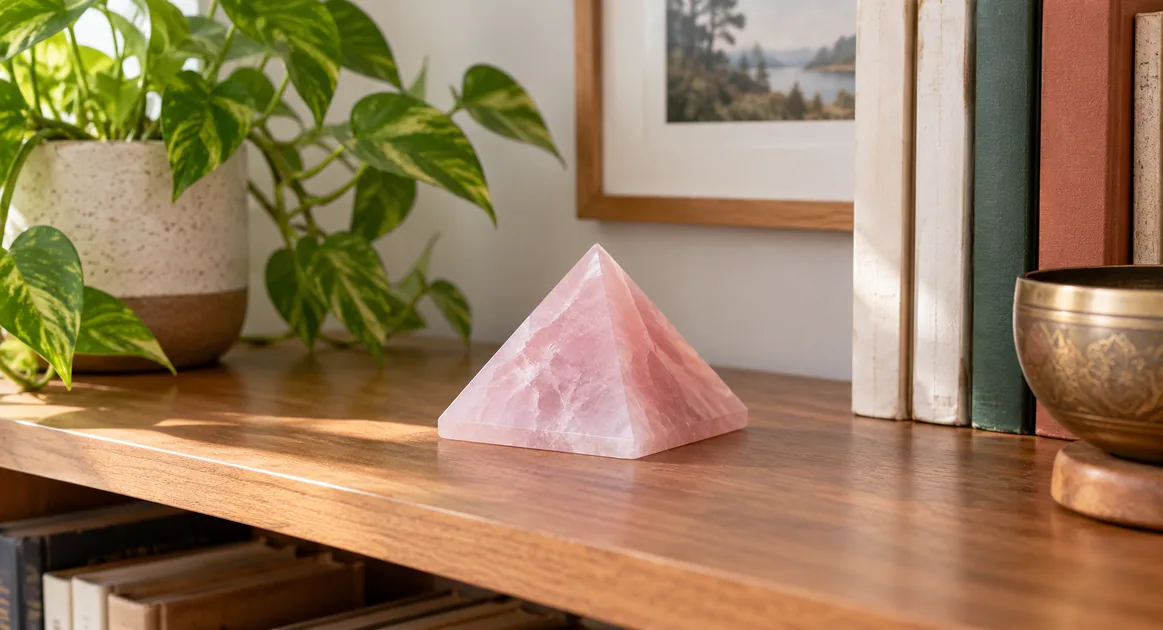
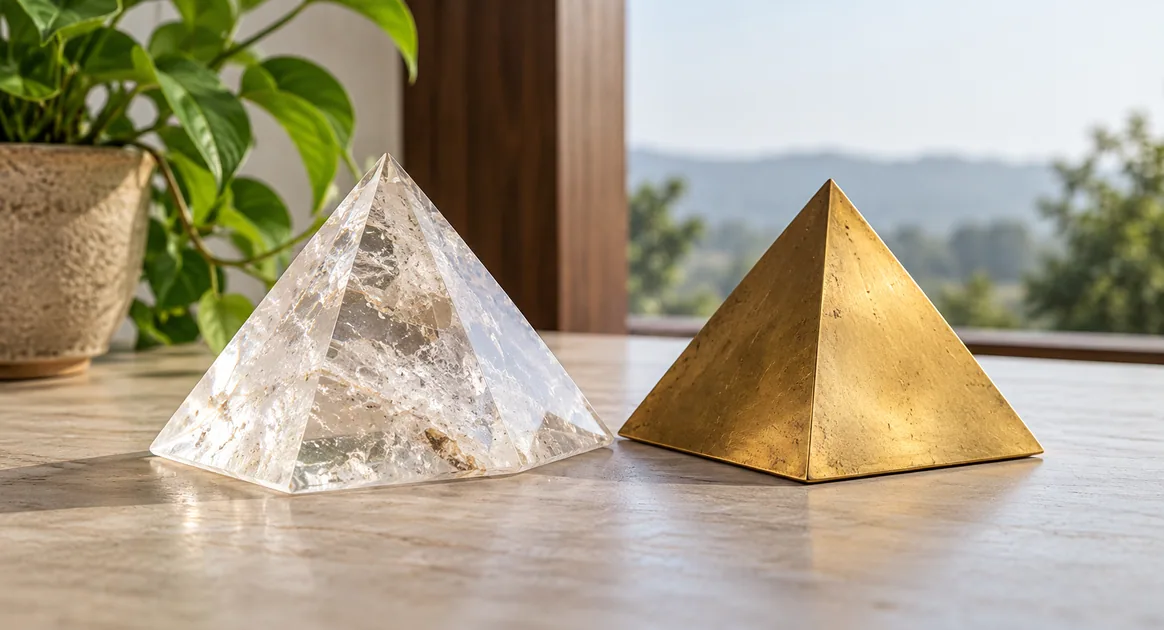
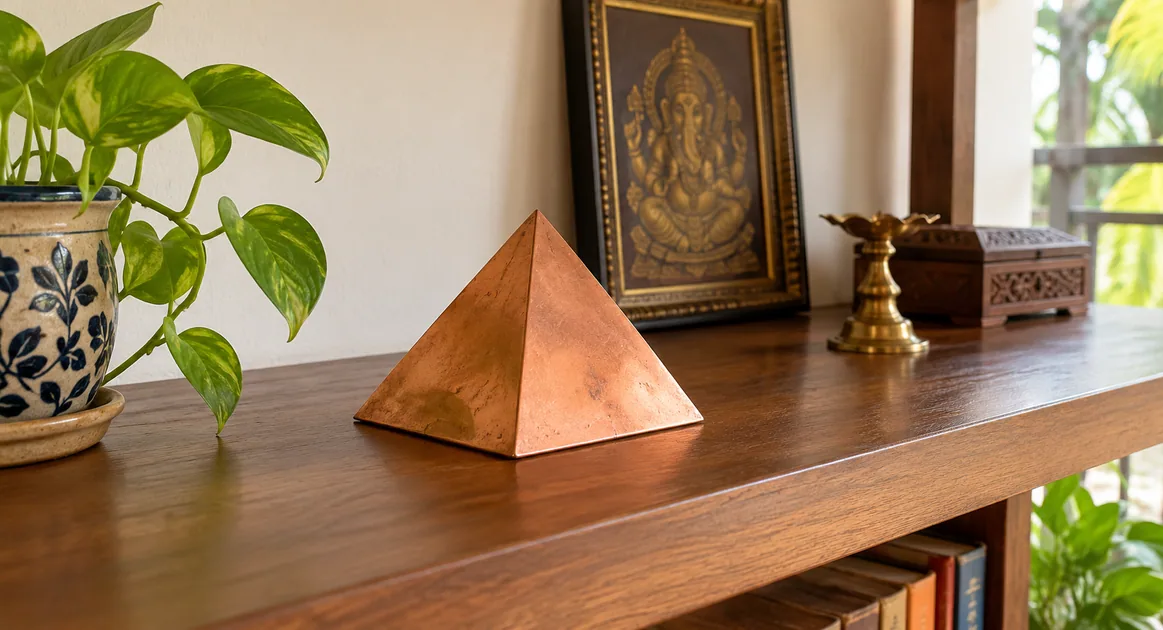
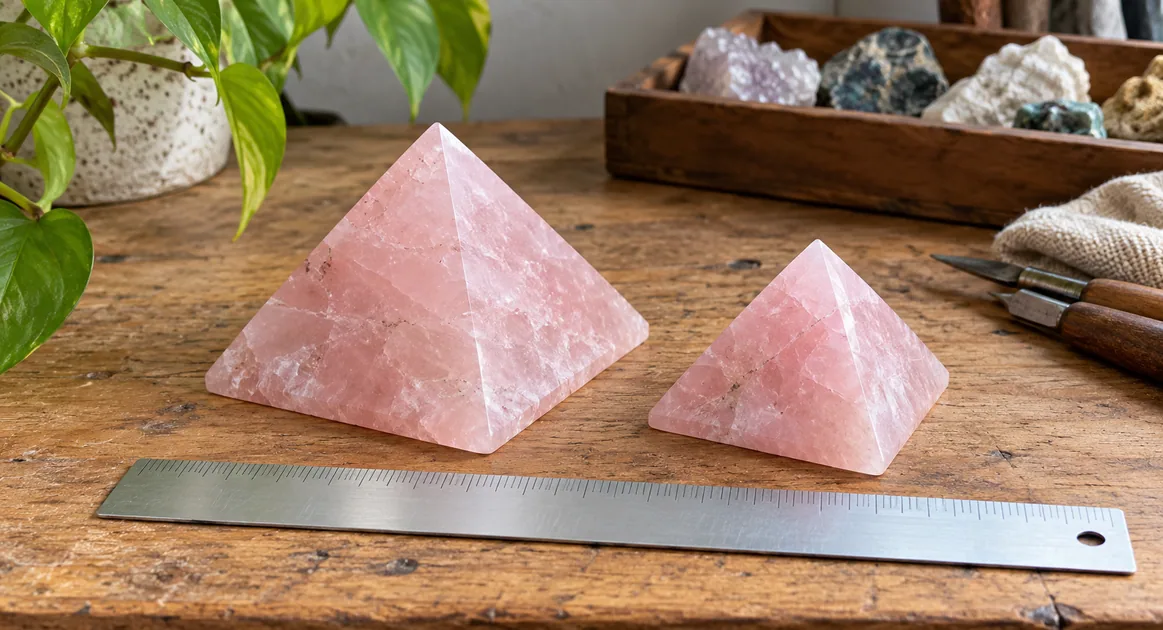
Should you buy one Vastu pyramid or a set of four, seven or nine pyramids? The most useful answer begins with the intention, the physical objects and the available place—not a claim that a higher count must create a stronger effect. A single Sphatik pyramid can be meaningful on a modest puja shelf. Four matching quartz pyramids may suit an ordered demonstration or symmetrical display. Seven different stones may help someone contemplate contemporary chakra associations. A nine-piece Navagraha-themed collection needs a coherent, clearly explained correspondence for Surya, Chandra, Mangala, Budha, Guru, Shukra, Shani, Rahu and Ketu. These are different choices, not interchangeable packages.
On a product listing, however, the terms can be confusing. One photograph may show nine pieces without saying whether each is included. A plate with nine raised pyramidal forms is physically unlike nine removable carvings. A colourful set may contain natural gemstone, dyed stone, glass, resin or mixed materials. A buyer deserves to know exactly what is supplied, what each component represents, how the arrangement is intended to be used, and how each material should be cared for.
This guide compares single pyramids, matching sets, mixed-gemstone sets, fixed plates and traditional or modern symbolic arrangements. It explains Sankalpa, Pancha Mahabhuta, Ashta Dik, Navagraha and contemporary chakra groupings without confusing a themed retail set with a universal instruction from classical Vastu Shastra. It also gives practical checks for dimensions, component count, material disclosure, condition, cleaning, shipping and professional Vastu consultation.
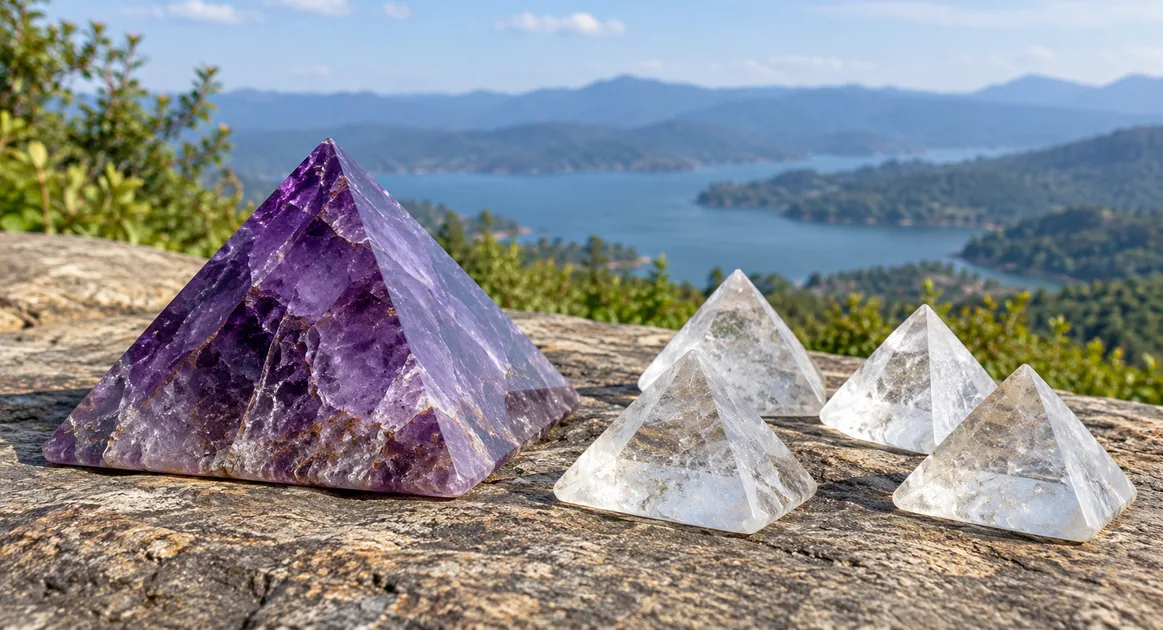
1. A single pyramid and a set solve different practical needs
A single pyramid is one identifiable object, usually with a square base and four triangular faces converging toward an apex. Its mineral, dimensions, finish and condition can be examined separately. If you want one clearly chosen object in a dedicated place, or you want to understand the material before buying more, the single-item format is often the most manageable. It is also easier to wrap, store, label and inspect for chips.
A set has more than one element, but the word “set” describes a sales and assembly format, not a single standard construction. Four independent carvings, seven different gemstones in a fitted box, nine pyramid shapes bonded to one base and a tray holding several pyramids are all different arrangements. A seller should describe the construction plainly because the display, care requirements and replacement options differ substantially.
| Format | What is physically supplied | Typical reason to choose it | Important check |
|---|---|---|---|
| Single loose pyramid | One freestanding piece | Compact puja shelf, desk, gift or mineral study | Actual material, measured base, apex and stability |
| Matched loose set | Several separate pyramids of one material or design | Symmetry, distribution or a repeatable display | Quantity, matching tolerance and dimensions of each |
| Mixed-stone set | Separate pyramids made from different listed materials | Colour symbolism, teaching or comparison | Individual stone identification and treatments |
| Fixed pyramid plate | Multiple raised forms attached to one common platform | One-piece placement or specific layout | Whether forms detach; plate size and material |
| Nested or stepped design | Several levels or forms built into one item | Architectural appearance or particular product design | Do not mistake visible layers for separate objects |
| Set with accessories | Pyramids plus tray, cloth, diagrams, cards or storage box | Gifting, display or professional reference | Which pictured accessories are actually included |
Before comparing prices, establish which of these formats the listing actually offers. “Nine pyramids” may mean nine individual units; “nine-pyramid plate” usually points to a single assembly. A photographic prop is not a promised component. A seller should list any base, velvet pouch, plate, compass, labels or diagram included in the order.
2. When one pyramid is the better choice
For a small Bengaluru apartment, a single well-described pyramid can be more useful than an elaborate group. Measure the available shelf and check that the base sits securely without tipping. Place it away from the edge, from the smoke and heat of a diya, and from areas where children or pets could knock it over. If the chosen piece is Sphatik, rose quartz, amethyst or another material with personal devotional meaning, the selection can be intentional without requiring a larger count.
A single pyramid is also an excellent way to examine finish and material honesty. You can see whether the apex is intact, whether the base is level, whether the pattern is natural or artificially coloured, and whether the supplier describes inclusions rather than hiding them. A lone piece avoids the problem of mismatched components arriving in a multi-unit order.
Choose a single when the placement has only one secure surface, you wish to gift a meaningful but uncomplicated object, you are beginning a mineral reference collection, or you prefer to add material varieties gradually. Do not treat the single format as spiritually inferior; in traditional practice, attention, appropriateness, cleanliness and Sankalpa can matter more to the devotee than the number of purchased objects.
3. When a set adds real value
Sets make sense when the relationships among the pieces have a purpose. A family may want matching small carvings for a symmetric shelf; an office may wish to display several consistent objects along one cabinet; a student may use different minerals to learn identification; and a Vastu consultant may need labelled, removable examples for explaining directional and elemental symbolism to clients.
The value lies in the actual included materials, the ability to compare or arrange them, and the convenience of a coordinated presentation. A seven-stone set, for example, may make colour-by-colour teaching easier. A nine-piece set may be useful for describing contemporary Navagraha associations if every correspondence is explicit. An assortment is less useful if several pieces have ambiguous trade names, an unverified mineral identity or overlapping descriptions.
For professional use, an organized set is usually more valuable when accompanied by component labels, real dimensions, documented material identity, source or treatment notes where available, and a repeatable packing plan. These practical details distinguish a study kit from a random cluster of decorative objects.
| Question | Single pyramid | Multi-piece set | Why it matters |
|---|---|---|---|
| Space | One stable footprint | Several footprints or one larger plate | Check actual surface dimensions |
| Inspection | One apex and base | Every component requires inspection | One good photograph may hide a damaged piece |
| Materials | Usually one stated material | Can vary by component | Care may differ within the same box |
| Symbolic use | One focused intention | Several related symbols or placements | Explain the correspondence rather than just the count |
| Replacement | Replace or repair one item | Missing or broken units may affect the grouping | Ask if individual replacements are offered |
| Storage | One padded pocket | Separated compartments and labels | Prevents scratches, tangles and loss |
| Budget comparison | One clearly priced item | Total price plus components and extras | Compare like-for-like dimensions and quality |
4. What do four, seven and nine signify?
Numbers carry different meanings in Indian religious, philosophical and ritual traditions. But those meanings must be explained in their appropriate setting. A set of four is not automatically a classical “four-pyramid cure”; a group of seven is not automatically an ancient seven-chakra prescription; and a box of nine stones is not necessarily a correctly assembled Navagraha arrangement. The component list, teaching tradition and intention determine how a specific set should be interpreted.
Four can invite discussion of the four cardinal directions—Purva (east), Dakshina (south), Paschima (west) and Uttara (north)—or of the four corners of a display. It is a convenient visual scheme for a physical arrangement. A buyer should not infer that placing exactly four pyramids in any four corners necessarily resolves a building’s Vastu Dosha. Traditional Vastu assessment concerns the site, entrance, room functions, orientation, proportions and the specific school of practice.
Seven is familiar from Sapta Rishi, Sapta Dhatu and contemporary seven-chakra presentations. In the chakra context, colours and stones are often used as a practical modern learning aid for Muladhara, Svadhisthana, Manipura, Anahata, Vishuddha, Ajna and Sahasrara. Those colour-and-stone correspondences vary among contemporary practitioners. They should be described as the selection used in the kit, not as one universally mandated mineral list.
Nine has a clear role in Navagraha worship and Jyotish, involving Surya, Chandra, Mangala, Budha, Guru (Brihaspati), Shukra, Shani, Rahu and Ketu. Yet the gemstones used for Navaratna or Navagraha discussions belong to specific traditional correspondences, and a commercial pyramid set might use affordable substitutes or symbolic colours instead. An authentic description must say whether it is a traditional gemstone set, a symbolic colour teaching kit, or merely nine assorted pyramids.
| Set count | Possible theme | What the seller should explain | What must not be assumed |
|---|---|---|---|
| 1 | Focused Sankalpa or one material | Selected stone, symbol and practical placement | One means weak or incomplete |
| 4 | Cardinal directions or symmetrical display | Compass orientation, layout and whether all four match | Four identical objects correct every Vastu concern |
| 5 | Pancha Mahabhuta teaching arrangement | How Prithvi, Jala, Agni, Vayu and Akasha are represented | One universal gemstone for each element |
| 7 | Contemporary chakra learning or seven-colour collection | Exact chakra and material mapping used | Seven stones automatically follow one ancient standard |
| 8 | Ashta Dik direction demonstration | Cardinal and intercardinal directions plus named correspondences | Any eight-piece kit is a full Vastu diagnosis |
| 9 | Navagraha/Jyotish teaching or nine-item display | All nine named grahas, component list and substitutes | Nine random stones are automatically Navaratna |
| Other | Custom personal, office or decorative arrangement | Purpose, count, individual materials and layout | Quantity produces a measurable multiplying effect |
5. A Navagraha-themed pyramid set: labels before assumptions
If you want a nine-piece set for Navagraha contemplation, read the item-by-item legend first. A correctly explained symbolic set should name the graha associated with each component, disclose the actual mineral, and say whether the selection represents a traditional gemstone association or a modern colour substitution. For example, a yellow quartz-like stone in a teaching set must not be marketed as natural yellow sapphire merely because it represents Guru. Likewise, a blue glass piece is not automatically genuine Neelam.
Some traditions discuss Navaratna with ruby for Surya, pearl for Chandra, red coral for Mangala, emerald for Budha, yellow sapphire for Guru, diamond for Shukra, blue sapphire for Shani, hessonite for Rahu and cat’s-eye chrysoberyl for Ketu. These are traditional associations, not proof that a given pyramid assortment contains those gem materials. Natural gem-grade materials of these types, especially in sizeable carved pyramids, can be substantially different from the inexpensive substitute stones commonly used in colour-coded craft or teaching products.
For Jyotish-based personal selection, a competent practitioner may also consider Janma Kundali, Lagna, Graha Bala, Rashi, Nakshatra, Dasha, Bhava associations and the specific purpose of a recommendation. Purchasing nine decorative pyramids does not replace that chart-based reasoning. A shop can still offer a clear symbolic educational kit without promising that it functions like a prescribed Navaratna ring or an individually chosen graha remedy.
| Graha | Traditional gemstone often discussed | Retail listing must clarify |
|---|---|---|
| Surya | Manikya / ruby | Ruby versus red glass, garnet or coloured substitute |
| Chandra | Mukta / pearl | Pearl, moonstone or white symbolic material are not identical |
| Mangala | Moonga / red coral | Organic coral versus dyed mineral or ceramic |
| Budha | Panna / emerald | Emerald versus green aventurine or coloured substitute |
| Guru / Brihaspati | Pukhraj / yellow sapphire | Sapphire versus citrine, calcite or glass |
| Shukra | Heera / diamond | Diamond versus quartz or crystal-like substitutes |
| Shani | Neelam / blue sapphire | Sapphire versus sodalite, lapis or blue glass |
| Rahu | Gomed / hessonite | Hessonite versus orange/brown substitute |
| Ketu | Lehsunia / chrysoberyl cat’s eye | Chrysoberyl cat’s-eye versus tiger eye or fibre-optic glass |
The above is a teaching reference for common traditional naming, not a claim that every Navagraha set should be carved from these materials. Some devotional practices use nine coloured substances, grains or other offerings instead of gemstone carvings. The listing should explain its own tradition and actual composition precisely.
6. Five elements and eight directions: how to design an educational arrangement
Pancha Mahabhuta names five elements: Prithvi (earth), Jala (water), Agni (fire), Vayu (air) and Akasha (space). In Vastu discussions these concepts describe qualities and relationships within a built environment. A modern group of mineral pyramids might use colour, texture or an explanatory label to represent one element, but natural minerals are materially composed of chemical substances; calling a stone “water element” is a traditional or symbolic classification, not its chemical identity.
The eight directions, Ashta Dik, are Purva, Agneya, Dakshina, Nairritya, Paschima, Vayavya, Uttara and Ishanya. When arranging individual pyramids for a directional demonstration, identify a north reference and label each intended location. Check whether the audience needs a simple eight-direction diagram, a chart of a particular Vastu school or an actual inspection of the building. These are different tasks.
A professional should avoid placing a ready-made “directional kit” without assessing the actual room orientation, circulation, lighting, shelves and safety. Ishanya may be associated with puja or reflective use in many contemporary explanations, while Agneya is discussed in relation to Agni; the real location, family practices and the consultant’s methodology should determine whether a particular object belongs there. No universal arrangement of loose pyramid carvings substitutes for a complete Vastu analysis.
| Direction | Traditional name | Common contextual association | Display consideration |
|---|---|---|---|
| East | Purva | Sunrise, Surya, openings and orientation | Avoid blocking light or circulation |
| South-east | Agneya | Agni and activity | Keep carvings away from cooking heat |
| South | Dakshina | Direction and room-function assessment | Choose a secure, accessible surface |
| South-west | Nairritya | Stability and grounding in some systems | Prefer a stable base and avoid clutter |
| West | Paschima | Western orientation in the plan | Check sunlight and display fading |
| North-west | Vayavya | Vayu, movement and transitions | Secure loose pieces in high-traffic areas |
| North | Uttara | Kubera and prosperity in some practices | Use a tidy shelf or work area |
| North-east | Ishanya | Puja, contemplation and Shiva associations | Maintain cleanliness and flame clearance |
7. Fixed nine-pyramid plates are not the same as nine loose pyramids
Many retail photographs show a baseboard, metal grid or resin platform carrying multiple pyramid shapes. This design may be described as a nine-pyramid plate or layered arrangement. It has its own dimensions, weight and joining system. The user usually places one assembly rather than arranging nine independent objects. The material of the plate and the material of its raised elements both matter: copper-coloured plating, brass sheet, solid copper, wood, composite resin and painted plastic have different properties and care needs.
By contrast, nine loose stone carvings need nine spaces or a tray with separate recesses. They can be examined, rotated or moved individually. Replacements are possible if matching stock is available. If the supplier promises a traditional geometric layout, ask for a diagram showing which piece belongs where and whether the orientation is fixed. A decorative 3-by-3 display photograph, on its own, is not enough to establish a particular Vastu practice.
| Buying detail | Fixed plate or joined assembly | Separate-pyramid kit |
|---|---|---|
| Piece count | One base carrying multiple forms | Count actual removable objects |
| Measurements | Overall base, thickness, raised height | Base and height for every pyramid; tray separately |
| Construction | Joining, coating, base material, fasteners | Natural or manufactured material of each piece |
| Installation | Stable location for whole object | Arrangement plan and room to separate pieces |
| Cleaning | Follow the most sensitive attached material | Clean each item according to its own composition |
| Repair | Damage to one form may affect whole assembly | One piece may be individually replaced |
| Packaging | Secure the entire frame and protrusions | Use padded individual pockets and a count sheet |
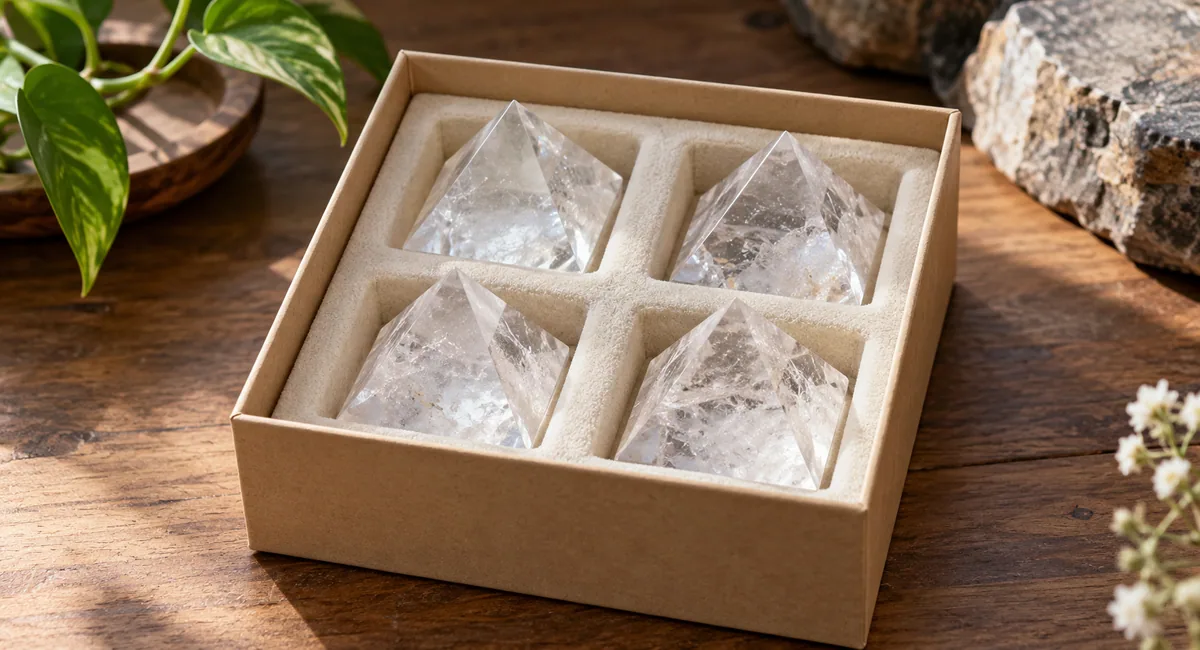
8. How to inspect every pyramid in a set
Begin with a count: remove only the protective top layer, photograph the unopened arrangement and compare the received pieces with the written invoice. A four-piece order should have four individual units if that is what the listing promises. Next compare the actual dimensions with stated measurements, allowing for any declared handmade tolerance. Check each apex under good diffuse light; a chip or unstable base should be recorded separately from ordinary natural mineral banding.
Inspect the sides and underside for cracks, glue seams, cavities, coating overspray, dye concentration, patched chips or labels hiding poor finish. A joined or reconstructed carving can still be sold transparently when described accurately. Natural variation may account for different colour bands or inclusions, but it should not be used to excuse missing pieces, undisclosed material changes, broken tips or a product substantially unlike the advertised construction.
For mixed-stone sets, look at the label for each specimen. Commercial names such as “onyx”, “jade”, “sunstone”, “cat’s eye”, “crystal” or “selenite” can be ambiguous. Ask which mineral, rock or manufactured material is meant. For a higher-value set, ask whether photographs show the exact supplied pieces and whether any test report applies to each item or only to an unrelated sample.
9. Care depends on the weakest material in a mixed set
One cleaning routine is not appropriate for every pyramid. Quartz and many silica-rich rocks tolerate gentle dusting, while gypsum and rock salt should generally be kept dry. Calcite can react with acids. Fluorite has prominent cleavage and can chip. Obsidian is volcanic glass and may have sharp fractured edges. Pyrite can deteriorate in unsuitable humidity, and copper or brass can tarnish or corrode depending on exposure. A mixed collection should be stored so that one damaged specimen does not contaminate the others.
GIA gemstone-care guidance distinguishes hardness from toughness and warns that heat, sudden changes in temperature, treatments and cleaning methods affect different materials differently. The Canadian Conservation Institute specifically identifies physical handling and humidity as major concerns for mineral collections, including pyrite and salt. For a shop or professional kit, a general rule is dry, gentle dusting; individual protective compartments; and material-specific care instructions. Never immerse a mixed set simply because one quartz piece can tolerate water.
Traditional Shuddhi or ritual cleansing can be respected without exposing vulnerable materials to damaging liquids. Maintain a clean altar, use suitable dry methods or symbolic prayer practices when appropriate, and keep the materials safely away from water bowls, salt solutions, incense ash, oil spills and the intense heat of lamps. Consult the specific family or sampradaya custom for devotional details while considering the conservation needs of the object.
| Material in set | Main concern | Conservative care approach |
|---|---|---|
| Clear, rose or amethyst quartz | Scratches, edges; possible colour/light sensitivity | Soft dry cloth; avoid impact and prolonged harsh sunlight for colour-sensitive pieces |
| Fluorite | Cleavage and relatively easy scratching | Separate padding; avoid knocks and heat shock |
| Calcite | Softness and acid reaction | Dry cleaning; no vinegar or acidic cleaners |
| Gypsum / satin spar | Soft surface and water vulnerability | Keep dry and prevent rubbing against harder stones |
| Halite / rock salt | Dissolution and moisture absorption | Dry stable location; never wet-clean |
| Pyrite | Potential oxidation in humid conditions | Dry ventilated monitoring; isolate any deteriorating specimen |
| Copper / brass | Tarnish, corrosion, surface coatings | Avoid salt residue and uncontrolled moisture |
| Obsidian / glass | Sharp chips and breakage | Padded individual recesses; inspect fractured edges |
| Dyed or assembled materials | Colour transfer, glue or coating damage | Avoid soaking, solvents and untested cleaners |
10. The actual price comparison: per-piece cost is only the beginning
To judge value, divide a set price by the number of included pyramids only after checking that their materials and dimensions are comparable. A smaller carving uses less material, and a seven-piece display of very small stones may contain less total gemstone than one substantial specimen. Conversely, a coordinated set may include individual identification, polishing, padded packaging or a useful printed legend. The correct comparison is between real, documented offers.
Ask for the net weight of the pyramids, not merely gross courier weight with box and padding. If the pieces differ in material, a higher mass does not prove better quality: quartz, pyrite, metal and resin have different densities. A matched single-material set should state whether it includes pieces of equal dimensions or a graded range. Natural inclusions and colour variation are not automatically defects, but substantial differences from a matching promise deserve clear disclosure.
Returns matter more with sets because the wrong component can spoil the intended grouping. Before buying, check whether a missing or damaged unit will be replaced individually, whether a replacement is likely to match and whether the customer must return the whole kit. Record each component in a delivery photo; this makes post-delivery conversations far easier.
| Ask before purchasing | What a useful answer contains | Red flag |
|---|---|---|
| Exactly how many? | Number of removable pyramids and other included parts | Photo shows more objects than order promises |
| What materials? | Individual mineral or alloy names; treatment disclosures | Only vague labels such as “original energy crystal” |
| What sizes? | Each base, perpendicular height and practical tolerance | No measurements, only “standard size” |
| What is the weight? | Net item mass and gross shipping mass separately | Shipping weight presented as mineral weight |
| Is the photo exact? | Exact-item images or clearly identified representative photographs | Unique patterns implied to be identical across stock |
| What does seven or nine mean? | Specific symbolic or educational legend | Number alone claimed as guaranteed performance |
| How is it packed? | A separate recess or wrap for every delicate component | Loose stones touching each other in a box |
| What if one breaks? | Replacement, return and defect-handling process | No practical policy for partial damage |
11. Worked example: one pyramid for a Bengaluru family puja shelf
Consider a family with a shallow wooden shelf used for flowers, photographs and a small diya. They are considering either one modest Sphatik pyramid or a seven-piece mixed-gemstone kit. First they measure the clear shelf space left after the daily puja objects are arranged. A small single piece with an identified material and stable base is easy to accommodate; seven pieces might crowd the lamp and the offering plate.
The family associates Sphatik with clarity and Shiva-oriented devotional practice, and sets a simple Sankalpa for regular prayer and a peaceful home. Their choice is meaningful because the object suits the space and their tradition. It does not need to be described as a measurable substitute for room planning or a stronger remedy because of the number of pyramids purchased. They store the object away from flame, wipe dust carefully and inspect its tip during cleaning.
If the family later wants to learn how contemporary chakra-themed sets are arranged, the seven-piece kit can be a separate educational purchase with the names and materials listed. The two purchases have distinct purposes, so comparing them by number alone would be misleading.
12. Worked example: showroom display with four matching pyramids
A jewellery showroom wants a balanced visual arrangement near a consultation counter, without blocking sightlines to the products. Four matching quartz pyramids in individual padded recesses may make an orderly presentation. The team checks that the pieces share the specified dimensions and finish, labels the stone type, and positions them on a stable display tray outside the flow of customers.
If the owner prefers a north-facing display associated with Kubera or prosperity symbolism, the shelf direction is checked rather than guessed from a photograph. The arrangement is explained as part of the showroom’s aesthetic and personal Vastu practice. It is not claimed that four objects guarantee increased sales or replace the real work of merchandising, service, security and lighting.
At closing time, the team can count all four, check their tips and put them back in their marked compartments. That simple operational habit is a reason a coordinated set may be preferable to unrelated loose pieces in a busy commercial environment.
13. Worked example: professional Vastu and Jyotish demonstration kit
A consultant may carry an eight-direction diagram, a five-element reference set, a seven-colour contemporary chakra sample and a nine-graha symbolic chart. These should be separate teaching modules—even if they use some of the same stones—because the conceptual frameworks differ. A client asking about Ashta Dik is not necessarily asking for a chakra selection or a Kundali-based gemstone prescription.
The consultant first labels every component with its physical material and treatment status. Next they add a second label for the symbolic association used in that teaching exercise. For example, “green aventurine — Budha-themed colour reference” is clearer than presenting the item as genuine Panna. The kit records whether an association is Jyotish, devotional, classical Vastu, or a modern crystal-practice interpretation.
For an actual property, the practitioner documents room orientation, entrance, kitchen, bedrooms, sanitation, ventilation, activity zones and customer concerns before recommending objects. A loose-pyramid arrangement can illustrate the plan but should not obscure the architectural questions. After a session, each piece returns to an individual labelled slot, and the consultant notes damaged, lost or substituted items before the next appointment.
14. How to plan a four-, seven- or nine-piece display without clutter
Sketch the entire display on paper before buying. Mark the outer dimensions of the tray, the footprint of each pyramid, the clearance needed for cleaning and the position of lamps, books, flower vases or customer paperwork. Three rows of three loose pyramids require more than three times the base length in each direction because there must be some gap between pieces. For a four-piece set, a two-by-two arrangement may be easy to view, but leave enough clearance so the corners do not touch.
Next decide whether order matters. In a simple decorative display it may not; in a Navagraha or eight-direction teaching layout the practitioner needs an explicit diagram. Labels should remain readable without needing the client to move sharp or fragile stone tips. A tray, open shelf or secure cabinet can support a presentation, but avoid assuming that a fixed orientation or numbered pattern supplied by one manufacturer is valid in every Vastu lineage.
Finally, plan the mundane details: where to put the storage box, how to keep a return inventory, who can handle the pieces and what to do when a replacement differs in colour or size. This prevents a visually attractive new set from becoming difficult to use or maintain.
15. Authenticity, certification and seller disclosure for mixed sets
A certificate attached to a mixed set may refer only to one sample, one material type or the seller’s own inspection. Read the report scope: does it identify each pyramid, a batch, a single selected stone or merely the trade category? Lab testing can help establish certain material properties, but no report should be represented as validating a specific spiritual outcome. For many modestly priced decorative sets, full gem-laboratory identification of every piece may be impractical; the alternative is a precise, modest description and honest treatment disclosure.
Differentiate natural gemstone, laboratory-grown gemstone, dyed natural stone, glass, resin, metal and assembled or reconstructed products. An object can be decorative and useful for a chosen symbolic activity without being sold as an untreated natural mineral. Genuine sellers should be willing to disclose when colour is enhanced, a stone is filled, material is assembled from fragments, or the pictured setting is not supplied.
For high-value or rare pieces, request close views of the underside, apex, four faces, edges, packaging and any hallmark or lab report actually associated with the delivered item. Do not test a retail item destructively with acid, heat, scratching or prolonged soaking. If identity matters commercially, use suitable professional gemmological examination.
16. A sensible receiving, labelling and storage routine
At delivery, photograph the closed box, the opened layout and the full spread of components. Count loose pyramids separately from the tray, cards and accessories. Match each piece to the product description and note any discrepancy immediately. Check the tips and bases under side light and inspect for loose fragments before placing anything near puja materials or public displays.
Label the individual pockets with a neutral component name such as “Clear Quartz 1”, “Amethyst 2” or “Blue symbolic reference — sodalite”; keep any separate Vastu or Graha interpretation in a companion key. This makes it possible to reorganize a kit later without losing the verified material identity. For a professional kit, retain the purchase date, photograph, any treatment declaration and a record of repairs or replacements.
For storage, use soft, clean, individual padding and avoid direct contact between different materials. Keep pyrite separate if signs of deterioration develop. Do not store halite in a damp cupboard or place gypsum beside an open water vessel. Metal plates should not sit in spilled salt, oil or strongly humid environments. A fitted box is a helpful accessory only if its compartments actually protect the objects.
17. Frequently asked questions about single pyramids and sets
1. Is one Vastu pyramid enough for a home?
A single pyramid can be enough for a modest decorative or devotional intention when it suits the available space. A building-specific Vastu assessment is a separate matter; more pieces are not automatically required.
2. Does a set of four have to go in all four corners?
No universal rule applies to all commercial sets. Some presentations use the cardinal directions or four corners as a symbolic framework, but room orientation, safety and the chosen tradition need to be considered.
3. What is the difference between four pyramids and a four-tier pyramid?
Four loose pyramids are four removable objects. A four-tier object is generally one joined or stacked construction. Ask for the actual component count and a photograph of the underside.
4. Are seven gemstones always the seven chakras?
No. A seven-stone assortment may use chakra symbolism, but the exact stones and colours vary among contemporary practices. Read the supplied mapping rather than assuming.
5. Is every nine-piece pyramid set a Navagraha set?
No. Nine pieces may simply be a decorative quantity. A Navagraha-themed kit should identify all nine grahas and disclose the material used for every association.
6. Must nine pyramids contain all nine traditional Navaratna gems?
Only when the seller explicitly offers such a material composition. A colour-coded symbolic set using substitute stones is different from a true Navaratna gemstone assortment and should be labelled accordingly.
7. Can I mix different stones in one set?
Yes, for a documented purpose such as learning, colour symbolism or display. Keep an inventory and adapt handling and cleaning to the most sensitive component.
8. Is the total number of points a measure of power?
There is no standard physical test that ranks a set by a claimed multiplying effect of its apexes. Evaluate the actual construction and the traditional meaning offered by the practitioner or maker.
9. Are all pieces in a matching set identical?
Natural materials may differ in inclusions, colour zoning and minor finish. Dimensions and acceptable variation should be disclosed; missing items and chipped tips are not ordinary natural variation.
10. Is a fixed plate easier to use than loose pyramids?
It may be simpler to position as one object, but it is less flexible for individual examination or replacement. Check the plate material, mounting method and dimensions.
11. Can a mixed set be cleaned with water?
Do not assume so. Gypsum and rock salt are moisture-sensitive, and some coatings or metals also need caution. Use a material-specific plan and conservative dry care where uncertain.
12. Can I place pyramids near a diya?
Use safe heat and flame clearance. Soot, spills and temperature changes can damage finishes and some minerals; an unstable pyramid near a lamp is also a physical hazard.
13. How should I compare prices per pyramid?
Divide only when the sets have comparable sizes and materials. Compare net mineral mass, condition, treatment, included accessories, packaging and replacement support too.
14. What if an online image shows a tray and nine stones?
Ask whether the tray and all nine stones are included. Props, cards and decorative fabric may appear in the photo without being part of the purchase.
15. Are seven-, eight- and nine-piece sets interchangeable?
No. Chakra-themed seven-piece, Ashta Dik eight-direction and Navagraha nine-graha arrangements address different frameworks; their intended interpretations should be kept distinct.
16. Should a Navagraha set be chosen from my Kundali?
A Jyotish recommendation for personal wearing or remedies may consider Lagna, Graha, Bhava, Dasha and other chart factors. A decorative nine-piece reference kit does not replace individualized chart interpretation.
17. Can one damaged pyramid be replaced separately?
Often that depends on the seller and on matching stock. Confirm the partial replacement or return policy before buying the full kit.
18. Do laboratory reports verify spiritual effectiveness?
A gemmological report may address identity, treatment and sometimes origin within its scope. Traditional significance and personal devotional use are separate from laboratory mineral analysis.
19. How many pyramids should a professional Vastu kit carry?
There is no universally required count. A small well-labelled set with credible material identification, clear teaching modules and protective storage is often more useful than a large unorganized assortment.
20. What is the best final buying checklist?
Confirm format, count, exact materials, treatment status, measured size, item weight, photographs, included accessories, arrangement legend, care instructions and replacement terms before purchasing.
18. Final recommendation: choose a coherent purpose, not a higher count
For a family choosing a single object for a tidy puja shelf, buy one well-identified pyramid with suitable dimensions and a material that fits the devotional practice. For a coordinated display, choose a matched set with every component accounted for. For contemporary chakra education, request the actual seven-colour or seven-stone legend. For Navagraha study, insist on nine clearly labelled graha correspondences and honest substitute-material descriptions. For a professional Vastu kit, prioritize traceable identification, care, storage, safety and the ability to explain why each object is present.
Whether the choice involves Sankalpa, Pancha Mahabhuta, Ashta Dik, Lakshmi, Kubera, Shiva, Navagraha or chakra symbolism, a useful article and a trustworthy seller should make the physical facts and traditional context easy to distinguish. The right set is the one whose contents, meaning, dimensions and care requirements match the intended use.
Research basis: GIA gem durability and gemstone-care guidance; Canadian Conservation Institute guidance for the care of natural history collections and metals; International Gem Society guidance on storing mineral and gemstone collections; published Sanskrit Vastu references on numerical and directional symbolism. References are acknowledged by name without adding unnecessary outbound shopping links.
Explore existing OmmRudraksha collections
Browse Vastu for the existing collection, or explore gemstone products for other material forms. Each product’s construction and care information should guide your choice.