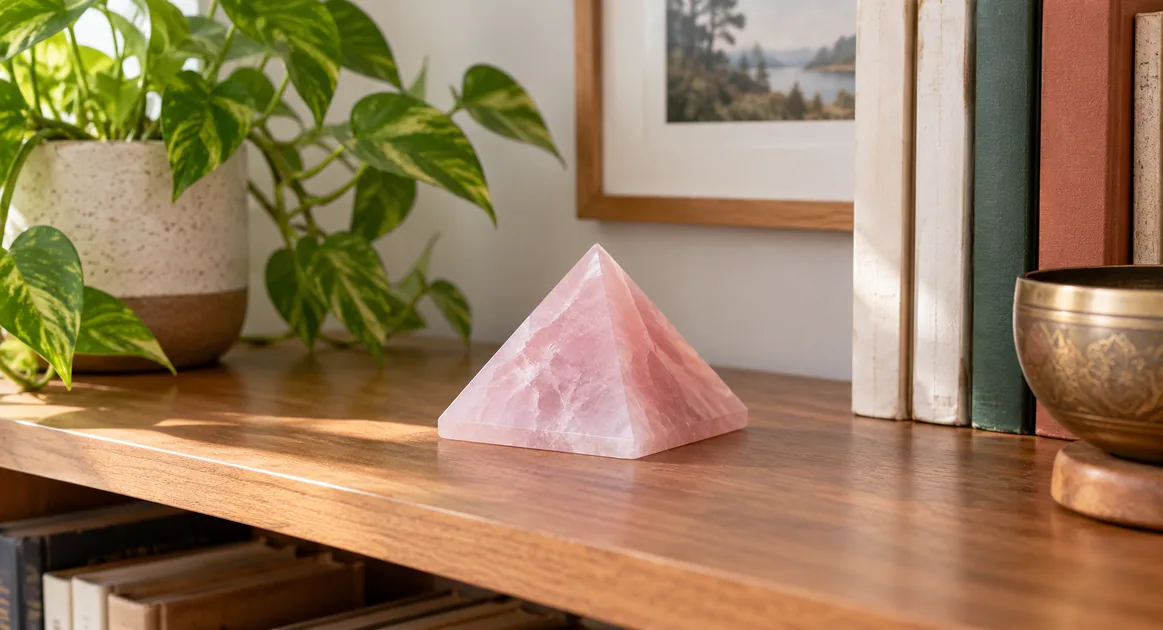
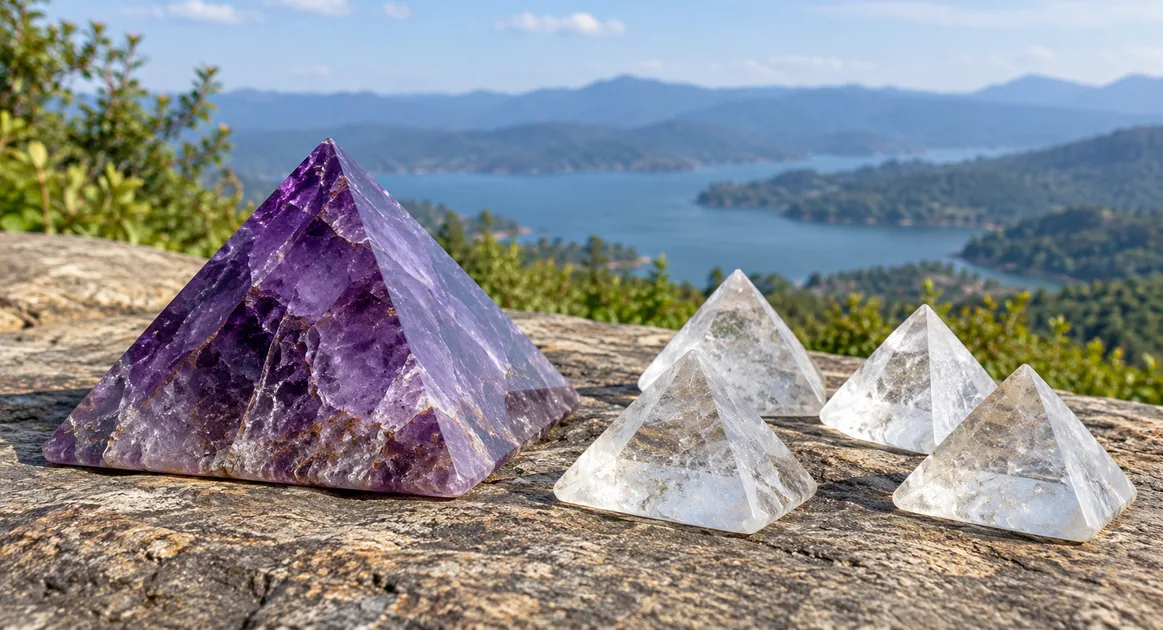
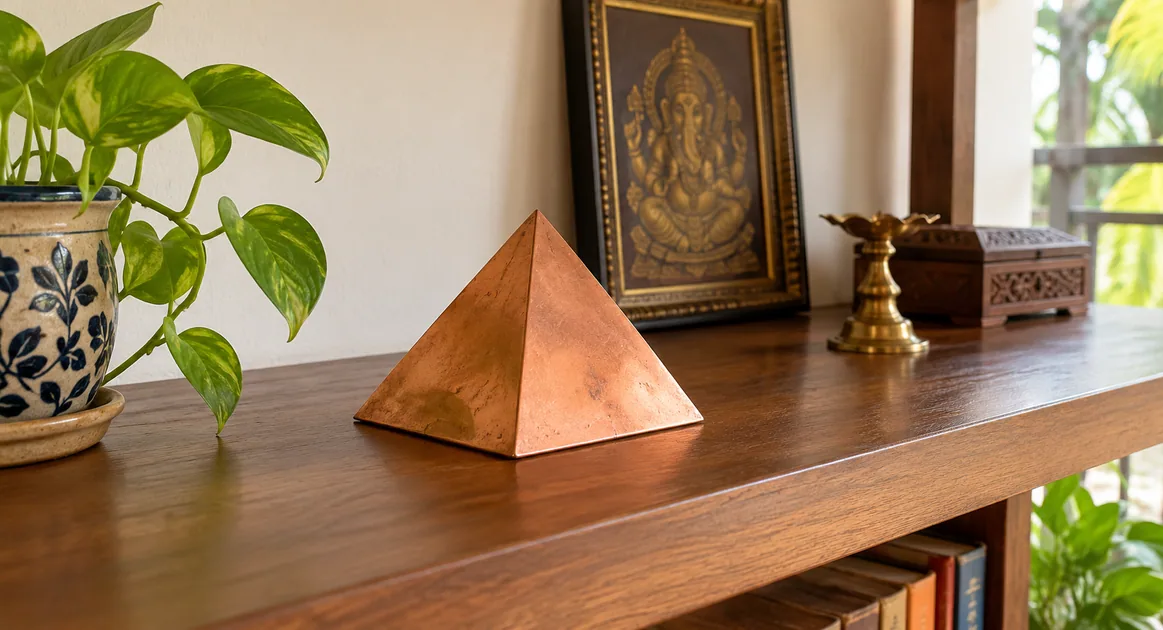
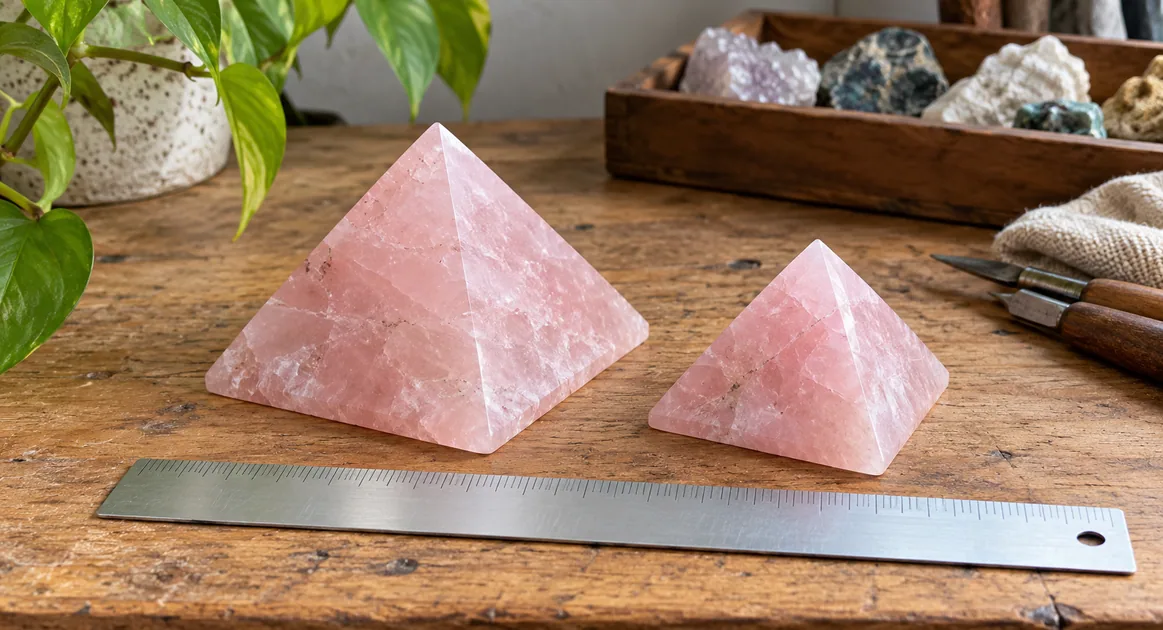
A crystal pyramid and a metal pyramid share a recognisable shape, but their substance, making method, finish, durability, weight and traditional interpretation can be remarkably different. One may be cut from a single piece of Sphatik (clear quartz), another carved from a variegated stone, while a third is a thin copper shell joined along its edges. Some brass pyramids have no faces at all: they are open frames. Others are fixed nine-pyramid plates. Comparing these designs only by photographs, colour or advertised “power” misses the most useful information.
This guide explains what each pyramid actually is, how to inspect construction and surfaces, what copper and brass mean in practical and traditional settings, and how Vastu practitioners select a suitable arrangement for a specific room. It also explains why a carefully made hollow piece can be preferable to a poorly finished heavy carving, and why a decorative crystal is not automatically the right material for every puja, meditation or professional Vastu setup.
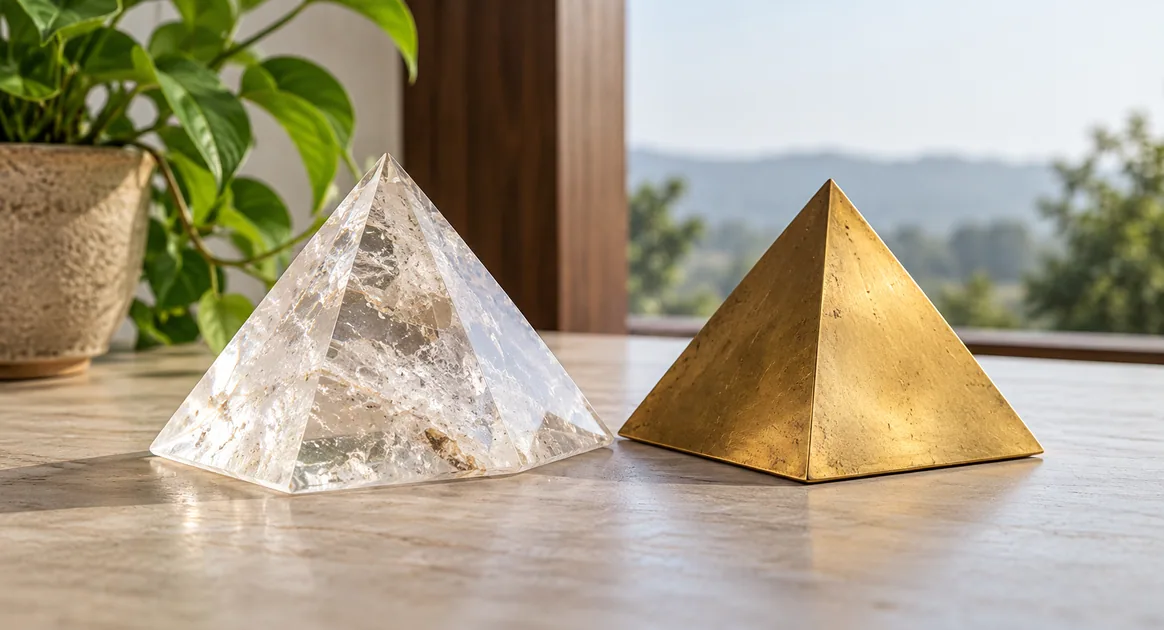
1. What counts as a crystal pyramid, and what counts as a metal pyramid?
In everyday shopping language, crystal pyramid may mean any pyramid-shaped object carved from an identified gemstone, mineral or decorative rock. The word “crystal” does not prove it is quartz, that it grew in the shape shown, or that the carving is untreated. Quartz, amethyst, rose quartz, agate, fluorite, calcite, pyrite and obsidian may all appear in pyramid catalogues, but they are not mineralogically interchangeable. Obsidian is volcanic glass rather than a crystal; lapis lazuli is a rock composed of several minerals. Ask for the actual material name rather than accepting “natural healing crystal” as an identification.
A metal pyramid can be a folded sheet-metal shell, a cast solid body, a hollow frame assembled from rods, a pierced or engraved metal construction, or one component of a larger plate. Copper and brass are both commonly marketed, but they are different materials: copper is an element; brass is an alloy whose chief ingredients are copper and zinc. A copper-coloured plated or painted product is not necessarily made of copper. Bronze, a different copper-based alloy, should likewise not be sold as brass without explanation.
For an Indian home, a puja shelf may favour a small quartz carving for its Sphatik association, while a simple copper frame may suit a carefully arranged Vastu display. Either can be respectful and useful when its identity is known. Shape, symbolism and practical suitability are separate questions that should be answered together, not collapsed into one slogan.
| Point of comparison | Carved gemstone or mineral | Hollow copper or brass shell | Open metal frame | Multi-pyramid metal plate |
|---|---|---|---|---|
| Physical body | Mineral or rock forms most of the object | Sheet, casting or assembled walls | Rods or strips outline the edges | Several forms mounted on one base |
| What you see | Natural colour, veils, grains or inclusions | Opaque reflective or patinated faces | Background visible through structure | Repeated geometry and joins |
| Primary inspection | Mineral identity, cracks, apex, underside | Metal identity, seams, thickness, edges | Joint strength and geometry | Count, attachment points, underside |
| Weight comparison | Depends on density and full volume | Depends on gauge and hollow space | Usually light relative to its footprint | Depends on number and thickness |
| Main care challenge | Material-specific scratching, cleavage, moisture or treatments | Tarnish, coatings, dents or corrosion | Bending and weak joins | Dust between elements and loosened parts |
| Good use | Individual devotional or decorative placement | Stable compact display | Light visual marker on an undisturbed shelf | A clearly documented repeated-pyramid arrangement |
2. Crystal pyramid materials are not one care category
Clear quartz or Sphatik is often chosen for its transparency and devotional associations. Quartz has Mohs hardness 7, making it relatively resistant to everyday scratches; however, a sharp tip can still chip and a surface-reaching fracture can still affect the carving. Amethyst, rose quartz and smoky quartz belong to the quartz family, yet colour stability, visibility of inclusions and treatments still need individual attention. A polished quartz pyramid should not be presented as naturally formed in that square shape: the pyramid is the result of cutting and polishing.
Agate and jasper are commonly durable silica-rich choices, though “jasper” is a broad trade grouping and some vividly coloured agate is dyed. Fluorite has striking colour zoning but lower hardness and pronounced cleavage; a clean-looking point can break if struck. Calcite and gypsum/satin spar are much softer and need careful storage and minimal handling. Rock salt is moisture-sensitive and unsuitable for wet cleaning. Pyrite offers a metallic appearance but certain pieces deteriorate in humid conditions. These differences matter more to maintenance than an all-purpose label such as “stone pyramid”.
The mineral's appearance also affects what buyers should ask. Cloudy rose quartz is not automatically defective; a clear-looking object is not automatically natural; dark inclusions in a stone may be part of its geology. By contrast, an open crack reaching the edge, loose grain, peeling coating or undisclosed repair is a condition or construction matter that deserves disclosure. The correct question is not “Does it look perfectly flawless?” but “What is it, how was it made, and is its condition appropriate for its intended use?”
| Material | Useful physical distinction | Main display or handling concern | Better buyer question |
|---|---|---|---|
| Quartz, Sphatik, amethyst | Quartz family; relative scratch hardness 7 | Chipped tips, fractures, colour/treatment sensitivity | Natural, lab-grown, filled or coated? |
| Agate or jasper | Silica-rich, often patterned | Dyed areas, wrong trade names, fractured edges | Is its colour natural and is the trade name precise? |
| Fluorite | Often green/purple zoning; cleavage | Splitting or chipping from knocks | Are edges intact and has it been repaired? |
| Calcite | Often banded or translucent; soft | Scratches and acid damage | Is it calcite rather than carnelian or quartz? |
| Satin spar gypsum | Fibrous sheen; very soft | Surface wear, water exposure | Is “selenite” being used as a trade name for satin spar? |
| Rock salt | Soluble, humidity-sensitive | Damp shelves and wet cleaning | Is the surface dry and stable? |
| Pyrite | Metallic iron sulfide | Humidity-related change in susceptible pieces | Is the material stable, and are loose grains present? |
| Obsidian | Volcanic glass, conchoidal fracture | Sharp chips, broken edges | Are there any sharp areas or repaired corners? |
3. Copper, brass, plating and surface finishes: what are you buying?
Copper generally shows a warm reddish colour when freshly cleaned; brass usually appears yellow-golden, although its exact tone varies by alloy and finish. Neither surface colour nor a seller's promotional description is a reliable composition test. Copper plating on steel, brass plating, transparent lacquer, coloured varnish and electroplated finishes can look similar in photos. For an expensive or specialised piece, ask whether the object is solid metal, sheet metal, an alloy, plated, lacquered, or mounted on a different substrate.
Copper and brass develop patina and tarnish through contact with moisture, air pollutants, salts and handling. A darkening surface does not by itself mean the piece is counterfeit or damaged. The Canadian Conservation Institute distinguishes stable tarnish from active, loose or powdery corrosion. Fingerprints can leave marks on polished metal. Aggressive polishing can remove the surface layer or destroy an intentional patina; a lacquered surface may need entirely different care from uncoated metal. For household display, gentle dry dusting is a sensible starting point, not lemon-and-salt scrubbing.
A fridge magnet is a weak test of a complete object's identity. Copper and ordinary brass are not strongly attracted to a magnet, but neither are many other materials. A magnet that sticks may indicate a ferrous component or concealed core; a magnet that does not stick cannot prove “pure copper.” Similarly, a printed product weight cannot establish alloy composition unless dimensions, metal thickness and construction are also known. A responsible product description should state what has been verified and what remains a supplier specification.
| Item sold as | Physical construction to verify | Surface language that helps | Main red flag |
|---|---|---|---|
| Copper pyramid | Copper sheet, casting, rod frame or copper-plated substrate | Polished, patinated, lacquered, plated | “Pure copper” without compositional support |
| Brass pyramid | Copper-zinc alloy; folded/cast/assembled | Brushed, polished, antique finish, lacquer | Brass colour used as proof of gold content |
| Copper-coloured frame | Actual rod alloy and joint materials | Paint, plating or clear protective finish | Colour used as the sole metal identification |
| Multi-pyramid plate | Base metal, attachment method, actual number | Engraved, stamped, riveted, soldered | Repeated pyramid count not matching photographs |
| Layered or joined form | Number of layers, gaps, joints and adhesive | Open, hollow, fixed, removable | Claimed single solid piece when assembled |
4. How to inspect a carved stone pyramid
Begin with the four triangular faces and the apex. A crisp meeting point looks attractive, but a tiny flattened or slightly rounded tip may be safer on a shelf and is not automatically poor craftsmanship. Examine whether edges are symmetrical enough for the stated design, whether the base sits flat, and whether colour bands or inclusions run continuously through the stone. These observations inform workmanship, but not material identity by themselves.
Check the underside. A photograph of only the attractive front face can hide a rough base, an uneven foot, a filled cavity, an adhesive pad, or construction seams. Ask for a bottom photograph and one image with a ruler. Do not assume that a heavier carving is better: one dense material can weigh more than another at identical dimensions, and a large-looking translucent carving can be internally filled or assembled. Nor is a tiny internal inclusion a reason to reject a natural mineral.
For a higher-value item, distinguish a one-piece carving from bonded slabs, a reconstructed stone, resin-bound chips or a coating that creates a particular colour. Bonded and composite objects can make attractive decorative gifts when labelled correctly. They become misleading when marketed as a single untreated natural mineral. When an important purchase depends on precise species or treatment, seek appropriate independent gemmological identification rather than destructive kitchen tests.
A close inspection checklist includes: front, back, both sides, top, underside, dimensions, surface feel, visible repairs, polishing quality and treatment disclosure. It is better to assess the actual specimen than rely on one representative catalogue photograph; natural stones vary in pattern and colour, and this variation may be part of their character.
5. How to inspect hollow shells, open frames and metal pyramid plates
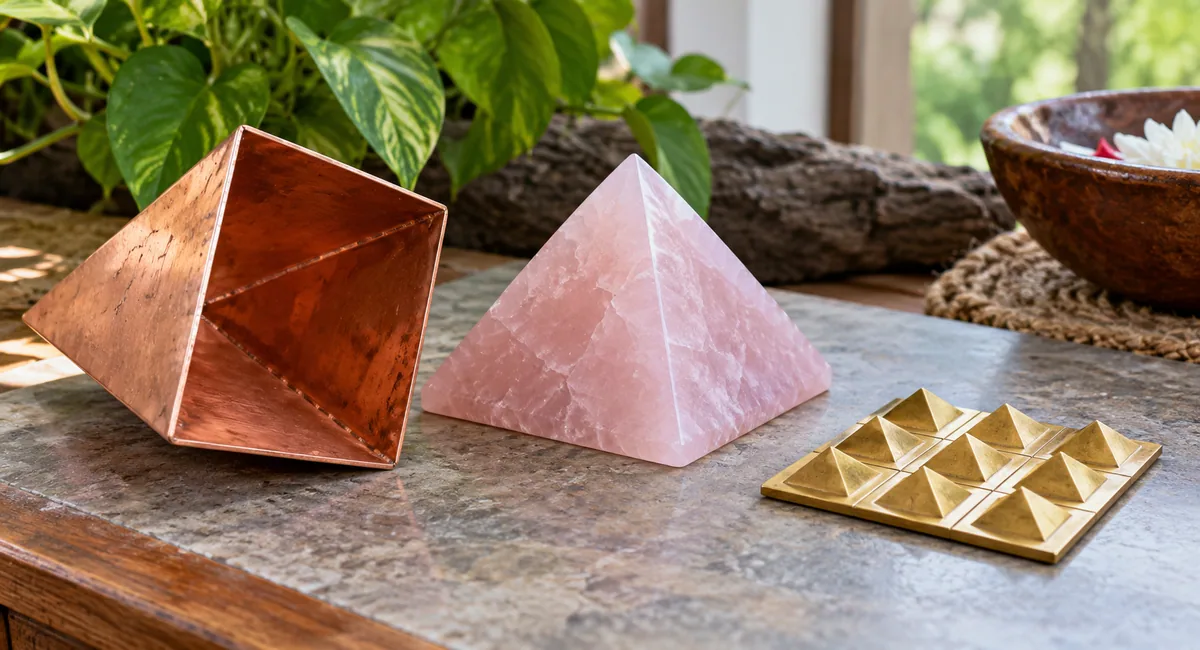
A folded sheet shell has faces, a base opening or cap, and joining points. Look at the edges from below: are they deburred, smooth and firmly joined? Check for visible cracks, uneven folds, thin unprotected corners or flaking finish. A well-made hollow shell is intentionally lighter than a fully cast object. Lightness is not a flaw when the construction is stated accurately and the shell is stable in use.
An open frame is visually different: it represents pyramid edges, leaving the faces empty. Check if the top joint is secure and whether four bottom corners rest in one plane. Gently supported frames should not rock significantly on a flat surface; do not test by squeezing delicate rods. Some frames are assembled with screws or solder and may have different strengths at different joints. If it is sold for an open shelf near visitors, edge comfort and stability matter as much as geometry.
A repeated or nine-pyramid plate adds another layer of questions. Count the actual raised forms. Check whether they are separate attachments, stampings in one sheet or parts of a cast piece, and whether the plate has a protective base. An engraved mantra or Om symbol should have legible, cleanly executed lettering; the presence of a symbol does not answer composition or durability questions. If a set claims special proportions, request actual measurements or a drawing, not just a marketing phrase.
| Form | What to inspect first | Typical construction weakness | Suitable place to display |
|---|---|---|---|
| Solid carving | Surface, tip, base, mineral identity | Chips, fractures, fillings | Stable shelf away from handling |
| Hollow folded shell | Folded edges and joints | Sharp seam, dents, loosened cap | Level, protected desk or shelf |
| Open rod frame | Apex joint, four feet, overall alignment | Bent rod or broken joint | Low-traffic shelf with clear space |
| Cast metal pyramid | Casting quality, finish, feet | Porosity, rough base, coating defects | Stable plinth or shelf |
| Repeated metal plate | Pyramid count, base and attachments | Bent base, detached element | Flat, dust-manageable surface |
| Layered assembly | Each level, fasteners and balance | Loose adhesive or uneven stacking | Protected stationary display |
6. Dimensions, weight and geometry without false precision
A square-based pyramid has a base side, a vertical height measured perpendicularly from the base plane to the apex, and a sloping edge or slant height that is not the same as vertical height. Sellers sometimes quote “height” without saying which measurement is intended. Ask for the base footprint, vertical height, weight and whether measurements include an attached stand. For metal products, request sheet gauge or approximate wall thickness when relevant.
For a geometrically regular solid square pyramid, approximate volume is one third of base area times vertical height: V = (base side × base side × vertical height) / 3. A hypothetical pyramid with a 6 cm base side and 6 cm vertical height has a volume of 72 cubic centimetres. If it were filled entirely with typical quartz at roughly 2.65 g/cm³, the theoretical mass would be about 191 g before allowances for rounded edges, cavities or mounting. This is an explanatory calculation, not a claimed weight for any item sold by OmmRudraksha.
A hollow copper shell of the same outside dimensions can be far lighter even though copper itself is much denser than quartz. That apparent contradiction illustrates why comparing listing weights is not a reliable material test without knowing wall thickness and hollow space. A dense solid metal casting and a very thin metal shell should not be treated as equivalent products merely because their heights match.
Do not infer a specific sacred ratio or a fixed Vastu effect from a product photo. Some modern designs refer to particular slopes or proportions, but a claim about geometry must be supported by actual measured dimensions. Small carved variations are common. For practical placement, stability and clearance around the point matter more than a mathematically perfect apex.
| Specification | What it means | How to verify | Common misunderstanding |
|---|---|---|---|
| Base side length | Width of a square base edge | Ruler or caliper along a straight side | Confused with diagonal width |
| Vertical height | Base plane to apex, perpendicular | Upright measurement on level surface | Slant edge called “height” |
| Slant height | Face-centre to apex distance | Geometric measure or stated drawing | Assumed equal to vertical height |
| Weight | Mass of the actual object | Scale; state whether stand included | Used as sole proof of authenticity |
| Metal gauge | Wall thickness for sheet products | Supplier specification or gauge | Heavier always judged superior |
| Finish | Polish, patina, lacquer, plating | Close-up and seller disclosure | Shiny implies solid precious metal |
| Construction | Solid, hollow, framed or assembled | Underside, joints, product description | All pyramids assumed one-piece |
7. Vastu interpretation: material, direction, intention and setting
In Vastu Shastra, the built space, entrance, use of rooms, directional organisation and the five elements (Pancha Mahabhuta) form a larger framework. A small carved or assembled pyramid is a contemporary Vastu accessory, not a substitute for understanding the premises. Its selection is usually based on the space, the owner's Sankalpa (purposeful intention), aesthetic suitability and the practice being followed. Different traditions and modern schools may give different directional recommendations.
Prithvi Tattva, the earth element, naturally provides language for stone, mineral and stability symbolism; yet a quartz pyramid does not physically become “earth energy” in a way that can be measured from its weight. Agni and Surya symbolism sometimes influence how copper, warm metal colours or a sun-facing space is interpreted. Jala relates to water and fluidity, Vayu to air and movement, and Akasha to space. The material used for a symbolic object is one detail in a much broader tradition, not a universal assignment based only on colour or conductivity.
Ishanya (north-east) is traditionally associated in many practices with the puja or contemplative area, so a small Sphatik object can feel appropriate there when the shelf is kept orderly. Uttara (north) has associations with Kubera in traditional directional deity systems and may be discussed when choosing a business display. Agneya (south-east) invokes Agni in a directional framework, but this does not justify putting a delicate object next to a flame. Nairritya (south-west) is often discussed in relation to steadiness; Vayavya (north-west) relates to air and movement. Actual layout, ventilation, moisture and daily use still determine whether a particular piece can be safely displayed.
A copper frame may be preferred because the practitioner uses a specific yantra-like geometry or metal tradition. A gemstone carving may be chosen for colour, crystal appearance, devotion or meditation. A plate of several forms may serve an organised ritual or visual reference. None of these choices proves that one material is inherently stronger than another. Claims that copper's electrical conductivity automatically establishes spiritual effectiveness confuse a tested physical property with a distinct traditional interpretation.
| Traditional consideration | How it can inform selection | Practical boundary |
|---|---|---|
| Sankalpa | Select a symbol that suits a defined purpose or devotional routine | A stated intention is not a material certification |
| Ishanya / north-east | Contemplative, puja-oriented placement where appropriate | Keep objects away from water spills and heavy traffic |
| Kubera / northern association | A prosperity or business display may use this symbolism | Do not treat placement as a guarantee of revenue |
| Prithvi Tattva | Stone texture and stable placement may suit grounding symbolism | Physical density alone does not decide Vastu suitability |
| Agni / copper symbolism | A metal form may fit a chosen ritual scheme | No flames against fragile coatings or gemstone tips |
| Navagraha or planetary context | Some practitioners integrate a chart-based recommendation | Pyramid shape alone does not assign a Graha |
| Puja and Shuddhi | Prayer, cleanliness and intentional arrangement | Cleaning substances must suit the actual material |
8. Choosing for a home, office, shop or meditation area
At a Bengaluru family home, imagine a compact shelf beside the puja area. The family already keeps a lamp, flowers and water vessels there. A small clear quartz pyramid could be displayed for its Sphatik association, but the shelf must have clearance so the lamp's heat and water do not reach it. A copper shell may be equally meaningful in a different family practice. The useful choice is the one with stable footing, known material, manageable cleaning and a place in the actual devotional routine, not one added because of a vague assertion that more pyramids are always better.
In a jewellery showroom, customers will see reflections, lighting and fingerprints. A polished brass shell looks warm and architectural but may show handling marks; an open copper frame can showcase the background but is vulnerable to bending if handled repeatedly. An agate or quartz carving can demonstrate natural colour and mineral texture, though the original specimen should be shown clearly rather than substituted with a representative photograph. A neat display label can explain “Brass, hollow folded construction, lacquered finish” or “Natural quartz carving, identified material, approximate dimensions” without mixing unverified geological and ritual claims.
On a professional consultant's Vastu table, multiple types can be useful as reference objects. One carved quartz specimen, one hollow copper pyramid, one brass open frame and one multi-pyramid plate let the practitioner demonstrate physical differences to a client. Separate labelled bags, printed measurements and notes on the object's intended symbolic role make the kit more reliable. Heavy stones should not be packed directly against delicate metal frameworks; the owner should be able to find the correct item without scraping finishes together.
At a meditation desk, the object should not crowd the work surface or become an obstacle to reading or breathing practice. The practitioner may prefer the soft visual presence of rose quartz or the clean line of a metal frame. Either can be a focal object in a personal routine. The selection can emphasise comfort, sight line, simplicity and the chosen practice; there is no need to claim that every new item has a distinct measurable force.
| Setting | Often suitable | Placement consideration | Avoid |
|---|---|---|---|
| Small home puja shelf | Compact Sphatik or well-finished metal piece | Stable base; lamp/water clearance | Direct flame, spills, overcrowding |
| Desk or study | Small smooth carving or light stable frame | Clear working area, no exposed sharp point | Unstable stack or frame near a mouse/keyboard |
| Jewellery showroom | Labeled specimen and clean metal comparison | Accurate lighting and easy dusting | Customer handling without supervision |
| Professional Vastu kit | Distinct labeled types and matching information sheet | Individual compartments, transport support | Unlabelled lookalikes and mixed loose pieces |
| Humid entrance/near planter | Material selected for that environment | Dry location, monitor metal finish | Salt, gypsum, pyrite or vulnerable lacquer near moisture |
| Gift | Clearly identified attractive, manageable design | Recipient's space and tradition | Unverified claims of certification or guaranteed results |
9. Buying checklist: inspect the actual product, not a category photograph
Before buying, establish the exact material. “Copper-tone” or “crystal look” describes appearance, not composition. For gemstones, ask for the mineral or rock name, whether it is natural, synthetic, dyed, assembled or reconstructed, and whether surface treatment is known. For metals, ask the base metal, alloy, plating and lacquer status. An honest seller may state that treatment status is not independently tested; that is more useful than an unsupported blanket guarantee.
Next, check construction. A carved one-piece stone, a glued composite, a folded shell and an open metal frame need different images and care instructions. Ask for the underside and close-ups of joints, apex, corners, printed symbols, plating wear and base stability. Confirm whether the product photo is of the exact unit or an illustrative sample. If the colour or banding is part of the attraction, specimen-specific photographs matter.
Then check specifications and intended use. Record base length, vertical height, weight and material; for a set, list each component rather than saying only “nine pyramids.” Check that a proposed location has a firm dry surface, sufficient clearance and a manageable dusting routine. If a practitioner recommends a direction, note the underlying rationale and ensure it is compatible with the real room.
Finally, compare value. A heavier object does not automatically contain a higher quality mineral, and a small hand-finished metal frame is not necessarily worse than an elaborate heavy plate. Price reflects material, size, labour, workmanship, finishing, seller support and sometimes certification. Compare like with like: a genuine carved quartz object should not be priced against a resin-lookalike as though their material claims were identical.
| Ask the seller | Acceptable evidence or answer | If unclear |
|---|---|---|
| What is it made of? | Named mineral/rock or specified copper/brass construction | Request the precise label before purchase |
| Solid, hollow or assembled? | Underside photo and making description | Do not infer from front view |
| Natural, treated, dyed or plated? | Relevant product-specific disclosure | Avoid unsupported “100% pure” labels |
| What are the dimensions? | Base side, vertical height and mass with units | Check diagonal/height ambiguity |
| What does the finish include? | Polish, patina, coating or lacquer details | Do not use solvents until identified |
| What is included in the set? | Exact count and photograph of all components | Reconcile listing title with supplied pieces |
| Is it suitable for intended shelf? | Footprint, point clearance, stability, care guidance | Change placement or choose a safer design |
| Are photographs exact? | Specimen photos or clearly labelled representatives | Request the actual piece when appearance matters |
10. Care, storage and ritual cleaning by material
Start with a clean, dry and stable surface. Dust a robust carving using a soft clean cloth or brush suitable for its finish. Use water only after identifying its mineral and verifying that coatings, fillers or joins tolerate it. Rock salt and satin spar gypsum should not be washed; pyrite should be kept dry; fluorite, calcite and some other softer materials need more protection from scratches and knocks. A single “soak every crystal” instruction would be inappropriate for this variety of materials.
For copper and brass, protect against fingerprints, moisture and aggressive polishing. A stable patina may be part of the intended finish, while powdery or spreading corrosion deserves attention. Do not rub lemon, vinegar, salt or unknown cleaning paste onto a lacquered or plated pyramid. Metal polish is an abrasive intervention, not routine dusting. Keep open frames in a container that supports the shape without compressing the rods; use separate soft dividers for carved gemstones.
Puja methods involving Shuddhi (purification), mantra, incense, flowers, water or oil can be adapted to the actual material. A verbal Sankalpa, a clean cloth and a respectful arrangement can be meaningful without immersing a vulnerable mineral in liquid. Keep oil from touching copper alloys or decorative lacquers; remove damp flowers promptly and do not let incense ash accumulate in metal joints. A pyramid is a decorative or ritual object, not a food-contact container or water-purifying device unless independently certified for that separate purpose.
During a humid season in Bengaluru, store valuable or moisture-sensitive pieces away from damp windowsills, bathrooms and potted plants. Monitor any salt crystal, pyrite or copper-alloy piece for change. For transport, wrap each object individually, protect the tip, label the material and pack hollow metal shapes so they cannot be crushed by heavier stone carvings. Separate a deteriorating specimen for inspection instead of wiping unfamiliar powder onto nearby pieces.
| Material or finish | Routine first step | Avoid | Storage note |
|---|---|---|---|
| Quartz / agate | Soft dry dusting; condition check | Hitting apex or assuming all treated stones are waterproof | Wrap separately from metal edges |
| Fluorite / calcite | Very gentle dry cleaning | Abrasive rubbing and knocks; acids on calcite | Padded, low-traffic storage |
| Gypsum / rock salt | Keep dry; careful light dusting | Immersion and wet ritual cleaning | Dry area, away from humid air |
| Pyrite | Gentle dry care and periodic condition check | Soaking or placing near damp plants | Dry, monitored compartment |
| Polished copper / brass | Remove dust and minimize handling | Aggressive repeated metal polish, salt/lemon paste | Dry padded storage |
| Plated / lacquered metal | Soft cloth and coating-aware care | Solvents, scouring and stripping patina | Prevent scratching and compression |
| Open frame / joined plate | Support all parts when moving | Lifting by a single thin joint | Rigid compartment and dividers |
11. Common buying mistakes and how to correct them
A common mistake is assuming all shiny yellow pyramids are brass or gold. Pyrite, goldstone glass, yellow coatings and brass can appear similar under warm lighting; their durability and meaning are not identical. Another is assuming all clear pyramids are Sphatik. Acrylic, glass and synthetic quartz can look clean in photographs. Request material-specific identification instead of relying on clarity or colour.
A second mistake is treating weight as the measure of effectiveness. Weight may be useful for packaging or confirming a claimed size, but a heavy quartz carving and a thin copper frame were constructed for different purposes. Material density, hollow space and mounted bases make mass an unreliable spiritual ranking. Similarly, a perfect-looking angle is not evidence of an ancient Vastu prescription.
A third mistake is copying one ritual-cleaning method to every object. Salt water, acid and long wet immersion can injure some minerals, coatings and copper alloys. A fourth is confusing traditional symbolism with an independently measured property. Copper conducts electricity and quartz has useful industrial piezoelectric properties in engineered devices, but those laboratory facts do not by themselves establish claims about a decorative pyramid in a room.
A better approach is to ask four questions in order: What material is this? How was it made? What traditional purpose does it serve in this setting? How will I keep it in good condition? When a seller or adviser can give clear, item-specific answers, the choice becomes more personal and much easier to assess.
12. Frequently asked questions
1. Is a crystal pyramid better than a copper pyramid for Vastu?
There is no universal answer. A Sphatik carving may suit a devotional setting, while a copper form may suit a particular contemporary Vastu arrangement. Assess the room, the intention, the practitioner's method, material identification and safe placement instead of treating one material as a guaranteed upgrade.
2. Are crystal pyramids always made of quartz?
No. Retailers use “crystal” for quartz, agate, fluorite and many ornamental rocks, sometimes even volcanic glass. Ask for the precise mineral or rock name and treatment details; the term is too broad to predict care needs.
3. Does Sphatik mean clear quartz?
In Indian devotional and retail usage, Sphatik or Sphatika generally refers to rock crystal (clear quartz). However, the word on a label does not authenticate a particular carving. Identification and source claims still need product-specific evidence.
4. Does heavier mean more effective?
No accepted material comparison follows from weight alone. Density, physical volume, thickness and hollow space explain much of the difference. Choose a stable, suitable object based on intended use and actual specifications.
5. Is brass the same as copper?
No. Brass is principally an alloy of copper and zinc, with varying composition. Copper is an element. Colour, corrosion characteristics and care can overlap, but a seller should identify the material accurately.
6. Is a copper-coloured pyramid always copper?
No. Copper-tone paint, electroplating, lacquer and other alloys can resemble copper. Request the base-metal and finish description; do not scrape or acid-test a finished decorative piece as a first step.
7. Can a magnet prove copper purity?
No. Weak magnetic attraction is expected for many copper and brass objects, but the absence of attraction does not prove composition or purity. A strongly sticking magnet may suggest ferrous material somewhere in the construction.
8. Is a hollow metal pyramid inferior to a solid stone carving?
Not inherently. They are different constructions. A well-finished hollow pyramid may be lighter and easier to place, while a solid stone offers natural colour and mass. Inspect their stated build quality instead of applying one ranking to both.
9. What is an open-frame pyramid?
It is a metal structure outlining the edges of the pyramid without solid triangular faces. Its rods, joints, apex and four feet should be secure and aligned. Open frames need protection against bending and accidental compression.
10. What is a nine-pyramid plate?
It is a base or plate presenting nine smaller pyramid forms. The actual forms may be stamped, cast, fixed or assembled. Count the pieces and check the material and joining method rather than assuming the name describes a single standard design.
11. Can a gemstone pyramid be dyed or assembled?
Yes. Some agates are dyed; some decorative forms are made from bonded pieces or reconstructed material. Treatment and construction should be described clearly, especially when “natural untreated” is part of the selling claim.
12. Is an internally cloudy quartz pyramid defective?
Not necessarily. Natural quartz may contain inclusions, veils or internal features. Distinguish ordinary visual variation from an unstable edge fracture, loose repair, or undisclosed coating. Look at the actual specimen before deciding.
13. Can I keep a pyramid beside a diya or incense burner?
Keep clearance from open flame, hot containers, falling ash and oil. Even if the main mineral or metal is durable, coatings, adhesives, bases and nearby decorations may not be heat-resistant. Select a stable location outside the flame's reach.
14. Which direction is best for a Sphatik pyramid?
Some households prefer a clean puja or meditation area, often associated with Ishanya (north-east), but room suitability and the practice followed matter. Do not treat a single direction rule as mandatory for every home or every object.
15. Can copper pyramids replace a building-level Vastu assessment?
A tabletop object may serve a symbolic or decorative role; it cannot substitute for practical consideration of access, ventilation, lighting, structure, safety and the overall layout. A professional recommendation should identify what issue is actually being addressed.
16. Can I wash copper and gemstone pyramids with salt water?
Do not use salt water as an all-purpose cleaning method. It can damage vulnerable minerals and aggravate corrosion or coating issues on metal. Choose a dry, material-appropriate maintenance method and adapt ritual practices accordingly.
17. Should I remove patina from a brass pyramid?
Not automatically. A stable patina can be natural or intentional. Frequent polishing removes some surface material and may disturb a lacquer or decorative finish. Dust gently and ask about the intended finish before intervening.
18. What photographs should I request before ordering?
Ask for front, side, top and underside views, a close-up of the apex and joints, and a measurement reference. For a natural stone whose pattern matters, request the actual item's photo; for a metal set, request all components laid out visibly.
19. What should a Vastu consultant keep in a demonstration kit?
A small selection of clearly labelled examples—one genuine quartz carving, one copper shell, one brass frame, and a repeated-form plate—can illustrate the options. Keep dimensions, known material details, condition notes and padding for safe transport.
20. How do I choose between a single pyramid and a set?
Start with the intended location and the method being followed. A single piece can be sufficient as a focal object; a set may be appropriate for a planned layout or professional reference. Confirm the exact component count and space requirements before buying.
13. A final decision framework
For a devotional Sphatik or gemstone preference, verify the stone species, source and treatment details; select a stable size and a respectful position where it can be cleaned without damage. For a metal or yantra-style Vastu arrangement, verify whether the object is copper, brass or a coated alloy, then examine its joins, base, edges and intended configuration. For a professional comparison set, keep the various constructions distinctly labelled and document their material and symbolism instead of treating them as interchangeable.
The best pyramid is not necessarily the heaviest, clearest, brightest or most elaborate. It is the one accurately described, appropriately made, meaningful in its intended tradition, suitable for the actual location and cared for according to its material. That combination gives buyers and practitioners a more reliable basis for selection than a single universal claim about “crystal” or “metal.”
Material and terminology references
For readers comparing product descriptions, useful primary references include the Gemological Institute of America (GIA) discussion of hardness, toughness and stability; the Canadian Conservation Institute guidance on copper-alloy patinas, lacquer and cleaning; and the CIBJO Gemstone Book distinctions among natural, treated, laboratory-grown and composite gem materials. These identify material properties and trade terminology; traditional Vastu choices are discussed as part of their own devotional and cultural context.
Explore existing OmmRudraksha collections
Browse Vastu for the existing collection, or explore gemstone products for other material forms. Each product’s construction and care information should guide your choice.