Natural, treated and manufactured pyramid materials are not interchangeable descriptions. A carved agate pyramid may be a natural stone that has been dyed; a transparent quartz pyramid may be natural or laboratory-grown; a glittering resin pyramid may contain genuine mineral chips without being carved from a solid gemstone. None of these labels by itself tells you how a pyramid was made, what it is worth, how to care for it, or what kind of Vastu arrangement it suits. The useful question is not simply “Is this crystal real?” It is: What is the body made from, how was it formed, what has changed since formation, and how was the object assembled?
For OmmRudraksha readers choosing a puja-shelf pyramid, a Vastu direction set, a desk arrangement or professional demonstration specimens, accurate identification protects both the purchase and the intended symbolism. This guide separates six often-confused categories, explains common treatments, gives examples across gemstones, metal, clay and composites, and shows the questions a customer can ask without damaging the object. It also connects material choice with Sankalpa, Pancha Mahabhuta and practical display considerations.
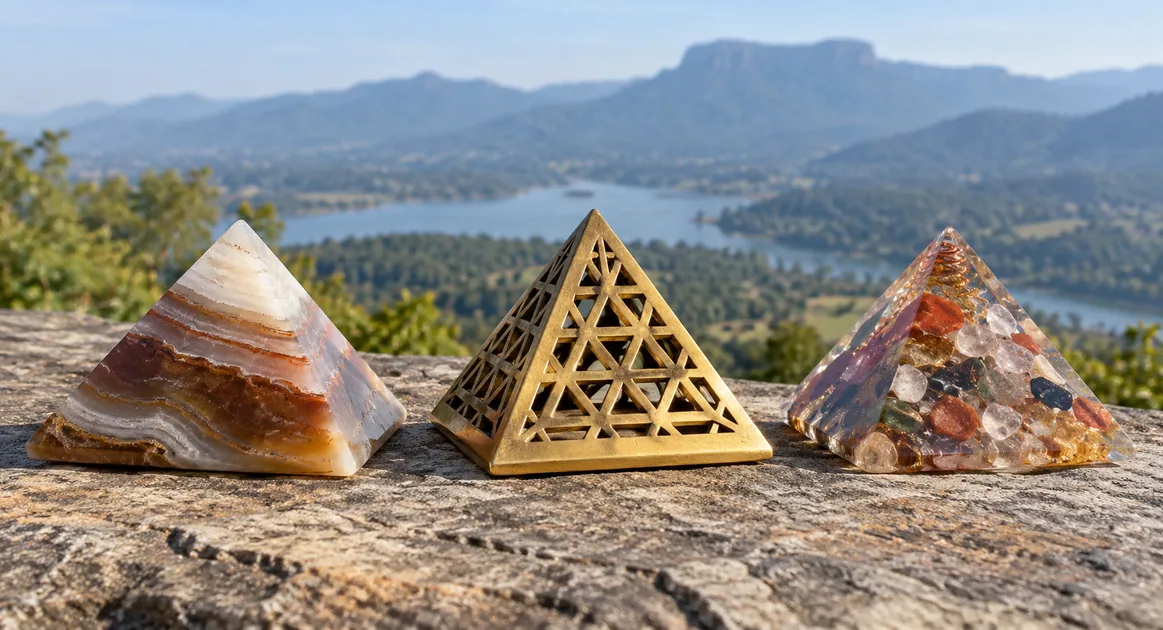
1. The four independent questions behind every pyramid description
A good product description answers four questions rather than collapsing everything into the adjective genuine. Identity: is the material quartz, agate, jasper, obsidian, copper, brass, gypsum, halite, clay or a mixture? Origin: did the mineral or rock form in nature, or was the counterpart created in a controlled process? Treatment: has colour, clarity, surface, porosity or stability been modified? Construction: was one piece carved, was sheet metal fabricated, or were layers, chips and binders joined? Each answer affects the fair trade name and care instructions.
A finished carving is a human-made object even when its raw stone is naturally formed. Cutting, shaping, polishing and drilling do not automatically make the gemstone itself synthetic. Conversely, a hand-carved pyramid can still be made from manufactured glass or cast resin. “Handmade” describes labour and technique, not geological origin. Similarly, the word “crystal” describes a broad family of uses in marketing; it does not establish that a particular object is crystalline quartz.
Read the four claims separately before deciding whether the name and price are appropriate.
| Question | What it establishes | What it does not establish |
|---|---|---|
| What is the material? | Mineral, rock, metal, glass, clay or composite identity | Natural formation or absence of treatment |
| Natural or laboratory-grown? | How a mineral counterpart formed | Whether colour was modified or an object assembled |
| Untreated or treated? | Presence or absence of disclosed modifications | Whether an individual item is a continuous solid piece |
| Solid, plated, cast or assembled? | Physical construction and any layer or binder | Spiritual suitability or mineral species |
| Where was it sourced? | Claimed supply chain or geological origin, if supported | Authenticity from a place name alone |
| Is there a report? | Findings about an identified examined sample | Every unseen treatment, spiritual outcome or entire batch |
2. Natural stone is not the same as untreated stone
In gemmology, a natural mineral or rock was formed by geological processes. A purple amethyst, patterned agate, red jasper, black tourmaline and smoky quartz may all be natural in this sense. After mining, however, the raw may have been heated, dyed, irradiated, bleached, waxed, filled or impregnated. These modifications do not rewrite its geological origin. They do matter to colour stability, cleaning, price expectations and what the label should say.
Consider two agate pyramids. The first has subtle natural bands and ordinary polishing. The second uses naturally formed chalcedony whose pores or fractures were dyed bright blue. Both could have a natural stone body, yet only the second has an added colour treatment. A responsible listing says “dyed natural agate pyramid” when that treatment is known, instead of treating the words natural agate as complete disclosure. The distinction is especially important when a customer believes a particular colour is a rare natural characteristic.
A treatment is not always evidence of poor workmanship. Stabilisation can make some porous materials more suitable for carving or long-term handling. Heat can produce an attractive and stable appearance in some gemstones. Problems arise when a material is misnamed, a treatment is hidden, its stability is exaggerated or its price depends on an unsupported rarity claim. The buyer can accept a well-described treated piece for its colour and traditional setting without confusing it with an untreated collector-grade sample.
3. Common colour, clarity and surface treatments in pyramid carvings
Treatment names address different interventions: they are not one quality grade.
| Treatment | Possible examples | Question to ask | Care consequence |
|---|---|---|---|
| Dyeing | Chalcedony, agate, howlite, some porous rock | Is the colour added or naturally present? | Avoid strong light, solvents or prolonged wetting when stability is unclear |
| Heating | Some quartz and other gemstone varieties | What colour or property was changed? | Check the particular stone and any associated repairs |
| Irradiation | Smoky quartz or other material with altered colour centres | Was irradiation used and subsequently heated? | Colour history may not be visible in ordinary photographs |
| Bleaching | Stained porous stones, sometimes before resin filling | Was acid or chemical bleaching involved? | Ask about structural stability and the following impregnation |
| Impregnation | Porous jadeite, lapis, turquoise and other stones | Was polymer or wax introduced? | Avoid high heat and aggressive solvents |
| Fracture filling | Cracks in otherwise natural material | Are any fractures filled with resin or glass? | Protect against heat, chemicals and hard impacts |
| Surface coating | Metallic-looking stone, coloured quartz or glass | Is this plated, lacquered, painted or coated? | Do not scratch, polish abrasively or soak |
| Reconstitution | Crushed mineral or chips bonded in resin | Is this a bonded body rather than solid stone? | Treat as a composite and check the binder |
GIA describes dyeing, heating, irradiation, coatings and impregnation as distinct categories of gemstone enhancement. The terminology in CIBJO’s Gemstone Book likewise separates natural material, treated stone, laboratory-created material and composite products. A report may say “no indications of treatment” within the tests performed; that is more precise than claiming an item is proven free of every conceivable treatment.
A practical sign such as concentrated colour around a crack, a uniform film over a surface or a filling visible at the base is reason to investigate, not a definitive home diagnosis. Different manufacturing methods can produce similar appearances. Ask for an item-specific description before assigning a treatment. The goal is accurate identification, not an amateur experiment that damages the pyramid.
4. Laboratory-grown, synthetic, imitation and artificial are not synonyms
A laboratory-grown or synthetic gemstone has essentially the same chemical composition and crystalline structure as the natural material whose identity it bears. For example, hydrothermally grown quartz is quartz, but it is not naturally formed quartz. By contrast, a glass pyramid may resemble clear quartz while having an amorphous glass structure rather than the crystal structure of quartz. It is therefore an imitation of quartz when represented as quartz, even if both materials are rich in silica.
This distinction matters when sellers call a pyramid “pure crystal” or “original crystal”. A transparent specimen might be a natural quartz carving, laboratory-grown quartz, glass, acrylic or a bonded piece. Some can be identified from a careful examination; others require instrumental testing. It is not responsible to identify all such objects using bubbles, surface temperature, scratches or visual perfection alone. Those popular shortcuts have exceptions and can damage polished pieces.
There are also manufactured ornamental materials that make no claim to be a synthetic counterpart of a natural mineral: coloured casting resin, a glass-and-glitter goldstone object, kiln-fired ceramic, and copper-coloured plastic. These can be valid decorative or teaching objects if labelled clearly. “Manufactured” is not a criticism; the relevant distinction is whether the materials and construction are represented truthfully.
Precise nouns make a listing easier to trust and compare.
| Retail label | Better description | Common confusion |
|---|---|---|
| Natural clear quartz | Quartz formed geologically, then cut and polished | Natural is confused with flawless or untreated |
| Synthetic clear quartz | Laboratory-grown crystalline quartz carving | Synthetic is wrongly called fake glass |
| Clear glass pyramid | Manufactured glass with quartz-like appearance | Glass is labelled Sphatik or rock crystal |
| Resin crystal pyramid | Cast resin, perhaps containing mineral chips | Real chips imply a solid gemstone body |
| Dyed agate pyramid | Natural chalcedony coloured by treatment | Natural geology is mistaken for natural colour |
| Copper-coated pyramid | A substrate with a copper-coloured or copper-containing surface | Coating mistaken for solid copper |
| Brass hollow pyramid | Formed brass alloy sheet or welded framework | Hollow metal mistaken for a carved stone |
| Terracotta pyramid | Moulded or shaped fired clay | Fired ceramic confused with natural stone |
5. Solid carved, assembled, coated and reconstructed: inspect the construction
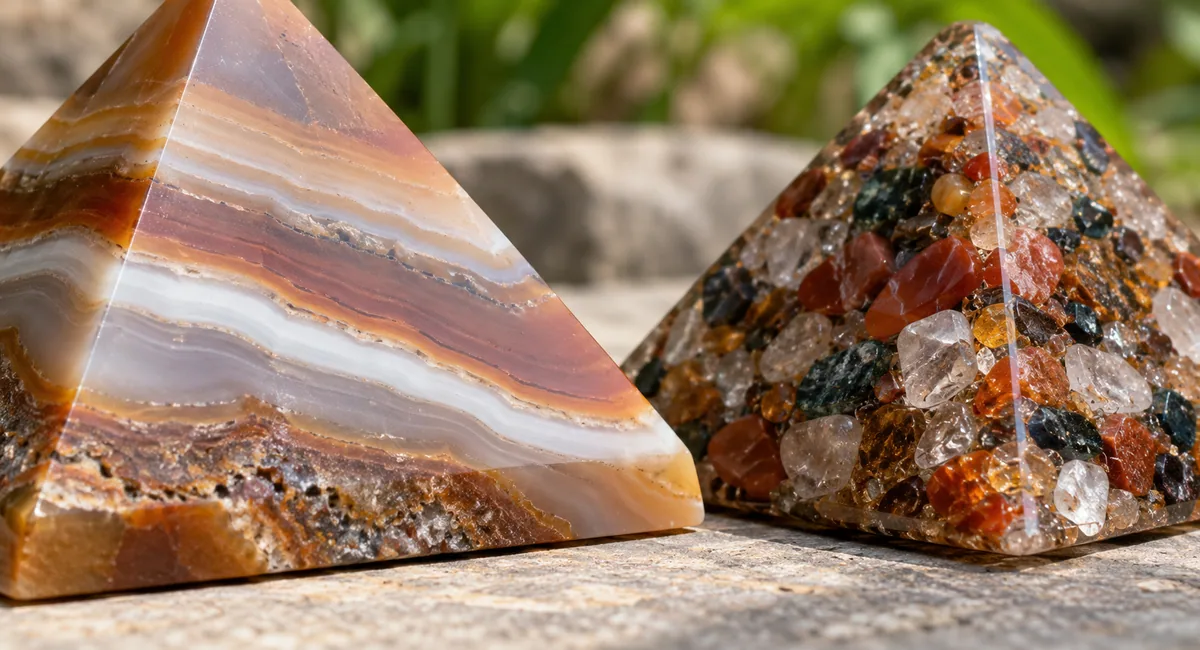
The phrase stone pyramid may describe a block of stone cut into a four-sided form, but a visually similar object could be cast from fragments, laminated from multiple pieces or mounted over a hidden core. Look at the underside, cut edges and all four faces. Continuous bands or grain across adjoining faces may support a single-body construction; a repeated pattern, different reflection or clear join can raise questions. None of these observations by itself is conclusive.
An assembled item can combine natural and synthetic components. A thin agate layer glued onto another stone or glass does not become a whole agate carving. A resin shape filled with amethyst chips contains amethyst, but its structural body is resin. A copper-coloured sheet on an iron support has a different construction and corrosion behaviour from a copper object. Good craftsmanship can be present in any category; what should not change is the written description.
A carved symbol is also part of construction. An Om mark may be shallowly engraved into quartz, painted onto a surface, gold-colour plated on a base or applied as a decal. The mark can have devotional value to its owner regardless of technique, but the cleaning method follows the most vulnerable part of the actual object. A polished stone and its painted inscription cannot automatically share one cleaning routine.
| Construction | Visual clue worth checking | Question for the seller |
|---|---|---|
| One-piece stone carving | Grain and banding may continue around faces | Is the whole body one piece of the named stone? |
| Joined solid sections | A seam or change of polish may appear | Where are the joints and what adhesive is used? |
| Chip-filled resin | Discrete particles suspended in a clear or tinted binder | What is the binder-to-stone construction? |
| Reconstituted material | Fine aggregate with possibly uniform colour or granularity | Was the stone crushed and bonded? |
| Hollow metal | Open underside, sheet edge, fold or weld | Which metal or alloy forms the walls? |
| Plated or coated base | Surface colour may differ near worn edges | What is underneath the plating? |
| Fired clay or ceramic | Ceramic body, firing marks and applied glaze | Is it fired, glazed, painted or unfired? |
6. Material-by-material examples: what the name should communicate
Quartz and chalcedony: amethyst, Sphatik, smoky quartz and agate
Quartz belongs to a mineral family that includes clear rock crystal, amethyst, citrine, smoky quartz and pink massive rose quartz. Chalcedony is a microcrystalline form of silica, with agate and many jaspers appearing in the ornamental trade. Colour alone cannot establish identity or treatment. Amethyst sold with unnaturally even saturation is not automatically synthetic, and a clear quartz pyramid without visible inclusions is not automatically glass. The terms deserve evidence proportionate to the price and rarity claim.
When an agate pyramid has striking pink, blue or green bands, ask specifically about dye. A brown smoky quartz pyramid may have natural colour centres or commercially modified colour; both can still be quartz. A natural quartz stone with resin-filled fractures remains a treated natural stone, whereas lab-grown quartz is a manufactured counterpart. A transparent cast polymer shaped like quartz is neither one.
Jade, jade-like stones and the limits of colour trade names
Jade properly includes jadeite and nephrite, but retail names such as “new jade”, “yellow jade” or “blue jade” may be applied to other stones. GIA notes that many geographical or colour-qualified jade trade names refer to materials outside jadeite and nephrite. Ask for the mineral or rock identification before discussing value or care. A green serpentinite or dyed quartzite may be decorative and attractive, but calling it jadeite would misstate the material.
Within the jadeite trade, the familiar A, B and C language refers to treatment categories, not a universal ranking of beauty: A generally allows ordinary surface waxing; B generally denotes bleaching and polymer impregnation; C denotes dyeing, with B+C meaning a combination. These letters should not be borrowed as grading shorthand for unrelated gemstone pyramids. A seller should state the actual treatment and the identity of the material.
Pyrite, hematite, shungite and black pyramids
A gold-toned pyramid may be pyrite, brass, plated resin or another mineral. Pyrite has its own granular metallic characteristics and moisture concerns; copper-alloy brass is a different substance with different ageing behaviour. In dark materials, natural hematite, magnetite, manufactured magnetic hematine, shungite, obsidian and black tourmaline each have different compositions. Do not identify all black pyramids as tourmaline on colour alone, or accept strong magnetism as proof of natural hematite.
Some black carvings are natural volcanic glass, some are crystalline minerals, and some are carbon-bearing rocks or composites. Their price should follow documented material and craft, not identical “protection stone” labels. Traditional grounding or protection symbolism can be discussed alongside precise material naming: those are separate kinds of description and neither replaces the other.
Metals, salts, clay and mixed-material Vastu sets
A copper pyramid may be hammered or folded from copper sheet, cast, plated, painted, or fitted with another metal. Brass is a copper-zinc alloy rather than pure copper. Metal percentage, fabrication, wall thickness, coating and whether the form is hollow are meaningful specifications. Rock-salt forms are made of halite and should remain dry; satin spar gypsum is soft and moisture-sensitive; fired terracotta differs from unfired clay and from cement or cast-resin décor.
Professional pyramid sets can deliberately combine metal, gemstone, clay and synthetic demonstration samples. For such kits, honest mixed-material labelling is more useful than pretending all pieces share one composition or one cleaning method. Every specimen should have its own name, construction, dimensions, handling precautions and intended illustrative use.
7. Natural, treated and manufactured materials in Vastu practice
In traditional and contemporary Vastu discussions, pyramid form is often used as a focal geometric arrangement, while colours and materials are interpreted with reference to Pancha Mahabhuta (Prithvi, Jala, Agni, Vayu and Akasha), Ashta Dik (the eight directions) and the purpose of a space. A family may prefer a Sphatik pyramid near a puja setting, a copper pyramid as an ornamental element or a small gemstone arrangement on a work desk. These are interpretive choices within particular traditions and contemporary practices, not a laboratory test of the object’s mineral authenticity.
Sankalpa, the consciously stated purpose of a ritual or devotional practice, helps explain why the owner chooses and places an object. A natural stone is not automatically the right material for every puja or Vastu setting, and a manufactured object does not acquire a traditional mineral identity through its form. If a custom calls for a specifically named stone or metal, identification matters. If the intention is simply to use a beautiful geometric form as an aesthetic reminder, a clearly labelled ceramic or metal piece may serve that purpose.
The association of a stone with Shani, Budha, Surya, Chandra or another Graha needs similar care. A commercial crystal pyramid is not necessarily the same as a classical Jyotish gemstone selected from a personal Kundali, Lagna, Graha strength, Dasha and established remedial tradition. A coloured pyramid chosen for a room should not be marketed as an equivalent to a gemstone prescription without actually performing the relevant assessment. This distinction retains the richness of Jyotish while making the scope of the product understandable.
| Traditional lens | Illustrative design choice | Material description still required |
|---|---|---|
| Prithvi / stability | Stone pyramid on a stable shelf or work desk | Exact stone, construction and care |
| Jala / calm surroundings | Clear or pale-coloured ornament near a calm space | Identify glass, quartz or another material |
| Agni / activity | Warm-toned stone or copper-coloured geometric form | State whether copper, brass, coating or orange stone |
| Vayu / openness | Uncluttered display and appropriate ventilation | Lightweight or hollow construction, safe installation |
| Akasha / contemplation | Simple focal object near prayer or meditation area | Any joins, applied Om symbols or coatings |
| Ashta Dik / directions | Site-specific placement considered in context | Room function, measurements and actual material |
| Sankalpa / intention | Object selected for a clear personal or devotional aim | Meaningful practice does not replace product disclosure |
8. Choosing pyramid shape, size and finish without misleading labels
A cleanly made pyramid should stand stably and have proportionate faces, an intact apex, carefully finished edges and a base that does not rock on a flat surface. These are workmanship criteria independent of spiritual symbolism and mineral origin. A natural stone may have colour bands, inclusions and nonuniformity; those can be attractive, but no buyer should be asked to accept an undisclosed crack, loose fragment or poorly joined base solely because a piece is described as “raw” or “natural”.
Compare actual measurements rather than a misleading product photograph. State the base length, height and weight for the particular variant being sold. A solid quartz block and hollow metal pyramid of similar outside dimensions can weigh very differently. Likewise, a resin-filled pyramid can have a heavy mineral base without having solid gemstone walls. A showroom photograph of one specimen cannot establish measurements, mineral percentages or treatment history for every item in a shipment.
Ask for photographs of the four sides, top, underside and any label or report associated with the actual item. Natural colour zoning should be described as observed rather than used as an origin certificate. The better seller is not necessarily the seller who says “100% original” most often; it is the one who identifies the material, states known treatment, describes construction, distinguishes evidence from inference and quotes a realistic care method.
| Feature | Good evidence | Concerning but nonconclusive sign |
|---|---|---|
| Base and apex | Sharp photographs, measured size, stable standing | Missing underside or cropped tip |
| Stone continuity | Side-by-side face images and construction declaration | Sudden seam or repeated chips/patterns |
| Colour claims | Plain-language natural/dyed/coated status | Rarity claimed solely from saturated colour |
| Metal composition | Alloy or plating declaration | “Copper” used for a copper-colour surface |
| Batch accuracy | Actual item photos or clearly labelled representative samples | Identical studio photo claimed for every unique item |
| Origin claims | Supplier chain and test scope when available | Famous origin asserted only from sales text |
| Certificates | Readable item-specific findings and identifying details | Generic certificate unlinked to the pyramid |
| Care instructions | Specific to mineral, finish and assembly | One soaking or polishing method for all materials |
9. How to read a gemstone laboratory report
A useful report identifies what was examined, by whom, under which reference number, and which conclusions the laboratory actually reached. An identification report on a loose stone may establish the species or detectable treatment of that submitted stone; it does not necessarily establish the composition of a larger pyramid subsequently assembled from several pieces. Even a report with an image is informative only when its identifying features match the item being purchased.
Read the phrasing carefully. “No indications of treatment detected” reflects the examinations performed, not a promise that every conceivable treatment is impossible. “Origin opinion” may refer to geological provenance and can have uncertainty; a seller invoice saying “imported from Brazil” may instead identify the route of commerce. A receipt, stock label, supplier statement and laboratory report serve different purposes and should not be represented as interchangeable proof.
For inexpensive decorative pieces, an honest materials declaration and clear close-up photographs may be more proportionate than a costly gemstone laboratory report. For a high-value natural-stone claim, professional analysis may justify its price. Avoid inventing laboratory findings from appearance. If an object is supplied without a report, the description should say what is known, what was stated by the supplier and what remains unverified.
10. Safe inspections: observations that do not harm the object
Begin with good white light and a plain background. Photograph the item from multiple sides. Look for mineral inclusions, colour concentrations, seams, coatings, applied paint, bubbles, scratched edges and the pattern of joins. A small magnifier may be useful, but it cannot identify every synthetic or treated material. Keep observations in plain terms: “green colour concentrated near visible fractures” is more defensible than “proved dyed” unless a qualified test establishes the mechanism.
Avoid popular scratch tests, open flames, drop tests, aggressive rubbing, acid, hot needles, soaking, salt baths and solvent experiments. Some purported tests are dangerous or damage genuine stones. Scratch hardness is not the same as toughness, and a coating or a different mineral inclusion can confuse results. Strong magnetism, water droplets, temperature-to-touch and phone flashlights cannot settle all material questions. If accurate identity materially changes price or intended application, professional identification is the appropriate next step.
- Check the name: request mineral, rock, metal or manufactured body and clarify any colour-based trade name.
- Check the treatment: ask what is known about dye, heat, irradiation, wax, resin, coating, filling and stability.
- Check the structure: ask whether the pyramid is one piece, layered, moulded, plated, cast or bonded.
- Check the proof: request actual-item photographs, batch documentation and a report when justified.
- Check the use: choose a safe display site, practical size and material-specific care.
- Keep the invoice: ensure its material description matches what was discussed before purchase.
11. Three realistic buying situations
A Bengaluru apartment: choosing one puja-shelf pyramid
A family wants a small clear pyramid for a modest puja shelf. The shop offers “original crystal”, “laboratory crystal” and “clear glass” versions at different prices. Rather than assuming that the clearest one is superior, the family asks for the actual material in each version. If they specifically want Sphatik, they choose an item described and documented as quartz, whether natural or laboratory-grown according to their own preference and custom. If they only want a transparent focus object, a plainly named glass piece may be sufficient. The shelf should still be stable, away from edges and easy to keep clean.
A jewellery showroom: deciding between decorative stock and gemstone claims
A showroom receives a tray labelled “natural gemstone pyramids”. On inspection, some items are dyed agate, several are coated resin with stone chips, and another batch is genuine mixed jasper. The stock manager creates separate product labels instead of putting them all under “natural healing crystals”. Customers can then compare material and finish correctly. The resin pieces may be sold as resin-chip décor, while the jasper and agate pieces carry their actual material and any known treatment in the sale description. A realistic sample card is more valuable than dramatic unsupported authenticity slogans.
A professional Vastu kit: working with named samples and mixed materials
A consultant prepares a demonstration kit with quartz, hematite, copper, terracotta, obsidian, pyrite, rock salt and resin-chip pyramids. Each compartment records material, construction, typical symbolism, proposed direction context, fragility and care. This lets a client distinguish a natural mineral from a fabricated metal form and a composite without losing the cultural discussion. If an object has uncertain treatment history, the kit notes that uncertainty. During visits, the consultant discusses Sankalpa and room suitability while keeping material identification independent from astrological prescription.
12. How material history affects cleaning, storage and price
The cleaning routine follows the most vulnerable component, not the boldest label. A quartz carving may tolerate methods unsuitable for gypsum, halite or delicate surface coatings. A soft calcite apex can scratch; fluorite can cleave; obsidian can chip into sharp fragments; pyrite should be protected from damp conditions; and rock salt should not be soaked. Adhesives and treatments may impose further limits even when the underlying stone is comparatively durable.
Waxed or resin-impregnated materials may be affected by heat or chemicals. Copper and brass can tarnish and can be affected by moisture and some household cleaners. A fired terracotta object can be porous, while an unfired clay item may deteriorate quickly when wet. When unsure, use gentle dry dusting, avoid oils and ritual water applied directly to vulnerable objects, and keep specimens separate in padded compartments.
Price depends on material identity, size, quality, rarity, labour, treatment, finish and commercial conditions. A natural unheated gemstone may command a premium in some markets; in others, professional carving and fine finishing drive the price. A synthetic piece may have excellent appearance and repeatable quality. Neither price nor spiritual terminology alone demonstrates authenticity. Ask for the reasons behind a premium in specific, checkable terms.
| Pyramid type | Main care concern | Conservative first action |
|---|---|---|
| Untreated quartz / agate | Edge chips and accidental damage | Soft dry cloth, inspect base and joints |
| Dyed or coated stone | Dye or surface stability | Avoid soaking, chemicals and abrasive polishing |
| Resin-chip composite | Heat and binder damage | Dust gently; avoid solvents and hot surfaces |
| Fluorite / calcite | Cleavage or surface scratching | Handle at base, pad separately |
| Satin spar gypsum / halite | Softness and moisture sensitivity | Dry storage and gentle brushing |
| Pyrite | Possible moisture-related deterioration | Dry storage; isolate if powder or cracking appears |
| Copper or brass | Tarnish, lacquer and corrosion risk | Use finish-specific handling; avoid acids |
| Obsidian or manufactured glass | Sharp chips at apex and edges | Avoid impact; individual cushioning |
13. A clear and useful OmmRudraksha product-description format
For catalogues, price tags and invoices, a consistent template prevents confusion: Product name: “Dyed Natural Agate Pyramid” rather than “Rare Blue Natural Crystal”. Body material: natural chalcedony. Treatment: blue dye as reported by supplier. Construction: single carved piece or assembled, as applicable. Size: measured base length and height. Finish and colour: observed bands or polish, without claiming that all batches are identical. Care: keep away from solvents and soaking where dye stability is unknown. Traditional context: stated clearly as a Vastu or devotional association, not a laboratory identification.
If a feature has not been established, say “not confirmed” rather than guessing. Unknown does not automatically mean false; it means the evidence is incomplete. Keep supplier and laboratory statements distinguishable. This is particularly important when publishing educational guidance that links to actual OmmRudraksha products, because customers may rely on the article to decide what a material name guarantees.
For professional sets, publish a simple material manifest. A set that contains eight different named pyramids should list eight component identities and note any shared base, coating or adhesive. If a product uses illustrative images rather than actual stock, say so in the product workflow and do not infer colour pattern, exact dimensions or geological source from the illustration.
14. Twenty frequently asked questions
1. Does “natural gemstone pyramid” mean untreated? No. A mineral or rock can form naturally and later be dyed, heated, filled, coated or impregnated. Origin and treatment must be asked about separately.
2. Is laboratory-grown quartz real quartz? It is crystalline quartz with essentially the same material identity as natural quartz, but it formed through a controlled manufacturing process rather than geology. It should be labelled as laboratory-grown or synthetic.
3. Is a glass pyramid a synthetic quartz pyramid? No. Glass can resemble quartz, but its structure differs from crystalline quartz. When sold as quartz it is an imitation, not synthetic quartz.
4. Can a dyed agate pyramid still be natural stone? Yes. The agate body can be natural while its visible colour has been modified. Disclose both parts of that description.
5. Does a flawless pyramid prove it is glass? No. Natural and laboratory-grown crystals, as well as glass, can be visually clean. Professional assessment may be needed for origin or composition.
6. Do bubbles prove a pyramid is glass? No single observation is universally decisive. Bubbles can support an inquiry about glass or resin, but the whole material and construction need evaluation.
7. What is a resin-chip gemstone pyramid? Usually a manufactured resin body incorporating pieces of mineral. The chips may be genuine; the body is not a single carved gemstone.
8. Is a joined pyramid automatically poor quality? No. An intentionally assembled object can be well made and attractive. Its joins, binder and materials should be stated accurately.
9. Does a copper-coloured pyramid contain solid copper? Not necessarily. It may be brass, painted, plated or formed from another substrate. Ask for the underlying material and finish.
10. Can “jade” mean a different green mineral? Yes. Several trade names use jade descriptively for materials outside jadeite or nephrite. Ask for the exact mineral or rock.
11. What do A, B and C mean on jade labels? In common jadeite treatment terminology, A generally means untreated except possible surface wax, B means bleaching and polymer impregnation, and C means dyeing. These are not universal quality grades.
12. Can a professional laboratory certify spiritual power? Gem laboratories test properties within their methods and scope. A mineral identification result is not a measurement of a Vastu or devotional outcome.
13. Can a report from one stone certify an entire production batch? Not automatically. Check what sample was examined and how the report is connected to the actual finished object.
14. Should I scratch a pyramid to test hardness? No. Destructive home tests may damage an otherwise sound specimen and can give misleading results.
15. Does strong magnetism prove a hematite pyramid is natural? No. Strongly magnetic products may be manufactured hematine, magnetite-bearing material or another mixture. Magnetism is not a full identification method.
16. Is an expensive stone always more appropriate for Vastu? No. Meaningful placement also depends on the intention, the space, the chosen custom and the item’s actual identity. High price alone does not establish spiritual suitability.
17. Can I perform jalabhisheka on every pyramid? No universal physical-care method suits every material. Salt, gypsum, pyrite, coatings, adhesives and metals can be affected by liquids. Adapt the practice without damaging the object.
18. Can I use a synthetic decorative pyramid in a spiritual space? That is a matter of personal and lineage practice. It should still be labelled honestly and not presented as a natural gemstone if it is not one.
19. Which photographs should I request before buying? Ask for front, back, both sides, underside, apex, scale or measurements, and any item-specific report or label.
20. What is the best final buying rule? Know the body material, formation, treatment and construction; check size and care; then choose the traditional significance and design that fit the intended space.
15. Final buying checklist: identify the object, then choose its meaning
The simplest rule is to make the commercial description and the spiritual interpretation both complete, but keep them distinct. A purchaser can respect the symbolism of Lakshmi, Kubera, Ganesha, Shiva, Graha associations, Pancha Mahabhuta and Sankalpa while still expecting an exact material name and clear treatment disclosure. A professional Vastu consultant can illustrate different directional arrangements without claiming that every polished decorative pyramid is a classical remedy. An OmmRudraksha seller can welcome questions about origin, finishes, repairs and care because such questions improve the purchase rather than diminish its spiritual significance.
Before paying, read the name on the invoice; verify whether “natural” refers to formation rather than colour; ask about treatments, joined materials and coatings; inspect actual-item images; confirm dimensions and any documentation; and choose the correct care routine. If the identity is genuinely uncertain, keep the label appropriately qualified until a suitable examination resolves it. The result is a pyramid chosen for its documented material, quality and traditional purpose—not merely for an attractive but ambiguous trade name.
Research basis for material terminology and treatment distinctions: Gemological Institute of America educational resources on gem treatments, synthetics and imitations; CIBJO Coloured Stone Commission Gemstone Book; and specialist jadeite treatment guidance. Source names are given for traceability without adding repetitive outbound commercial links to the article.
Explore existing OmmRudraksha collections
Browse Vastu for the existing collection, or explore gemstone products for other material forms. Each product’s construction and care information should guide your choice.
Explore related pyramid designs
- Amethyst Pyramid
- Clear Quartz Pyramid
- Smoky Quartz Pyramid
- Tiger Eye Pyramid
- Hematite Pyramid
- Lapis Lazuli Pyramid
- Sodalite Pyramid
- Sunstone Pyramid
- Bloodstone Pyramid
- Shungite Pyramid
- Ruby Zoisite Pyramid
- Green Aventurine Pyramid
- Yellow Aventurine Pyramid
- Banded Agate Pyramid
- Carnelian Pyramid
- Om Engraved Amethyst Pyramid
- Om Engraved Rose Quartz Pyramid
- Om Engraved Clear Quartz Pyramid
- Clay Pyramid