Hematite pyramids are chosen for their dark iron-grey colour, compact substantial feel, metallic to subdued polish and the symbolic language of steadiness, discipline and grounding in contemporary Vastu and crystal practice. Yet a small pyramid described as “hematite” may be a carving from natural hematite (Fe₂O₃), an iron-rich mixed rock, a manufactured ferrite-based object, or a decorative imitation. These are different materials, even when photographs look alike.
The useful question is not whether the pyramid looks shiny or attracts a magnet. It is what the specific object is made from, how its identity was checked, how it was formed and finished, and where it can be displayed safely. This guide explains mineral properties, natural versus manufactured “magnetic hematite,” practical examination without damaging a product, grading and buyer questions, Vastu directions and traditional associations, and realistic care in an Indian home or business.
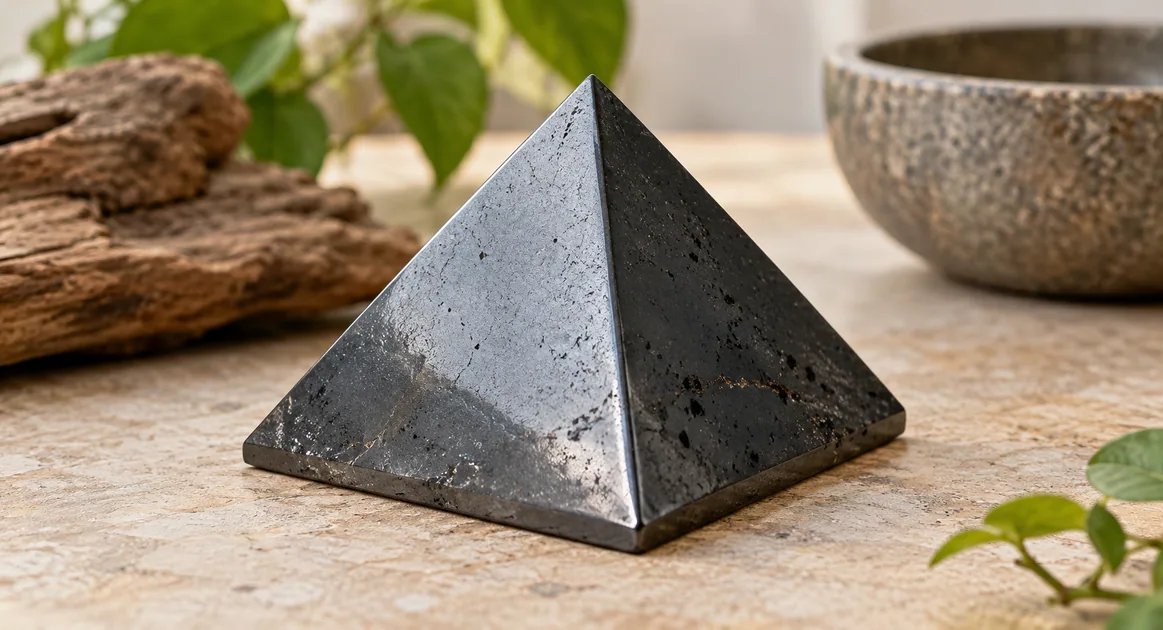
1. What is hematite? Iron oxide beneath the metallic shine
Hematite is a naturally occurring iron(III) oxide mineral with the formula Fe₂O₃. It belongs to the oxide group and has a trigonal crystal structure. It can appear as a sparkling steel-grey specimen, a heavy blackish lump, thin specular plates, compact red material or earthy red pigment-bearing masses. The name relates historically to blood because its characteristic powder is reddish. Colour on a polished face and colour of a mineral's powder are not the same property.
Unlike a pure metal, hematite is a mineral compound: its grey metallic appearance does not mean the carving is made of iron, stainless steel, magnetite or graphite. Natural material may also contain associated minerals and tiny fractures. A polished pyramid can therefore differ in shade between its faces, show fine speckling or have a less uniform gloss than a moulded product. Variation alone is neither proof of natural origin nor a defect.
| Property | Useful reference | Buyer implication |
|---|---|---|
| Mineral formula | Fe₂O₃, iron(III) oxide | Not elemental iron and not the same as a magnetic ferrite ceramic |
| Appearance | Steel-grey, silver-grey, black, red-brown or earthy red | Colour alone does not prove identity |
| Lustre | Metallic, submetallic or earthy | A mirror polish is not mandatory for natural material |
| Streak | Usually reddish to reddish-brown | A useful mineralogical clue, but a streak test can mark or damage finished goods |
| Mohs hardness | About 5–6.5 depending on source and form | Can scratch or chip; not equivalent to diamond-hard or indestructible |
| Specific gravity | Approximately 4.9–5.3 for natural hematite | Dense for its size, but weight does not confirm natural origin |
| Cleavage / fracture | No true cleavage usually recorded; brittle with possible parting | Thin edges and pointed corners still need protection |
| Magnetic response | Generally weak or negligible to an ordinary hand magnet | Strong magnetism calls for a closer material description |
These are typical reference values for the mineral species, not test results for an OmmRudraksha inventory item. A stone-cutting workshop, mineral laboratory or gemmologist must evaluate a particular object if its exact composition is commercially important. It is especially useful to distinguish a natural single-rock carving from a product made with binders, powders or moulded ferrite.
2. The magnetic hematite question: natural, mixed or manufactured?
One of the most persistent buying confusions is the phrase “magnetic hematite.” Natural hematite generally does not behave like a refrigerator magnet: pure hematite is weakly magnetic in ordinary conditions. But natural hematite can occur alongside magnetite and related iron oxides, making some mixed specimens respond to a hand magnet. Therefore “any attraction means fake” and “no attraction means genuine” are both unreliable shortcuts.
Highly magnetic jewellery components sold as hematine, hemalyke, hemalike or magnetic hematite are commonly manufactured simulants. Gemmological references describe commercial hematine as ceramic-like ferrite material; historical descriptions have included pressed-and-sintered iron oxide. It can be an attractive, functional ornament in its own right. What is wrong is selling it as a tested, carved natural hematite mineral when it is not.
| Observation | Possible explanation | What to verify |
|---|---|---|
| Little or no attraction | Consistent with natural hematite, but also some nonmagnetic imitations | Supplier classification, other physical clues and documentation |
| Weak attraction | Possible associated magnetite, another iron-rich phase or material variation | Whether the item is a mixed rock and how it was tested |
| Strong attraction / snaps to a magnet | Often manufactured ferrite-like “hematine,” magnetite or another magnetic material | Do not accept “natural hematite” without reliable identification |
| Attracts another identical pyramid | May indicate a deliberately magnetized or manufactured object | Ask about manufacturing process and magnetic parts |
| No magnet available | No conclusion can be drawn from this absence | Use truthful supplier disclosures and professional testing if needed |
Using a magnet on delicate retail samples is not a complete laboratory identification method. Ask permission before bringing strong magnets near displays, electronics, payment cards or sensitive devices. A careful seller should disclose if a product contains magnets or is strongly magnetic. Conversely, weak magnetic response is not evidence that the pyramid has a particular spiritual effect.
3. Hematite versus magnetite, hematine, black onyx and other lookalikes
Compact dark pyramids can be visually similar in a photograph. Material names become more informative when compared by chemistry, structure, surface behaviour and how the item was made, rather than by dark colour alone. Even a very heavy polished carving could be hematite, magnetite, another mineral-rich aggregate or a dense composite.
| Material | What it is | Distinguishing point | Buyer question |
|---|---|---|---|
| Natural hematite | Iron(III) oxide mineral Fe₂O₃ | Typically reddish-brown streak, dense and weakly magnetic | Is this carved from identified natural hematite? |
| Magnetite | Iron oxide Fe₃O₄ | Commonly strong magnetic response and darker streak | Have you confused magnetite with hematite? |
| Hematine / magnetic hematite | Manufactured ferrite-type simulant | Often strongly magnetic and especially uniform | What is the actual manufactured composition? |
| Black onyx / black chalcedony | Silica-rich chalcedony, often treated to appear black | Different mineral family and usually less dense | Is the colour treatment disclosed? |
| Black obsidian | Natural volcanic glass | Glasslike fracture; possible sharp chips, different density | Was it correctly identified as volcanic glass? |
| Shungite | Carbon-bearing rock of variable mineral content | Not a single iron oxide species; some grades can smudge | What is its actual rock description? |
| Pyrite | Iron disulphide FeS₂ | Usually brassy rather than steel-grey, different care sensitivity | Is this pyrite-bearing stone or metallic coating? |
| Painted resin / cast composite | Manufactured decorative product | May have seams, coatings or filler; mass varies | Is this a manufactured decorative pyramid? |
A mineral identification decision should consider several observations together. The reddish streak is a valuable diagnostic clue for hematite in geology, but customers should not rub a purchased pyramid on unglazed porcelain: the test removes material and may damage its finish. A microscopic or professional non-destructive examination is preferable for a valuable polished object.
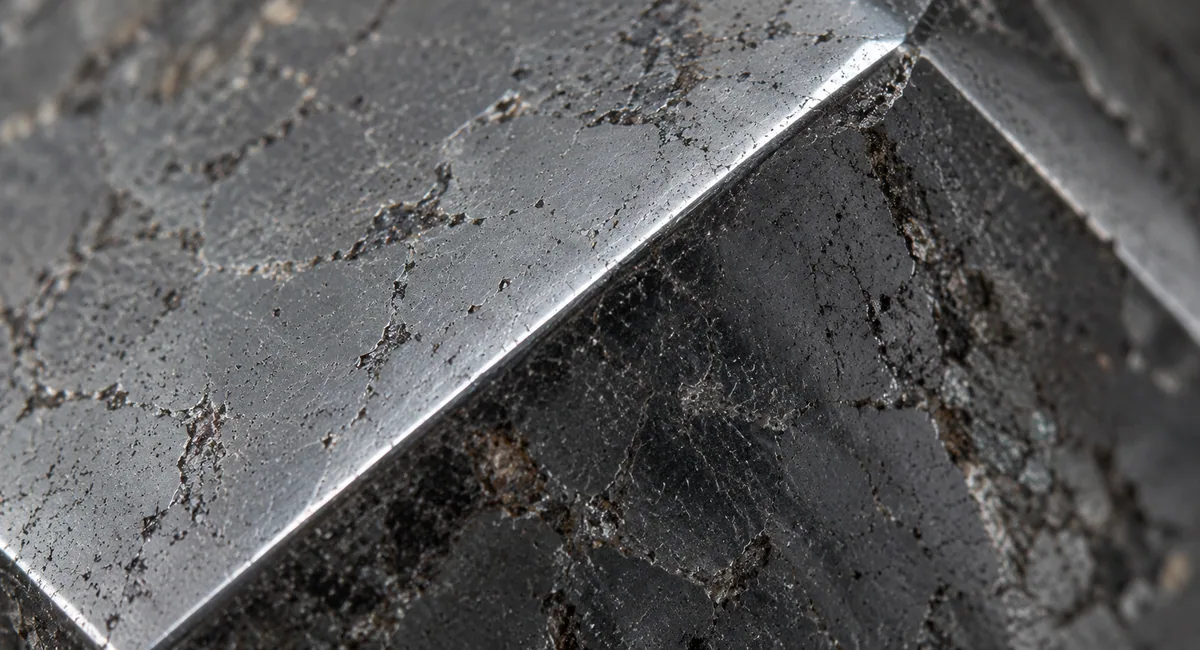
4. Natural hematite pyramids: carving methods, quality and finishes
A true stone pyramid must be shaped from a suitable piece of natural material, cut into faces and an even base, and then polished or finished. The maker must accommodate fractures, granular zones and the mineral's brittleness. Attractive workmanship does not require optical perfection: an object with slight natural tonal variation may be more honest than a coated, machine-uniform imitation. However, large chips, a rocking base, crumbling grains or a visibly repaired apex are defects that should be disclosed.
Look separately at material integrity, geometry and surface finish. Check whether the pyramid has four triangular faces meeting at a point, a square base if advertised, clean edges and a stable underside. Some products intentionally use truncated or rounded tips; these should be described as a design variation, not concealed in photography. A smooth lustrous finish can reveal fingerprints or light scratches more readily than a matte finish.
| Inspection area | Acceptable variation | Concern requiring clarification |
|---|---|---|
| Colour | Steel-grey to charcoal tones; natural subtle variation | Paint flaking or an undisclosed metallic coating |
| Faces | Fine natural texture with intentional polishing | Deep fractures, flaking or resin-filled patches not disclosed |
| Apex | Intact or intentionally softened point | Fresh chips, sharp broken protrusions, undisclosed repair |
| Base | Flat and safely seated on a pad or shelf | Rocking, uneven cuts, unstable weight distribution |
| Edges | Smooth transitions with consistent finish | Razor-like chips or weak corners prone to breakage |
| Construction | Clearly identified natural, mixed or manufactured material | No answer about seams, pressed powder or assembled sections |
| Photography | All sides and underside under neutral light | Only one glossy image that hides defects and variation |
| Dimensions | Measured base, height and actual weight | Approximate claims presented as specimen-specific results |
If a seller calls the product a natural hematite pyramid, ask whether the statement applies to the entire body of the carving or only to a constituent pigment. Some decorative ceramic products may contain iron oxides without being a single mineral specimen. Accurate product naming is especially important when comparing a premium natural carving with a lower-cost display object.
5. How density, size and weight should be interpreted
Hematite's specific gravity near 5.3 makes it noticeably dense, but comparing two pyramids by hand is unreliable when one is hollow or truncated, has a different base size, includes another mineral, or contains metal and resin. Use recorded dimensions and measured weight where available; treat a simple calculation as a rough expectation, not an authenticity certificate.
For a regular solid square pyramid, volume = (base side × base side × vertical height) ÷ 3. As an illustrative example, a 30 mm × 30 mm base with 30 mm vertical height occupies about 9 cm³. A fully solid pure hematite object at 5.3 g/cm³ would weigh roughly 48 g before accounting for slight edge rounding. A 40 mm square base and 40 mm vertical height would occupy about 21.3 cm³ and weigh around 113 g. Real products may deviate because of cavities, cut corners, mineral inclusions, density variability and design geometry.
| Nominal square base × height | Ideal volume | Approx. mass at 5.3 g/cm³ |
|---|---|---|
| 25 × 25 × 25 mm | 5.21 cm³ | 28 g |
| 30 × 30 × 30 mm | 9.00 cm³ | 48 g |
| 40 × 40 × 40 mm | 21.33 cm³ | 113 g |
| 50 × 50 × 50 mm | 41.67 cm³ | 221 g |
Request the actual unit weight and how the measurements were taken. A weight outside an expected range is a reason to investigate geometry and composition, not automatic proof of a false label. Likewise, a dense ceramic imitation may be close in mass to a natural piece. A buyer choosing a pyramid for a glass shelf must also evaluate shelf capacity and use a stable protective pad.
6. Hematite in Vastu: Prithvi, stability and the meaning of a dark pyramid
In contemporary crystal-Vastu practice, a hematite pyramid is commonly chosen to represent grounding, steadiness, order, protection and the discipline of following through on work. Its weight, iron-grey appearance and geometric form create a visual language of firmness. A person may place it as a reminder of a chosen Sankalpa—a clear personal intention—such as maintaining calm routines, completing a business task or approaching a difficult decision deliberately.
Prithvi Tattva, the earth element among the Pancha Mahabhuta, is often used to interpret stable, heavy, grounded materials. Some modern practitioners also discuss the pyramid's triangular faces, square base and orientation using Vastu and geometric symbolism. These are interpretive associations rather than a universal instruction in all classical Vastu texts. Different teachers and lineages may describe element correspondences differently, so a responsible guide identifies the tradition being used instead of asserting a single fixed placement for every home.
The darkness of hematite should not be confused with something inauspicious. Indian ritual and decorative traditions use a broad range of colours and materials according to deity, purpose, region and family practice. A black or grey object may fit a study or business setting, but it should be kept off a crowded altar when it obstructs lamps, photographs, sacred books or other puja items. Respect the household's established practices.
| Intention | Hematite-associated symbolism | Practical placement principle |
|---|---|---|
| Stable daily routine | Grounding, steadiness, continuity | Secure desk or shelf near a planner, not in the working path |
| Business focus | Discipline and clear responsibility | Stable office surface away from payment terminals and edges |
| Thoughtful study | Concentration and consistency | Quiet study area with no risk of falling onto electronics |
| Intentional meditation | Settling attention and Sankalpa | Low dry shelf near but not touching the meditation seat |
| Vastu reference collection | Example of dark dense iron-oxide material | Clearly labelled tray separating natural and manufactured items |
There is no need to promise guaranteed changes to wealth, relationships or health. The object's cultural and personal meaning can be explained fully without confusing a symbolic practice with a measured material property. For an actual building assessment, room use, entrances, airflow, light and household needs are far more consequential than selecting a single ornament by a blanket directional rule.
7. Directions, Ashta Dik and when placement advice differs
Vastu Shastra discusses spatial orientation through the four cardinal directions and intermediate directions, often referred to collectively as Ashta Dik. The directional deities are customarily described as Indra in the east, Agni in the southeast, Yama in the south, Nirriti in the southwest, Varuna in the west, Vayu in the northwest, Kubera in the north and Ishana in the northeast. Their ritual associations provide important traditional context, but do not amount to a mineral-specific requirement that every hematite pyramid belongs in the same corner.
For example, a contemporary consultant might associate a dense iron-grey object with earthy stability and choose a protected southwest display area; another may focus on a work desk's practical orientation rather than the room's compass bearing. A practitioner may also distinguish objects used for a symbolic intention from actual architectural corrections. The decision should consider the full room plan, who uses the space, local puja practice, safety and the exact object.
| Area / direction | Traditional context | Consider before placing the pyramid |
|---|---|---|
| North / Uttara | Kubera associations in directional tradition | A financial desk may be suitable if the object is stable and unobtrusive |
| Northeast / Ishanya | Prayer, clarity and Ishana in many traditions | Follow existing puja etiquette; keep clear of lamps and sacred books |
| East / Purva | Indra; morning light and activity in some layouts | Prevent reflection into screens and avoid open window edges |
| Southeast / Agneya | Agni and fire symbolism | Keep all decorative stones away from cooking heat and hot appliances |
| Southwest / Nairritya | Nirriti and stability interpretations in contemporary Vastu | Heavy objects need a secure shelf with enough load capacity |
| West / Paschima | Varuna and water symbolism | Avoid wet bathroom ledges and spill-prone surfaces |
| Northwest / Vayavya | Vayu and movement | Avoid unstable entryways or places where the item may be knocked over |
Direction labels are a framework for discussing space, not a laboratory property of hematite. Avoid suggesting that a compass heading by itself determines whether a carving is genuine, auspicious or effective. In a rented Bengaluru apartment or a compact shop, a secure shelf may reasonably take priority over a theoretically preferred direction.
8. Jyotish, Shani, Mangala and chakra associations: do not confuse systems
Because hematite contains iron and is dark grey, some modern gemstone sellers connect it with Shani (Saturn), discipline or the symbolism of iron; others use red iron-oxide themes to discuss Mangala (Mars). These are not equivalent to a classical horoscope-based gemstone prescription. In traditional Navagraha Ratna lists, Neelam (blue sapphire) is commonly associated with Shani and Moonga (red coral) with Mangala. Hematite is not automatically interchangeable with either gem simply because of its colour or chemistry.
Jyotish assessment, when requested, considers factors such as Lagna, Rashi, Graha placement, lordship, strength, Dasha and individual circumstances. It should not be replaced with a quick chart saying that everyone born under a particular sun sign needs hematite. If someone is requesting a traditional astrological recommendation, distinguish an ornamental hematite pyramid used in Vastu from a wearable astrological stone selected after a personal chart review.
Contemporary chakra systems may associate hematite with Muladhara (root chakra) because of its heavy, dark appearance and modern language of grounding. That is a symbolic association within present-day crystal practice; it is not an analytical test for Fe₂O₃ and does not establish clinical outcomes. Readers can use the symbolism meaningfully while keeping the mineral identity and Jyotish prescription separate.
9. Worked example: an apartment study in Bengaluru
A family in a Bengaluru apartment wishes to create a quieter study area shared by an adult working from home and a student preparing for examinations. The room has a small desk, a laptop, loose paper, one wall-mounted shelf and a modest puja area in another room. They like a dark hematite pyramid because its substantial feel suggests steadiness and attention.
First they confirm the item is described honestly as natural hematite or manufactured hematine. They request photographs of all faces, the base and a measurement next to a ruler. If it is strongly magnetic they check the seller's description rather than assuming the effect is mystical. They choose a shelf behind the desk instead of a narrow laptop stand, put a protective felt pad beneath the object, and keep the item out of reach of small children.
The family's Sankalpa is simple: begin study sessions on time, reduce desk clutter and complete one task before opening another. The pyramid becomes a quiet visible cue beside a planner. In this scenario, the material description, secure placement and actual daily habits are clearly explained; no claim is made that the carving itself improves examination marks or workplace performance.
10. Worked example: jewellery showroom and professional Vastu kit
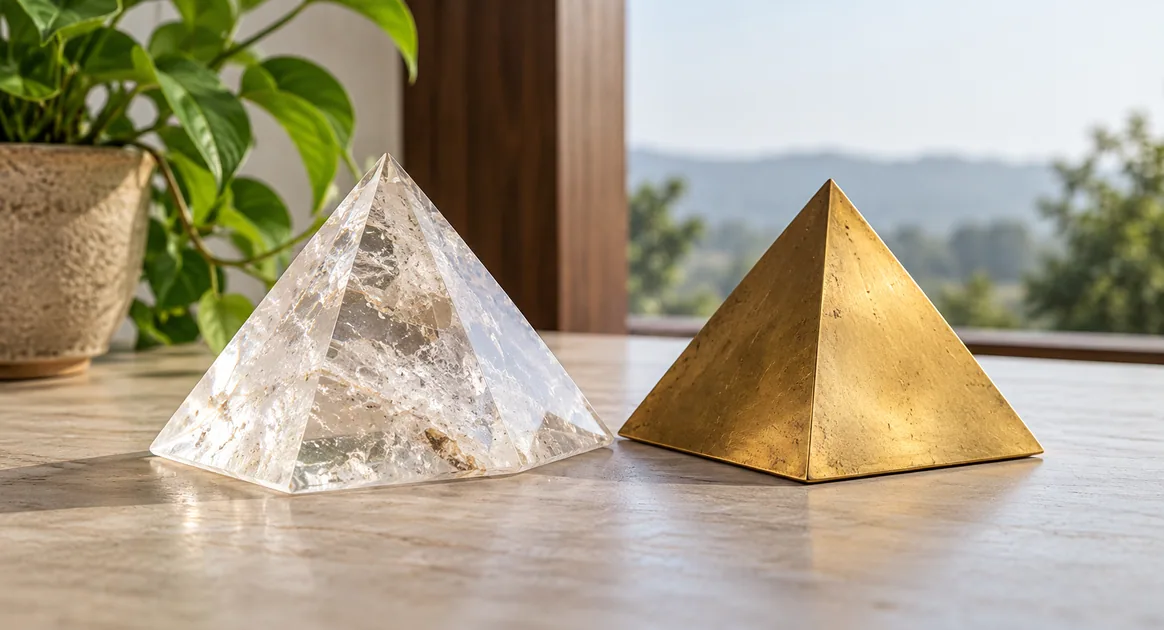
A jewellery showroom owner wants a compact dark pyramid for a counter display alongside a brass pyramid and a pyrite pyramid. All three can appear metallic in a casual photograph. The useful comparison is educational: brass is a copper alloy, pyrite is iron disulphide and hematite is iron oxide. The owner asks suppliers for exact material declarations and labels the three items separately so a customer does not confuse them.
For the showroom, the hematite pyramid sits on a secure display riser behind the selling counter. The owner checks that its dense base will not scratch the glass and that it cannot fall into the customer walkway. Staff are instructed not to use chemical jewellery dips, polishing compounds or aggressive magnets to demonstrate authenticity. An information card can mention the contemporary associations of discipline and stability while explaining that the object is sold for its actual named material and workmanship.
For a professional Vastu consultation reference kit, the consultant carries examples of natural hematite, identified magnetite and manufactured magnetic hematine in separate labelled compartments. Each card records mineral or manufactured classification, supplier, weight, geometry, observed magnetic response if professionally assessed, care instructions and any outstanding identification question. A kit used for client education should not silently mix synthetics with natural specimens. Honest distinctions build more trust than dramatic claims.
| Field | Example entry / instruction |
|---|---|
| Display label | Hematite pyramid — identity subject to supplier documentation |
| Composition | Fe₂O₃ if verified; otherwise record claimed material pending confirmation |
| Source / invoice | Record supplier and lot rather than guessing a mining country |
| Geometry | Measured base side, vertical height and tip condition |
| Weight | Actual grams measured with a calibrated scale |
| Magnetic response | Observation plus test conditions; never a sole authenticity verdict |
| Finish / flaws | Photograph all faces, base, seams, chips and coatings |
| Tradition / use | Vastu symbolism noted separately from mineral identity |
| Care | Support base, dry gentle dusting, avoid unknown cleaners |
11. Buying a genuine hematite pyramid online or in a store
Start by deciding whether your purpose requires a verified natural mineral carving or merely an attractive dark decorative pyramid. Both can be useful purchases when described accurately, but their prices should not be compared as if they are identical. A seller who can explain the distinction between natural hematite, hematine and magnetite provides more information than one who describes every grey object as “100% magnetic natural hematite.”
Ask for actual stock photographs where possible, not only a repeated supplier render. Check the apex, all four sides, the underside and how the object sits on a level surface. Request measurements in millimetres, actual weight in grams, any disclosed coating or bonded material, and handling instructions. If the item has been represented as originating from a particular mine or country, the provenance needs documentation independent of its appearance.
| Question to ask | What a helpful response includes |
|---|---|
| Is it natural hematite, mixed rock or a manufactured hematine object? | A clear specific classification, not the phrase “all hematite is magnetic” |
| Is the piece carved, cast, pressed or assembled? | Manufacturing method and disclosure of seams, resin or fillers |
| Is the magnetism noticeable? | A factual observation and explanation; no claim that attraction proves authenticity |
| Does the exact piece have chips or repairs? | Close photographs of all faces, point and base |
| Are size and weight for this exact piece? | Measured rather than generic catalogue values |
| Has the colour or surface been coated? | Treatment details and any corresponding cleaning limitations |
| Can the material claim be supported? | Supplier documentation or suitable independent identification where warranted |
| How should it be packed? | Protected apex, stable support, separate wrapping for dense pieces |
A certificate is useful only if it identifies this exact product, states what was tested and comes from an appropriate competent source. Generic authenticity graphics, photos of unrelated specimens or certificates without a matching identification record should not be treated as evidence of composition. Record the seller's response at the time of purchase so later care and resale descriptions remain accurate.
12. Cleaning, storage, puja display and handling a dense iron-oxide carving
For a finished hematite pyramid of unknown treatment history, the safest everyday routine is gentle dry dusting with a clean soft cloth or soft brush, followed by inspection of edges and the base. Natural compact hematite is not necessarily ruined by brief contact with water—some gemmological care guides describe mild soapy-water cleaning of identified hematite—but a finished mixed-material or coated product may respond differently. Unless the maker confirms its construction and finish, do not soak it or experiment with jewellery dips, acids, saltwater, abrasive powders, ultrasonic cleaners or steam.
Lift the object from underneath, not by its tip. A dense pyramid dropped from even a modest shelf can chip itself, damage glass or dent a floor. Store it separately in a padded compartment rather than beside softer polished stones that it may scratch or harder objects that may mar its surface. In a humid monsoon season, check for moisture trapped under felt and avoid leaving a wet cloth beneath a coated base.
For a prayer setting, place the pyramid outside the direct path of diya flame, incense ash, abhisheka water, oil and turmeric paste unless its finish is known to tolerate those substances. A person may observe puja or Sankalpa in the manner of their own tradition without pouring liquids over the specimen. Wiping away dry incense dust after use is preferable to repeatedly washing an uncertain manufactured piece.
| Situation | Preferred response | Avoid |
|---|---|---|
| Ordinary dust | Clean soft dry microfibre cloth or brush | Rough metal polishing pads |
| Fingerprints on a polished face | Gentle clean cloth; ask supplier before damp cleaning | Strong solvents or metal-polish chemicals |
| Unknown surface coating | Keep dry, request care from the maker | Acetone, acid tests, scraping |
| Fresh chip at point | Set aside, document, protect users from sharp edge | Home grinding of the finished product |
| Pyramid falls on a shelf | Inspect base, shelf and adjacent objects | Putting it back without checking stability |
| Puja ash / oily residue | Remove loose dust gently; consult seller for residue treatment | Soaking or ritual liquids on uncertain composition |
| Shipping a dense pyramid | Pad apex and faces, prevent movement inside a rigid box | Loose contact with fragile beads or crystal points |
13. Common misunderstandings about hematite pyramids
“All hematite must be magnetic.” No. This confuses natural hematite with magnetite or with manufactured products sold under magnetic-hematite trade names. Conversely, some natural iron-oxide mixtures contain magnetic minerals, so a response to a magnet is an observation requiring context.
“Red streak guarantees this polished object is natural.” A reddish mineral powder is a useful hematite identification characteristic, but other products may imitate aspects of the test. In addition, a streak test sacrifices surface material. Do not perform it on a finished retail object without authorization and a reason.
“A heavier object is a stronger Vastu remedy.” Mass matters for packaging, shelf stability and mineral comparison, not as a universal measure of spiritual significance. For a display, choose a piece that fits the space and your chosen intention.
“Iron oxide means magnetic therapy.” Mineral chemistry does not establish therapeutic benefit. Historical or contemporary symbolic associations with grounding should be described as such; wearing or keeping a magnetic ornament is not a substitute for health care or evidence-based treatment.
“Hematite can replace blue sapphire or coral in every horoscope.” No. Classical Jyotish uses specific planetary gemstone associations and chart interpretation; ornamental iron-oxide pyramids belong to a different decision from astrological gemstone selection.
14. Frequently asked questions about hematite pyramids
- 1. What is a real hematite pyramid?
- A carving made from naturally occurring hematite-bearing material, preferably identified accurately as hematite Fe₂O₃ rather than a mixed or manufactured simulant.
- 2. Are hematite pyramids naturally magnetic?
- Pure natural hematite is usually not strongly attracted to an ordinary hand magnet. Natural inclusions or mixed iron oxides can affect observed response.
- 3. What is hematine?
- A manufactured material often sold as “magnetic hematite,” commonly a ferrite-type ceramic simulant, not necessarily a carving from natural hematite mineral.
- 4. Does a strong magnet prove my pyramid is fake?
- It is a reason to question a claim of pure natural hematite. Magnetite-bearing natural material and other compositions exist; professional material identification is needed for certainty.
- 5. Can hematite be silver-grey and still be genuine?
- Yes. Hematite ranges from steel-grey and black metallic forms to earthy red masses. Grey appearance is consistent with the mineral but not sufficient proof.
- 6. Why is its streak red when its surface is grey?
- The mineral's fine powder has a reddish-brown colour, whereas reflected light from compact polished material can appear grey or black.
- 7. Should I test a new pyramid on ceramic tile?
- No. A streak test may permanently mark or damage a polished product. Use seller documentation and professional advice rather than destructive experiments.
- 8. Is hematite the same as magnetite?
- No. Hematite is Fe₂O₃; magnetite is Fe₃O₄ and is typically strongly magnetic. Both are iron oxides but distinct mineral species.
- 9. Is hematite a metal?
- No. It is an iron oxide mineral that may have metallic lustre. It is not a piece of pure iron.
- 10. Why can a small hematite pyramid feel very heavy?
- Natural hematite has relatively high specific gravity, about 5.3, so a compact solid carving may have noticeable mass for its size.
- 11. Can an inexpensive pyramid be made from a composite?
- Yes. Manufactured ferrite, cast or bonded materials may be sold as decorative pyramids. Such objects should be identified and priced honestly.
- 12. What does hematite symbolize in Vastu?
- It is often associated in contemporary crystal-Vastu language with grounding, steadiness, discipline and the symbolism of Prithvi Tattva.
- 13. Which direction is always correct for a hematite pyramid?
- There is no single universal mineral-specific rule. A practitioner's Vastu system, layout, intention and physical safety all affect placement.
- 14. Can a hematite pyramid be placed near a puja altar?
- It may be used as a symbolic object when consistent with family practice, on a stable surface away from flames, ash and ritual liquids.
- 15. Is hematite a Shani or Mangala gemstone?
- Modern associations vary; it is not automatically a classical replacement for Shani's Neelam or Mangala's Moonga in Jyotish prescriptions.
- 16. Is it linked with Muladhara chakra?
- Contemporary chakra practice often associates dark dense stones with grounding and Muladhara; this is a symbolic interpretation, not a material test.
- 17. Can I wash it in saltwater or lemon juice?
- Do not use saltwater, acids or unknown chemicals, particularly on a coated or manufactured piece. Follow care instructions for the actual identified material.
- 18. How should I store it?
- Support the base in a dry padded compartment, protecting its tip and preventing contact with other polished objects.
- 19. What should a seller disclose?
- Natural or manufactured classification, any magnetic or composite construction, treatment, actual dimensions, weight, chips and recommended care.
- 20. Is a hematite pyramid suitable for a professional Vastu kit?
- Yes, as a clearly labelled material example. Keep natural hematite, magnetite and manufactured hematine distinct, with recorded identification and handling notes.
15. Research basis and practical conclusion
The mineral properties summarized here were checked against Mindat's hematite species record, the University of Minnesota's mineral teaching references, and geological descriptions of hematite's colour, characteristic reddish streak, density and magnetite intergrowths. The trade-name distinction between natural hematite and hematine/“magnetic hematite” was cross-checked against published gemmological guidance from the International Gem Society and Gemstones.com. These are research attributions in plain text, not outbound shopping links.
When choosing a hematite pyramid for Vastu, begin with the exact material claim, not the magnet test or a promise of benefits. Inspect the carving's base, point, finish and actual dimensions; decide whether a natural specimen or clearly labelled manufactured decorative item meets your purpose; then choose a secure shelf appropriate to your room and Sankalpa. Good guidance respects both authentic traditional symbolism and honest material identification. The most useful pyramid is one whose identity, workmanship, placement and long-term care are understood.
Explore existing OmmRudraksha collections
Browse Vastu for the existing collection, or explore gemstone products for other material forms. Each product’s construction and care information should guide your choice.