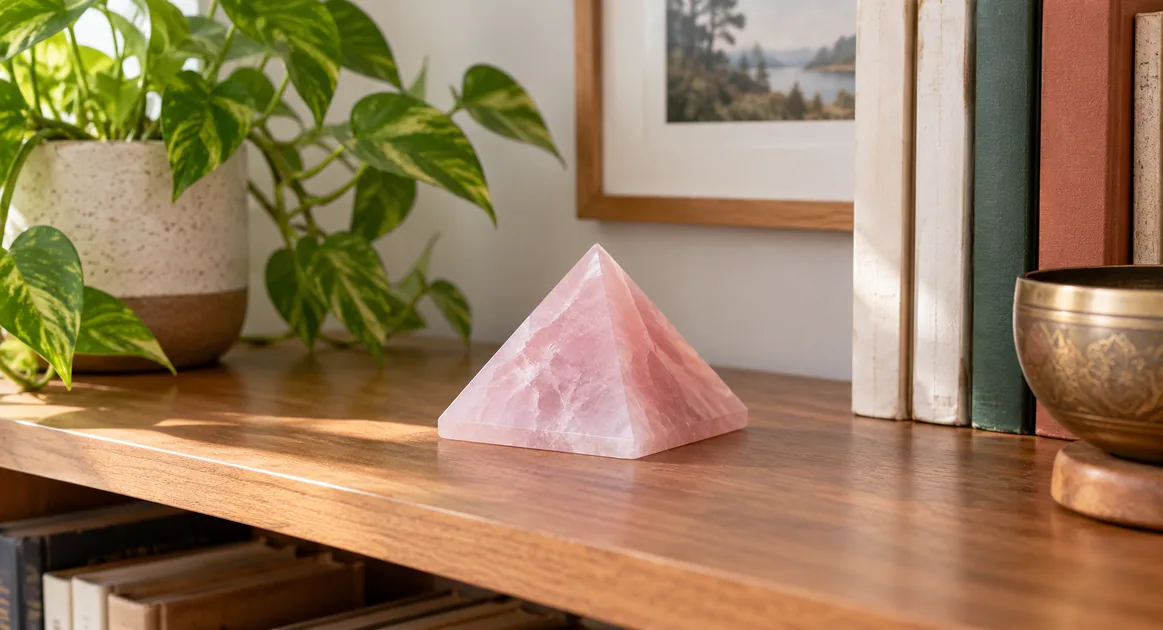
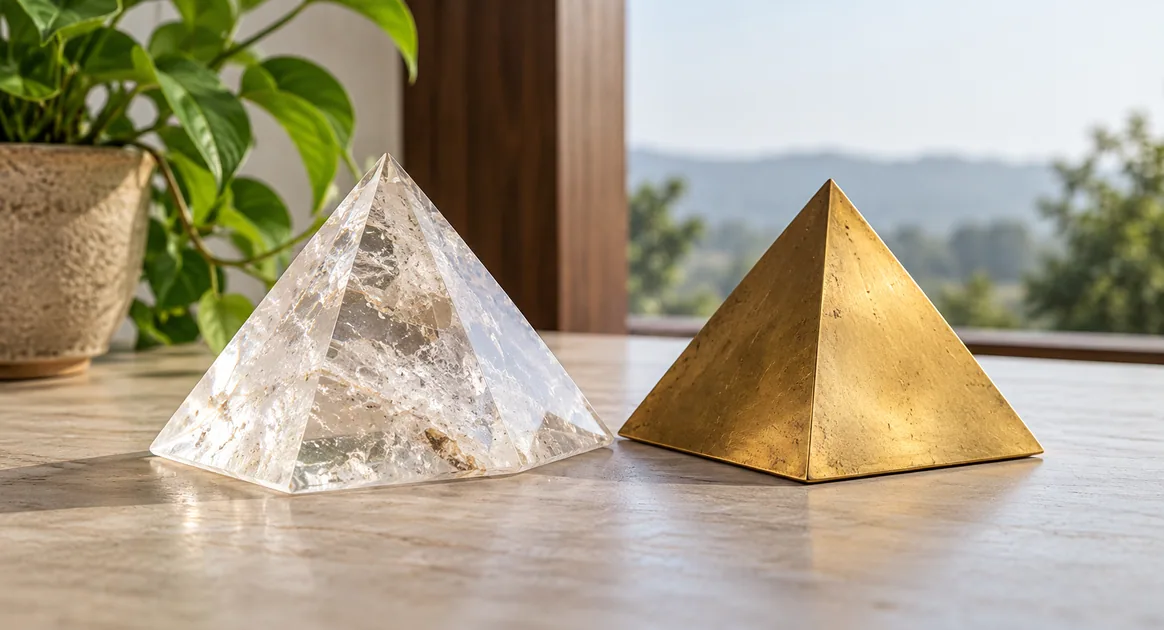
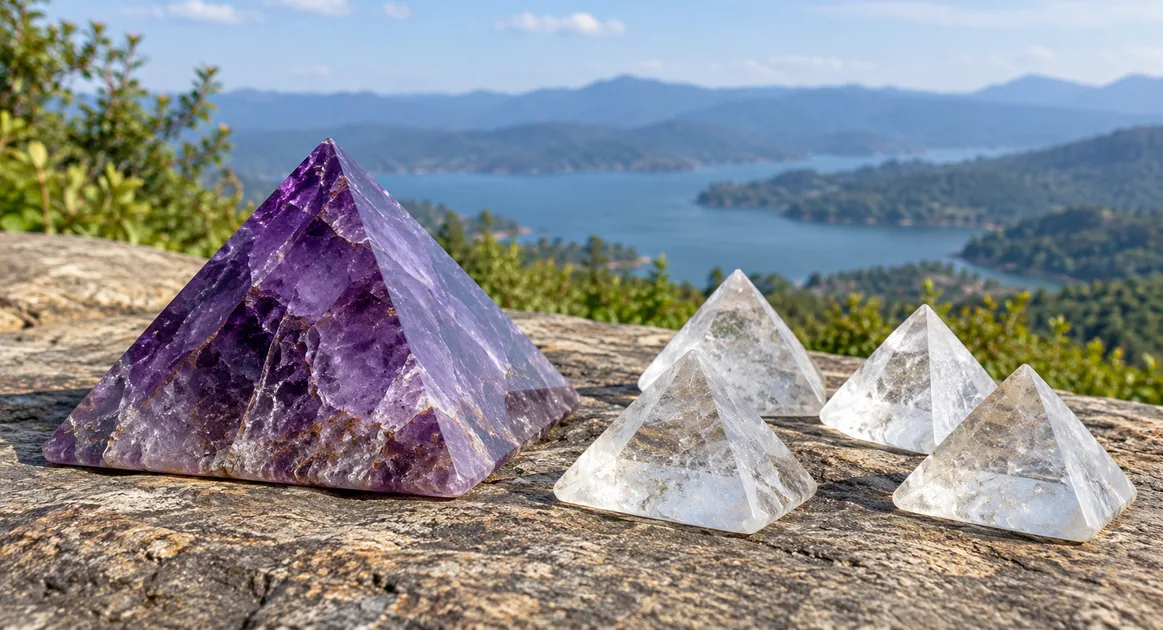
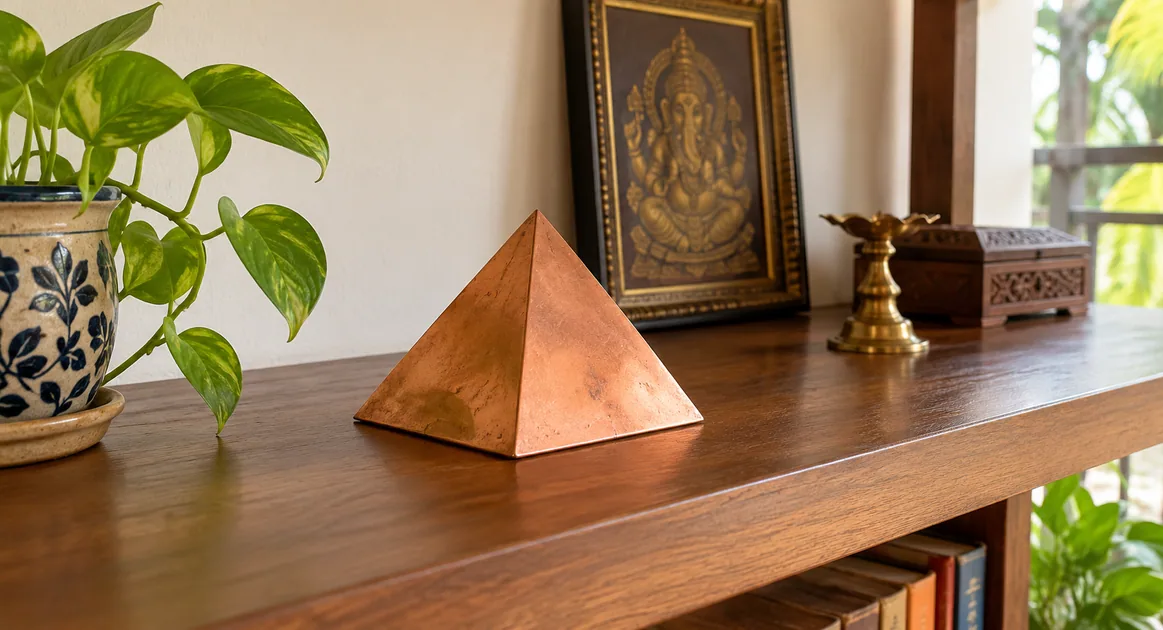
A Vastu pyramid may look small in a photograph and surprisingly substantial on a shelf—or look imposing online yet measure only a few centimetres across. Pyramid dimensions, mass, finish and construction answer different buying questions. A 50 mm base is not a 50 mm vertical height; a solid piece of quartz does not weigh the same as an open copper frame; and a glossy face does not prove a mineral is genuine. Whether you are choosing a Sphatik pyramid for a puja shelf, a tiger eye pyramid for a desk, a brass geometry set for a Vastu demonstration or a labelled specimen for professional consultation, the specifications should describe the actual item rather than an attractive stock photograph.
This guide shows how to read size listings, measure a pyramid properly, understand weight and density, assess polish and defects, plan real placement in Indian homes and shops, and ask a seller for the right evidence. It also explains the connection between the geometry of the pyramid, Sankalpa, Pancha Mahabhuta, the eight directions (Ashta Dik) and traditional Vastu use—without confusing a dimension on a product page with a universal scriptural prescription.
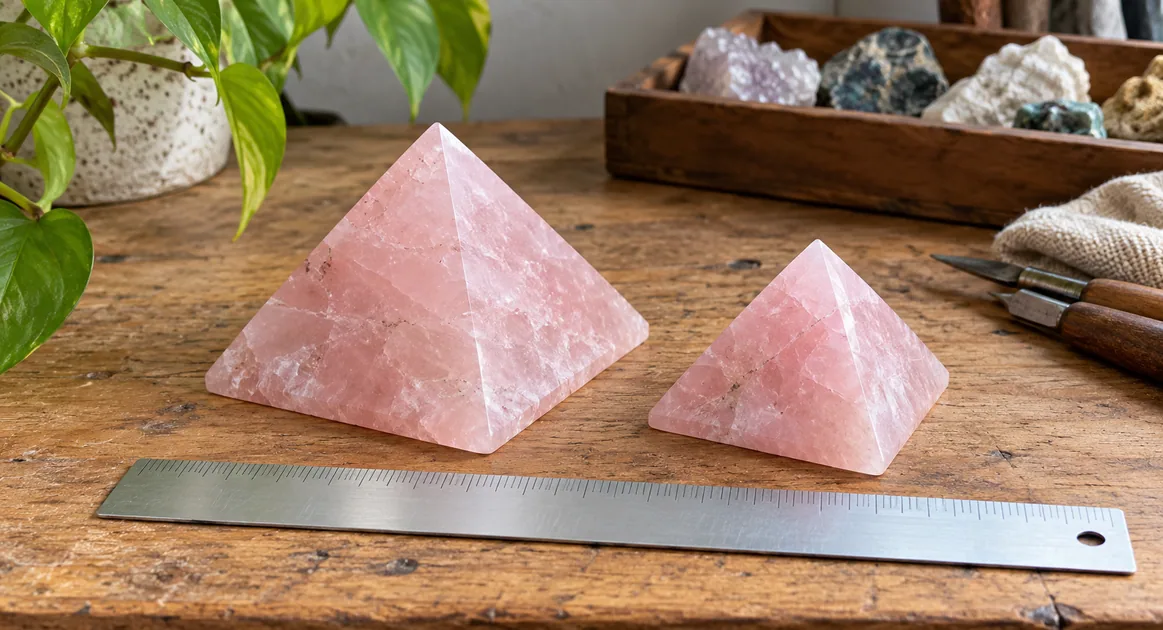
1. What exactly should a pyramid size specification contain?
A square-based pyramid has a base length, base width and a height measured perpendicularly from the plane of its base to the apex. Its sloping face length and slant height are different quantities. If the object is rectangular rather than square, list both base dimensions separately. The apparent height in a photograph can change with camera position, cropping and perspective. That is why a written specification is more reliable than a label such as “small”, “large”, “mini”, “standard” or “extra power”.
| Specification | Correct meaning | What to ask or verify |
|---|---|---|
| Base length | One horizontal side of the bottom face | Is this the longest side, or is the base square? |
| Base width | Second horizontal side | Is it measured across the actual base, excluding packaging? |
| Vertical height | Perpendicular distance from base plane to apex | Has someone confused this with sloping edge length? |
| Slant height | Distance along the triangular face from midpoint of a base edge to apex | Is this useful for comparing face geometry, not total height? |
| Overall width or diameter | Widest outside dimension of an unusual or mounted design | Does a metal stand or frame project beyond the base? |
| Net item weight | Mass of the actual article without a box | Does the number include a stand, filling, adhesive or hanging hardware? |
| Material and build | Solid carved stone, joined stone, hollow metal, open frame, resin or other form | What exactly does the buyer receive? |
| Finish and condition | Polished, satin, raw, coated, sealed, engraved, and any visible defects | Are chipped edges, repairs and coatings disclosed? |
For an ordinary square pyramid, an unambiguous listing can read “base approximately 50 × 50 mm; vertical height approximately 45 mm; net item weight measured separately”. These values are a teaching example, not measurements of OmmRudraksha stock. If the material, dimensions or weight of a real item have not been verified, the product listing should not borrow this example.
Millimetres, centimetres and inches
Use one primary unit system and display helpful conversions, ideally millimetres for physical stock measurements. One centimetre equals 10 millimetres; one inch is exactly 25.4 millimetres, according to the international definition described by NIST. So a base described as exactly two inches would convert to 50.8 mm; a nominal “2-inch” product, however, may be rounded and should be measured to establish its actual dimensions. Converting a stated number cannot improve the accuracy of the original measurement.
| Example of a dimension label | Metric interpretation | What it does not establish |
|---|---|---|
| 20 mm base | 2 cm across one base edge | Height, mass or material |
| 40 × 40 mm base | Square base with 4 cm sides | Whether the piece is solid or hollow |
| 50 × 45 mm | Ambiguous without labels | Which figure is base and which is height |
| 2 in base | 50.8 mm when exact; often only nominal in retail | An equal 2-inch vertical height |
| 70 mm overall height with stand | Total displayed assembly height | Height of the pyramid body by itself |
2. How to measure the actual pyramid without damaging it
Put the object on a stable, dry, level surface with soft protection beneath it. Use a clean ruler or, when suitable, a digital calliper for base length and width. Do not clamp hard over a brittle edge, polished point, fibrous gypsum surface or thin metal tip. For vertical height, take the perpendicular measurement from the base plane to the apex, not from the bottom corner along a sloping edge. If the apex is gently rounded for safety, state that and measure to the actual highest point.
A square base can be checked along both perpendicular edges; four edges that vary slightly may indicate handmade finishing. An irregular or repaired base should be described honestly rather than rounded into a claim of machine-perfect geometry. For a pyramid mounted on a raised plinth, record pyramid body height, stand height and total assembled height separately. For a set, measure the major component and document the other pieces as individual dimensions rather than calling the whole collection one size.
For online photographs, a view straight toward the base, a side elevation and a view showing the actual item beside a measuring rule are more useful than a dramatic perspective shot. Avoid printing artificial measurement graphics on a stock illustration when they do not match the article for sale. A photograph with a reference object is supplementary evidence, not a substitute for a reliable specification field.
How precise should the numbers be?
A ruler marked in millimetres cannot justify micron-scale measurements. If an actual base measures near 49 mm, avoid writing “49.000 mm” or promising a fictitious 0.01 mm manufacturing tolerance. State the observed measurement and use “approx.” where ordinary handwork, cutting or batch variation affects the size. If there is a documented manufacturing tolerance, publish the actual acceptable range and explain whether the customer receives a random piece or selects a specific pictured unit. Measurement accuracy and manufacturing tolerance are different things.
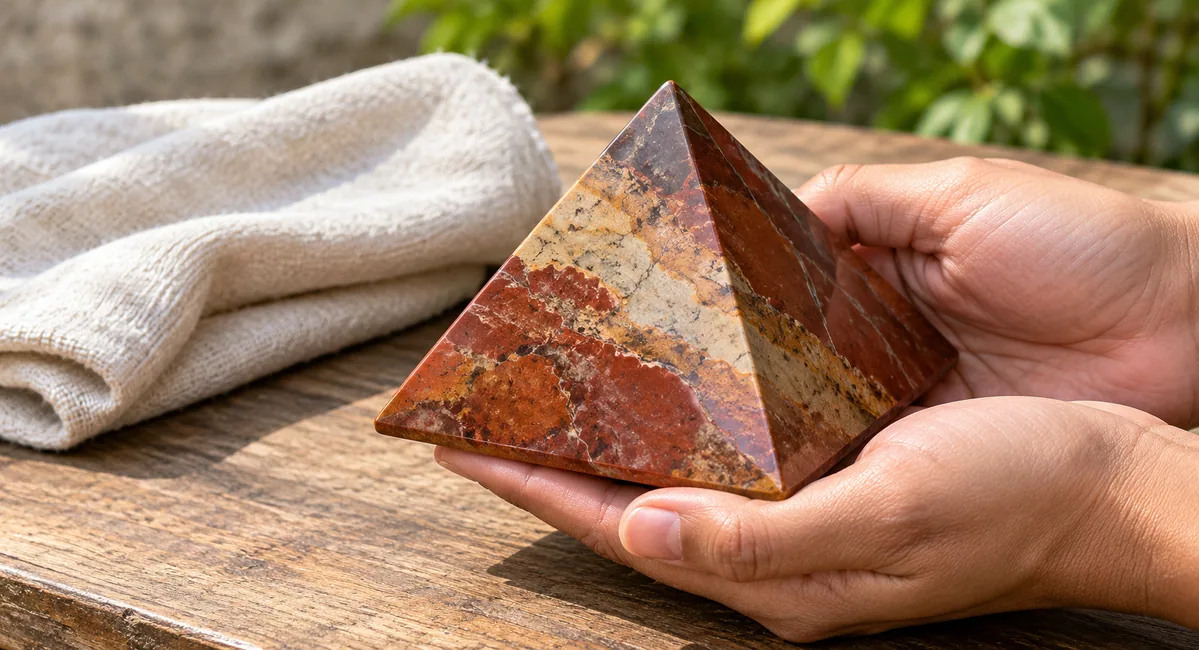
3. Geometry: base, apex, angles and the volume of a pyramid
A pyramid is not defined by its weight or by a single symbolic angle. In elementary geometry, the volume of an ideal solid pyramid is one-third of the base area multiplied by its perpendicular height. For a square base of side b and height h, this is V = b × b × h ÷ 3. A rectangular-base version uses length × width × vertical height ÷ 3. This formula is useful for comparing theoretical volume; it is not a guaranteed product weight, especially when a carving has rounded tips, bevelled edges, a hollow centre, internal fractures or a stand.
Here is an explicitly hypothetical calculation. Imagine a perfect solid square pyramid with a 40 mm × 40 mm base and a 40 mm vertical height. Its geometric volume is 40 × 40 × 40 ÷ 3 = approximately 21,333 cubic millimetres, or 21.33 cubic centimetres. A real stone pyramid with the same outside measurements may contain less material because corners and apex are rounded. An open-frame pyramid contains far less body material, despite occupying approximately the same visual envelope.
A pyramid can also have a sloped apex not exactly above the centre. Geometry still uses perpendicular height for volume; simply measuring a sloping edge does not substitute for vertical height. An “Egyptian angle”, “perfect angle” or “sacred geometry” description is not a substitute for a measured drawing. If a seller promises a specific face angle or proportion, ask which angle, which reference plane, and how it was measured. Avoid attaching a universal Vastu benefit to a precise number unsupported by the selected tradition or product evidence.
| Geometry or construction | What to check | Why it matters |
|---|---|---|
| Square-based cut | Both base axes, level base, apex centring | Stable display and clear dimensions |
| Rectangular-based cut | Length and width independently | Prevents calling a rectangle a square |
| Stepped or layered pyramid | Each tier, overall body dimensions | A single “size” hides the tier structure |
| Hollow folded-metal pyramid | Outer dimensions, sheet thickness, joints | Total envelope is not equivalent to solid volume |
| Open-frame pyramid | Frame width, member thickness, joints | Weight largely reflects wire or rod construction |
| Faceted crystal pyramid | Face angles, edge finishing, point condition | Light effects depend on cut and orientation |
| Pyramid on a base or stand | Item and stand measured separately | Prevents incorrect comparisons |
4. Why two pyramids of the same size can have very different weights
Mass follows the amount and density of the actual material. In simplified terms, mass = density × material volume. A compact polished stone and a hollow brass pyramid can both have a nominal 50 mm base, yet contain vastly different amounts of matter. Two stone pyramids can also differ because quartz, fluorite, pyrite, calcite and other minerals do not have identical density. Joined pieces, cavities, filler, attached feet and coatings further affect an actual weighing.
Density, or specific gravity when expressed as a ratio to water, is useful in gemmology but cannot be inferred with confidence from the feeling that a piece is “heavy”. GIA laboratory descriptions explain that accurate measurements and, when needed, hydrostatic methods support specific-gravity testing. A retail kitchen scale and rough theoretical volume are useful for a shipping estimate; they are not an origin or mineral-authenticity certificate. Immersion may damage gypsum, salt, metal assemblies or unstable materials, so a buyer should not attempt a water-displacement test on an unknown pyramid.
| Pyramid type | Expected reason for weight variation | Better check than “feels heavy” |
|---|---|---|
| Solid carved quartz | Volume, inclusions and finish affect mass | Actual net weight and reliable material identification |
| Dense iron-bearing or sulphide material | Different mineral density, possible mixed-rock composition | Mineral testing when identity matters; treatment and condition disclosure |
| Softer calcite or gypsum | Distinct density and delicate cutting | Confirm material, edges, and safe handling |
| Natural glass such as obsidian | Different density and brittle chipping behaviour | Inspect edge condition and actual dimensions |
| Hollow copper or brass shell | Sheet thickness, fold, seams and inserts | State hollow build and material composition |
| Open copper frame | Wire/rod section and joining points | State frame design, not “solid metal” |
| Reconstructed chips in resin | Binder ratio, voids and embedded filler | Clearly name composite construction |
| Multi-part set | Number, size and material of each piece | Give item-by-item and total packaged weights separately |
Weight specifications need two separate values when shipping is involved: net item mass, measured without packaging, and shipping weight, which can include protective foam, a box and other contents. A 200 g boxed package does not prove the pyramid inside weighs 200 g. For a bundle, item weights and total bundle weight should not contradict one another. State whether measurements apply to the photographed exact piece or a range of individually made stock.
5. Solid, hollow, open-frame, composite and assembled construction
“Solid pyramid” should describe the actual body. A pyramid carved from one mineral-bearing piece may still contain natural mineral seams or a restored fissure; the seller should describe repairs or significant fillers. “Solid gemstone” should not be used for a dyed resin block with suspended chips. A composite may be attractive and suitable for display, but its name must disclose its construction. Likewise, a brass-coloured finish on a different base metal is not automatically solid brass.
An open copper frame intentionally has no solid faces. A folded copper shell may have faces but an empty interior. A layered nine-pyramid design may contain multiple interconnected parts; it should not be measured or weighed as though it were one carved gemstone pyramid. For tiered kits, a packing manifest identifying each part often gives the buyer more useful information than a single glamour photograph.
How to verify construction before ordering
Ask for an underside image, a close-up of any joint or seam and a photograph of the entire article alongside a scale. For metal, ask whether the surface is solid copper, copper-plated, brass, lacquered, patinated or an alloy of stated composition. For mineral carvings, ask whether the body is natural, treated, joined or reconstructed; ask about visible filling at fissures. The answer should be based on the actual stock item, not on assumptions from a competitor’s product description.
6. Surface finishes: mirror polish, satin, raw texture and coatings
Gloss is a finishing choice, not a universal grade. A fine-grained quartz pyramid may take a reflective polish; pyrite can retain natural granular pits; satin spar gypsum shows a fibrous directional sheen; an obsidian face can appear mirror-dark while its edges remain vulnerable to chipping. Different cuts, species and grains respond differently to polishing, and a cloudy natural inclusion is not automatically poor workmanship.
| Finish or appearance | What it may mean | What a buyer should inspect |
|---|---|---|
| High gloss or mirror polish | Smooth, highly reflective surface | Fine scratches, filler, uneven polishing, glare hiding defects |
| Satin or matte finish | Deliberate diffuse texture | Whether finish is consistent or abrasive damage |
| Fibrous sheen | Characteristic of some gypsum and other materials | Fragile tips, fibre shedding, moisture sensitivity |
| Granular or speckled texture | Natural mineral aggregates or mixed rock | Loose grains, open fractures, genuine mineral description |
| Waxed or oiled surface | Added lustre or protected porosity | Disclosure, future care and whether treatment masks cracks |
| Lacquered or plated metal | Protective or decorative coating | Metal underneath, abrasion, tarnish and cleaning directions |
| Dyed or coated stone | Colour may be enhanced or entirely surface-applied | Whether colour is stable, disclosed and suitable for handling |
| Rounded point or bevel | Intentional safety finish or reworked damage | Uniformity and accurate photographs |
Inspect the four sides, top, bottom and corners. A black line may be a mineral inclusion, a joined seam or a crack; photographs from multiple angles can narrow the possibilities but do not always settle the identity. A slight asymmetry in handmade work need not make an item unsuitable for a puja or display purpose. Conversely, a cracked base that rocks on a shelf, a powdering surface or a loose attachment requires attention even if the listing calls it “natural character”.
7. Distinguish ordinary variation from a defect that should be disclosed
Natural stone is variable. Rose quartz can be cloudy; tiger eye’s moving light band appears only from certain viewing angles; labradorite’s flash may show best on one face; agate banding is rarely symmetric across a carving. These are material features that should be shown in honest photographs. They are not a free pass for undisclosed breaks, repairs or unstable construction.
| Observation | Often normal, depending on material | Needs clearer disclosure or inspection |
|---|---|---|
| Colour or band differences | Natural zoning, mixed minerals, orientation | Suspicious coating, dye pooling or wrong material label |
| Small surface pits | Can occur in granular pyrite or aggregate stone | Powdering, flaking, loose particles or progressing damage |
| Rounded apex | May be a deliberate safe finish | Jagged break, repair or point worn away |
| Fine lines | May be inclusions or growth boundaries | Open crack crossing a stress-bearing edge |
| Light-weight item | Expected in an open or hollow frame | Listing incorrectly claims dense solid stone |
| Slight handmade variation | Small dimension or alignment differences | Inability to stand upright or distorted joints |
| Clear coating | May protect metal or enhance colour | Coating concealed from the product description |
When the question matters commercially, ask for a close-up in soft, even light. Avoid rubbing aggressively with a fingernail or testing a stone by scratching it with a knife. Such tests may damage a genuine piece and do not establish species reliably. A high-value or unusual-material purchase may justify gemmological testing, but routine product listings should not claim laboratory verification without documentation.
8. How size relates to actual Vastu placement and traditional use
In Indian settings a pyramid may be chosen for its form, colour, material and Sankalpa (intention). Contemporary Vastu practices sometimes arrange a single stone pyramid near a study space, a group of pyramids in a consultation diagram, or a metal pyramid at a selected architectural point. The precise approach differs by teacher, practice and object. A label such as “9 cm pyramid” alone cannot decide a directional remedy; the room plan, entry, structure, existing worship arrangement and the selected tradition matter.
The Pancha Mahabhuta—Prithvi (earth), Jala (water), Agni (fire), Vayu (air) and Akasha (space)—provide a traditional framework for reflecting on a space. The Ashta Dik describe eight directions; the northeast (Ishanya) has a devotional association in many Vastu interpretations, while other directions have context-specific functions. These ideas add cultural significance but do not turn millimetres, mass or an unverified face angle into a proven physical energy rating. Describing a contemporary crystal pyramid as a modern practice where appropriate preserves historical distinctions without stripping its spiritual meaning.
For a puja shelf, a compact stable pyramid may allow adequate space for lamps, a Sphatika Lingam, deity images and routine cleaning. Near a diya or incense burner, keep any gemstone, coating, resin or metal piece away from flame, rising heat and oily soot. For a family’s devotional use, the ease of handling and respectful placement can be more important than the biggest size available. The existing OmmRudraksha consultation process can guide a person who wants a chart-informed recommendation rather than assuming that one pyramid size suits every Rashi, Nakshatra or Graha association.
| Intended setting | Size decision | Additional Vastu and practical consideration |
|---|---|---|
| Puja shelf or shrine | Enough footprint without crowding | Stable base, safe lamp clearance, traditional appropriateness |
| Study desk | Space for work and unobstructed sightlines | Sankalpa for learning; avoid placing a sharp point where hands strike it |
| Business reception | Visible but not intrusive | Clean access, customer safety, relevant symbolism of auspiciousness |
| Jewellery showroom | Sufficient display scale and secure mounting | Explain actual mineral rather than implying gemstone grade from weight |
| Home entrance console | Stable, child-safe placement | Actual shelf depth, movement and ambient humidity |
| Professional Vastu demonstration kit | Several labelled small reference models | Consistent labels and transparent difference between teaching and remedy use |
| Directional layout discussion | Scale should suit the plan or model | Do not extrapolate millimetres into guaranteed correction results |
Lakshmi, Kubera, Shiva, Graha and chakra references
Lakshmi and Kubera symbolism may occur in prosperity-themed contemporary Vastu displays; Sphatik may be used in Shiva-related puja contexts; gemstones may be discussed through Graha and chakra associations. These references must match the particular article, tradition and customer question. A quartz pyramid, a yellow gemstone pyramid and a Yantra are not interchangeable merely because all have spiritual uses. Likewise, Shani or Brihaspati associations in Jyotish depend on the tradition and horoscope, not on the weight of a generic pyramid. In a product specification, place cultural associations beside—rather than instead of—clear factual measurements.
9. Three worked examples for Bengaluru homes, showrooms and consultants
A family apartment. Consider a narrow puja ledge where a customer wants an amethyst or rose quartz pyramid. Instead of choosing by a close-cropped image, the family measures usable shelf depth, checks clearance from the lamp and looks for a base that sits entirely on the ledge. If the two candidate pyramids have the same advertised “2-inch” size, they ask for base and vertical-height measurements separately. They also confirm whether the piece shown is their actual stock item, since amethyst zoning and rose quartz cloudiness vary. Their Sankalpa and placement are considered alongside these ordinary safety and space facts.
A jewellery showroom. A retailer considers a heavier polished tiger eye pyramid and a lighter open brass frame for a reception counter. The objects communicate different material stories and have different contact hazards. A tiger eye carving needs honest photographs of its chatoyancy in several light angles; a brass frame needs clearly described joins and a non-rocking base. The showroom records net weight for stock handling and packaged weight for dispatch. It does not advertise one as stronger in Vastu merely because the scale reads more grams.
A professional Vastu consultation kit. A consultant carries specimens to demonstrate quartz, calcite, obsidian, copper and layered pyramid designs. A useful kit has a small label with material, construction, base dimension, vertical height, approximate net weight if measured, cautions and inventory code. Different samples are kept in padded compartments; gypsum and pyrite are protected from moisture, while fragile points are secured. A reference specimen aids explanation but does not authorize using its generic dimensions as a substitute for an individual room or horoscope assessment.
10. Care and packing depend on material and finish, not just size
A larger stone may require stronger padding because of its mass; a very small pyramid may have an especially delicate tip. Protect both. Use a dry soft cloth and avoid universal “wash and recharge” instructions. Gypsum or rock salt may be damaged by water; pyrite and metal need moisture-aware care; some coated or dyed pieces should not be rubbed with solvents; obsidian can chip into sharp edges. Material-sensitive handling should be followed even when an object is also used in devotional or Vastu arrangements.
| Material or construction | Handling priority | Packing and display note |
|---|---|---|
| Quartz, agate, jasper | Cushion points, prevent rubbing | Individual soft sleeves and stable shelf |
| Fluorite or calcite | Protect edges from impacts | Extra tip protection and avoid acids |
| Satin spar gypsum or rock salt | Keep dry, avoid soaking | Dry storage and humidity protection |
| Pyrite | Avoid standing moisture, check surface condition | Separate dry wrapping, periodic inspection |
| Obsidian | Beware brittle chips and sharp corners | Padded rigid compartment |
| Copper or brass | Keep clean and dry, check coatings | Separate metals from abrasive stone surfaces |
| Resin or treated composite | Avoid heat, solvents and intense abrasion | Follow maker-specific finish directions |
Shipping descriptions should specify whether the item comes in a padded box, whether a stand is included and which pieces are separate. For a nine-piece or stepped set, a parts list reduces confusion. If the product image shows a tray, flowers, coins, deity figurine or measuring rule for scale, identify whether those props are included. The packing check should confirm that a fragile point cannot press directly against the outer carton wall.
11. A seller-ready specification template for OmmRudraksha
A professional listing is clear enough that two customers can compare objects without guessing. It need not publish laboratory-level dimensions for every everyday carving, but it should answer the practical questions before purchase. Product data ought to be entered from the measured item or verified batch, not copied from reference websites. Different sizes of one genuinely identical design may be sold as variants where the platform supports that; materially different builds should be distinguished in their names and content.
| Field | Seller entry guidance | Evidence or validation |
|---|---|---|
| Product name | Material + “Pyramid” + meaningful size/build qualifier | Actual item identity |
| Material | Quartz, agate, brass, copper etc.; qualify mixed materials | Purchase record, inspection or suitable report |
| Treatment | Dye, heat, filling, coating, composite, unknown if unresolved | Seller disclosure; avoid unsupported “untreated” claims |
| Construction | One-piece, joined, hollow, frame, tiered, resin or assembled | Underside and joint photographs |
| Base length and width | Actual measured values with units | Ruler/calliper and appropriate precision |
| Vertical height | Perpendicular body height, excluding stand | Side measurement |
| Net mass | Actual measured mass or a disclosed verified range | Scale and item inventory code |
| Finish | Polished, satin, raw, engraved, lacquered etc. | Close-up of actual surface |
| Variation statement | Natural inclusions or documented batch variation | Representative and exact-item images |
| Care | Material-specific, including relevant humidity/impact guidance | Reviewed care instructions |
| What's included | Pyramid, stand, box, certificate, accessories as applicable | Packing manifest |
| Inventory record | SKU, stock photograph or unique piece ID | Internal validation before public sale |
What a buyer should request before placing a bulk order
For wholesale, event gifts or professional-kit quantities, ask whether the same dimensions, stone variety, finish and packing method are achievable across the batch. Request a small physical sample or detailed measured sample record and agree on acceptable variation before ordering. If a buyer requires uniform orientation of tiger eye chatoyancy or similar labradorite flash, explain that natural patterns may make exact optical uniformity unrealistic. A written variation policy is more helpful than a claim that every natural specimen will match the same photograph.
12. Common buying mistakes and how to avoid them
One frequent error is confusing shipping weight with item weight; another is assuming “2 inch” means base, height and sloping side are all two inches. Some listings use “large” as a substitute for a dimension; others claim a particular angle because the shape resembles a famous monument. A third error is treating a shiny, heavy or flawless piece as automatically natural. Genuine mineral identity needs evidence appropriate to the value and situation, while physical specifications need straightforward measurement.
| Mistake | Better question |
|---|---|
| Choosing from a perspective photograph alone | What are the base length, base width and perpendicular height? |
| Interpreting shipping mass as gemstone mass | What is the net weight without box and stand? |
| Equating heavy with natural | What is the actual body material and construction? |
| Assuming gloss means high quality | Can I inspect edges, underside, coating and any repair? |
| Believing the largest size has the strongest traditional effect | Which practice is being followed, and why is this placement selected? |
| Assuming a perfect angle from a stock image | Is a measured drawing or design specification available? |
| Buying identical photographs as identical natural stones | Can I see the actual piece or a documented variation range? |
| Ignoring the shelf footprint | Will the base sit securely with clearance from heat and movement? |
| Choosing one cleaning method for all pyramid materials | What are the care instructions for this exact material and finish? |
13. Frequently asked questions
1. Does “2 inch pyramid” refer to the height or the base?
Not necessarily either: the listing must name the measurement. Ask for base length, base width and perpendicular height separately. A two-inch base is 50.8 mm if the number is exact.
2. Can two pyramids have the same base dimensions but different heights?
Yes. Their faces will slope differently, and their enclosed ideal volumes will differ. They may still share the same outside footprint on a shelf.
3. Is the height measured along the sloping edge?
No. Vertical height is perpendicular to the base. Sloping edge length and face slant height are separate measurements; a seller should label each clearly.
4. Does a heavier pyramid contain better-quality gemstone?
No. Mass depends on density, volume, filling and construction, among other things. Weight is useful stock information, not proof of origin, quality or spiritual suitability.
5. Is there one compulsory angle for every Vastu pyramid?
Different contemporary designs and teachers use different forms. A specific angle claim should identify the reference and how it was measured; appearance alone does not prove an exact angle.
6. Are small pyramids less useful for puja or Sankalpa?
A smaller form may fit a puja shelf better. The object should be stable and appropriate to the practice; do not treat its weight as a measured spiritual rating.
7. How can I tell a solid stone pyramid from a hollow object?
Read the construction description and inspect underside, seams, weight and close-ups. Do not assume “solid” from a single front photograph.
8. Do handmade pyramids have to be perfectly symmetrical?
Minor handmade variation can be normal. A rocking base, damaged tip or misleading dimensional description should be disclosed rather than dismissed as character.
9. Does a highly polished surface guarantee a genuine crystal?
No. Glass, resin, dyed stone, lab-grown material and natural mineral can all be polished. Ask for the actual material name and treatment disclosure.
10. What is the difference between polished and satin finish?
Polished surfaces reflect light sharply; satin finishes scatter it more diffusely. Neither label alone indicates species, purity or strength of a traditional association.
11. Why does tiger eye look different on different pyramid faces?
Chatoyancy is directional. Orientation of the material and viewing light control the moving bright band, so photographs should show more than one angle.
12. Why does a labradorite pyramid flash blue only from certain directions?
Labradorescence varies with viewing and illumination angle. One face may show more play of colour than another, without necessarily being defective.
13. Should a pyramid be washed before placement in a puja space?
Not automatically. Water can harm some materials and finishes. Choose a material-safe cleaning method while respecting the devotional practice separately.
14. Can I place a pyramid near a diya or incense burner?
Allow adequate heat and soot clearance. Resin, coatings, some stone surfaces and fragile finishes should not be exposed to concentrated flame or heat.
15. Can a measuring rule in an image replace written dimensions?
No. Camera angle, cropping and a non-measured sample can mislead. The listing should report actual labelled dimensions.
16. Are size and weight sufficient to identify quartz, calcite or fluorite?
No. They are useful clues but not conclusive mineral tests. Identification may require appropriate gemmological methods; destructive scratch or soaking tests are inappropriate for retail stock.
17. What details matter for a metal pyramid?
Distinguish brass, copper, plating and other alloys; describe whether the build is solid, hollow or open, and disclose joins, coatings and actual dimensions.
18. How should a set of nine pyramids be listed?
Give the count, construction, relevant dimensions of each component, included accessories, net mass where measured, and total packed mass separately.
19. Is the “exact pictured piece” important for natural-stone pyramids?
Yes when customers care about unique banding, inclusions, optical effects or a high-value specimen. Otherwise a representative image should be accompanied by a clear natural-variation statement.
20. What is the most useful final check before purchase?
Confirm actual material and treatment, measured base and height, net item mass or verified range, finish and condition, what is included, care instructions and suitability for the intended shelf or demonstration.
14. A clear specification supports a meaningful traditional choice
The purpose of a useful pyramid listing is to let material facts and traditional significance reinforce one another. Accurate measurements help a family plan its puja space, a business select a stable display and a Vastu consultant maintain a reliable reference kit. Terms such as Ishanya, Pancha Mahabhuta, Sankalpa, Lakshmi, Shiva, Graha and chakra associations belong where they illuminate the chosen tradition—not as a replacement for dimensions, mineral identification, treatment disclosure or safe care.
Buy the pyramid whose material, construction, size, weight, finish, condition and intended placement are understandable. A clear, well-measured product can serve both its practical purpose and its personally meaningful devotional or Vastu setting without exaggerated claims attached to arbitrary numerical specifications.
Research basis for measurement and mineral distinctions: NIST guidance on SI length and unit conversion; standard geometric treatment of pyramid volume; GIA laboratory guidance on dimensions, density and material identification; International Gem Society educational resources on density and specific gravity. Reference names are included for traceability without repeated outbound links.
Explore existing OmmRudraksha collections
Browse Vastu for the existing collection, or explore gemstone products for other material forms. Each product’s construction and care information should guide your choice.