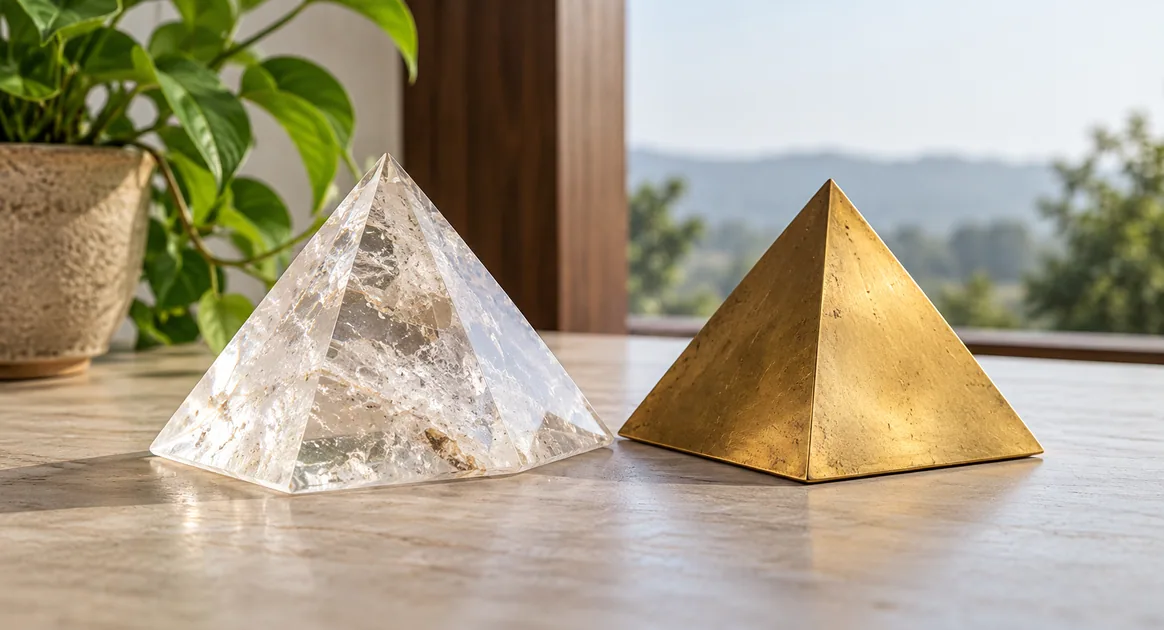
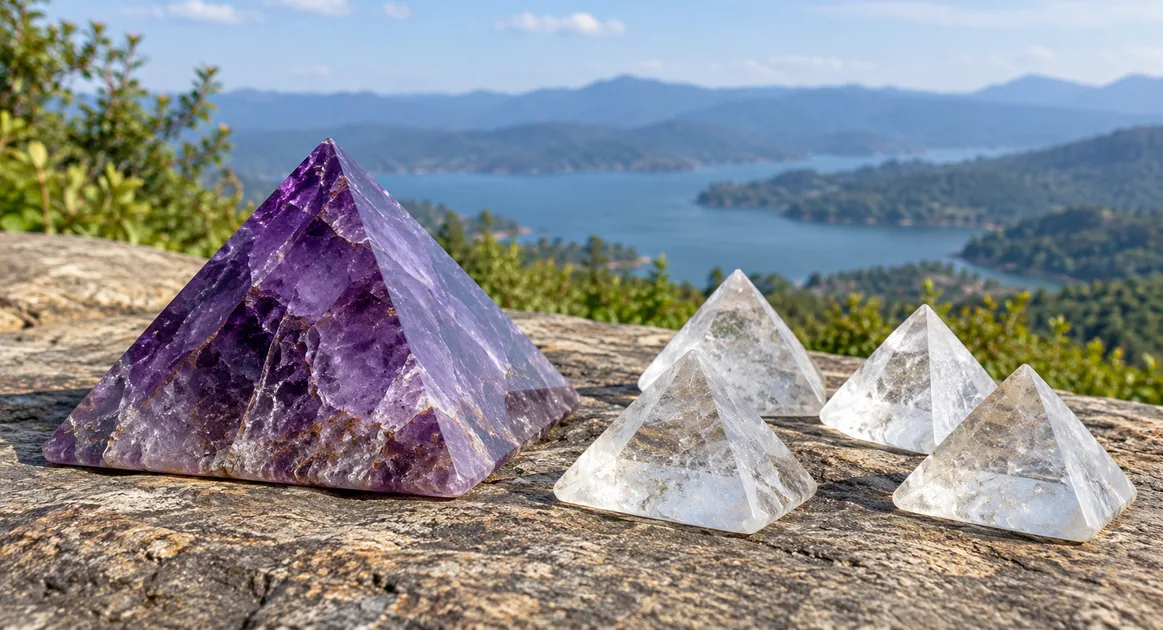
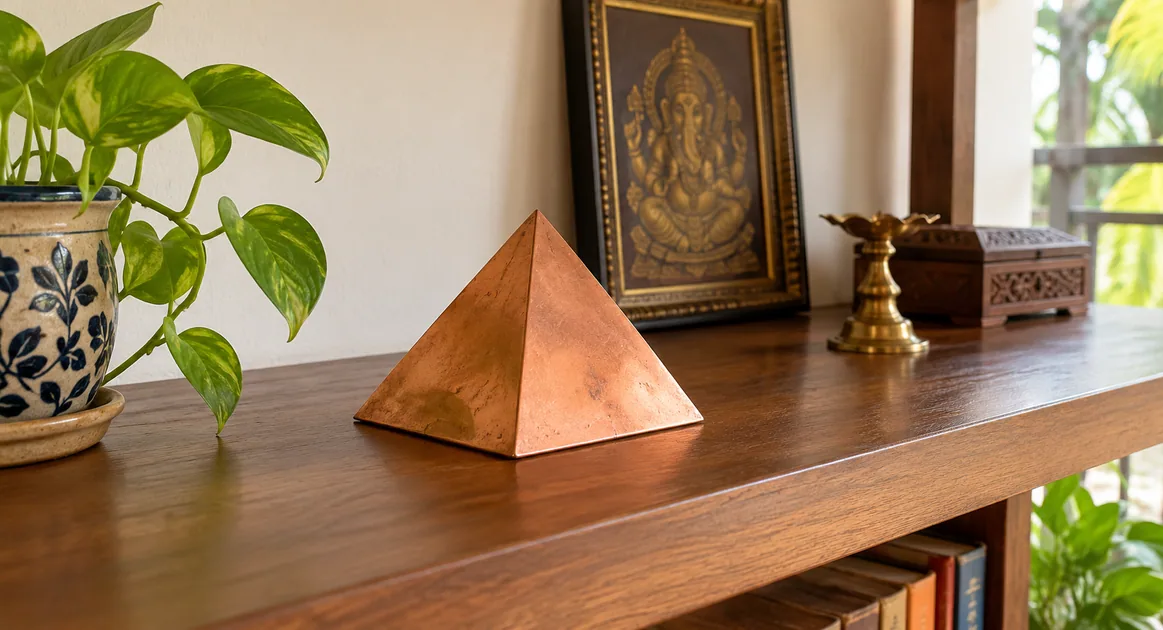
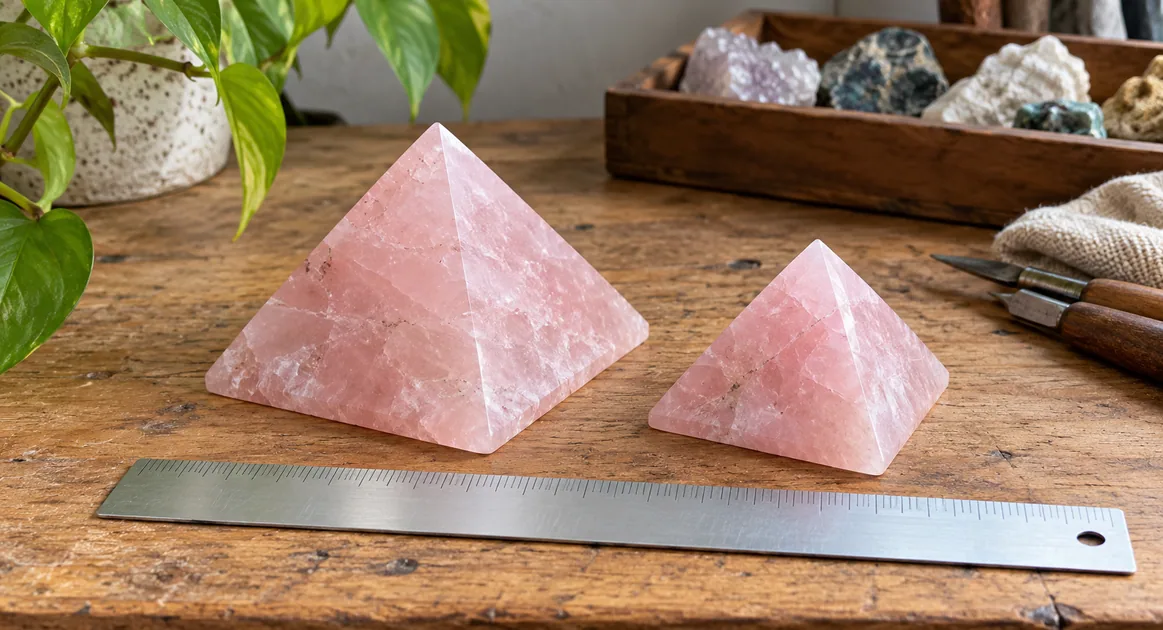
Which Vastu pyramid should you choose for a home, office or meditation space? Begin with the actual space, your intention (Sankalpa), and the material you can identify and care for. A translucent Sphatik carving in a puja room, a small copper pyramid on a dry office shelf and a rose quartz pyramid in a family sitting room offer different appearances and traditional associations. None is automatically the “best pyramid” for every house or every person. A good choice fits the location, is honestly described, and is used with meaning rather than purchased only because a seller promises an extraordinary result.
This guide brings together Vastu Shastra, Ashta Dik (eight directions), Pancha Mahabhuta (five elements), devotional use, material knowledge and practical buying checks. It distinguishes longstanding spatial concepts such as Ishanya and Agneya from newer retail interpretations of gemstone pyramids. You will find room-by-room examples, stone and metal comparisons, a measurement checklist, humidity and light precautions, and questions to ask before paying. The aim is a thoughtful, traditionally meaningful object that remains practical in everyday Indian homes and workplaces.
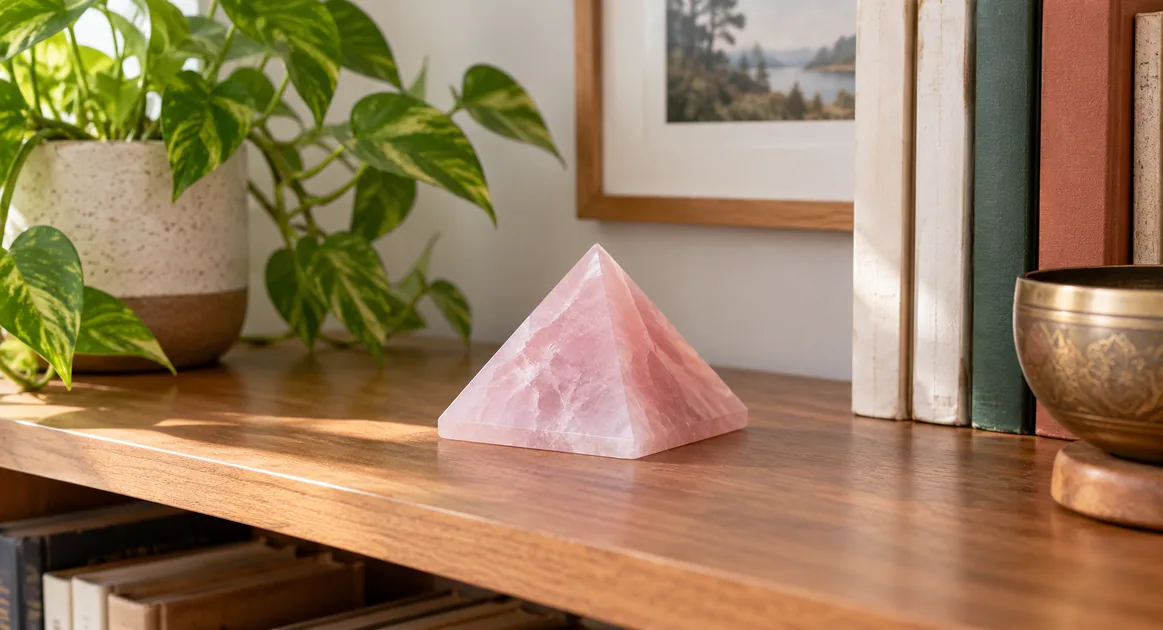
Start with three decisions: place, purpose and material
First, define the location. Is the intended spot a puja shelf, a living-room console, a study desk, an office reception counter or a quiet meditation corner? Observe the area for one ordinary day: where sunlight falls, where water is used, which surfaces are handled often and whether children, pets or visitors can bump the object. The perfect photograph is not evidence that a delicate mineral will survive on a humid windowsill or a heavily used counter.
Second, name the purpose without forcing one formula onto every household. It could be devotional focus, a reminder of a daily Sankalpa, a gift for a Griha Pravesha (housewarming), a conversation piece about traditional Vastu, or a professional collection demonstrating different materials. If you are seeking a specific Vastu rectification, identify the actual floor plan and the tradition or consultant guiding that selection before buying a generic “remedy kit.”
Third, confirm what is physically being supplied. “Crystal pyramid” may refer to natural quartz, treated stone, laboratory-grown crystal or even coloured glass. “Copper pyramid” might be solid metal, a thin hollow shell, a plated object or an open wire frame. The right terms affect price, durability and care. Size, thickness, included components and surface treatment matter as much as colour.
| Decision | Question to ask | Why it matters |
|---|---|---|
| Placement | Exactly which shelf, room or surface? | Controls size, safety, light and humidity exposure. |
| Intention | Puja, meditation, gift, display or Vastu consultation? | Keeps selection connected to a genuine use. |
| Traditional framework | Which direction and element association is intended? | Avoids treating one retailer’s chart as universal scripture. |
| Material | Natural stone, treated stone, metal, glass or composite? | Changes identity, treatment disclosure and cleaning. |
| Practical limits | Budget, width, weight, stability and access? | Prevents buying a carving unsuited to the space. |
What Vastu Shastra contributes to choosing a pyramid
Vastu originally concerns the relationship among site, built form, orientation, function and inhabitants. Traditional discussion includes the Vastu Purusha Mandala, a directional grid, and the use of space in relation to deities and elements. Textual and regional traditions differ, and a modern gemstone pyramid is not identical to an architectural feature prescribed in every classical manual. That does not remove its devotional significance: it tells us to use directional language carefully and to say when a placement is a contemporary practice rather than a universal classical rule.
In a household, an Ishanya (northeast) puja area may already be part of the family’s practice. A clean, stable Sphatik pyramid there may support a visual focus for prayer, alongside a deity image, lamp or Sphatika Lingam. But an entrance, a bedroom and a workplace have their own practical requirements. The location should not block a lamp, sit under dripping water, interfere with worship or create an object that must be constantly moved to clean a shelf.
The direction of a room is usually discussed in relation to the orientation of the actual building or plan, not guessed from where a photograph was taken or from the direction a desk chair happens to face. For an apartment with a complicated footprint, first determine a consistent north reference and the areas actually available. The symbolic aim of a placement should be clear to the person who uses it.
| Direction | Common traditional association | Possible contemporary display context | Practical check |
|---|---|---|---|
| North — Uttara | Kubera, prosperity and stewardship | A small, well-labelled piece on a stable business shelf | Keep clear of cash drawers and busy handover paths. |
| Northeast — Ishanya | Ishana/Shiva; worship and contemplative space | Sphatik or a chosen devotional object on a puja shelf | Keep away from oil lamps and spilled ritual liquids. |
| East — Purva | Surya, light and beginnings | A bright but indirectly lit study or prayer display | Avoid harsh sunlight on fade-sensitive materials. |
| Southeast — Agneya | Agni, fire and heat | Symbolic reference in a consultation or study display | Do not place fragile pieces by a hot stove or diya. |
| South — Dakshina | Yama; order and boundary symbolism | A deliberate display where family tradition calls for it | Ensure shelving and movement remain safe. |
| Southwest — Nairritya | Stability and weight in many Vastu traditions | An orderly low-risk shelf, not an exposed ledge | Do not infer that a heavy stone alone corrects a layout. |
| West — Paschima | Varuna, water and containment | Symbolic display on a dry protected cabinet | Do not place moisture-sensitive minerals by water. |
| Northwest — Vayavya | Vayu, air and movement | A compact, secure office or reading-room display | Avoid draught-prone precarious shelves. |
| Centre — Brahmasthana | Central ordering of a built space | Often best understood through the plan, not a cluttered ornament cluster | Retain accessible circulation and usable floor space. |
The five elements: a useful symbolic vocabulary, not a universal product chart
Pancha Mahabhuta refers to Prithvi (earth), Ap or Jala (water), Agni (fire), Vayu (air) and Akasha (space). These ideas provide a vocabulary for intention, design and devotional contemplation. Retail catalogues sometimes assign one gemstone exclusively to one element or prescribe every pyramid for the same direction. That level of one-to-one certainty is rarely warranted. Colour, material, deity association and regional practice may lead to different interpretations.
| Tattva | A traditional theme | How it can inform a selection | Important distinction |
|---|---|---|---|
| Prithvi — Earth | Steadiness, embodiment and continuity | A stone carving with a stable base may express groundedness. | A material’s mass is not a measurement of a ritual effect. |
| Ap/Jala — Water | Flow, purification and nourishment | A clear, uncluttered display may symbolize clarity. | Water symbolism does not authorize washing soluble stone. |
| Agni — Fire | Transformation, illumination and effort | Warm tones or a copper-coloured object may express intention. | Never put an object where heat or flames endanger it. |
| Vayu — Air | Movement, exchange and breath | Choose a compact object that does not obstruct movement. | Wind symbolism is not a reason for an unstable display. |
| Akasha — Space | Openness, awareness and spaciousness | Maintain space around the pyramid in meditation areas. | The value of open space is not a promise of a cure. |
Choosing for a family home: room by room
Puja room or family altar
A puja room needs a clear sightline to the object of worship, space for offerings, and safe handling of oil lamps, incense and water vessels. The pyramid is usually a secondary devotional focus rather than a replacement for the family’s established deity images or prescribed practices. Choose a stable base and easy-to-dust material. Clear quartz or Sphatik may be attractive where transparency is associated with clarity and purity; an amethyst pyramid may suit a quieter purple-toned altar if the family prefers it.
Leave a real gap between the carving and hot lamps or falling incense ash. Sphatik is a form of quartz, but a metal paint or adhesive on a product still requires its own care. If water or milk is part of an established abhisheka practice, keep decorative composite or soluble pyramids out of the liquid unless that exact object has suitable material guidance. The care of the selected physical item and the ritual meaning need not conflict.
Living room, reception area or gifting display
In a living room, the usual constraints are daylight, dust, children, visitors and the furniture finish. A medium carved quartz, rose quartz, agate or jasper piece may provide a legible form without crowding a console. For a housewarming gift, identify the material honestly and include a short care note; do not assume the recipient observes the same colour or planetary associations. A small protective pad beneath the base can prevent scratches on polished wood or glass.
Near an entrance, a decorative object should not narrow the path or create a sharp edge at hand or child height. A fixed shelf with enough depth is better than a thin wall bracket. Keep pyrite and rock salt away from damp shoe areas and plant watering, and avoid direct hot sunlight for materials whose colours may be sensitive. In Bengaluru, a covered balcony can still have moisture from monsoon air and splash from driving rain.
Bedroom and restful corner
A bedroom pyramid should never compromise an uncluttered nightstand. Consider the space used for glasses, water, charging cables, medicines and nighttime movement. If the household associates rose quartz with affection or amethyst with quiet reflection, a modest object on a higher stable shelf may suit the mood. Do not substitute stone symbolism for sleep hygiene, ventilation, comfortable light and the ordinary uses of the room.
| Home space | Good starting point | Avoid | Why |
|---|---|---|---|
| Puja shelf | Small stable Sphatik/quartz or chosen devotional carving | Lamp flame, oil drips and water splash | Supports prayer without introducing a hazard. |
| Living room console | Visible medium stone or finished metal piece | Narrow ledges, direct collision path | Balances decoration with everyday traffic. |
| Entrance | Secure compact item with non-slip base | Floor-level sharp points and wet shoe zones | Safer for people and materials. |
| Study corner | Small uncluttered pyramid on fixed shelf | Keyboard space, water cup, monitor view | Keeps working area functional. |
| Bedroom | Modest visual focus away from bedside essentials | Overloaded bedside table | Maintains restful, usable space. |
| Balcony | Only a material suitable for the actual exposure | Rain, condensation, harsh heat, wind | Reduces avoidable deterioration. |
Choosing for an office, shop, showroom or professional desk
Commercial spaces have a different rhythm from homes: customers lean on counters, staff wipe surfaces, paperwork moves quickly, and display items are frequently handled. Begin with a location that does not compete with a payment terminal, jewellery tray, invoice printer or customer handover. A compact copper or brass design may offer a traditional visual association with disciplined effort and craft; a quartz carving may provide a clear, neutral display. Neither needs to be oversized to make a visual point.
Prosperity associations appear in Indian devotional practice through Lakshmi and Kubera, while business Sankalpa may concern ethical trade, diligence and good relationships. A small pyramid may serve as a reminder of that intention. Do not make the sale depend on an unsupported promise that a particular metal or gemstone guarantees revenue. When choosing by Jyotish, keep the question of a personal planetary gem separate from a decorative office pyramid: a birth-chart recommendation involves its own tradition and assessment, not simply the colour of an ornament.
For a jewellery showroom, inspect finish quality under both daylight and showroom LEDs. Use a clean dry plinth, actual labels and a discreet “display only” note if appropriate. Soft fluorite or gypsum at a customer handling station can chip; a fragile metal frame can deform. At a consultation desk, a labelled set of different materials is educational only when each label accurately distinguishes natural stone, treated stone, composites and plated metal.
| Workplace | Selection priority | Suggested approach | Failure to avoid |
|---|---|---|---|
| Reception | Stable, low-maintenance and visually clear | Compact metal or durable stone on protected shelf | An exposed point in a busy queue. |
| Jewellery showroom | Identification and presentation quality | Display one representative sample with honest label | Calling all clear objects natural Sphatik. |
| Personal work desk | Small footprint, low glare, easy cleaning | A small pyramid away from a laptop and drink | Blocking screens or cables. |
| Professional consultation | Variety, disclosure and portability | Mapped reference kit with cushioned compartments | Unlabelled mixed stones sold as verified types. |
| Cash office | Orderly space and meaningful Sankalpa | A small dedicated shelf if desired | Interfering with secure cash handling. |
| Shared meeting room | Neutral aesthetics and safety | One well-positioned example rather than a cluttered cluster | Creating a trip or knock hazard. |
Meditation, mantra, japa and devotional practice
In meditation the most important physical requirement is that the object should not interrupt breathing, sitting, movement or attention. Choose a height and finish that is comfortable to look at and position it outside the reach of swinging sleeves or mala beads. Sphatik, amethyst and plain natural stone are common visual choices in contemporary meditation displays, but the object may also be absent: dhyana and japa do not require the purchase of a pyramid.
If you wish, establish a brief Sankalpa in your own words before the session: a commitment to steadiness, clarity, compassion or disciplined study. A chosen object can mark the boundary between everyday activity and practice. Place it close enough to be seen but far enough not to intrude on seated posture. Keep surfaces dry and stable and position incense away from the pyramid. A colourful stone or Om engraving can have personal devotional value; verify the symbol and workmanship before purchasing.
A practitioner following a specific sampradaya, guru or family puja tradition should prioritize that tradition rather than a generic online placement chart. An image of Ganapati, a Sphatika Lingam, a mantra text or a japa mala has a distinct role. The pyramid can be a companion object without becoming an asserted substitute for established upasana. For a shared meditation room, simplicity, cleanliness and respect for different practices are more useful than a dense arrangement of many stones.
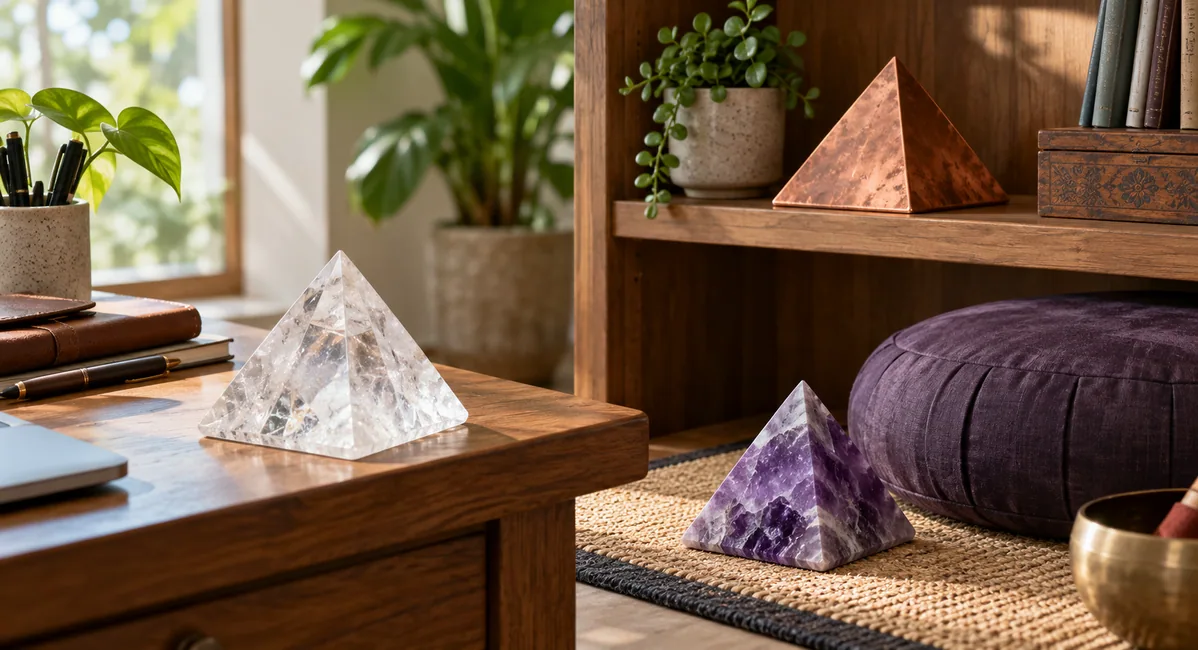
Which pyramid material suits the actual environment?
A product’s colour may suggest one meaning, but material properties determine whether it withstands a busy desk, direct sunlight or repeated handling. “Gemstone” is not a guarantee of toughness. GIA distinguishes scratch resistance (hardness), resistance to breakage (toughness) and environmental stability. Soft or cleavable minerals can chip even when their surface looks polished; treated items and layered assemblies may need extra care.
| Material or construction | Why someone chooses it | What to verify | Display and care priorities |
|---|---|---|---|
| Clear quartz / Sphatik | Clarity, puja and neutral appearance | Natural vs lab-grown vs glass; cracks and fillings | Stable support, avoid hard impacts. |
| Rose quartz | Soft pink colour; harmony symbolism | Natural colour, inclusions, possible treatment | Protect from prolonged direct sunlight. |
| Amethyst | Purple; reflective or spiritual setting | Colour distribution, origin and treatment disclosure | Avoid strong prolonged light and heat. |
| Aventurine quartz | Green/golden hues; contemporary prosperity symbolism | Quartzite and inclusions vs imitation | Keep separate from hard abrasive objects. |
| Agate or jasper | Patterns, robust decorative appearance | Correct variety and any dye or resin | Wipe gently; avoid aggressive cleaning. |
| Tiger eye | Moving silky band and warm colour | Chatoyancy, orientation, colour treatment | Inspect all faces before purchasing. |
| Fluorite | Purple-green bands and translucency | Cleavage, cracks, edge condition | Protect from falls and repeated handling. |
| Calcite | Warm pale tones and translucence | Correct mineral and any filling | Soft; avoid acids and abrasive cleaning. |
| Satin spar gypsum | White fibrous glow | Gypsum vs transparent selenite naming | Soft and moisture-sensitive; dry handling. |
| Rock salt | Translucent salt colour | Halite identity, coatings, environment | Keep dry; avoid bathrooms and splash. |
| Pyrite | Metallic gold-like texture | Pyrite-bearing material, active deterioration | Dry storage, inspect for powdering. |
| Obsidian | Black reflective volcanic glass | Natural vs manufactured glass; sharp chips | Protect edges and handle with care. |
| Copper | Warm metal tone and craft appearance | Base metal, thickness, plating and finish | Keep dry; inspect patina and lacquer. |
| Brass | Warm golden tone and decorative detailing | Alloy, coatings, joints and edge finish | Gentle cleaning suited to surface treatment. |
| Terracotta | Earthy handcrafted texture | Fired/unfired clay, paint, sealant | Avoid soaking and knocks. |
| Composite or resin | Affordable shape/colour choice | Composition, coating, assembly and fillers | Follow manufacturer-specific cleaning advice. |
How to distinguish natural stone, treatment, coating and assembled goods
Two objects that look similar in a photograph may have different origins. Natural stone can be coloured, waxed, filled or stabilized; laboratory-grown material is not automatically imitation; glass or resin may be a legitimate decorative product when sold under its correct description. The terms natural, untreated, synthetic, imitation, reconstructed and assembled answer different questions. Ask sellers which claim they can support and which remains unverified rather than assuming a high-gloss finish proves anything.
Inspect the apex, all four faces, the underside and the base corners. Ask whether the shape is carved from one piece or joined. A cloudy vein within quartz is not the same as an open fracture; an inclusion in aventurine is not proof of a single universal origin; a gold-like coating is not pyrite identification. A fair listing should disclose visible repairs, resin infill, surface plating, unusual treatments and material mixtures as relevant.
- Request actual-object photographs for individually varying materials; representative images should be labelled accordingly.
- Request a concise material declaration: “natural quartz, treatment unknown” is more useful than “100% powerful crystal” without evidence.
- Check package contents: base, stand, velvet pad, box, lab report and any included pieces should be specified.
- Check return and damage terms before ordering delicate carved points, especially for shipping.
- Keep invoice and seller description when the identity of a higher-value stone matters.
Size and proportions: what actually fits the shelf?
A pyramid may be described by base width, vertical height, sloping edge or diagonal length. These measurements are not interchangeable. For a typical square-base pyramid, request base side, vertical height, weight and a clear image beside a scale. Two objects with the same base dimension can be different heights; a hollow shell may weigh very little compared with a solid quartz carving of similar outer size. Weight alone does not establish material authenticity.
For a typical office desk, a small item with a base comfortably within the available shelf or desk space is often more useful than a tall point. For a puja shelf, allow space for the diya, bell, prasad and cleaning. For a living-room console, look from normal standing distance and keep the object away from the edge. When moving a set, record each piece’s dimensions and provide a box where the apex does not touch another stone.
The mathematical volume of an ideal solid square pyramid is base area × perpendicular height ÷ 3. Real products may have trimmed bases, rounded corners, cavities, irregular stone or an attached stand; therefore theoretical volume and published density cannot verify a finished item on their own. A surprising weight should prompt a material and construction question, not an instant authenticity verdict.
| Listing field | What a reliable description should say | Commonly misleading substitute |
|---|---|---|
| Base dimensions | Side × side in mm or cm; rectangular if relevant | “Medium size” alone |
| Height | Perpendicular base-to-apex height | Slant length presented as vertical height |
| Weight | Weight of actual item or disclosed tolerance | “Heavy energy” with no grams |
| Construction | One piece, hollow shell, frame, layered or assembled | “Pure solid” without underside photo |
| Surface | Polished, matte, lacquered, plated, painted or waxed | “Premium shine” without finish details |
| Origin/treatment | Verified information or clearly stated uncertainty | Unsubstantiated origin or untreated guarantee |
| Included pieces | Explicit count, stand and packaging details | Lifestyle picture showing items not included |
| Care | Guidance matched to material and finish | Universal instruction to soak everything |
Appearance, colour and sacred symbols: what should guide choice?
Colour can carry meaning through personal tradition and aesthetics: white or transparent Sphatik for clarity, rose quartz for affectionate intention, green aventurine for growth, warm citrine-coloured stone for auspiciousness or deep amethyst for contemplation. These are familiar modern and devotional associations rather than fixed evidence that every stone is assigned to one Graha or one room. The same colour may appear in different minerals with very different care needs.
Om engravings, yantras or deity motifs make the object more than a generic shape for some buyers. Confirm that the engraving is clear and accurately described, whether it is carved, etched, painted, printed or glued, and whether its orientation matters to the family using it. If the object will be handled as a sacred item, also consider how it will be cleaned and respectfully stored. A neatly made unengraved object is often preferable to a poorly executed sacred symbol.
Sellers sometimes assign yellow to Brihaspati, warm gold to Surya or green to Budha. Jyotish gemstone selection by Janma Kundali is a separate exercise involving graha, rashi, bhava, dasha, strength, personal tradition and actual gemstone suitability. An ornamental pyramid should not automatically be promoted as a substitute for a prescribed Navaratna, Graha Shanti or other personal practice. The distinction preserves the meaning of both.
Should you buy one pyramid, several or a ready-made Vastu set?
One thoughtfully chosen piece is enough for a single display location. A four-piece arrangement may be used by some contemporary practitioners as a spatial teaching aid; seven-piece sets may use chakra-colour themes; nine-piece collections may evoke Navagraha or Navaratna symbolism. These are not interchangeable, and the fact that a package contains nine pieces does not show that it follows a particular classical ritual prescription. The buyer should see a precise component list and intended use.
A professional Vastu reference kit should emphasize identification and explanations. One well-labelled sample each of quartz, agate, pyrite, copper shell and a composite may be more educational than ten near-identical pieces with unknown origins. In a client consultation, distinguish what the material visibly is, what traditional symbolism is being discussed and what remains specific to the client’s floor plan or family practice.
| Option | Best-fitting use | Questions before buying | Practical drawback |
|---|---|---|---|
| One carved gemstone pyramid | Puja shelf, meditation focus or single-room display | Is mineral identity known? Are size and cracks disclosed? | Material-specific fragility or light sensitivity. |
| One copper/brass shell | Dry office or traditional metal display | Solid/hollow, alloy, edges, plating, lacquer? | Patina, coating wear or dents. |
| Four-piece arrangement | A deliberately planned contemporary display or demonstration | What do four positions represent for this practice? | More clutter and corners to secure. |
| Seven-piece colour set | Chakra-themed educational or personal display | What seven materials, not just seven colours, are supplied? | Colour may conceal mixed or treated identities. |
| Nine-piece set | Navagraha/Navaratna symbolism where appropriate | Are identities, correspondences and ritual claims supported? | Not a substitute for a personalized Jyotish assessment. |
| Professional reference kit | Comparative consultation and material teaching | Are labels, specimen photos, packing and care complete? | Higher handling and inventory demands. |
Practical care: humidity, sunlight, heat, liquids and daily dust
Begin with a clean soft dry cloth or suitable soft brush and a stable display surface. Wet cleaning is not a universal ritual purification method for stones. The Canadian Conservation Institute warns that some mineral specimens, notably pyrite and halite, can be damaged by humidity; certain specimens may also fade in light. Metal objects can corrode or develop unwanted changes in poorly controlled environments. The sensible practice is identify first, choose the cleaning method second.
A fragile cleavable stone such as calcite, fluorite or gypsum should not be placed where visitors routinely pick it up. Pyrite should be kept dry and observed for any powdery deterioration. Rock-salt pieces need protection from damp air and splashes. Rose quartz or amethyst is better displayed away from prolonged intense sunlight. Copper or brass may have a desirable patina, while a plated or lacquered item may be damaged by abrasive metal polish.
Puja settings introduce additional issues: hot oil lamps, ghee, kumkum, sandal paste, flowers, water and periodic washing of the altar. Keep any material not suitable for these substances to one side or on its own protected stand. Do not use acids, strong cleaners, salt solutions or ultrasonics on an unidentified object. When storing, wrap separately and keep points from pressing against one another.
| Exposure | Potential issue | Better action |
|---|---|---|
| Standing water or wet altar | Soft, soluble or treated surfaces may change | Use a dry stand; move objects during washing. |
| Monsoon humidity | Pyrite deterioration, salt moisture uptake, metal corrosion | Choose dry display; inspect regularly. |
| Direct hot sunlight | Colour fading in some minerals; heat stress | Use indirect light and an interior shelf. |
| Dust and abrasive wiping | Scratches and loss of fragile surfaces | Soft brush and gentle dry dusting. |
| Open diya or incense | Heat, soot, ash and accidental contact | Maintain separation and fire-safe access. |
| Unstable shelf or high traffic | Chipped apex, falls, injury and furniture marks | Stable broad base and adequate clearance. |
| Mixed loose stones in one bag | Surface scratches and broken points | Individual compartments and padding. |
| Metal polish or solvent | Can remove plating, lacquer and applied symbols | Follow finish-specific instructions; test only where suitable. |
Three worked examples from Bengaluru homes and businesses
Example 1: A compact apartment with a shared puja cabinet
A family has a narrow cabinet used for daily puja, with a diya and a small water vessel. They like the clarity of Sphatik and ask whether a larger quartz pyramid would be “more powerful.” The practical choice is a modest, stable piece that leaves sufficient room to handle the lamp, the bell and offerings. They inspect the actual stone for chips, ask whether it is natural quartz or decorative glass, and set it on a separate dry spot. If the family follows Ishanya placement and the cabinet fits that plan, they may use it as a Sankalpa focus. Size does not replace a suitable location or the family’s worship.
Example 2: A jewellery showroom with a busy customer counter
A showroom owner wants a display referring to Kubera and the intention of fair trade. A polished brass shell seems attractive, but the counter is cleaned several times a day and customers handle trays there. Instead, the owner selects a stable dry side shelf, confirms whether the shell is brass or plated steel, checks underside seams, and keeps the object away from cleaning spray. Its information card explains the material and the traditional prosperity symbolism; it does not promise increased sales. A professional impression comes from clear labelling and material care rather than theatrical claims.
Example 3: A practitioner assembling a portable reference set
A consultant regularly visits flats and offices and wants clients to see differences among Sphatik, amethyst, agate, copper and rock salt. The kit uses exact specimen labels, measurements, disclosure of treatments when known, cushioned partitions and a care sheet. Rock salt is isolated from moisture; a fluorite sample is not left loose among hard quartz pieces. Before suggesting any directional placement, the consultant identifies the client’s available floor plan and intended use. The specimens serve as teaching aids, while personal spiritual recommendations remain tied to the client and tradition.
A twelve-point buyer inspection checklist
| Check | What to record before payment |
|---|---|
| 1. Location | Room, shelf depth, sunlight, water and traffic. |
| 2. Intention | Decoration, Sankalpa, puja, meditation or professional reference. |
| 3. Direction | Actual floor plan and tradition being followed. |
| 4. Exact material | Stone/mineral/metal/composite; unknowns disclosed. |
| 5. Treatment | Dye, wax, heat, irradiation, plating, resin or coating where known. |
| 6. Construction | One piece, filled, joined, hollow, frame or layered. |
| 7. Dimensions | Base side, perpendicular height and weight. |
| 8. Detail photos | Apex, sides, base, underside, chips and repairs. |
| 9. Finish | Polish, lacquer, engraving quality and stability. |
| 10. Contents | Actual quantity, stand, packaging and labels. |
| 11. Care | Light, humidity, cleaning and handling requirements. |
| 12. Transaction | Price, returns, damage policy and description on invoice. |
Common selection errors and how to avoid them
The most expensive or largest pyramid is not necessarily the most appropriate. A small stable carving with accurate identification may be a better fit than a large point projecting into a walkway. Likewise, a dramatic promotional photograph can conceal a damaged corner or a shallow hollow shell. Always request a scale and underside image. The claim that every pyramid must face one universal direction overlooks differences in space, practice and the item’s actual purpose.
Another mistake is treating all similarly coloured stones as interchangeable. Yellow calcite, citrine, treated quartz, goldstone and brass differ in composition and care. Sphatik and transparent glass may appear alike but are different offers. A “Navagraha set” consisting of nine vaguely coloured pieces requires a proper material list before its Jyotish terminology is meaningful. For devotional symbols, craftsmanship and respect are as important as marketing.
Finally, avoid creating unnecessary maintenance: delicate minerals on a child-height table, salt by a humid bathroom, metal on a wet plant tray, or a pyramid inside the path of a lamp. If a placement requires constant rescue from heat or water, change the placement or material. A workable Vastu-inspired arrangement should support an orderly room, not obstruct it.
Frequently asked questions about choosing a pyramid
Answers to common buying and placement questions
Which pyramid is best for a home?
There is no universally best material. Identify the intended room and traditional intention first, then choose a suitable, correctly described piece. Stable quartz or a well-finished metal display can both be appropriate in different settings. Moisture, direct sun, safety and available space may decide more than colour.
Which pyramid should I keep in a puja room?
Many families appreciate Sphatik for clarity and devotional associations, but family puja practice takes priority. Keep the pyramid on a stable clean shelf, away from diya heat, water and oil. Do not assume a decorative carving is intended for immersion or abhisheka.
Can a pyramid be placed in Ishanya, the northeast?
Ishanya is traditionally important in many Vastu systems, particularly for contemplation and puja. A suitable object may be displayed there if the actual room and family tradition allow it. This does not create a universal prescription for a given gemstone, nor override the need to handle lamps and liquids safely.
Is a crystal pyramid better than copper or brass?
These are physically and aesthetically different objects. Stone carvings offer translucence and mineral patterns; metal pyramids offer fabrication details and changing patinas. Choose according to construction, purpose, treatment disclosure, display conditions and personal tradition, not a blanket ranking.
Can I put a Vastu pyramid on my office desk?
Yes, if it is stable and does not occupy space needed for work, cables, papers or drinks. A compact pyramid on a side shelf may be more practical than an exposed point beside a keyboard. Keep client-facing claims about prosperity separate from material facts.
Should a pyramid face north or east?
A pyramid usually has a base and apex, while faceted designs may have different decorative alignments. Traditional advice about directions varies with purpose and system. Confirm which direction is meant, how it relates to the floor plan, and whether the object itself has an inscribed orientation.
Does the pyramid have to be exactly aligned with a compass?
Some practitioners use directional orientation as part of a defined practice; others use the item mainly for puja or contemplation. If alignment is important, use a consistent reference for the room and follow the chosen tradition. Do not treat the accuracy of a smartphone compass beside metal objects as infallible.
Is a larger or heavier pyramid more effective?
Neither physical mass nor decorative height establishes spiritual efficacy. The larger object may have different visual impact, cost and handling risk. Select dimensions that fit the shelf, permit safe cleaning and correspond to the intended use.
Can I keep a rose quartz pyramid in a bedroom?
Rose quartz is often associated with affection and harmony in contemporary crystal use. Place it securely away from bedside essentials and prolonged direct sun. It is an optional personal symbol rather than a substitute for ordinary sleep and relationship practices.
What is the difference between Sphatik and glass?
Sphatik refers to clear quartz in Indian usage, whereas glass is manufactured material with different structure. Transparency and the absence of inclusions do not alone prove quartz origin; sellers should clarify whether the item is natural quartz, laboratory-grown quartz or glass.
Can a pyramid contain dyed or treated stone?
Yes. A treated natural stone can remain a real mineral object if the material and relevant treatment are disclosed. Treatment, reconstruction and imitation are different categories. Ask about colour enhancement, surface filling and stability before selecting the cleaning method.
Are seven- or nine-pyramid sets mandatory in Vastu?
No single modern retail configuration should be treated as an obligatory prescription for all homes. Seven may reference chakra colours and nine may reference Navagraha symbolism, but actual components and ritual systems differ. Ask what the set contains and what practice its mapping follows.
Can I gift a pyramid for Griha Pravesha?
Yes. Choose a suitable material, an attractive stable form and accurate description. An optional note about auspicious intentions or family blessings is thoughtful; do not impose a ritual the recipient does not follow. Include care instructions and secure packaging.
How do I choose a pyramid for a jewellery showroom?
Prefer a stable, safely positioned display with material and construction clearly identified. Check the finish under showroom lighting, avoid customer handling zones, and keep cleaning spray away. A small information card may explain symbolism while keeping claims about products accurate.
Is pyrite suitable near a bathroom or plant tray?
Pyrite is a poor choice for persistently damp environments because some specimens can oxidize and deteriorate at elevated humidity. Use dry display and inspect for powdery changes. Never soak pyrite merely to perform a generic cleansing ritual.
Can rock salt be washed for purification?
Rock salt is halite, a water-soluble mineral. Water washing can damage it and humid surroundings may cause moisture problems. If your spiritual practice calls for purification, select a method that preserves the material or use a different ritual object.
Can I put a pyramid beside an oil lamp?
Place it at a safe distance from flame, falling ash, hot oil and accidental knocks. Heat can affect some stones, coatings, adhesives and metal finishes. The ritual lamp needs clear space for safe lighting, offering and extinguishing.
What should I inspect when buying online?
Ask for exact material, treatments where known, dimensions, weight, underside and apex images, defects or repairs, actual included quantity, care and return terms. The listing should distinguish actual-object photos from representative illustrations.
Does a pyramid replace gemstone advice from a Kundali?
No. Chart-based Jyotish considerations involve graha, bhava, dasha and personal tradition. A decorative gemstone pyramid may have symbolic meaning but should not be marketed as automatically equivalent to a prescribed astrological gemstone or Graha Shanti practice.
What is the best first purchase for a beginner?
Choose one well-described, manageable pyramid that genuinely fits a known location. A stable quartz or another appropriately cared-for material is easier to learn from than a large unidentified mixed set. Expand only after you understand how to handle, display and store what you already have.
An informed final choice
Choose the room first, tradition second, material third, and dimensions before payment. For a home, prioritize a respectful, safe display that suits actual family activities. For an office, look for stability, accurate labels and a clear working surface. For meditation or puja, choose a meaningful focus that does not interfere with japa, worship or safe handling of ritual objects. For professional Vastu consultation, keep specimen identification, directional interpretation and personal advice clearly differentiated.
The pyramid’s form can be a reminder of steadiness, aspiration or a personal Sankalpa. Its physical quality is evaluated by material identity, carving or fabrication, finish and care. Keeping these layers distinct makes the choice richer and more credible: the symbolism retains its cultural meaning while the object remains an understandable, durable part of the home or workplace.
Research and terminology notes
For built-space principles and directional context, the Vastu Purusha Mandala is discussed in research on Indian architecture, including Indira Gandhi National Centre for the Arts materials and academic architectural studies. For mineral care, the Gemological Institute of America explains hardness, toughness and stability, while the Canadian Conservation Institute provides conservation guidance on humidity, pyrite, halite, light-sensitive minerals and copper-alloy objects. These are research references, not links to competing product sellers; individual traditional associations have been identified as such throughout the article.
Explore existing OmmRudraksha collections
Browse Vastu for the existing collection, or explore gemstone products for other material forms. Each product’s construction and care information should guide your choice.