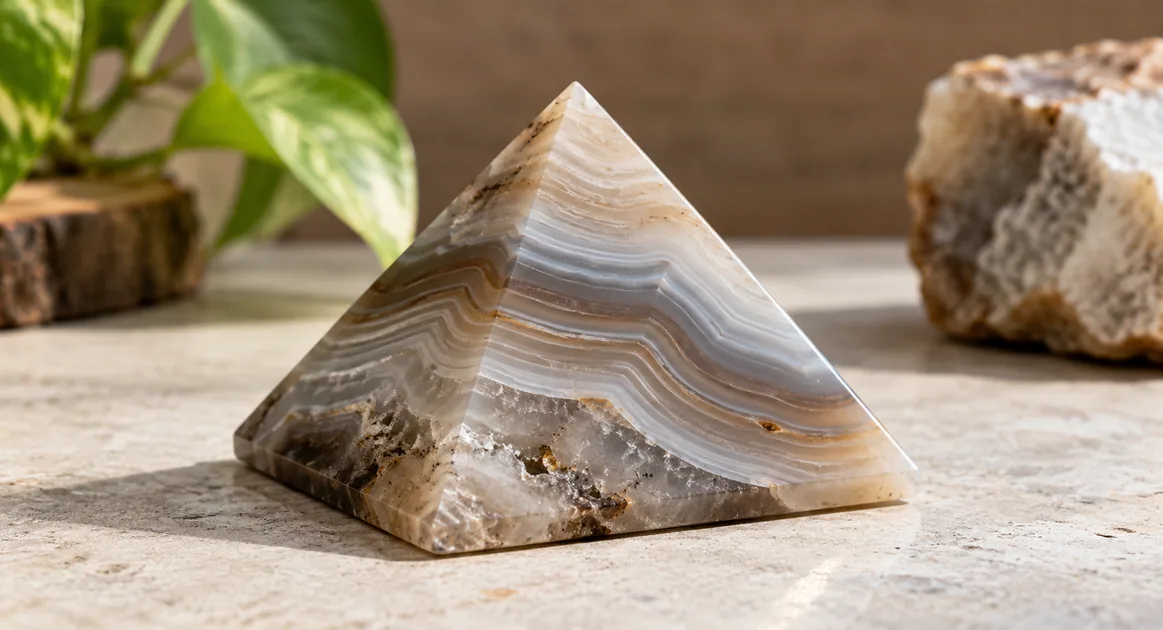
A banded agate pyramid is appealing because no two band arrangements are exactly alike. Curved grey and cream lines may cross a point, a brown translucent pocket may appear near the base, and a single face can contain several stages of mineral growth. Yet these attractive patterns raise practical questions: is the stone really agate, are its colours natural, and is the pyramid carved from one piece or assembled from several? This guide explains how to assess those questions before choosing a pyramid for a home, puja space, shop, office or professional Vastu collection.
Agate belongs to the chalcedony family of silica materials. Its pattern is both an identification clue and a record of the material’s development. In contemporary Vastu and crystal practices, collectors associate patterned stones with steadiness, harmony and intention; the interpretation should be considered alongside a concrete evaluation of the physical carving. A beautiful story about a stone cannot replace accurate disclosure about dye, adhesive, cracks, size and finish.
1. What is banded agate? Chalcedony, quartz and the bands
Agate is a variety of chalcedony, a microcrystalline-to-fibrous silica material commonly classified within the quartz family. Its chemical composition is chiefly silicon dioxide (SiO₂). Mineralogically, agate is particularly recognised for its characteristic bands: differences in translucency, fine structure and impurities can make neighbouring layers visible as curved, parallel or concentric zones. The term “multi-agate” has no equally precise mineralogical definition and must be explained on each product listing.
Many agates developed as silica-rich solutions deposited material in cavities or fractures over successive episodes. Layers formed along cavity walls can create contours that resemble tree rings, while other band types may run relatively straight across a cut. Once a rough stone is turned into a pyramid, the saw angle can transform those patterns: a curved ring in the rough can become diagonal stripes on one face and a broad arc on another. That is one reason a real stone may look different from a symmetrical catalogue drawing.
The mineral itself is relatively hard, commonly about 6½–7 on the Mohs scale, and has no observed cleavage in the way that calcite or gypsum does. However, “hard” does not mean unbreakable: a thin apex may chip and fractured or joined pieces need gentler handling. The chemical identification, colour treatment and physical construction are separate questions.
| Description | What it means | What it does not prove |
|---|---|---|
| Banded agate | Chalcedony exhibiting characteristic bands | That every visible colour is untreated |
| Natural agate colours | Colour derived from mineral constituents and the stone’s history | That the pyramid is unfilled or single-piece |
| Dyed agate | Chalcedony whose colour has been intentionally modified | That the underlying material is synthetic |
| Multi-agate | Ambiguous retail wording: multiple colours, specimens or joined pieces | A specific mineral variety or construction |
| Agate-look composite | Assembled or manufactured object imitating agate bands | That it has the same structure as natural chalcedony |
2. How to read natural bands across the four faces
Look first at the direction of the bands in relation to the cut. A natural contour may bend around an inclusion, widen gradually or disappear as a face turns away from the original growth surface. Some layers transmit more light and appear darker against a bright background; others contain additional mineral particles and look opaque. A mobile-phone photograph against neutral daylight often shows these effects better than a strong coloured shop light.
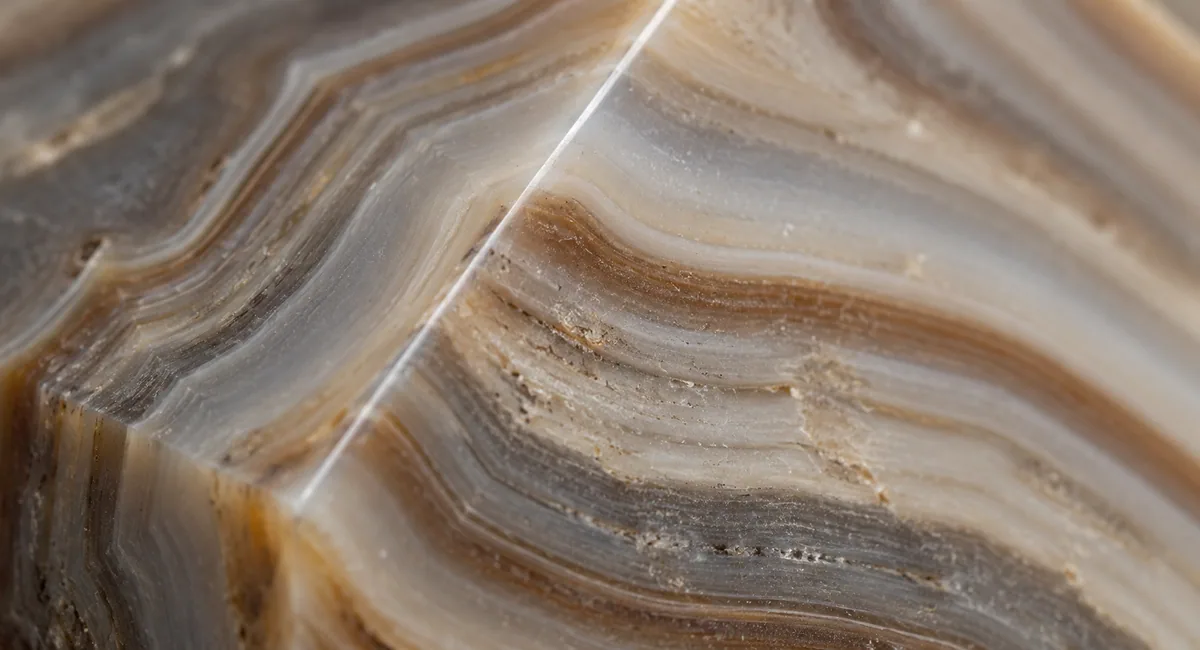
A single-piece pyramid may show bands that appear to continue logically around an edge, though a change in cutting plane can alter their apparent direction. Conversely, an abrupt, ruler-straight boundary, repeated identical motifs on different faces or a visible glue line merits a question about assembly. None of these clues is a definitive home laboratory test. Genuine stones can contain natural straight fractures; assembled pieces can be expertly joined. Ask for photographs of all four faces, the apex and the underside.
Do not insist that every real agate must have dramatically high-contrast stripes. Bands may be faint, layered in similar colours, or visible only with backlighting. Likewise, strong bands do not automatically guarantee a premium specimen. A sound polish, stable base, accurate stone name and declared treatment may matter more than artistic drama.
| Visual feature | Possible explanation | Useful next action |
|---|---|---|
| Curved repeating bands | Layered chalcedony growth | Compare side and opposite faces |
| Alternating cloudy and translucent zones | Variation in structure and inclusions | View under neutral transmitted light |
| Sudden straight seam across faces | Possible fracture or join | Inspect the base and request construction disclosure |
| Colour concentrated in tiny cracks | Possible preferential dye penetration | Ask about dye; do not apply household solvents |
| Small pits or cavities | Natural void or finishing defect | Check whether the surface is stable and smooth enough for display |
| Identical appearance across listings | Stock photograph used for a batch | Request actual-piece images when pattern matters |
3. Natural colour, dyed agate and responsible treatment disclosure
Agate can be naturally grey, white, brown, red, bluish or varied in other subdued and sometimes vivid tones depending on its chemistry and origin. It is also a material historically treated to enhance colour. Because fine-scale structure and porosity permit colourants to enter some zones, chalcedony may be dyed into striking bright blue, magenta, violet, emerald green or other shades. Treatment is not inherently a defect in a decorative pyramid. It becomes a problem when a treated stone is advertised as having a rare natural colour without evidence.
Some natural materials are genuinely strongly coloured, so “very bright” is a reason to ask, not a verdict. Similarly, a soft grey-brown banded pyramid is not automatically untreated. Sellers should state natural agate, dyed agate, otherwise treated agate, or treatment not established according to their actual evidence. A direct statement of uncertainty is better than a false certificate of natural colour.
Dyes may distribute unevenly through bands, accumulate around fractures or appear more intense at porous areas. However, visual inspection is only screening. If untreated status is commercially important, ask for a clear supplier declaration and appropriate independent testing where available. Do not try bleach, acetone, prolonged soaking or scratch tests on retail stock to prove authenticity: these methods can damage the finish, colour or adhesives.
| Colour or treatment issue | What to ask the seller | How to describe the product |
|---|---|---|
| Muted grey, cream and brown bands | Was any enhancement reported for this lot? | Natural-colour appearance; untreated only if substantiated |
| Electric pink, vivid blue or purple | Is colour applied by dye or another treatment? | Dyed agate when confirmed |
| Very dark or nearly black bands | Was it heated, carbonised or dyed? | State disclosed enhancement rather than guessing |
| Coating or sealant | Does the polish include a surface coating? | Describe the finish and care limitations |
| Colour along cracks | Has the piece been filled or dyed? | Disclose known filling and dye, individually |
| Treatment cannot be verified | Is supplier documentation available? | Treatment status not established |
4. Single-piece carving, bonded stone and reconstructed material
A single-piece banded agate pyramid is cut and polished from one body of suitable rough material. An assembled pyramid uses two or more elements attached with adhesive or another joining method. A reconstructed or composite object may incorporate chips, particles, resin and colourants. These are different constructions, even if each may be sold decoratively as “agate”. The article’s buying advice and the corresponding product page must agree on which type is actually offered.
For a single block, look for plausible continuity in the pattern and a consistent feel across the edges, but do not use pattern as sole proof. For an assembled piece, inspect seams, alignment, adhesive residue, surface changes around the base and whether all components are the named stone. Some joins can be invisible without technical examination. A glued object is not automatically unsuitable for display; it simply needs accurate naming, a sensible price and care tailored to its construction.
The phrase “multi-agate pyramid” should never be left undefined. It might refer to one stone with several colours, a selection of differently coloured agate pyramids, or a structure made of multiple stones. The three choices should be distinguished in catalogue filters, captions and variant descriptions rather than treated as interchangeable SEO labels.
| Construction | Buyer benefit | Inspection priority | Care implication |
|---|---|---|---|
| One carved agate body | Natural variation in a single specimen | Apex, base, band continuity, surface cracks | Protect corners; generally straightforward dry wiping |
| Several agate pieces bonded | Distinct colours or layered design | Glue lines, alignment, strength, disclosure | Avoid soaking and solvents; check joins |
| Agate chips in resin | Consistent crafted design and shapes | Binder description, actual mineral content | Follow maker-specific polymer and stone care |
| Coated agate-look material | Decorative colour or uniformity | Substrate identity, coating condition | Avoid abrasion and strong cleaners |
| Unverified mixed material | May be aesthetically attractive | Request an exact construction statement | Treat conservatively until identified |
5. Banded agate compared with jasper, onyx and glass
Different trade names overlap in decorative stone markets. Jasper is commonly used for opaque, patterned silica-rich rocks or materials, whereas many agates show distinctive translucent banding. Some commercial “onyx” is banded chalcedony, and the term also describes a completely different calcite-family material in ornamental-stone trade. A vendor describing a black-and-white “onyx agate” should say which material is meant, rather than assuming the name establishes composition.
Dyed glass and resin can imitate layers or mineral colour; glass may be uniform with bubbles or moulding signs, but sophisticated imitations require more than visual confidence. Banded calcite, including so-called “onyx marble”, is softer and chemically different from agate. A family of descriptive photographs—front, sides, base and light-transmitted view—together with an honest material declaration is often more valuable to an ordinary buyer than a confusing list of trade names.
| Material | Distinguishing context | Common naming pitfall |
|---|---|---|
| Banded agate | Layered chalcedony; Mohs about 6½–7 | Treatments and joined construction omitted |
| Jasper | Typically opaque silica-rich ornamental stone | All opaque patterns called agate |
| Chalcedony “onyx” | Banded chalcedony in some trade usages | Confused with carbonate onyx |
| Calcite onyx / onyx marble | Banded carbonate; much softer and acid-sensitive | Presented as quartz-family onyx |
| Glass | Manufactured silicate glass | Imitation sold without disclosure |
| Resin or composite | Binder with or without mineral pieces | Composite advertised as single natural stone |
6. Traditional Vastu symbolism: earth, steadiness and deliberate placement
In contemporary Vastu and crystal traditions, patterned agate is frequently associated with stability, balance, grounding and patient growth. Its layered appearance makes a natural visual metaphor for gradual development and resilience. People may use a banded agate pyramid as a reminder of orderly work, harmonious decisions, or sustained effort. These are interpretive associations, not a classical requirement that every Vastu floor plan contain a banded agate pyramid.
The geometry of a pyramid also has a symbolic appeal: a broad stable base narrowing toward a point can stand for concentration, hierarchy and direction of attention. Yet Vastu Shastra, regional puja practices, modern crystal symbolism and specific gemstone prescriptions in Jyotish are different traditions. They may influence the same household, but a decorative agate object should not be described as automatically correcting every Vastu Dosha or serving as a universal Navagraha remedy.
The Pancha Mahabhuta framework—Prithvi (earth), Jala (water), Agni (fire), Vayu (air) and Akasha (space)—is used to discuss balance in multiple Indian philosophical and traditional settings. Some modern Vastu practitioners relate the solidity and muted earth tones of banded agate to Prithvi. That is an interpretive association, not a scientifically measured energy output or a fixed mineral-to-element mapping across every school.
Similarly, a family may place a small pyramid on a clean shelf during a Sankalpa, using it as a visible reminder of a clearly stated intention: diligence in study, calm family communication, or thoughtful progress in business. The meaning arises from the household’s own religious and cultural context. Do not confuse a voluntary personal practice with an obligatory religious ritual.
7. Which direction suits a banded agate pyramid?
No single placement direction is universally necessary for all agate pyramids. The north-east (Ishanya) is often discussed for prayer and contemplation in Vastu-oriented guidance; north and east are also common suggestions in contemporary crystal placement writing. For a professional assessment, the property’s orientation, room function, access, light, furniture, and the practitioner’s actual method matter more than copying a one-line direction chart.
A home puja or meditation area should be clean, stable and away from accidental impact. A work desk should remain functional, and a shop display must not interfere with customer movement, merchandise security or ventilation. A pyramid does not require placement in a wet planter, at a busy door threshold or beside a lit diya simply because it is regarded as auspicious. The practical integrity of the space is part of good Vastu advice.
| Space or intention | Possible placement idea | What to check first |
|---|---|---|
| Puja or meditation area | Dry shelf close to the owner’s practice area | Respect ritual layout; protect from oil, flame and washing |
| Study desk | Stable rear corner of a clear desk | Prevent collisions and reduce clutter |
| Family living area | A shelf or small decorative tray | Avoid high-traffic ledges and children’s reach |
| Office reception | Visible but secure counter display | Do not block documents, queue or payment equipment |
| Jewellery showroom | Separate gemstone education display | Label material and treatment; secure against falls |
| Professional Vastu kit | Padded, tagged compartment | Record classification, colour treatment and construction |
8. Worked examples in Bengaluru homes, offices and shops
Example A: a compact Bengaluru apartment
A family wants a small ornament for a north-east side shelf used for quiet reflection. They choose one muted grey-cream banded agate pyramid because it visually suits the room. Before purchase they review all faces and confirm that the item is single-piece and not advertised with unsupported rare-colour claims. After bringing it home, they keep it on a stable tray, not beside a water vessel that may splash. Its symbolism is a personal reminder of calm continuity; the room’s lighting and cleanliness remain practical priorities.
Example B: a jewellery showroom display
A Bengaluru jewellery showroom compares two agate pyramids: a naturally muted banded specimen and a vivid blue dyed piece. Both may be legitimate retail items, but the labels must communicate the distinction. The display card for the second says “dyed agate” instead of “rare natural blue agate”. Staff show underside photographs and explain why glued joints or coating would be disclosed. This makes the display educational as well as attractive.
Example C: professional Vastu and gemstone-reference kit
A consultant assembling a reference kit records specimen name, visual pattern, known treatment, source claim, photograph of the actual piece, dimensions and a short care instruction. A banded agate pyramid can sit alongside jasper, quartz, calcite and metal pyramids to demonstrate physical differences. Its role is a labelled comparative sample, not a replacement for a site evaluation, an astrological chart, or verified gemstone identification.
9. Choosing dimensions, grade and a fair description
Most carved agate pyramids are sold by approximate height, base width, weight and appearance. These dimensions should be measured on the actual product or verified stock batch. Do not borrow size, weight, country of origin or certification statements from another seller’s listing. A small specimen with excellent band presentation may appeal more than a larger one with a damaged apex; grading needs an understandable basis rather than invented “AAA+ energy” categories.
Ask whether the base sits flat, whether the apex is intact, whether a crack crosses a load-bearing edge and whether the polish is consistent. Natural inclusions and colour zones do not themselves imply poor quality. By contrast, an undisclosed repaired break, unsecured join or inaccurate natural-colour claim is relevant to the price and the customer’s trust. Product photographs should depict the actual piece when band orientation and colour are selection criteria.
For gift purchases, consider the recipient’s preferences and the setting: subtle neutrals for a professional desk, warm bands for a living-room shelf, or a smaller stone for a compact puja corner. A meaningful gift message may mention growth, patience and harmony without making promises of income, cure or guaranteed results.
10. Cleaning, handling and storing banded agate pyramids
Sound, untreated agate is relatively durable, but a pyramid is not just a mineral sample; it may have dye, sealant, fill or adhesive. Begin with gentle dry dusting using a clean soft cloth or brush. For a verified single-piece, stable and appropriately finished specimen, a slightly damp cloth followed by thorough drying may be acceptable. Do not soak an unknown carving or use a hot-water bath, steam or ultrasonic cleaner merely because agate is quartz-family material. The construction and treatment determine the conservative care rule.
Avoid bleach, acids, aggressive solvents, abrasive paste and rough scrubbing. Heat or direct sun over long periods can be undesirable for some dyed or treated colourants. Do not place the pyramid on a surface where perfume, puja oil, turmeric paste or cleaning solution repeatedly contacts it. When dusting a shelf, lift the pyramid by its base rather than pinching the point. Pack each piece separately in soft padding, with enough space to prevent another stone from striking the apex.
| Situation | Recommended action | Avoid |
|---|---|---|
| Routine dry dust | Soft microfiber cloth or soft brush | Gritty cloth and hard brushes |
| Fingerprints on known sound stone | Slightly damp wipe only if finishing and treatment permit; dry promptly | Prolonged soaking or immersion |
| Dyed or joined pyramid | Keep dry and follow supplier guidance | Solvents, steam, heat and vigorous washing |
| Shipping | Pad apex, corners and base separately | Loose contact with other stone carvings |
| Display | Secure level surface away from drops | Crowded ledges or wet planters |
| Visible repair or loose join | Stop using roughly; ask seller or specialist | DIY glue and polishing without material knowledge |
11. A buyer’s checklist before paying
Request a clear statement of the stone variety, construction and treatment; photographs of the front, three other sides, point and underside; approximate measured dimensions and weight; and an explanation of any repair, fill, dye or coating. Confirm whether the image represents the individual unit or an assortment from which one will be supplied. For “multi-agate”, ask whether the product is one naturally multicoloured carving, several separately sold stones or a bonded design.
Clarify whether the product price includes a stand, box, cloth or protective packaging. If a seller cites a gem laboratory, check whether the document identifies a relevant specimen and the claimed property, not merely the word “agate”. A trustworthy description tells you enough to choose even if you never use the stone in a Vastu setting.
12. Frequently asked questions
Are all visible bands natural?
Agate is known for natural mineral bands, but synthetic patterning, colouring and bonded construction are possible in finished decorative products. Pattern by itself is not certification.
Does “multi-agate” mean several stones glued together?
Not necessarily. It is ambiguous retail wording and may refer to one varied stone, a set of stones or an assembly. Ask the seller to define it.
Is vivid blue agate always dyed?
Many brightly coloured agates are treated, but colour alone cannot establish the treatment of every specimen. Ask for a treatment declaration and verification when needed.
Can a dyed agate pyramid be used for Vastu decoration?
A dyed piece can be a chosen decorative or symbolic object when its treatment is openly disclosed. The owner should decide based on meaning, appearance and accurate product facts.
Is agate the same as jasper?
Both are commonly silica-rich decorative materials, but agate is recognised for characteristic banding, while jasper is generally opaque and differently patterned in retail usage.
Is agate harder than calcite?
Typically yes. Agate is around Mohs 6½–7, while calcite is about Mohs 3. Still protect the carved apex and any glued joints.
Can I wash a pyramid in running water during puja?
Avoid immersion when dye, fills or joins may be present. Use a dry ritual arrangement or a gentle non-contact symbolic practice where appropriate.
Which Vastu direction guarantees success?
No direction or pyramid can guarantee a personal or financial result. Use the household’s traditional practice and functional space layout rather than a universal guarantee.
Does more banding mean stronger spiritual benefits?
No established grading system translates a band count into spiritual strength. Select by personal symbolism, material accuracy, stability and finish.
Can the same specimen serve as a Jyotish planetary gemstone?
Do not automatically substitute a decorative agate pyramid for a chart-selected gemstone. Jyotish recommendations depend on a separate tradition of analysis.
How should I pack it for travel?
Wrap the point and corners, use a padded compartment, and keep harder objects from striking the edges. Label dyed or joined pieces with suitable care notes.
What should a professional reference kit record?
Material identification, known treatment, single-piece or composite construction, size, weight, source, photographs, and care limitations.
13. Final selection: pattern, provenance, construction and meaning
A good banded agate pyramid earns its place through an interesting natural-looking pattern, an accurate description and sturdy construction. It may also carry personal associations of steadiness, harmony and Sankalpa within a household’s contemporary Vastu practice. The two forms of value can coexist: mineral properties help you buy and care for the object responsibly; tradition gives the owner a reason to display it thoughtfully. When the listing clearly identifies colour treatment and any bonded elements, the customer can choose confidently without confusing appearance, mineral authenticity and spiritual interpretation.
Explore existing OmmRudraksha collections
Browse Vastu for the existing collection, or explore gemstone products for other material forms. Each product’s construction and care information should guide your choice.