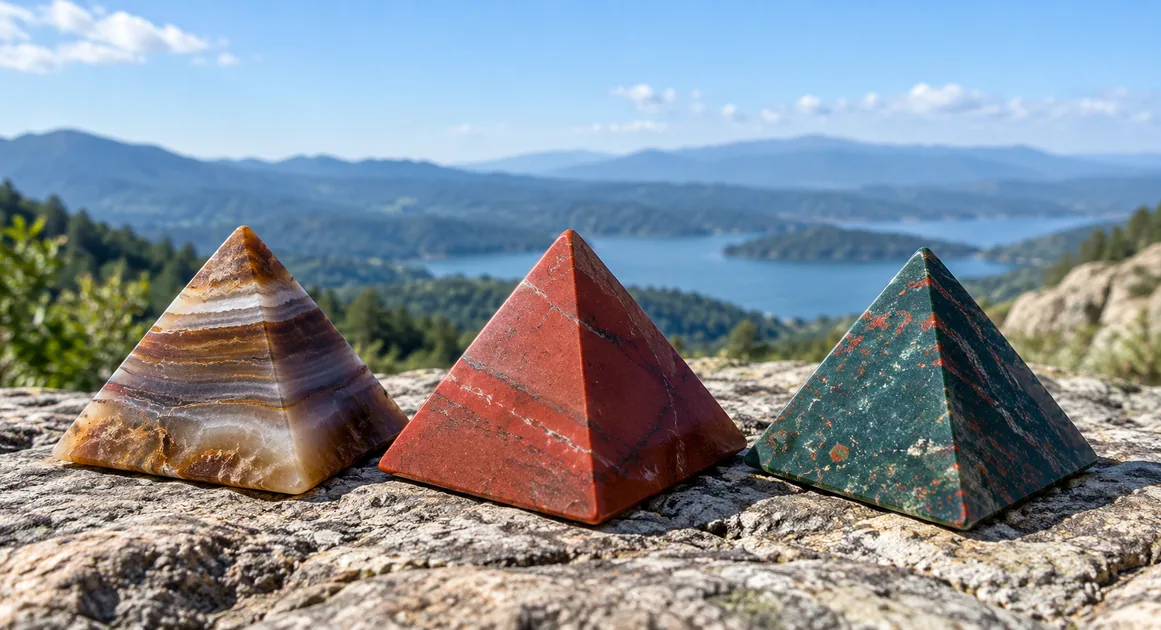
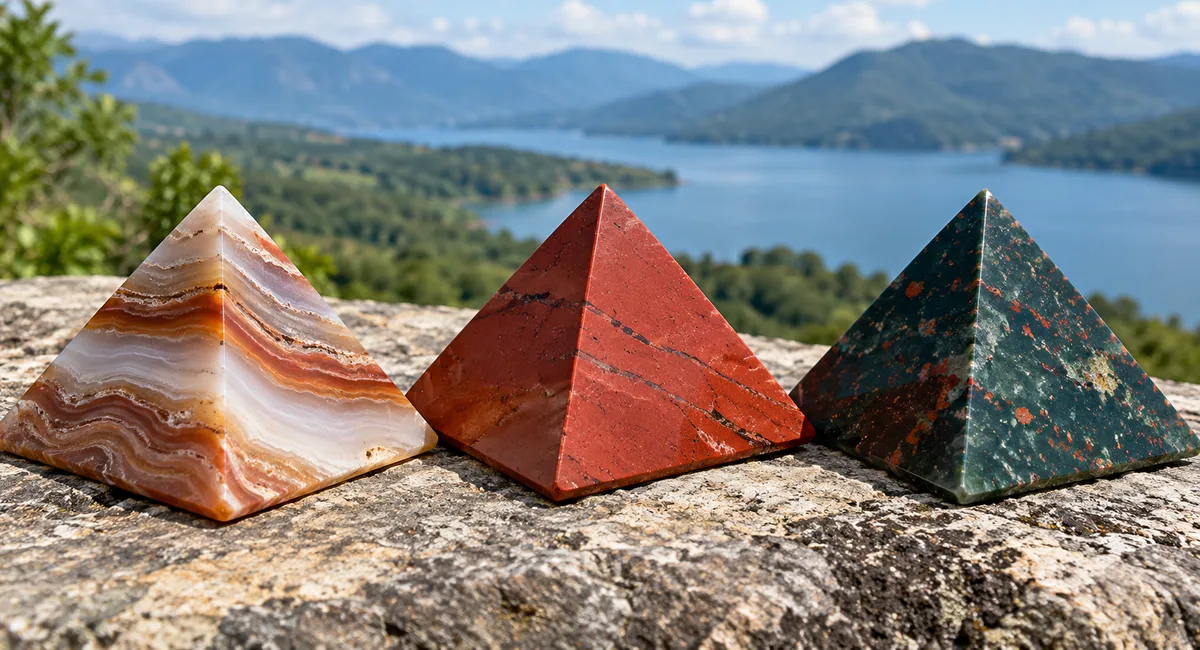
How do you identify agate, jasper and bloodstone pyramids when all three may be sold as patterned gemstone carvings? Start with what the material is, then study the pattern across all four triangular faces, the point and the base. A banded agate pyramid may carry winding translucent layers; a jasper pyramid commonly shows an opaque body with patches or landscape-like figures; a bloodstone pyramid usually has a dark green ground interrupted by red to orange inclusions. Yet two carvings of the same named material can look remarkably different. Their natural pattern is part of the appeal, not a standardized print.
This guide helps buyers and Vastu practitioners distinguish the three stones, understand the symbolism associated with them, inspect pyramid workmanship and choose a sensible location for a home, puja space, office or gemstone showroom. It also explains why a photograph of one beautiful face is inadequate when you are ordering a real carved object. Throughout, keep three questions separate: Is the material correctly named? Is the carving well made? Does its appearance and meaning suit the intended spiritual or decorative setting?
1. Agate, jasper and bloodstone: what do the names actually identify?
These three materials belong to the broad silica or quartz family, especially fine-grained chalcedony and related aggregates. In gem trading, agate normally refers to chalcedony recognized by banding or other distinctive layered patterns; jasper is usually an opaque, often iron-coloured or patterned siliceous material; and bloodstone, also known as heliotrope, refers to dark green chalcedony with characteristic red or orange iron-oxide markings. Commercial definitions overlap because specimens vary and trade names have evolved. These are useful descriptive categories, not three wholly unrelated minerals.
The term jasper is especially broad: red jasper, picture jasper, brecciated jasper and many named market varieties differ in pattern and sometimes in geological composition. Bloodstone is sometimes marketed as blood jasper, although gemological sources may treat it as a distinct chalcedony variety. When a seller offers an unfamiliar variety, request the actual stone description instead of relying solely on a poetic trade name.
| Feature | Banded agate pyramid | Jasper pyramid | Bloodstone pyramid |
|---|---|---|---|
| Typical appearance | Curving, fortification or near-parallel bands; translucent and opaque zones | Mostly opaque body; solid colours, streaks, spotted or scenic patterns | Dark to medium green body, often with red or orange flecks |
| Mineral description | Banded chalcedony | Generally opaque silica-rich chalcedony or related material; trade usage varies | Green chalcedony, often called heliotrope |
| Approximate Mohs hardness | 6.5–7 | Often around 6.5–7, depending on the actual material | Approximately 6.5–7 |
| Most helpful visual clue | Bands continuing from one carved face to another | Opaque texture and the named variety's colour/pattern | Green ground with iron-oxide red markings |
| Ask the seller | Are the bands natural, dyed or joined? | Which jasper variety and is it treated? | Can I see the red pattern on every face? |
2. How does banded agate form its striking lines?
Many agates develop through successive deposition of silica inside rock cavities or other openings. Variations in the conditions of deposition create layers with differences in colour, translucency, grain and texture. When the original mass is sawn, its internal arrangement becomes visible: concentric curves can resemble nested rings, angular bands can look like a fortress wall, and some pieces show broad cloudy sections between fine lines. A pyramid cutting across these layers makes four different snapshots of the same geological structure.
Fortification agate is prized by some collectors for angular, closely nested outlines. A single pyramid may show a triangular echo on one face and disconnected arcs on another because the saw and final polishing crossed the bands at different angles. In a thicker piece the base may display much more pattern than the apex. A stone that appears less striped in one photograph is not necessarily inferior; the cutting orientation can be responsible.
Translucency also helps. Hold the object near a soft light—without overheating it—and inspect whether thin portions transmit light. Many agates have translucent layers, while jasper is generally more opaque. This is an observation, not a conclusive laboratory test. Some agate is mostly opaque, and the material at the very tip may not match the body. The edge between translucent and opaque bands is often a better clue than how shiny the polish looks.
Natural bands, dye and composed pieces
Agate readily accepts some colour treatments. Deep electric blues, brilliant greens, hot pinks and high-contrast purples may be dyed; calmer colours can also be enhanced. Dye may concentrate in pores, cracks or particular layers, producing a striking striped effect. Dyed agate can still be genuine agate—the important distinction is between the mineral body and its colour treatment. A seller should describe both. An assembled pyramid made from bonded agate slices is another object again: it may be attractive but is not a single-piece carving.
Look closely at face-to-face continuity. Do bands run naturally around a corner? Is there a straight glue line, a repeated slab boundary or a discontinuity between top and base? A single carved nodule can have irregular transitions; an obvious assembly seam is more meaningful than a mere change of band direction. Ask for base and side photographs if the price or product description depends on one-piece construction.
3. Jasper: identify the variety before judging the pattern
Jasper is a useful family name but not a promise that every pyramid will be uniformly red or brown. Red jasper often shows an earthy red body due to iron oxides; yellow jasper may display ochre tones; picture jasper is sold for landscape-like bands or patches; and brecciated jasper may show angular fragments within a contrasting ground. A seller using the phrase “mixed jasper” should make clear whether you receive a selected variety or any one from an assorted batch.
Opaque does not mean visually flat. A strongly patterned jasper can look almost like a painted landscape, particularly when polished. Sometimes the most beautiful patch will be on just one side. For a carved pyramid, consider how the design looks when the piece sits at its intended viewing angle. If the pyramid is to stand on a reception table, broad visible faces may matter more than a dramatic but normally hidden base; for a study collection, all-face variation can be the attraction.
Not every item sold under a jasper trade name has identical mineralogical character. Terms such as “ocean jasper”, “leopard skin jasper” or a locality-based nickname may be used inconsistently across suppliers. Do not infer exact mineral species, country of origin or treatment status from the variety word alone. Product photographs of the actual object and a clear supplier description are more reliable than generic colour charts.
4. Bloodstone or heliotrope: the green body and red markings
Traditional bloodstone, often called heliotrope, is a green chalcedony distinguished by red to orange patches or spots associated with iron oxides, commonly hematite. Some stones display a dense constellation of tiny flecks; others have a small red cluster on one face; a few have very limited visible red. The green body may appear forest green, greyish green or nearly black under weak light. This variability explains why two pyramids described as bloodstone can look so different.
For a bloodstone carving, a good inspection photograph includes the front, both side faces, back and base. If the customer specifically desires visible red flecks for the traditional visual association, the seller should show where they occur. Do not assume every side will carry an equal number of speckles. A single vivid product image cannot guarantee identical markings in a natural replacement unit. Equally, a stone labelled “blood jasper” or “dragon blood jasper” may not be true heliotrope; those names deserve clarification.
The name bloodstone has a long history in different cultures and lapidary traditions. It should not be confused with hematite itself: hematite is an iron-oxide mineral, whereas bloodstone is primarily a silica-rich chalcedony whose red markings may involve hematite. The two can be discussed together without treating them as interchangeable. In Indian spiritual retail, bloodstone may be selected for its red-green symbolism, devotional collections, mindful contemplation or as part of a broader gemstone display; it is not one of the standard nine gems in the classical Navaratna arrangement.
5. Compare a carved pyramid properly: the five-view method
A pyramid creates four triangular faces, an apex and a supporting base. Its silhouette is deceptively simple: poor cutting, an unlevel base, a chipped tip or a seam can undermine an otherwise attractive material. When ordering remotely, request a short, well-lit video turning the exact pyramid or five clear views: front, left, right, back and underside. Add a ruler or reliable dimension reference rather than judging size against a hand.
| Area | What to check | Why it matters |
|---|---|---|
| Apex | Point centred, no missing tip or filled chip | Visible workmanship and easy handling |
| Four faces | Even polishing, no open fractures, pattern described accurately | Appearance from all normal viewing angles |
| Edges | Symmetry, small chips, sharpness and uneven grinding | Durability and the consistency of the silhouette |
| Base | Flatness, stability, material continuity, repair and adhesive lines | Safe standing and evidence about construction |
| Measurements | Height, base length, approximate weight and variation tolerance | Matching several pieces to a shelf or grid |
| Supplier description | Named material, treatments and single-piece versus assembled build | Accurate selection and future replacement |
Use a clean, level surface to check whether a pyramid rocks. A very small hand-finished variation is different from a base that repeatedly tips. Inspect both dry and under normal room lighting; strong studio illumination exaggerates translucency, while filters may exaggerate colour. Never perform destructive scratch or acid tests on a finished, saleable pyramid merely to confirm a guess. A professional mineral or gemological assessment is more suitable when an identification materially affects value.
6. One-piece carving, joined stone and composite construction
The phrase “gemstone pyramid” can describe several builds. Solid single-piece carvings are cut from a block and polished. Joined-stone pyramids may use layers or panels assembled with adhesive. Composite or reconstructed pieces can incorporate stone fragments and binder. Some decorative versions are glass, resin or a different stone sold under a colour-based name. These distinctions matter to customers who expect natural variations across a single carved mass.
Continuous banding around adjacent faces is useful evidence, but it is not alone decisive; individual stones can change abruptly and joins can sometimes be disguised. Study the underside for a regular meeting line, repeated layer thickness or a different finish. If the supplier offers a joined mosaic as a design, describe it positively and accurately instead of treating it as equivalent to a single-carved specimen. Likewise, acknowledge a repaired corner or filled fissure when it is visible.
7. Vastu interpretation: meaning, form and directional choice
Vastu Shastra attends to the character and orientation of space: entrances, movement, light, proportion, zones, worship areas and the relationship of the home to its surroundings. Gemstone pyramids are a contemporary object-based application within many present-day Vastu collections. The pyramid form and three stone varieties should not be presented as if every named combination carried a fixed prescription in a classical text. A thoughtful Vastu display instead begins with the room and its use, then selects a visual material and purpose consistent with the household's practice.
In a traditional language of interpretation, Prithvi Tattva suggests firmness, support and continuity; Agni Tattva evokes illumination, transformation and disciplined action; Jala Tattva evokes flow, receptivity and calm; and Akasha concerns openness and spatial clarity. Vayu expresses movement and circulation. These elements belong to a broader philosophical framework. It is reasonable for someone to choose an earthy-red jasper as a personal reminder of steadiness or a water-like banded agate for its flowing appearance, but the geological stone is not itself a classical element certificate.
The eight directional guardians, the Ashta Dikpalas, are another traditional reference. Indra is associated with the east, Agni with the southeast, Yama with the south, Nirrti with the southwest, Varuna with the west, Vayu with the northwest, Kubera with the north and Ishana with the northeast in a widely used directional scheme. This helps describe why practitioners attach symbolic importance to directions. It does not establish a universal requirement to place banded agate, jasper or bloodstone at a particular compass point. Directional use should follow the actual method being practised and the room's layout.
| Material | Visual character | Contemporary symbolic association | Useful display idea |
|---|---|---|---|
| Banded agate | Repeated layers and graceful curves | Rhythm, balance and continuity | Reading shelf or calm shared space where its banding is visible |
| Red jasper | Warm, opaque and earthy | Grounded attention, determination and steadiness | Study desk or workspace with warm-colour decor |
| Picture or landscape jasper | Earth-tone scenic variations | Connection to landscape and settled surroundings | Entrance console or natural-material display |
| Bloodstone | Deep green with red inclusions | Resolve, balance of contrasting colours and recollection | Personal meditation shelf or specimen collection |
These are interpretive associations and design choices, not claims that a polished object alone changes a room's architectural Vastu. Keep pathways unobstructed, avoid unstable ledges and give devotional objects an appropriate, cared-for place. If the household uses a particular parampara or teacher's directional protocol, let that practice take precedence over a generic retail chart.
8. Are agate, jasper and bloodstone Navagraha gemstones?
They do not replace the familiar primary Navaratna list used in many Jyotisha traditions: ruby for Surya, pearl for Chandra, red coral for Mangala, emerald for Budha, yellow sapphire for Guru, diamond for Shukra, blue sapphire for Shani, hessonite for Rahu and cat's-eye for Ketu. Lists of secondary or substitute gems appear in various modern systems, but a bloodstone pyramid should not simply be advertised as a prescribed planetary ratna because it is red and green, and red jasper does not become red coral merely through colour resemblance.
Gemstone wearing prescriptions in Jyotisha and decorative Vastu selection are separate decisions. The former may depend on a kundali, planetary strength, metal, contact and ritual method; the latter may be chosen for the object's meaning, pattern, dimensions and setting. A carved pyramid on a shelf has a different role from a gemstone ring. Preserving this distinction strengthens the usefulness of product guidance instead of stripping gemstones of their traditional significance.
9. Pyramids and sacred geometry: how much does the shape tell us?
The four converging faces of a geometric pyramid form a memorable image of ascent toward a point. Modern Vastu literature sometimes uses the pyramid as a symbolic form for focus or spatial organization. A classical yantra, however, is a particular diagram with its own geometry, deities, mantras and prescribed context. A plain stone pyramid is not automatically a Sri Yantra or a Meru merely because it has triangular faces. A carved symbol, if present, should be described by its actual name rather than a generic “activated geometry” label.
The most reliable distinctions for shopping are straightforward: whether the apex is centred, whether the square base is stable, whether an engraved motif exists and whether the material is natural, treated or assembled. When a seller adds ritual preparation, energizing, puja or Sankalpa as a service, the listing should specify the actual service being provided; those actions do not follow automatically from the mineral label or the carving angle.
10. Practical home example: three pyramids, three roles
Imagine a Bengaluru apartment with a compact puja shelf, a shared study table and a south-facing living-room console. The family owns a natural grey-brown banded agate pyramid, a red jasper pyramid and a dark green bloodstone pyramid. Instead of forcing all three into one corner, they first confirm that the puja shelf is stable and appropriate for devotional articles, and that the study table has room for books and lighting.
The agate can sit on an open shelf where its layered banding is visible as a contemplative visual. The red jasper can be used as a desk focal object selected for its earthy colour and personal association with sustained effort. The bloodstone can be retained in a named specimen display beside other stone labels, or placed in a household meditation space if that suits the family's custom. A practitioner who uses a specific directional plan may vary these locations. Neither the stone's colour nor the pyramid shape is a substitute for lighting, ventilation, a workable layout and ordinary household use.
11. Worked example: a nine-piece professional comparison tray
For a showroom demonstration or Vastu consultation, assemble nine pyramids—three examples of each material. The purpose is not to claim that nine pyramids equal Navaratna. It is to illustrate that natural variations within one variety can be as important as the difference between varieties. Use a padded tray with three labelled rows and three columns. Every specimen should have an individual code, height, base size, approximate weight, treatment disclosure and photographs of at least its most and least patterned sides.
| Tray position | Specimen | Demonstration point |
|---|---|---|
| A1 | Grey-white banded agate | Soft natural layering and translucency |
| A2 | Brown fortification agate | Angular or concentric bands, cutting orientation |
| A3 | Colour-treated agate, clearly labelled | How disclosed dye changes the visual result |
| B1 | Red jasper | Opaque iron-coloured body and polish |
| B2 | Picture jasper | Scenic pattern from side-to-side cutting |
| B3 | Brecciated jasper | Fragment-like areas and material continuity |
| C1 | Bloodstone with many red flecks | Pattern density and expected specimen variation |
| C2 | Bloodstone with sparse red flecks | Why a green face alone can mislead |
| C3 | Bloodstone with concentrated red patch | Importance of front, side and base photographs |
Keep the same approximate height for the nine pieces when possible, because a large pyramid can dominate the comparison simply by scale. Let customers handle one at a time over the padded tray. Position the tray so the actual pattern is visible in natural-looking light. Keep a separate card for the spiritual symbolism attached to the materials; the specimen label itself should state material identity, modification and physical details. This method is useful in consultation because it demonstrates choice without promising that every order will match one photograph exactly.
12. A showroom comparison: matching the pattern to the customer
Suppose a buyer requests “the strongest patterned pyramid” as a gift for a newly opened shop. Ask what they mean by strong: vivid contrast, visible banding, a dramatic red-green pattern or a durable one-piece carving? If their priority is layered visual movement, bring out a banded agate. If they want a warm opaque object that blends with wood, show red or picture jasper. If they specifically value the traditional name and red-green contrast of heliotrope, show bloodstone, with a clear photograph of the actual markings.
Next compare equivalent sizes and construction. An 80 mm assembled agate may weigh and look very different from a 45 mm single-piece bloodstone; comparing only the photographs is not useful. Record the customer's preferred appearance, actual material, treatment, base size, height and budget. If the selected specimen has unusual red speckles or an especially dramatic eye band, photograph that physical unit before packing rather than implying all stock has the same pattern.
13. Pattern quality is not the same as stone quality
Visual drama and structural soundness must be evaluated separately. A heavily banded agate can contain a fracture, a visually plain jasper may be very well carved, and a bloodstone with beautiful red spots may still have a chipped apex. Conversely, a small natural veil or a slightly uneven colour field need not be a defect. Quality is best judged through the combined evidence of mineral naming, disclosure, finish, integrity and fit for purpose.
| Observation | Usually normal variation | Worth asking about |
|---|---|---|
| Agate bands change across faces | Yes, cutting angle reveals different layers | A perfectly straight assembly seam or abrupt glue line |
| Jasper has cloudy or patchy tones | Common in opaque patterned varieties | Unexplained artificial colour or incorrect variety label |
| Bloodstone has few red spots | Possible natural distribution | Product promised dense spots on all faces |
| Minute natural inclusions | Can occur in natural stone | Open crack reaching the point or base |
| Subtle hand-finished differences | May be acceptable within stated tolerance | Unstable base, tilted apex or undisclosed repair |
| Brilliant agate colour | Can be deliberately dyed and disclosed | Claims of untreated colour without supporting information |
14. Choosing and packing a pyramid set for a Vastu consultation
A professional consultant carrying three or more carved pyramids should prepare them as separate specimens rather than loose stones. Use individual padded compartments; an apex can be damaged when it rubs against a harder edge even if the body material is reasonably durable. The carrying box should have stable dividers, clean labels and a sheet recording the specimen code. Place heavier pieces in lower compartments and prevent the contents from knocking together during travel.
For each object, record: material name, named variety, one-piece or assembled construction, treatments disclosed by the supplier, height, base size, approximate weight, distinguishing pattern and condition. Photograph the front and base before the kit leaves the shop. After a consultation, compare the items with the checklist, note new chips or repairs and store them in dry, stable conditions. Do not use bleach, acid, rough polishing paste or untested chemical cleaners on a decorative carving. Start with soft dry dusting; if the stone's treatment and construction permit, a lightly damp cloth followed by prompt drying may be suitable.
15. How to photograph pattern and texture for an honest online listing
Use one clear hero photograph showing three pyramid forms or the featured individual piece. Add a close-up showing the bands, opaque grains or bloodstone flecks without excessive saturation. Show the base and at least one less patterned face. Include a scale reference, and state whether the pictured specimen is the exact item supplied or an example from a naturally varying batch. For group listings, describe the expected variation in colour and markings, not just the most attractive unit.
Stone names are not enough to answer all product questions. “Natural banded agate pyramid, dyed blue, single-piece, approximately 50 mm high” is more informative than “rare blue energizing agate”. “Opaque red jasper carved pyramid, one-piece, variable mineral veining” is clearer than “pure powerful red crystal”. “Bloodstone/heliotrope pyramid, actual green-red pattern shown” gives a buyer an honest visual expectation. The traditional association can then be explained in its own paragraph without concealing the physical details.
16. Frequently asked questions
Does more agate banding mean a more effective Vastu pyramid?
More banding changes the object's appearance and may affect a collector's preference or price, but no universal classical rule measures Vastu value by the number of agate stripes. Select the piece that fits the space, the intended symbolism and the quality requirement.
Can red jasper replace bloodstone because both may show red?
No. Red jasper commonly presents a red opaque body, while true bloodstone has a green chalcedony body with red or orange markings. They can be chosen for different visual and symbolic reasons and should be labelled accurately.
Is every brightly coloured agate artificial?
No. Natural agates have a wide palette. However, unusually saturated or uniform colours can suggest dye or other enhancement; the distinction should be established from supplier disclosure and suitable examination, not colour prejudice alone.
Can these three be sold as a Navaratna pyramid set?
A three-material comparison is not the standard nine-gem Navaratna arrangement. It may be sold as an agate–jasper–bloodstone Vastu or study set, with its intended purpose stated clearly. If a Navaratna product is offered, its nine constituent materials should be identified individually.
Should a pyramid be placed in the northeast, southeast or southwest?
There is no single universally applicable direction for all three materials. Begin with the property's layout, the traditional practice followed, the devotional or functional purpose, and a stable display location. Do not put a fragile carving in a hazardous position merely to satisfy a generic colour-direction chart.
What should be checked before buying online?
Confirm the precise stone name, treatment disclosures, actual-object photographs, all-face pattern, one-piece construction, measurements, apex condition, base stability, packaging and the return or replacement terms. When the price is tied to an exceptional pattern, ask whether that specific photographed unit will be shipped.
17. Final selection checklist
Choose banded agate when visible natural layers and a flowing pattern are your priority; choose a named jasper variety when you want a distinct opaque colour or scenic texture; choose bloodstone when the green body and red flecks are meaningful to your collection or spiritual display. In every case, consider the whole pyramid rather than a single attractive face. A correctly identified, sound carving with clear treatment and size information makes a better long-term choice than an ambiguous label or an exaggerated photograph.
Explore existing OmmRudraksha collections
Browse Vastu for the existing collection, or explore gemstone products for other material forms. Each product’s construction and care information should guide your choice.