Jasper pyramids: choosing a real named variety, understanding Vastu meaning and caring for the carving
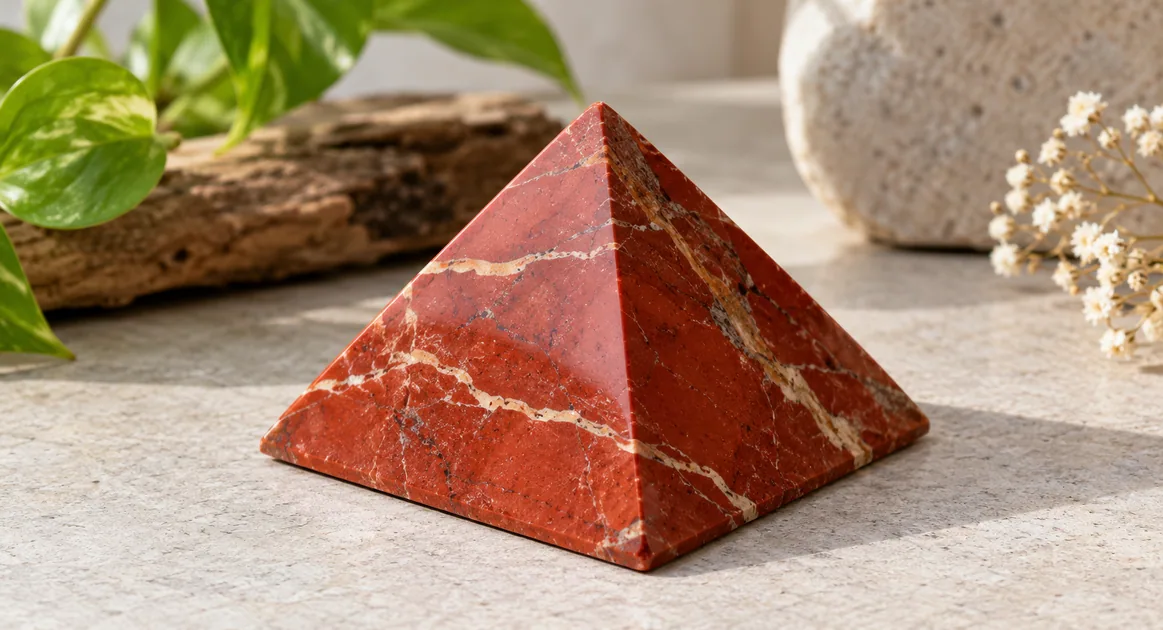
A jasper pyramid is a polished, carved decorative object made from a natural stone that may be brick red, brown, yellow, green or richly patterned. In an Indian home it might sit beside a puja shelf; in a Bengaluru showroom it may be selected for a counter display; in a professional Vastu collection it serves as a labelled example of an opaque stone. Yet the name jasper alone tells surprisingly little about the actual object. A uniform earthy red pyramid and a picture-patterned stone may have different origins, inclusions, finishes and prices.
A thoughtful purchase begins with the named material and actual photographs, followed by the carving quality, the treatment and construction disclosure, safe handling and an appropriate place for display. This guide explains what jasper is, how several trade varieties differ, which labels deserve closer checking, and how traditional Prithvi symbolism, Sankalpa and directional considerations can enrich a personal arrangement without replacing material facts.
The article is especially useful when comparing a red jasper pyramid with brecciated or landscape-patterned pieces, when buying for a shop or gifting occasion, or when assembling a practical Vastu reference kit. Different patterns are not automatically different mineral species, and a dramatic name should never substitute for clear photographs and a reliable description.
What is jasper? Mineral character, colour and natural variation
Jasper is traditionally used for opaque or nearly opaque, silica-rich material related to chalcedony, chert and fine-grained quartz. It is often described as impure microcrystalline quartz: tiny intergrown silica grains together with iron oxides, clay minerals and other constituents. Depending on the deposit, its colour may be red, yellow, brown, green, grey or multicoloured. The closely packed grains usually accept an attractive polish; a well-finished pyramid can show earthy depth rather than a transparent crystal sparkle.
This is not one universally narrow mineral-species label. Mineralogical references treat jasper as a rock or rock subtype, and gemmological authors note disagreement over which colour-patterned materials ought to count as jasper. The trade also uses the word for some altered volcanic or sedimentary rocks. Consequently an honest label may identify a material as “red jasper,” “picture jasper,” “jasper-like decorative rock” or a more precise geological name when the supplier has sound evidence. A guessed mine or country of origin is not an improvement.
Natural red hues frequently involve finely dispersed iron oxides such as hematite; ochre and yellow tones can involve other iron compounds. White or pale veins can be silica-rich seams, secondary filling or a mineral inclusion. Those visual clues are informative but not a laboratory certificate. The same stone type can show soft patches, dark specks, compact fine grain or broad streaks depending on how a rough block is cut.
Jasper is generally opaque, whereas some agates and chalcedonies transmit more light at thin edges. However, a strict opacity test does not solve every naming question: chert may look similar, and some commercial “jasper” products are other rocks. In retail circumstances, start with what can actually be observed and confirmed.
Jasper material at a glance
| Characteristic | Typical guidance | Why the buyer should care |
|---|---|---|
| Material | Opaque, impure fine-grained silica rock or chalcedony/chert-related aggregate | Do not expect a single transparent crystal |
| Colour | Commonly red, brown, ochre, yellow, green or patterned | Colour alone does not prove a trade variety |
| Hardness | Often approximately Mohs 6.5–7 for silica-rich jasper | Durable against ordinary scratching but corners can still chip |
| Cleavage | No pronounced crystalline cleavage in typical microcrystalline quartz-rich jasper | Open veins or healed fractures still merit inspection |
| Fracture | Conchoidal to uneven or granular depending on rock texture | A broken apex can leave a cutting edge |
| Finish | Dull or waxy rough surface, attractive polish after carving | Check for surface repairs and even polishing |
| Treatment | Dyes, heat or resin/filler may occur in the trade | Ask rather than assuming every vivid hue is natural |
| Origin | Depends on the actual stone, not the catalogue adjective | Only state a specific locality when documented |
| Construction | Single stone, bonded fragments or manufactured composite are different offers | Material declaration should match the physical item |
Red jasper: the clearest starting point for a named pyramid
For a first Jasper Pyramids collection, red jasper is often easier to describe and compare than an unnamed assortment: its earthy red to reddish-brown appearance is familiar and its matte-to-polished finish suits simple carving. A buyer can inspect fine pale lines, rust-coloured patches, darker mineral flecks and differences in polish. A genuinely natural stone does not need to be uniformly scarlet from tip to base.
Red jasper does not have one internationally fixed colour grade. Retail labels such as “premium,” “AAA,” or “temple grade” should be explained through actual visible criteria rather than treated as laboratory terminology. The best available item for a customer may be the one with a stable square base, neat apex and pleasing pattern, not the one with the brightest colour-filtered photograph.
A seller should also distinguish a solid carved piece from a pyramid built from bonded stone sections. A seam is not always a break; some pale lines are natural veins. Nevertheless, a straight continuous glue line, one side lifting away, resin in a chip or a visibly repaired tip changes what the buyer is purchasing. State that accurately alongside the size and price.
If choosing several red jasper pyramids, distinguish individual measurements and patterns. Three sizes of the same material can be size variants, not artificially presented as three wholly different geological varieties. This protects clarity for buyers and avoids multiplying near-duplicate catalogue pages.
Picture, brecciated, yellow and other jasper trade varieties
Picture jasper is marketed for layered, landscape-like bands in ochre, brown or cream. The scenes are interpretations of natural shapes, not actual drawings of mountains or deserts. Brecciated jasper usually describes a broken-and-recemented appearance with angular fragments; the exact history and composition depend on the specimen. Yellow jasper emphasizes ochre to golden tones and may show veins or mottling. These descriptors can be useful when the actual material matches the name.
Other names, such as orbicular, ocean, mookaite and leopard-skin jasper, are often linked to pattern or trade origin. They should be approached one by one: a familiar commercial name does not always establish a particular mineral assemblage or an authenticated geographical source. Some pattern materials sold as “jasper” include volcanic or sedimentary rocks not fitting a narrow silica definition.
The distinction matters particularly for a pyramid, because a cut exposes different areas of the source block. A seller may photograph one spectacular face while the reverse is almost plain. For a landscape design, the orientation of the cut can be part of the appeal. Ask for all faces and the base before treating a trade variety as a standardized repeatable colour pattern.
Named varieties: what a careful listing should explain
| Name encountered | Visual description | Important qualification |
|---|---|---|
| Red jasper | Earthy red, brick or reddish brown, sometimes veined | Document material, polishing and any treatment |
| Yellow jasper | Ochre, mustard or golden earthy shades | Not interchangeable with yellow calcite or citrine |
| Picture jasper | Tan-brown bands resembling a landscape | The “scene” is natural pattern interpretation |
| Brecciated jasper | Contrasting angular fragments or repaired-looking patches | Natural brecciation is different from artificial glue assembly |
| Orbicular jasper | Round spots or rings in a contrasting matrix | Verify the broad rock identity, not just round pattern |
| Mookaite / mookite | Often cream, yellow, red and brown combinations | Ask for supply documentation before claiming an exact Australian source |
| Ocean jasper | Typically orbicular/polychrome material marketed by locality | Locality and authenticity need evidence; not all ringed stones qualify |
| Dalmatian “jasper” | Pale body with black spots | Published gemmological work recommends “dalmatian stone” for a material not strictly jasper |
| Leopard-skin “jasper” | Spotted, mottled, often volcanic-looking stone | Name can cover materials unlike strict jasper |
| Mixed “jasper” pyramid | Multicoloured collection with uncertain variety names | Request a clear material label and actual-unit photograph |
Why trade names require a little extra diligence
A trade name may help a customer find a visual style, but it is not a replacement for geological identification. A case frequently discussed in gemmology is Dalmatian jasper. A Gems & Gemology study concluded that the tested decorative material did not meet the usual gemmological definition of jasper and recommended the name Dalmatian stone. That example illustrates why classification matters without implying that every trade label is deceptive.
The same care applies to labels such as “Picasso jasper,” “rainforest jasper” and “leopard skin jasper,” which may be applied to quite different rocks across sellers. If the item is fundamentally a rhyolite, another volcanic rock or a carbonate-rich material, a specific identification is more useful than stretching the jasper name to cover everything patterned.
Avoid assigning a named stone a guaranteed locality, an ancient scriptural origin or an exact mineral percentage from photographs alone. These points may be established by credible supplier documents or testing, but the surface appearance is insufficient. A conservative description can still be attractive: explain colour, visible pattern, finish, physical size and intended display.
For professional buyers, recording the supplier’s wording separately from what has been independently verified is a particularly useful habit. It makes future corrections to material names possible without changing the identity or history of the existing customer order.
How jasper differs from agate, quartz, carnelian and lookalikes
Jasper and agate belong to overlapping families of very fine-grained silica materials, but their usual retail appearances are different. Agate often reveals translucent zones and rhythmic banding; jasper is more often opaque, earthy and patchy. A particular stone can show both jasper-like and agate-like areas, which is why mixed descriptions sometimes occur. A laboratory result or credible supplier description may be needed for an exact classification.
Carnelian is commonly translucent orange-to-red chalcedony, rather than the opaque brick-red look often associated with red jasper. Quartz crystal is usually marketed for visible transparency and may be a different ornamental choice. Calcite, serpentine, rhyolite, dyed glass and resin composites can approximate some jasper colours but differ in hardness, polish, fracture or chemistry.
Non-destructive observation is more sensible than trying to prove a sale item by scratching it. Photograph opacity and colour in diffuse daylight, inspect the base and edges, and ask the supplier for known treatment history. A scratch test on a polished apex can damage the very item the customer is trying to evaluate.
Comparison guide for pyramid buyers
| Material | Common appearance | Buying distinction |
|---|---|---|
| Red jasper | Opaque earthy red, sometimes pale or dark veins | Silica-rich natural rock; variation expected |
| Banded agate | Often translucent layered chalcedony | Layer continuity and light transmission can differ |
| Carnelian | Orange to reddish, typically translucent chalcedony | Do not label every reddish carving “red jasper” |
| Clear or smoky quartz | Often transparent or translucent macrocrystalline quartz | Different visual effect and crystal character |
| Yellow or orange calcite | Sometimes cloudy or translucent and often softer | Much more scratch- and acid-sensitive than quartz-rich jasper |
| Rhyolite sold as jasper | Variable volcanic patterns or orbs | Confirm actual geology if supplier can document it |
| Dyed or coated silica material | Very intense or unevenly concentrated colours possible | Request treatment disclosure; appearance is not definitive proof |
| Manufactured glass or resin | May imitate colour and banding | Ask natural versus manufactured and construction type |
Natural colours, dye, fillers and reconstructed materials
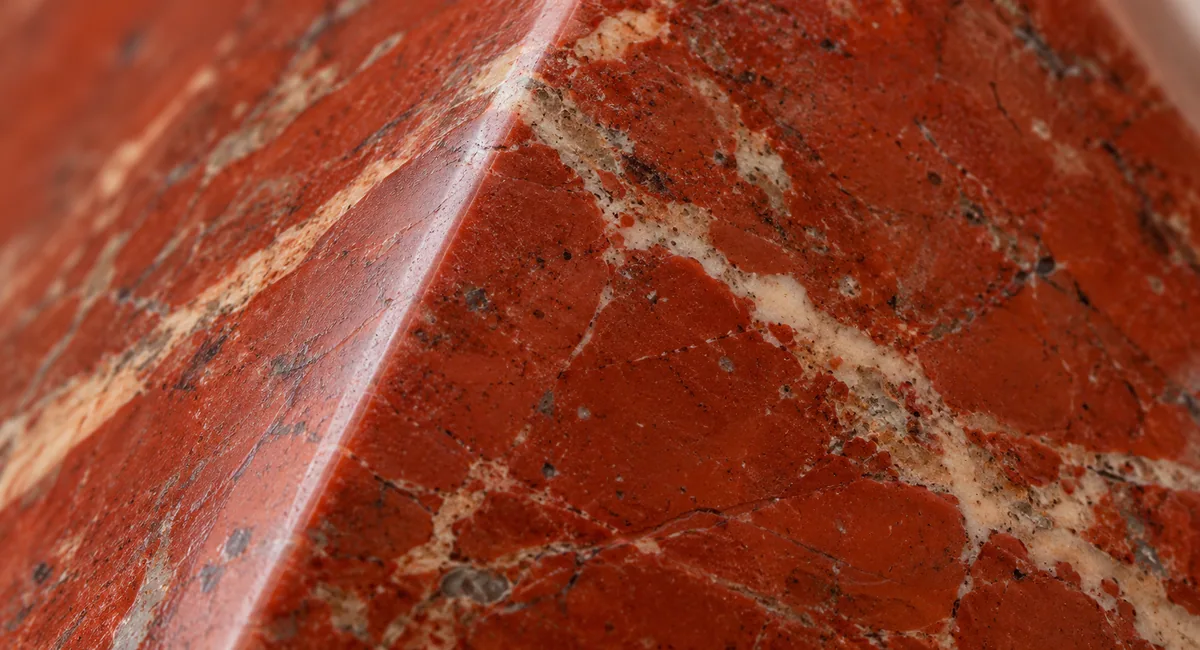
Because jasper can be porous in some varieties and can contain fissures, the decorative trade includes dyed, heated, impregnated, filled or assembled products. Not every bright green or blue piece is treated, but unusual uniform colour, darker concentrations at cracks or different colour in a chip can prompt a question. They are clues, not tests that settle authenticity on their own.
Gemmological treatment guidance explains that dyes can be affected by solvents and prolonged strong sunlight, while coatings and polymer impregnation require particular care. The safest shop practice is to obtain a written supplier statement and avoid claiming “untreated” unless that can be supported. A colour-enhanced stone may still be a useful decorative object when transparently labelled; it should not be sold as an equivalent untreated natural specimen without disclosure.
A naturally brecciated rock consists of geological fragments joined by later mineral cement. An assembled retail composite may consist of powders or chips deliberately bonded with resin. The visual resemblance does not make them identical constructions. For a carved pyramid, inspect whether a line is a natural vein, a stable mineral-filled fracture, a structural crack or a modern glue joint. If uncertain, state the uncertainty and request a professional opinion.
Do not subject the stone to bleach, acid, acetone, boiling water or an improvised flame test. Such methods may alter polish, dye, glue or filler and can produce misleading results. For a higher-value or disputed item, use an independent gemmologist or competent mineral laboratory rather than a destructive retail test.
What an appearance may suggest—and what it cannot prove
| Observation | Possible explanation | Responsible follow-up |
|---|---|---|
| Earthy red with paler veins | Natural iron-coloured silica and veins | Request daylight photos and material description |
| Deep colour concentrated in cracks | Could be dye accumulation or naturally darker material | Ask whether any colour treatment is known |
| Regular straight joint across faces | Possible assembled construction | Request underside view and disclosure of bonding |
| Angular contrasting internal fragments | Could be natural breccia or composite fragments | Distinguish geological structure from man-made assembly |
| Small shallow pit after polishing | Natural porosity or finish issue | Ask for close-up; check whether loose material remains |
| Highly glossy painted-looking film | Possibly coating or enhanced polish | Ask about surface treatment and care |
| One face dramatically different from another | Normal pattern changes through source rough | Compare all four triangular faces |
| Grand rarity or exact-origin claim | Could be genuine, but not visible in a simple picture | Request supporting provenance documentation |
Carving quality: the base, four faces, apex and dimensions
A pyramid is not a natural jasper crystal point. It is an intentional carved form, commonly with a square base and triangular sides. Its appeal rests on symmetry, material pattern and finish. A stable bottom is often more important for daily use than achieving a needle-sharp apex. Check that the base sits flat on an ordinary level shelf, the corners are finished consistently and no edge has an undisclosed break.
Under gentle side lighting, look for shallow polishing lines, resin-filled pockets and rough patches. Some genuine stone has veins and subtle grain; these need not be faults. What matters is whether there is loose material, a crack likely to spread, a glued repair or an unreasonably sharp damaged edge. The seller should not hide a major defect beneath a front-facing catalogue photograph.
Measurements should be given for the actual unit or clearly defined size variation: base width, height and approximate weight in the stated units. If dimensions are approximate, say so. The same height can have different weight when the base width changes or when a different rock is used. The price should reflect material declaration and workmanship, not an unsupported percentage of supernatural strength.
If buying a matched group for a Vastu consultant, record each stone’s label and keep a photograph of its distinctive face. More or less veining within the same natural variety is not automatically a grade difference. Avoid attaching a laboratory claim to representative stock photography.
Five-minute physical inspection
| Check | Acceptable signs | Clarification needed |
|---|---|---|
| Base on a level shelf | Stable without rocking | One corner lifts noticeably |
| Apex | Neat tip, safely finished | Chip, glue patch or needle-sharp defect |
| Edges | Evenly polished, not cutting | Fresh fractures or sharp splinters |
| Front, back and sides | Natural pattern variance shown clearly | Only a single edited image |
| Veins | Closed natural lines or disclosed features | Open crack, filler or loose powder |
| Surface | Consistent polish for this rock type | Visible peeling coating, severe scratches |
| Material description | Named type and known treatment status | Unsupported “100% rare” claims |
| Packing | Separate cushioning, secured base and apex | Loose contact with other stones or metal |
Traditional meaning: Prithvi, Sankalpa and the symbolism of jasper
In contemporary crystal and Vastu-inspired practice, jasper is frequently associated with stability, grounding, patience, protection and steady effort. An earthy red pyramid can symbolize disciplined work; a yellow or ochre piece may suggest warmth, growth and attentive stewardship; patterned stones may represent the meeting of different experiences within a stable whole. These are meaningful symbolic readings when people choose the material consciously, not conclusions inferred by geological tests.
The Indian framework of Pancha Mahabhuta describes Prithvi (earth), Jala (water), Agni (fire), Vayu (air) and Akasha (space). Jasper’s dense, opaque and earthy appearance makes it an intuitive modern visual representation of Prithvi Tattva; red colour can also be associated symbolically with warmth, vigour and Agni in some interpretive systems. The visible colour need not determine the literal elemental composition of the rock.
Bhumi Devi or Bhudevi embodies the earth in devotional contexts. A family that values earth-centred symbolism may appreciate a jasper object as part of a thoughtful, clean arrangement. However, a contemporary carved jasper pyramid should not be presented as an exact ancient Vastu ritual instrument or as a compulsory item prescribed by a specific classical text without evidence.
Sankalpa is a considered intention taken within a spiritual or personal discipline. For example, a person might choose a red jasper ornament to accompany a vow to manage responsibilities steadily. A shop owner might keep it near a written business plan as a reminder of orderly service and reliable conduct. Those uses retain traditional vocabulary without attributing guaranteed outcomes to the piece of stone itself.
Vastu directions: how to think beyond a one-size-fits-all placement claim
A proper Vastu discussion considers the building plan, entrance, circulation, sunlight, use of rooms and specific school of practice. The eight principal and intercardinal directions, often discussed with Ashta Dik, provide a familiar orientation framework: east (Purva), southeast (Agneya), south (Dakshina), southwest (Nairitya), west (Pashchima), northwest (Vayavya), north (Uttara) and northeast (Ishanya). They do not create a universally documented rule that any jasper pyramid must go in the same corner of every property.
Some modern Vastu advisers associate earth-like colours and heavier-looking forms with steadiness in southwestern areas, while others consider the specific Sankalpa or function of a room. If a consultant recommends a jasper piece for a particular direction, ask whether the reasoning comes from a defined traditional practice, a contemporary gemstone system or the practical intention for the room. Do not infer the remedy solely from the product colour.
For ordinary household placement, put the object somewhere it can be kept clean and stable: a protected living-room shelf, a work desk with enough space, or a side altar compatible with family customs. A bathroom ledge, narrow windowsill and a high shelf where it may fall are poor choices even when a generic chart labels that direction favorable.
Where an altar includes an active diya or incense, maintain a safe clearance from flames, ash, oils and accidental knocks. If the family practices traditional cleansing, do not automatically subject a treated or repaired pyramid to saltwater, vinegar or repeated soaking. Respect the purpose of the ritual while selecting a non-damaging method appropriate to the actual stone.
Vastu placement considerations by use
| Purpose | Potential arrangement | Practical safeguard |
|---|---|---|
| Quiet daily Sankalpa | Stable shelf in a reading or prayer area | Do not block ritual movement or use close to a diya |
| Study and disciplined work | Rear area of a desk, not the writing surface | Leave room for books, cables and hands |
| Living room symbolism | Single accent on a stable side cabinet | Keep away from corners where children may pull it |
| Shop prosperity intention | Secure display within a well-managed counter | Do not place in the handling path of customers |
| Professional Vastu teaching | Labelled sample alongside contrasting materials | Record directions as practice-dependent interpretations |
| Southwest-inspired earth symbolism | Consider only within an actual layout evaluation | Avoid declaring this a universal cure for Nairitya concerns |
| Puja accessories | Supplementary decoration if appropriate for household worship | Keep dry and away from oils, smoke, heat and cleansing liquids |
Jasper in Jyotish, Navagraha and chakra discussions
Indian Jyotish uses Graha, Rashi, Nakshatra, Lagna, Dasha and other principles when advising about planetary gemstones. A red decorative stone may prompt comparisons with Mangala (Mars), Surya (Sun) or particular chakra colours in modern crystal literature. These analogies should not be mistaken for a standardized classical prescription that replaces natural red coral, ruby or another specifically recommended gemstone.
Within contemporary chakra practices, red and earthy stones are sometimes placed in a Muladhara or root-centre display to represent stability. A practitioner may use a jasper pyramid as a physical focus during breathing or japa. The association describes the practice’s symbolic framework; it does not establish that a purchased carving has measurable therapeutic properties or that an exact shade of red corresponds to a particular horoscope.
Traditional devotional practice may also involve a mantra, puja, yantra, mala or a properly advised gemstone. These are distinct objects and disciplines. When a customer asks whether jasper should be worn or displayed for a particular Graha Dosha, it is more useful to examine the actual question and the relevant tradition than to sell a generic pyramid as an astrological substitute.
Worked example: a Bengaluru family choosing a first jasper pyramid
A family wants a modest item for a living-room shelf near a small prayer area. They see three online listings: one calls itself red jasper, one shows a “rare landscape jasper,” and one is simply labelled “lucky red crystal.” First they compare the actual photographs, not the slogan. The red jasper listing shows all sides and the base, gives dimensions and states that the piece is carved from one stone. The landscape listing has attractive patterns but a large chip visible only on the back image. The generic listing has no material declaration.
They choose the first item because they can understand what they are receiving and why it suits their quiet shelf. They ask that the tip be protected during shipping and select a placement away from the lamp and from a frequently opened cupboard. For their Sankalpa, the stone represents steadiness and care for the home. The choice is grounded in sound workmanship and family preference, not an asserted magical ranking among sellers.
Worked example: a jewellery showroom using jasper as a display accent
A showroom in Bengaluru plans to arrange a red jasper pyramid near a counter, perhaps alongside small gemstone products. The owner wants the red stone to echo warmth and a sense of grounded prosperity. Before placing it, staff confirm that the stone will not be knocked by trays, cash drawers or customers reaching across the counter. A small protective felt base keeps it stable and limits scratches to furniture.
For price signage and customer questions, staff use a clear label: “Red jasper pyramid — decorative carved natural stone; appearance varies; ask for actual-unit photos and treatment information.” They do not promise a specific rise in sales because of a compass direction. In this context, traditional Lakshmi-related prosperity symbolism may enrich the shop’s intention, while the actual business benefits come from service, clear pricing and careful product handling.
Worked example: professional Vastu consultant preparing a comparison kit
A professional wants samples of red jasper, picture-patterned stone, banded agate, black obsidian and fluorite for teaching. Instead of placing them loose in one box, the consultant gives each piece a separate compartment with the supplier name, trade name, verified or unverified mineral identification, weight and photographic record. An identification card contrasts opaque jasper with translucent agate and volcanic glass.
The consultant can then explain Prithvi symbolism and modern colour associations without telling clients that a red stone is automatically the correct remedy for every southwest room. A labelled kit encourages better questions: Is the item a genuine single carving? Are the patterns natural? Is the colour treated? Is this the same material as the product on the invoice? Which Vastu school underlies the proposed placement?
When the sample is used repeatedly, periodic checks for chipped edges, broken tips and stained surfaces are worthwhile. Replace or repair damaged teaching specimens before letting students handle them. Long-term usefulness depends as much on accurate reference information and safe packing as on an attractive collection.
Cleaning, dry display, storage and shipping
Jasper made from dense microcrystalline silica is generally more robust than gypsum or calcite, but a carved pyramid still has vulnerable corners and may contain pores, filler, adhesive or dye. For routine care, use a soft dry cloth or a clean, very soft brush to remove dust. Where a supplier confirms an untreated, intact material that tolerates mild moisture, a lightly dampened cloth can be used sparingly and the piece dried promptly. Avoid long immersion when treatment details are uncertain.
Avoid acidic cleaners, harsh household solvents, bleach, abrasive scrubbing pads, ultrasonic cleaning and unnecessary heat. Strong direct sunlight may affect certain dyed materials. Do not use saltwater as a universal cleaning method, even where salt is part of a separate household spiritual practice: it may leave residue in a porous surface, joint or crack.
Store each pyramid in its own padded compartment. A polished face can be scratched by harder nearby objects, and sharp corners can damage other specimens. Secure the base against movement and protect the tip with soft non-abrasive padding during shipment. A heavy metal pyramid should not travel unseparated against a jasper carving.
If the piece develops a loose grain, widening crack, peeling finish or staining, stop chemical cleaning and seek clarification about the stone and treatment. For a valuable object, professional examination is safer than home polishing or attempted glue repair.
Care and handling checklist
| Situation | Recommended approach | Avoid |
|---|---|---|
| Weekly dusting | Dry soft microfibre cloth or soft brush | Coarse scrubbing and harsh detergents |
| Small surface mark | Ask supplier about material and treatments first | Acid, bleach, alcohol or acetone experiments |
| Near puja lamp | Provide distance from flame, ash and oil | Placing tip against a hot diya or oil spill |
| Bright windowsill | Check stability and possible dye fading | Hours of strong heat on an unverified dyed item |
| Stone with a crack or filler | Limit handling, inspect and ask for expert guidance | Soaking, ultrasonic cleaning or impact tests |
| Long-term storage | Individual padded labelled space | Loose pile of mixed heavy stones |
| Dispatch | Cushion all corners, wrap separately and restrain movement | Unsecured hard contact with other merchandise |
Buyer questions before ordering a named jasper pyramid
A useful seller should be able to explain whether a listing is for red jasper, a named patterned variety or a general mixed-jasper assortment. Ask whether the displayed unit is the actual item or a representative photograph, and whether the material is solid carved rock or an assembled/decorative composite. A short answer that acknowledges genuine uncertainty is better than a confident but uncheckable locality or rarity story.
Photographs should include the front, back, two side faces, base and tip, ideally under neutral lighting. Request the measured base width and vertical height; ask for approximate weight if it affects shipping or shelf stability. If a certificate is shown, check what it actually certifies, who issued it and whether it describes this exact item rather than a generic mineral name.
For a gift, identify the symbolism the recipient will understand: a compact red jasper pyramid may represent steadiness and continued growth; a landscape stone can express appreciation for nature and patience. For professional selection, material data, disclosure and condition matter more than a dramatic gift narrative.
Final purchasing questions
| Ask the seller | Why the answer matters |
|---|---|
| Which named jasper variety is this? | Separates red, yellow, picture and generic patterned material |
| Is the photo of the exact unit? | Patterns and repairs vary from piece to piece |
| Is the carving one stone? | Discloses joined, reconstructed or composite construction |
| Has it been dyed, filled, coated or heated? | Informs colour expectations and safe care |
| Can I see all faces, the base and the apex? | Reveals finish, stability and damage |
| What are the actual dimensions and weight? | Ensures it fits the intended shelf and shipping plan |
| Do you have evidence for the claimed locality? | Avoids unsupported geographic origin claims |
| What is the return policy for damage or misdescription? | Protects the customer if the delivered unit differs |
| How will the tip and corners be packed? | Reduces shipping breakage |
Frequently asked questions
Is jasper a crystal or a rock?
The name commonly describes an opaque, silica-rich fine-grained rock or chalcedony/chert-related material, not a distinct large single crystal growing naturally as a pyramid.
Is every red stone sold as jasper genuine red jasper?
No. Similar-looking carved objects can be other rocks, dyed materials, glass or composites. Check the actual material declaration and photographs.
What makes red jasper red?
Fine iron-oxide and related mineral inclusions commonly contribute the earthy brick-red or reddish-brown hue; precise composition varies by specimen.
What is the hardness of typical jasper?
Silica-rich jasper is often around Mohs 6.5–7. This does not mean the pointed carving cannot chip or fracture if dropped.
Are all jasper variety names separate mineral species?
No. Many are colour, pattern, locality or commercial names; some marketed jaspers belong to other kinds of rock.
Is Dalmatian jasper really jasper?
A published GIA gemmological study recommended calling the studied decorative material Dalmatian stone because it did not meet the usual jasper definition.
Is picture jasper a painted landscape?
In genuine natural picture-patterned material, the landscape-like effect comes from mineral colours and structures, not a painted scene. Specific listings still require verification.
How is jasper different from agate?
Jasper is usually more opaque and earthy; agate more often displays translucent, layered chalcedony. Mixed or borderline stones do occur.
Can jasper be dyed?
Yes. Some trade material is dyed or otherwise treated. Request disclosure rather than trying destructive home tests.
Does a brighter red pyramid mean higher quality?
Not necessarily. Actual stone identity, sound carving, stability, treatment disclosure and condition matter more than saturated photographs.
Can I choose a brecciated jasper pyramid?
Yes, if you like its fragment-like pattern and the item is described accurately. Natural brecciation and artificial assembly are different construction histories.
What does jasper symbolize in Vastu?
In contemporary Vastu-inspired and crystal practices, earthy jasper is often associated with stability, persistence, Prithvi symbolism and an intentional home setting.
Which is the correct Vastu direction for a jasper pyramid?
There is no well-established universal classical prescription for every modern jasper pyramid. Evaluate the actual room and the tradition or purpose behind the advice.
Is jasper the same as a classical Navagraha gemstone remedy?
No. A decorative jasper pyramid is not automatically interchangeable with prescribed Jyotish gemstones; horoscope-based decisions have their own frameworks.
Can jasper be used in a Muladhara chakra display?
Many contemporary chakra systems use earthy or red stones symbolically for grounding and root-centre reflection. This is a practice association, not a mineral test.
Can I wash a jasper pyramid in saltwater?
Routine soaking is unnecessary, especially when dyes, filler or adhesive may be present. Prefer soft dry care and follow material-specific guidance.
How do I inspect a pyramid without damaging it?
Request all-side photographs, check finish and stability visually, and avoid scratching, hot needles, acids or impact tests.
Should a professional Vastu kit include jasper?
It can be useful as a clearly labelled opaque silica-rock sample with accurate trade name, dimensions, condition and sourcing notes.
How should a jasper pyramid be packed?
Wrap separately, protect the tip and all base corners, and prevent movement against other stones or metal items.
Is a high-priced “rare jasper” always better?
No. Assess proof of origin, real material, craftsmanship and condition before paying for an unverified rarity claim.
Reference basis and terminology
For the mineral classification, physical properties and differences among traded “jasper” names, this article draws on Mindat’s jasper entry and the International Gem Society’s jasper material profile. The published Gems & Gemology study True Colors of “Dalmatian Jasper” illustrates a case in which a familiar trade name does not match the scientific identification. GIA’s introductory material on gem treatments explains why dye, coating and impregnation disclosure affects care. These references are cited here by publication name rather than filling the customer page with repeated commercial outbound links.
The discussion of Pancha Mahabhuta, Bhudevi, Sankalpa, Ashta Dik, Graha and chakra practice concerns traditional and contemporary interpretive systems. Mineral science helps identify a carving and its care requirements; symbolic interpretation helps a family or practitioner decide how they wish to use it. The two should be described clearly without flattening the authentic vocabulary or treating a particular retail object as an automatically prescribed scriptural remedy.
Explore existing OmmRudraksha collections
Browse Vastu for the existing collection, or explore gemstone products for other material forms. Each product’s construction and care information should guide your choice.