Bloodstone pyramids: real heliotrope, red spotting, Vastu use and practical buying
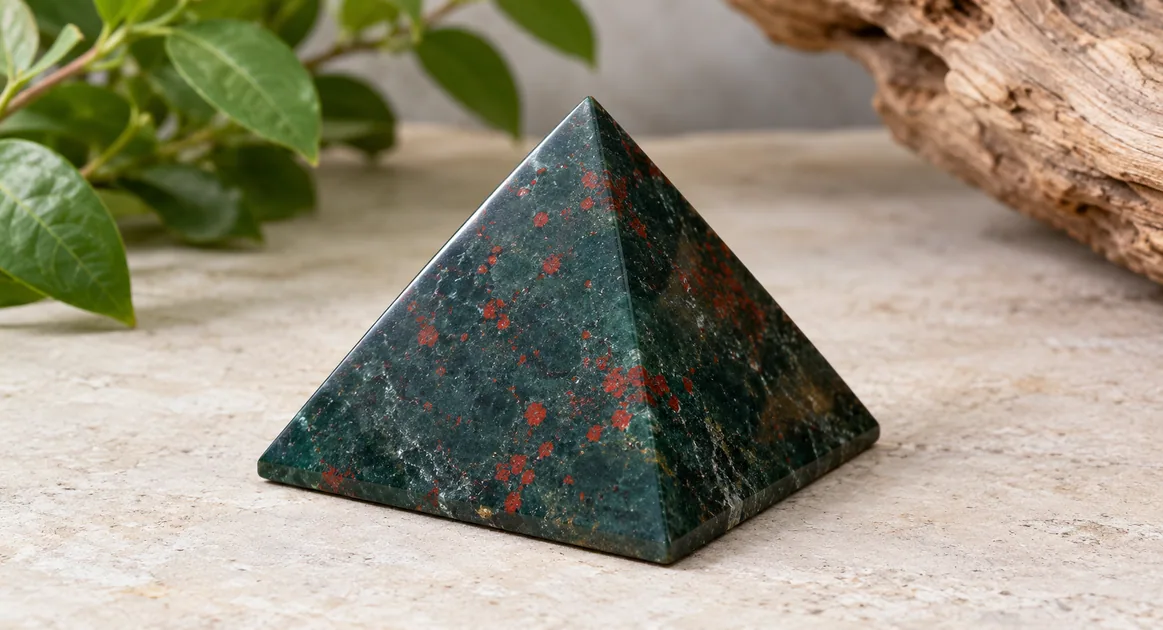
A bloodstone pyramid combines two instantly recognizable features: a dark, commonly forest-green body and scattered red or reddish-brown markings. When the stone is authentic heliotrope, those colours belong to a natural silica-rich gem material rather than applied surface decoration. The pyramid is a carved decorative form; a particular orientation or number of red spots does not turn one carving into a guaranteed remedy. The useful questions are therefore concrete: what mineral material was carved, is the pattern natural, are the faces sound, what traditional meaning does the owner attach to it, and how should the piece be maintained?
A photograph of one spectacularly spotted face can make a modest carving seem uniformly red-speckled. In practice, natural bloodstone varies from predominantly green with a few precise dots to irregular crimson islands, brownish flecks and broad streaks. Some stock labelled bloodstone does not meet the usual description at all. This guide explains identification and the overlapping names bloodstone, heliotrope, blood jasper and plasma, then gives considered Vastu and devotional placement examples, shop-floor quality checks and a realistic care routine.
What is bloodstone, scientifically?
Bloodstone, or heliotrope, is a variety in the quartz/chalcedony family, commonly described as dark green, largely opaque chalcedony or jasper-like material carrying red to brown-red spots. The chemical framework is silica, SiO2. Its attractive red pattern is generally related to iron-oxide-rich areas; hematite is a common explanation. The green matrix may owe its colour to fine inclusions such as chlorite or amphibole-group minerals. Precisely which inclusions occur in an individual carving requires examination, not a conclusion from product photography.
The international gem-material definitions published by CIBJO describe heliotrope as dark green chalcedony with red or brownish-red spots. Mindat places bloodstone within green chalcedony or jasper-like prase. The USGS likewise groups heliotrope among the cryptocrystalline silica varieties. These descriptions are compatible in the essentials, even though gem merchants may use different boundaries between opaque jasper and more translucent chalcedony. Do not present the naming variation as evidence that the stone itself is necessarily artificial.
The usual chalcedony-family Mohs hardness is approximately 6.5–7. That is substantially harder than calcite or gypsum, but it does not make a pointed pyramid unbreakable. Hardness measures resistance to scratching; a thin tip can still chip after impact. A polished face should have an even sheen appropriate to the material, without requiring a glassy mirror finish or synthetic-looking perfection.
| Property | Reasonable description | What to verify on the actual carving |
|---|---|---|
| Material family | Quartz / microcrystalline silica; bloodstone is a chalcedony variety | Supplier identification and any available testing |
| Common appearance | Dark green matrix with red or brown-red inclusions | Photos of four faces, top and bottom |
| Colour-causing matter | Red commonly associated with iron oxides; green with fine inclusions | Do not infer exact mineral species from colour alone |
| Mohs hardness | Generally around 6.5–7 | No destructive scratch test on a finished retail piece |
| Transparency | Often opaque to slightly translucent at thin edges | Compare with backlit edge only if safe |
| Surface | Waxy-to-vitreous polish depending on texture and finishing | Check cracks, fillings and corner chips |
| Origin | Deposits exist in several regions, including India | Origin claims need parcel-specific evidence |
Heliotrope, blood jasper, plasma and hematite: the names explained
The Greek-derived name heliotrope refers to historical interpretations of the stone in relation to the sun; it does not indicate that a pyramid must be placed in direct sunlight. Bloodstone refers to the visual resemblance of red speckles to drops. Some sellers say blood jasper or oriental jasper. The terms can overlap in retail usage, yet an accurate listing should still identify a green silica-rich matrix with characteristic red markings.
Plasma is a traditional gem name for a green chalcedony material; adding red spots describes the classic bloodstone appearance. The strictly scientific distinction between jasper and chalcedony is not always obvious in a photograph, especially for microcrystalline, opaque material. Bloodstone is not itself the mineral hematite: hematite is iron oxide, whereas bloodstone is predominantly silica. Likewise, a generic deep-red stone sometimes called bloodstone in a regional marketplace may be an entirely different product. Ask for the underlying material description rather than debating names in isolation.
| Name on a listing | What the name may properly mean | Main buyer caution |
|---|---|---|
| Bloodstone / heliotrope | Dark-green chalcedony with red or brown-red spotting | Check green base and intrinsic red pattern |
| Blood jasper | Trade expression used for some bloodstone material | Confirm the stone is genuinely heliotrope-type silica |
| Plasma | Green chalcedony, often without prominent red spots | A plain green piece may not show the bloodstone pattern |
| Hematite / bloodstone | Some language traditions use the word bloodstone for hematite | Hematite is not green chalcedony |
| Dragon blood jasper | Separate trade material with red-and-green appearance | Do not assume it is heliotrope |
| African bloodstone | Commercial locality-style expression, sometimes ambiguous | Ask exact material and evidence of provenance |
| Dyed green-red stone | Possible treated or composite imitation | Require clear treatment and construction disclosure |
How natural red spots form and why each pyramid looks different
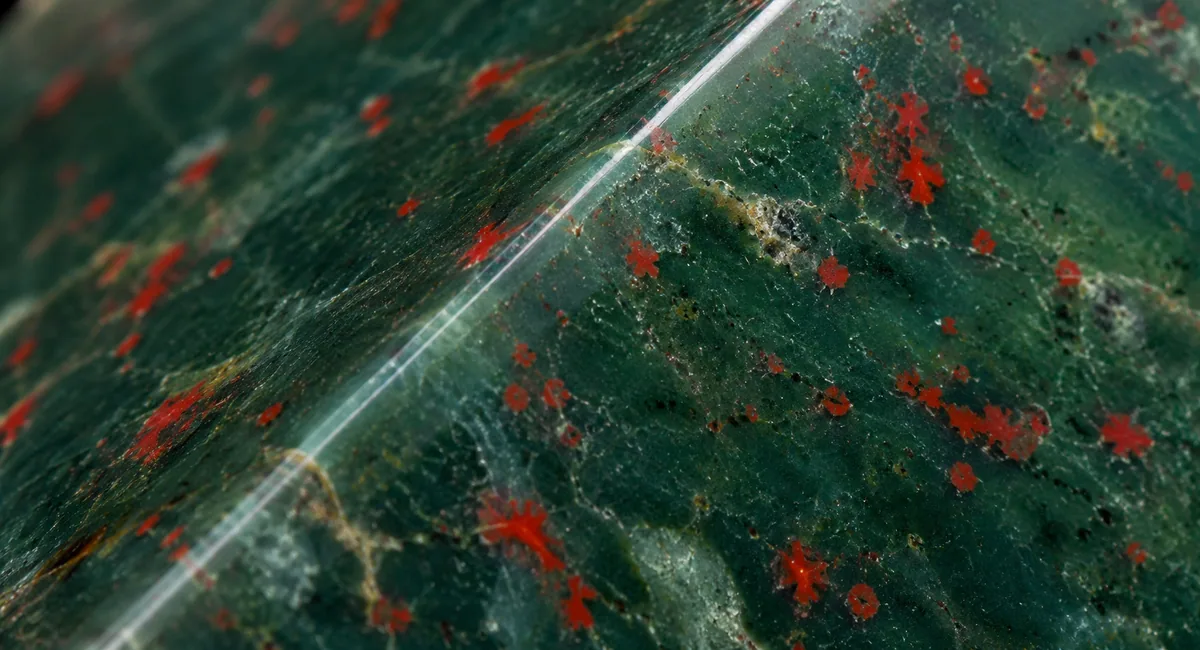
The characteristic red is not a uniform coating expected to cover every face. Mineral-rich areas occur within the rough stone; cutting the rough along a chosen direction exposes a changing cross-section. One finished pyramid might have a vivid patch running up one side, tiny scattered dots around the base and nearly plain green faces opposite. Another may show much wider russet clouds. Neither arrangement proves superior mineral quality by itself. Both are consistent with a naturally varied stone if the pattern belongs inside the material.
Close-up inspection helps separate a pattern that continues into an edge from paint gathered in surface scratches. Under consistent light, look across the red and green boundary, including the base, to see whether pigments seem superficial or whether colour appears integrated with the rock. A suspiciously identical design repeated across many supposedly unique stones, red material concentrated only in pores, or colour transfer to a cloth may prompt a treatment question. Such signs are indications for disclosure, not a definitive laboratory diagnosis.
A buyer who wants especially visible red can choose the strongest patterned side for the display orientation. A professional kit may do better with an ordinary, representative specimen: recognizable green ground colour, clear spots, clean workmanship and documented dimensions. The idea of more red equals more spiritual power is neither a mineralogical grading rule nor a universally fixed Vastu principle. Pattern intensity changes appearance and sometimes market preference; it should not become an unsupported guarantee.
| Pattern observed | Plausible interpretation | Appropriate next step |
|---|---|---|
| Sparse tiny red dots | Natural spot distribution can be uneven | Inspect every face before accepting the photograph |
| Broad rusty-red island | Another possible cut through iron-oxide-rich material | Ask for macro image to assess polish and cracks |
| Brown rather than bright crimson | Normal iron-related colour range may be muted | Do not assume paint or low quality from hue alone |
| Green face with almost no red | Pattern may be on another face or absent in that slice | Request underside and all-side photographs |
| Red concentrated in fractures | May be natural iron staining or added treatment | Request treatment disclosure; avoid confident diagnosis |
| Loose granules or open fracture | A condition/workmanship concern independent of tradition | Reject damaged carving or request exact defect disclosure |
| Identical red pattern across units | Can suggest image reuse, decorative coating or stock error | Seek item-specific photographs |
Bloodstone versus visually similar green-and-red stones
Bloodstone is especially vulnerable to trade-name confusion because a casual photograph of a green base with red spots can resemble several unrelated materials. Ruby zoisite (anyolite) generally has contrasting ruby-bearing pink/red areas in green zoisite with possible dark mineral patches; the components are different from the silica matrix of bloodstone. Ruby fuchsite has ruby in green mica-rich material. Dragon blood jasper is sold as a distinct green/red decorative material. Moss agate can show green dendritic or moss-like inclusions rather than classic red-speckled dark green. Red jasper tends to have a mainly red body, not a dark-green matrix punctuated by red.
There are also inexpensive green glass, dyed stones and assembled resin items. Natural glass and engineered glass should not be confused with chalcedony simply because both polish well. Bubbles, colour pooling, unnatural regularity or signs of glued construction may be useful clues, but no single home check reliably establishes authenticity. Treat the material description and return terms as part of the product, not as optional marketing details.
| Material | Appearance often seen | How to distinguish responsibly |
|---|---|---|
| Bloodstone / heliotrope | Dark green silica-rich matrix; red-brown speckles | Look for included red zones and ask for chalcedony identification |
| Ruby zoisite / anyolite | Green zoisite with pink-red ruby and possible black inclusions | Separate multi-mineral rock; different gem components |
| Ruby fuchsite | Green mica-rich rock with ruby spots | Different mica-rich matrix, often different sheen |
| Dragon blood jasper | Green with bold red patches | Trade description is not proof of heliotrope |
| Moss agate | Translucent to opaque chalcedony with moss-like green inclusions | Pattern and body colour differ; may lack red speckling |
| Red jasper | Predominantly opaque red or earthy patterning | Not classic green-background heliotrope |
| Green-red dyed stone | Variable artificial colour distribution | Ask for treatment disclosure and object-specific details |
| Hematite | Iron oxide with typically metallic grey-black appearance | Not a green chalcedony carving |
Carving quality: the pyramid must be a sound object, not just an attractive photograph
A good bloodstone pyramid should sit stably on a flat surface, have a well-formed apex, edges consistent with the chosen design and a finish that reveals rather than hides the natural pattern. Symmetry can be checked by viewing the object straight-on from four sides. A slight natural variation in the stone is not the same as sloppy geometric cutting. It is reasonable to request measured base length, vertical height and weight rather than substitute a typical dimension from an unrelated specimen.
Inspect the top carefully. The point is vulnerable during unpacking, shelf handling and courier movement. A minute polish variation can be acceptable if disclosed; a missing corner, open fracture, repaired apex or adhesive line changes the condition and sometimes the value. A chip at the base can become more visible when the item sits on a glass shelf. The safest assessment is visual and documented—not a metal-knife scratch test, an acid drop or striking the point.
The underside matters. A seller may show polished faces while omitting a rough base, a filled cavity, an uneven foot or a joint between sections. Most customers expect a carving cut from one piece of material unless the listing says otherwise. Where a piece is assembled, stabilized, resin-filled or coated, those facts should appear in product specifications. Transparent presentation earns more trust than calling every imperfection a mysterious energy mark.
| Inspection point | Acceptable or expected | Question / rejection signal |
|---|---|---|
| Tip | Centered enough to read as a pyramid; undamaged | Missing apex, loose repair or sharp splinter |
| Four faces | Natural pattern differences, consistent polish | Undisclosed cracking or poorly aligned edges |
| Base | Stable, safely finished footprint | Wobble, unreported rough cavities or bonding lines |
| Red areas | Embedded spots with natural variation | Surface staining claimed to be untreated without proof |
| Dimensions | Real dimensions for the offered item | Unverified generic measures copied from another product |
| Treatments | Known dye, fillers or joining disclosed | Claims of pure untreated stone without support |
| Media | All-side actual-product photos when selling a specific piece | Only one perfect image for multiple unequal specimens |
Vastu significance: Prithvi, intention and the meaning of green and red
Within Indian Vastu and contemporary gemstone practice, a carved pyramid may be selected as a symbolic object for a defined intention (Sankalpa) and a thoughtfully arranged space. The Pancha Mahabhuta framework—Prithvi (earth), Ap or Jala (water), Agni (fire), Vayu (air) and Akasha (space)—provides a vocabulary for material, colour and atmosphere. Bloodstone is a physical earth-derived object; the green matrix often evokes growth, steadiness and renewal while the red accents suggest vitality, initiative or courage. These are interpretive associations, not a statement that a physical mineral automatically corrects an architectural defect.
When discussing Vastu directions, the eight directions (Ashta Dik) and their traditional directional guardians should be distinguished from contemporary product-selling charts. Northeast is commonly called Ishanya, southeast Agneya, southwest Nairritya and northwest Vayavya; north, south, east and west have their own traditional associations. The practice of choosing a gemstone pyramid solely by body colour is a modern simplification. A practitioner may examine room function, orientation, surrounding clutter, light and the family’s devotional preferences before discussing symbolic placement.
The red speckles can invite an association with Agni or disciplined effort; the green can suggest nature, continuity and a peaceful working environment. It is better to state the selected intention specifically—such as maintaining a calm, orderly puja shelf, marking a workspace with a reminder to act decisively, or displaying a material specimen in an educational set—than claim that any bloodstone pyramid must always face a fixed compass direction. No single universally binding rule applies to every size of commercial carving in every Vastu tradition.
For families who maintain a daily puja or dhyana practice, a pyramid can remain a secondary decorative object, separate from consecrated murtis, lamps and offerings. It should not block a diya, obstruct access to puja materials or sit where water and oil will frequently spill onto it. A simple, reverent arrangement can be more appropriate than adding several competing symbolic objects to a crowded shelf.
| Context | Possible symbolic reading | Practical placement consideration |
|---|---|---|
| Puja shelf or meditation corner | Sankalpa, steadiness and attentive practice | Choose clean stable space, away from lamp heat and water |
| Family living room | Balance between growth (green) and initiative (red) | Use a small stable platform that is not easily knocked |
| Work desk | A visual reminder of focused action and continuity | Keep out of typing area and cable paths |
| Shop / showroom | A visually distinctive mineral display with a prosperity intention | Do not interfere with transactions or merchandise handling |
| Professional Vastu reference kit | Material comparison and explanation of colour symbolism | Label the object, not a promised outcome |
| Hallway or busy entrance | An attractive display if desired | Avoid narrow ledges where a tip or corner can chip |
Jyotish and Navagraha: where bloodstone does and does not fit
In Jyotish, gemstones used as planetary ratna are traditionally considered in relation to a person’s Janma Kundali, Lagna, Rashi, planetary strength, Dasha and the intended upaya. The familiar Navaratna tradition involves specific stones such as ruby for Surya, pearl for Chandra, red coral for Mangala, emerald for Budha, yellow sapphire for Guru and other recognized planetary gemstones. A decorative bloodstone pyramid should not be advertised as a universal replacement for one of those primary Navaratna gemstones.
Because bloodstone contains green and red areas, contemporary sellers sometimes connect the colours with Budha (Mercury), Mangala (Mars), initiative, composure or the Muladhara and Anahata chakra systems. Those connections need to be identified as a specific interpretive tradition or modern practice rather than an invariable classical prescription. Red does not by itself make a stone a substitute for red coral, and green does not make it an emerald. Wearing a Jyotish gemstone and placing a decorative pyramid are two different decisions with different purposes.
A consultation, where requested, can discuss a person’s concerns and the broader traditional context while keeping the product description accurate. For a shopper seeking a Vastu object, the first decision remains whether they like and understand this material and can place it safely. For someone asking about astrology-based gemstone selection, a birth-chart-based approach is more appropriate than assigning a Graha from the pyramid’s appearance alone.
Ritual use, Sankalpa and respectful handling
Owners sometimes place a new gemstone item on a clean cloth, offer a brief prayer to their chosen Ishta Devata, and articulate a Sankalpa before displaying it. The content of the prayer may emphasize courage, steadiness, household harmony, ethical livelihood or clarity of effort. Local sampradaya, family practice and temple guidance should guide any formal ritual. There is no need to claim one mandatory Sanskrit mantra or one special consecration procedure for every ordinary decorative pyramid.
If the object will be kept near incense, avoid direct smoke deposits on the polish and do not place it close to an open flame. Water, milk, oil, turmeric or salt are not automatically safe cleaning media for a commercial object whose treatments and joints may be unknown. A cloth-covered clean surface and a prayer do not require bathing the mineral. In this sense, practical conservation and respectful use support each other.
Some contemporary crystal traditions discuss bloodstone in connection with courage, perseverance, energetic renewal and personal grounding. These can be presented as traditional or modern symbolic associations. The word bloodstone is not a medical indication: a decorative carving does not diagnose or treat anaemia, bleeding, circulation disorders or any other disease. The meaningful cultural vocabulary remains intact without confusing a spiritual object with a clinical treatment.
Worked example 1: a Bengaluru apartment puja shelf
A family has a compact northeast-side puja niche with a brass lamp, framed images and a few small devotional objects. They like a green-and-red stone and consider a bloodstone pyramid. Before buying, they compare base dimensions with available shelf space and request photographs of the front, back, tip and base. The stronger red-spotted face is turned toward the viewer, while the pyramid sits on a small stable tray that does not obstruct lamps or daily worship. The family can associate the stone with disciplined Sankalpa without declaring that its red spots independently change the apartment’s Vastu.
The most useful practical improvements may be unrelated to stone choice: sufficient clearance for the diya, cleaning access, a level shelf and uncluttered placement. A very large pyramid would crowd the area; a small, sound carving may be better suited. If only one face shows red, that is a design preference to understand before purchase, not a defect in the family’s intention.
Worked example 2: a jewellery showroom counter
A Bengaluru jewellery showroom wants a distinctive stone item near a consultation counter but does not want it to interfere with bills, packaging or customer handling. It selects an actual-unit bloodstone piece with visible red inclusions and a stable footprint. The store photographs the material with honest lighting, notes the measured dimensions, and makes no unsupported claim that a pyramid guarantees revenue. A short display card can explain the green chalcedony matrix, red iron-related spotting, traditional symbolism and safe dry wiping.
The proprietor may choose to use the object as a reminder of steady customer service, fair trade and a clear Sankalpa for the business. That cultural interpretation is legitimate as a personal intention; sales performance continues to depend on pricing, merchandise quality, service and commercial operations. Keeping the pyramid out of routine handling also protects its corners from chips.
Worked example 3: a professional Vastu reference kit
A consultant preparing a professional comparison set could include bloodstone alongside red jasper, banded agate, ruby zoisite and green aventurine. The purpose is to show clients the distinctions: green chalcedony with red spots; opaque earthy red silica; layered chalcedony; ruby-bearing green zoisite; and green aventurescent quartzite. Each sample should have a legible label with material, trade name, visual traits, approximate dimensions, known treatments and date of acquisition.
The professional can explain Pancha Mahabhuta, Ashta Dik, Sankalpa and Graha terminology when relevant while showing what is and is not demonstrable from a specimen. The bloodstone should be securely packed in an individual pouch or compartment. The kit is most valuable when labels and comparisons can be trusted rather than when every item is promoted as an all-purpose correction.
Choosing authentic bloodstone online: an evidence-based purchase sequence
Start with the expected appearance, not the advertised powers: dark-green silica-rich material with red to brown-red areas. Check whether the seller means heliotrope specifically, and whether the offered item is the one shown. Request natural and artificial-light photographs without excessive saturation. Look closely at the corners and underside. Ask whether the stone is dyed, coated, filled, glued, stabilized or assembled, and whether the seller has reliable information on origin. If identification is important to the price, seek an appropriate independent gemmological report rather than trusting only a certificate printed by the seller.
A listing claiming “100% pure untreated bloodstone” deserves support, especially when colour is unusually vivid or the piece is reconstructed. At the same time, ordinary natural variations are not proof of alteration. Use a structured short list: material clarity, photographs, construction, dimensions, return conditions and price. A lower-cost item with accurate disclosures can be a better purchase than a prestigious trade name accompanied by poor documentation.
| Ask the seller | Why the answer matters | Best acceptable evidence |
|---|---|---|
| Is this heliotrope/bloodstone or only a bloodstone-like trade item? | The trade name can cover different stones | Specific material description |
| Are the actual four sides and base photographed? | Red spots are not evenly distributed | Actual-unit photographs and short video if available |
| Any dye, treatment, filling or glued construction? | Affects both price and cleaning | Explicit treatment declaration |
| What are its measured base, height and weight? | Important for display and shipping | Measurements of the offered unit |
| Any chips, repairs or open cracks? | Condition is part of value | Closeups under neutral lighting |
| Is country of origin verified? | Location names are frequently used as marketing terms | Parcel-level supplier evidence if claimed |
| What return rule applies if the pattern differs? | Single representative photo may mislead | Clear product-specific return terms |
Cleaning, storage and shipping: protect a polished silica carving
For everyday display, begin with a soft microfiber cloth or a clean, soft brush to lift loose dust. If the piece is verified as an untreated, unjoined chalcedony carving and the finish permits, a slightly damp cloth with mild soap may be used briefly; wipe residue away and dry immediately. Avoid long soaking, prolonged immersion, abrasive pastes, harsh detergents, bleach, vinegar or acid-based cleaners. A piece with unknown dye, filler, resin, metal fittings or repairs should be treated more cautiously, with dry wiping first and professional advice where needed.
Never use the popular “scratch glass to prove authenticity” test on a saleable pyramid. Gem materials can break, and scratches permanently reduce finish quality. Nor should one test red marks with acid or open flame. Ultrasonic and steam cleaning are unnecessary for a shelf object and may be inappropriate if the material has fractures or repairs. A polished stone and a mounted jewellery item have different cleaning requirements; a generic instruction copied from a loose gemstone catalogue may not fit the carving.
For storage, wrap the pyramid separately from harder gems, metal tools and other heavy carvings. Use a box with a firm base and soft side cushioning so the apex is not the load-bearing point. Avoid loose stones striking the corners while the box is moved. Keep the object out of damp places, household chemical cupboards and areas where children or pets may knock it from a high shelf. On a shelf or display table, place it where accidental contact is unlikely.
For shipping, stabilize the base in a fitted insert or padded compartment, protect all four corners and leave clearance around the tip. Do not bind tape directly to polished stone. A box-in-box arrangement can be helpful for fragile shipments, especially with several different stone articles in one parcel. When receiving a shipment, unpack above a soft surface and photograph damage before discarding the packing if a claim may be necessary.
| Situation | Recommended handling | Avoid |
|---|---|---|
| Normal dust | Soft dry brush or microfiber cloth | Abrasive scrub and gritty cloth |
| Light residue on verified untreated carving | Brief mild damp wipe, then immediate drying | Long soak or unknown cleaning products |
| Unknown treatment or adhesive | Dry-first cleaning and seller clarification | Steam, ultrasonic bath or solvents |
| Puja-adjacent display | Protect from oil, incense residue and lamp heat | Pouring ritual liquids over a saleable carving |
| Cabinet storage | Individual padded space with stable base | Loose contact with harder stones or metal |
| Courier packing | Tip clearance, corner protection and firm support | Pressure directly on the apex |
When a red-speckled stone deserves more investigation
Occasionally a carving has very pale green material, bright red paint-like flecks, a heavy resin shine or a visibly assembled base. None of those observations alone proves fraud, but they justify a request for material and treatment detail. A magnified view of an actual specimen may reveal evidence that a generic product image hides. With higher-priced or high-volume purchases, an independent laboratory can help assess whether a claimed material identification is supported. A material description should be proportionate to the evidence available.
Do not confuse a naturally fractured or repaired object with an automatically “energized” or “powerful” one. The appropriate questions concern condition, durability and informed consent to the purchase. A repair, dye or composite construction can be perfectly legitimate when disclosed, accurately priced and suitable for the intended use. Misdescription—not the existence of a treatment—is the central issue.
Frequently asked questions about bloodstone pyramids
What is a genuine bloodstone pyramid?
A pyramid carved from heliotrope-type dark-green chalcedony material with characteristic red or brown-red spots. Ask whether the seller identifies the actual carving as bloodstone rather than a vaguely similar green-and-red stone.
Is bloodstone the same as hematite?
No. Bloodstone is a silica-rich chalcedony variety, although the red marks may involve iron oxides including hematite. Hematite itself is an iron-oxide mineral.
Is it blood jasper or chalcedony?
Both expressions appear in the trade. The material belongs to the microcrystalline silica family. A seller should describe the actual material instead of relying on a trade label alone.
Why does one side have more red spots?
The mineral pattern varies through the rough stone. Different cutting faces expose different sections, so one side may be richly speckled and another nearly plain green.
Do more red spots make the stone more powerful?
No universal mineralogical or Vastu grading standard assigns spiritual strength by red-spot count. Choose a pattern you like and check condition and material authenticity.
Are brown spots normal?
Yes. Iron-related marks can be brick red, rust red or brownish. Colour alone cannot prove whether a mark is natural or treated.
Can a bloodstone pyramid be used in Vastu?
Yes, as a decorative or symbolic item in contemporary Vastu practice, preferably with a clearly stated Sankalpa and appropriate regard for the room and household tradition.
Which direction is mandatory for bloodstone?
There is no single universal classical compass rule for every commercial bloodstone pyramid. Consider the use of the room, the wider Vastu assessment and the household’s practice.
Is bloodstone a replacement for emerald or red coral?
No. A red-and-green chalcedony carving is not automatically a substitute for Budha or Mangala ratna selected under a Jyotish system.
May it be kept in a puja room?
It may be kept as a separate decorative object on a clean, stable surface, away from lamps, liquids and the handling of consecrated items.
What is a suitable size for a desk?
Measure the available surface, distance from the keyboard or work area, and stability of the base. Choose actual dimensions rather than assuming a standard pyramid size.
Can I cleanse it with salt water?
Avoid soaking or salt-water cleansing, particularly when treatments or repairs are uncertain. Routine dry wiping is adequate for most shelf display.
Is rubbing with turmeric or lemon juice advisable?
No. Coloured powders can lodge in pores and residue; acids and household products may damage treatments or finish. Prefer gentle cleaning.
How do I distinguish ruby zoisite from bloodstone?
Ruby zoisite is a different multi-mineral rock, often with ruby-red and green zones and possibly black components. Bloodstone has a green microcrystalline silica matrix with iron-related red spotting.
Should I perform a hardness scratch test?
No. Destructive tests can permanently mark or chip a finished pyramid and are not a reliable consumer authentication strategy.
Does a bloodstone pyramid cure blood-related illness?
The name refers to red spotting, not a medical mechanism. Cultural beliefs about strength or vitality should not be represented as treatment for bleeding, anaemia or other disorders.
How should I store the pyramid?
Use a stable, dry location or a padded compartment. Keep the apex and four base corners free from hard impact and abrasive contact.
Can I buy a repaired or dyed pyramid?
You can choose a disclosed treated or repaired piece if the appearance, condition, price and care requirements suit you; the listing should not describe it as untreated.
What photographs should I request?
Ask for front, back, left, right, tip and base images under neutral light, plus a close-up of red markings and any repairs.
Can a professional Vastu kit include bloodstone?
Yes. It is useful for comparing green-red chalcedony with jasper, agate, ruby zoisite and other stones when labelled with the true material and treatments.
Reference basis and responsible product descriptions
For material definitions, this guide uses the CIBJO Gem Materials Definitions for heliotrope, Mindat’s bloodstone entry, the USGS quartz-family gemstone classification and the International Gem Society’s bloodstone trade-name discussion. The USGS economic-geology literature describes dark-green chalcedony with red hematite-related markings; gemmological trade references describe why red-green materials and the word “bloodstone” can be confused. Publication names are presented as readable references, without flooding the customer article with repetitive outbound commercial links.
The discussion of Pancha Mahabhuta, Sankalpa, Vastu, Ashta Dik, puja, Jyotish and Navagraha reflects traditional and contemporary interpretive frameworks. It is deliberately distinguished from the identifiable mineral facts, specific material condition and trade descriptions of a purchased pyramid. The traditional vocabulary should remain meaningful, while the product’s claimed composition, origin, treatment and dimensions should be stated only to the extent supported for the actual object.
Explore existing OmmRudraksha collections
Browse Vastu for the existing collection, or explore gemstone products for other material forms. Each product’s construction and care information should guide your choice.