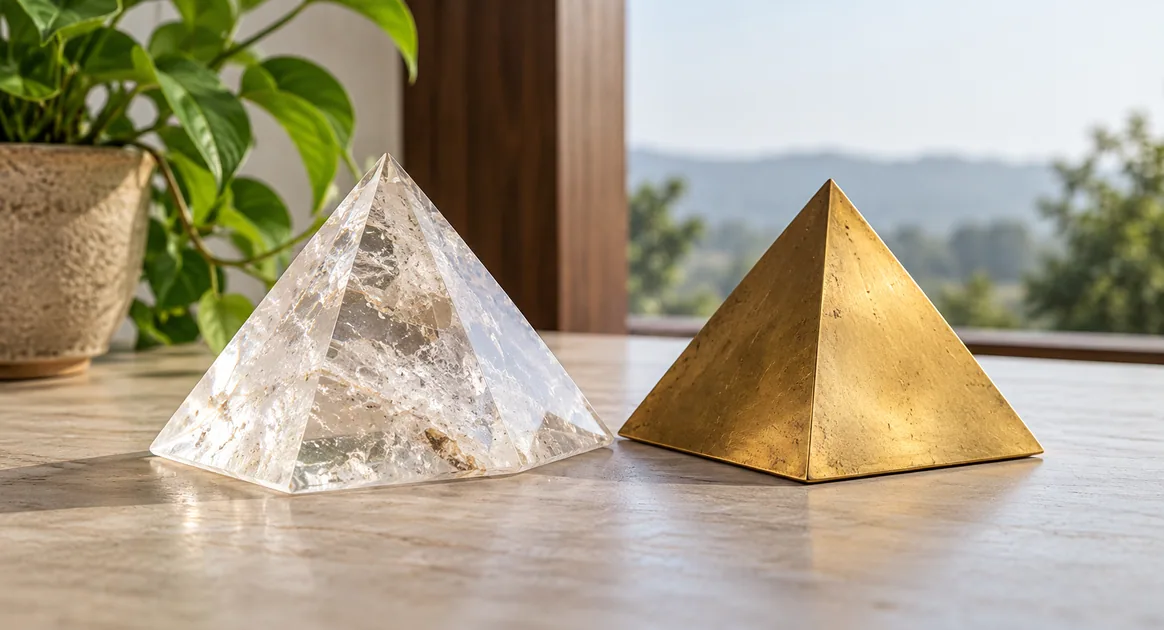
Copper and brass Vastu pyramids are not interchangeable simply because both are metallic and pyramid-shaped. Copper is a reddish metal; brass is an alloy based mainly on copper and zinc, commonly golden-yellow but variable in colour. Both appear in Indian homes, pooja spaces and contemporary Vastu collections. The important buying differences lie in the actual metal, whether the pyramid is made from sheet or cast material, how the corners and seams are joined, whether the surface is plated or lacquered, and whether the design is a hollow pyramid, an open frame or a nine-pyramid plate.
This guide compares copper and brass from three angles: material identity, fabrication and durability, and traditional use and Vastu placement. It also provides an inspection method, clear examples for an apartment, shop and consultation kit, and a worksheet for recording what a supplier actually offers. The aim is to choose a properly described piece that fits the intended space and is easy to maintain.
1. Copper and brass: what are you actually buying?
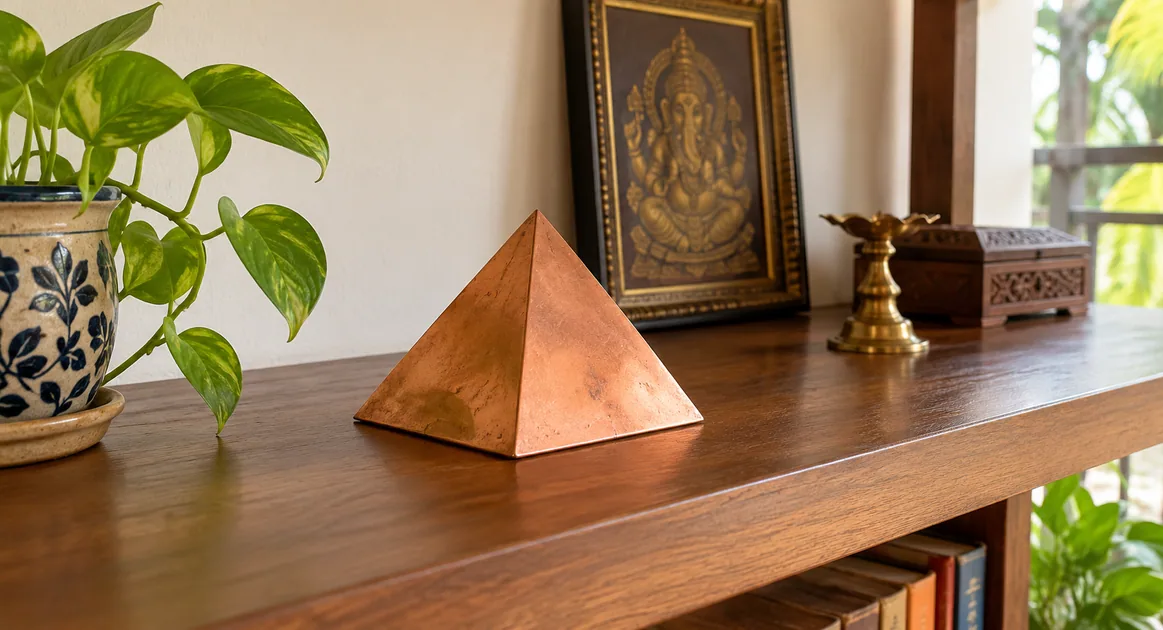
Copper (tamra) is a chemical element, Cu. Fresh, uncoated copper generally has a reddish-orange to reddish-brown appearance. It can develop brown and sometimes darker or greenish surface layers depending on exposure, finishing and time. Commercial copper sheet is often workable enough to form folded shells or open frames, but the finished object's strength still depends on sheet thickness, joint design and workmanship.
Brass is a family of copper-zinc alloys, not one fixed recipe. Alloy ratios vary and other minor elements may be present. Many decorative brasses are yellow or golden, while copper-rich brasses can appear redder. Brass is a legitimate material in its own right; it is not automatically a cheap imitation of copper. When a product is called "pure brass," that usually means the main body is brass rather than a plated substitute, not that brass contains only one chemical element.
Bronze is another broad copper-alloy family traditionally associated with tin; it should not be silently substituted for brass. Gold-coloured metal is a description of appearance, not an identification. An item sold as "copper finish," "copper coated" or "brass tone" may contain a different structural metal beneath its coating. For a product meant to be sold as a named metal pyramid, ask the seller for the base material and whether any plating or clear coating has been applied.
| Comparison | Copper pyramid | Brass pyramid | What the buyer should verify |
|---|---|---|---|
| Basic material | Copper metal, Cu | Copper-zinc alloy, with variable composition | Written material specification, not just colour |
| Common new appearance | Reddish orange or warm brown | Yellow-gold, sometimes reddish or pale | Natural, polished, plated or lacquered finish |
| Typical fabricated forms | Folded sheet shell, frame, small linked pyramids | Folded shell, cast form, plate or layered assembly | Hollow versus solid, sheet thickness and joints |
| Surface ageing | May darken or form a patina | May darken, spot or develop a patina | Whether the patina is intended or removable |
| Cleaning | Depends on coating and intended finish | Depends on coating and intended finish | Seller-approved cleaning for that particular piece |
| Indian ritual context | Tamra vessels and plates are familiar | Brass lamps, vessels and ritual accessories are familiar | Do not equate a modern pyramid with an ancient prescribed yantra |
2. The construction makes a greater difference than colour
A pyramid manufactured from a folded sheet behaves differently from a solid cast pyramid or an open frame. When two items are compared, match their height, base dimensions, construction style and intended location before judging weight or price. A small copper shell and a heavy brass multi-pyramid assembly do not constitute an equal material comparison.
Folded sheet or hollow pyramid
Many simple pyramids start as metal sheets marked, cut and folded along four sloping faces. Corners may be soldered, brazed, welded, crimped, overlapped or mechanically attached. A base may remain open, or a separate base plate may be added. Folded sheet can produce a light yet useful decorative object; thinness alone does not prove poor quality. Instead, inspect the apex alignment, four edges, joint consistency and base stability. A light shell with clean joints can be preferable to an uneven heavy body.
Open-frame pyramid
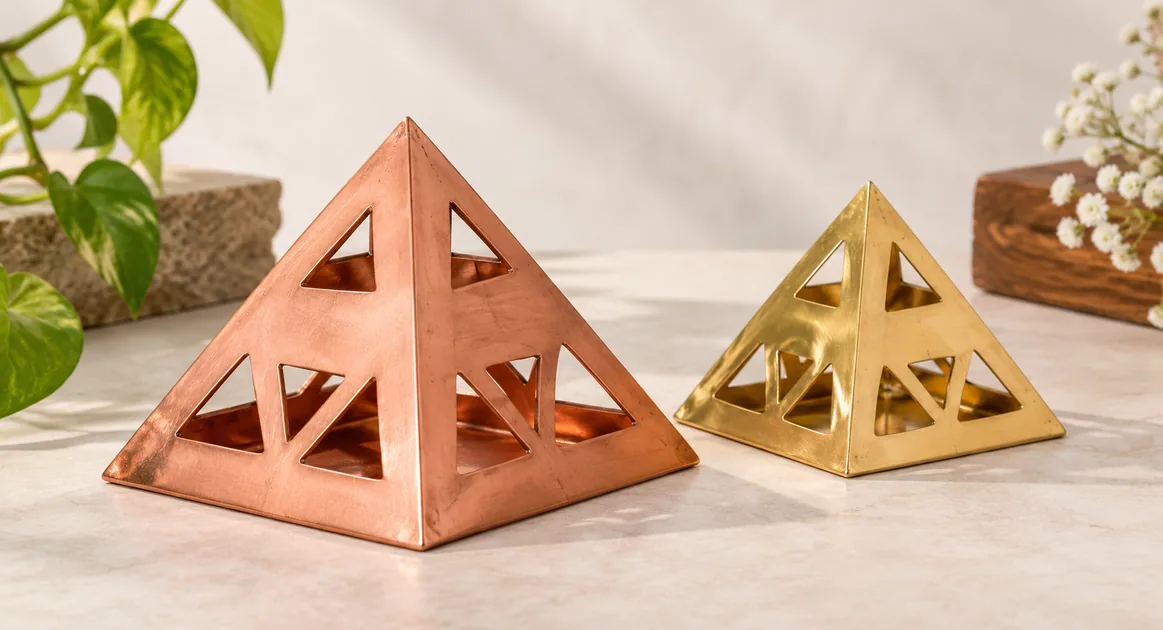
An open frame uses rods, wires or strips to outline the base and rising edges. The empty interior is intentional. The buyer should check whether the material specification describes the entire frame or merely an applied copper-coloured surface. Because frame members are narrow, the areas to inspect are the top joint, the four base corners and any bends caused by packing pressure. A frame should stand squarely without rocking and should not present sharp wire ends.
Nine-pyramid plate
A nine-pyramid plate generally contains nine small pyramid forms on or attached to a flat support. The number is a retail design feature; its precise use depends on the system described by the maker. A vendor should specify whether the small pyramids are stamped from a single sheet, individually attached, hollow underneath or cast with the plate. Check for loose attachments and uneven rows. If the product is promoted as a Navagraha arrangement, confirm how its maker relates the positions to the nine grahas; a numerical resemblance alone does not establish that association.
Layered or stepped assembly
Some brass products use several tiers or stacked plates rather than four continuous triangular faces. These may include spacers, bolts or concealed fasteners. Determine whether the stated dimensions refer to the overall assembly or to one tier. The assembly should be checked for loose elements and the number of layers should match the listing. A layered design is not structurally identical to a single hollow shell, even when both are sold under "Vastu pyramid."
| Design type | Typical structure | Inspection priority | Useful placement |
|---|---|---|---|
| Hollow copper pyramid | Folded or formed sheet with open/closed base | Edge fold, apex, underside, dents | Shelf, dedicated Vastu display, work desk |
| Copper open-frame pyramid | Metal rods/strips forming pyramid outline | Joint firmness, frame squareness, sharp ends | Stable high shelf or protected display |
| Copper nine-pyramid plate | Nine small forms on a flat plate | All nine present, fastening, flatness | Horizontal tray or cabinet shelf |
| Hollow brass pyramid | Folded or formed brass shell | Edge seams, plating/coating, wobble | Pooja cabinet or reception shelf |
| Brass nine-pyramid plate | Small brass pyramids on support plate | Attachment points, surface uniformity | Flat, dry consultation or display surface |
| Brass layered assembly | Several tiers with joined supports | Layer alignment, loose fasteners, balance | Dedicated pedestal or protected display |
3. How to identify the metal without damaging a pyramid
Begin with the label and order description. "Copper pyramid" should tell the buyer whether the body is copper or an alloy. "Brass pyramid" should state brass rather than "gold metal." If a product description uses "copper-plated iron," "brass finish" or "metallic gold," retain that exact distinction in the sales record. A photograph cannot establish alloy composition.
Inspect the object under indirect daylight and compare the top, underside, inside of a hollow shell, seams and visible wear points. If a bright coating covers everything, colour is weak evidence. A magnet may reveal a magnetic steel core when it is strongly attracted, but lack of magnetism does not prove solid copper or brass; nonmagnetic substrates and coatings exist. Do not file, scratch, apply acids, or drill into a finished Vastu object simply to satisfy curiosity: those tests can damage the saleable finish and may give ambiguous results.
For wholesale purchases, ask for a material declaration, a product-specific invoice and, when commercially justified, independent alloy analysis. Handheld XRF screening can help an appropriately qualified specialist characterise an accessible surface, but plating can make a surface reading unrepresentative of the entire object. A genuine material report should be matched to the actual production batch or tested item, rather than a generic sample certificate.
| Observation | Possible interpretation | What it cannot establish |
|---|---|---|
| Reddish-orange colour | Copper, copper-rich alloy or copper-coloured coating | Purity or full-body composition |
| Yellow-gold appearance | Brass, gold-coloured plating or finish | Presence of a particular brass alloy |
| Strong magnetic attraction | Possible iron/steel-containing component | Exact composition of every layer |
| No magnetic attraction | Consistent with some copper-alloy bodies | Proof that the object is copper/brass throughout |
| Low weight | Thin sheet or hollow construction may be present | Automatically low workmanship quality |
| Green/brown patina | Ageing of copper-containing surfaces can be involved | Age, authenticity or devotional effectiveness |
| Visible overlap at a corner | Folded sheet construction | Whether the joint is soldered or only crimped |
4. Fabrication quality: what does a well-made pyramid look like?
A good pyramid can be visually simple. Place it on a genuinely level surface and look straight across the base: all contact points should feel stable. Examine whether the apex sits approximately above the centre, the sloping edges are comparable, and the object can be picked up without flexing dangerously. The external dimensions should be close to those published; variation caused by hand finishing is normal only within what the seller has disclosed.
Pay particular attention to the underside. It often reveals whether a pyramid is a sheet-metal shell, a cast form, a joined set of parts or a decorative plated object. Unfinished sharp edges are undesirable near children, cloth-covered puja shelves or jewellery displays. Solder, rivets and brazed joints are not inherently defects: the issue is whether they are secure, tidy and described accurately. If the item carries etched symbols, check the engraving for legibility and verify that cleaning will not erase painted detail.
Small blemishes need context. Minor handmade marks may be normal on an artisanal copper object; deep dents, peeling plating, a rocking base or loosened corners should not be described as deliberate patina. For plates with nine pyramids, count each component and inspect the four corners of the plate for bending. For layered brass products, hold the item at its designed support points rather than lifting it by the smallest upper tier.
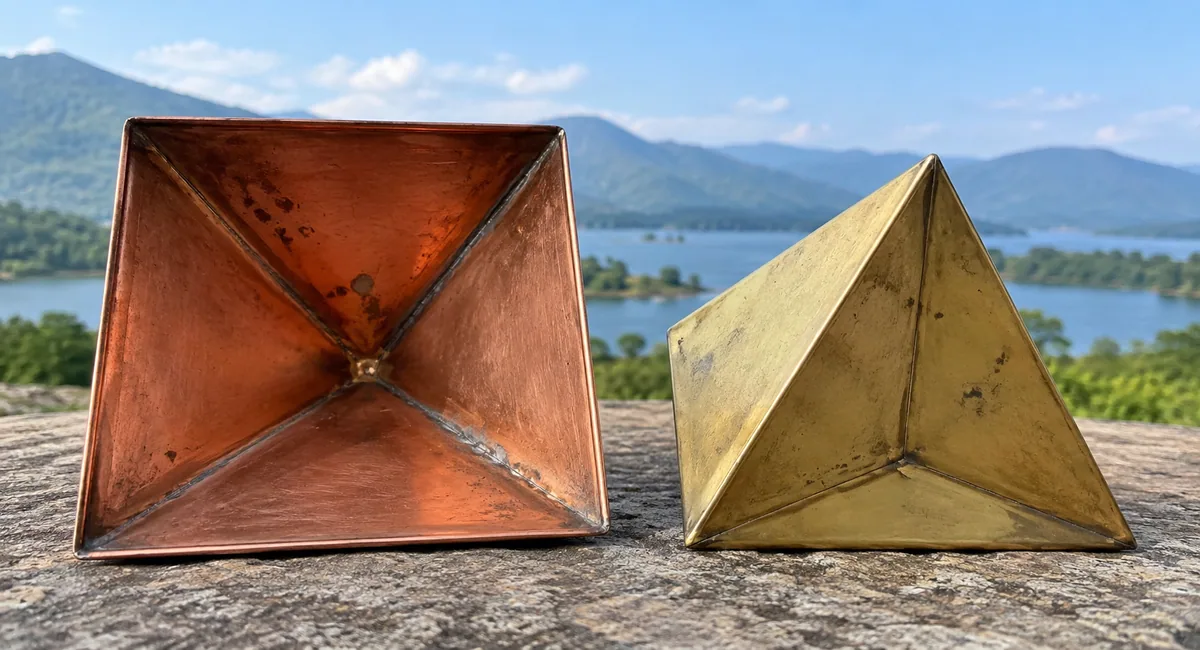
5. What changes over time: patina, tarnish, lacquer and plating
Both copper and brass can change appearance because they react with air, moisture, skin oils and environmental pollutants. New copper may be bright and reddish; a used surface may become deeper brown. Brass can move from bright gold to a subdued brownish yellow. These changes are not necessarily material defects. A coherent stable patina can be an intended surface finish, especially on deliberately aged decorative pieces.
Patina is not the same as dirt. Some items are sold bright-polished and intended to remain shiny. Others are intentionally darkened, waxed or lacquered. A third group is electroplated to create a certain colour. Polishing a coated pyramid can wear through the coating; aggressive polishing of exposed metal can abrade engraved symbols, edges and fine texture. Museum conservation guidance distinguishes routine gentle cleaning from material-removing polishing.
A common mistake is to treat every green mark as an ordinary decorative patina. Firm, stable surface colouring may be acceptable; loose powder, bubbling coating, crusting around joints or fresh damp deposits require closer examination. If green or blue residue transfers to the hand, isolate the item from porous wood, cloth, gemstones and paper until its condition is understood. Avoid contact with salt lamps, rock-salt pyramids and damp plant trays, which create conditions unfavourable for many metal finishes.
Cleaning routine for modern copper and brass display objects
- Identify the finish first: ask whether the metal is bare, waxed, lacquered, plated, chemically patinated or painted.
- Remove loose dust gently: use a clean, soft, dry cloth or suitable soft brush; support the pyramid at its base.
- Inspect joints before applying anything: liquids can become trapped under plates, in hollow shells and around soldered seams.
- Use only a maker-approved method: never assume lemon, salt, vinegar, abrasive metal polish or immersion is suitable for a coated, engraved or assembled piece.
- Dry and store separately: avoid damp cloth bags and direct contact with rough gemstone edges or salt products.
- Record surface changes: a monthly photograph is useful for stock kept in a showroom or professional kit.
For old or historically important objects, preserving the existing surface can be more appropriate than restoring a new shine. For ordinary contemporary uncoated stock, a seller may provide a specific maintenance method, but even then the finish should be tested on the actual product type. Acid mixtures and aggressive commercial polishes should not become a general puja-cleaning ritual for these pyramids.
| Finish type | How it may look | Routine approach | Avoid |
|---|---|---|---|
| Uncoated copper | Warm reddish colour; may darken | Dry dusting; preserve patina or follow documented care | Unnecessary repeated abrasive polishing |
| Uncoated brass | Gold/yellow; may tarnish | Soft dry cleaning; keep fingerprints under control | Unknown acid or ammonia cleaners |
| Lacquered metal | Gloss retained; sometimes clear film | Gentle dusting in line with seller's instructions | Solvents or metal polish that affect lacquer |
| Electroplated finish | Uniform applied metallic colour | Minimal friction and careful dry handling | Abrasive polishing that exposes the substrate |
| Antiqued/patinated | Deliberate brown, dark or green highlights | Retain intended colour and finish | Trying to polish back to mirror shine |
| Layered assembly | Multiple joints and hidden gaps | Dry brush corners; check fasteners periodically | Immersion, trapped moisture, lifting by upper tier |
6. Copper, brass and Indian spiritual tradition
In Indian ritual language, tamra refers to copper. Copper vessels, plates and ritual implements have long-standing associations with worship and offerings in many households and temple customs. Brass is also familiar in deepa (lamps), bells, vessels and decorative devotional articles. Regional, family and sampradaya practices differ; a brass lamp's ritual purpose cannot automatically be transferred to every brass pyramid-shaped item. The object, its use and its traditional context should be described separately.
Pancha Mahabhuta—Prithvi (earth), Jala (water), Agni (fire), Vayu (air) and Akasha (space)—offers a traditional language for thinking about material, light, space and use. Metal objects may be discussed with reference to dhatu (metal) and traditional ritual symbolism. Modern Vastu consultants sometimes assign specific uses to copper or brass pyramids; those assignments belong to the method being followed. They are not equivalent to a universal ancient rule that a particular brass composition must be kept in a particular direction.
Yantra and pyramid are different categories. A Sri Yantra, Navagraha Yantra or another formally specified sacred diagram has its own geometry, inscriptions and ritual context. A hollow copper pyramid with no engraved diagram is a pyramid-shaped article; it should not be described as a ritually installed Yantra without the relevant design and practice. Likewise, panchaloha or panchadhatu refers to particular five-metal traditions whose composition can vary; an ordinary copper-zinc brass item does not become a five-metal object merely because it is used in puja.
Vastu directions and a measured way to choose a location
Traditional Vastu uses directional concepts such as Ishanya (north-east), Agneya (south-east), Nairritya (south-west) and Vayavya (north-west). A family may prefer to display a sacred item in a clean north-east prayer area or position an ornament on a work desk based on its decor and intended use. In consultant-led modern pyramid arrangements, direction may be more specific. Record which school or method supplies that placement instead of claiming the same direction suits every household, material and purpose.
For a simple display, a safe level surface, access for cleaning, and an uncluttered devotional environment are useful first checks. Keep pyramids clear of open flames, wet flower vessels, salt residue and unstable edges. Metal conducting heat is a physical fact, but electrical or thermal conductivity alone does not demonstrate a spiritual effect. The traditional use of copper in a kalasha or puja plate is a separate, culturally meaningful reason someone may prefer the metal.
| Intended use | Copper option | Brass option | Decision point |
|---|---|---|---|
| Prayer shelf | Simple tamra-coloured hollow pyramid | Golden brass pyramid near other brass ritual objects | Family custom, finish and space available |
| Contemporary Vastu display | Open frame or plate where specified | Layered or nine-pyramid plate where specified | Consultant's design and verified dimensions |
| Office desk | Low-profile shell with soft edges | Compact brass shell with stable base | Footprint, handling and cleaning frequency |
| Professional demonstration | Copper shell, frame and plate samples | Matched brass shell and plate samples | Explain construction differences visibly |
| Jewellery showroom | Warm red-brown contrast to polished stones | Golden highlight beside gemstone products | Lighting, fingerprint resistance and finish |
7. Worked example: choosing for a Bengaluru family apartment
Consider a family arranging a compact puja shelf in an apartment. They are comparing a 7 cm hollow copper pyramid with a similarly sized hollow brass pyramid. Their current worship accessories are mainly brass, the cabinet is dark teak-coloured, and the shelf is regularly cleaned. There is no need to assume one metal creates a stronger result. The family can compare colour, surface finish, size and whether the maker's cleaning method fits their routine.
Step one: identify both metal bodies and confirm whether the items are lacquered. Step two: place the items on a level tray to compare visibility and stability. Step three: check whether lamp heat or water from offerings could reach them; move the display if necessary. Step four: photograph the selected arrangement so it can be returned to the same position after cleaning. The outcome might be brass for visual continuity or copper because the family prefers tamra in its prayer setting. Both are coherent choices when documented accurately.
8. Worked example: jewellery showroom reception
A Bengaluru jewellery showroom wants two decorative Vastu pyramids on a customer-facing counter. The counter receives bright overhead lighting and constant handling. A mirror-polished brass pyramid may match gold-tone display fixtures; a softly patinated copper shell may provide warm contrast to gemstone beads. Before selecting, the store compares coated versus uncoated options, checks whether fingerprints will show in the lighting, and measures the exact base so the pieces cannot be easily knocked over.
The showroom records a sample card for each piece: "Body: brass, folded sheet; finish: clear lacquer; base: 8 × 8 cm; underside: open; cleaning: soft dry cloth" or "Body: copper sheet; finish: uncoated warm brown; base: 8 × 8 cm; seams: soldered." These are illustrative specification formats, not claims about any existing product. Customers can then see the real reason for a difference in price. Stock should not be exposed to damp flower trays or repeated abrasive wipe-downs.
9. Worked example: professional Vastu consultation and teaching kit
A consultant wants to demonstrate why "metal pyramid" is not one product. Build a six-part display with one hollow copper shell, one copper open frame, one copper nine-pyramid plate, one hollow brass shell, one brass nine-pyramid plate and one brass layered assembly. Mark each sample with its verified metal, body construction, base dimensions and finish. Lay the pieces on individual felt-lined recesses rather than stacking them.
At a consultation, first compare the two hollow shells, because they are the nearest like-for-like material pair. Next show how an open frame differs from a plate. Finally use a labelled compass diagram to discuss the direction and functional purpose of a proposed display. If a recommendation refers to a Yantra or Navagraha practice, introduce the actual prescribed design separately instead of treating any group of nine decorative pyramids as automatically consecrated or identical to a sacred diagram.
| Sample ID | Object to demonstrate | Primary learning point | Record before use |
|---|---|---|---|
| C1 | Copper hollow shell | Sheet folds, apex, underside | Body specification and wall thickness if supplied |
| C2 | Copper open frame | Corner joints and empty interior | Frame dimensions and joint method |
| C3 | Copper nine-pyramid plate | Array construction, flatness | All nine pieces, plate dimensions |
| B1 | Brass hollow shell | Like-for-like metal comparison with C1 | Alloy description and coating |
| B2 | Brass nine-pyramid plate | Array comparison with C3 | Fasteners and finish |
| B3 | Brass layered assembly | Multi-part construction and stability | Tier count and overall dimensions |
10. An actual purchase checklist: 15 questions to ask
- Is the structural body copper, brass or another metal with a coloured finish?
- For brass, is an alloy description available? For copper, is the material described as copper rather than "copper tone"?
- Is the piece hollow, cast, folded, an open frame, a plate or a layered assembly?
- What are its base width, height, weight and expected measurement tolerance?
- Is the underside open, capped or filled?
- What method joins the edges, base, tiers or nine miniature pyramids?
- Are the corners smooth and is the apex free from deformation?
- Is the finish bare, polished, lacquered, waxed, plated, antiqued or painted?
- Will polishing remove an intended patina or coating?
- Are etched symbols genuinely engraved, printed or applied as a sticker?
- Does the item stand steadily on a flat surface?
- Are product photographs of the specific construction being sold?
- Does the listing explain which Vastu method or design its placement instructions follow?
- How should the seller's finish be cleaned and stored during a humid season?
- If pieces arrive bent, chipped or detached, what is the replacement process?
11. Frequent questions about copper and brass Vastu pyramids
Is brass a lesser or false version of copper?
No. Brass is a copper-based alloy and has its own appearance and fabrication characteristics. It becomes a misdescription only when a brass product is sold as pure copper or an unrelated plated item is sold as solid brass. Traditional use also differs by object and local practice; a brass pooja lamp is not less legitimate because it is not tamra.
Which is better for Vastu: copper or brass?
There is no universally applicable metal ranking for every Vastu pyramid. Choose according to the specific traditional or consultant-led method, verified product material, construction, available location and maintenance needs. For family devotional use, customary preference and the role of the object often guide the choice.
Does a heavier metal pyramid have more Vastu power?
Weight indicates some combination of size, material, wall thickness and construction. A cast solid object will weigh more than a hollow shell of similar dimensions. Weight alone does not establish better alignment, workmanship or a different spiritual outcome. It is most useful as a specification for packing and shelf load.
Will copper turn green and brass turn black?
Both copper and brass can undergo colour changes; the actual appearance depends on the alloy, moisture, pollutants, coating and handling. A green film does not by itself identify the alloy, and many pieces remain brown or gold-coloured for long periods. Dry storage and appropriate cleaning help maintain their intended appearance.
Can I use lemon, salt or acidic cleaners during spiritual cleaning?
Keep ritual practice and material maintenance separate. Salt or acids can damage some metal finishes and joints, and liquids may remain trapped in a hollow shell. A clean dry cloth is a better starting point for an unfamiliar finish; use any additional method only when the maker has confirmed it is suitable for that exact object.
Do nine small pyramids automatically represent the Navagraha?
Not automatically. Navagraha is a specific traditional planetary framework with named grahas and established iconographic and ritual conventions. A decorative nine-pyramid plate may be associated with it by a particular modern design method; ask how the correspondence is specified. Do not relabel a generic plate as a Navagraha Yantra.
Should a copper pyramid point in a special compass direction?
A manufacturer's or consultant's system may prescribe a direction for a particular pyramid form. General traditional direction names do not create one universal instruction for all items. In an ordinary puja or decorative display, place the item safely and consistently, and respect the household's established ritual arrangement.
12. Final comparison: match material, form and practice
Choose copper when a clearly identified tamra article, its warm reddish finish or a specified copper-frame/plate design fits your intended practice. Choose brass when a gold-coloured metal finish, a brass ritual-object context or the required layered construction is a better match. For a professional Vastu toolkit, keeping one properly labelled example of each material and each major form is more educational than buying many superficially similar pyramids without clear specifications.
The strongest buying decision is not simply "red metal versus yellow metal." It is a verified metal, an accurately described fabrication method, a stable finish, a documented place in the intended Vastu practice and an object that can be handled and maintained for years.
Explore existing OmmRudraksha collections
Browse Vastu for the existing collection, or explore gemstone products for other material forms. Each product’s construction and care information should guide your choice.