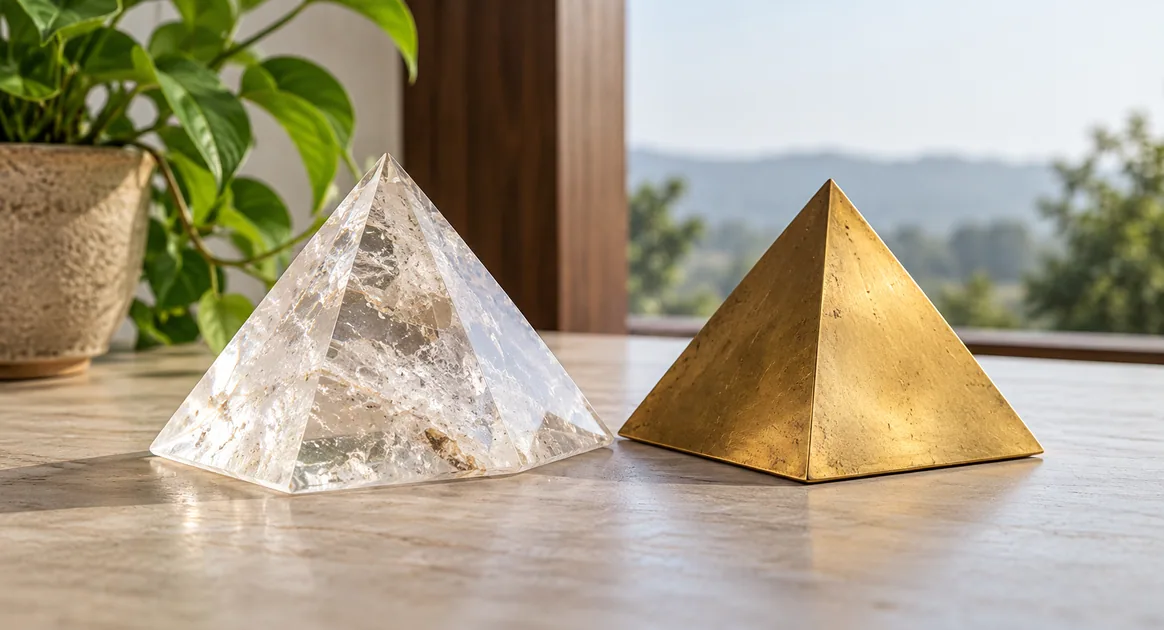
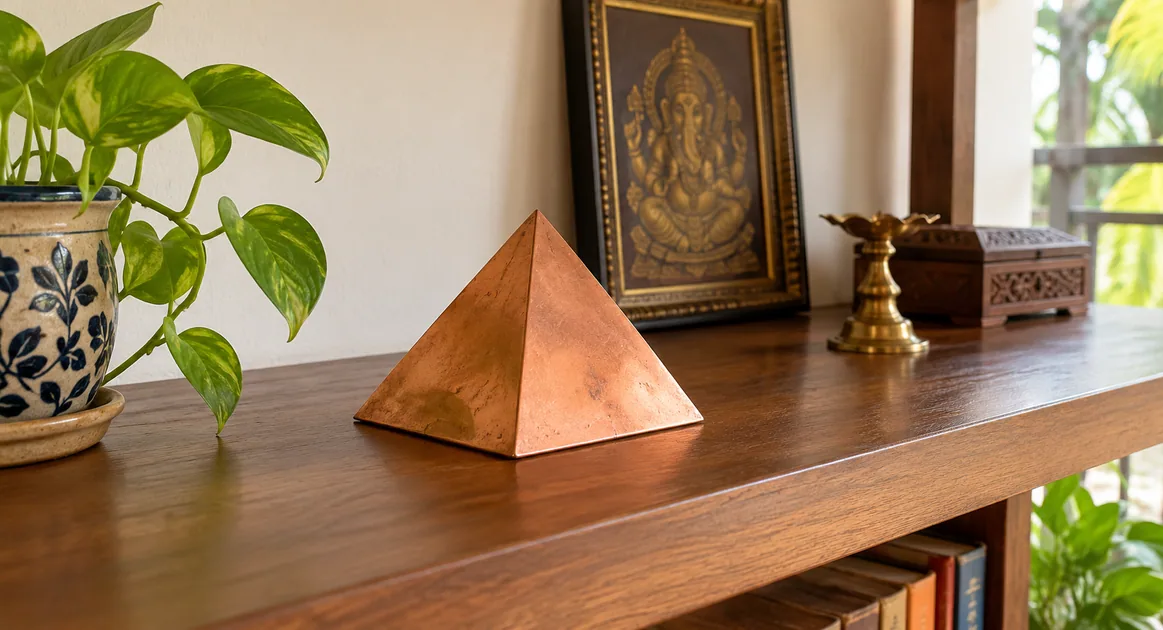
Copper Vastu pyramids are sold in several constructions, and their shape alone does not tell you what is inside. A folded copper-sheet pyramid has four continuous faces and usually a hollow underside. An open-frame pyramid is made from rods or wire joined along its edges; it has no sheet faces. A copper nine-pyramid plate consists of nine small pyramid forms on a supporting base. All three may be described as “copper pyramids,” yet the quantity of copper, workmanship, physical size, display method, maintenance and suitability for a particular space differ substantially.
In Indian devotional and Vastu settings, copper is known as tamra and is familiar in kalasha, ritual vessels, plates and other puja objects. Contemporary Vastu pyramid collections draw on that long association while offering new forms of geometric display. The useful buying question is not simply “Which pyramid has the strongest colour?” but “What is its actual metal, how is it constructed, how many separate pieces are supplied, and where will it be placed?” This guide connects those choices to fabrication details and to the symbolic significance of direction, centre, intention and order in Vastu practice.
Three main types of copper Vastu pyramids
The word pyramid describes a geometric form, not a manufacturing method. A physical description makes it easier to compare products, identify missing components and understand whether two listings represent variants or genuinely different designs.
| Type | What the buyer receives | Most useful inspection | Typical use |
|---|---|---|---|
| Folded sheet / hollow shell | Sheet-metal faces folded and joined, normally open or partially enclosed underneath | Underside, sheet thickness, seams, base flatness | A single focused display on a shelf or tray |
| Open-frame pyramid | Rod, tube or wire edges forming the outline; centre and faces remain open | Corner joints, frame stiffness, rod diameter, symmetry | Light, visually unobtrusive geometric display |
| Nine-pyramid plate | One plate bearing a three-by-three arrangement of nine small pyramids | Count, spacing, whether pieces are fixed, mounting strength | A structured grid or demonstration display |
| Other composite construction | Several layers, mixed metals or a copper-coloured outer skin | Complete material and component breakdown | Specialist designs, only when their construction is clear |
A nine-pyramid plate is not automatically nine individual pyramids that can be moved separately. A fixed sheet with nine raised forms is one assembled article; a kit of nine loose pyramids is nine movable articles. Check this distinction before planning a directional Vastu layout, calculating a unit price or assigning an inventory code.
Why copper, or tamra, matters in Indian practice
Copper has a recognised place in Indian household ritual. Tamra patra refers to copper vessels or plates, while the kalasha appears in many forms of puja and auspicious installation. Indian copper craftsmanship also includes worked sheets, repoussé, engraved surfaces, trays and ornamental fittings. These historical and living traditions explain why a warm reddish metal is a natural material for a sacred or meditative setting.
A contemporary copper Vastu pyramid, however, is not identical to a traditional kalasha, a consecrated yantra, a temple shikhara or a Vastu Purusha Mandala drawing. Each has a different form and ritual context. The pyramid may serve as a visible reminder of Sankalpa (intention), ordered geometry and a carefully arranged place; its use does not require treating every modern product feature as a rule found in ancient texts.
In Vastu Shastra, the dwelling is studied through direction, proportion, orientation, circulation and the allocation of activities. The Vastu Purusha Mandala organises space into a symbolic grid; the Ashta Dikpalas relate to the eight directions. Metal items can be selected as part of a broader design, but they do not replace attention to the entrance, ventilation, daylight, usability and the actual room plan. Householders and consultants can present a copper pyramid as a meaningful supporting object while still treating the house as a complete spatial system.
What about copper and the Navagraha?
Different regional and practitioner traditions associate metals with grahas in different ways. Copper may appear in discussions concerning Surya or Mangal, but an ordinary unmarked copper pyramid should not be sold as a specifically consecrated Surya yantra, Mangala yantra or Navagraha instrument. For graha-specific use, verify the practitioner’s selected tradition, the exact inscription or yantra, the intended place and the separate ritual process. Material, sacred symbol and astrological recommendation are related questions, not interchangeable labels.
Folded copper-sheet pyramids: understanding the construction
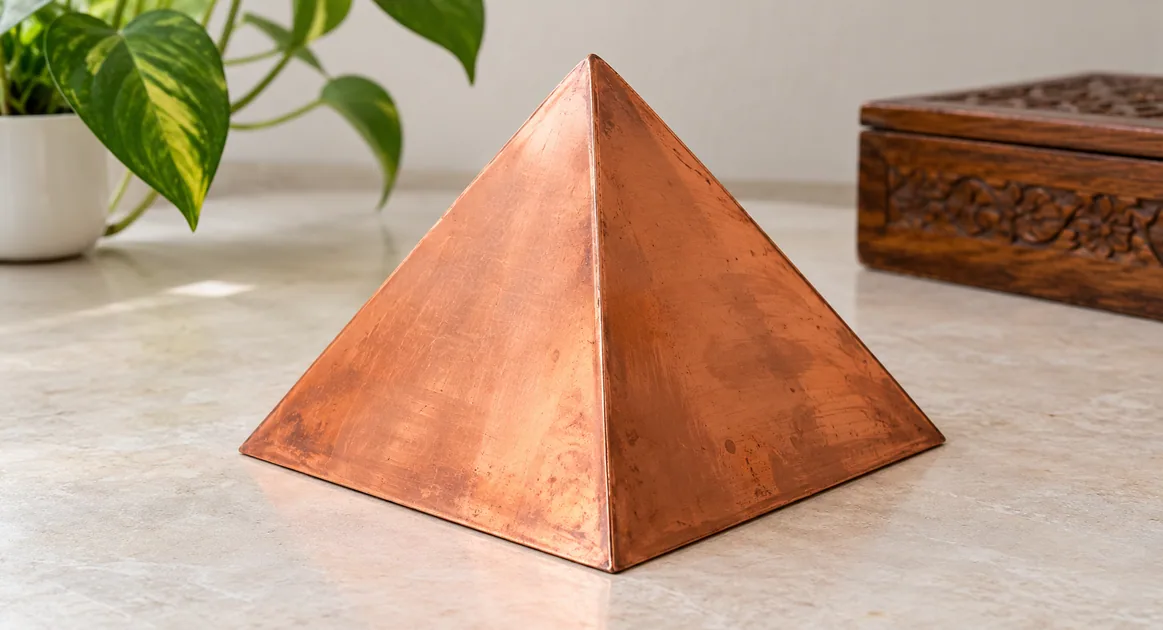
A sheet-metal pyramid begins with flat stock that is cut, folded, bent and assembled. The side faces may meet at soldered, brazed, welded, crimped or mechanically folded seams. Some models have a closed bottom; others show an open square underneath. Because sheet copper is relatively workable, a well-made shell can have crisp edges and a clean silhouette without the weight of a solid metal casting.
The first evaluation is whether the shell stands squarely and whether the four faces meet cleanly at the apex. A poorly formed pyramid may have a twisted top, mismatched slopes or an uneven square footprint. These are more useful observations than judging quality by the depth of the red colour in a photograph.
Six checks for a hollow copper pyramid
- Material disclosure: ask whether the main body is copper sheet, a copper alloy, copper plating over another metal, or copper-coloured finish.
- Sheet thickness: request a thickness in millimetres and confirmation of whether it is measured before coating. Thickness influences stiffness but not the claimed spiritual value.
- Four-face alignment: sight along the edges and compare the symmetry of opposing triangular faces.
- Apex and seam quality: look for clean joining, excessive solder blobs, gaps or a fragile peak that catches on fabric.
- Underside finish: inspect exposed cut edges and confirm whether an open bottom is the intended design, not a missing part.
- Base stability: place it on a flat, level surface. A shell that rocks can scratch a shrine shelf or sit poorly beside other objects.
Minor handmade variation does not necessarily indicate a defective piece. The important distinction is between natural craft variation and construction defects: sharp edges, weak seams, an unstable base and inaccurate product descriptions require attention.
Open-frame copper pyramids: what makes them different?
An open-frame copper pyramid shows only the edge lines of the shape. The frame may use solid copper rod, copper tube, wire or a copper-finished material. Unlike a folded shell, it has no four continuous faces and may allow light and sightlines to pass through the centre. A framed form suits a minimal display where the geometry, rather than the surface colour, is the main visual element.
Frame construction raises a different set of questions. A rigid four-sided base requires dependable corners; the upper arms must meet securely at the apex. Wire that bends easily may be acceptable for a small craft model but unsuitable for repeated transport in a professional kit. Tubes and solid rods of similar diameter can feel different in weight. Copper-coloured joints can hide another joining metal, so the maker should describe the frame and its connections separately.
| Feature | Sheet shell | Open frame | Why it matters |
|---|---|---|---|
| Visible surfaces | Four solid triangular faces | Only edges and joints | Changes appearance and cleaning access |
| Weight | Depends on sheet thickness and base | Depends on rod diameter and whether solid/tubular | Cannot infer purity from lightness |
| Most vulnerable part | Folded seams, sharp base rim | Apex and corner joins | Guides inspection and packing |
| Cleaning | Wipe faces and underside | Dust joints and rods gently | Residue can collect in corners |
| Visual effect | Reflective copper planes | Transparent geometric outline | Choose for the setting and intention |
A simple frame-inspection demonstration
Set the frame on a level table and view it from the front, side and directly above. All four base corners should contact the table without a wobble; the peak should appear above the centre of the base; the arms should be consistently attached. Lift the frame by its base rather than its apex. If it flexes or a joint moves under ordinary handling, ask the seller whether that degree of flexibility is intended.
Nine-pyramid copper plates: reading a three-by-three arrangement
A copper nine-pyramid plate commonly presents nine repeated forms in three rows and three columns. Its visual grammar resembles a compact grid, and a practitioner may use that order for a contemporary Vastu arrangement. Yet a nine-pyramid plate and the traditional Navagraha Mandala are not automatically the same. A true Navagraha-specific representation should indicate which graha occupies which position and what tradition the arrangement follows; nine anonymous raised pyramids only establish a count.
Some plates use separately made pyramids fixed to a base. Others are pressed or formed so that the raised shapes and supporting sheet are continuous. The two constructions should not be confused. A plate with one damaged raised form may need a different repair from a set of nine loose pyramids. Always ask for an underside photograph: it often reveals mounting posts, folded edges, adhesives or the continuity of the metal sheet.
| Nine-plate question | What to verify | Decision it affects |
|---|---|---|
| Fixed or movable? | Nine raised forms attached to one base, or nine removable pieces | Whether directional rearrangement is possible |
| Same metal throughout? | Copper plate, copper pyramids and joining material described separately | Material accuracy and care |
| Symmetry? | Three rows and three columns, consistent spacing and upright peaks | Display quality |
| Surface detail? | Any engraving or number labels; whether motifs have defined meaning | Appropriate traditional interpretation |
| Base thickness? | Flatness, support, and protected edges | Stability and safe handling |
| Complete shipment? | Base, protective supports, loose parts and instruction card, if advertised | Receiving checklist |
Do not infer that a nine-pyramid plate can be separated or that the nine forms correspond to the nine grahas unless the specific product documentation says so. The attractive three-by-three layout can still be meaningful as a representation of order and harmony without assigning unverified deity or planetary names.

How to read dimensions, sheet thickness and pyramid angle
Product photos alone rarely reveal scale. A palm-sized pyramid and a broad desktop plate can appear identical when photographed against a plain background. For a single square-based pyramid, request base width, vertical height, approximate mass and construction thickness. For a nine-pyramid plate, also request the total outside length and width, plate thickness, individual pyramid dimensions, and the spacing of the raised forms.
In a symmetrical right square pyramid, the centre of the apex lies above the centre of the square base. A pyramid with a base 100 mm wide and a vertical height of 70 mm has a side-face inclination of approximately 54.5° to the base plane, calculated from the 70 mm rise and 50 mm half-base. This is a geometry example, not a universal prescribed Vastu angle. A different base-to-height ratio produces a different slope; an open frame and a folded shell may use the same dimensions but be completely different products.
| Specification | What it describes | Useful seller wording |
|---|---|---|
| Base width × depth | Space occupied on the shelf or tray | “Square base, 100 × 100 mm” |
| Vertical height | Distance from base plane to apex | “70 mm overall vertical height” |
| Sheet or rod size | Structural material dimension | “Copper sheet thickness … mm” or “rod diameter … mm” |
| Mass | Actual assembled product weight | “Measured net weight … g” |
| Interior / underside | Hollow, closed, framed or plate-backed construction | “Open-bottom folded shell” |
| Surface finish | Uncoated, lacquered, polished or intentionally patinated | “Clear-coated polished copper” |
| Count and assembly | Number of movable pieces versus attached raised forms | “One plate carrying nine fixed pyramids” |
If a product advertises a specific “sacred angle,” request the exact angle definition and a measurement for that product: side-face inclination, edge inclination and apex angle are not interchangeable. Precision in geometry and construction description builds confidence without imposing a single geometry on all Vastu traditions.
Copper, copper alloys, plating and surface colour
Clean copper usually appears reddish-orange, but surface colour changes as the metal interacts with air, skin oils and other substances. Brass has more yellow tones because it is primarily a copper-zinc alloy. Copper plating can give another metal a copper-coloured outer layer. Paint or a coloured clear finish can also imitate copper. Red colour alone is not proof of a solid-copper body.
Questions that help distinguish these products include the material used for the faces, the base and any fittings; whether a plating or lacquer layer is present; whether an alloy grade or supplier declaration is available; and whether an underside photograph shows the same substrate as the visible faces. A magnet can sometimes reveal a ferrous core, but a non-magnetic response is not conclusive proof of copper because several other metals and alloys are also non-magnetic. For an important material claim, rely on reliable supplier documentation or appropriate non-destructive testing rather than a household trick.
The distinction between uncoated copper and clear-coated copper is important for cleaning. A lacquer may preserve shine but can scratch or peel; an intentionally oxidised surface may be an aesthetic finish, not a defect. The right care method depends on the actual construction and finish.
Workmanship checklist: seams, joints, edges and stability
A consistent inspection sequence helps whether you are buying a single Vastu pyramid for the prayer room or sourcing dozens for a showroom. Start with clean photographs from the top, side and underside. On arrival, use a dry soft cloth underneath the object to protect the work surface while checking it.
- Confirm the SKU, promised construction and number of supplied pieces against the order.
- Check that the pyramid or plate stands on a level surface without rocking.
- Inspect the apex and all four corners for impact dents, sharp burrs or loose metal.
- Inspect the seams on a hollow shell; an open frame should have secure, visually consistent joints.
- For a nine-pyramid plate, count nine raised forms and check that none is detached, flattened or misaligned.
- Look for unintended scratches, surface blisters or patches where a copper-coloured coating exposes a different substrate.
- Check whether engraving, if present, is legible, centred and aligned as pictured.
- Record actual base, height and weight. Photograph any discrepancy before placing or displaying the item.
Do not bend a frame or press a thin copper apex to “test strength.” A normal non-destructive inspection is sufficient. For regular trade purchasing, specify tolerances and acceptable handmade variations in advance so that the supplier and buyer are applying the same standard.
Vastu directions and placement: from symbolism to a usable arrangement
Traditional Vastu describes directions in relation to the dwelling and its activities. The eight directional guardians are commonly presented as Indra in the east, Agni in the southeast, Yama in the south, Nirrti in the southwest, Varuna in the west, Vayu in the northwest, Kubera in the north and Ishana in the northeast; practices and interpretive associations vary. A copper pyramid is a modern display object selected within that wider setting, not a substitute for a carefully considered floor plan.
The practical first step is to establish the orientation of the building or room, identify the intended location and decide whether the piece will be touched or moved. The following examples are display possibilities, not universal prescriptions to place copper in every listed direction.
| Zone or setting | Relevant traditional idea | Possible copper form | Practical placement check |
|---|---|---|---|
| Northeast / Ishanya | Purity, reflection, sacred orientation | One modest hollow shell on a separate shelf | Keep space clean and do not crowd actual puja objects |
| Southeast / Agneya | Agni, fire, purposeful activity | A copper form as part of a deliberate scheme | Keep away from cooking heat, flames and steam |
| North / Kubera direction | Order, planning and wealth-related symbolism | Open frame beside a study or accounts area | Do not obstruct working space, cabinets or access |
| Home office or consultation table | Sankalpa and disciplined attention | Small shell or nine-pyramid plate | Use a stable tray, away from drink spills and cables |
| Prayer room or meditation area | Respectful geometric focus | Single copper pyramid | Protect cloth, images and delicate wooden surfaces |
| Retail Vastu display | Teaching material and clear category identity | Three different constructions side by side | Label materials and construction accurately |
A genuine room-specific Vastu recommendation may take other factors into account, including how the zone is used, available surfaces and the household’s practice. A small object placed carefully can be more meaningful and aesthetically successful than a large collection that blocks light or creates clutter.
Three complete examples: choosing the right copper pyramid
Example 1 — One copper shell in a Bengaluru apartment
A family wants a compact copper pyramid near its pooja area. The shelf has an available space of about 15 cm and already holds a lamp and framed images. A small, stable copper folded shell is more practical than a broad nine-pyramid plate, provided the metal and underside are clearly described. The family can place it on a dry protective mat, leave space around the existing objects and handle it by its base when dusting. If the lamp is used, keep the metal ornament safely away from flame and hot oil.
Example 2 — Open frame for a professional consultation desk
A practitioner wants a light geometric demonstration piece for showing the difference between a pyramid’s edge structure and a continuous copper face. An open-frame copper model makes the lines and base-to-apex proportions easy to see. The kit should record its rod diameter, base and height, the joints and the packed dimensions. During a house visit, the practitioner can place it on a level surface, rotate it to explain orientation, and return it to a fitted compartment without bending the apex.
Example 3 — Nine-pyramid copper plate for a showroom display
A jewellery and Vastu showroom wants to compare a single hollow pyramid, an open frame and a nine-pyramid plate. A three-part counter display can list each item’s true construction, actual count, metal description and care instructions. The nine-pyramid plate should be labelled as one plate with nine fixed raised forms if that is what the customer receives. This presentation teaches customers why a nine-pyramid plate is not the same as a nine-piece movable kit and prevents the expectation that every raised form can be lifted out.
A ready-to-use copper pyramid comparison kit
For an OmmRudraksha demonstration or staff training kit, consider one representative model of each of the three core constructions. The kit is educational: the purpose is to compare physical forms while explaining their traditional setting. It need not be sold as a prescribed planetary or remedial set.
| Component | Count in kit | What it demonstrates | Label text |
|---|---|---|---|
| Copper folded hollow pyramid | 1 | Continuous faces, folds, seam and underside | “Folded copper sheet; hollow form” |
| Copper open-frame pyramid | 1 | Edge geometry, rod joints and empty faces | “Open copper frame; joints visible” |
| Copper nine-pyramid plate | 1 plate, 9 raised forms | Repeated three-by-three pattern and fixed assembly | “One plate; nine attached pyramids” |
| Construction and care reference card | 1 | Material verification, dimensions, finish and maintenance | “Compare before selecting” |
Count clarification: this demonstration kit contains three primary display objects, not eleven independent pyramids. One of the three objects incorporates nine raised forms. Write the inventory that way so sales, packing and replacement records stay accurate. For an educational session, photograph the front and underside of each object and show the differences to the customer.
Patina, fingerprints and safe care for copper pyramids
Uncoated copper can darken from bright reddish orange to brown through normal surface reactions. An even, adherent patina can be part of the intended appearance. Moisture, salts, acids, ammonia and certain atmospheric pollutants can accelerate undesirable corrosion. Distinguish a stable finish from powdery or spreading deposits, especially near seams and recessed joints.
For a lightly dusty item, use a clean soft dry cloth or a soft brush around joints and engraved areas. Handle polished pieces with clean dry hands or gloves, because skin oils and salts can mark copper. Do not use lemon, vinegar, salt paste, abrasive powder, harsh metal polish or immersion on an unknown finished object. Household “shine instantly” remedies may strip a protective coating, remove a deliberate patina or leave residues in hard-to-clean joins.
If the piece is lacquered, preserve the coating by following the seller’s finish-specific instructions. If it is deliberately patinated, repeated polishing can remove the appearance you purchased. For long-term storage, choose a clean dry box, soft separation and a stable indoor environment. The Canadian Conservation Institute recommends controlled conditions for stable metal collections, generally around 35–55% relative humidity where practical; that is preservation guidance, not a spiritual placement rule.
| Observation | Likely significance | Sensible next action |
|---|---|---|
| Uniform reddish-brown darkening | Often ordinary copper patina | Dry-dust; preserve finish if desired |
| Fingerprints on a polished face | Contact oils and salts | Wipe gently with clean soft cloth |
| Patchy coating or flaking lacquer | Surface finish may be failing | Avoid aggressive polish; seek maker guidance |
| Powdery green or blue deposits | Possible active corrosion or residues | Separate from other items; seek appropriate care advice |
| Loose corner or seam | Construction issue | Stop repeated handling; contact seller |
| Moist packing or condensation | Risk of staining and corrosion | Unpack promptly and assess in a dry space |
Transport, receiving and long-term storage
Pack a folded copper shell so it cannot be crushed or pierced by another object; protect the sharp rim and keep weight off the apex. An open frame needs a rigid protective cavity that prevents bending at its corner joints. A nine-pyramid plate needs a flat protective base and enough clearance above the nine tips. Do not place loose stones or metal ornaments directly against a polished copper face.
At receiving, match each SKU to its count, photograph both sides, check joins and dimensions, then confirm that the packed item matches the advertised construction. Store the piece separately from salts, acids and damp cleaning supplies. A product card should record whether it is copper sheet, copper rod/frame, copper-plated metal or another material, plus finish and care method. This description is especially useful for online retail because a small image rarely shows the underside.
Frequently asked questions
Is a hollow copper pyramid less authentic than a solid one?
No. A folded hollow shell is a legitimate sheet-metal construction when accurately described. Its lower mass reflects the chosen form, not necessarily poor workmanship. Inspect the metal, thickness, finish and joins instead of treating weight as a direct authenticity test.
Does reddish colour prove it is pure copper?
No. Copper plating, copper-containing alloys and coloured finishes can look similar. Request a trustworthy material description. A magnet test by itself cannot establish copper purity.
Can a copper open-frame pyramid replace a sheet-metal pyramid?
It can be selected as an alternative display form, especially if you want visible geometry and a light appearance. It does not have the same continuous copper faces, so compare the intended aesthetic, construction and handling rather than claiming the two objects are physically identical.
Is a nine-pyramid plate the same as nine loose pyramids?
No. The former may be one fixed assembly with nine raised shapes; the latter offers nine separate movable pieces. Check the underside and the seller’s component list before planning a movable grid.
Does every nine-pyramid plate represent the Navagraha?
Not by count alone. A Navagraha-specific piece should state its planetary layout and traditional references. An unmarked three-by-three group can be used as an orderly decorative or Vastu-inspired arrangement without assigning planetary identities.
Which is better for a small prayer shelf?
Choose the form that fits the available flat space, can be kept clean and does not crowd lamps or other sacred objects. A modest hollow pyramid may be more practical than a large plate, while a frame may suit a minimal display.
Should I polish copper every week?
Usually not. Frequent polishing can remove surface material and disturb an intended patina or coating. Gentle dry dusting is a better routine; use maker-approved care only when cleaning is genuinely needed.
What should the product listing mention?
Include the body material, whether plating or coating is present, folded/rod/plate construction, dimensions, actual net weight, finish, number of movable pieces, any attached forms, underside photos, and storage instructions. These details help customers select the correct copper Vastu pyramid rather than buying by appearance alone.
Choosing a copper Vastu pyramid with confidence
A copper shell, open-frame pyramid and nine-pyramid plate each express geometry differently. Copper’s cultural association with tamra and devotional objects can enrich the setting; the craftsmanship and truthful material specification determine what the buyer actually receives. When shape, material, component count, finish and placement are all clear, the object becomes easier to appreciate, display and care for. For a considered Vastu arrangement, begin with the room and its purpose, then select a copper form whose size and construction genuinely suit that space.
Explore existing OmmRudraksha collections
Browse Vastu for the existing collection, or explore gemstone products for other material forms. Each product’s construction and care information should guide your choice.