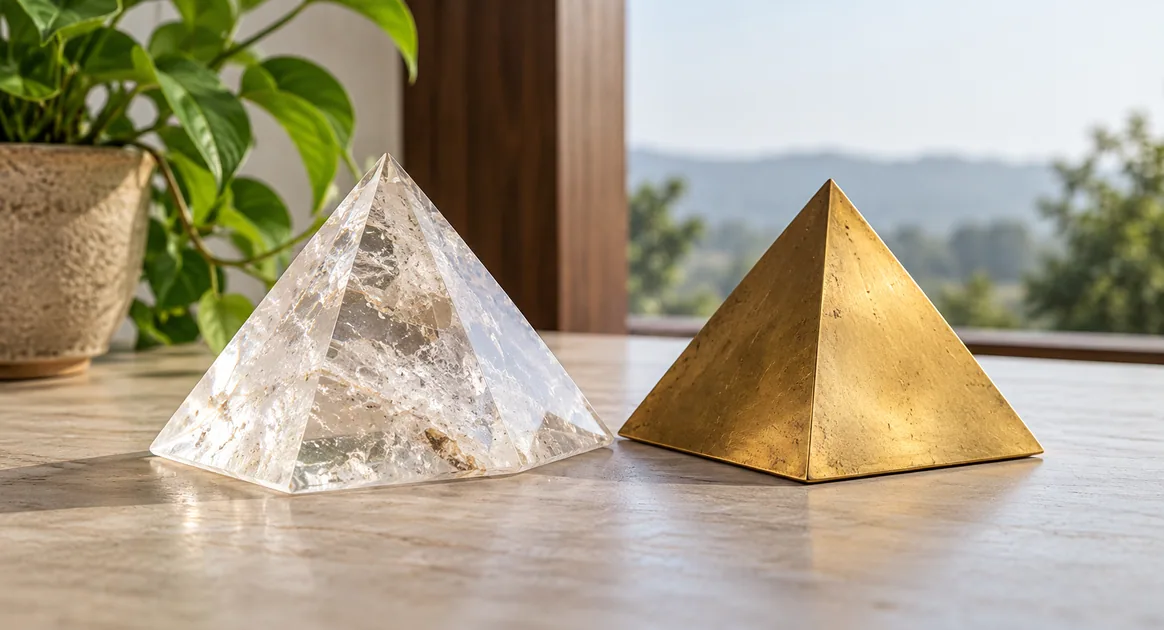
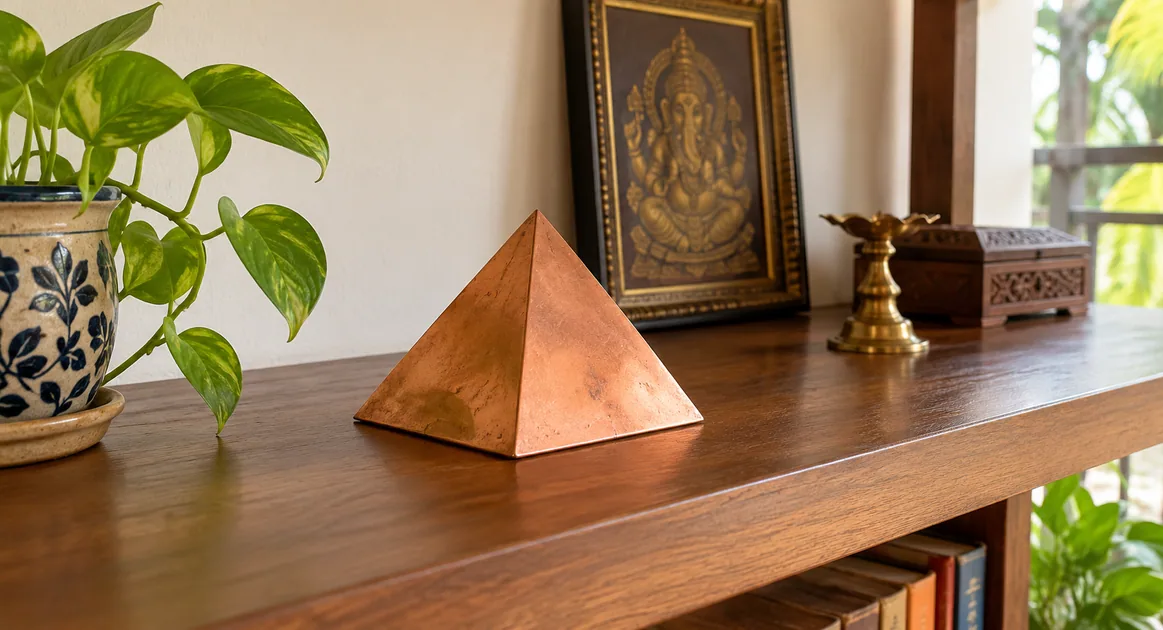
A brass Vastu pyramid is not defined by its golden colour alone. The alloy inside, the way its walls are shaped, the underside of the base, the joins holding the metal together and the arrangement of any individual pyramids all determine what a buyer actually receives. A hollow brass pyramid, a brass nine-pyramid plate and a layered brass assembly may look related in photographs, but they differ in structure, weight, handling, display and the questions worth asking before purchase.
Brass is familiar in Indian homes through lamps, bells, utensils, pooja articles and decorative objects. Its warm appearance also makes it a natural choice for contemporary Vastu displays. This guide connects that cultural familiarity with a precise examination of brass construction: copper-zinc alloy identity, sheet and cast forms, hollow bases, seams, nine-pyramid layouts, layered plates, finishes, orientation and practical maintenance. The aim is to help a householder, temple-room decorator, shop owner or Vastu consultant select the correct design rather than assuming that every golden pyramid is the same product.
What exactly is brass? Understanding the copper-zinc alloy
Brass is primarily an alloy of copper and zinc. Different brass grades contain different proportions of these metals; some grades also include small amounts of other elements to alter how they machine, cast or resist particular environments. A pale yellow shade, deep golden shade or reddish-gold appearance can result from composition and finish, so colour is a visual clue, not a reliable composition certificate. Many decorative pyramids are made from formed sheet metal; others use casting or assembled components.
Brass should not automatically be called bronze. Bronze generally denotes copper alloys traditionally associated with tin, although commercial alloy names can be more complex. Copper itself is a separate metal, usually more reddish when freshly polished. Likewise, brass-plated steel, gold-coloured resin and brass-coloured painted pieces are not solid brass merely because their exterior resembles it. A seller may accurately describe a hollow object as brass if its walls are brass; hollow does not mean inferior or imitation. It describes construction, not material identity.
| Material description | What it means | What the buyer should verify |
|---|---|---|
| Solid brass alloy | The structural metal is brass, whether a sheet, casting or several joined brass pieces | Material declaration, underside, edge and manufacturing method |
| Hollow brass | Brass metal forms a shell with an internal void | Wall integrity, open or closed bottom, seams, stability and dimensions |
| Brass plating | A thin brass-coloured or brass alloy layer over another substrate | Base metal, coating thickness if stated, visible wear and care rules |
| Brass finish / gold-tone | A colour or visual finish; not necessarily brass metal | Actual substrate, surface coating and accurate product label |
| Bronze or copper | Related but materially distinct copper-based metal descriptions | Supplier's material declaration, not colour alone |
If the exact alloy designation is essential for an institutional purchase, request supplier documentation or appropriate compositional testing. The weight, shine, magnet response or a photo of the base alone is not enough to confirm the complete alloy formulation. A magnet can help identify some magnetic substrates, but a non-magnetic result is not proof of brass.
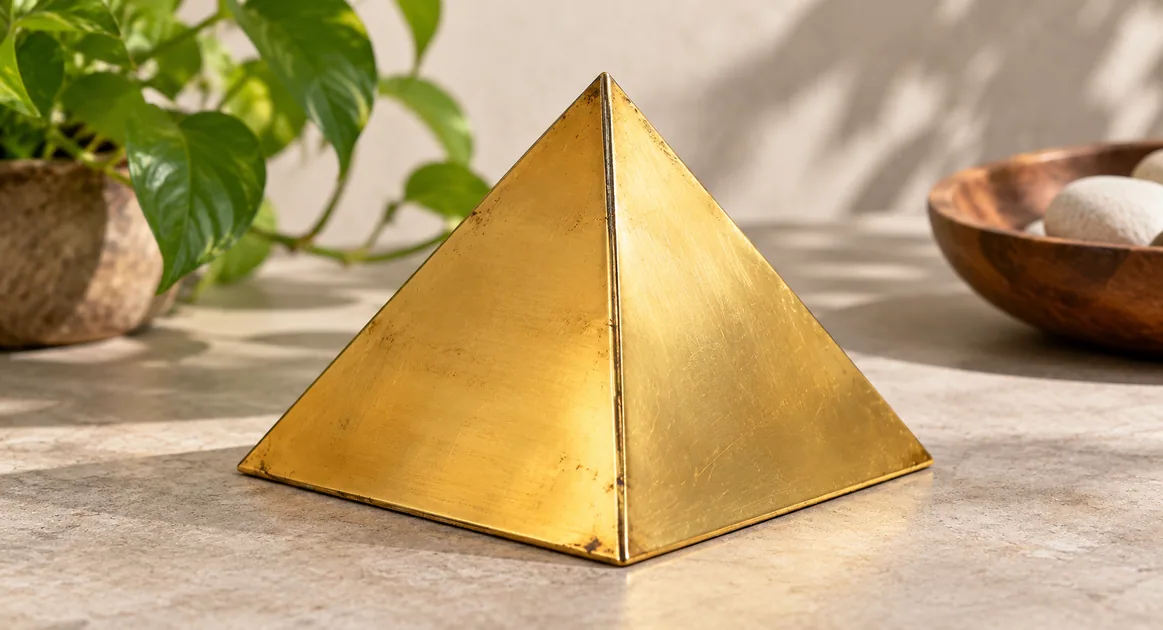
Three common brass pyramid constructions
OmmRudraksha groups related pyramid products by their intended form. For brass, three particularly useful forms are a single hollow pyramid, a nine-pyramid plate and a layered pyramid assembly. These are not merely small, medium and large sizes of the same design. A single shell emphasizes one uninterrupted outline; a plate arranges multiple small peaks across a base; a layered design uses separate levels or nested elements, sometimes with supports between them.
| Design | Typical physical structure | Best suited to | Main inspection point |
|---|---|---|---|
| Hollow brass pyramid | Four sloped metal faces joined around a square base; may be open underneath | Single focal display, pooja shelf or small teaching demonstration | Square seating, apex, seam strength and edges |
| Nine-pyramid brass plate | Usually nine individual peaks mounted or formed on one backing plate | Compact repeated geometry, directional presentation or professional kit | Count of nine, equal spacing and secure attachment |
| Layered brass assembly | Two or more separate levels, nested forms or stepped/stacked plates | Structured display, layered-model demonstration or larger shelf installation | True number of layers, centre alignment and secure connections |
A photograph taken directly from above may hide a hollow base, make separate layers look like a solid casting or conceal whether small pyramids were soldered onto a backing sheet. For all three forms, ask for a front view, top view, underside view and close-up of a join. These four photographs often answer more useful questions than a single polished catalogue image.
How a hollow brass pyramid is made
A sheet-metal version may begin as measured flat stock. The maker marks the faces and base edges, cuts the blank, bends the faces upward, brings seams into alignment, and joins or secures the meeting edges. Depending on the design, the bottom may remain open or gain an additional metal plate. Finishing may include deburring, surface polishing, brushing, patination and lacquer. A cast version takes a different manufacturing route and has different evidence of manufacture.
For a square-based pyramid, equal base edges and a centred apex create a visibly balanced outline. Examine all four faces at eye level. The apex should not appear pulled towards one corner unless the object is intentionally asymmetrical. The base should contact the surface without rocking, and a hollow open edge should be smooth enough to handle without snagging fabric or scratching furniture.
Understanding the underside
An open underside can show folded tabs, welded seams, brazed or soldered joins, adhesive attachments, reinforcing strips or a separate rim. The presence of a seam is not itself a defect: many hollow metal objects require joins. The relevant questions are whether the seam is secure, cleanly finished and consistent with the stated construction. A completely sealed bottom may be convenient for display but prevents the purchaser from viewing the interior; in that case ask how the maker describes the shell and whether its base is a separately fitted piece.
| Visible feature | What it may suggest | What to check next |
|---|---|---|
| Even folded edge | Formed sheet construction | Whether the fold is smooth and the base remains flat |
| Thin vertical seam | Joined sheet faces | Any separation, sharp solder residue or visible stress |
| Continuous heavier wall | Potentially a cast or thicker formed construction | Ask for manufacturing details; weight alone is not conclusive |
| Colour difference at the rim | Coating, exposed substrate or dissimilar joining material | Clarify metal identity and finish |
| Uneven contact at base | Warping, irregular rim or poor adjustment | Test gently on a flat, stable surface |
A hollow brass pyramid can be light yet structurally sound. Do not assume that a heavier object is automatically purer or more effective for Vastu. Weight depends on the footprint, wall thickness, base plate, attached supports and possible filling. For comparison shopping, request base side, overall height, approximate mass and whether the base is open or closed.
What is a nine-pyramid brass plate?
A nine-pyramid plate is a defined multi-peak assembly. The most immediately checkable interpretation is a three-by-three arrangement, giving nine visible pyramidal units. The maker may raise the peaks from one sheet or attach individual mini-pyramids to a flat backing. Both approaches are possible, but the descriptions should distinguish them. One product may contain nine hollow peaks on a plate while another consists of nine separate solid or cast units fixed together.
Count the peaks rather than assuming that “nine” refers to the number of loose components in the package. Check whether all nine apexes are intact, whether the rows are evenly spaced, and whether the outer peaks and corners are correctly supported. If mini-pyramids are separately attached, inspect the joints under the plate where visible.
How to read a 3 × 3 layout
A rectangular drawing is enough for inspection: top row three, middle row three, bottom row three. The centre is the fifth position when counted row by row, not an extra tenth pyramid. In a teaching setting, a consultant may label the rows north, centre and south after aligning the actual display to the room. These labels describe a demonstration orientation, not a guarantee that every nine-pyramid product carries an ancient nine-direction prescription.
| West column | Centre column | East column |
|---|---|---|
| NW position — peak 1 | N position — peak 2 | NE position — peak 3 |
| W position — peak 4 | Centre — peak 5 | E position — peak 6 |
| SW position — peak 7 | S position — peak 8 | SE position — peak 9 |
This table should be read as three rows from north to south (northwest–north–northeast, west–centre–east, southwest–south–southeast). Rotate the entire diagram only if required to match the real compass orientation of the placement surface. In an actual one-piece nine-pyramid plate, the nine peaks remain in their fixed positions; the tray itself is rotated or repositioned. Do not pretend that bonded peaks can be individually moved.
For consistency, verify actual plate dimensions, whether the edges are squared or rounded, underside pads, peak height, and the distance between neighbouring peaks. If the centre peak is deliberately taller or the pattern differs from 3 × 3, describe that specific design rather than applying a standard diagram to it.

Layered brass pyramid assemblies: count the parts, not the claims
“Layered” can describe nested pyramid shells, a stepped stack, or separate square plates whose dimensions diminish from bottom to top. Such assemblies may use threaded rods, central pins, spacers, soldered joints or detachable parts. The design is visually appealing in a display because each level establishes a different outline. But layer count, plate count and the number of pyramid-shaped peaks are different inventory measures.
For instance, a three-level assembly might have three plates and one peak at the top; it is not necessarily a “three-pyramid set.” A nine-pyramid plate can itself be placed beneath a larger separate shell, making a combined assembly. A buyer should record the real number of physical pieces, not infer it from a spiritual name or marketing label.
| Assembly question | Why it matters | Useful evidence |
|---|---|---|
| Are the layers one piece or detachable? | Affects handling, cleaning, replacement and delivery counts | Separated-parts photograph or maker description |
| How many physical levels are present? | Prevents confusion between stacked platforms and separate pyramids | Front view with level count |
| Are the layers centred? | Contributes to stable, balanced appearance | Top-down photograph |
| Are metal spacers and fasteners brass? | Decorative assemblies may contain mixed hardware | Material list for shell, plates, rods and screws |
| Does the base remain flat? | Reduces wobble on shelves and trays | Flat-surface test |
| Can a layer rotate or loosen? | Indicates assembly and transport requirements | Gentle stability test and assembly instructions |
A professionally packaged layered set should include a complete inventory and, if dismantled for delivery, a straightforward reassembly sequence. Do not tighten unfamiliar threaded joints with excessive force: a slim fitting or soldered mount can be damaged. Place the largest supporting element on a level surface first, then add the intermediate components and finish with the smallest or top element according to the supplied product diagram.
Brass in Indian spiritual practice and contemporary Vastu
Brass has a long-standing everyday and devotional presence in India. Brass lamps, bells and ritual vessels are associated with household worship and temple-room preparation across diverse regional traditions. The metal's golden appearance suits an altar, while the ritual role of a particular vessel or lamp depends on the custom followed. A brass pyramid used for a Vastu display is a contemporary product form and should not be presented as identical in origin to the classical Vastu Purusha Mandala or a prescribed temple Yantra.
Traditional Vastu considers the organisation of space, directions, the Brahmasthana or central zone, entrances, natural light, circulation and appropriate use of rooms. The Ashta Dikpalas provide a symbolic vocabulary for the eight directions. A brass pyramid is typically chosen today as a devotional, symbolic or Vastu-inspired object within an already functioning room. The metal alone does not determine the direction; instead consider the room's plan, the purpose of the display, local customs and the product's physical size.
Sankalpa, the conscious statement of intention, can give a personal practice structure: the owner chooses a clean, stable surface, arranges the object respectfully and uses a brief prayer or quiet reflection according to their tradition. A display may accompany an existing lamp, a photograph of a deity or a symbolic diagram, but it should not obstruct worship materials or become a replacement for any ritual implement whose form matters to that practice.
| Vastu or spiritual context | How a brass pyramid may be used | What takes priority |
|---|---|---|
| Home pooja shelf | A single compact hollow pyramid beside established devotional objects | Cleanliness, stability and room for lamp/puja articles |
| Study or work desk | A small unobtrusive symbol for focus and intention | Comfort, usable desk space and avoiding sharp-edge contact |
| Jewellery or spiritual-product showroom | One nine-pyramid plate demonstrating geometry and workmanship | Clear material labels and safe customer handling |
| Vastu consultation kit | Three contrasting brass constructions used to explain product categories | Correct directions, accurate inventory and informed selection |
| Workshop or educational setting | Layered model to show multiple levels and construction methods | Distinguishing observable structure from symbolic interpretation |
Placement: orientation, base size and practical safety
Before selecting a precise room position, measure the pyramid base. A square base of side s occupies an approximate footprint of s × s; a nine-pyramid plate uses the footprint of its backing plate, not the combined area of the individual peaks. A tall layered assembly needs additional clearance above its apex and room for a hand to lift it safely. A tabletop display should not be perched on a narrow ledge, unstable wall bracket or soft material likely to tip.
When a consultant refers to north, northeast or another direction, first identify the orientation of the actual room and distinguish geographic orientation from the way a photograph is taken. A square-based pyramid can have a base edge aligned to a wall or compass axis; a seller may also show the corner-forward presentation. Neither is a universal rule for every metal pyramid. Record the chosen orientation in the consultation notes if repeatability matters.
Keep brass away from wet windowsills, continuously damp bathrooms, active water features, salt lamps that shed deposits and exposed cooking vapours. The item should not share a crowded shelf with heavy sharp-edged items that may scratch or dent it. Near a pooja lamp, maintain practical clearance from flame and heat: an alloy ornament is not automatically designed as an incense holder, wick stand or fire-safe ritual vessel.
Worked example: a three-design brass pyramid consultation tray
Imagine a Vastu practitioner preparing a compact demonstration kit for a Bengaluru apartment visit. The purpose is to explain three constructions, not to imply that the client must buy all three. Use a stable rectangular tray with separate protective compartments and clear labels:
- Position A — hollow brass pyramid: inspect the open base, document dimensions and show how one sheet-metal shell stands on a flat shelf.
- Position B — nine-pyramid plate: count nine peaks in the actual layout, confirm the backing plate is level and explain how a fixed multi-peak object differs from nine loose pyramids.
- Position C — layered assembly: count physical levels, show how parts connect and record whether the set is supplied assembled or detachable.
Record a separate line for each design: product name, composition declaration, base dimensions, height, mass, finish, number of physical components, underside construction, condition and intended display location. For a family pooja shelf with limited depth, the compact hollow piece may be the most practical. For a workshop requiring repeated geometry, the plate could be easier to explain. For a spacious showroom shelf, a layered piece can demonstrate construction and visual depth. The right option depends on space, handling, design and intention, not on a blanket ranking of spiritual power.
Inspecting workmanship before buying a brass pyramid
Good workmanship is visible in details often missing from promotional images. A square-based form should sit evenly; a joined seam should not protrude dangerously; the finish should be consistent with its description; and detachable parts should connect without forcing. Any intentionally handmade variation should be identified rather than mistaken for a machining defect. For a brass plate, verify each attached peak rather than only the backing surface.
| Inspection stage | Simple check | Reason to ask the seller |
|---|---|---|
| Composition | Request base-metal declaration; inspect a hidden edge when permissible | Clarify solid brass, plated substrate or gold-tone material |
| Geometry | Compare base sides, apex alignment and symmetry | Understand intentional design versus accidental distortion |
| Joining | Check folds, soldered edges and plates for separation | Know whether repair is possible if a joint loosens |
| Finish | Examine evenness under ordinary light | Learn whether lacquer, wax or patina is present |
| Safety | Feel for sharp underside edges with a cloth rather than bare fingers | Prevent scratches and cuts during handling |
| Inventory | Count peaks, plates and removable levels independently | Ensure the delivered item matches the listing |
| Display | Test on a level board; note mass and footprint | Confirm shelf suitability and packing requirements |
For web listings, clear dimensions and an underside photo can be more informative than phrases such as “premium,” “powerful” or “100% pure.” Brass is an alloy by definition, so “pure brass” is imprecise if it is meant to imply elemental purity. If a product is made from a specifically declared alloy, state the designation when supported by documentation; otherwise use honest material and construction language.
Polished, lacquered, brushed and aged brass finishes
The appearance of brass changes with finishing and exposure. Polished brass emphasizes shine but shows fingerprints. Brushed brass has a directional texture that can soften reflections. Lacquered brass is sealed by a transparent protective coating, while uncoated brass can naturally darken over time. An intentionally aged or patinated object has a finish that may be part of its design and should not be scrubbed away automatically.
To evaluate a coating, inspect the apex, corners and underside, where wear or uneven application may appear. Avoid assuming that discolouration proves a counterfeit: genuine brass can develop tarnish and corrosion. Conversely, a bright yellow surface does not prove genuine brass. A lacquered object and an uncoated object may require quite different cleaning even when they look nearly identical on a shelf.
Cleaning, storing and packing brass Vastu pyramids
For ordinary household care, start with a soft, dry cloth or a gentle dry brush to remove loose dust. Handle the object with clean, dry hands or suitable gloves if keeping fingerprints off polished metal matters. If an item is lacquered, follow the finish maker's directions; aggressive rubbing may scratch the coating. If the finish is unknown, dry cleaning is the conservative first option.
Abrasive polishing removes material over time and can soften delicate edges and engraved detail. Household recipes using lemon juice, vinegar, strong cleaners or salt can be especially unsuitable for finished or assembled objects: chemical residues may remain in seams and encourage corrosion. Before using any metal polish, confirm that the maker allows it and that the object is not intentionally patinated or lacquered. Professional preservation practice distinguishes simple dust removal from polishing, and recommends protecting existing finishes.
After routine handling, return each pyramid to a dry shelf or a soft-lined compartment. Pack hollow pyramids so pressure is not concentrated on the apex; pack nine-pyramid plates with clearance above all peaks; pack layered assemblies according to the supplied assembled/dismantled instructions, with loose fittings in separately labelled bags. Avoid placing metal objects directly against damp rock salt or wet cloth. Record the condition and count before and after any exhibition or house visit.
Frequently asked questions about brass pyramids
Is a hollow brass pyramid a cheaper substitute for a solid one?
Hollow and solid describe how much metal occupies the internal volume. Either design may be carefully or poorly made. Choose according to stated material, geometry, wall strength, intended use, dimensions and finish; price alone does not establish which is better.
Are nine-pyramid plates identical to nine separate pyramids?
No. A bonded plate behaves as one object and has fixed spacing. Nine loose pyramids can be moved individually. Check whether the listing promises a single plate, a detachable arrangement or nine separate pieces.
Does brass turn black or green over time?
Uncoated brass may tarnish and darken. Green or blue-green deposits can indicate active corrosion or residues, particularly where moisture, salts or inappropriate polish have accumulated. Distinguish normal ageing from an active surface problem before cleaning.
Does the golden shine mean gold plating or a particular alloy grade?
No. Both metal composition and surface treatment can affect shade. A product description should state the structural material and any coating separately.
Should a Vastu pyramid always face northeast?
No single orientation covers every home, ritual, pyramid construction and contemporary display convention. Establish the room directions, the intended purpose, placement stability and any specific instruction supplied for the chosen design.
Can a brass pyramid replace a traditional Yantra?
They are not interchangeable by default. A Yantra has its own symbolic geometry, inscriptions and associated practice; a brass pyramid is a three-dimensional decorative or Vastu-inspired object. Where the owner follows a particular puja tradition, use the prescribed form for that practice.
How to choose among the three brass designs
Choose a hollow brass pyramid for one compact and clearly shaped devotional or decorative focus. Choose a nine-pyramid plate when a fixed repeated layout and easy counting are important. Choose a layered brass assembly when a multi-level structure, visible construction details and a larger installation are the purpose. Whatever you select, start with the actual alloy declaration, physical inventory, quality of joins and shelf dimensions.
For OmmRudraksha's brass pyramid collection, the three related designs below should remain separate products because their construction is different. Their size and finish variations can be specified within the relevant product listing where appropriate. Review the product details for the actual delivered material and construction rather than relying on colour or a promotional photograph.
Explore existing OmmRudraksha collections
Browse Vastu for the existing collection, or explore gemstone products for other material forms. Each product’s construction and care information should guide your choice.