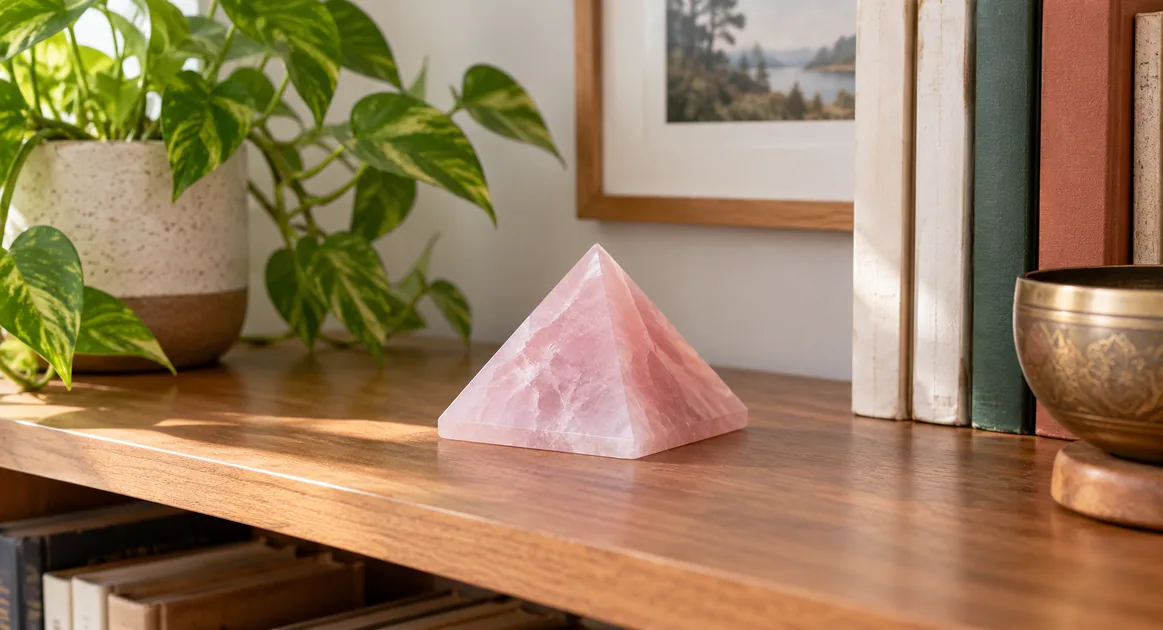
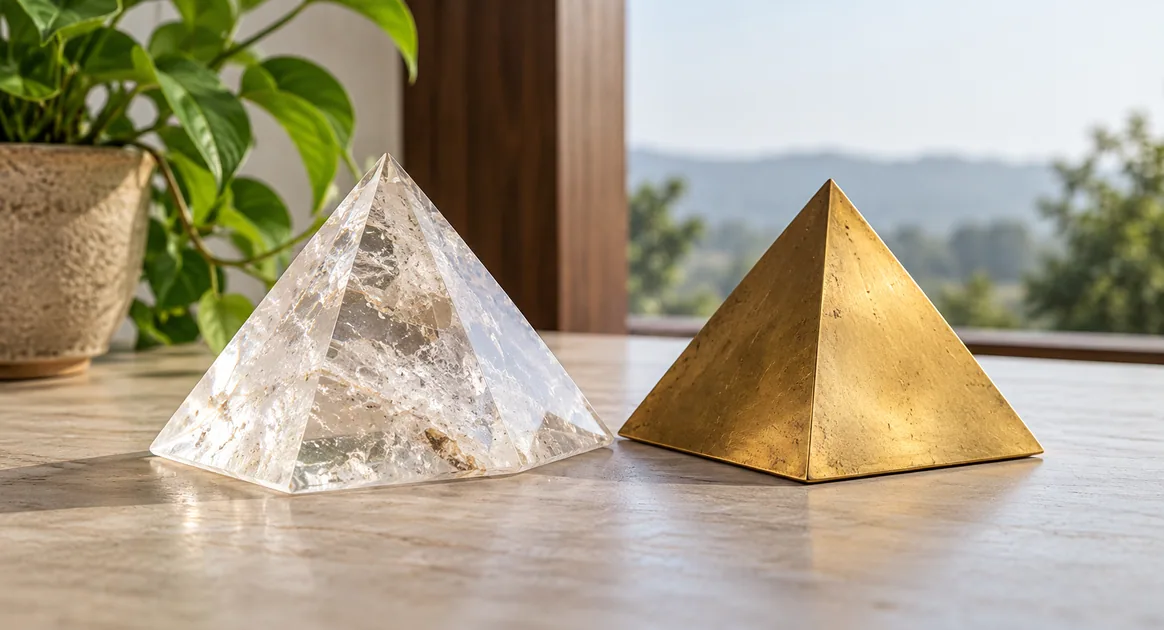
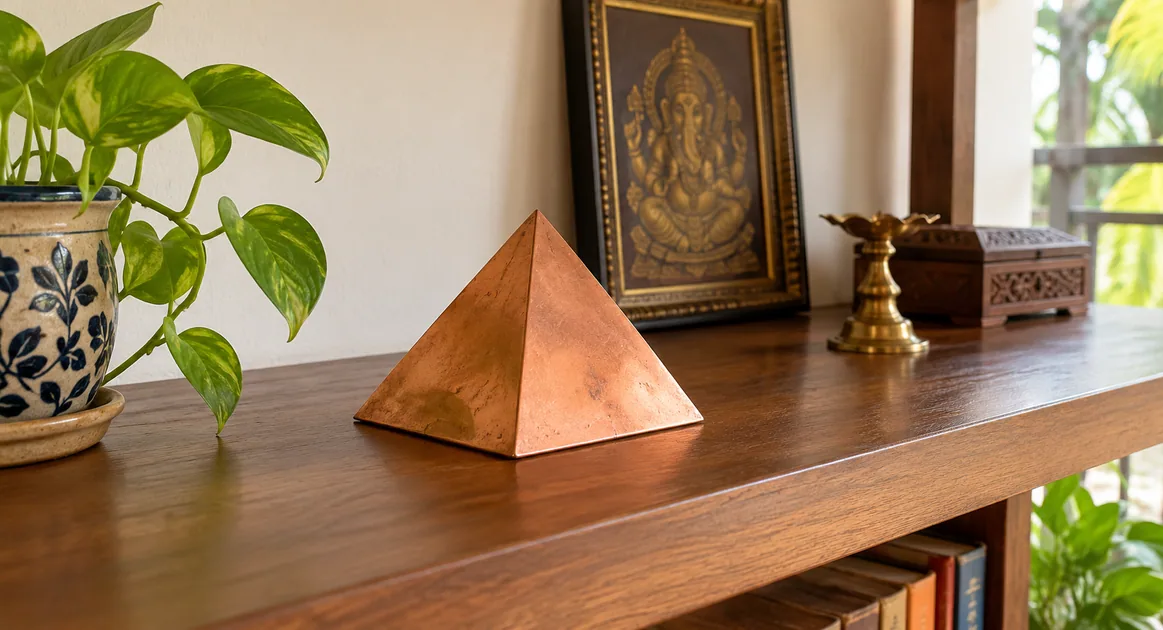
How should you unpack a Vastu pyramid set? Treat the first opening as an inventory and condition inspection, not merely the moment when you remove attractive stones from a box. A pyramid can have a perfectly polished face but a chipped apex; a mixed-gemstone set can contain the correct number of pieces but the wrong stone; and a metal pyramid assembly can arrive with all visible layers yet have a loose fitting. A careful ten-minute examination protects both the collection and the record of what was supplied.
For OmmRudraksha customers, the same method works for a four-piece clear quartz pyramid set, a seven-stone engraved set, a nine-piece mixed-gemstone set, and a more elaborate Vastu installation kit. The essential sequence is: verify the order, count the components, identify the material, inspect the pyramid geometry and finish, photograph the condition, compare the kit with the product specification, and then decide where the items belong. Do not begin by arranging all the pyramids on the floor or placing them directly on a hard marble or granite surface.
This guide provides a complete receiving workflow, inspection standards for different materials, an item-by-item record template, examples of both acceptable natural variation and delivery problems, and the distinction between checking a supplied product and selecting its eventual Vastu position.
1. Prepare a safe unpacking area before cutting the box
Choose a clean table with diffuse daylight or a bright room light, a stable surface, and enough room to spread the pieces without stacking them. Put down a smooth, clean, non-shedding cloth or a padded inspection mat. Keep drinking water, oil, incense ash, perfume and harsh cleaners away from the table. A set containing pointed clear-quartz carvings, polished stone pyramids or metal plates should not be emptied in one movement: a single collision can create damage that was not present on arrival.
Have the order confirmation, product page or packing list open; keep your phone ready to photograph the unboxing; and prepare a simple record sheet. If the parcel looks compressed, punctured or wet, photograph the unopened carton and the external label first. Cut only the outside tape, away from the objects beneath it. Put inserts, smaller envelopes, labels and separators to one side until the inventory is finished, because a small component can remain inside wrapping.
- Soft base: a clean inspection mat supports the pyramid without scratching its underside.
- Good light: examine each piece under ordinary light first; a second oblique light angle can reveal chips and polishing marks.
- Separate zones: mark an unopened zone, a checked zone and an area for objects needing closer inspection.
- One object at a time: lift from the broad base instead of gripping the apex or an attached finial.
- Original packaging: preserve individual sleeves, labels and cushioning until the entire order has been reconciled and any delivery issue resolved.

2. Identify exactly what the product description promises
The word set is not a universal quantity. One listing may offer four separate stone pyramids; another may offer seven stones mounted on a single support; a third may refer to a composite pyramid with layers or internal geometric pieces. Check the actual included-items section rather than counting objects in a lifestyle photograph. A tray, stand, cloth, brass plate or decorative prop shown in a picture may or may not be part of the supplied product.
Read the quantity, stone names, size or size range, finish, engraving, base or accessory information, and whether any particular pieces are individually identified. If a listing says assorted gemstone pyramids, record the exact stone names supplied rather than substituting a preferred colour-based interpretation. If it names a seven-stone set, verify whether the description promises seven individual pyramids, seven gemstone types, or seven embedded pieces.
| Listed detail | What to check at delivery | Useful record |
|---|---|---|
| Quantity / component count | Separate free-standing pieces, plates, lids and genuine loose accessories | Expected 4; received 4; separately count included extras |
| Material names | Every named gemstone or metal against the specification | Quartz, agate, copper, brass, or "material not confirmed" |
| Nominal dimensions | Base width, height, visible tolerance or stated range | Measurements in mm with instrument and date |
| Shape and surface | Square or other stated base, apex, faces, underside, polish | Acceptable variation or photo-linked observation |
| Decoration | Engraved symbol, orientation, colour fill or attached emblem | Mark present; legibility; no detachment |
| Supplied accessories | Tray, holder, instructions, mounting hardware only when included | Listed separately; not assumed from photos |
| Packaging and transport | Individual padding and signs of contact or impact | Exterior condition and unboxing photographs |
Maintain two different columns for promised and received. This avoids the common mistake of treating a missing inclusion as a permissible handmade variation. Conversely, do not reject naturally patterned stone simply because each surface differs in colour. Quantity and named material are objective checks; natural veining is not a fixed uniformity standard unless the offer specifies matching pieces.
3. Unpack and count in a repeatable order
Before opening the inner wrapping, arrange each protected bundle in a row and photograph the layout. Open the first bundle, inspect it over the padded mat, give it a temporary identifier such as P01, and place it in the checked zone. Continue P02, P03 and so on. Never label a gemstone directly with permanent ink, adhesive or a sticky inventory tag; put the identifier on its compartment or paper sleeve.
- Record carton and order information, including product name and date received.
- Photograph the unopened inside arrangement and count individual bundles.
- Remove one pyramid, supporting its base with your palm.
- Compare the component with the included-items list; identify its packaging position.
- Record material, stated dimensions, visible pattern and initial condition.
- Capture front, back, underside and apex photographs if an issue needs documentation.
- Return the inspected item to a protected compartment before picking up the next.
- Reconcile every item and every specifically included accessory before disposing of the packaging.
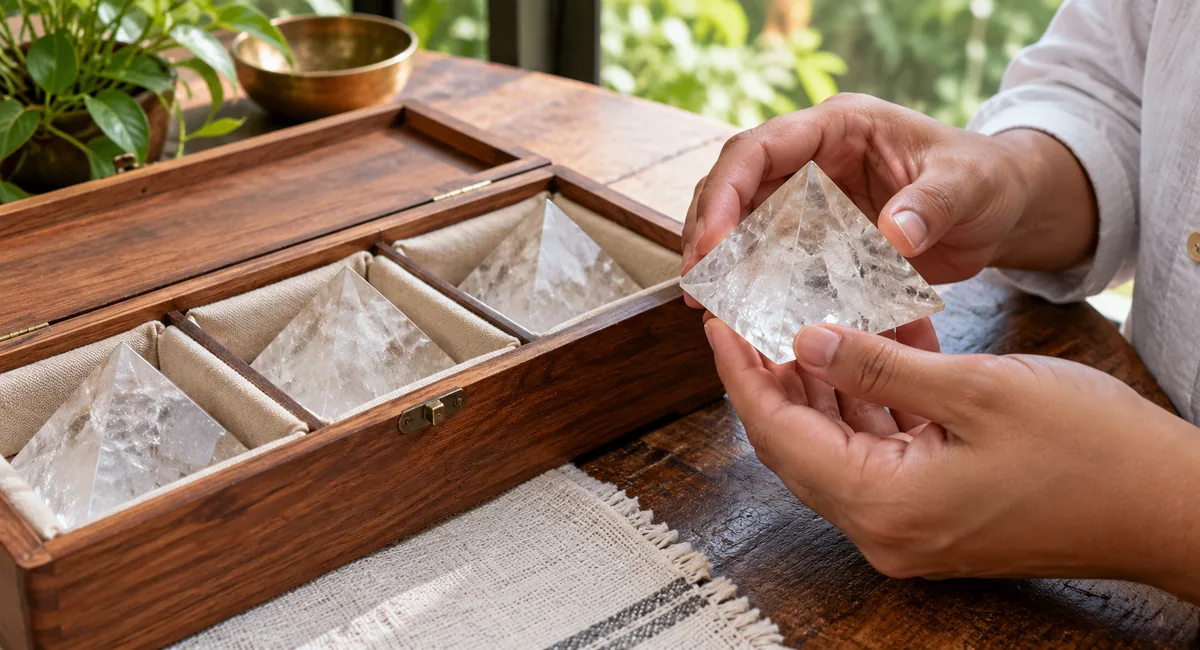
For a four-piece clear-quartz pyramid set, the correct arithmetic may be straightforward: expected P01–P04 and received P01–P04. The four stones need not be optically identical. Internal veils, minor natural inclusions and colourless-to-milky zoning can differ. What matters is that there are four separately supplied pyramids matching the stated description and with a condition consistent with the seller's quality information.
For a seven-stone engraved pyramid set, the inspection also requires seven material or symbol records, according to the listing. Check that the engraving on the piece is legible and does not have an unexpectedly chipped or detached fill. For a nine-piece gemstone set, use a numbered grid of nine compartments so colour-similar pieces cannot accidentally be counted twice. A yellow dyed stone must not automatically be recorded as citrine, and a blue stone must not automatically be assumed to be lapis lazuli; rely on the seller's actual material declaration and supporting information.
4. Inspect the apex, edges, faces, base and balance
Every pyramid has vulnerable regions. The apex is exposed to knocks; corners can chip when objects collide; broad faces display polishing marks; the base influences standing stability; and a metal or composite pyramid may have several joints. Examine these regions systematically rather than concentrating only on colour.
| Area | Acceptable finding | Question worth documenting |
|---|---|---|
| Apex | Defined point or stated intentionally softened tip | Fresh irregular break, missing pointed segment, rough exposed fracture |
| Four or more side edges | Consistent hand-finished profile within stated tolerance | Fresh impact notch, corner crushed during transit |
| Faces | Natural bands, inclusions, veins, polishing character | Unmentioned deep gouge, peeling coating or loose insert |
| Underside | Flat enough for the stated display purpose | Crack crossing the base, unsecured foot or rocking instability |
| Engraving or symbol | Present and legible according to the offer | Omitted symbol, material loss, incorrect supplied design |
| Multi-part construction | Stable assembly with components as advertised | Separation, rattling or exposed sharp edge |
Place the pyramid gently on its intended stand or another level test surface. Some carved natural stones have a tiny hand-finished irregularity; a severe wobble on a truly level surface may point to an uneven base. Test the surface with another flat object before assuming the pyramid is at fault. Do not press down on the apex to see whether it will "settle" and do not attempt to polish an apparent chip before recording it.
5. Natural mineral character versus damage or incorrect material
Natural gemstones are not manufactured ceramic tiles. Two clear-quartz pyramids may show different internal clouds; an agate pyramid may display offset bands; jasper may contain mottled colour fields; and labradorite may flash from only certain viewing angles. These differences are part of mineral appearance, not evidence of poor workmanship by themselves. Yet a polished item can also have a genuine transportation chip, an undisclosed coating or a construction issue.
Use three separate questions: Is this the material or material group promised? Does the object have expected natural character? And is there any new or unacceptable physical damage? A colour pattern answers neither authenticity nor quality on its own. For expensive or disputed identities, descriptive retail photos are not a substitute for appropriate gemological examination.
| Material | Normal visual variation | Special delivery consideration |
|---|---|---|
| Clear quartz / Sphatik | Transparent zones, milky veils, internal inclusions | Inspect the apex for impact; internal features are not automatically damage |
| Rose quartz / amethyst | Variable pink or purple colour and transparency | Check colour and disclosure; do not expose to prolonged strong light unnecessarily |
| Agate and jasper | Bands, spots, colour fields, inclusions | Inspect polish along patterned areas without treating every seam as a break |
| Fluorite / calcite | Colour zones and growth patterns | Check delicate edges carefully; avoid scratching and strong impact |
| Malachite / lapis lazuli | Colour zoning or mixed-mineral appearance | Check finish and coatings; avoid experimental cleaning |
| Copper / brass assembly | Manufacturing texture and surface patina as described | Check fitted layers, burrs, tarnish, plating and loose joints |
| Rock salt / gypsum | Natural grain, translucency and variable texture | Check for moisture, crumbling and soft edges; keep dry |
Hardness and toughness are different: even quartz, which resists ordinary scratching better than many soft stones, can chip at a sharp tip. Conversely, a lower-hardness mineral can look flawless immediately after delivery if it was protected during transport. Never use a knife, acid, flame, scratch test or salt-water immersion to establish gemstone identity on a retail pyramid.
6. How to inspect engraved, copper, brass and composite pyramid sets
An engraved pyramid needs an additional artwork inspection. Identify the symbol named by the product: it might be a Yantra design, deity motif, Navagraha representation, Bija syllable, geometric grid or simply decorative engraving. Record the actual design supplied. A sacred symbol should be described by its correct name, not guessed from a faint photograph. If the listing promises a specific symbol or plate orientation, take a close-up photograph to compare.
Copper and brass objects require a different inspection from gemstone carvings. Check edges for sharp unfinished burrs, attached plates for looseness, and coatings for peeling. Copper naturally oxidizes; brass can darken or develop spots depending on finish and storage. An intentionally aged finish and active surface damage are not the same thing. Follow the finish-specific product information rather than applying lemon, vinegar, abrasive metal polish or salt immediately after unboxing.
A multi-layer Vastu pyramid may count as one manufactured assembly even when multiple layers are visible. Record any detachable base, fastener or specified component separately, but do not dismantle permanently bonded parts to satisfy a visual count. If a loose plate is found in the box, document its position and contact the seller for instructions before attempting to reattach it.
7. Record a practical inventory: the pyramid-set receiving register
An inventory record should be simple enough to complete during delivery and detailed enough to settle a question months later. Use a notebook, spreadsheet or photographs tied to an order number. Give each pyramid an internal identifier, store its photos with the same identifier, and keep a copy of the product specification. The inventory should follow the actual pieces; a speculative traditional association should not replace a material name.
| Item ID | Listed material / design | Received description | Condition | Photo and next action |
|---|---|---|---|---|
| P01 | Clear quartz pyramid | Mostly transparent, internal veil | Acceptable; apex present | IMG-01; pack in slot 1 |
| P02 | Clear quartz pyramid | Milky quartz with clear bands | Inspect one edge more closely | IMG-02; hold for comparison |
| P03 | Clear quartz pyramid | Clear body, small inclusions | Acceptable; stable base | IMG-03; pack in slot 3 |
| P04 | Clear quartz pyramid | Cloudy area near base | Acceptable if matching listing | IMG-04; pack in slot 4 |
This is an illustrative four-piece register, not a representation of a particular stocked lot. For a real delivery, enter your actual findings. Useful extra fields include date, dimensions in millimetres, weight if relevant, accessory count, box position, invoice reference and the name of the person who checked it.
Take photographs of the outer box, inner packaging, every disputed item and the complete reconciled set. Frame the damaged area from more than one angle with a scale or ruler nearby, but do not press it against the stone. If one component differs from the description, first record that difference; then decide whether you need a seller clarification, a replacement or an agreed variation. A return or replacement decision should follow the seller's published terms and the actual condition evidence.
8. Reconcile mixed kits, substitutions and missing pieces
Mixed gemstone sets are more complicated than single-material sets because the count can be correct while the composition is wrong. For example, a nine-piece kit may contain nine carvings but only eight of the nine materials specified. An ornamental stone may have been substituted because it looks similar, or the wrong label may have been put on a compartment. A label mistake and a material substitution have different remedies, so record them separately.
- Count: compare actual physical pieces with the promised total.
- Composition: check each named gemstone or stated assortment rule.
- Identity: distinguish verified material names from tentative colour descriptions.
- Dimensions: check any stated uniform size or allowable range.
- Symbols: confirm engravings, script and design on the intended item.
- Accessories: compare the actual included tray, plate, holder or document.
- Condition: note missing tips, fresh chips, unstable fittings or broken components.
Suppose a set is marketed as a nine-gemstone pyramid arrangement. It is not enough to count nine coloured pieces and conclude that all nine gemstones are present. Make a row for every specified material and mark received, unconfirmed or missing. If the supplier only states "nine assorted gemstones," the record should faithfully reflect that broader promise instead of assuming it is a classical Navaratna set.
For Navaratna, the traditional grouping represents nine planetary gems associated with Surya, Chandra, Mangala, Budha, Guru, Shukra, Shani, Rahu and Ketu. A nine-colour ornamental pyramid set is not automatically the same as that system. Likewise, a seven-colour display may be marketed for seven chakras, but a modern gemstone colour arrangement is not identical to the full classical treatment of chakras in Yoga and Tantra. Accurate naming matters in a spiritual store as much as it does in mineral inventory.
9. Decide the Vastu arrangement only after completing the inventory
Once the set is complete and sound, consider its purpose. In contemporary Vastu practice, a crystal or metal pyramid may be chosen as a symbolic geometric object for a prayer area, a direction-based teaching model, a work desk, an entrance display or a designated Vastu correction arrangement. The pyramid's physical shape should not be confused with a historically specific Vastu Purusha Mandala or a consecrated Yantra; the latter involve their own geometric and ritual traditions.
The Ashta Dikpalas frame eight directional guardians: Indra (east), Agni (southeast), Yama (south), Nirrti (southwest), Varuna (west), Vayu (northwest), Kubera (north) and Ishana (northeast). A consultant may use these references when discussing a layout, but a retail seller should not imply that every coloured pyramid has one universally fixed direction across all Vastu lineages. Confirm the relevant tradition, the product's specified use and the actual floor plan before assigning a permanent position.
| Display intention | Suitable first arrangement | What to document |
|---|---|---|
| Four-piece quartz set for a prayer shelf | Four stable individual positions with clear space between tips | Item IDs, base orientation, shelf material, photographs |
| Seven-stone engraved teaching set | Seven labelled compartments or a protected demonstration tray | Exact engraving or gemstone associated with each item |
| Nine-piece gemstone Vastu display | Nine separate positions following the chosen reference plan | Material map, intended direction and source of arrangement |
| Metal pyramid assembly for an office | One secure level surface, away from water and heavy traffic | Assembly condition, installation details and cleaning limits |
Do not balance a pointed pyramid above a walkway, on an unstable high shelf or in a place where children may pull it down. If the product is intended for installation in flooring or walls, inspect the supplied components before fixing them; after installation, defects may be more difficult to photograph and isolate. The result should be a spiritually meaningful arrangement that is also physically secure and accurately documented.
10. Cleaning and repacking by material after inspection
Unboxing dust does not justify washing an entire mixed set. The safest first step for many polished, dry objects is to remove loose surface dust with a clean, very soft dry cloth or suitable soft brush. Material-specific instructions take priority. Gemstones can be affected by coatings, dyes, fillings or fractures; some mineral species respond poorly to moisture, heat or aggressive cleaning. A mixed kit should be separated by material before any stronger cleaning is considered.
For quartz and agate, routine gentle care is often straightforward if the stone is not treated, but the pointed geometry still needs careful handling. For fluorite, calcite, malachite and layered or repaired pieces, avoid experimental immersion, household chemicals and ultrasonic cleaning. Rock salt and gypsum require protection from water and excessive humidity. Copper and brass should be cleaned according to their specific protective finish; abrasive treatment can irreversibly change a decorative or engraved surface.
Wrap each piece individually in material that will not rub off colour or scratch the finish. Leave the apex clear of pressure, use partitions so side faces cannot strike each other, and keep the item identifier with its own compartment. The original moulded insert is useful if clean and structurally sound. Save the inventory sheet separately as a photo or digital note as well as in the box. For long-term storage, place the set away from leaks, damp floors, direct heat and locations with frequent vibration.
11. Three worked receiving examples
Example A: four-piece quartz set for a family prayer room
A Bengaluru household receives a four-piece clear-quartz pyramid set for a prayer shelf. The outer box is intact, and all four protected packets are present. The first piece is clear, the second slightly milky and the third shows an internal veil. The fourth has a small irregularity at one corner. Rather than calling all four identical or treating natural inclusions as defects, the family records P01–P04, photographs the corner, checks the stated grade and compares the fourth piece with its unboxing image. Only then are the four carvings placed on individual stable positions, with their points separated from other puja objects.
Example B: seven-piece engraved set for an OmmRudraksha-style consultation kit
A consultant opens seven labelled pyramids intended for a tabletop demonstration. Seven carvings are present, but a label reads one material while the invoice uses another name. The consultant does not relabel the stone solely by visual colour. The register flags material confirmation required; engraving, dimensions and condition are documented; and the supplier is asked to clarify the stated material. The set remains usable for physical counting and geometry teaching, while claims about the disputed stone's planetary association wait for the confirmed name.
Example C: mixed gemstone set for a jewellery showroom
A showroom receives a nine-piece assorted pyramid set. All nine units are present. One has an unusually short apex, and two are delivered loose in a common pouch. The receiving staff records carton and pouch condition, isolates the short-tipped piece, checks whether the design intentionally has a softened point, and takes photographs before setting the pieces in a public display. The final record distinguishes a packaging issue from an actual component defect and lists each stone as supplied rather than treating nine different colours as confirmed Navaratna identities.
12. Quick answers to common receiving questions
Should all four or nine pyramids be exactly alike?
Only if the listing promises a matched appearance or tightly controlled dimensions. Carved natural minerals regularly vary in transparency, inclusions, veining and polish character. A named quantity, however, should still be delivered in the promised count.
Does a white vein inside quartz mean the pyramid is cracked?
Not necessarily. Quartz can contain internal veils, healed fractures and inclusions. A fresh external break, sharp exposed edge or loose fragment is a different observation. Examine under ordinary and angled light, then record the actual feature rather than guessing a cause.
How do I check if a coloured pyramid is a particular gemstone?
Start with the product specification, label and supplied documentation. Colour alone does not confirm mineral identity. If the material is consequential for value or a particular Jyotisha selection, request proper identification from a suitably equipped gemologist instead of scratching or chemically testing the pyramid.
Can I install the set before checking every piece?
Complete the count and condition record first. Once pieces are installed, glued or positioned within a fixed array, an individual missing item, wrong material or pre-existing chip becomes harder to establish.
What if I discover a chip or missing component?
Keep all labels and packaging, photograph the complete received contents and the affected piece, and compare with the original item list. Contact the supplier promptly through the normal order channel before modifying or repairing anything. The issue should be described as a factual discrepancy: missing piece, different material, damaged tip or loose component.
Are these pyramid arrangements identical to traditional Yantras?
No. A carved gemstone or metal pyramid is a physical geometric object that may be used in modern Vastu practices. A traditional Yantra has a specific symbolic diagram and its own interpretive or ritual context. It is useful to respect both traditions without merging their names or implying that a particular retail pyramid is universally prescribed.
13. Final receiving checklist
- Order specification, actual item count and separately supplied accessories reconciled.
- Each piece inspected at apex, edge, face, base and any engraved or attached part.
- Natural variations separated from observable delivery damage.
- Gemstone and metal names recorded as declared, without identifying by colour alone.
- Photos stored for the full set and for any questionable item.
- Temporary item IDs assigned to protective compartments, not stuck on stones.
- Material-sensitive cleaning and individual padded storage confirmed.
- Vastu or puja placement considered after verification, with secure supports.
- Supplier contacted about any real discrepancy before modifying the item.
Explore OmmRudraksha Vastu collections
Browse Vastu for related arrangements, or explore gemstone products to compare different material forms. For every pyramid set, the product's exact included-items list and care notes are the starting point for an accurate inventory.