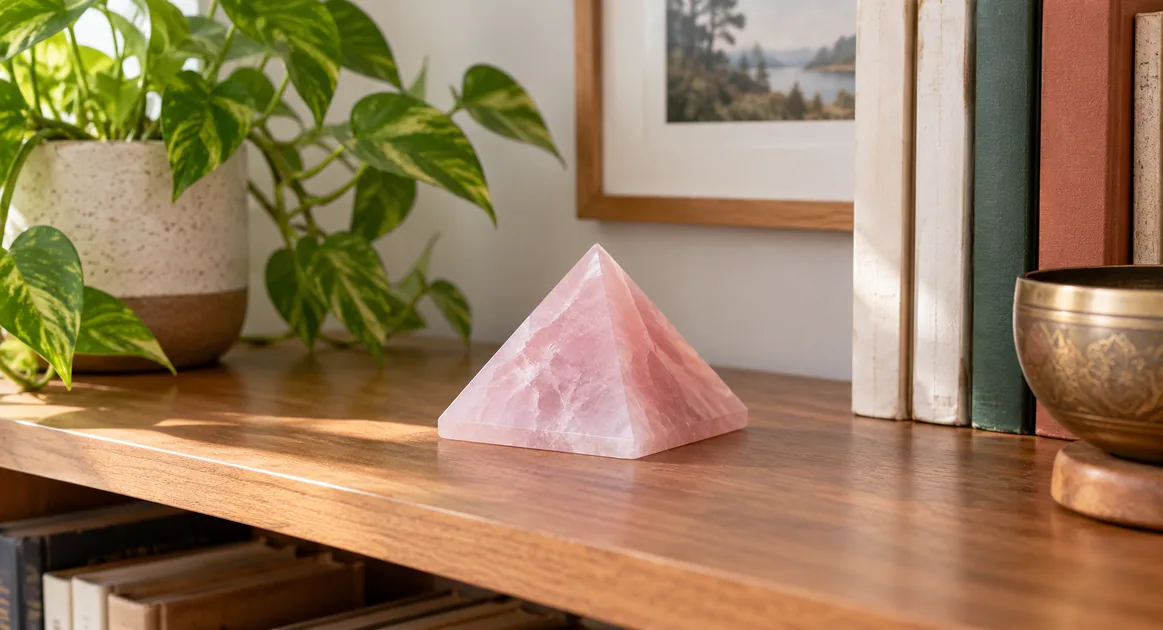
A Vastu pyramid set is a defined group of pieces, not merely several pyramids photographed together. A four-piece clear-quartz set can provide a uniform arrangement; a seven-piece engraved collection may be organised around a chakra theme; and a nine-piece gemstone set can serve as a colour-comparison or planetary-symbolism display, depending on which stones are actually supplied. Each is a different product decision because its count, material identities, construction and arrangement differ.
The most useful questions are practical: How many separate pieces are included? Which stones are they? Are all pieces the same size? Are inscriptions or a base included? Can the layout be changed? What is the condition of each apex and underside? The answers allow a family, a jewellery showroom or a Vastu practitioner to compare sets without depending on an attractive group photograph alone.
Indian Vastu thought gives importance to directions, built-space order and the five elements; Jyotisha has its own Navagraha gemstone associations; Hindu worship has a longstanding place for Sphatik and certain sacred symbols. These are related contexts, but not identical systems. Modern kits often combine them with colour-based chakra arrangements and pyramid-shaped carvings. Understanding the layers makes the set more meaningful and its description more accurate.
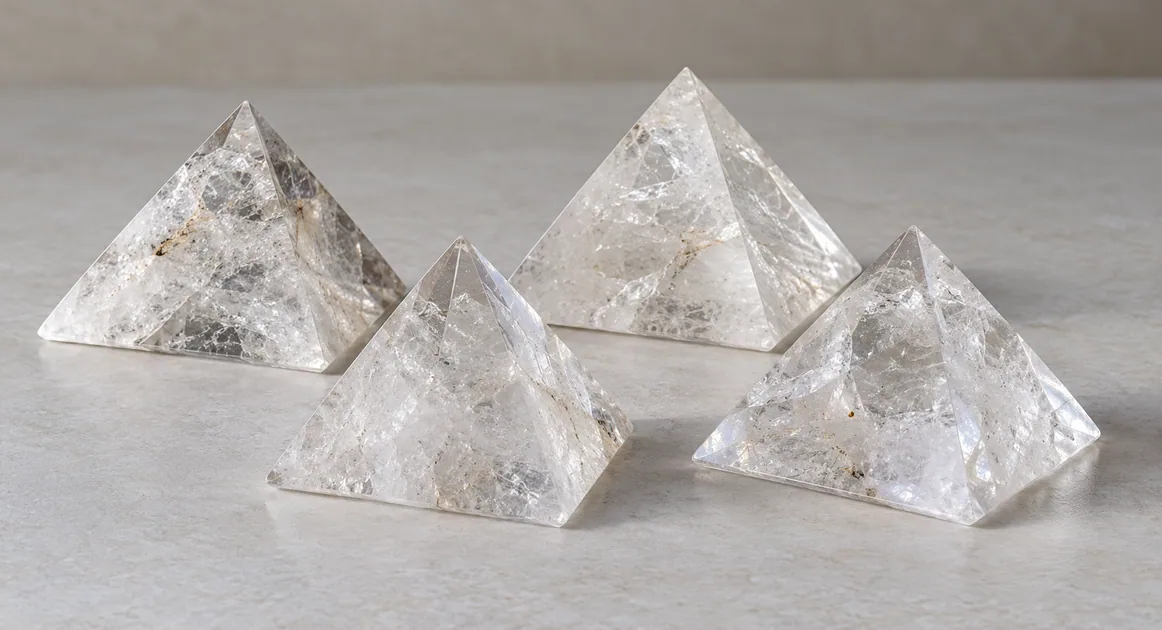
Quick comparison: what four-, seven- and nine-piece sets actually offer
| Set style | Typical arrangement | Main advantage | Verify before ordering |
|---|---|---|---|
| Four matched quartz pyramids | Four corners of a square, or a 2 × 2 tray | Visual symmetry, same-material comparison and flexible placement | All four are genuine quartz; individual dimensions; loose versus fixed pieces |
| Seven engraved or multistone pyramids | Seven labelled positions, often chakra-inspired | Structured teaching, colour sequence or symbol reference | Exact seven materials, engraving on each face, symbol meanings and order |
| Nine-piece gemstone assortment | 3 × 3 grid, a centre with eight around it, or a numbered case | Broader variety, colour comparison and professional demonstrations | Actual nine stone names; whether it is truly a Navaratna selection |
| Fixed plate with many pyramid points | One permanently assembled object | Stable single-piece ornament, simplified display | Whether the advertised number refers to individual points rather than removable pyramids |
| Mixed-material specialist set | Gemstone, metal, ceramic or other pyramids grouped for study | Comparison of construction and finish | Distinct material-care requirements and any attached hardware |
Count and construction are the first filters. A box holding four independent crystal carvings should not be described as the same thing as a single moulded plate carrying four raised pyramid shapes. A set also need not be spiritually themed: carefully matched carvings may be bought simply for a display cabinet or a gemstone-identification lesson.
What should a complete pyramid set contain?
Before comparing price, separate the core components from the packing and display accessories. A listing that shows six pyramids, a tray, a fabric pouch and a decorative plate may supply only the six pyramids. A correct bill of materials identifies each object by quantity, material and whether it is included. This is especially useful when buying multiple sets for a Vastu consultation practice.
| Component | What a clear description says | Why it matters |
|---|---|---|
| Pyramid carvings | Exact number and material of each piece | The count defines the actual kit, not the photograph |
| Measurements | Base length and perpendicular height for each or an honestly stated range | Allows even spacing, stable display and comparison |
| Weight | Total net gemstone weight, or individual weights if different | Separates stone quantity from packaging weight |
| Labels and engravings | Which piece carries which Sanskrit syllable, image or symbol | Prevents mixing of meanings and visual identification errors |
| Tray or stand | Included or photographed only; removable or attached | Changes total size and ability to rearrange |
| Protective dividers | Individual compartments, fabric sleeves, foam or paper separators | Protects polished faces and sharp points |
| Reference sheet | Stone names, layout, symbol legend and care notes | Makes the set useful for students and consultants |
A well-specified set is easy to reorder or replace. If the owner drops one amethyst pyramid from a nine-piece collection, a record of the original stone, base dimensions, height, finish and engraved symbol makes it possible to look for a suitable replacement without rebuilding the entire set. Matching pieces need not be perfectly identical, but the advertised matching criteria should be known.
Set 1: four clear-quartz or Sphatik pyramids
The four-piece quartz set is a particularly straightforward introduction because the material can be consistent across the collection. Clear quartz is crystalline silicon dioxide (SiO₂), normally assigned Mohs hardness 7. The Indian name Sphatik or Spatika commonly refers to rock crystal in devotional and gemstone contexts. Its established association with malas and worship objects gives clear quartz a recognisable spiritual background; cutting that quartz into a four-sided pyramid, however, is a particular modern decorative choice rather than proof of a classical four-pyramid rule.
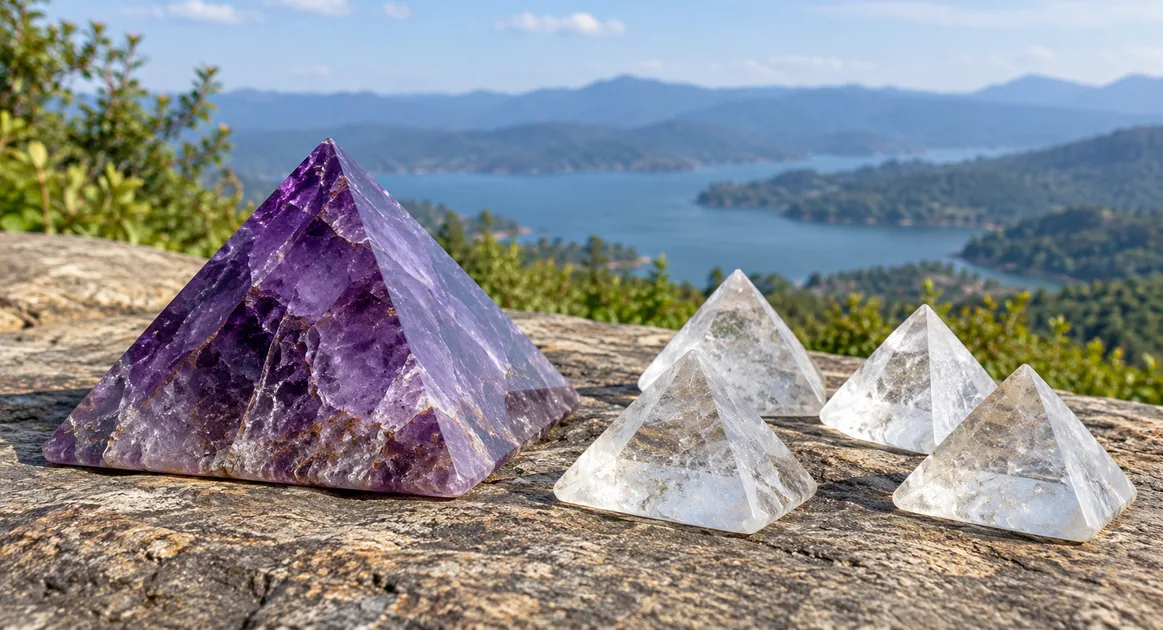
A matched set may use four approximately equal square-based pyramids, each with four sloping faces meeting at a point. The comparison is easiest when pieces are photographed together on the same neutral background. Look at the clarity of all four, the evenness of the base, the sharpness of each apex and any internal veil or fracture. Tiny natural inclusions may add character; a base that rocks, a visible glued repair or a chipped point should be recorded as an actual condition issue.
A reproducible 2 × 2 square layout
Use a rigid tray or level shelf and label the pieces Q1, Q2, Q3 and Q4. Arrange Q1 at the back-left, Q2 at the back-right, Q3 at the front-left and Q4 at the front-right. Space them so the sides do not touch; if the base is 35 mm wide, a sample gap of approximately 15–25 mm leaves space to lift each pyramid safely. That spacing is a practical display example, not a prescribed Vastu measurement.
For a four-corner study, a compass-oriented tray can label the corners northeast, southeast, southwest and northwest. But the set’s four placements should not be claimed to replace the complete eight-direction Vastu framework. A second possible use is one pyramid each in four chosen display areas, provided their placement is stable and appropriate for the room.
Worked sample specification
Imagine a shop listing with four independently carved clear-quartz pyramids, each advertised with a base of 30–35 mm and height of 27–33 mm. The listing should state whether the dimensions are measured from the actual pieces, the total net weight of the four pyramids, whether a box is included, and whether their colour and clarity are matched. These figures are illustrative specifications, not measurements or contents asserted for an OmmRudraksha product.
For worship or meditation, a simple quartz collection may be positioned as a quiet display beside other devotional objects, without crowding the diya, incense holder or working surface. In a jewellery showroom, the same four carvings can explain differences between transparent, translucent and included quartz. Both uses respect the material while keeping the arrangement easy to maintain.
Set 2: seven engraved pyramids and the chakra theme
Seven-piece collections are often presented as chakra sets. In Indian yogic and tantric streams, the chakra is an important subtle-body concept, and many modern teaching charts use seven principal positions. Today’s retail combinations of seven colours, polished stones and individually engraved pyramids are generally contemporary interpretations of that framework. They should be described as such rather than presented as an ancient rule requiring seven mineral pyramids.
The meaning of an engraving matters as much as the stone. A Sanskrit seed syllable, the written name of a chakra, a lotus motif and a modern graphic icon are not automatically interchangeable. A seller should give a clear photograph and identification of each symbol; an unreadable or inaccurate engraving is a quality issue, even if the underlying stone is genuine.
| Position | Common Sanskrit name | Contemporary stone example | Example symbol or teaching focus |
|---|---|---|---|
| 1 — Base | Muladhara | Red jasper | Earth element; Lam is commonly used in seven-chakra teaching |
| 2 — Lower abdomen | Svadhisthana | Carnelian | Water element; Vam |
| 3 — Solar region | Manipura | Tiger eye or citrine | Fire element; Ram |
| 4 — Heart region | Anahata | Green aventurine or rose quartz | Air element; Yam |
| 5 — Throat | Vishuddha | Sodalite | Space or ether element; Ham |
| 6 — Brow | Ajna | Amethyst | Concentration or inner vision; Om is used in some teaching lineages |
| 7 — Crown | Sahasrara | Clear quartz | Consciousness; symbolic practices and syllables vary by lineage |
The gemstone column is a modern example selection, not a universal Sanskrit scriptural gemstone list. Teachers and shops may use different materials while retaining the seven-position framework. A seven-piece set containing only quartz with seven different engravings is likewise different from a mixed gemstone set containing seven minerals. Do not infer its composition from chakra colours alone.
Two practical ways to arrange seven pieces
For a classroom, line up seven labelled pyramids in a straight row from Muladhara to Sahasrara. This is easy to photograph and makes the written sequence obvious. For a compact personal display, arrange six in a gentle arc around the seventh, while keeping the legend alongside it; note that this circle is an ornamental arrangement and does not itself represent bodily chakra positions. If a seller provides a printed diagram, the diagram’s ordering should match the engravings and the names used in the item list.
For a beginner’s study set, consistency is more valuable than a claim about an unseen effect. The purchaser should know why each stone was selected, which image is engraved, how the seven pieces are numbered, and whether the intended use is teaching, meditation symbolism or simple decoration.
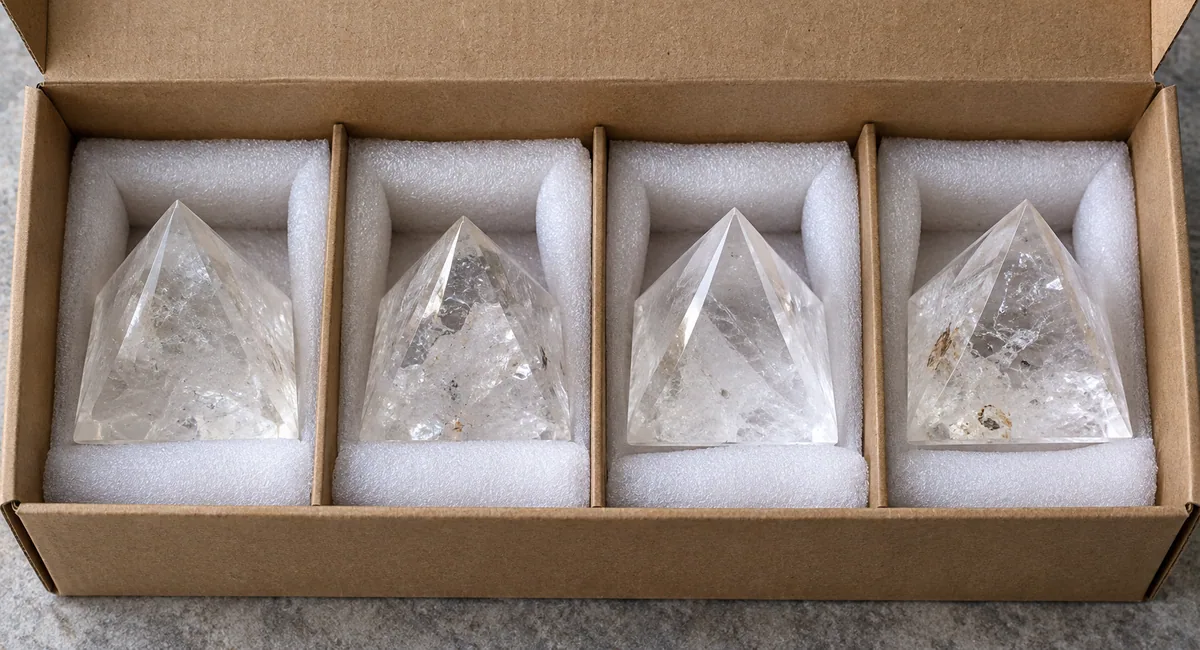
Set 3: nine gemstone pyramids, Navagraha and the 3 × 3 grid
A nine-piece kit allows three quite different approaches: a collection of nine assorted gemstones, a nine-position teaching tray, or a deliberate Navagraha-inspired set. The first two do not become Navaratna sets merely because they contain nine pieces. A Navaratna association has a recognised gemstone-to-planet tradition, and a vendor should identify any departure from it rather than silently replacing a gem with a coloured lookalike.
In Jyotisha the Navagraha are Surya, Chandra, Mangala, Budha, Guru or Brihaspati, Shukra, Shani, Rahu and Ketu. Common Navaratna gemstone correspondences are outlined below; exact traditional and regional practices can vary. The mapping describes a gemstone tradition, not a requirement that all stones be carved as pyramids.
| Graha | Common traditional gem association | What to clarify in a pyramid set |
|---|---|---|
| Surya (Sun) | Ruby | Red jasper or red glass is not a genuine ruby merely because it is red |
| Chandra (Moon) | Natural pearl | A white quartz pyramid is not a pearl; state the chosen symbolic substitute clearly |
| Mangala (Mars) | Red coral | Red coral is an organic gem, not an ordinary carved mineral pyramid |
| Budha (Mercury) | Emerald | Green aventurine or dyed stone is not automatically emerald |
| Guru / Brihaspati (Jupiter) | Yellow sapphire | Citrine or yellow glass has a different material identity |
| Shukra (Venus) | Diamond | Clear quartz is not diamond even when transparent |
| Shani (Saturn) | Blue sapphire | Blue sodalite or lapis lazuli should be named accurately |
| Rahu | Hessonite garnet (Gomed) | A brown agate or smoky quartz pyramid is not Gomed |
| Ketu | Chrysoberyl cat’s-eye (Lehsunia) | Cat’s-eye quartz or glass does not equal chrysoberyl cat’s-eye |
For most affordable nine-piece carved assortments, a more accurate description is simply “nine gemstone pyramids for comparison and display.” An illustrated set might consist of one each of clear quartz, rose quartz, amethyst, smoky quartz, carnelian, red jasper, green aventurine, tiger eye and sodalite. That gives nine identifiable materials and a strong contrast of colours and textures. It is not a strict Navaratna selection, and the label should not suggest otherwise.
Worked layout: 3 × 3 gemstone display
Mark a tray with nine cells. For a comparison lesson, place clear quartz, rose quartz and amethyst in the back row; green aventurine, tiger eye and sodalite in the middle; and red jasper, carnelian and smoky quartz at the front. Write each stone’s name under its cell. This is an easy-to-read collection with exactly nine stones, but the cell positions are a teaching layout, not an astrological planetary chart.
A different eight-plus-centre layout can be useful when discussing directional Vastu ideas: eight outer places illustrate the cardinal and intercardinal directions, with a central position representing the centre or Brahmasthana. That diagram is a conceptual display; the selected mineral at each position is not a universally prescribed remedy. The central area in an actual home should not be cluttered merely because a tabletop teaching model has a central stone.
Vastu directions: separate the symbolic map from the physical placement
Classical Vastu traditions are concerned with the orientation and organisation of built spaces; a modern gemstone pyramid set is a movable object within that space. A compass layout may be helpful to teach the eight directions, but it does not replace analysis of doors, daylight, movement, structure and how each room is used. Some families place a simple spiritual display in the northeast prayer area; others prefer a work desk or a showroom demonstration table. The most appropriate choice often depends on both their devotional custom and the nature of the actual room.
| Direction | Traditional directional name | Useful visual cue for a teaching tray |
|---|---|---|
| East | Purva / Indra | Mark the tray’s east edge and its relationship to sunrise |
| Southeast | Agneya / Agni | Show this as an intercardinal position, not a new north-facing edge |
| South | Dakshina / Yama | Keep the direction label visible, independent of the stone colour |
| Southwest | Nairritya / Nirriti | Use a distinct corner label to prevent misreading of orientation |
| West | Paschima / Varuna | Place the west label opposite east |
| Northwest | Vayavya / Vayu | Mark the corner between north and west |
| North | Uttara / Kubera | Use a north arrow before assigning any gemstone |
| Northeast | Ishanya / Ishana | Show the corner between north and east |
The eight guardian associations and spellings vary among texts and regional traditions. The table is intended to make a labelled Vastu demonstration understandable, not to impose a single gemstone on every direction. When laying out a nine-piece kit for a customer, keep three separate things clear: the compass bearing, the symbolic label and the actual material in that numbered position.
Matching standards: uniform, coordinated and intentionally varied sets
Matched does not necessarily mean “indistinguishable.” Real mineral carvings differ in inclusions, translucency and pattern, even when all pieces came from the same rough-material category. But customers can reasonably expect a balanced group if the product is sold as matched. The clearest approach is to state which properties are controlled and which vary naturally.
| Inspection point | Matched same-stone set | Mixed gemstone set | Helpful product disclosure |
|---|---|---|---|
| Material identity | All pieces the same stated mineral | Every stone individually named | Any dye, treatment, synthetic origin or identification uncertainty |
| Base length and height | Comparable or specified size tolerance | May be varied if clearly listed | Measurements or size ranges in millimetres |
| Shape and apex | Similar four-face geometry and point finish | Different materials may polish differently | Chips, rounded tips, off-centre point or rocking base |
| Colour and pattern | General visual harmony; natural variation expected | Difference is often the purpose of the set | Actual photos of all supplied or representative pieces |
| Engraving | Same symbol or specified series | Clear legend for each different motif | Close-up image, script and orientation |
| Finish | Similar polish, matte or intentional rustic style | Differences documented by material | Surface filling, coatings and polishing variation |
For example, a four-piece set could be described as “four loose clear-quartz pyramids, each 30–35 mm at the base; polished faces; natural clarity variation; individual chip inspection.” A less useful description is “four perfect spiritual quartz pyramids, identical in every way.” The first can be verified; the second promises something natural stone rarely supports.
Some small natural stones have internal colour zones, veils or inclusions. Those are different from surface chips, gluing, cracked bases and inaccurate gemstone labels. A customer can value variation while still expecting competent workmanship. High-priced or specialised gemstone sets may justify a formal laboratory identification for the material, but no laboratory report should be presumed merely from a premium retail description.
Materials and construction: not every pyramid-shaped object is a gemstone
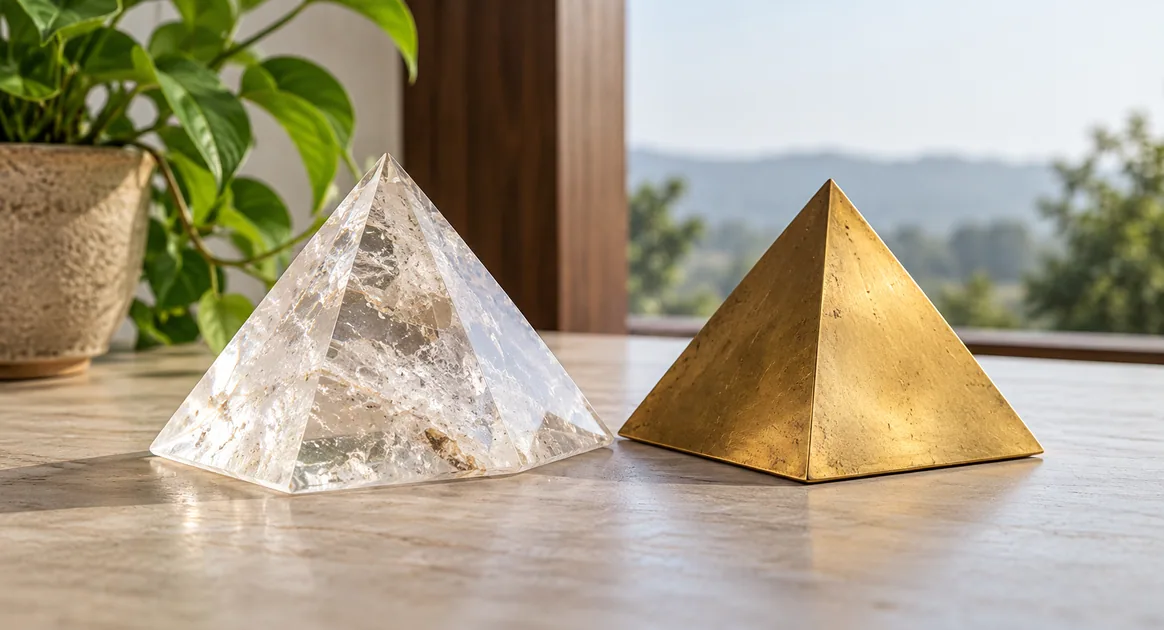
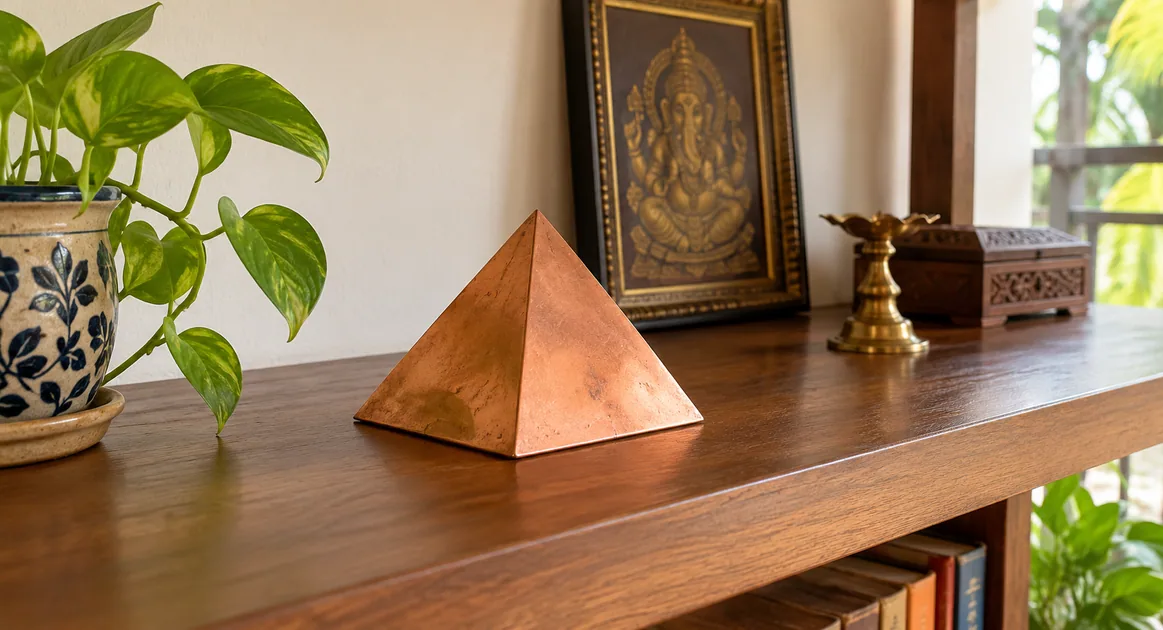
Retail listings may place carved rock crystal, glass, resin, painted ceramic, copper, brass and composite objects in the same “pyramid set” category. The shared silhouette does not make their ingredients equivalent. Real quartz is a crystalline mineral; transparent glass is an amorphous manufactured material. Copper is an elemental metal, brass is a copper-based alloy, and resin is a polymer composition that may contain fillers or embedded stones.
For mixed gemstone sets, pay attention to names commonly used as trade labels. “Green jade” might refer to actual jadeite or nephrite, but it can also be used loosely for serpentine or another green stone. “Turquoise blue” may describe the colour of dyed howlite rather than genuine turquoise. Similarly, a yellow gemstone is not automatically citrine, and a black stone is not automatically black tourmaline. When the stated material matters to a Vastu or Jyotish buyer, confirm the identification instead of relying on colour.
Carved stone also differs from a pyramid plate. A plate can have multiple raised points permanently attached to a substrate; the number advertised might count those points, not detachable units. Ask whether the plate is metal, a cast composite, a gemstone slab or something else. The number of peaks is not the number of pieces one can hold in the hand or place independently.
Simple inspection with normal retail tools
Check the product under diffused white light, examine all four sloping faces, tilt it to view the base, read the engraving if present, and record size and mass. A magnifying loupe may help reveal surface polish and the nature of a visible chip. These steps assess the object’s condition but do not prove a difficult mineral identity or treatment history. Avoid destructive scratch, acid, flame and heated-needle tests on a finished retail product: they can damage the pyramid without resolving what it is.
Choosing the set by purpose: home, showroom or professional consultation
There is no single best piece count for every situation. The smallest meaningful set is often the one whose contents can be explained and used consistently. Consider the space available, whether stones will be moved frequently, the intended tradition and how many different minerals the owner actually wants to study.
Example A: a family apartment with a compact prayer shelf
A household wanting a quiet, balanced display might choose four clear-quartz pyramids in a compact tray or a small single-material set with an understandable devotional association. Place the tray on a firm surface where it does not obstruct lamps, incense, ritual utensils or normal household use. A photograph of the actual shelf, along with dimensions of the proposed set, is more informative than choosing by “energy strength” claims. A family practising specific forms of worship may prefer to keep its chosen ritual objects separate from newer crystal arrangements.
Example B: a jewellery showroom comparison counter
A showroom can use seven different gemstones for customer education even if it does not sell them as a complete seven-chakra ritual kit. Each pyramid sits behind a name label, with a small material card identifying natural mineral, treatments where known, approximate size and cleaning restrictions. A separate engraved collection can illustrate Sanskrit symbols. This avoids asking customers to identify stone from lighting or colour alone and makes a strong visual comparison without turning every specimen into a claim about a guaranteed outcome.
Example C: a travelling Vastu practitioner
A consultant may prefer a numbered nine-piece assortment stored in individual compartments, with a reference diagram showing eight directions plus a centre and a second diagram displaying the same stones in a neutral 3 × 3 grid. The directional diagram teaches orientation; the mineral grid teaches identity. Both diagrams may use the same stones, but their labels must not be silently interchanged. A small notebook can record the contents and explain why a particular demonstration was chosen. For actual house visits, building layout remains a separate analysis rather than something decided by the kit alone.
How to compare a set’s price fairly
A more expensive set may contain larger, rarer or more carefully finished materials, but the quoted total price must be considered alongside the pieces actually included. The simplest comparison starts with cost per pyramid = total set price ÷ number of included removable pyramids. That is only a first measure: a four-piece quartz set and a four-piece set of mixed premium gemstones need not have similar stone values.
As an illustrative arithmetic exercise, consider a four-piece set quoted at ₹2,000 and a nine-piece set at ₹3,600. The prices work out to ₹500 and ₹400 per pyramid respectively, but these are example prices, not current OmmRudraksha product prices. The lower unit cost does not automatically make the second set better. Compare net stone weight, identities, carving precision, condition, packaging, engraving and whether a tray or reference card is actually included.
| Question for the supplier | Why it changes the value |
|---|---|
| Are the four, seven or nine pyramids all loose pieces? | A cast plate with nine points is not priced like nine separate carvings |
| What are the exact stone names? | Quartz, real jade, painted resin and glass have different material value |
| What size and total stone weight are included? | Visual scale and net material quantity affect comparison |
| Are engravings made by hand, machine or surface printing? | Legibility, craftsmanship and durability may differ |
| Does the price include the tray, labels, case and packing? | Accessories can explain part of the price gap |
| Can a damaged piece be replaced individually? | Replacement policy affects long-term usefulness of a set |
A clearly photographed, correctly named and carefully packed set can offer better practical value than a visually grander assortment with uncertain materials. For buyers selecting a symbolic set, the meaning should be presented consistently with the actual contents—not added as an unexplained promise after purchase.
Keeping a pyramid collection useful over time
A long-lasting set should be easy to handle and simple to put back together. Keep a small card listing the piece number, material, any engraved symbol and physical condition. For a varied mineral collection, allow for different care needs: quartz can generally be gently wiped, whereas materials such as malachite, calcite, rock salt or certain surface-finished products require more conservative cleaning. A mixed set should not be soaked as a group or exposed to ultrasonic equipment simply because some pieces are quartz.
Protect points and polished faces from rubbing together. A fitted case with separate compartments is particularly useful for an engraved seven-piece or a nine-piece set used in demonstrations. If a piece is missing, match the replacement by material and specifications first; colour similarity is not enough. Keeping the printed legend with the case also helps ensure that the new piece returns to the intended position.
For displays, aim for a comfortable eye-level or shelf-height view, a stable base and lighting that does not distort the gemstones. A bright spotlight can make transparent quartz look dramatically different from cloudy rose quartz. A consistent, gently lit setting helps customers see the real variations. If the set is used during a puja, avoid placing vulnerable materials directly in contact with burning incense, oil lamps, water containers or ritual mixtures.
Common questions about Vastu pyramid sets
Does a four-piece quartz set have to be placed in four corners of a room?
No fixed general rule establishes that every four-piece quartz assortment must be distributed throughout a building. Four-corner display is one modern layout choice. A compact tray can be more practical and visually harmonious on a household shelf; the actual location should respect normal room function and the household’s tradition.
Is every seven-colour pyramid set a traditional seven-chakra set?
Not automatically. It becomes a clearly explained chakra-themed collection when the seven positions, stone identities, symbols and intended sequence are stated. Colour coding and mineral choices are often contemporary additions to older chakra concepts. A blue stone might be sodalite, lapis lazuli, dyed howlite or another material; the colour alone does not identify it.
Can nine ordinary gemstone pyramids be called Navaratna?
The count nine is insufficient. Traditional Navaratna refers to recognised gem-planet correspondences, including gems such as pearl and coral that are not ordinary mineral carvings. A nine-colour assortment may be a useful contemporary Navagraha-inspired display, but its description must list actual contents and make the symbolic nature of substitutions clear.
Must all matched pyramid stones be identical in colour?
No. Natural stone often has variations in inclusions and tone. Matched usually means a coherent size, finish, material category or deliberately coordinated appearance. Major chips, cracks, unstable bases and incorrectly identified materials are separate issues.
Should I buy a fixed pyramid plate or separate carvings?
Choose a fixed plate if a stable single ornament and minimal handling matter most. Choose separate carvings if you want to reconfigure the layout, teach stone identification, compare the pieces individually or replace one damaged object. The advertised component count should state which construction is being sold.
What makes the best first pyramid set for a beginner?
A modest, well-described set with identifiable materials, sensible dimensions, good workmanship and a clear purpose is a strong starting point. Four matched quartz pyramids offer material consistency; seven labelled stones offer a chakra teaching sequence; nine clearly identified materials offer a wider comparison collection. None requires exaggerating spiritual claims to be worthwhile.
Explore existing OmmRudraksha collections
Browse Vastu for the existing collection, or explore gemstone products for other material forms. Each product’s construction and care information should guide your choice.