Ruby zoisite pyramids are polished carvings made from a vivid intergrowth of green zoisite, pink-red ruby and often dark amphibole. The distinctive red, green and black pattern makes each pyramid different. A red patch is real corundum only if the material has been properly identified, while the majority of the carving can still be green rock. The careful description is ruby in zoisite or anyolite, not a pyramid made entirely of gem-quality ruby.
This in-depth guide covers anyolite mineralogy, genuine ruby identification, the important distinction from ruby in fuchsite, mixed-rock carving quality, condition, price factors, Vastu directions, Sankalpa, traditional red-green symbolism and safe cleaning. It includes home, shop and professional consultation examples, buying tables and answers to common customer questions. The mineral facts explain the physical object; the cultural sections help readers make thoughtful traditional and decorative choices.
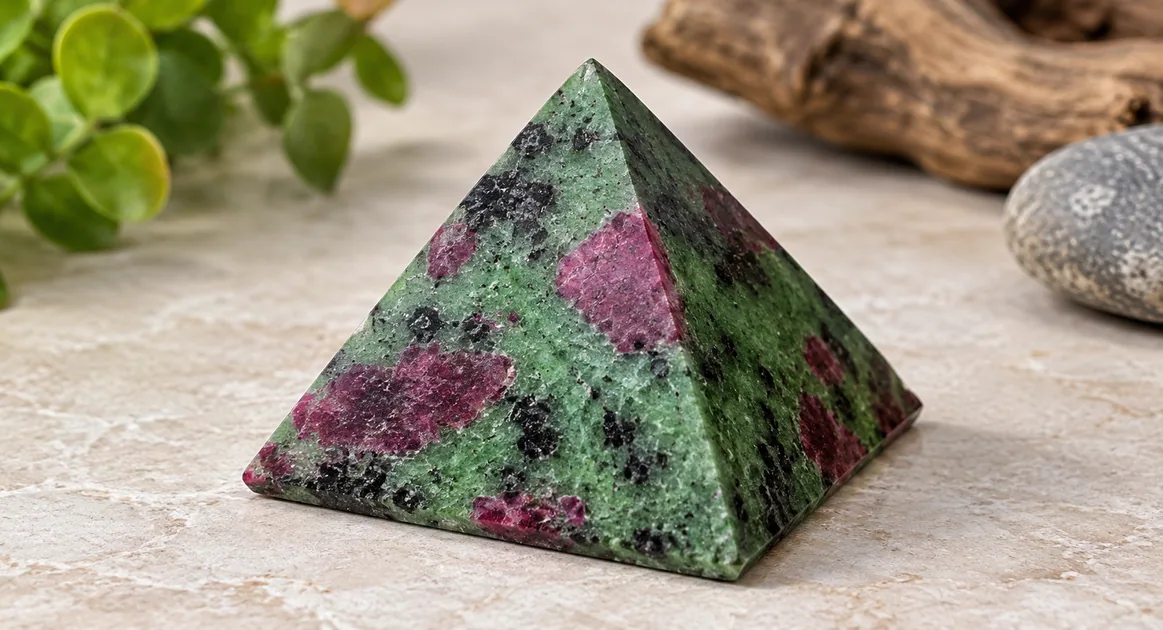
1. What is ruby zoisite or anyolite?
The trade names ruby zoisite, ruby in zoisite and anyolite commonly describe a rock in which red to purplish ruby-bearing corundum occurs within green zoisite-rich material, accompanied in many pieces by dark amphibole such as hornblende or pargasite. It is a multi-mineral rock, not one new mineral species. The green region, ruby crystals and black grains have different physical properties and may polish to different textures.
Zoisite is a calcium aluminium silicate mineral; ruby is the red gem variety of corundum, aluminium oxide. Typical anyolite contains distinct patches and crystals rather than evenly blended colour. The name is associated with the Tanzanian Longido region and the Maasai word for green. That background is useful, but a retail seller cannot claim a particular mine or origin merely because a carving resembles classic Tanzanian examples.
| Visible part | Typical identity | What customers should understand |
|---|---|---|
| Green matrix | Zoisite-rich rock | Principal background; it is not transparent emerald |
| Red to pink patches | Ruby-bearing corundum when confirmed | May be opaque, irregular and differently distributed |
| Black spots or ribbons | Amphibole minerals in many anyolite specimens | A natural part of the rock pattern, not necessarily damage |
| Pale lines or other grains | Accessory minerals, veins or fractures | Require inspection before assigning an identity |
| Square pyramid shape | Lapidary carving | Cut shape, not the natural growth form of ruby or zoisite |
2. How to read red, green and black areas on a pyramid
A cut pyramid exposes several sides of the same three-dimensional rock. The front may contain several ruby islands while the rear shows almost entirely green zoisite. Dark mineral grains may sit beside red crystals, form striking streaks or create a mottled background. Such asymmetry does not by itself signal a defective product; it is one reason actual-piece photography matters.
A product description should indicate the visible colour distribution without inventing an exact percentage of ruby. When a customer chooses a stone for conspicuous red inclusions, show all four faces and the base in ordinary light. A tiny red dot on a sample photograph is not a promise that every shipped item contains a large ruby patch. Colour balance is a matter of aesthetic preference; it does not automatically establish geological quality or monetary value.
| Visual observation | Possible interpretation | Buyer action |
|---|---|---|
| Red islands surrounded by green | Typical mixed-rock appearance | Ask for actual-piece photos from all faces |
| Black grains across red and green | Common amphibole association | Confirm whether any spot is a cavity or inclusion |
| Different polish on colour boundaries | Constituents respond differently to finishing | Check for ridges, chipped seams or fillers |
| Uniform bright green background | Could be a naturally green matrix or altered/other material | Request mineral identification; do not rely on colour |
| Large flat red face | Potentially attractive pattern | Do not equate red area with facetable ruby value |
3. Anyolite is not a solid ruby gemstone
Ruby is corundum and has Mohs hardness 9, but a ruby-in-zoisite carving is an intergrowth with substantial softer constituents. The whole pyramid cannot be described as “hardness 9 ruby.” Likewise, a certificate confirming a ruby inclusion would not necessarily identify the green matrix or document coatings and other constituents. The scope of any report matters.
Most ruby areas in ornamental anyolite are opaque or heavily included. That does not make them insignificant; it simply means the decorative value comes chiefly from the contrast and carving rather than from the price category of transparent faceted ruby. A buyer should compare size, symmetry, pattern, condition and evidence of authenticity together, rather than calculating a price from assumed ruby weight.
| Material property | Ruby constituent | Zoisite constituent | Whole pyramid implication |
|---|---|---|---|
| Mineral family | Corundum | Calcium aluminium silicate | Mixed rock, not one uniform gemstone |
| Hardness | Mohs 9 | About Mohs 6–7 | Treat according to the more vulnerable constituents |
| Typical colour here | Red or pink | Green | Surface pattern varies across faces |
| Commercial form | Included grains/crystals | Groundmass | Decorative carving, not faceted-ruby jewellery |
| Identification | Needs suitable gem testing | Needs mineral confirmation | A single casual colour test is insufficient |
4. Ruby in zoisite versus ruby in fuchsite
Two green-and-red ornamental rocks are frequently confused: ruby in zoisite and ruby in fuchsite. Fuchsite is a chromium-rich green mica with a softer, sometimes glittering or flaky character. Ruby-in-fuchsite specimens commonly show bluish kyanite alteration rims near ruby crystals, whereas classic anyolite is often associated with black hornblende grains and a more granular green background. These are useful field clues, not an infallible test of a finished carving.
Fuchsite is dramatically softer than zoisite; a careless scratch demonstration may damage it and should not be encouraged on a retail product. Other red-green composites, dyed rocks and glued pieces can imitate either material. If the exact matrix matters, a reputable mineral or gem laboratory should identify it. The safe seller language is “ruby in zoisite, supplier-identified” when that is what the available evidence supports—not a certainty inferred solely from photos.
| Question | Ruby in zoisite / anyolite | Ruby in fuchsite |
|---|---|---|
| Green host | Zoisite-rich rock | Chromium-bearing mica |
| Common visual clue | Granular green with black amphibole | Soft green micaceous or sparkly groundmass |
| Around ruby | Often without blue kyanite alteration rims | Blue kyanite rims may appear |
| Durability concern | Mixed polishing and vulnerable boundaries | Very soft mica matrix may scratch or flake |
| Carving description | Ruby-bearing zoisite rock | Ruby-bearing fuchsite mica rock |
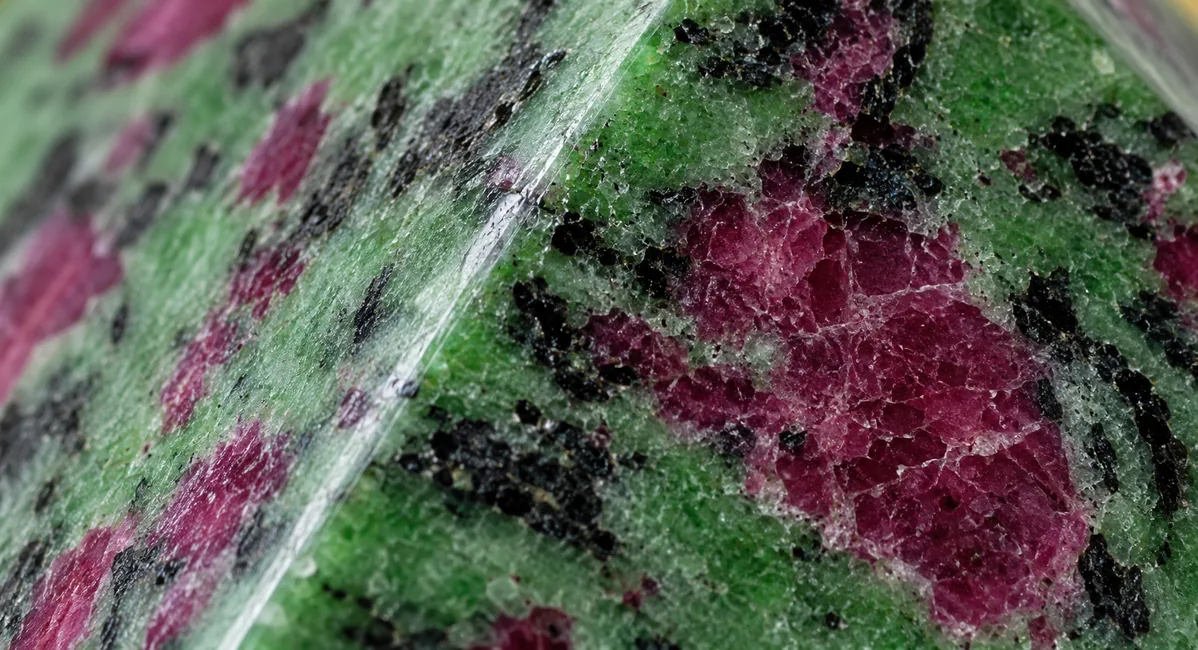
5. Differences from ruby in kyanite and artificial composites
Ruby in kyanite may display red corundum in a blue to blue-grey matrix. Its colour scheme is unlike the common green of anyolite, yet bright lighting, alteration, coatings or mixed mineral layers can create confusion. Painted stone, bonded fragments and reconstructed resin-mineral mixes are also sold in the decorative market. There is nothing inherently wrong with an openly declared composite; the problem arises when construction is incorrectly presented as a natural solid carving.
Inspect the underside for abrupt straight adhesive seams, uniform resin borders, air bubbles, colour pooling in cracks and unusual wear around the point. None of these observations alone proves a particular method. Avoid acid, blades, heat, solvents or destructive scratch tests at home. Request an invoice describing the actual material and treatments, and seek laboratory evidence for high-value or provenance-dependent purchases.
6. Assess symmetry, apex, base and polished boundaries
A quality pyramid should stand steadily, have a consistent square base and an apex positioned appropriately for the chosen design. The stone need not display a perfectly symmetrical colour pattern. Judge the craftsmanship separately from natural mineral irregularities: a beautifully patterned rock may still have a chipped tip, poorly levelled base or filled fracture that should be explained in the listing.
Pay special attention to boundaries between green and red areas, where differential polishing can reveal slight steps or dull patches. A naturally rough grain can be part of the rock, while an open seam that catches a fingernail or appears to widen may indicate a condition problem. A fixed repaired area must be disclosed rather than simply called a natural marking. Request measured height, base width and weight for the actual item.
| Inspection point | Good sign | Question to raise |
|---|---|---|
| Apex | Clearly photographed; no new chip | Is it intentionally rounded or broken? |
| Base | Flat, stable and measured | Does it rock on a level shelf? |
| Faces | Balanced workmanship despite varied mineral patches | Are there deep unfilled pits or tool marks? |
| Colour boundaries | Honest textures and clear photos | Any repaired crack or glued fragment? |
| Listing images | Actual item or explicit assortment notice | Will this exact red-green pattern arrive? |
| Size and weight | Clearly recorded measurements | Are sample values being presented as exact? |
7. Natural variation, treatments and ethical selling
Some ornamental carvings may be oiled, waxed, filled or otherwise surface-finished to improve gloss or conceal small cavities. The existence of an attractive polish is not evidence of enhancement, and not every ruby-in-zoisite object is treated. What matters is specific disclosure when treatment, assembly or repair is known. An accurate listing does not need unsupported claims such as “100% untreated, museum-grade, rare mine specimen” when the supply records only say ruby zoisite.
Good documentation records supplier description, lot, dimensions, condition, visible pattern and photographs under ordinary lighting. For imported stock, origin claims should be tied to purchase documents rather than the trade name alone. Photos from a different pyramid cannot establish the exact red content or repairs of the object being sold. Where customers want certified gem material, specify exactly what the laboratory tested and what it did not test.
8. Traditional meaning of ruby, green colour and the pyramid shape
In modern spiritual and gemstone practice, the combination of ruby red and green zoisite is often interpreted through contrasts such as energy and steadiness, initiative and harmony, or courage and growth. The red areas invite associations with activity and resolve, while green is commonly linked to renewal, nature and balance. The pyramid’s upward-converging geometry provides a visual focus for a chosen Sankalpa—a deliberate personal intention.
These associations should be explained with cultural care. Ruby is associated with Surya in several traditional Jyotish gemstone systems, but a ruby-in-zoisite decorative pyramid is not automatically a prescribed Manikya Ratna for someone’s horoscope. Green material should not automatically be identified as emerald or a Budha gemstone merely because it is green. Traditional gemstone prescription and modern colour-symbolism arrangements are distinct practices.
Likewise, the presence of a red-green object does not make it an ancient, universally required Vastu rectifier. For a family choosing it for a puja shelf, office or meditation space, the symbolism may be meaningful without asserting one compulsory placement or guaranteed result. OmmRudraksha consultation can help distinguish decorative selection from individual astrological guidance.
9. Pancha Mahabhuta and Vastu directions: a practical interpretation
The Pancha Mahabhuta—Prithvi, Jala, Agni, Vayu and Akasha—are a traditional framework for discussing space, qualities and balance. A stone object naturally invites reflection on Prithvi (earth and stability); its red and green palette can be interpreted through other associations chosen by a practitioner. However, a multi-mineral pyramid does not carry one objectively fixed elemental code or universal placement direction across all schools of Vastu.
A sensible approach is to identify the purpose of the room, the family’s established spiritual practice, available shelf space, light and risk of disturbance. Northeast is often chosen for calm devotional spaces in many modern Indian homes; some practitioners may choose the east for a study or the north for a professional workspace. These are contextual preferences rather than guarantees, and practical building safety comes first.
| Setting | Possible symbolic emphasis | Practical placement |
|---|---|---|
| Puja shelf or meditation area | Sankalpa, contemplation and auspiciousness | Steady dry shelf with room for cleaning |
| Study or reading room | Attention, learning and personal resolve | Away from desk edges and falling books |
| Reception or shop counter | Hospitality, considered growth and presentation | Secure plinth away from cash handling |
| Office consultation room | Illustration of minerals and traditional material meanings | Labelled display, protected from accidental knocks |
| Gift for a new home | Good wishes for growth and harmony | Include material and care details, not just symbolism |
10. Worked example: a Bengaluru apartment
Consider a Bengaluru apartment with a compact prayer corner that shares space with books and decorative objects. A resident likes the red-green pattern of ruby zoisite and wants to connect it with a Sankalpa for steadiness and new beginnings. Instead of placing the object over an oil lamp or on the edge of a narrow shelf, they choose a stable platform a short distance from heat, water, ash and daily traffic.
They inspect all faces at purchase, accept that one side carries less ruby, and record how the pyramid is oriented for their chosen view. If someone in the family asks whether ruby content makes it astrologically suitable for Surya, they distinguish the decorative mixed rock from a horoscope-based gem prescription. The meaningful arrangement is also physically sustainable: a gentle dry dust and occasional inspection maintain the carving.
11. Worked example: a jewellery showroom or spiritual shop
A jewellery showroom wants a bright mineral display near its consultation desk. The owner compares several ruby-zoisite pyramids. One has a striking red front but a chipped base corner; another has more modest ruby patches but better symmetry, condition and documentation. For a public counter, the second may be a better choice despite the first photograph appearing more dramatic.
The showroom labels the item as ruby-in-zoisite ornamental rock, states its measured dimensions and identifies its purpose as a decorative Vastu-themed piece rather than promising business revenue. The display is not placed where customers repeatedly lift it by the point. Staff can explain that the black inclusions are commonly amphiboles and that proportions vary naturally. This builds confidence without replacing product information with exaggerated claims.
12. Worked example: a professional Vastu reference kit
A professional reference kit may include ruby zoisite alongside ruby fuchsite, green aventurine, jade alternatives, single-mineral quartz and other composite rocks. The objective is comparison, learning and clear communication. Each sample should have a card listing its trade name, proposed mineral constituents, actual photo, handling advice and what remains unverified. A different rock should not be relabelled to fill a missing kit slot.
For practical demonstration, place an actual ruby-zoisite sample next to ruby in fuchsite and explain the harder granular green matrix versus soft micaceous green host. Show the black amphibole inclusions, red patches and variable polish under good light. Keep the samples individually padded so their points and corners cannot hit one another. A mineral study kit may be useful regardless of the practitioner’s preferred Vastu placement tradition.
| Kit label field | Recommended entry |
|---|---|
| Material | Ruby in zoisite / anyolite, with identification status |
| Main colours | Green, pink-red and often black |
| Main constituents | Zoisite-rich matrix, ruby-bearing corundum, amphibole where verified |
| Source | Supplier lot and documented origin if known |
| Condition | Actual scratches, fillings, repairs or chips |
| Traditional context | Colour symbolism, Sankalpa and selected Vastu approach |
| Care | Dry display, no abrasive contact or harsh cleaning |
13. Clean, handle and store a mixed-mineral pyramid safely
Ruby has a reputation for durability, but the whole carving is only as secure as its vulnerable constituents, cracks and repairs. Use a clean soft dry brush or microfibre cloth for dust. Avoid acids, salt solutions, harsh detergents, long soaking, steam cleaners and ultrasonic baths unless a qualified specialist confirms that a particular object and any treatments can tolerate them. A quick damp wipe is sometimes used for sound untreated pieces, but dry cleaning is the prudent default when the treatment and seam history are unknown.
Support the pyramid from its base, not by gripping the pointed apex. Set it on a clean, level shelf away from repeated vibration, children’s play areas, hot lamps and heavy objects. During storage and shipping, wrap it individually with non-abrasive material and use a fitted insert. Separate it from loose quartz pieces, metal ornaments and other hard objects that can scratch polished zones or chip corners.
| Situation | Preferred care | Avoid |
|---|---|---|
| Light dust | Soft dry brush or clean microfibre | Abrasive polishing powder |
| Unknown fill or wax | Dry handling until treatment known | Solvents or aggressive immersion |
| Puja-area display | Stable shelf away from oil and heat | Direct contact with flame, ghee or incense ash |
| Moving the item | Lift and support base | Pulling or gripping only the apex |
| Storage | Padded separate compartment | Loose stones hitting one another |
| Shipping | Photos plus stable protective insert | Single thin bubble bag for several carvings |
14. Buyer checklist: what matters more than red percentage?
A confident purchase begins with a clear identity and an accurate picture. Check whether the seller means natural ruby-bearing zoisite rock, ruby in fuchsite, a different red-green stone or an assembled decorative object. Confirm the actual dimensions, visible ruby pattern, colour of the host, treatment status and physical condition. Ask for the reverse and underside before paying a premium for a particularly attractive carving.
There is no universal rule that the pyramid with the highest visible red percentage is automatically best. An evenly finished, stable carving with modest ruby areas can be preferable to a brighter but damaged or repaired item. A buyer seeking an astrological gemstone should seek the appropriate individual gem and consultation rather than assuming the decorative pyramid is equivalent to a faceted Jyotish ruby. A customer seeking Vastu-themed symbolism may prioritize colour, craft and placement compatibility.
| Seller claim | Useful follow-up question |
|---|---|
| “Solid ruby zoisite” | Does this mean one carved piece of multi-mineral rock? |
| “Pure ruby pyramid” | What percentage and mineral identification support that statement? |
| “Natural Tanzanian anyolite” | Is there actual supplier provenance? |
| “All red areas are gem-grade ruby” | Are the inclusions opaque, and what was verified? |
| “No treatment ever” | Has the supplier documented oil, wax, filling and assembly? |
| “Perfect for every horoscope” | Is this decorative symbolism or chart-specific Jyotish guidance? |
| “Exactly as pictured” | Is the photo of my specific piece and all faces? |
15. Frequently asked questions
Is ruby zoisite a single mineral?
No. Ruby in zoisite or anyolite is a mixed rock, typically containing green zoisite, ruby-bearing corundum and dark amphibole minerals.
Does it contain real ruby?
When correctly identified, the red patches are ruby-bearing corundum. The carving as a whole is not a uniform ruby gemstone.
What is anyolite?
Anyolite is a familiar trade name for the distinctive green, red and often black ornamental rock associated with ruby in zoisite.
Is anyolite the same as tanzanite?
No. Tanzanite is a blue-violet gem variety of zoisite; anyolite is an ornamental intergrowth of minerals.
Why are there black spots?
Many classic specimens contain dark amphibole minerals. A black spot is not automatically damage, although open cavities still require inspection.
Is ruby zoisite the same as ruby in fuchsite?
No. Fuchsite is a soft green mica, while the green host in anyolite is zoisite-rich. Finished pieces can look similar, so accurate identification matters.
Do more red patches mean a higher grade?
Not necessarily. Workmanship, stability, actual mineral identity, transparency, pattern and condition all matter.
Is every red patch facetable ruby?
No. Red corundum in ornamental rock is frequently included or opaque and is not equivalent to a clean faceted ruby.
Can a ruby report certify the whole stone?
Only if the report explicitly identifies all relevant constituents. Read its actual scope.
Can I scratch test the green area?
Do not use destructive tests on a finished carving. Ask for professional identification when necessary.
Where should it go in Vastu?
Use the chosen tradition and room function, plus a safe stable location; there is no single universal placement for every building.
Is ruby zoisite a substitute for Manikya?
A decorative mixed-rock pyramid should not automatically be treated as a Jyotish-prescribed ruby.
Can I keep it on a puja shelf?
Yes, as a decorative or devotional object on a firm dry surface away from oil, flame and falling items.
Can it be immersed in salt water?
Avoid soaking and salt solutions, particularly where fills, seams or treatments are unknown.
How do I clean it?
A soft dry brush or clean microfibre cloth is a prudent choice for routine care.
Is it a good item for a professional reference kit?
Yes, when correctly labelled and used to teach distinctions among natural intergrowths, treated stones and similar trade names.
Why does one face show less red?
Different carving faces cut through different parts of the irregular three-dimensional rock.
Should I buy from a single front photograph?
For a patterned carved stone, request all four sides, the underside, dimensions and condition details.
16. Final perspective: combine honest mineral description with meaningful tradition
A good ruby zoisite pyramid is not required to look identical on every face. The appeal is its natural green-red-black intergrowth, supported by a sound carving, accurate material description and transparent condition notes. Correctly distinguishing anyolite from ruby in fuchsite prevents mistakes that affect buying, cleaning and expectations about the object.
Its cultural meaning can be personal and substantial: Sankalpa, Prithvi-associated steadiness, red-green symbolism, devotional display and Vastu-inspired placement are legitimate subjects for explanation. Those interpretations should not replace the separate discipline of individual Jyotish Ratna selection. The best article equips readers to make both distinctions comfortably.
Research basis: mineral identity and ruby-in-zoisite versus ruby-in-fuchsite distinctions were checked against Geology.com mineral education references and an authored ruby-zoisite gem guide; ruby hardness and care were compared with GIA material. Source references inform factual accuracy without adding unrelated commercial outbound links to the article.
Explore existing OmmRudraksha collections
Browse Vastu for the existing collection, or explore gemstone products for other material forms. Each product’s construction and care information should guide your choice.