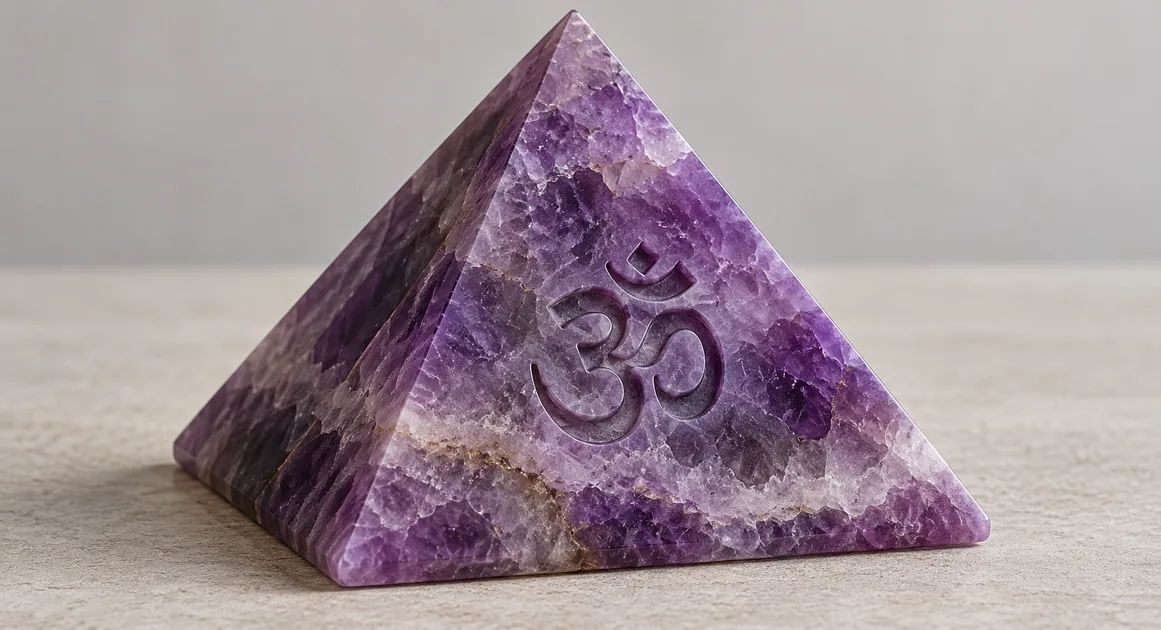
What does an Om-engraved gemstone pyramid mean, and how should you choose one? The answer begins with three separate parts of the object: the sacred or decorative symbol, the material from which the pyramid is made, and the quality of the engraving. A beautifully cut amethyst pyramid can carry the Pranava symbol Om (ॐ), while another pyramid in rose quartz or clear quartz may carry the same sign. Their spiritual associations, visual character and practical care are not identical merely because the lettering matches.
Engraved pyramids are selected for home puja spaces, meditation tables, Vastu displays, personal gifts and spiritual jewellery showrooms. Some buyers recognise the syllable Om as a focus for mantra and contemplation; others choose a yantra or geometric motif; others prefer plain pyramids without any engraving. A careful purchase makes the motif's identity, orientation, application method, stone name, dimensions and actual included services clear. This guide explains the meanings and the physical details together, with close attention to the Hindu concepts behind Om, distinctions from other symbols, and usable buying examples.
1. What is engraved on a spiritual pyramid?
An engraving is an intentional mark made on the surface of an object, generally by cutting or etching. The mark might be ॐ (Om or Aum), a lotus, a Swastika in its auspicious Indian religious context, an abstract triangle, a named yantra, the word Shree, or a sign from a different spiritual system. These cannot all be described as the same sacred geometry. The actual symbol, tradition and arrangement must be stated precisely.
| Symbol or design | Meaning and traditional setting | What the buyer should verify |
|---|---|---|
| ॐ / Om / Aum | Pranava, a sacred syllable in Hindu mantra, worship and Upanishadic contemplation | Accurate form of the sign, clear orientation, whether one or more faces are engraved |
| Lotus / Padma | Purity, spiritual unfolding and associations with several deities in Hindu and Buddhist art | Actual number of petals, intended design and whether the lotus is a standalone motif |
| Shree / Śrī | An auspicious word associated with prosperity, honour and Lakshmi in devotional usage | The script and spelling, not merely a generic “wealth symbol” description |
| Swastika | An ancient auspicious symbol widely used in Indian Hindu, Jain and Buddhist settings | Faithful orientation and cultural context; distinguish it from unrelated appropriations |
| Yantra | A deliberately composed sacred diagram, often with a specific deity, mantra or ritual tradition | The named yantra and complete geometry, not a random triangle called Sri Yantra |
| Reiki or modern esoteric sign | Symbol used within a specific modern practice or lineage, separate from Sanskrit mantra traditions | Exact name, practice and permissions; do not relabel as a Vedic yantra |
| Plain geometric pattern | Decorative lines, triangles, concentric rings or dots | Whether any religious interpretation is actually offered by the maker |
For example, three simple concentric triangles are not automatically a Śrī Yantra. A named Sri Yantra has a distinctive interlocking-triangle composition and associated ritual interpretation. Likewise a pyramid shape, which has a base and rising triangular faces, is not itself a substitute for the particular diagram of a yantra. If a listing claims a specific yantra, request a photograph of the complete drawing and its traditional name.
2. The spiritual meaning of Om: Pranava, Omkara and meditation
Om (Oṃ, ॐ) is called Praṇava and Oṃkāra in Sanskrit traditions. It is pronounced during prayer and recitation and appears at the beginning of many mantras and devotional practices. Its importance is not a modern concept introduced by crystal sellers. The Māṇḍūkya Upanishad develops Om as a profound exposition of the Self, Brahman and states of consciousness. This is the most useful scriptural context for understanding why a practitioner might respectfully select an Om-engraved object for concentration or worship.
The text discusses the syllable's sound elements A, U and M with waking (jāgrat), dreaming (svapna) and deep sleep (suṣupti), and the transcendent fourth, turīya. This is a philosophical reading of the sacred sound. It does not say that cutting Om onto a piece of amethyst automatically installs a particular blessing, converts an untested stone into a ritual object or establishes a universal Vastu prescription. The depth belongs to the mantra and its contemplative tradition; an inscription can be chosen as a visual reminder and focal point.
In household practice, Om is also familiar in puja rooms, prayer books, deity images, door hangings and meditation spaces. A visible Om pyramid may therefore be a meaningful devotional accessory. The owner might begin a short sitting with the remembrance of Om, offer a personal saṅkalpa (intention), or simply keep the inscription in a respectful place. A formal prāṇa-pratiṣṭhā, pūjā or other consecration is an actual religious service, not a property that follows from the factory engraving. If a product includes such a service, its details should be explicitly described.
How an engraved Om differs from other symbols
Om is a sacred syllable, not simply a pictogram for a planet, element or Vastu direction. A planetary yantra may incorporate geometric forms, letters or deity associations; a Navagraha design may reference nine planetary deities; and a contemporary Reiki motif has a different historical and practical context. Buyers should not assume they all perform an identical function or that every item engraved with a sacred character has the same origin. The language of a listing should respect the particular tradition rather than merge several systems under a single vague label.
3. Why the symbol's shape and orientation matter
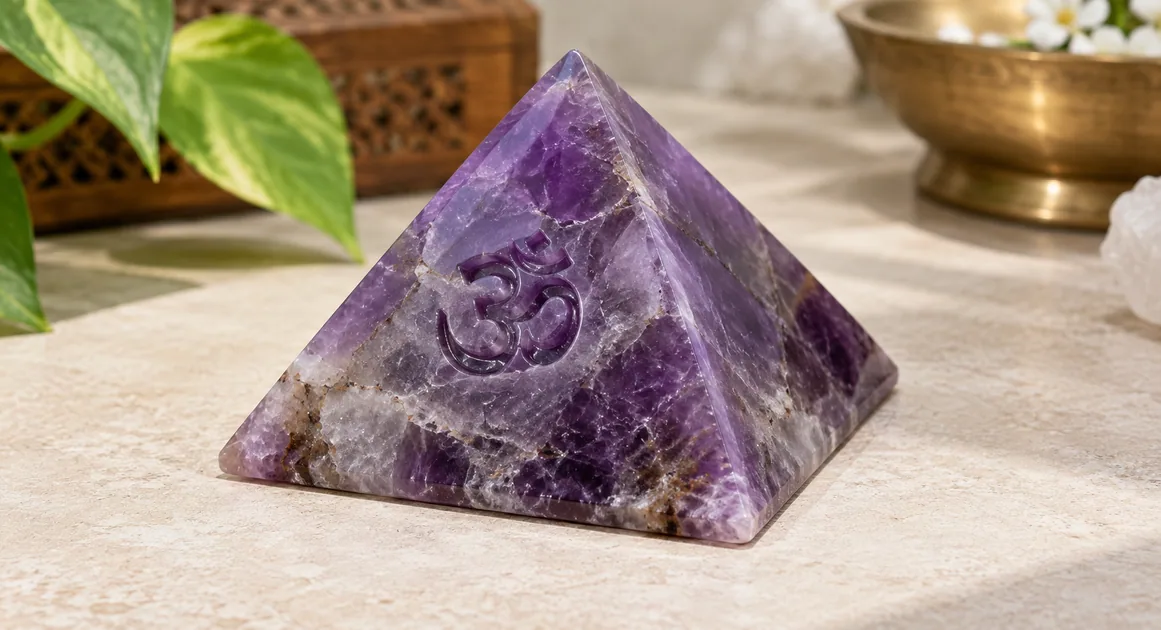
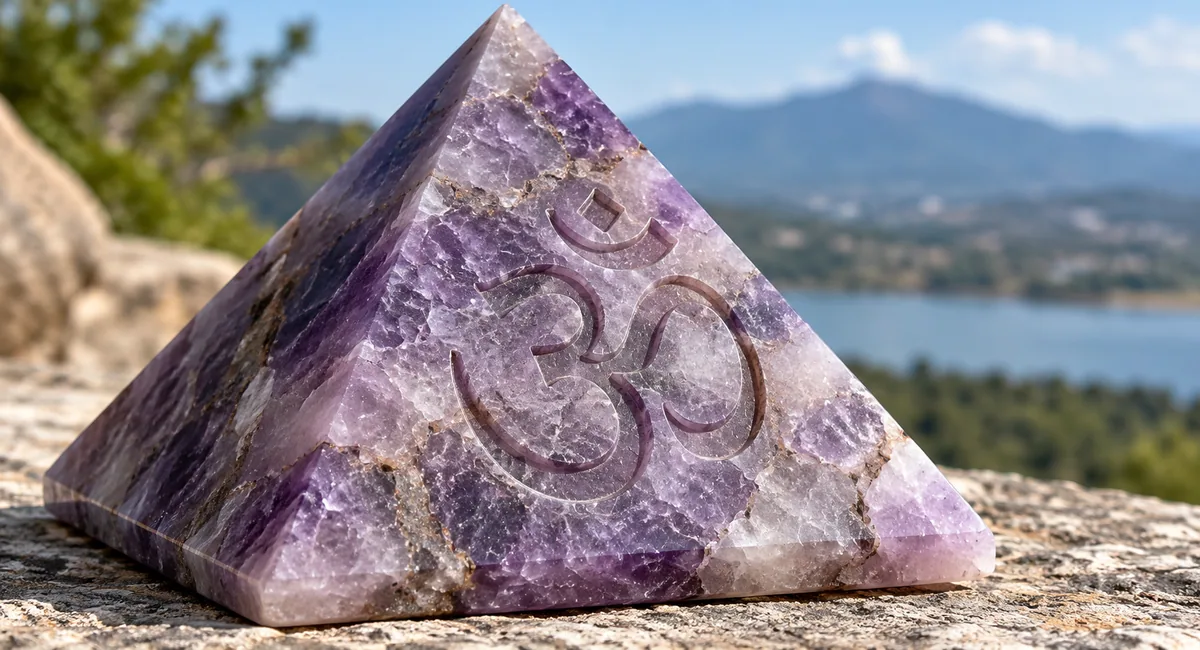
Lettering must remain legible once it is cut into a triangular face. Om has a recognisable visual form: the main curves, upper crescent-like component and dot. In a shallow engraving, the smallest sections are vulnerable to being lost during polishing. In a poorly placed design, the apex may intrude into the top of the symbol, or the lower stroke may disappear at the base edge. Request a direct, well-lit photograph of the actual engraved face rather than relying only on a distant product rendering.
Other scripts and motifs have different requirements. Devanagari lettering should not be reversed for aesthetic symmetry. The exact orientation of a Swastika, the arrangement of a deity's yantra or the stroke order and character form of a tradition-specific symbol may matter to practitioners. A left-right mirror image, missing segment or ornamental substitution should never be silently presented as the canonical form.
| Visual feature | Good workmanship | Reason to ask for another image or clarification |
|---|---|---|
| Position | Centered with comfortable space from edges and apex | Symbol touches a corner or runs over a damaged point |
| Orientation | Correct readable direction when pyramid rests on its base | Reversed, sloping or upside-down mark |
| Line continuity | Continuous, intentional grooves or print strokes | Interrupted lines, filled grooves or polishing damage |
| Depth | Even depth suited to the stone and carving | Deep gouges or cracking around thin sections |
| Contrast | Recognisable in ordinary light | Visible only under exaggerated studio lighting |
| Number of faces | Exactly the advertised single or multiple engraved faces | Listing shows many sides but supplied item has only one |
| Finish | Smooth adjacent polish; no chips or adhesive residue | Rough burrs, open fractures or careless paint |
An inscription can be lovely even when it is subtle. A deep groove is not automatically better. On a small clear quartz pyramid, a clean shallow marking may look more refined and may preserve more of the face than aggressive cutting. On strongly banded or included stone, contrast is particularly important. These are practical quality criteria—not a ranking of spiritual merit.
4. Carved, laser-engraved, etched, printed, painted or gilded: what changes?
Product photographs often show the symbol while concealing how it was made. The production method influences price, legibility, surface finish and future care. “Engraved” ordinarily suggests a mark within the surface; a gold-colour surface print is a different finish. The difference matters both for appearance and for accurate product descriptions.
| Method | Physical characteristic | Inspection and care question |
|---|---|---|
| Hand-cut carving | Tool-shaped recess, sometimes with small variation in stroke width | Are groove edges smooth and free of new chips? |
| Mechanical engraving | Controlled recess cut by a rotating or other tool | Does the carving follow the face evenly, especially near corners? |
| Laser marking | Surface alteration or microscopic etching, depending on material and process | Is it legible without dark paint and is the surface sound? |
| Chemical etching | Material-specific surface reaction or texture change | What process and finishing were used; is the item fully cleaned after manufacture? |
| Paint or surface print | Applied coloured layer, usually without a recessed outline | Could the colour rub or fade; how should it be cleaned? |
| Metallic paint or gilding | Metal-colour layer; may or may not contain precious metal | What is the actual composition, and does “gold” mean colour or metal? |
| Inlaid material | Separate filling in a carved groove | Is the inlay securely bonded and which cleaners are suitable? |
A photograph shot at an angle can make a flat print look recessed because of reflections. A side-lit macro image showing the symbol and a fingertip-scale reference is helpful. A purchaser does not need specialist laboratory equipment to see basic construction differences, but should avoid conducting scratch, solvent or acid experiments on a finished devotional object.
5. Amethyst, rose quartz and clear quartz: which body should carry the Om symbol?
The three commonly offered gemstone varieties share a useful mineral relationship: amethyst, rose quartz and transparent rock crystal are varieties of quartz (SiO₂). Their standard Mohs hardness is around seven, yet a finished pyramid may still chip if its point strikes a hard surface. The colour, transparency, inclusions and polish vary, and sellers should name treatments honestly. The choice of material can express a customer's preferred visual and contemporary spiritual association; the actual Om symbol retains its own traditional significance.
| Pyramid body | Recognisable appearance | Associated use in contemporary practice | What to check before buying |
|---|---|---|---|
| Amethyst quartz | Purple to violet, sometimes with pale and deep colour zoning | Meditation, contemplation, spiritual focus and devotional display | Natural versus treated colour, even polish, visible Om, protection from prolonged intense light |
| Rose quartz | Pale to medium pink, commonly translucent or cloudy | Harmony, affection, relationship reflection and peaceful surroundings | Actual pink body, inclusions or fractures, secure engraved area, treatment disclosure |
| Clear quartz / Sphatik | Colourless to milky transparent or translucent quartz | Shiva-related worship associations, mantra practice and clean minimalist puja displays | Quartz rather than glass, visible natural features where relevant, readable symbol and sound apex |
Sphatik is widely used in Indian religious and devotional contexts, particularly in mala and worship articles. The word refers to crystal, commonly rock crystal in product usage, but the presence of an Om sign does not itself establish that a transparent item is quartz rather than glass. A seller should distinguish the mineral name from the artistic inscription. Likewise, amethyst is a quartz variety with its own mineral identity: its purple colour alone does not make it a canonical Navaratna substitute.
For a practitioner who prefers a calm, simple puja arrangement, a transparent clear quartz piece may be the natural choice. An amethyst pyramid may be selected for a purple contemplative setting, while rose quartz may suit a personal altar concerned with affection and family harmony. These are recognisable contemporary spiritual and aesthetic choices; they should not be presented as a fixed rule contained in every classical Vastu treatise.
6. How to distinguish a genuine engraved stone from misleading product descriptions
A high-gloss finish, a sacred sign and a luxury box can make a listing attractive. None of those details identifies the actual material. Check the product name, stone body, production method, dimensions, weight, number of engraved faces, paint or inlay, treatment information and any included ritual service separately. A materially different product should have a materially distinct listing, even if the artwork is identical.
Some descriptions confuse natural stone with untreated stone. Natural quartz can have been dyed or otherwise modified; an engraved quartz piece is still a manufactured artefact made from stone. A shaped and polished pyramid should not be described as an “unworked natural crystal formation”. Similarly, a symbol stamped onto a resin pyramid should not be called a hand-carved mineral simply because the colour imitates amethyst.
| Listing claim | Useful evidence | What the evidence establishes |
|---|---|---|
| “Amethyst pyramid” | Stone identification and actual photographs | Body material, not ritual history |
| “Deep Om engraving” | Close-up with side light and dimensions | Recess geometry and legibility, not gemstone origin |
| “Gold engraved Om” | Composition of applied decoration | Whether the finish is paint, foil, inlay or precious-metal content |
| “Energised or consecrated” | Specific service description, if offered | What ritual was performed, by whom and what was supplied |
| “Vastu pyramid for all directions” | Practitioner's stated method and arrangement | The claimed usage system; not an automatic directional property |
| “Authentic Sri Yantra” | Full accurate geometry and named tradition | Design being sold; not stone species or installation |
There is a useful difference between a faithful product claim and an overgeneralisation. Saying “Om-engraved amethyst pyramid with one recessed motif, approximate 45 mm base, natural purple colour zoning and polished finish” is specific. Saying “all-powerful Vedic pyramid removes every Vastu Dosha” gives the purchaser neither a material specification nor a traditional method to examine. The valuable listing is the one that makes the physical and symbolic offer understandable.
7. Placement in a puja room, meditation space and Vastu arrangement
Traditionally, the location of a puja room, the order of worship objects and the interpretation of directional zones are matters of household custom, temple or lineage practice, and Vastu advice. A small engraved pyramid is a later decorative or spiritual product, not a compulsory article of household architecture. Use it respectfully within the existing arrangement rather than treating it as an automatic replacement for a deity image, mantra, yantra or puja procedure.
Puja shelf: Choose a clean, stable platform and leave sufficient space for lamps, flowers and ritual vessels. Orient the engraved face so the symbol is readable during prayer and keep it outside the path of ghee, oil, ash, water or candle heat. If the family follows a particular direction or ordering of objects, that practice should take priority over a generic sales chart.
Meditation desk: A palm-sized, stable Om-engraved pyramid can serve as an object of visual remembrance. It may be accompanied by a mala or text used for mantra practice. The purpose is to support a chosen routine, not to prescribe the same stone or compass direction for every meditator. Keep the pyramid on a small tray where it cannot roll or be knocked off.
Vastu demonstration: A consultant may use differently coloured pyramids to illustrate a client's preferred material correspondences alongside an eight-direction plan. If a system maps a colour or deity to one direction, label it as the method used for that demonstration. The symbol Om does not itself establish a compulsory north-east, south-west or other location. In classical Vastu, direction, activity, access, light and spatial arrangement have broader importance than the sale of one ornament.
Jewellery showroom: Position a small sample next to a clearly printed description of the stone and engraved method. Display amethyst, rose quartz and clear quartz on separate pads so customers can compare both the body colour and the mark. A sign reading “Om Engraved — Quartz Varieties” is more informative than a blended tray labelled “Vedic crystals” without material names.
| Setting | Practical placement | Principal consideration |
|---|---|---|
| Home puja room | Clean elevated shelf beside other worship articles | Respect household practice; keep away from flame and liquid offerings |
| Meditation corner | Stable eye-level table or low tray | Readable symbol and an uncluttered focus area |
| Study desk | Dry corner of the desk, beyond the active work area | A quiet personal reminder without obstructing work |
| Retail showroom | Separate labelled samples with a close-up engraving photo | Correct material and finish disclosure |
| Professional Vastu kit | Individual padded compartment with numbered identification | Consistent records of shape, symbol, material and usage |
8. A worked comparison: three Om pyramids for one spiritual display
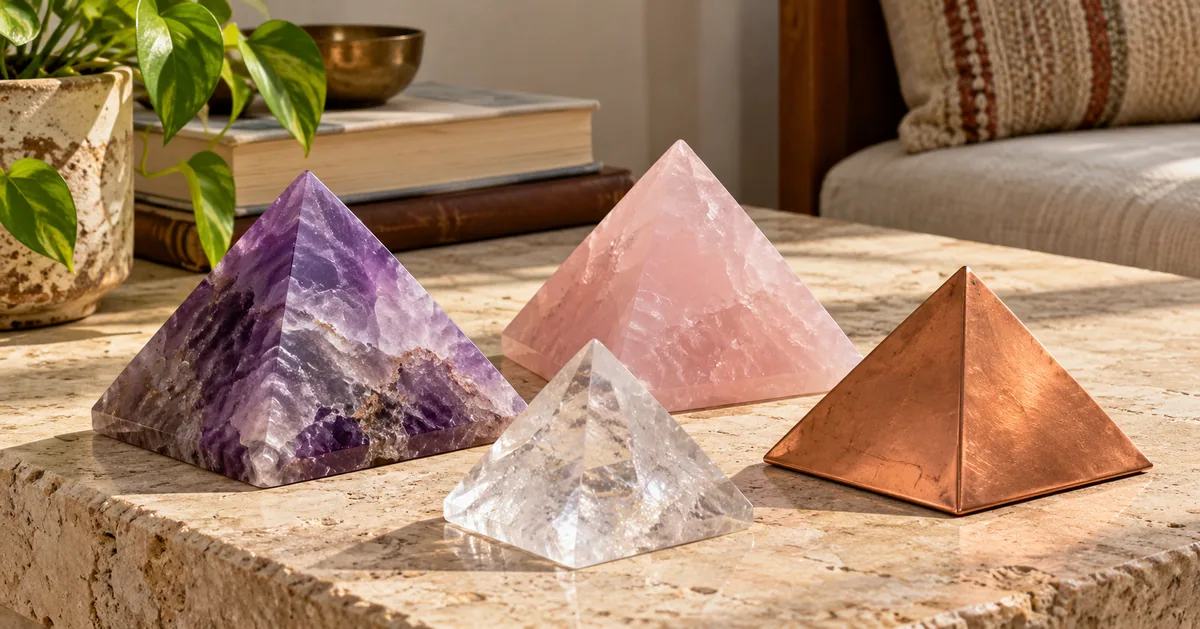
Suppose a customer wants a small set to illustrate gemstone colour without changing the symbol. Select three finished pyramids of roughly similar dimensions, all with one clearly visible Om engraving on the front face: amethyst, rose quartz and clear quartz. Place them separately on a stable three-compartment tray. Before arranging, check that all three have a complete symbol, sound tips, flat bases and the promised stone labels.
- Position the clear quartz pyramid in the first compartment and label the material “Sphatik / Rock Crystal (Quartz)”. Explain the material's place in Indian devotional objects without claiming the pyramid itself is a naturally formed rock-crystal point.
- Position the rose quartz pyramid second. Show its milky pink translucency in ordinary neutral lighting. Explain its contemporary associations with affection and harmony without calling it a classical replacement for a designated planetary ratna.
- Position the amethyst pyramid third. Observe purple colour zones, natural internal features and the contrast of the Om against the surface. Explain its modern use as a contemplation aid and the need to avoid prolonged strong sun exposure.
- Make a simple reference card for each piece: material, approximate base length and height, number of engraved faces, production method if known, treatment information, and care instructions.
- Compare the motif as a constant. If one marking is clear and another partially cut away, the difference is engraving workmanship, not proof that the first stone is spiritually superior. If the tray is used for worship, follow the family's chosen devotional practice.
This comparison makes an important distinction visible: the sacred inscription can be the same, while the stone, appearance and manufacture differ. That is a useful way to choose between Om Engraved Amethyst, Om Engraved Rose Quartz and Om Engraved Clear Quartz designs without confusing colour associations with the meaning of the syllable.
9. Care of the stone, the apex and the inscription
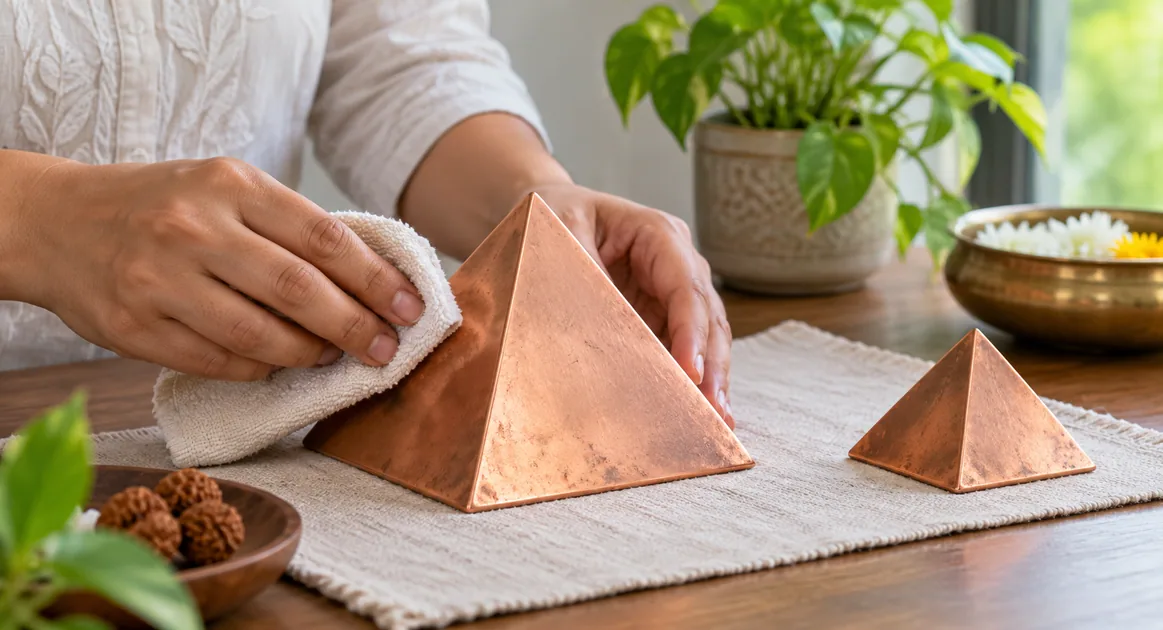
Gemstones must be cared for as physical materials. Quartz has good scratch resistance but a thin carved apex or groove can chip. A clean dry microfibre cloth and soft brush are generally useful for dusting; for confirmed sound quartz without delicate applied finishes, mild soapy water and careful drying may be appropriate. When paint, gilding, fracture fillings or adhesives are present, start with dry dusting and the actual maker's care advice rather than assuming the base stone's resistance extends to the decoration.
| Condition | Preferred approach | Avoid |
|---|---|---|
| Fine dust in recessed Om | Soft clean brush used gently along the groove | Metal pins, knives, hard picks |
| Polished quartz face | Microfibre cloth; careful mild cleaning if untreated and sound | Abrasive powder, rough scrubbing |
| Painted or gilded lettering | Dry soft cloth, maker's guidance for any further cleaning | Solvent, alcohol, metal polish, vigorous wet rubbing |
| Loose inlay or adhesive repair | Stop handling the damaged section; seek repair advice | Soaking, heat or pressure on the join |
| Chipped apex or corner | Photograph and protect in a padded compartment | Grinding it down without considering the design |
| Amethyst in a sunny display | Choose indirect light and stable room temperature | Extended harsh sunlight or abrupt heating |
Keep individual pyramids separated in soft compartments. Do not place several hard points loose in a single pouch where they can strike one another. A small object used near incense should be positioned far enough from smoke, oil drops, hot metal holders and ash. Respectful care includes keeping the symbol readable, storing it appropriately when not in use, and avoiding damage during packing or house moves.
10. A buyer's checklist for Om-engraved pyramids
Use this checklist before placing an order, particularly for an online photograph where the front engraved face looks larger than the actual object. It also helps when comparing a budget laser-marked piece with a deeper hand-finished design.
- Confirm the symbol: Om (ॐ) is named correctly, written legibly and not reversed.
- Confirm the body: amethyst, rose quartz, clear quartz or another specifically identified material.
- Confirm genuine construction: solid carved gemstone, composite body, glass, resin or another specified manufacture.
- Confirm dimensions: base edge, total height, approximate weight and tolerance.
- Confirm marking method: recessed hand or machine carving, laser mark, printed ink, gilded paint or inlay.
- Confirm coverage: whether the motif appears on one face, several faces, or the base.
- Confirm appearance: actual photographs of the front face, point, other faces and underside.
- Confirm disclosures: any known dye, colour treatment, fracture filling, repair or coating.
- Confirm services: if a puja, energising or consecration service is offered, ask exactly what is included.
- Confirm packing: separate padding around the tip and around any delicate engraved or applied finish.
If two pieces share the same Om motif, prefer the one whose material and workmanship meet your needs, rather than judging by dramatic claims. If buying for devotional use, the clarity of the symbol and the suitability of the object for your chosen practice deserve particular attention. If buying for a showroom or a professional collection, a reliable inventory label and consistent specification are essential.
11. Frequently asked questions
Is Om engraved on a pyramid the same as a Sri Yantra?
No. Om is a sacred syllable; Sri Yantra is a specific sacred geometric diagram with its own traditional structure. A pyramid bearing Om is not automatically a Sri Yantra pyramid, and a random triangle motif should not be advertised as a full Sri Yantra.
Does an Om mark mean that the gemstone is energised?
Engraving establishes the artwork. A separately performed puja or consecration is a distinct religious service. If offered, it should have a clear description of the procedure or arrangement, rather than being assumed from the presence of the symbol.
Which is better: amethyst, rose quartz or clear quartz?
Choose for your preferred devotional setting, material colour, quality of carving and care needs. Clear quartz is familiar as Sphatik in Indian worship objects; amethyst and rose quartz are also widely used in contemporary gemstone and meditation displays. No universal hierarchy follows from the same Om marking.
Should a pyramid carry Om on every face?
Not necessarily. A single correctly placed inscription can be a complete design. Multiple faces are a distinct specification and should be shown accurately in the product photographs; they are not automatically better or more authentic.
What if the marking looks golden?
Gold colour can come from paint, foil or another decorative layer. It should not be represented as real gold without the relevant material description. Examine the edges for wear and follow the finish's special cleaning requirements.
Can an engraved pyramid replace a traditional yantra or puja object?
In a devotional space, a pyramid may be an additional accessory or focus of contemplation. A ritual yantra or prescribed article belongs to a specific practice and is not interchangeable merely because both objects have geometric shapes or sacred lettering.
What does a damaged Om engraving mean for the purchase?
If the supplied symbol is incomplete, chipped or reversed, assess it as a workmanship or description issue. Photograph the condition and compare the actual item with the accepted design before deciding whether to keep, exchange or repair it.
In summary: a thoughtfully chosen Om-engraved pyramid joins a meaningful sacred sign to a particular gemstone and a piece of craftsmanship. Identify all three accurately. The result is an object whose spiritual symbolism, visual character, physical quality and practical care can be understood without confusing one with another.
Explore existing OmmRudraksha collections
Browse Vastu for the existing collection, or explore gemstone products for other material forms. Each product’s construction and care information should guide your choice.