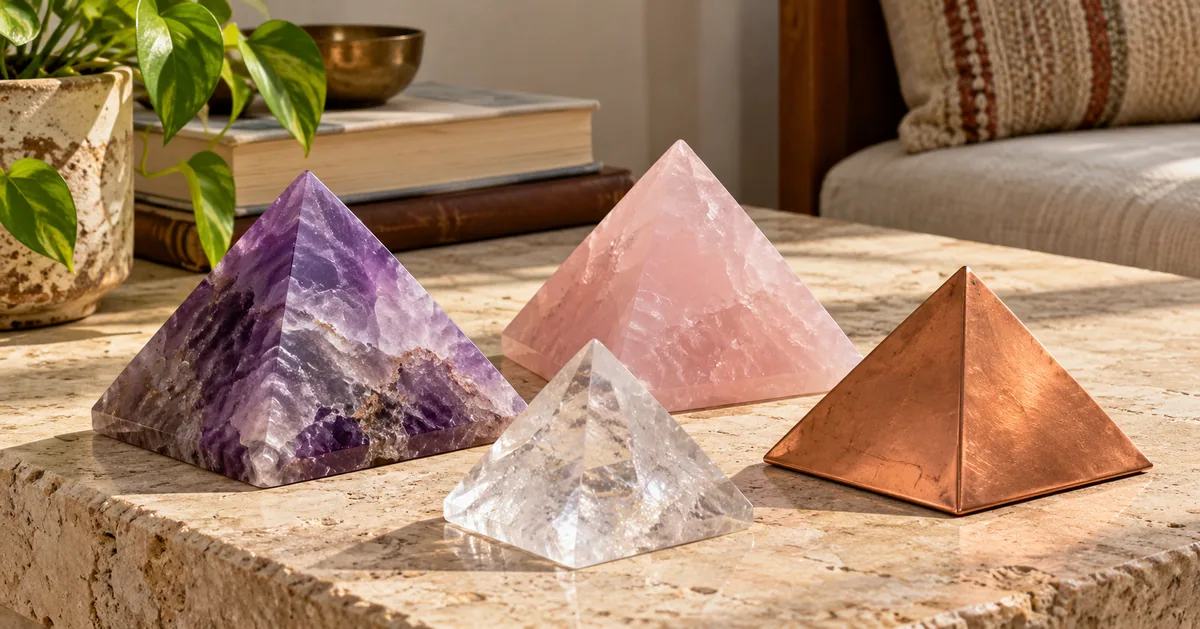
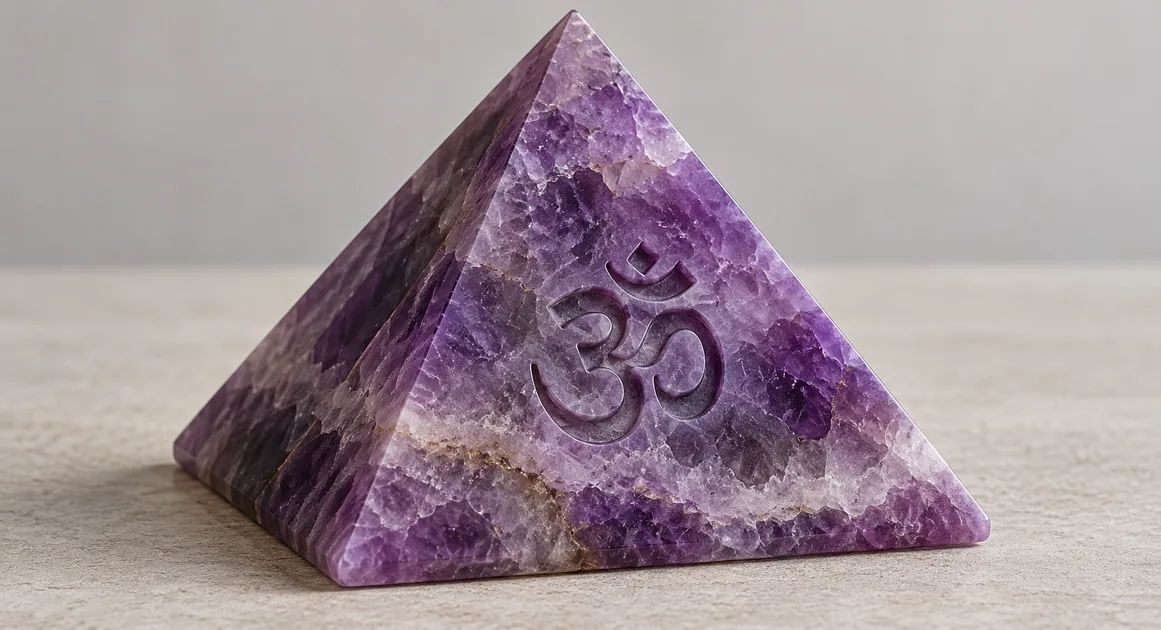
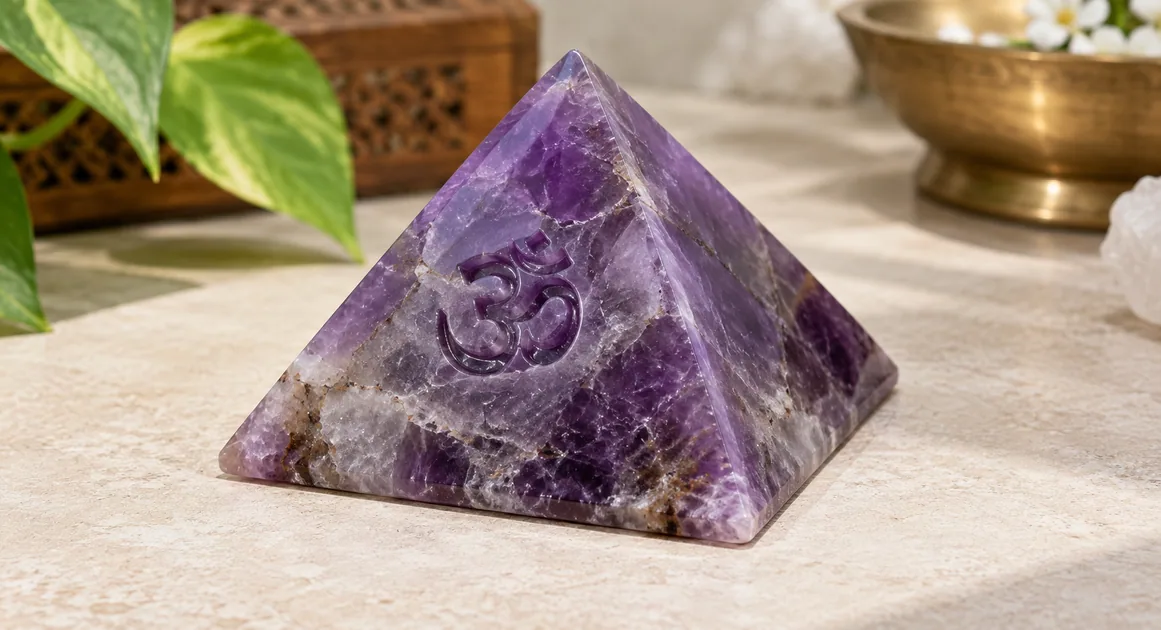
An engraved gemstone pyramid combines three different choices: the stone, the geometric carving and the sacred or decorative symbol on its surface. A purple amethyst pyramid carrying Om is not the same object as a plain amethyst pyramid, yet the engraving does not change amethyst into a different mineral. For a home altar, a study table, a Vastu display or a thoughtful gift, it helps to read each part correctly: identify the stone, understand the symbol, examine the workmanship and then decide where the finished piece belongs.
This guide focuses on Om-engraved amethyst, rose quartz and clear quartz pyramids, the three designs represented in the OmmRudraksha engraved-symbol collection. It also explains how to assess other symbols without confusing their origin. The goal is to select an object that is materially well described, visually balanced and meaningful in the tradition chosen by the owner.
What is an engraved-symbol pyramid?
A gemstone pyramid is a shaped stone object with a broad base and sloping faces converging towards an apex. A square-based pyramid normally has four triangular faces. An engraved version carries a recessed, raised, etched or colour-filled motif on one or more of those faces. The motif may be a mantra syllable, sacred diagram, floral emblem or another intentionally selected design. Stone identity and artwork identity should always be stated separately.
The term “engraved” is sometimes used loosely in product listings. A motif cut into the mineral, one printed on top of a polished face, and one created using a colour-filled groove will age and clean differently. Likewise, a genuine quartz body can carry poor engraving; excellent artwork can be placed on an unidentified composite. A reliable product description reports both materials and methods.
| What you see | What to ask | Why it matters |
|---|---|---|
| Purple, pink or transparent body | Is it amethyst, rose quartz or clear quartz? Is it natural, treated or an imitation? | Names the mineral rather than merely its colour. |
| Om on a triangular face | Is it actually cut into the face, printed or inlaid? On which face? | Identifies the technique and the exact design ordered. |
| Gold or silver in the lettering | Paint, pigment, metallic foil or a documented metal inlay? | Prevents confusing golden colour with precious metal. |
| Regular square base and sharp apex | Are dimensions, base stability and edge condition shown? | Helps compare usable workmanship and safe display. |
| “Energised,” “blessed” or “consecrated” | Is a particular service, ritual and date actually documented? | Separates a supplied service from a decorative symbol. |
The traditional meaning of Om, Pranava and Omkara
Om (Oṃ, ॐ) is a sacred syllable of exceptional importance across Hindu philosophical and devotional traditions. It is called Pranava or Omkara in many contexts and frequently appears at the opening of mantras, prayers and contemplative recitations. The Māṇḍūkya Upanishad devotes its twelve mantras to Om and its relationship to consciousness and the Self. Its teaching associates the sounds A, U and M with waking, dreaming and deep sleep, and describes the measureless fourth, turīya, beyond those states. An Om engraving may therefore serve as a reminder of mantra, contemplation and the unity expressed by the syllable.
That scriptural meaning belongs primarily to a sacred sound and its philosophical interpretation. The familiar written ॐ is a visual form used to represent the syllable; a stone engraving is a contemporary way of carrying that symbol. The Māṇḍūkya Upanishad does not prescribe a purple gemstone pyramid, a fixed apex angle or a mandatory Vastu corner for such an engraving. Traditional meaning can be respected without attributing a modern commercial product specification to the ancient text.
For a person following a particular sampradāya, household tradition or temple practice, details of facing, altar arrangement and ritual handling may come from that tradition. The owner may choose a single clean Om design rather than crowded lettering because the symbol itself deserves visual clarity. The written form should be recognizable, upright and not casually inverted for the sake of a symmetrical photograph.
How Om differs from other motifs
Symbols should be named precisely. A lotus (padma) commonly conveys purity and spiritual unfolding in Indian art. A chakra or wheel can have several contexts depending on the deity and art tradition. A yantra is a more specific sacred diagram whose arrangement and ritual interpretation cannot be replaced by an arbitrary decorative triangle. Reiki symbols arise in a different, comparatively modern healing lineage. These designs may be meaningful to their respective practitioners, but a seller should not label every mark as “Vedic Om,” nor describe all motifs as interchangeable Vastu remedies.
| Motif | Context | Correct description on a pyramid |
|---|---|---|
| Om / ॐ | Hindu mantra, philosophical and devotional symbolism | “Om-engraved [named gemstone] pyramid”; specify script and technique. |
| Lotus / Padma | Common sacred and artistic motif in Indian traditions | “Lotus-motif pyramid”; identify design rather than claiming a prescribed yantra. |
| Specific Yantra | Recognisable diagram with an established traditional arrangement | Name the actual yantra only when its geometry is correctly reproduced. |
| Reiki symbol | Reiki practice with its own symbol conventions | Name the symbol and context, not “Om” or “ancient Vedic geometry.” |
| Unidentified ornament | Decorative carving or maker's pattern | “Decorative engraved motif,” pending accurate identification. |
Choose the body stone: amethyst, rose quartz or clear quartz
All three of the featured materials are varieties of quartz, with silicon dioxide as their principal chemical composition. They may look quite different because of colour and inclusions, but they have broadly similar physical hardness within the quartz family. Their spiritual associations are not the same thing as mineral identification: a transparent quartz body is not automatically an authentic ritual Sphatik article, and a purple object is not automatically natural amethyst.
| Gemstone | Appearance and identity | Traditional or contemporary symbolic use | Good display purpose |
|---|---|---|---|
| Clear quartz / Sphatik | Colourless to translucent quartz; may have veils, fractures or inclusions | Sphatik is familiar in Hindu worship and japamala traditions; transparency is often chosen for contemplative simplicity | Prayer shelf, single Om focal piece, reference stone for comparing engraving clarity |
| Rose quartz | Soft pink, frequently milky or translucent quartz | Popular in contemporary crystal practice for affection and harmonious relationships; not a fixed classical Navaratna assignment | Family-room shelf, gift, restrained home display |
| Amethyst | Violet to purple quartz, with natural colour zoning possible | Often used in modern meditation collections for reflection and quiet focus; not interchangeable with every traditional planetary gemstone | Meditation desk, personal study corner, purple-toned devotional collection |
1. Om-engraved clear quartz pyramid
Clear quartz makes the engraved line easy to examine when lighting and surface polish are suitable. At the same time, a transparent face can create reflections and make a shallow groove look discontinuous from some angles. Ask for one front-facing photograph and a second oblique image. Check that the lettering remains legible against the transparent body, and whether the inscription is deliberately colour-filled or left natural.
Sphatik is a familiar term in Indian devotional practice, especially for quartz objects associated with japa and worship. A Sphatik lingam, a Sphatik mala and an Om-engraved square-based pyramid are not the same ritual object even if all are made of quartz. A family can value the familiar material without automatically importing rites prescribed for another form.
2. Om-engraved rose quartz pyramid
Rose quartz is usually less transparent than clear quartz, which can make pale or shallow engraving harder to see unless the groove casts a shadow or a contrasting infill is used. Its colour may vary within a single stone; soft white veils or subtle zones need not be defects. A saturated pink paint on the surface, however, should not be called the natural colour of the crystal without confirmation.
In contemporary crystal symbolism, rose quartz is often selected as a reminder of affection, kindness and relationships. For a couple's gift or family shelf, that theme may be appropriate. It is distinct from a scriptural rule that rose quartz must occupy a certain bedroom corner. When using a sacred syllable on a bedroom object, many families prefer a clean and elevated devotional location rather than a low bedside surface; personal worship customs should guide the choice.
3. Om-engraved amethyst pyramid
Amethyst is the violet variety of quartz, and natural purple colour can vary from pale lilac to deep violet within the same carving. Strong light across the polished face may reveal zoning or internal veils that are part of the stone's appearance. An extremely even colour is not by itself proof of treatment, and a cloudy face is not by itself proof of authenticity. Material identity should be established from reliable provenance or gemological examination when the claim matters.
Amethyst is commonly included in contemporary meditation displays and can visually harmonise with an Om motif. It should not be presented as a universally prescribed substitute for a named Jyotish gemstone. For a prominent window-side shelf, limit prolonged direct sunlight because some amethyst colours can fade with exposure. A stable indoor placement also protects the engraving and reduces the need for frequent handling.
How to read the engraving: recessed, etched, printed and filled
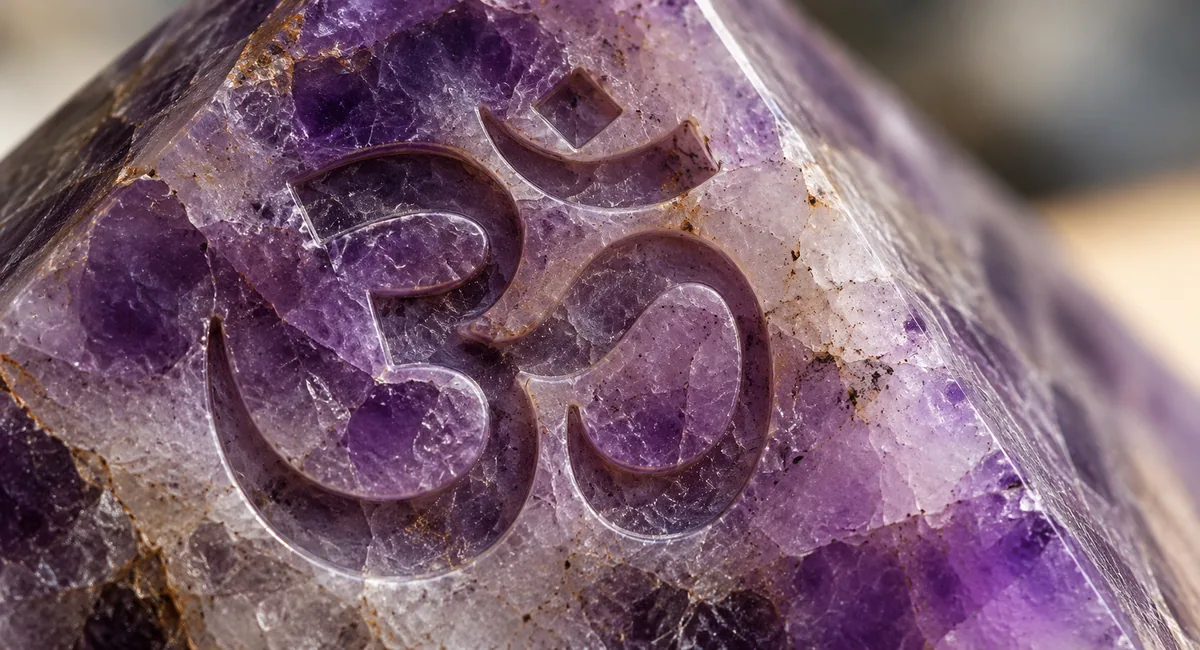
Look at the motif from the side, not only from the front. A true recessed carving creates a groove or depression. A raised relief leaves the motif proud of its background, with stone removed from around it. A printed or painted image may be completely level with the surface. Laser marking, abrasive engraving, rotary-tool cutting and hand carving can leave different textures and edge shapes, but appearance alone may not identify the equipment with certainty.
| Technique or finish | What the close-up may show | What to verify | Handling implication |
|---|---|---|---|
| Recessed engraving / intaglio | Grooves below polished face; shadows when viewed sideways | Consistent depth, legible strokes, no chipped groove endings | Use a soft brush for trapped dust. |
| Raised relief | Letters or motif above lowered background | No thin unsupported ridges, even surrounding polish | Protect raised edges against knocks. |
| Laser or abrasive marking | Fine matte or frosted surface marking | Legibility, permanence, whether treatment is only superficial | Avoid harsh rubbing over a fragile colour finish. |
| Colour-filled groove | Contrasting paint or pigment inside cut lines | What the fill actually is and whether it is sealed | Do not soak or apply solvents without instructions. |
| Surface print or transfer | Coloured outline with little or no physical depth | Print type, abrasion resistance, exact symbol orientation | Gentle dry dusting; no scrub pads. |
A close photograph showing the motif at a slight angle is often more revealing than the familiar marketing picture taken directly in front. Inspect the beginning and end of each stroke: these small areas show whether the maker rushed the cutting, whether a tool slipped and whether the lines are blocked with excess paint. For a sacred inscription, legibility and correct orientation matter more than metallic decoration.
Distinguish painted “gold” from metal inlay
“Gold Om” is an ambiguous sales expression. It may refer to gold-coloured pigment, brass-coloured paint, metallic leaf, a plated insert or genuinely specified gold. Unless a material and method are documented, describe the visible appearance—such as gold-coloured Om detailing—rather than the presence of precious metal. Similar care applies to silver-coloured work. Price differences should reflect the actual documented finish, not a suggestion created by colour.
Ten-point workmanship inspection before buying
Use the same checklist for each gemstone in a set. A fine piece should feel intentional when viewed from the front, sides and underside; a beautiful face does not compensate for an unstable base. The following ten checks are suitable for a showroom inspection or incoming-stock process.
- Correct subject: the intended Om motif is present, recognisable and not replaced by a generic spiral.
- Correct orientation: the script is upright when the pyramid rests on its base; photographs do not reverse the design.
- Material match: the invoiced stone agrees with the item's identity and disclosed treatments.
- Face selection: the motif is centred adequately on the chosen triangular face, with suitable margins.
- Stroke integrity: each visible line is continuous where it should be; no accidental crossings or missing parts.
- Edge condition: grooves, corners and apex do not show new chips, fractures or adhesive repairs.
- Base condition: the underside sits steadily; no wobbling that risks tipping.
- Finish disclosure: clear stone, paint, foil, lacquer or inlay are described accurately.
- Size confirmation: height, square-base dimensions and actual weight correspond to the listing.
- Photographic record: front, reverse or second face, apex and underside are documented for the batch.
A useful grading shorthand is acceptable / inspect further / reject, rather than unsupported “AAA engraving” claims. One slightly off-centre motif on a handcrafted item may still be acceptable if it is legible and the customer knows what to expect. A broken apex, an illegible sacred inscription or an unstable base warrants a more serious decision. For a pair or set, compare all items side by side before promising a matched display.
What the pyramid shape adds to the visual and spiritual arrangement
A square pyramid offers four sloping surfaces and a central apex. Its form naturally draws the eye upwards, so an Om symbol on the front creates a clear devotional focus. This is a visual and contemplative design choice; it is not identical to a traditional yantra, whose geometry can include prescribed lines, enclosures, bindu, lotus petals or deity correspondences. A simple gemstone pyramid with one Om cannot automatically be described as a Sri Yantra, Meru Yantra or fully established Vastu Yantra.
The base is just as important as the apex for a useful display. A stable base means the symbol remains upright during daily worship or when a shelf is dusted. If several pyramids are used, do not assume that their faces must point to exact geographic bearings for every tradition. A practical arrangement begins with stable surfaces, easy visibility, respect for the symbol and the owner's established worship practice.
Vastu placement: choose purpose before direction
In many contemporary Vastu arrangements, the northeast (Ishanya) is associated with prayer, contemplation and a lighter, uncluttered setting. East-facing prayer areas are also common. The centre (Brahmasthana) is significant in Vastu planning, but that does not mean it should be crowded with small products; circulation and the room's actual function matter. These associations provide context rather than an ancient rule that an Om-engraved amethyst pyramid must go in one precise spot.
| Purpose | Practical place | Why it is chosen | Useful check |
|---|---|---|---|
| Daily mantra or silent contemplation | Clean elevated puja shelf or meditation space | Om remains visible as a focus for practice. | Keep away from burning camphor, lamp heat and soot. |
| Quiet personal study | Stable desk shelf, beside but not underneath books | Symbol acts as a reminder of concentration. | Avoid computer-cable snags and desk-edge falls. |
| Family devotional display | Respectful corner of an existing home altar | Fits established household practice. | Preserve room for flowers, lamps and ritual items. |
| Jewellery showroom explanation | Protected counter riser or glass cabinet | Allows side-by-side comparison of material and engraving. | Show stone name and treatment disclosures next to the item. |
| Professional Vastu consultation | Portable reference tray, unpacked only for demonstration | Demonstrates material and geometry without prescribing every piece to every room. | Document position and return pieces to labelled slots. |
Choose a dry, level shelf with sufficient clearance around the apex. Keep a sacred motif off the floor and away from areas where it will be repeatedly handled as a toy or pushed aside. If the display is close to a diya, protect the stone from heat and pigment from soot. A clean cloth or small stand is usually more helpful than a complicated “activation” arrangement. Genuine building defects, poor lighting or leaks are separate practical matters and should be corrected by appropriate maintenance.
Worked arrangement 1: one Om pyramid on a home prayer shelf
Goal: a simple focal point for daily Om japa. Selection: one clear-quartz pyramid with an accurately engraved, upright Om, a secure base and no loose colouring in the groove. Place it on a clean, raised surface of the existing puja area. Keep a lamp at a safe distance and leave the front face visible from the normal seated prayer position. The shape need not be turned repeatedly; consistent placement is easier to maintain and keeps the inscription readable.
Before beginning, gently remove dust with a soft, dry cloth or clean brush. The owner can set a simple sankalpa—a conscious intention for the practice—and perform the customary prayer or japa of their tradition. The engraved object is a focus for the practice rather than a substitute for it. There is no need to claim that an untreated quartz pyramid automatically becomes ritually consecrated on purchase.
Worked arrangement 2: three quartz pyramids for a comparative display
Goal: demonstrate how one sacred motif appears on different stones. Select three similarly sized square-based pyramids, one each of amethyst, rose quartz and clear quartz. Place them left to right in that order on a clean 30–45 cm wide display tray, allowing a comfortable gap between bases. Face all Om inscriptions towards the viewer. If their heights differ slightly, raise the smaller pieces with safe, non-slip stands rather than balancing them on stacked loose stones.
Label them “Amethyst / Purple Quartz,” “Rose Quartz / Pink Quartz” and “Clear Quartz / Sphatik.” In the adjacent description, explain that their quartz mineral family is shared, while colour, internal clarity and engraving contrast differ. A short card can note their contemporary meditation associations without presenting the entire group as a classical Navaratna or a formal Yantra. This arrangement suits a jewellery showroom or a learning demonstration where material identification is the main objective.
Worked arrangement 3: a respectful gift or small consultation kit
Goal: create a compact three-piece gift in which every component can be identified. Choose one of each quartz variety, record each height and base dimension, and photograph the inscription from the same angle. Wrap separately in non-abrasive sleeves and put a labelled divider between pieces. Include a small explanation of Om, a card naming the actual stones and a note distinguishing an engraved devotional object from a ritual service.
For consultation work, add a clean mat and one printed comparison sheet. During the meeting, explain the symbolism of Om and the proposed Vastu context, then display one piece at a time to avoid crowding. If a family already has a central worship image or established ritual object, the pyramid can remain an optional accessory. A useful consultation explains why this particular form is chosen rather than merely multiplying pyramids around every direction of the house.
Care: protect both quartz and the engraved surface
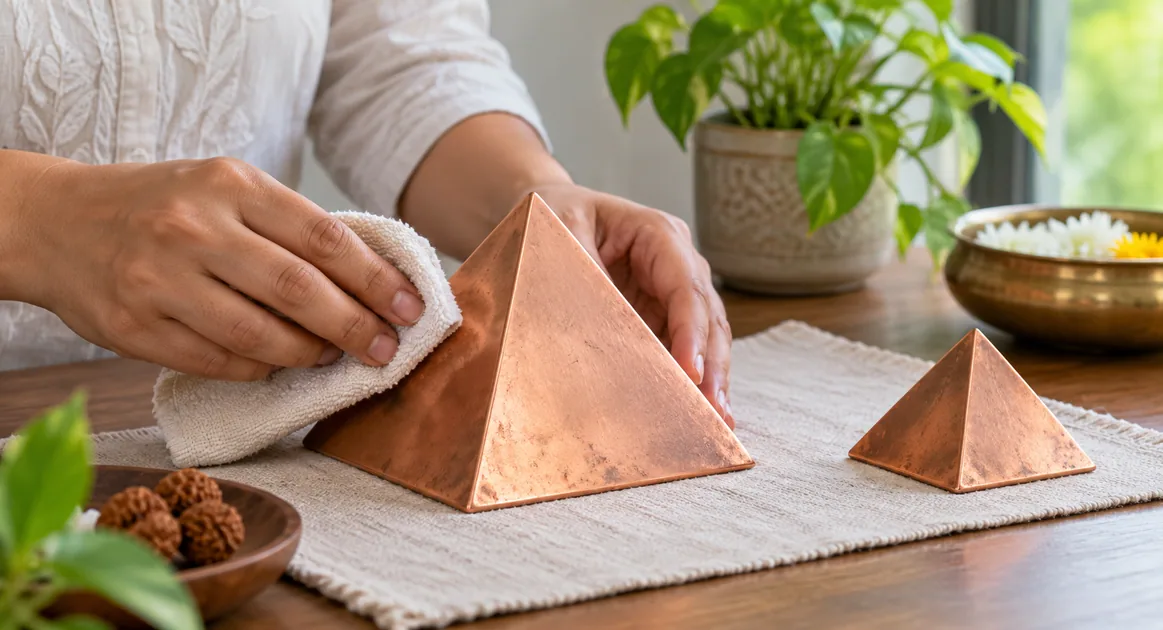
The body stone and motif may have different vulnerabilities. Quartz is fairly resistant to everyday light handling, but its polished edges and apex can still chip when struck. Paint, gilding, glue or coatings inside the engraving may be more delicate than the stone. The safest general starting point for an unidentified finish is a clean soft dry cloth and a soft brush; confirm any wet cleaning with the seller if there is infill or an uncertain treatment.
| Issue | Better response | Avoid |
|---|---|---|
| Dust inside carved Om strokes | Soft dry artist's brush with minimal pressure | Needles, hard toothbrushes and abrasive powders |
| Fingerprints on polished quartz | Clean soft microfibre cloth; follow maker's advice for coated work | Metal polish, rough cloths and unverified solvents |
| Coloured lettering or gilded accent | Very gentle dry cleaning and edge inspection | Scrubbing or prolonged soaking that can lift infill |
| Amethyst in strong window sunlight | Stable indoor shelf away from prolonged direct sun | Long-term high-light exposure where colour retention matters |
| Loose shelf or transport | Individual padded compartments and stable stands | Stacking point-to-point or loose stones in a single bag |
| Flowers, water or oils from a ritual | Keep liquids in separate vessels and wipe spills promptly | Unverified chemical or oil contact over decorative engraving |
Do not use a metal cleaner just because the engraving appears gold-coloured: the colour may be paint over quartz. Likewise, do not assume every “cleansing” method used for an unpainted quartz pebble is suitable for a painted Om engraving. A soft dedicated cloth, a dry protected stand and periodic condition checks are sufficient for most display needs.
Buyer questions worth asking before checkout
For an Om-engraved pyramid, request the exact stone variety, dimensions, base shape, approximate weight and individual-piece photograph when available. Ask whether the motif is cut, etched, printed or filled; whether it appears on one face or multiple faces; and whether the finish is plain stone or a separately applied pigment. If the listing offers a ritual or consecration service, the name and scope of the service should be stated separately from the physical product.
A photograph showing only the decorated front is not enough for careful buying. The side view helps reveal engraving depth, the rear view shows the rest of the mineral, the apex view shows whether a point is intact, and the underside reveals base stability. Buyers of matching sets should ask whether sizes and colour tones are approximate and whether photographs represent the exact received pieces or representative stock.
Frequent questions about Om-engraved pyramids
Is an Om-engraved quartz pyramid a Yantra?
It carries a sacred syllable on a geometric object. A named yantra has its own design grammar and context; the two should not be identified as equivalent merely because both feature geometry.
Does engraving make quartz more powerful or change its mineral identity?
Engraving changes the object's surface design and intended significance to its owner. It does not convert quartz into another mineral. Spiritual interpretation follows the symbol and practice, not a laboratory change in gemstone identity.
Must the Om appear on every face?
No universal rule requires four Om inscriptions. One well-executed front symbol can be a clear choice. A multiple-face design should be identified as such, with photographs confirming all the motifs.
Are amethyst and rose quartz classical Navaratna gemstones?
They are quartz varieties with their own aesthetic and contemporary symbolic uses. Classical Navaratna lists name a specific nine-gem set with planetary associations; a three-quartz Om display should not be marketed as that traditional set.
Can a gold-coloured Om engraving be described as gold?
Only when the actual finish is confirmed. Otherwise use “gold-coloured” or state the documented pigment, foil, coating or metal-inlay method.
Where should an engraved sacred symbol be kept?
A clean, elevated and stable prayer or contemplation area is a practical, respectful choice. Follow family or lineage customs for specific altar directions and ritual usage rather than treating one commercial placement claim as universal.
Can the three quartz pyramids be displayed together?
Yes, as a clearly labelled comparison or personal devotional group. Keep their bases separate, inscriptions legible and colours out of prolonged strong sunlight. The grouping is a modern display choice, not a required traditional three-stone ritual.
Selection summary
Start with the actual gemstone, then judge the engraving, workmanship and intended use. Clear quartz is useful when a simple Sphatik-inspired appearance and inspection clarity matter; rose quartz provides a gentle pink presentation associated with modern themes of kindness; and amethyst offers purple colour frequently selected for contemplative displays. In every case, an accurate upright Om, secure base, protected apex and honest finish description matter more than exaggerated promises about the object. A thoughtfully placed engraved pyramid can complement prayer and Vastu-inspired arrangement while remaining properly described as a modern gemstone carving.
Explore existing OmmRudraksha collections
Browse Vastu for the existing collection, or explore gemstone products for other material forms. Each product’s construction and care information should guide your choice.