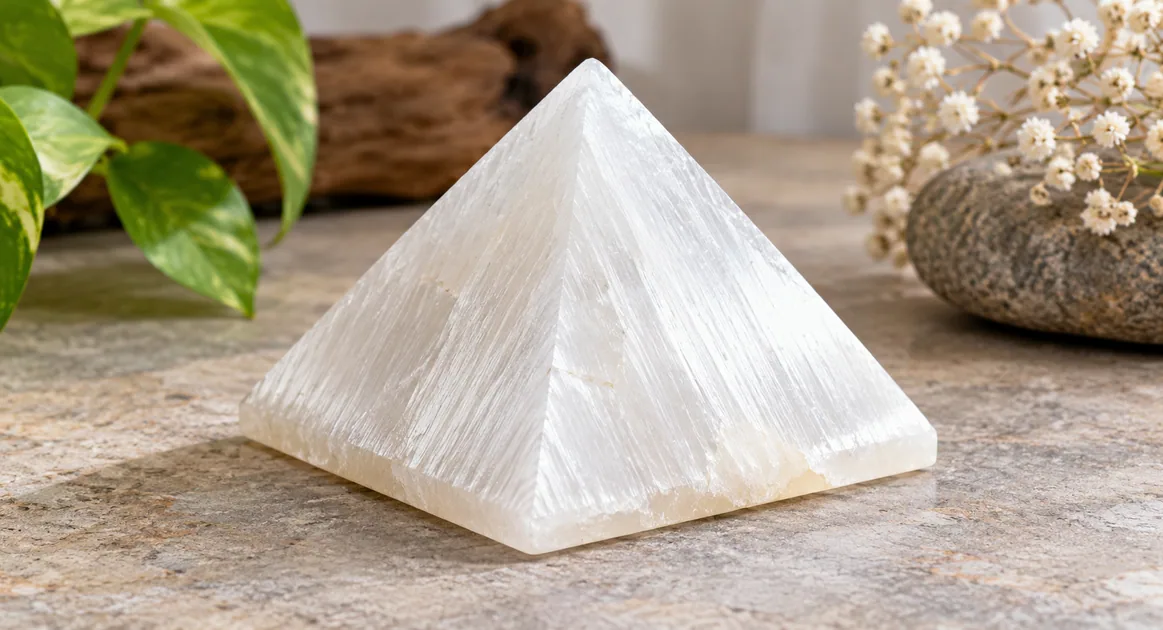
A white, silky pyramid sold as a “selenite pyramid” is often carved from satin spar gypsum. Both names refer to forms of the mineral gypsum, yet the habit of the crystals is not the same. The distinction affects how the surface looks, how the carving can chip, which descriptions are accurate and how the object should be cleaned. A beautiful shaft of light across the face is a useful visual clue; it is not a substitute for identifying the material. This guide connects mineral evidence, careful buying, Vastu placement, traditional white-colour symbolism and everyday dry care.
For a home shrine, meditation desk, office reception or professional Vastu collection, a pyramid should be chosen with two separate questions in mind: What is the actual material and construction? and What significance does the owner attach to its form and placement? A clearly described gypsum carving can be valued for its luminous appearance and its personal meaning without treating the trade name as mineral certification.
1. What is satin spar gypsum, and why is it called selenite?
Gypsum is hydrated calcium sulphate, with the mineral formula CaSO₄·2H₂O. It occurs in several habits. Transparent, often plate-like or tabular crystals are called selenite in mineralogical usage. Fine, parallel fibrous aggregates are known as satin spar. A dense, fine-grained variety of gypsum used for carving is called gypsum alabaster. Retailers sometimes use “selenite” as an umbrella name for polished white satin spar wands, towers and pyramids because customers recognise the term. A transparent selenite crystal and a silky fibrous satin spar carving should nevertheless be described separately.
The terminology is not merely academic. A product listed as “clear selenite” suggests a different appearance from an opaque-to-translucent satin spar piece. Fibrous structure may give a streaked, shimmering or cat’s-eye-like band; transparent selenite may have visible cleavage sheets instead. If the seller can establish that the material is satin spar, the most useful listing is “Satin Spar Gypsum Pyramid (commonly sold as Selenite)”. This respects familiar shopping language while clearly naming the material.
| Term | Material or habit | Typical appearance | Safe product wording |
|---|---|---|---|
| Gypsum | The mineral species | White, colourless or tinted; several habits | Gypsum pyramid when variety is uncertain |
| Satin spar | Parallel fibrous gypsum | Silky bands, translucent-to-milky glow | Satin spar gypsum pyramid |
| Selenite | Transparent or clear crystallised gypsum | Glassy/tabular plates; visible cleavage | Selenite gypsum only when specimen matches |
| Gypsum alabaster | Fine-grained compact gypsum | More evenly cloudy or massive appearance | Carved gypsum alabaster, if verified |
| Retail “selenite” | A trade label, often applied to satin spar | Cannot prove crystal habit by name alone | Explain the trade usage alongside the identified variety |
2. Recognising the characteristic silky light
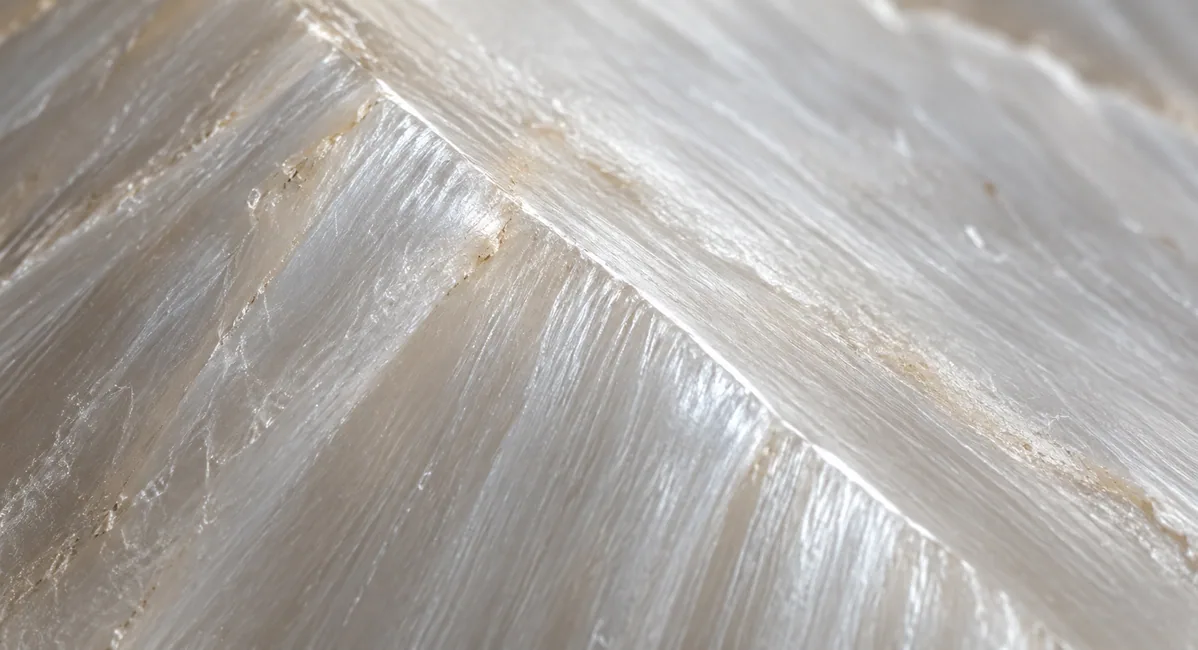
Many satin spar objects exhibit a shifting pale line or luminous ribbon as the carving is rotated under a lamp or daylight. The aligned microscopic fibres reflect and transmit light preferentially along their structure, creating a chatoyant or satin-like appearance. The effect can be striking on broad faces of a pyramid: one face may show stronger bands, another a soft diffuse glow. A photographic highlight can exaggerate the effect, so ask for a short video turning the actual object rather than relying on a single studio shot.
Look for consistent fine parallel lines, gentle pearliness and fibres that seem to run through the carving rather than painted streaks on top. Some natural satin spar contains small irregularities, seams or cloudy layers. These do not automatically indicate a poor specimen. However, loose strands, fresh crumbling edges and deep fractures call for closer inspection. If a seller claims “lighted selenite,” confirm whether an electrical base is included; ordinary satin spar glows in suitable light without electronics.
3. Physical properties that decide durability
Gypsum has a Mohs hardness of approximately 2. That makes it substantially softer than quartz (7) and softer than calcite (3). Its prominent cleavage and, in satin spar, fibrous construction add handling considerations. A decorative pyramid may mark when rubbed with gritty dust or knocked against a harder crystal. These properties make it a display item rather than a durable countertop tool. Do not scratch a retail piece deliberately: destructive testing is unnecessary and damages stock.
| Property | Typical gypsum fact | Practical consequence |
|---|---|---|
| Chemistry | Calcium sulphate dihydrate, CaSO₄·2H₂O | Not quartz, glass, calcite or halite |
| Mohs hardness | About 2 | Avoid abrasive cloths, grit and harder stones |
| Habit | Satin spar is fibrous; selenite is transparent crystalline gypsum | The retail name should not conceal the material |
| Lustre | Silky, pearly or vitreous depending on habit | A moving shine may be normal rather than a coating |
| Water interaction | Slightly water-soluble; sustained wetting is unwise | Never soak or repeatedly wet-wash the carving |
| Breakage | Gypsum cleavage and fibrous edges can split or chip | Cushion apex and corners; handle by the base |
4. Satin spar versus clear quartz, calcite, halite and glass
White translucent objects are easy to confuse in online photography. A pale quartz pyramid may resemble gypsum in a washed-out picture but normally lacks the concentrated parallel silky streaks of satin spar and is much harder. White calcite can have cloudy bands and cleavage faces, yet its fracture and optical appearance differ. Rock salt or halite may be offered in white translucent carvings; it is hygroscopic and behaves differently around humidity. Glass may be extremely uniform and feature bubbles, though appearance alone cannot establish identity. Ask for the supplier’s material description and origin where available, rather than relying on “energy stone” labels.
| Material | What to notice | Buying question |
|---|---|---|
| Satin spar gypsum | Silky linear fibres and soft milky chatoyancy | Is the pyramid carved from natural fibrous gypsum? |
| Transparent selenite gypsum | Glassier clear/tabular crystal texture | Is the item true transparent selenite or satin spar? |
| Clear or milky quartz | Harder, generally nonfibrous appearance | Is it quartz rather than gypsum? |
| White calcite | Often cloudy; distinct cleavage and Mohs hardness 3 | Was the mineral checked before the listing was written? |
| Halite or rock salt | Different crystal habit; especially vulnerable to moisture | Is it a salt carving and are humidity instructions supplied? |
| Glass or resin composite | Potential mould marks, uniformity, bubbles or binder | Is it manufactured, reconstructed or coated? |
5. How the pyramid form changes the inspection
A square-based pyramid concentrates attention on four triangular faces, a narrow apex and four lower corners. Because satin spar fibres may run preferentially in one direction, the orientation of the cut changes the appearance of each face. A bright vertical band on one side and a quieter horizontal effect on another is not automatically a flaw. The cutting orientation, thickness and translucency can account for the difference. A clear photograph of all four faces and a base view helps reveal what the buyer will receive.
Examine the apex for crushed fibres, the base for wobble, and the edges for chips that extend beyond ordinary handmade variation. Ask if the pyramid is a single piece or assembled, filled, coated or bonded. Subtle natural striation is different from painted artificial lines, and a repair line is different from a natural mineral seam. A responsibly written listing distinguishes these. Exact weight, measurements, finish and origin must be verified for the individual piece; generic dimensions from another seller should not be adopted as stock facts.
| Part of pyramid | Acceptable variation | Reason to ask again |
|---|---|---|
| Apex | Small changes in fibre direction or polish | Crushed point, crumbly fibres or adhesive |
| Faces | Soft sheen, natural bands, diffuse translucency | Deep break, peeling coating or unmentioned repair |
| Base | Light saw or finishing marks | Major wobble, cracks or unstable flatness |
| Edges | Minor texture in soft gypsum | Sharp detached splinters, chips not disclosed |
| Entire object | Different brightness in different lighting | Only edited photos and no actual-piece view |
6. White colour, Vastu, Sankalpa and devotional setting
White has longstanding Indian associations with shuddhata (purity), clarity, simplicity, peace and auspicious ceremonial presentation. A pale satin spar pyramid can therefore be chosen as a quiet visual element on a clean shrine shelf, in a meditation area or on a reception console. In devotional use, intention or Sankalpa gives personal significance to how an object is placed. These are traditional and contemporary interpretive practices, not a laboratory classification of gypsum.
A pyramid is a geometric decorative form; it should not be presented as a required classical Vastu prescription in every home. Different Vastu advisers and modern crystal practitioners associate colours and directions in different ways. Some suggest light-toned objects toward the north-east or in a prayer area for a calm, reflective setting; others prioritize functional room layout and the household’s actual rituals. Before giving an exact directional recommendation, identify the entrance, intended activity, surrounding moisture and whether the shelf is genuinely suitable. The object should never obstruct movement, worship or normal cleaning.
The name “selenite” is sometimes marketed with lunar or Chandra symbolism because of its pale appearance and a historical association of the name with moonlight. This association must not be mistaken for a standardized Navagraha gemstone prescription. Jyotisha recommendations for Chandra and pearls have their own traditional contexts. A white gypsum pyramid is not automatically a substitute for a properly selected Ratna or a personalised Kundali-based recommendation. Likewise, contemporary crystal claims of energetic cleansing should be identified as beliefs or ritual symbolism rather than tested sterilisation or a way to treat disease.
| Context | Symbolic or practical interpretation | Placement consideration |
|---|---|---|
| Puja shelf | Whiteness, neatness, Sankalpa, sacred space | Keep clear of water vessels, oil lamps and heat |
| Meditation corner | Quiet light and visual simplicity | A stable side table out of traffic |
| Office reception | Minimal white decor and welcoming presentation | Away from beverages, rough handling and sun-heated ledges |
| North-east Vastu discussion | A commonly proposed placement in some modern practices | Consider actual plan, dryness and adviser’s approach |
| Navagraha or Jyotish | May evoke Chandra by colour in popular practice | Do not confuse this with prescribed gemstone selection |
7. A realistic placement plan for Indian homes
In a Bengaluru apartment, a satin spar pyramid might sit beside a framed deity photograph in a dry prayer alcove. The owner enjoys its pearly reflection in morning daylight. A good arrangement leaves space for incense and aarti while keeping the gypsum away from water-filled kalash, flowers that drip and splashes during routine cleaning. Use a small dry tray or cork pad rather than placing it directly where floor-cleaning water collects.
In a jewellery showroom, a white pyramid can be a decorative counterpoint to gold-toned and coloured gemstone displays, but it should not be handled by dozens of visitors every day. A covered glass display with a stable pad limits chips. A product label may say “Satin Spar Gypsum (sold as Selenite)” with the basic care cue “Keep dry; handle gently.” A shop assistant should not promise that the mineral disinfects jewellery or guarantees sales.
In a professional Vastu consultation kit, keep the satin spar pyramid in a labelled, foam-lined compartment away from quartz points, copper pyramids, salt samples and damp materials. The consultant can use it as an example of white-colour symbolism and the difference between physical mineral properties and traditional interpretations. The field label should include mineral name, habit, appearance, care and any unverified provenance as a pending field rather than a made-up fact.
8. Dry cleaning, storage, handling and transport
Gypsum dissolves slowly in water and is sensitive to prolonged wetting; repeated soaking or flowing-water “cleansing” is especially unsuitable for a delicate fibrous carving. Dry cleaning is the sensible default. Remove loose dust with a very soft, clean brush or a gentle dry microfiber cloth, working lightly along rather than across vulnerable edges. Avoid vigorous rubbing, wire brushes, powders, ultrasonic cleaning, steam, salt-water rituals, vinegar, acids and harsh household cleaners. Do not rub with a nail or use a coin to “prove” softness.
Store separately, wrapped in a non-abrasive tissue or soft cloth and cushioned at the apex. A dry cabinet away from bathroom humidity, sink areas and damp planters is preferable. Gypsum is not unusually fragile merely because of its spiritual nickname: like any soft mineral, it needs basic informed handling. On delivery, photograph any damaged point before disposing of the packing. If fibres or chips are loose, do not brush them forcefully back into place; contact the seller for an assessment.
| Situation | Recommended action | Avoid |
|---|---|---|
| Routine dust | Soft dry brush with light strokes | Scrubbing grit into the polish |
| Puja water nearby | Move the item before rituals and let nearby surfaces dry | Abhisheka, soaking or a wet tray |
| Storing several stones | Individual padded compartment | Contact with harder quartz or metal edges |
| Moving a pyramid | Support from beneath at the base | Lifting by the apex |
| Shipping | Pad point and all corners; immobilise within box | Loose stones moving in the same pouch |
| Unexpected surface powder | Stop aggressive cleaning; document and ask seller | Acids, sanding or improvising surface repair |
9. Buyer checklist for an authentic and suitable piece
A genuine buying decision combines mineral identity with a clear representation of the actual object. Request unedited front, side and base views; a short rotation under neutral light; and confirmation of approximate dimensions and weight. Ask whether the listing uses “selenite” only as a retail alias. Ask about dyes, coatings, resin, adhesive, assembled parts, damaged edges and protective packaging. If a lab certificate is advertised, inspect what was actually tested and whether it identifies the same specimen or lot. A name on a catalogue page is not itself an authentication report.
Price differences can reflect carving size, usable material, finish, breakage risk, packaging and the seller’s service. A stronger lustre does not necessarily mean a spiritually stronger pyramid or a higher mineral grade. Transparent selenite and fibrous satin spar can both be naturally occurring gypsum; choose the look, accuracy of description and condition you want. The most credible seller will explain limitations such as softness before a purchase, not only after a damaged delivery.
10. Frequently asked questions
Is a satin spar pyramid really selenite?
It is gypsum, the same mineral species as transparent selenite, but the fibrous satin spar variety is physically distinct. “Selenite” is commonly used as a broad retail label; a precise listing explains that usage.
Can I keep the pyramid in water to charge it?
No. Soaking is poor care for soft, slightly soluble gypsum. Choose a dry placement and any non-contact personal ritual consistent with your practice.
Why does the white line move when the pyramid rotates?
Parallel fibres cause an optical satin or chatoyant effect. Different orientations and lighting change its appearance.
Is it clear quartz or white calcite?
Not if correctly identified as satin spar gypsum. The minerals differ in composition, hardness and texture. Appearance alone may be insufficient to verify a questionable purchase.
Which Vastu direction is universally required?
There is no single defensible direction for every dwelling and every contemporary crystal interpretation. A commonly proposed north-east placement should be weighed against dryness, safety, purpose and the actual layout.
Can it cleanse other crystals or disinfect objects?
Some people use it symbolically in contemporary crystal traditions. Physical contact with gypsum does not replace cleaning, sanitising or sterilising any item.
How can I tell whether a chip is natural?
Small changes in fibre direction may be natural; broken or loose material is a condition issue. Ask for close-up photos of the apex, edges, underside and any repaired area.
Is more brightness proof of better quality?
No. Lighting angle and fibre orientation influence brightness. Check cut precision, stable base, disclosed repairs and accurate material identity as well.
Should I use it for a Chandra remedy?
Do not assume a gypsum carving is an equivalent to a prescribed Jyotish gemstone. Traditional Chandra-related selections involve a different framework and may require individual consultation.
Can I keep it beside a lamp or diya?
Keep it away from open flames, concentrated heat, wax or oil splashes. Gypsum can change when subjected to high temperatures, and a puja shelf should remain safe.
11. A straightforward purchasing decision
If you want a luminous white decorative pyramid that is meaningful to your puja or meditation setting, satin spar gypsum can be an attractive choice. If you need a stone that tolerates frequent handling and washing, select a different material. If you want a particular mineral specimen, insist on the precise variety and actual-piece evidence. And if you are choosing an object for Vastu, distinguish the symbolism of placement from an individualized astrological recommendation. Good sourcing combines truthful mineral language, respectful traditional discussion and care that helps the piece last.
Explore existing OmmRudraksha collections
Browse Vastu for the existing collection, or explore gemstone products for other material forms. Each product’s construction and care information should guide your choice.