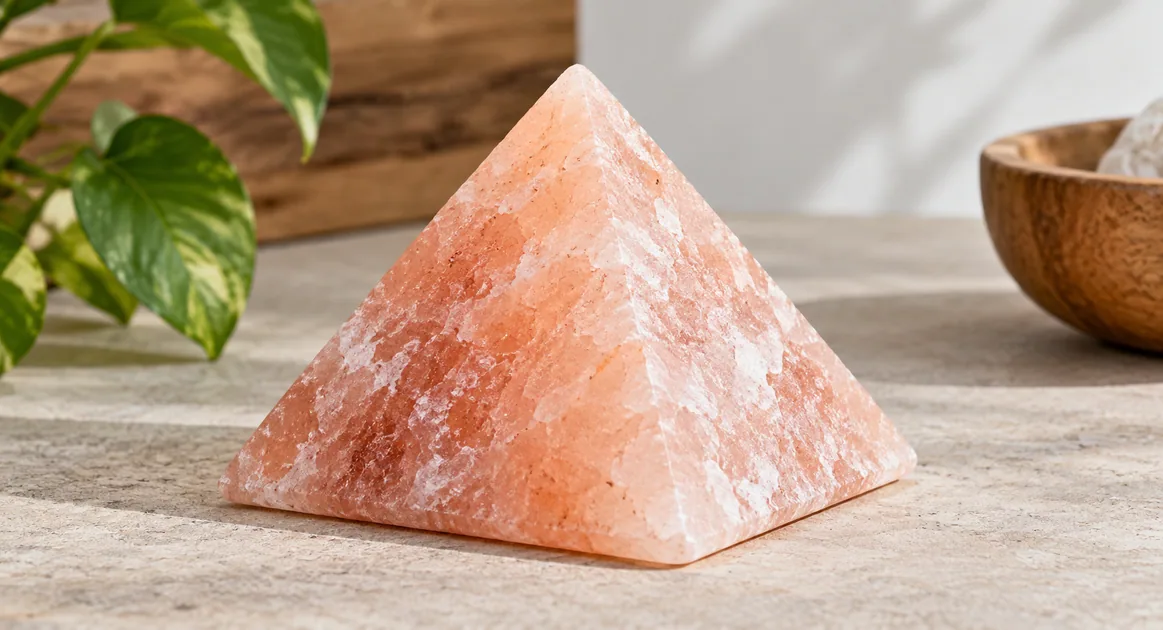
A rock salt Vastu pyramid is a carved or formed object whose main appeal is the conjunction of salt, geometric form and intentional placement. It is not the same material as a quartz or marble pyramid. Rock salt is principally halite, the mineral form of sodium chloride (NaCl). Halite may be white, colourless, pale pink, peach or orange-tinted, and its translucent granular appearance is part of its character. The important practical difference is that halite dissolves in water and is sensitive to humid conditions. A rock salt pyramid therefore needs a placement plan and a care plan before it needs an elaborate ritual arrangement.
In a Vastu setting, salt is often chosen for shuddhi (cleansing or purification symbolism), an orderly household environment and a simple daily sankalpa (intention). These associations belong to household and contemporary spiritual practice; the familiar square-based decorative salt pyramid is not a prescribed substitute for the traditional Vastu Purusha Mandala or a classical Yantra. Understanding that distinction lets you honour the traditional symbolism while making a good material choice for a real Indian home, shop or consultation room.
1. What exactly is inside a rock salt pyramid?
“Rock salt pyramid” describes an appearance, not a complete manufacturing specification. Some pieces are cut from a single mass of halite-rich rock. Others may be moulded from granular salt with a binder, assembled from pieces, coated with an applied finish or made from a different mineral sold under a salt-like trade description. These constructions do not necessarily respond the same way to light, handling, humidity or a small impact. Ask the seller for the principal material, method of manufacture and finish rather than relying on a photograph of the finished shape.
| Construction | Typical visual clues | Useful question | Care implication |
|---|---|---|---|
| Single carved halite mass | Continuous internal clouds, bands or granular zones; no regular joint | Is the pyramid carved from one salt block? | Still water-soluble; protect the base and point from moisture and impact |
| Pressed or moulded salt composite | More uniform texture; possible binder sheen or mould line | What binder, coating or other ingredients are included? | Care must consider both the salt and the binder; do not assume it is washable |
| Joined or repaired segments | Distinct straight seams, adhesive line or discontinuous grain | Is it assembled or repaired? Are joints stable? | Temperature and humidity changes may affect joints separately |
| Other stone sold as “salt-like” | May look opaque, polished or unusually hard | What is the mineral identification? | Cleaning and durability follow the actual mineral, not the product name |
The often-advertised “Himalayan pink salt” description is an origin claim, not a visual test. Pink or peach tones can arise from trace impurities and inclusions, but neither colour nor a grainy texture alone establishes mine location, purity, food grade or authenticity. Ask for a responsible origin description if geographical origin matters to the buying decision.
2. Halite and humidity: the most important physical fact
Relative humidity (RH) indicates how much moisture is in the air compared with what that air can hold at the same temperature. Pure sodium chloride has a deliquescence threshold of roughly 75% RH near ordinary room temperatures. At or above this condition, salt can take up sufficient atmospheric moisture to form a thin saline liquid; people describe the object as “sweating,” “weeping” or “melting.” When the room later becomes drier, that liquid may leave fresh crystals or a rough, powdery crust behind. Repeated wetting and drying can progressively blur carved edges and disturb the base.
Do not treat 75% as a guarantee that every commercial salt pyramid is safe below that number. Natural rock salt can contain other soluble salts, inclusions, residual moisture, coatings or binders. Some salt mixtures absorb water at lower RH. A wet-looking surface may also result from direct condensation, wet hands, a leaking shelf, recently cleaned furniture or packaging moisture. Monitor the actual display, not just a threshold quoted for pure NaCl.
| Observed condition | What it may indicate | Practical response |
|---|---|---|
| Dry, stable faces; clean base | Current display conditions are suitable | Continue occasional dry inspection; keep off bare wood and metal |
| Fine loose grains at the point or edge | Minor chipping, abrasion or moisture cycling | Reduce handling, check packaging or airflow, photograph changes |
| Sticky or glossy patches; damp tray | Possible salt solution on the surface | Isolate from furniture, move to a reliably drier room, allow gradual drying |
| Whitish crust or new rough texture | Salt dissolved and recrystallized after moisture change | Stabilize the room and avoid scraping or wet cleaning |
| Persistent pooling, loss of corners or soft base | Active deterioration or direct water exposure | Remove from display, protect surrounding items and review suitability of the site |
A small hygrometer is more useful than guesswork if the shop has a humid back room, the home is on a poorly ventilated ground floor, or the pyramid is displayed through a monsoon. Measure conditions close to the intended shelf for several days, including after cooking, rain and overnight. An air-conditioned sales floor may be more stable than a window ledge or bathroom, but the room still needs assessment. Avoid cycling a salt piece repeatedly between cold air-conditioning and warm, moist outdoor air in an open bag; condensation can appear on colder surfaces during the change.
3. Why the base, dish and supporting shelf matter
Unlike a solid quartz ornament, a rock salt pyramid can leave saline residue on its support. Salt water can stain or lift some furniture finishes, attack exposed metal fittings, and be drawn into porous stone, cement or unglazed ceramic. The most vulnerable part is commonly the base, because any moisture collects where the pyramid meets the shelf. Protecting the shelf is not merely cosmetic; it makes inspection easier and avoids damage to the display around it.
Use a clean, non-porous glass or glazed ceramic dish, or a suitably inert removable display tray with a stable flat bottom. The tray should be wider than the pyramid base and easy to inspect and clean separately. Place it away from hinges, brass ornaments, jewellery findings and electronic connectors. Do not set the rock salt directly on polished wood, marble, fabric, paper, sacred books, metal plates or an antique shrine. Ordinary paper towels and fabrics can wick moisture and leave lint; they are poor permanent display liners.
A raised stand can be attractive but must be stable and should not concentrate pressure under a narrow corner. Do not use an untested adhesive to attach the salt to a shelf or a metal base. If you prefer a display case, make sure it is dry and not trapping condensation; an airtight case containing a damp object simply encloses the problem.
4. Choosing a Vastu direction without sacrificing the material
Classical Vastu uses directions, proportions, entrances, circulation, light and the function of rooms as part of a larger plan. Contemporary gemstone and salt pyramids are accessory objects within that plan. A practitioner may connect salt with elemental purification, and the pyramid’s orderly base and rising form with focused intention. Those are symbolic choices, not fixed rules that override safety or the actual use of a space. First choose a clean, accessible, low-humidity shelf; then select a meaningful direction within the suitable locations.
| Location | Traditional or practical context | Good display choice | What to avoid |
|---|---|---|---|
| Northeast / Ishanya | Often associated with prayer, clarity and a light, uncluttered atmosphere | Dry side shelf near, rather than inside, a prayer arrangement | Wet offerings, water-filled vessels, damp flowers or sprinkling directly onto salt |
| East | Often connected with light, renewal and a morning routine | Dry indoor shelf away from window condensation | Open windows during rain or repeated splash from cleaning |
| North | Used in some contemporary work or study arrangements | Dry bookcase shelf, separated from documents | Direct contact with paper files, laptop vents or electrical fittings |
| West or near a water feature | Sometimes discussed with Varuna and the water element | Only when the shelf itself is reliably dry | Fountains, aquariums and a habit of misting plants nearby |
| Southwest / Nairitya | Associated in Vastu interpretation with stability and heavier furnishings | Stable, protected sideboard if the room is appropriate | Unsealed stone, damp corners or inaccessible storage behind furniture |
| Entrance or showroom counter | Visible reminder of order, welcome and intentional work | Protective dish beyond frequent contact and cleaning spray | Wet shoes, floor mopping, water bottles and constant handling |
There is no need to force a rock salt pyramid into a damp northeast bathroom merely because the compass says northeast. If the northeast is wet, use a dry part of another suitable room for the salt piece and keep the functional Vastu analysis of that room separate. It is also sensible to rotate between display locations seasonally rather than allowing a decorative object to deteriorate on principle.
5. Lavana, Shuddhi and the meaning of a salt object
Lavana is the Sanskrit term commonly used for salt. In Indian households, salt has long had ordinary roles in food preparation, cleaning and preservation, and it also appears in varied regional customs connected with drishti (the evil-eye tradition), removal of ritual impurity and symbolic cleansing. Practices differ substantially by region, family and lineage. A salt pyramid, specifically, is a modern decorative form through which a household may express that symbolism. It should not be described as an ancient requirement of every Vastu Shastra text.
A simple sankalpa could be to keep a work area orderly, begin the day with attention, or mark a meditation corner as a place of quiet activity. The pyramid then acts as a visible sign of that chosen practice. The significance is in the intention and the routine; it is not necessary to give the object an unsupported physical mechanism such as absorbing all indoor pollutants. Similarly, moisture on salt is adequately explained by its chemistry, rather than used as a test of whether a cleansing ritual succeeded.
When a puja corner includes water, flowers, lamps and incense, position the salt separately from drops, smoke residue and flame heat. Traditional use of a water vessel or lamp does not require placing the pyramid in contact with either. An existing common site-wide disclaimer can cover general spiritual product context; the material-specific instruction here is simply that this particular mineral must remain dry.
6. Inspecting a salt pyramid before purchase
Ask the seller for a normal daylight photo of the whole pyramid, a side view, a close-up of the apex and corners, and a photograph of the underside. Backlit images can make pale salt look extraordinarily luminous and hide chipping; a realistic photo taken without strong backlighting is important. Check all four sides if the pyramid has different natural mineral zones. Irregular colour is not automatically a defect, and a flawless pink look is not proof of quality.
| Inspection point | What to record | Decision guide |
|---|---|---|
| Material declaration | Halite/salt block, composite, binder, coating, origin if stated | Do not substitute a colour-based guess for a composition statement |
| Base width and overall height | Centimetres, including whether measurements are approximate | Choose a support tray slightly larger than the actual footprint |
| Dry weight | Piece weight without packaging or stand | Record for matching shipments; weight alone cannot prove authenticity |
| Apex and four corners | Photographed chips, fissures, rounded or repaired tips | Minor roughness may be expected; active crumbling needs attention |
| Base contact | Flatness, wobble and any residues under the piece | Stable contact and no dampness are important for display |
| Surface finish | Uncoated, waxed, sealed, lacquered or unknown | Coatings can change care advice; do not assume waterproofing |
| Packaging | Individual cushioning, rigid box and dry inner support | Point and edges must be isolated from impact during transit |
The traditional halite taste test does not belong in retail verification. Do not lick or taste a decorative pyramid; it may have been handled, treated, coated or contaminated, and it is not represented as food. A scratch test can permanently damage the edges, and dropping the piece is not a legitimate way to evaluate whether it is solid. Prefer the manufacturer's written material declaration and photographs, and ask about replacement terms before shipping if the object is fragile.
7. Comparing a carved block, granular composite and coated pyramid
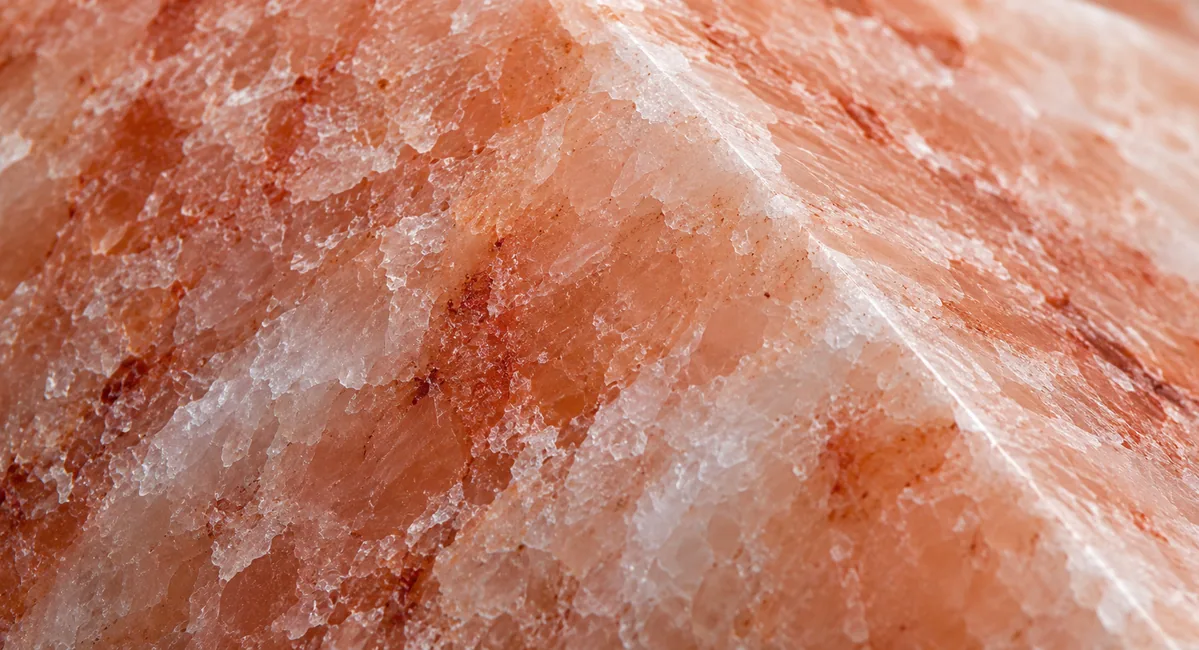
A carved block is often chosen for its natural internal texture and visible mineral layers. A salt composite may offer a more consistent shape, but the binder's identity and surface finish become important. A coating may reduce minor dusting or change the sheen, yet an applied layer can have weak points at corners, the base or small cracks. No ordinary retail coating should be assumed to make an unknown salt assembly completely resistant to immersion or long exposure in a humid room.
To compare offers fairly, list actual dimensions, material, finish, weight, inclusions or other contents, and the number of pieces. Avoid treating variants of the same design as fundamentally different spiritual products merely because one is called “prosperity,” one “protection,” and one “meditation.” If the manufacture is identical, a clear material-specific description is more useful than a different assertion for each colour.
8. Cleaning: what to do and what never to do
For a stable, dry halite piece, begin by lifting it from the base with clean, dry hands, supporting the body rather than pinching the point. Place it on a clean dry tray. Remove loose dust with a soft dry brush or dry lint-free cloth; avoid vigorous rubbing over a naturally granular face. Inspect the supporting dish separately and clean the dish only after the salt has been moved safely away. Return the pyramid after the dish is entirely dry.
Do not immerse or rinse the salt in water; do not use a damp cloth as a routine cleaning method. Steam cleaners, ultrasonic machines, wet flower offerings, saltwater cleansing baths and acid-based household cleaners are unsuitable. A rock salt pyramid is itself soluble salt: washing it with saltwater does not protect it. Avoid household oils and perfume sprays; these can attract dirt, affect binders or leave stains. A hair dryer, strong direct sun or rapid high heat is not a good substitute for stable dry storage, particularly if the object has joints or a coating.
If damp patches appear, first remove nearby papers, electronics and metal objects from the exposure. Put the pyramid on a clean non-porous tray in a more stable, dry room, and allow gradual equilibration. Do not scrape away fresh crystals or pull off damp grains with a cloth. If the item repeatedly develops liquid or loses its shape, discontinue that location and consult the supplier about the materials used. The support shelf may also need cleaning after the object is removed; assess the shelf's own finish separately.
9. Packing and shipping a fragile salt carving
Packaging needs to prevent both impact and moisture exposure. Photograph the dry object and record its dimensions, colour zones, weight and any existing small chips before dispatch. Let it settle in a stable dry room before packing. Use a clean, dry inner wrap that will not stick to a possibly coated or uneven surface; isolate the tip, the four corners and the base inside a rigid protective box with cushioning that does not shed damp fibres. A pyramid should not be loose in a bag with other crystals or metal pieces.
For a consignment in wet weather, provide a suitable dry outer barrier and an undamaged rigid carton. A dry-condition indicator or desiccant can be helpful in a properly designed moisture-resistant package, but it is not a remedy for sealing a damp object. Keep any loose desiccant packet isolated from the carving and away from children. On arrival, inspect the closed package for water exposure, and allow the box to approach room temperature before opening if it came from a cold environment. Check the tray and the object's base before display.
| Stage | Required check | Record or action |
|---|---|---|
| Before packing | Dry surface, intact point, exact quantity | Save front/back/base photographs; note condition |
| Inner protection | Point, corners and underside supported independently | Use dry inert padding and protect from scratching |
| Outer carton | Rigid box, suitable fit, clean moisture barrier | No loose stone-to-stone contact; seal and label appropriately |
| Delivery day | Check parcel for moisture, dents and large temperature change | Photograph external damage before unpacking |
| Receiving inspection | Confirm quantity, dry base, new chips and dust | Record discrepancies promptly with the seller |
| First display | Dry room and non-porous supporting dish | Recheck after the first few humid days |
10. Seasonal care for Indian homes and shops
A pyramid placed in a Bengaluru home may remain stable on a dry interior shelf for much of the year, but a low-ventilation corner, a kitchen-adjacent niche or a leaky window can still become damp during monsoon weather. Coastal or exceptionally humid locations require particular caution. Rather than using a city-wide weather average as the deciding number, monitor the actual shelf and inspect the base in the morning and after rainfall.
For a shop selling mineral and spiritual products, keep rock salt pyramids in their own well-organized display zone instead of alongside polished brass items, exposed silver findings and absorbent jewellery boxes. A removable glass dish makes it easy to demonstrate the product without leaving salt residue on the counter. Avoid sample spraying, wet wiping while stock remains on the shelf, and direct contact with damp decorative plants. Staff should know that the display piece is not intended for an aqueous cleansing demonstration.
For a travelling Vastu consultant, rock salt may be a less robust material than quartz for routine site visits. If the case is opened repeatedly outdoors or moved between hot vehicles and cooled interiors, carrying a sample image or a demonstration piece in protective packaging may be more sensible than using a fragile carved halite specimen on every visit. The correct recommendation can be a dry permanent display at the client's site rather than insisting on transporting the same salt ornament to every appointment.
11. Three practical Vastu display examples
Example A: Northeast prayer shelf in an apartment
The apartment has an Ishanya prayer niche with a brass lamp, flower plate, small water vessel and framed images. The family prefers a pale pink salt pyramid as a reminder of household shuddhi. Position it on a separate glazed dish on a dry side shelf, out of the path of water drops and lamp cleaning. Record the pyramid's base size to ensure the dish has a margin. During monsoon weeks, check for a damp ring beneath the object, not merely on the surrounding shelf. If the niche gets wet during daily worship, relocate the salt pyramid rather than altering the family's existing ritual items.
Example B: Jewellery showroom display
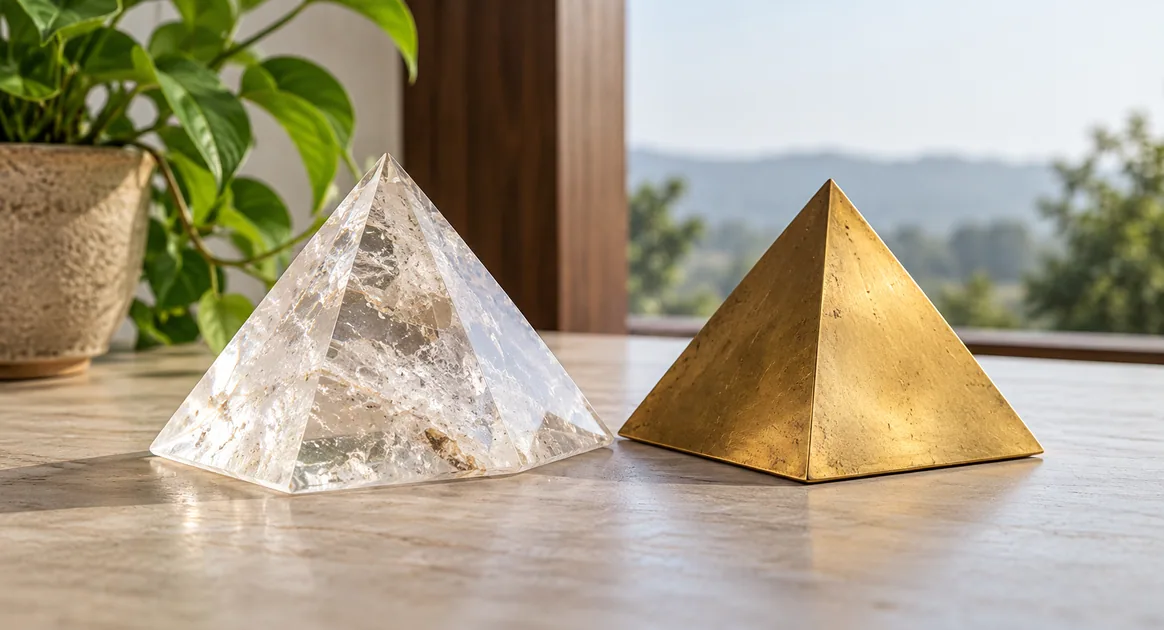
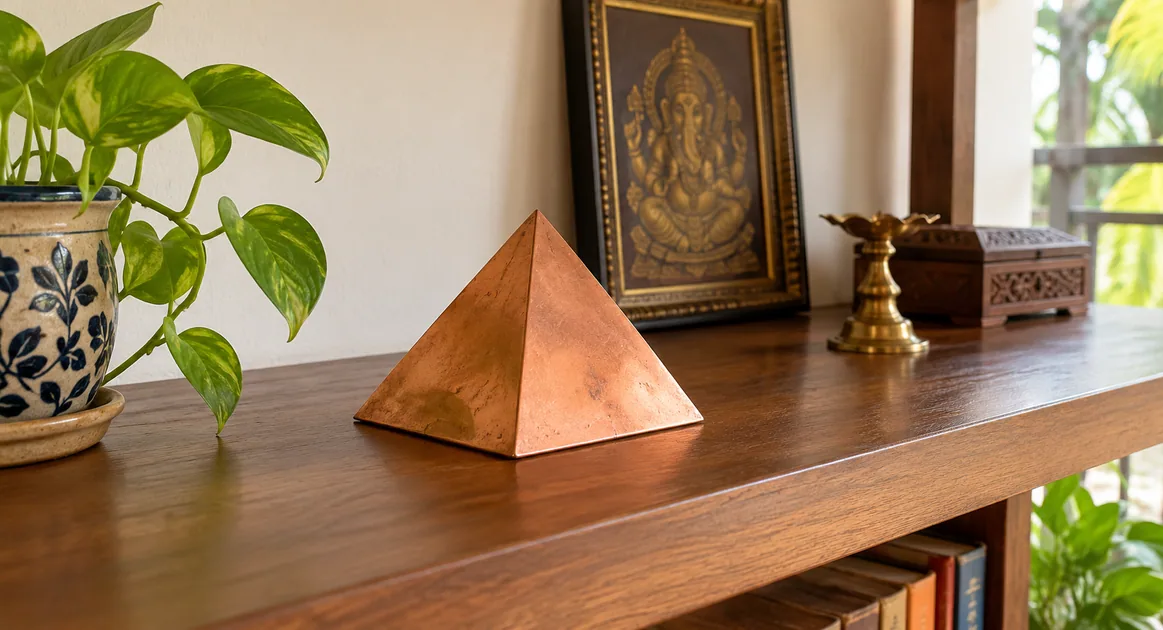
A showroom wishes to present a salt pyramid alongside Sphatik, rose quartz and copper pyramids. Use individual labels: “rock salt / halite—keep dry,” “clear quartz,” “rose quartz,” and “copper construction.” Explain the differences in mineral identity and care without suggesting these are equal in moisture resistance. Display each on a separate support, and let a customer handle the salt sample only with clean, dry hands. Keep spare stock in labelled dry cartons, inspect for new powder or wetness and separate it from metal inventory. The customer receives the exact material and care details with the product.
Example C: Professional Vastu material study
For a teaching kit, include one protected rock salt pyramid, one clear-quartz pyramid, one fired-clay pyramid and one copper pyramid. The exercise is to compare material, construction, surface, weight, moisture tolerance and symbolic association—not to claim that each shape has a measurable power ranking. Place the pieces on separate labelled trays. Demonstrate orientation, stable base support and photographs for inventory. Keep the halite specimen out of any live water or cleaning experiment; use a diagram to explain deliquescence instead of sacrificing a saleable article.
12. Rock salt versus other pyramid materials: a decision table
| Buyer priority | Rock salt / halite | Clear quartz / Sphatik | Fired terracotta | Copper or brass |
|---|---|---|---|---|
| Symbolic theme | Lavana, household cleansing and simple ritual intention | Clarity, light and devotional Sphatik traditions | Prithvi Tattva and earth symbolism | Ritual metalwork, Yantra and contemporary Vastu displays |
| Water exposure | Highly unsuitable; dissolves | Usually more tolerant, with finish and treatment exceptions | Depends on firing, porosity and glaze | Susceptible to tarnish or corrosion in unsuitable conditions |
| Humidity resilience | Requires a reliably dry environment | Generally comparatively stable | Depends on porosity and salt contamination | Keep clean and away from saline moisture |
| Likely handling concern | Point chipping, granular loss, damp base | Corner chips, fractures and coatings | Fragility, edge chips and moisture absorption | Sharp edges, joints, plating and tarnish |
| Most suitable buyer | Someone with a stable dry shelf who appreciates salt symbolism | Someone seeking a more robust clear-crystal display | Someone preferring an earth-material aesthetic | Someone seeking metal workmanship or multi-pyramid assemblies |
This is a material-selection comparison; it does not replace a full Vastu assessment of entrances, rooms and the built environment. An object can be aesthetically and spiritually meaningful without being the right physical material for every shelf. If the display must tolerate incidental moisture or frequent handling, choose a more durable material rather than relying on a label describing salt as “self-cleansing.”
13. Product listing checklist for transparent buying
A useful rock salt pyramid listing should state the likely material or composite composition, whether it is one block or moulded, the measurements and approximate weight, the actual photographs or representative-sample policy, the finish, known repairs, the recommended dry display conditions, packaging method and replacement process for shipping damage. If the product is marketed as “Himalayan,” its origin should be explained rather than inferred from pink colour. If a lamp or light is integrated into a salt object, that is a different electrical product and requires its own safety and use instructions; do not transfer lighting claims to a plain solid pyramid.
For SEO, terms such as rock salt pyramid, halite pyramid, pink salt Vastu pyramid, rock salt pyramid placement, salt crystal pyramid, Vastu salt pyramid care and rock salt humidity are informative when the article genuinely answers those questions. Avoid multiplying product records for identical pyramids whose only distinction is an unverified promise; describe material, size and finish as concrete attributes instead.
14. Common questions about salt pyramids
Why is my rock salt pyramid wet at the bottom?
The most likely causes are humidity, condensation, a damp support or direct moisture. Salt can dissolve by absorbing moisture under sufficiently humid conditions. Isolate the piece from the furniture, move it to a drier and more stable location and inspect any base damage. Wetness is not a reliable way to assess a spiritual effect.
Can I wash a salt pyramid before a puja or a new placement?
No. Water physically dissolves halite. Prepare the shelf, dish and surroundings instead, and use a brief dry dusting if needed. Your own prayer or sankalpa does not require water contact with the carving.
Is a pink rock salt pyramid always from the Himalayas?
No. Colour alone does not identify a geographical source. Ask for the seller's origin information and whether the object is a carved salt block, composite or other material.
Is it safe to put the pyramid on a wooden study desk?
Only with a suitable non-porous protective dish and routine inspection; do not place it directly on varnished wood, paper or near electronics. A reliably dry shelf elsewhere may be preferable.
Does the northeast direction require a salt pyramid?
No such universal requirement follows from classical Vastu planning. Ishanya is important in many Vastu interpretations, but a salt pyramid is one optional contemporary accessory. Room suitability and moisture exposure come first.
Can a coating make it waterproof?
A coating may affect the surface appearance or reduce minor dusting, but the seller must disclose the coating and its care. Do not assume an unspecified finish makes soluble salt safe to rinse, soak or display near a water source.
What if grains are falling off?
Record whether grains appear only after handling or continuously. Check for chips, dampness and repeated humidity changes. Reduce movement, cushion the base and point, and ask the seller about structural integrity if the loss persists.
Should I buy a rock salt or quartz pyramid for a humid room?
For a room where humidity is hard to control, quartz is generally the more practical material. Choose rock salt only when you can display it dry and safely protect its surroundings. The materials offer different symbolism and very different handling needs.
15. A simple placement and maintenance routine
On the day of purchase, photograph the dry pyramid, confirm size and finish, select a dry and clean display location and put it on a protective dish. During the first week, inspect the underside and support every few days. Thereafter, check occasionally and more often during the monsoon, after water-related activities or when the room climate changes. Dust gently without wetting. If the location consistently causes moisture or granular loss, use another place or choose a sturdier material. A thoughtful Vastu display combines clear intention, good housekeeping and an understanding of the actual object in front of you.
Explore existing OmmRudraksha collections
Browse Vastu for the existing collection, or explore gemstone products for other material forms. Each product’s construction and care information should guide your choice.