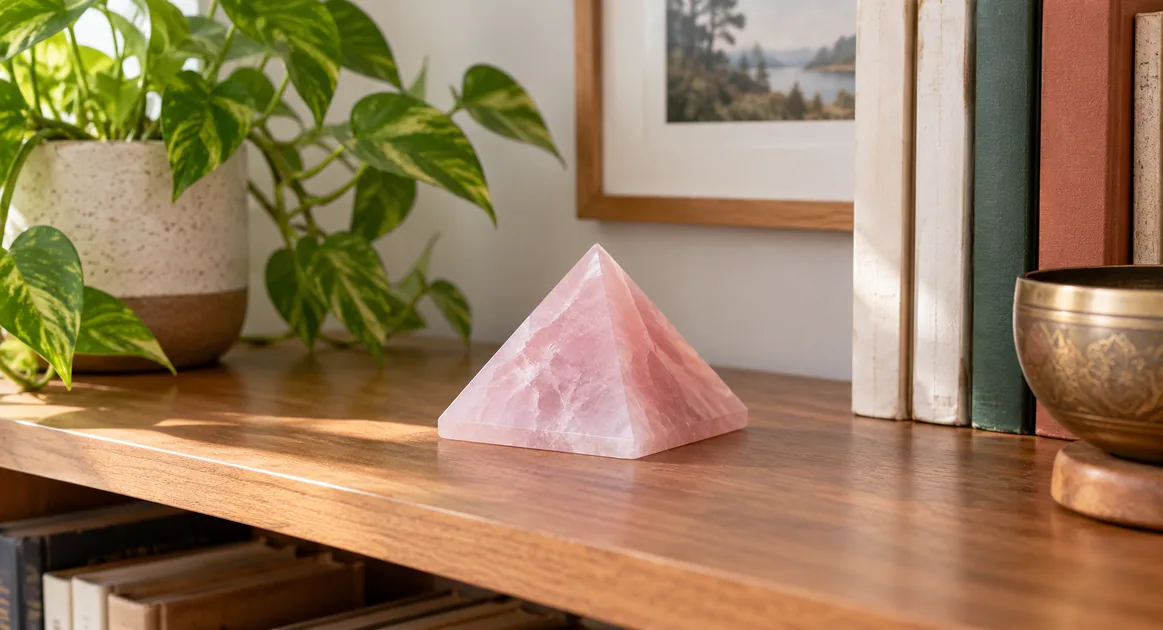
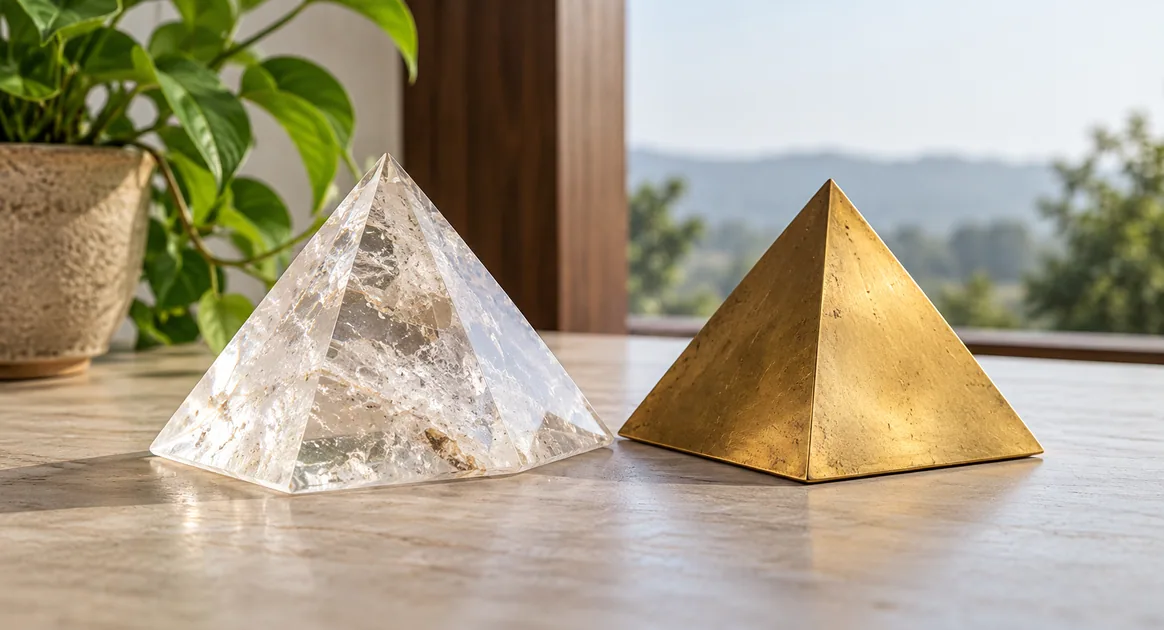
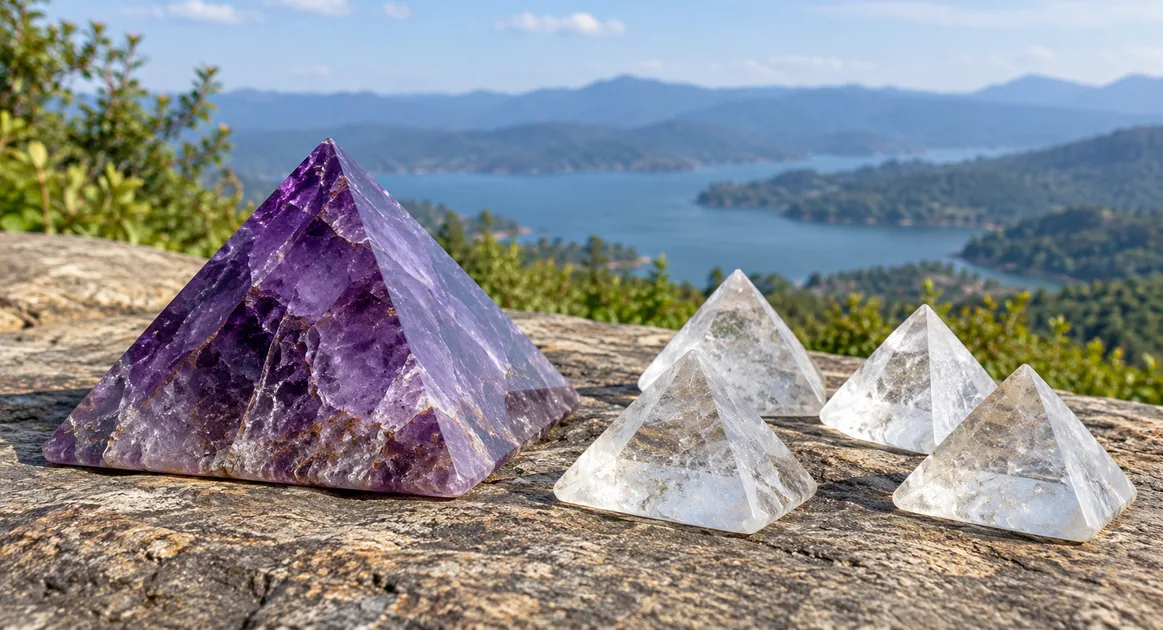
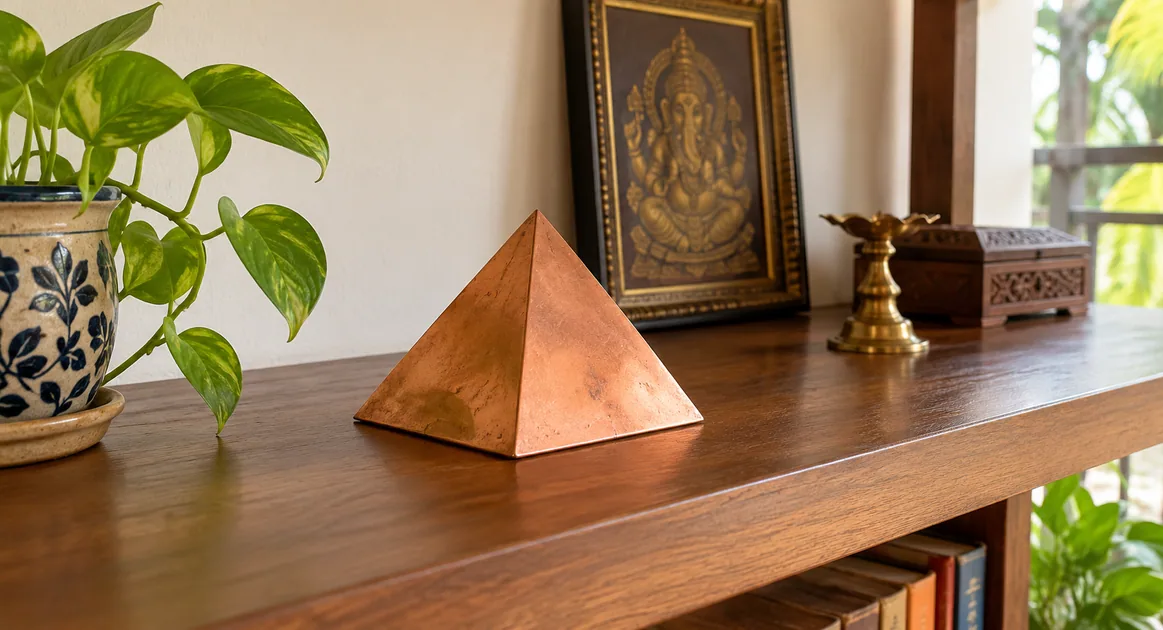
A Himalayan pink rock salt pyramid and a carved gemstone pyramid may have the same shape, but they do not belong to the same care category. A salt pyramid is a water-soluble mineral object whose surface can become damp, rough or crusted when surrounding humidity changes. A quartz pyramid is comparatively durable, while calcite, fluorite and satin-spar gypsum require different handling. For a Vastu shelf, a puja corner, a reception counter or a professional consultation kit, material identification should come before any discussion of where the pyramid is placed.
This comparison covers the nature of rock salt (halite), the properties of carved stones, humidity and seasonal maintenance, traditional Indian associations of lavana (salt), shuddhi (purification), Pancha Mahabhuta and Ishanya (north-east), and step-by-step selection, transport and inspection. It also explains how to choose between a salt pyramid and a stone pyramid when both are offered under the general name “Vastu pyramid.”
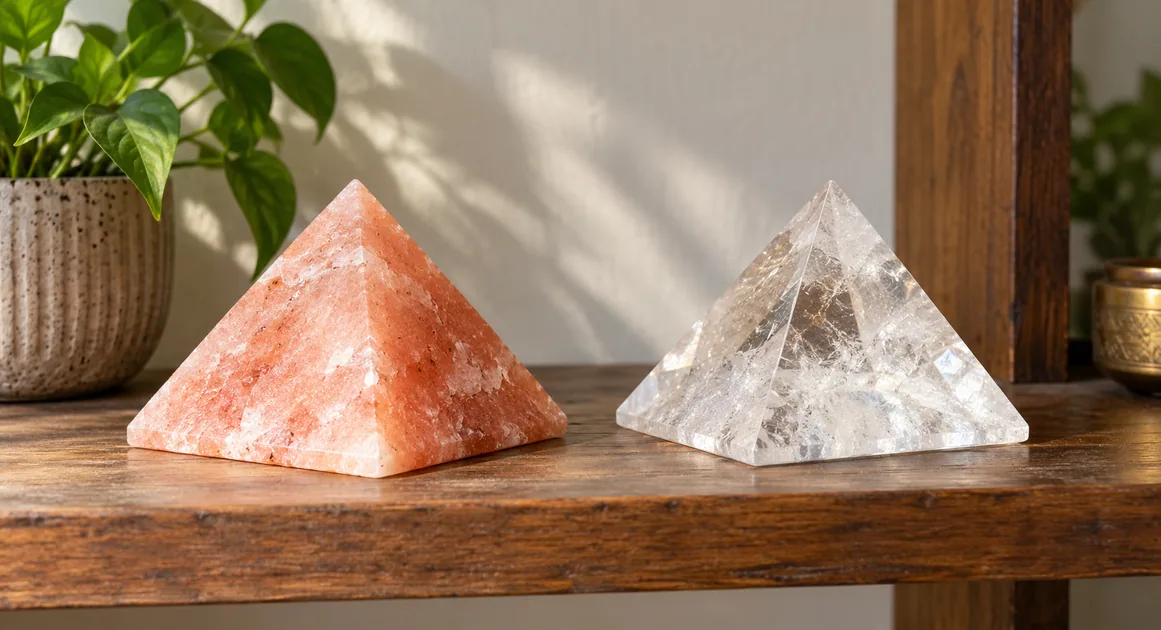
1. What actually differs between a rock salt pyramid and a stone pyramid?
Rock salt is naturally occurring halite, composed predominantly of sodium chloride (NaCl). Pink varieties often contain small quantities of additional minerals or impurities, which influence colour and appearance. Natural colour is not a measure of spiritual strength or mineral purity. A salt carving is formed from a soluble, relatively soft material; the point and thin edges can be vulnerable to moisture and abrasion.
Carved stone is not a single mineral category. A stone pyramid might be quartz, amethyst, rose quartz, banded agate, calcite, fluorite, gypsum, marble, serpentine or a composite. Each has its own crystal structure, hardness, cleavage, possible treatments and surface finish. Transparent clear quartz generally tolerates everyday dry handling better than halite; satin-spar gypsum can be scratched easily and affected by prolonged moisture; calcite requires special care around acids. A label saying only “natural crystal pyramid” does not tell you which maintenance method is appropriate.
| Property | Rock salt / halite | Quartz / sphatik | Calcite | Satin-spar gypsum |
|---|---|---|---|---|
| Typical composition | Sodium chloride | Silicon dioxide | Calcium carbonate | Calcium sulfate dihydrate |
| Approximate Mohs hardness | 2–2.5 | 7 | 3 | 2 |
| Water response | Dissolves readily | Generally stable in brief moisture; assess coatings | Not like salt, but avoid prolonged soaking and acidic solutions | Slightly soluble; avoid prolonged moisture |
| Typical visual clue | Granular, translucent pink or white mass | Glassy polish, clear or coloured crystalline body | Cloudy translucence, possible cleavage | Fibrous, silky sheen |
| Conservative cleaning | Dry soft brush or cloth | Soft dry cloth; damp only if verified untreated and sound | Dry soft cloth; no acid | Very gentle dry dusting |
| Important buying question | Solid carved halite or pressed/bonded salt? | Natural quartz, glass, composite or treated carving? | Correct mineral and any coating? | Actual gypsum or trade-named substitute? |
Mohs hardness describes resistance to scratching, not impact strength. A hard quartz point can still chip if dropped; a soft salt carving may stay presentable for years when kept consistently dry. Material, finish, workmanship and environment all matter.
2. Why humidity changes the surface of rock salt
The central difference is deliquescence. Sodium chloride can absorb enough moisture from very humid air to form a thin liquid salt solution. For comparatively pure sodium chloride near ordinary room temperature, this becomes pronounced around 75% relative humidity. This is a physical property of halite, not a rule that a decorative pyramid will remain perfectly dry at every reading below 75%: impurities, mixed salts, surface dust, nearby condensation and local microclimates can change what happens in practice.
When conditions turn drier, moisture can evaporate and dissolved salt may recrystallise. Repeated damp–dry cycles can alter a point, blur polished faces, create white deposits, roughen surfaces or leave residue on a stand. A pyramid may seem to “sweat” or appear wet underneath without any liquid being poured on it. That appearance should lead you to inspect humidity, the protective tray and ventilation.
Relative humidity is not the same as water vapour content alone; it changes with temperature. A cool window ledge, an air-conditioner outlet or a wall near condensation may behave differently from the centre of the same room. A small digital hygrometer gives more meaningful information than simply assuming that every room is dry. In Bengaluru’s rainy season, a closed cupboard may retain moisture; a coastal house can have a different pattern again. Check the actual location rather than relying only on the city’s general climate.
| What you observe | Likely physical explanation | Useful response |
|---|---|---|
| Moist or sticky base | Water uptake, surface condensation or trapped dampness | Move to a dry ventilated room; inspect the tray and shelf |
| White crust or grains on coaster | Salt has dissolved and crystallised again | Separate pyramid and clean the stand by its own care instructions |
| Rounded tip or softened edges | Repeated moisture exposure or handling wear | Stop wet cleaning; protect the carving from future exposure |
| Colour appears patchy | Natural variation, moisture, surface condition or finish differences | Review construction and compare photographs over time |
| Nearby metal shows corrosion | Salts and moisture encourage metal corrosion | Remove direct contact; isolate salt from metal shelves and fittings |
Important distinction: a halite carving is not a room dehumidifier designed to collect and safely contain moisture. If salt dissolves on a valuable wooden or metal surface, the resulting brine can damage the setting. An absorbent-looking object should not be relied upon to manage damp air.
3. Traditional meaning: lavana, shuddhi, and the place of pyramids in Vastu
Salt, or lavana, appears in Indian household practices, customary cleansing routines and various regional traditions. Some contemporary Vastu practices place rock salt in bowls or use salt-related arrangements as a symbolic part of maintaining a space; local customs and family instructions vary. The idea of shuddhi can refer to physical cleaning, ritual preparation or spiritual purity depending on context. It is useful to identify which meaning is intended when buying a salt object.
A carved pink salt pyramid is a contemporary devotional or Vastu retail form, not a universally prescribed object in classical Vastu texts. Likewise, coloured gemstone pyramids are often modern adaptations used alongside traditional directional ideas. A Yantra has its own geometry, deity, mantra and ritual tradition; a four-sided decorative stone pyramid is not automatically a Yantra. This distinction helps a buyer appreciate spiritual meaning without confusing separate traditions.
The Vastu framework of Pancha Mahabhuta—Prithvi (earth), Jala (water), Agni (fire), Vayu (air) and Akasha (space)—is frequently used to discuss the qualities of a room. Salt originates from the mineral world and dissolves in water; that material relationship can be used symbolically when planning a display. Carved quartz or agate is often selected for clarity, colour, beauty or particular personal associations. The natural physical behaviour of the object still decides how it should be cared for.
Salt, gemstone and directional symbolism are three different choices
When a customer requests a pyramid for the north-east (Ishanya), first establish whether they want a traditional prayer arrangement, a modern gemstone display or a practical Vastu accessory. Light, cleanliness, calm and an uncluttered surface are frequently emphasised for a prayer or meditation area. A solid clear-quartz pyramid may be easier to maintain there than halite if the same corner is also near an open window or a vessel of water. Conversely, a rock salt carving can be displayed in a controlled, dry area chosen for its symbolism rather than forced into a moisture-prone corner.
No single material should be declared obligatory for all houses or offices without understanding the room, the intended practice and the actual object. The significance of a directional choice belongs to the Vastu interpretation; whether a pyramid becomes wet or chipped belongs to its mineral properties.
4. How to choose between salt, quartz, calcite and fluorite for a Vastu shelf
Begin with the desired appearance and practice, then consider room conditions. For a compact puja shelf where water is routinely offered, objects are wiped frequently and lamps are used, avoid positioning a halite piece within the splash or heat zone. On a dry meditation table with no water service, a salt pyramid may be easy to maintain. For a reception counter handled by several people, an identified solid quartz carving usually offers a more practical maintenance profile, while softer materials require additional protection.
| Display situation | Material to consider | Reason | Key preparation |
|---|---|---|---|
| Dry meditation shelf | Rock salt or quartz | Both can be displayed when the environment suits them | Use separate stable stand; keep salt dry |
| Prayer space with daily water offerings | Identified quartz, away from splash | Less vulnerable to accidental drops of water than salt | Protect all carvings from oil and flame |
| Open window or humid entryway | Durable identified carved stone | Halite is more likely to change condition | Inspect condensate, sunlight and rain exposure |
| Glass reception cabinet | Quartz, agate or protected salt | Depends on actual enclosure humidity and access | Use a dry base; separate metals and salt |
| Professional travelling Vastu kit | Quartz or well-protected specimens | Ease of repeated unpacking and cleaning | Give salt its own sealed dry compartment |
| Temporary seasonal display | Any correctly labelled material | Short display can accommodate delicate items with care | Inspect before and after the season |
Colour should not be treated as a hardness or care rating. A pale rose-quartz carving and pink rock salt can look similar from a distant photograph but differ fundamentally. Ask for the material, the finish and an underside photograph. Avoid buying on colour alone.
5. Inspect the construction, not just the pink or translucent colour
A genuine rock salt pyramid may be cut from a larger piece, assembled from pieces, pressed with binders or shaped using other manufacturing methods. All of these need clear description. “Himalayan” is often a trade description and by itself does not verify a mine, provenance or single-piece construction. A carved quartz pyramid likewise may be natural crystal, dyed stone, glass, resin or a layered object. Ask for accurate naming rather than assuming that a beautiful finish proves mineral identity.
Inspect five views: the four sloping faces, the pointed apex and the base/underside. Check whether the pyramid rests without rocking, whether edges are deliberately rounded, whether the base has a protective pad and whether anything has been glued. A hairline may be a natural vein, a cutting mark or damage; a detailed photograph helps decide. Compare the item offered with the item pictured, especially where natural salt bands or crystal inclusions vary from piece to piece.
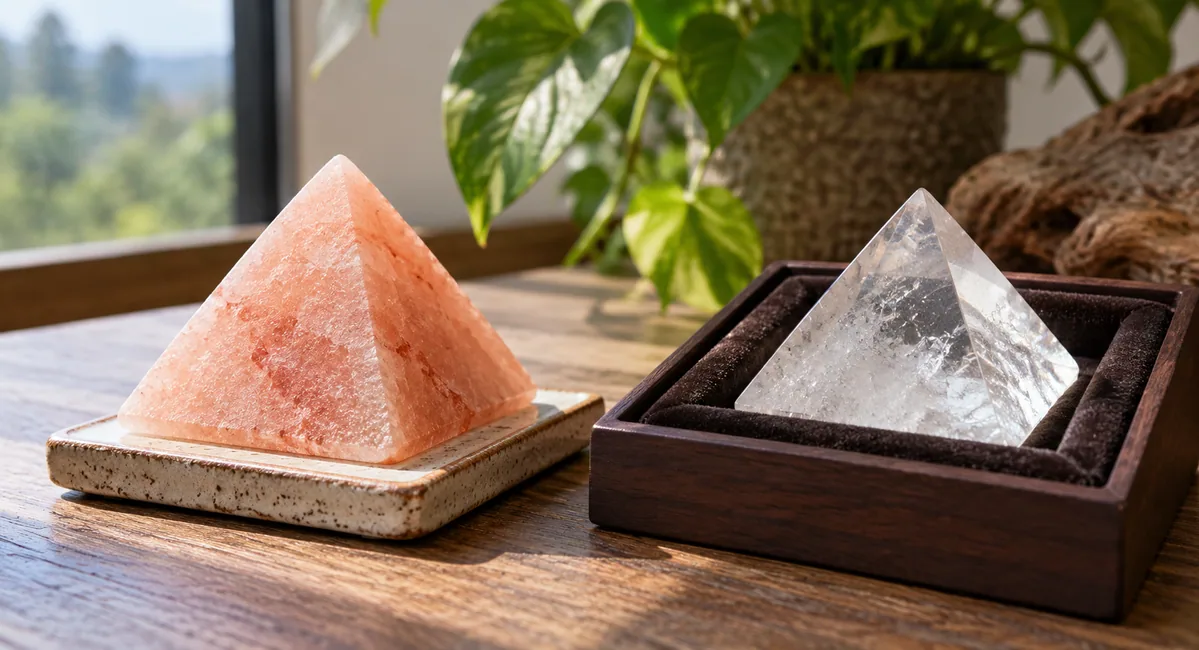
A practical eight-point inspection
- Name: Is the body labelled halite, quartz, calcite, gypsum or another specific material?
- Construction: Is it solid carved, bonded, coated, pressed, hollow or assembled?
- Finish: Is there lacquer, colour treatment, a sealant or an added polish?
- Dimensions: Are base width and vertical height stated in centimetres?
- Weight: Is the number net weight of the pyramid, excluding stand and packaging?
- Condition: Are the point, edges and underside shown clearly?
- Location: Will the intended space be dry, humid, frequently handled or near a wet ritual area?
- Care: Does the seller give directions specific to the actual mineral and coating?
Do not taste an unidentified decor item or carry out scratch, water-drop or acid tests on a saleable carving. These may damage the surface and can be inappropriate when the piece is coated or bonded. Accurate seller records, genuine photographs and gemological examination when warranted are better starting points.
6. Cleaning procedures: why the same ritual cannot suit every material
For rock salt, begin with dry dusting using a very soft brush or lint-free cloth. Do not submerge it or wash it under a tap; the surface can dissolve. If the carving is already wet, set it on a clean non-metallic protective surface in a controlled dry room and inspect the extent of softening before moving it again. Do not try to remove crust by force while the edges are damp. After it has stabilised, assess whether it is still suitable for display.
For untreated, sound quartz, dry dusting is still the safest default. Some properly identified quartz objects may tolerate brief cleaning with a damp cloth, followed by immediate drying, but this does not extend automatically to dyed, repaired, glued or coated carvings. Calcite is sensitive to acids and prone to cleavage-related chips. Fluorite can cleave and is not a good choice for rough handling. Satin-spar gypsum is exceptionally easy to scratch and benefits from gentle dry cleaning. For unknown stones, request the material identity before using detergent or water.
| Action | Rock salt | Quartz | Calcite / fluorite | Gypsum |
|---|---|---|---|---|
| Soft dry cloth | Preferred | Preferred | Usually preferred, with light pressure | Preferred with very light pressure |
| Water rinse | No | Only if verified appropriate | Avoid as a routine default | Avoid |
| Vinegar or acidic cleaner | No | Not routine | Especially avoid for calcite | No |
| Steam / ultrasonic cleaning | No | Not for unverified carvings or repairs | No routine use | No |
| Repeated communal handling | Not ideal | More practical if sound | Requires extra care | Not ideal |
| Storage | Dry individual box with suitable barrier | Padded separate compartment | Padded compartment; guard against chips | Protected from abrasion and humidity |
Traditional abhisheka, water sprinkling or ritual cleansing can be meaningful in appropriate contexts, but they are not universal maintenance instructions for minerals. When someone wishes to include a delicate object in a prayer routine, keep the object dry and perform the water-related step on another suitable vessel or surface. The practice and the object can be respected without exposing a soluble carving to water.
7. Protection of furniture, metals and nearby objects
A rock salt pyramid belongs on a stable, dry, non-reactive tray or coaster. Glazed ceramic, glass or another appropriate clean barrier can protect furniture provided that the tray itself is checked and cleaned. Avoid letting the piece stand directly on untreated wood, porous paper, polished metal, electrical equipment or the surface of a precious instrument. If moisture reaches the base, salt solution can transfer to adjacent objects. A plastic protective base may be useful for portability, but do not trap active moisture under an unventilated wrap.
Metal decorations deserve particular separation. Chloride-containing brine can accelerate corrosion on susceptible iron and other metals, particularly with sustained humidity. Keep salt apart from brass plates, copper pyramids, painted iron shelving, steel fasteners and jewellery. A rock salt bowl placed on the same cloth as metal articles may leave deposits even if it appears dry when first arranged.
Near a diya, incense holder, lamp, humidifier or a plant tray, allow a separate zone for the pyramid. Heat and smoke can alter finishes, and accidental splashing is a direct problem for salt. If a product is sold as a lighted salt lamp rather than a simple decorative pyramid, verify its electrical construction and follow its specific maker instructions; do not improvise wiring or apply heat to an ordinary carving.
8. Seasonal Vastu placement: monsoon, coastal air and air-conditioning
The correct question is not simply “Which direction is lucky for a salt pyramid?” but “Which location combines the intended Vastu purpose with a suitable environment?” In a dry study or meditation room, an attractive salt pyramid can be placed on a protected shelf. If the preferred north-east corner is beside a bathroom door or gets regular wet cleaning, a durable identified gemstone may be more sensible there. Traditional directional ideas do not cancel the material’s exposure to humidity.
Bengaluru apartment example: imagine a compact flat where the north-east prayer shelf is beside a balcony door. The household cleans the area daily and leaves the door open during rainy evenings. Move any salt carving to the inner, dry portion of the cabinet with its own coaster; keep the offering vessels and wet-cloth cleaning away. If there is no consistently dry position, a clear quartz display is easier to maintain. A hygrometer inside a closed cabinet can reveal whether it actually remains drier than the rest of the room.
Coastal office example: a reception counter in a humid coastal town has a brass lamp, an iron-framed shelf and several gemstone pyramids. A rock salt pyramid would be better isolated in a controlled, accessible enclosure rather than placed directly next to the metal pieces. The office can retain its chosen Vastu arrangement while selecting a different location for the delicate material.
Air-conditioned showroom example: staff close the shop overnight and run cooling during business hours. Alternating temperature and humidity can encourage condensation on some surfaces. The store manager should inspect the tray during opening, especially after a long closure, and record any changes. An air-conditioned room is not automatically a humidity-controlled room.
9. Packing and transporting mixed pyramid sets
Professional Vastu consultants and gemstone retailers often carry several materials in one kit. Halite should occupy a separate labelled compartment with a protective base, a dry barrier and gentle padding that does not adhere to the surface. Do not pack a damp salt piece into a sealed box; moisture should be resolved before packing. Avoid salt dust contacting metal tools, paper labels, velvet and other gemstones.
Pack clear quartz separately from softer stones so its hard facets cannot scratch calcite or gypsum. Protect each apex; a point that takes direct pressure during transport can chip even when the material is naturally hard. Keep weighty crystal carvings low in the case and fragile pyramids away from hinges and the lid. For repeated travels, use a simple inventory card: mineral, approximate size, condition, last inspection and intended display zone.
| Kit component | Separate packing approach | Check before next use |
|---|---|---|
| Pink rock salt pyramid | Dry non-metallic tray, own cushioned compartment | Moisture, residue, point condition |
| Clear quartz pyramid | Padded compartment, apex supported | Cracks, chips, coatings, stability |
| Orange calcite pyramid | Soft individual wrap; no hard contact | Fresh chips and scratched faces |
| Fluorite pyramid | Protective compartment with no edge pressure | Cleavage cracks and colour/finish |
| Satin-spar gypsum pyramid | Soft, clean padding without abrasion | Surface scratches, loose fibres |
| Metal pyramid or accessory | Isolated from salt dust and dampness | Corrosion and edge safety |
For a purchase order containing multiple pyramids, record the actual material rather than “crystal pyramid × 6.” A mixed box might need six different care labels even when every item has the same general shape.
10. An illustrative five-piece learning and display kit
A useful workshop kit can compare five pieces: one rock salt pyramid, one clear quartz pyramid, one orange calcite pyramid, one fluorite pyramid and one satin-spar gypsum pyramid. The purpose is material literacy: to observe how different minerals respond to light, pressure, storage and humidity—not to expose them deliberately to water or damage.
Arrange the pieces on five separate pads with short labels. At the left, show the salt carving as the moisture-sensitive example. Next place the quartz as a harder, generally more durable reference. Display calcite and fluorite in protective stands to demonstrate why cleavage matters. Place gypsum on a low-contact pedestal to illustrate softness. Use a separate printed Vastu directional diagram beside the minerals rather than insisting the five stones themselves represent a fixed scriptural five-element correspondence.
| Label | Piece | Teaching point | Suggested note |
|---|---|---|---|
| 1 | Pink rock salt pyramid | Soluble halite and humidity sensitivity | Dry display only |
| 2 | Clear quartz pyramid | Silica, clarity, inclusions and harder polish | Check any adhesive or repair |
| 3 | Orange calcite pyramid | Carbonate mineral and cleavage | Avoid acid and impact |
| 4 | Fluorite pyramid | Colour zoning and pronounced cleavage | Do not apply edge pressure |
| 5 | Satin-spar gypsum pyramid | Fibrous appearance, low hardness | Gentle dry dusting only |
This collection also clarifies a common market confusion: “soft stone” does not mean “poor gemstone,” and “natural crystal” does not mean “water-safe.” A valuable or meaningful object can be delicate. Proper material disclosure and careful display preserve its quality.
11. Common customer questions
Should a rock salt pyramid be placed in the north-east?
A practitioner may recommend that direction within a particular contemporary Vastu plan, but placement must also suit the object. A dry protected shelf is preferable to a north-east corner exposed to water and condensation. There is no need to compromise the carving simply to follow a generic directional chart.
Why is my rock salt pyramid leaving moisture on its stand?
Halite can absorb moisture at high relative humidity, and salt mixtures may behave at lower thresholds. Verify actual room conditions, remove contact with wood or metal, and look for salt deposits. A damp base is a material-care issue that merits attention.
Is a pink crystal pyramid always rose quartz?
No. Pink salt, rose quartz, dyed calcite, glass, resin and other materials can appear pink in marketing images. Ask for the named mineral and the construction. Different materials have different prices, durability and care.
Can I keep salt and a brass or copper pyramid together?
They may be present in the same display when physically separated and kept dry, but do not allow salt residue or brine to contact metal. Give each piece its own stand or compartment.
Can I sprinkle water on a salt pyramid during puja?
Water dissolves halite. If a prayer involves sprinkling or offering water, keep the salt carving outside the splash zone and use an appropriate vessel for the water ritual.
Are rock salt pyramids and stone pyramids interchangeable Vastu products?
They share a shape but differ in material, symbolism, durability and upkeep. Choose according to the intended practice and environment instead of treating all carved pyramids as equivalent.
12. Final buying checklist for a dry and lasting Vastu display
Before paying, confirm the exact material, method of construction, size, net weight, finish, visible condition and after-care instructions. For rock salt, inspect the point and underside and ask whether the piece has been stored dry. For gemstone carvings, request the mineral name, treatments and clear views of all faces. Plan a non-reactive stand and a dedicated storage compartment before the object arrives.
For OmmRudraksha customers, the most useful comparison is not a claim that one pyramid is universally more powerful, but a choice that respects the material’s character and the buyer’s Vastu practice. A salt carving suits a dry, carefully maintained symbolic display; a verified quartz or other gemstone pyramid may suit more frequently handled spaces. The correct purchase is one whose identification, presentation and care remain understandable years after the initial selection.
Explore existing OmmRudraksha collections
Browse Vastu for the existing collection, or explore gemstone products for other material forms. Each product’s construction and care information should guide your choice.