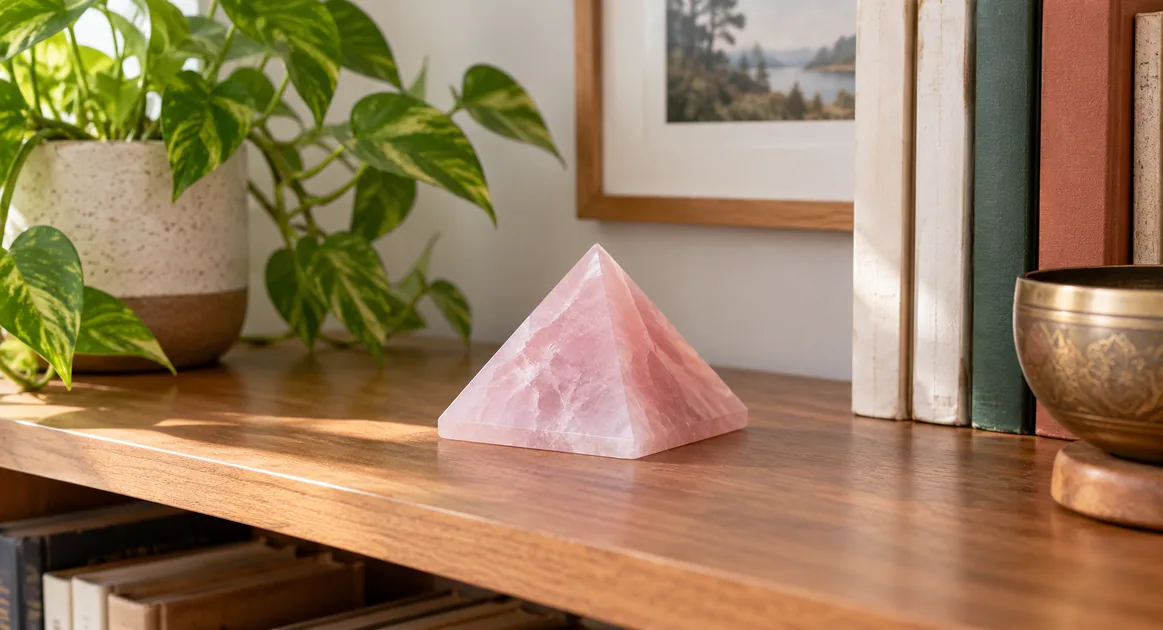
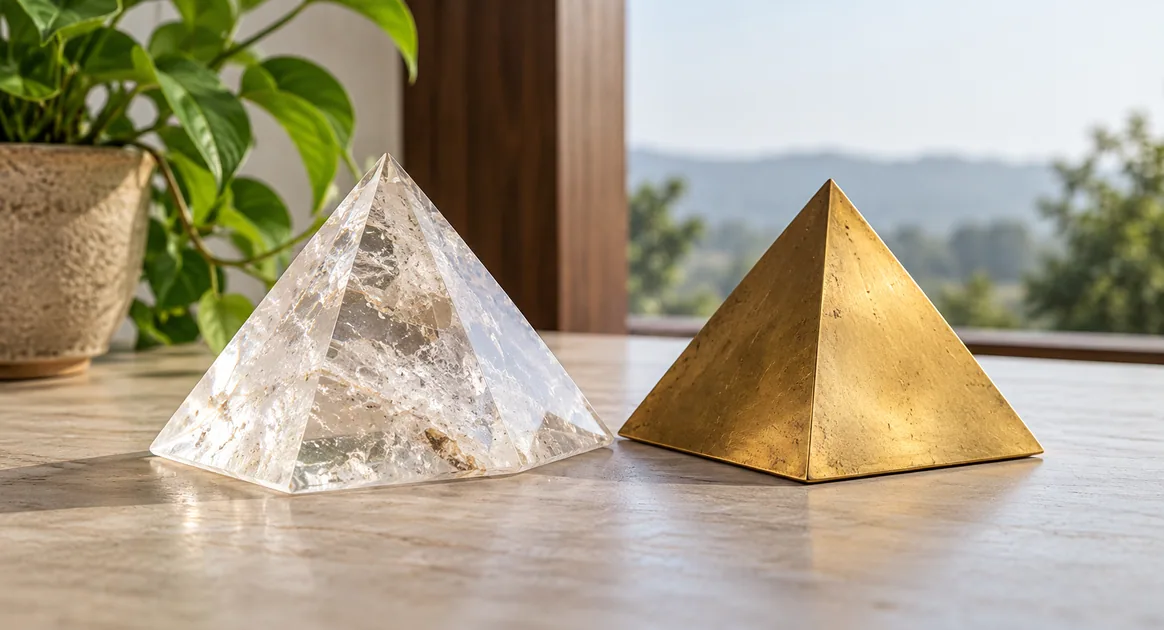
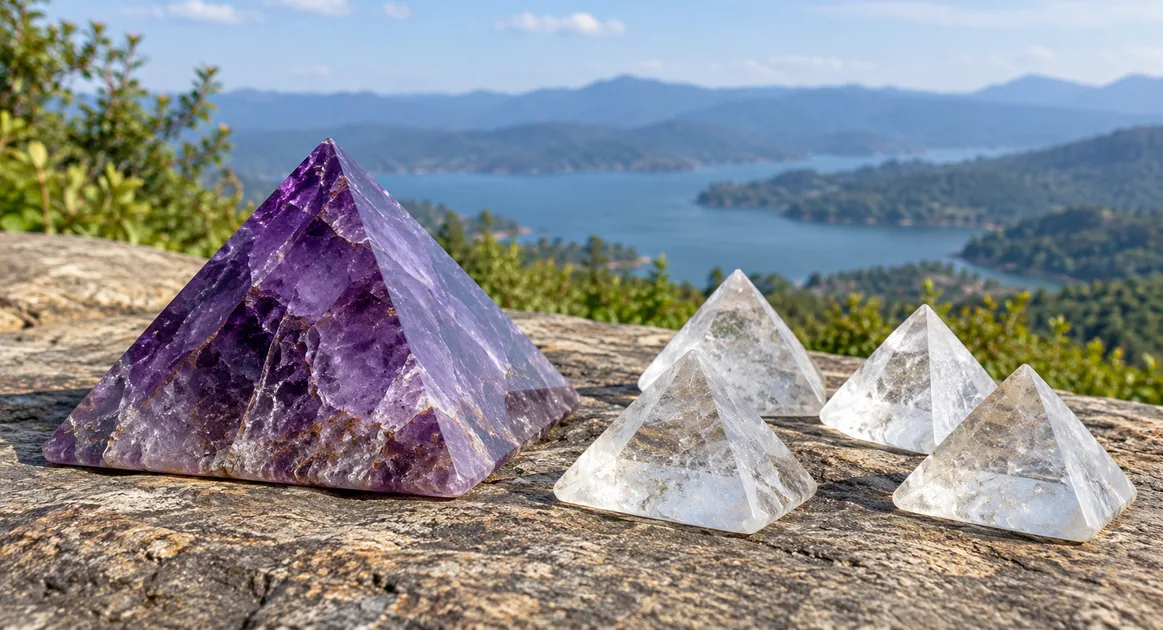
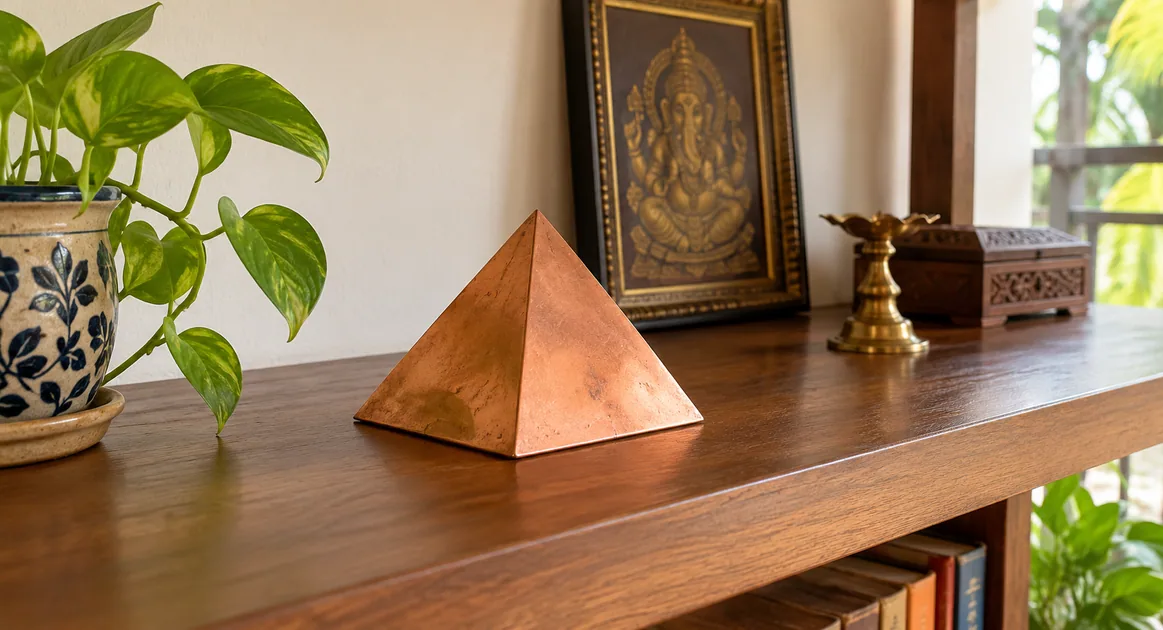
An orange calcite pyramid combines the warm honey, peach and amber shades of a calcium-carbonate mineral with the carefully carved geometry of a square-based pyramid. It may glow beautifully in side lighting, show cloud-like bands or retain fine natural lines within the stone. But the most important buying question is not simply whether the colour looks attractive. Calcite is softer than quartz, has excellent cleavage and reacts to acids. The material, its finish and its condition determine where it should be displayed and how it should be handled.
This guide explains how to identify orange calcite, distinguish it from carnelian and coloured quartz, examine cut edges and internal planes, understand its role in contemporary gemstone and Vastu arrangements, and keep a carving clean without damaging the polish. It also includes practical scenarios for Bengaluru apartments, a small business reception and a professional Vastu material kit. The point is to appreciate both rupa (appearance) and upayog (appropriate use) without confusing spiritual associations with physical identification.
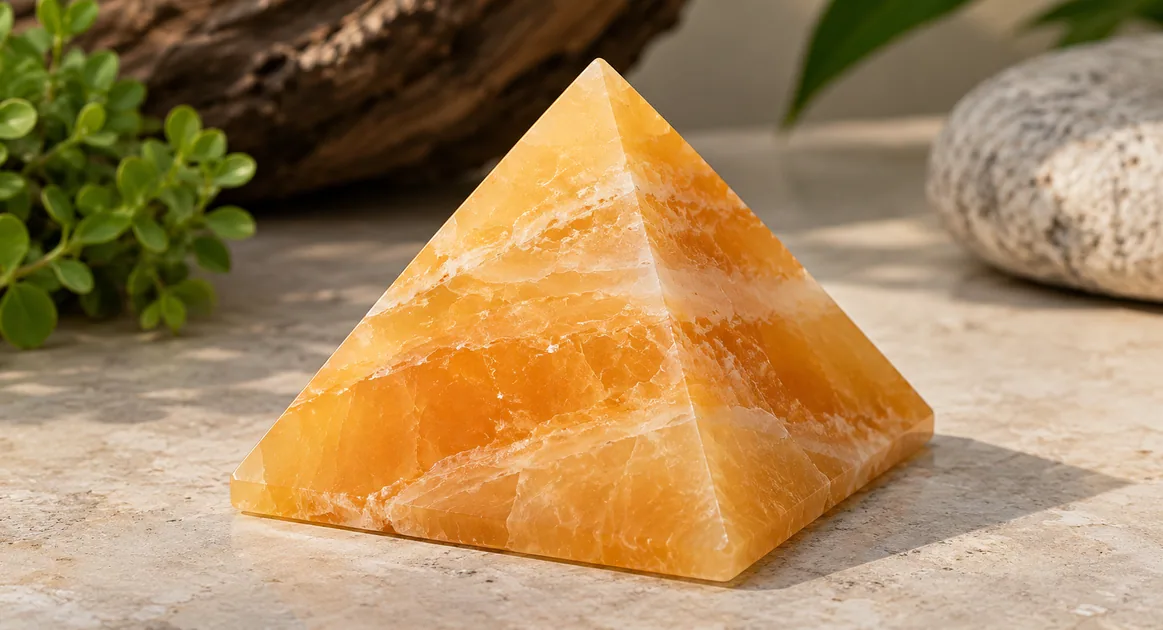
1. What is orange calcite?
Calcite is calcium carbonate, with chemical formula CaCO3. It belongs to the carbonate mineral group and forms in many geological environments, including veins, sedimentary rocks and cavities. The familiar orange trade variety is generally a translucent-to-opaque calcite coloured by minor constituents or inclusions. A name such as orange calcite describes appearance and mineral identity together; it is not by itself a certificate of provenance, natural colour, or specific therapeutic effect.
Calcite's Mohs hardness is approximately 3. Quartz measures 7 on the same scale; that is a major difference for an ornament whose pointed apex and straight edges are repeatedly handled. Calcite is brittle and shows three directions of perfect rhombohedral cleavage in suitable crystals. In a massive carved object, crystal boundaries and internal planes may intersect polished faces and create reflective bands. Those features should be inspected calmly rather than assumed to be either damage or proof of authenticity.
| Property | Calcite | Why it matters for a carving |
|---|---|---|
| Chemistry | Calcium carbonate, CaCO3 | Acids can react with and etch its surface |
| Mohs hardness | About 3 | Metal tools, grit and harder gemstones can scratch it |
| Cleavage | Excellent rhombohedral cleavage | Some internal planes can form points of weakness |
| Appearance | Peach, honey, orange, cloudy or banded, often translucent | Colour alone cannot establish identity |
| Lustre | Vitreous to pearly on some surfaces | Polish varies with grain, flaws and finishing |
| Form of finished item | Cut or carved pyramid, not a natural pyramidal crystal habit | Geometry is workmanship rather than mineral proof |
2. Where does the orange colour come from?
Pure calcite can be colourless or white. Orange, red-brown and yellow appearances in natural material may reflect impurities, inclusions and geological history. Individual deposits differ, and an orange label alone cannot establish whether a specimen's colour is natural, enhanced or artificially applied. A seller should not claim a single origin, rare locality or precise pigment mechanism for every item without specimen-level evidence.
Inspect the piece under neutral daylight or a neutral white lamp. A slightly honey-coloured centre, pale rims and flowing cream bands can be natural-looking features. Backlighting can make any translucent carving appear more saturated; highly edited photographs can do the same. Ask for one normal-light photograph from the front and one with light passing through the side. Even distribution of colour is neither conclusive evidence of treatment nor proof that a piece is genuine.
3. Calcite, quartz, carnelian and orange selenite are not interchangeable
Several materials are sold in warm orange shades. Their appearance can overlap in photographs, yet their durability and care routines differ. Carnelian is a chalcedony variety composed predominantly of microcrystalline silica; orange quartz trade descriptions may refer to different quartz varieties, treated stones, or other materials. Gypsum marketed as orange selenite or satin spar is softer still. Colour is a useful aesthetic selection factor, not a reliable mineral identification method.
| Material | Typical Mohs hardness | Useful distinction | Care emphasis |
|---|---|---|---|
| Orange calcite | 3 | Calcium carbonate, perfect cleavage, reacts with acids | Dry and gentle; protect edges |
| Carnelian / chalcedony | About 6.5–7 | Microcrystalline quartz family, often more uniform waxy translucence | Still inspect dyes and treatments |
| Quartz | 7 | Silica, lacks calcite's cleavage and acid response | Avoid impacts and unknown coatings |
| Gypsum / satin spar | 2 | Often fibrous or silky; trade name confusion possible | Keep away from water and abrasion |
| Coloured resin or composite | Variable | May contain pigment, bonded chips or filler | Ask for honest construction disclosure |
Do not perform a home acid test or deliberate scratch test on a retail-quality carving. Both can cause permanent damage. If identification materially affects an expensive purchase, ask for clear seller documentation or appropriate professional gemmological or mineralogical assessment.
4. How to inspect the pyramid: apex, base, faces and cleavage
A square-based pyramid has four triangular sides rising to an apex. Inspect all sides rather than judging only a flattering hero photograph. The apex may be slightly rounded for safer handling, but a visibly broken point should be disclosed as a condition issue. Look along each edge to identify chips, repairs and rough patches. Turn the carving over: the underside often reveals sanding quality, filler, saw marks and the presence or absence of a stable flat base.
Natural bands should not automatically be treated as cracks. A white or darker line enclosed within the stone can be colour variation or a mineral boundary. A line that reaches the outside surface, catches a fingernail without forcing it, or widens under gentle normal handling deserves closer inspection. Because calcite can part along cleavage planes, the same feature that gives a pleasing flash may sometimes coincide with a structural weakness. Do not press, pry or flex a suspected plane to test it.
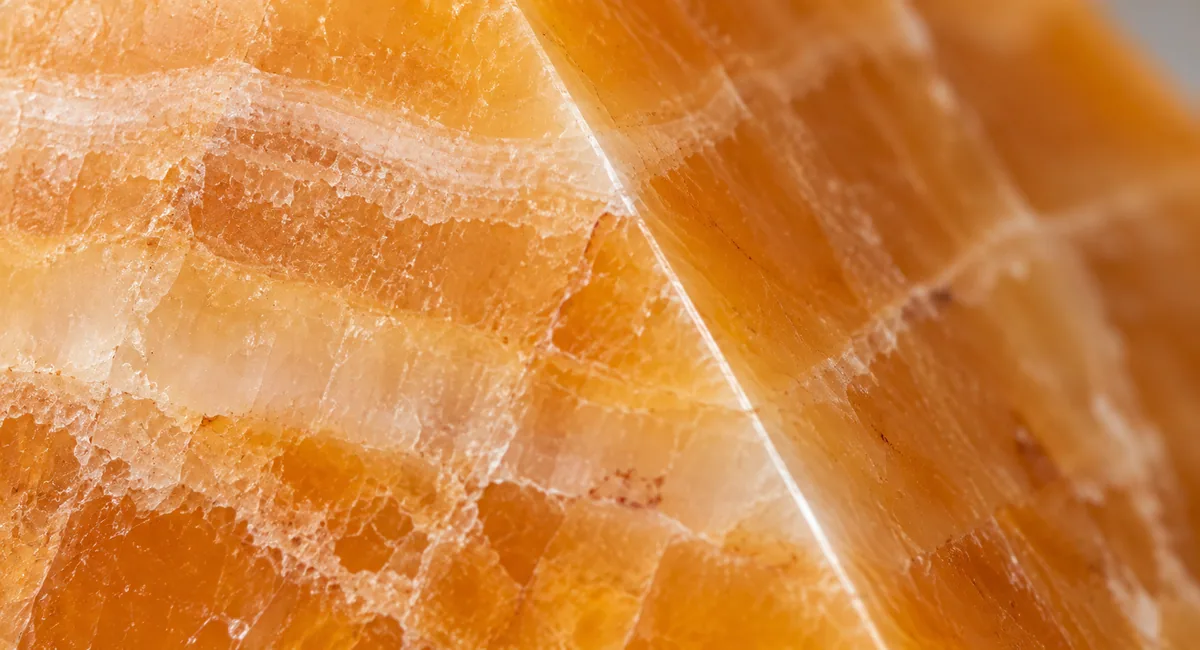
| Check | Usually acceptable | Ask about before purchase |
|---|---|---|
| Colour | Natural-looking tonal variation and bands | Undisclosed dye, surface paint or misleading photographs |
| Apex | Neatly carved or deliberately slightly softened point | Fresh chips, cracks or glued reconstruction |
| Edges | Consistent polished transitions | Loose flakes or large unreported repairs |
| Internal planes | Visible intact mineral structure | Open fractures reaching multiple faces |
| Base | Stable, level placement | Rocking, deep gouges or a concealed damaged underside |
| Finish | Consistent polish appropriate to calcite | Unknown heavy coating, oily residue or sanding defects |
5. Carved from one piece or assembled?
A carving can be cut from a single calcite-bearing block, bonded from several pieces, filled to stabilise minor voids or produced from powdered mineral and resin. These are different products and should be described accordingly. A simple surface photograph cannot always prove the construction method. Ask directly whether the pyramid is one solid carved piece, whether resin or filler is present and whether the colour or polish has been enhanced.
For a product listing, exact dimensions should describe the actual object: base length, full vertical height, weight, visible stone variety and finish. Where pieces vary, photographs and measurements should correspond to the supplied item or clearly state representative variation. Distinguish natural mineral lines from defects that affect stability. Origin claims, grade claims and promises of specific energy outcomes should not be substituted for these objective details.
6. Meaning of orange calcite in Vastu and contemporary crystal practice
In contemporary crystal practice, orange calcite is commonly chosen as a symbol of warmth, creativity, cheerful activity and renewed intention. A pyramid form supplies a focused central object; the warm colour gives the arrangement a distinct visual tone. Indian households may also place attractive stones near an altar, workspace or decorative shelf as part of a personal Sankalpa—a deliberate intention accompanying prayer or daily action.
Traditional Vastu Shastra is concerned with the relationship of built space, directions, proportion, entrance, light and the organisation of activities. Modern decorative gemstone pyramids are not identical to prescriptions found in classical architectural texts. A useful explanation separates three layers: the Vastu direction and functional character of a space; the symbolic meaning attributed to the stone in contemporary practice; and the actual physical characteristics of calcite. A seller should not present a universal rule such as 'every orange calcite pyramid must go in one exact direction' as if all traditions agreed on it.
The Sanskrit ideas of Agni (fire), Tejas (radiance) and Pancha Mahabhuta (five elements) can help discuss warm colours and purposeful activity. In some modern interpretations, orange objects evoke fire, enthusiasm or creative action. But a colour correspondence is an interpretive aid, not a laboratory property or a substitute for considering the actual room, its use, and its layout.
| Layer | Question | Responsible interpretation |
|---|---|---|
| Vastu setting | What direction and activity define the room? | Consider the full layout and intended use |
| Stone symbolism | What does its orange colour mean to the owner? | Warmth, optimism or a creative reminder in modern practice |
| Sankalpa | What action or prayer accompanies the object? | A clear personal intention, without promised outcomes |
| Physical material | Will calcite survive the chosen spot? | Keep dry, stable, shaded from hazards and away from acid |
7. Can orange calcite be linked to the Svadhisthana chakra?
Many modern chakra guides pair orange with Svadhisthana, the sacral chakra, commonly discussed in relation to creative expression, feeling and connection. That association explains why orange calcite is often grouped with carnelian and other warm-toned stones in contemporary chakra sets. It is a colour-symbolic association; the names of minerals and their commercial pyramid forms should not be retroactively described as mandatory prescriptions of ancient Sanskrit texts.
Someone arranging a meditation shelf might use the pyramid as a visible cue to settle attention before mantra, breathwork or reflection. It need not touch the body, be placed in water or form part of a treatment plan. In traditional devotional settings, the suitability of any object depends on the household's particular practice; a gemstone ornament is not automatically a consecrated idol or yantra.
8. Directions and placement in a house, office or puja area
Placement should start with stability and function. Choose a dry, secure and level surface; leave enough space that the apex will not be knocked by books or cleaning equipment. Avoid bathroom shelves, open balconies exposed to rain, damp planters, kitchen acid splashes and crowded floor corners. A dry living-room shelf or a protected desk display is usually more practical than a location selected only because a generic direction chart says so.
For a Vastu-oriented consultation, identify the actual north and other directions from a reliable plan or compass reading, then distinguish the main activity and the room's circulation. A decorative stone cannot, by itself, justify sweeping claims about correcting structural Vastu doshas. Where a client follows a family tradition concerning Agneya (southeast), Ishanya (northeast), Kubera or directional deities, acknowledge that tradition and discuss the choice within the complete layout.
| Setting | Possible use | Practical caution |
|---|---|---|
| Living room | Warm focal object on a dry shelf | Away from edges, rough stone décor and spills |
| Study desk | Visual reminder of Sankalpa or creative work | Do not wedge under heavy equipment |
| Puja room | Optional decorative support to personal practice | Avoid direct water, oil, lemon and abrasive ash |
| Reception desk | Distinctive material display with a label | Prevent repeated handling by visitors |
| Professional reference kit | Example of softer carbonate material | Separate padded compartment and clear ID |
9. Example: a Bengaluru apartment with a compact meditation shelf
Imagine a family in a Bengaluru apartment that has a narrow wooden shelf beside the living-room prayer space. The family likes orange calcite's warm translucent appearance and wishes to use the pyramid as a symbol of focus during a short daily Sankalpa. A small carving with a stable base is more sensible than a heavy, tall piece near the edge. Place it on a soft, dry mat, leaving a gap from water vessels and oil lamps. The direction can be considered according to the family's established practice, but the shelf's stability, access and routine cleaning deserve equal attention.
During the monsoon, check whether a nearby wall is damp or exposed to condensation. Calcite is not unusually soluble like halite, but a dry shelf still prevents grit and cleaning liquids from lingering on its surface. If flower offerings and other ritual items are cleaned with water or citrus, move the pyramid aside before the cleaning begins.
10. Example: an office reception or jewellery showroom
A jewellery showroom may want a small orange calcite pyramid on a reception counter because it adds warm colour to a neutral display. The label should identify it accurately as calcite rather than carnelian, orange quartz or a gemstone of undisclosed origin. Position it beyond the reach of bags, coins and metal stationery, which can abrade the polish. Staff can explain how the pyramid's form and colour are used symbolically in modern crystal arrangements, while keeping price, material and condition claims grounded in the actual piece.
Where the proprietor follows Lakshmi or Kubera devotional practices for auspicious beginnings, the decorative pyramid may sit nearby as a personal object, not as a replacement for the ritual's primary elements. Avoid guaranteeing revenue increases from any stone placement. A thoughtful display combines cultural relevance, attractive presentation and proper material care.
11. Example: a professional Vastu or gemstone reference set
A consultant building a reference kit should include different material classes rather than several orange stones presented as interchangeable. An orange calcite piece can illustrate a carbonate that scratches relatively easily and reacts with acids; carnelian demonstrates a harder silica-based material; satin spar gypsum shows a different soft, fibrous mineral. The kit should contain concise labels with the stone name, formula or mineral family, basic hardness, typical cleavage and safe handling notes.
Transport each sample in its own padded slot. Avoid packing calcite directly against quartz points or metal specimens. Do not demonstrate acid reactions on a polished commercial carving; if a mineralogical demonstration is required, use an appropriately identified expendable teaching specimen under suitable safety controls. A professional kit is most valuable when students can see the difference between spiritual associations and mineral identification.
12. Cleaning orange calcite: why acid-free care matters
Calcite reacts chemically with acids. Household vinegar and lemon juice can etch or dull its finish; acid cleaners intended for bathroom scale or metal are especially inappropriate. A carved pyramid also has narrow edges that are vulnerable to scratching. For routine dusting, use a clean, very soft, dry brush or microfibre cloth with almost no pressure. Remove loose grit before moving the cloth across the polish.
When residue remains, first ask the seller whether the carving carries wax, dye, stabiliser or surface treatment. A brief, barely damp wipe may be suitable for some untreated, intact calcite pieces, but it is not a universal instruction for unknown coatings, glued repairs or porous matrices. Do not soak, steam-clean, ultrasonically clean or repeatedly rinse the item. If a minor damp wipe has been approved, promptly dry it with a soft cloth and allow it to air-dry in a protected space.
| Situation | Preferred action | Avoid |
|---|---|---|
| Routine dust | Soft clean dry brush or cloth | Abrasive pads and gritty wiping |
| Oil or puja residue | Consult seller about treatment and appropriate removal | Vinegar, lemon, strong detergent and scraping |
| Display | Flat, dry, protected shelf | Sink edges and wet ritual trays |
| Storage | Individual soft wrap or padded box | Loose contact with quartz or metal tools |
| Damaged edge | Photograph and request professional advice | Home polishing, adhesives or hard pressure |
13. How to store and pack a carved orange calcite pyramid
Wrap the pyramid in a clean, soft, non-abrasive material and support the apex without pressing it into a tight container. A shaped insert or two-piece cushion is useful for shipping. Keep labels and packing tape away from the polished stone itself. If several gemstones travel in one carton, provide separated compartments so a quartz crystal or metal object cannot strike the calcite faces.
For a shop or stockroom, maintain a dry, clean shelf rather than a damp floor-level box. Inspect the piece after transit for chips and loose crumbs before giving it to a customer. A small condition photograph of the actual item is more useful than a generalized claim that all natural stones have imperfections.
14. Buying checklist: questions to ask before ordering
Request the actual material name, base measurement, height, weight, a clear underside photograph, and confirmation of whether the stone is carved from one piece or assembled. Ask whether there is dye, coating, resin, filling or repair. Request photographs in neutral light and a close-up of the apex and any visible cleavage line. If the advertised price depends on a rare origin or special grade, ask what evidence supports that claim.
| Ask the seller | What the answer should clarify |
|---|---|
| Is this calcite rather than carnelian? | Correct mineral identification and product naming |
| Is the colour treated? | Natural, enhanced or undisclosed appearance |
| One piece or composite? | Construction and possible bonded seams |
| Can I see the base and apex? | Real finishing and condition |
| What are the exact dimensions? | Scale and suitability for a shelf |
| What cleaning is safe for this finish? | Coating-specific handling instructions |
| Is the photograph of this exact item? | Whether tone and banding will match delivery |
15. Questions readers frequently ask
Is orange calcite the same as orange quartz?
No. Calcite is calcium carbonate and quartz is silica. Their hardness, cleavage and reaction to acids differ greatly. Similar colour does not make two minerals identical.
Do pale bands mean an orange calcite pyramid is cracked?
Not necessarily. Bands may be compositional or structural features within the mineral. Ask for close, neutral-light photographs and distinguish enclosed colour lines from open breaks at the surface.
Can I clean the pyramid with salt water, lemon or vinegar?
No. Acids can react with calcite, and salt solutions can leave residues. Prefer gentle dry care and ask about any surface treatment before using moisture.
Does orange calcite have to face southeast?
There is no single universal placement rule for every modern orange calcite carving. Consider the space's actual layout, the household's Vastu tradition, the intended use and the object's physical safety.
Is orange calcite traditionally a Navagraha gemstone?
It should not be casually presented as one of the classical principal Navaratna gemstones. A contemporary colour or chakra association is a different classification from chart-based Jyotish gemstone prescriptions.
Can I put it beside a diya or incense?
Keep it away from direct flame, hot surfaces, falling ash and oil spills. A safe, separate shelf is preferable to placing the carving among items that require frequent wet or oily cleaning.
Is a highly polished pyramid always better?
A consistent polish and sound edges are useful, but polished sheen alone does not verify the mineral, its treatment history or its internal stability.
Can a damaged tip be repaired at home?
Do not attempt amateur grinding or adhesive repair on a valuable item. Document the condition and consult a knowledgeable seller or specialist.
16. Bringing material knowledge and spiritual significance together
Orange calcite is compelling precisely because it joins an attractive natural mineral appearance with a recognisable carved form. In a Vastu-inspired home, a meditation area or a professional reference collection, it can carry the owner's intention while also teaching care and material literacy. The best selection considers authenticity, finish, dimensions, placement and the buyer's actual purpose. Warm colour and pyramid geometry can be meaningful personal symbols, but they do not replace the broader disciplines of Vastu planning, devotion, responsible buying or the practical realities of a soft carbonate mineral.
Explore existing OmmRudraksha collections
Browse Vastu for the existing collection, or explore gemstone products for other material forms. Each product’s construction and care information should guide your choice.