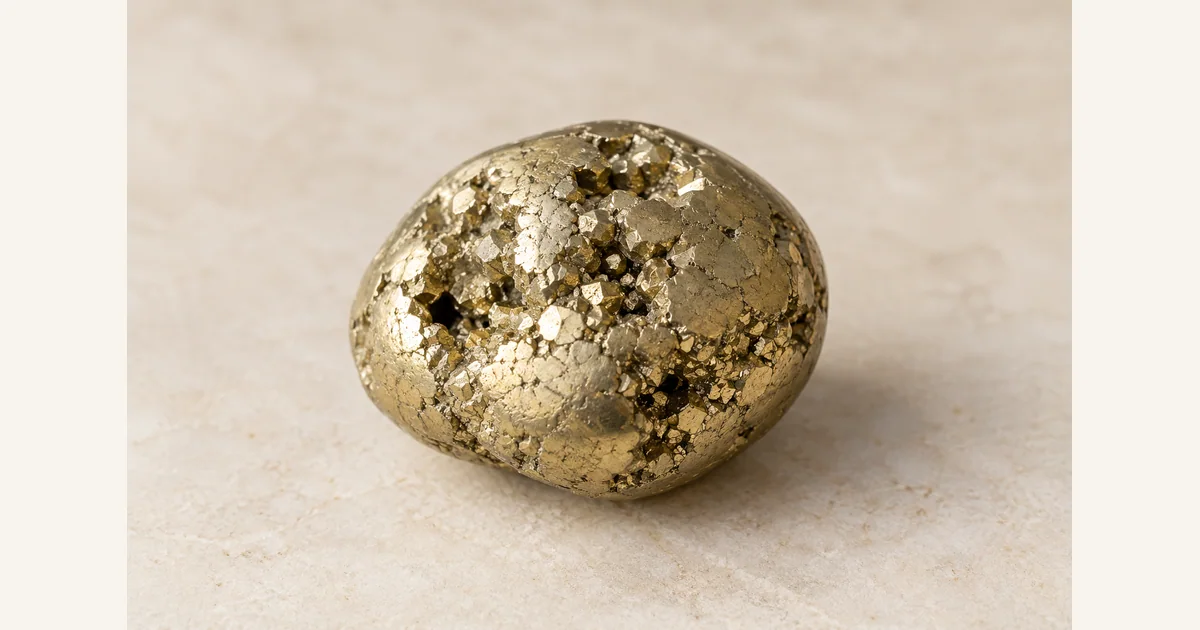
Pyrite tumbled stones have a brilliant brass-gold colour, but not every gold-coloured pebble is pyrite and not every pyrite specimen behaves like a smooth quartz tumble. A genuine piece may show fine granular texture, small cavities, tiny angular crystals or darkened recesses even after polishing. These details matter when choosing a stone for a Vastu display, a professional gemstone reference kit or a customer order. They also explain why pyrite needs drier storage than many common tumbled stones.
This guide brings three questions together: What is the material? What does its form and condition tell us? and How can it be used and cared for as a traditional or contemporary spiritual object? The first question is mineralogical; the other two involve presentation, preservation and the buyer's purpose. Keeping them separate produces a much more reliable choice than relying on a bright photograph or an unexplained label such as “golden prosperity stone”.
1. What is pyrite? The mineral behind the golden colour
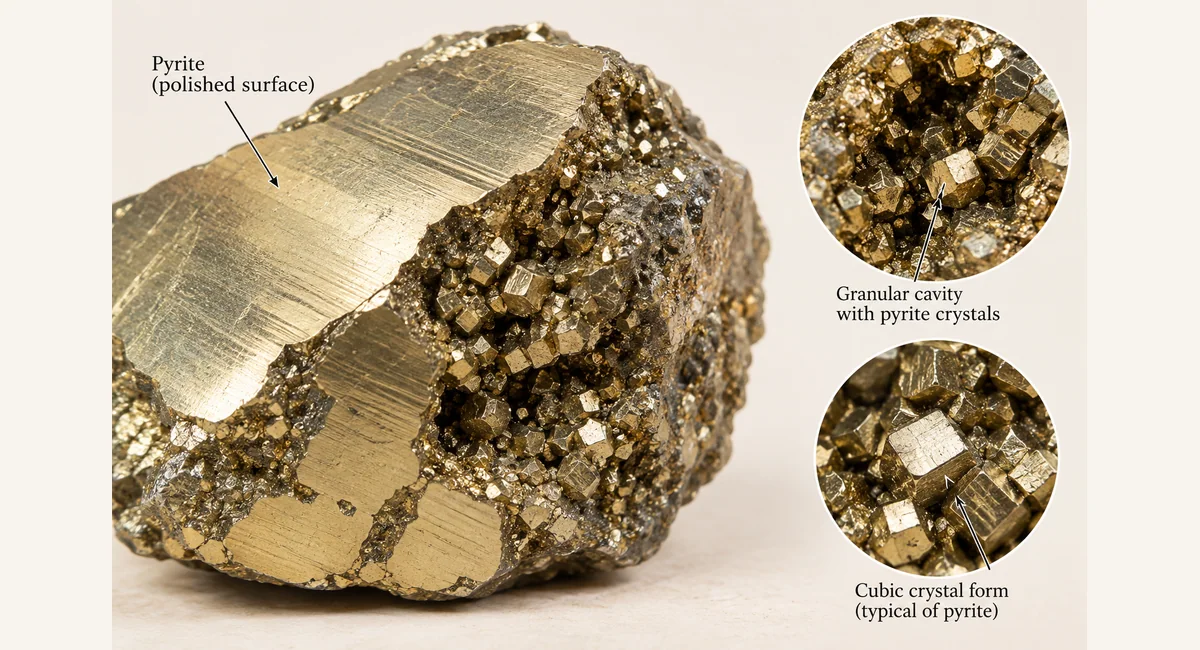
Pyrite is iron disulfide, written FeS2, an opaque sulfide mineral with a metallic lustre. Its well-known nickname, fool's gold, comes from the resemblance of its brass-yellow surface to gold. Natural crystals commonly grow in the cubic crystal system. They may form sharply edged cubes, twelve-faced pyritohedra, clustered intergrowths or irregular granular masses. In a polished tumble, the original crystal faces may have been rounded away, while the internal grain and little crevices remain visible.
Pyrite is fairly hard on the Mohs scale—approximately 6 to 6.5—yet it is also brittle. Hardness describes resistance to scratching, not resistance to a blow. A thin protrusion or a grainy corner can chip even when the flat surface resists everyday rubbing. Its specific gravity is near 5, giving a comparable-size piece more heft than quartz, which is roughly 2.65. The comparison works best only when pieces have similar volumes and are solid mineral rather than hollow, porous or resin-filled constructions.
Fresh pyrite is often bright yellow-brass. Oxidised or tarnished surfaces can turn darker, sometimes with iridescent colours. One photograph cannot establish the mineral's exact purity, original locality or treatment history. These are distinct claims requiring appropriate supplier evidence. For a reference collection, record the full sold-as name and any treatment or construction disclosure rather than merely writing “gold stone”.
| Property | What is typical of pyrite | Why a buyer should care |
|---|---|---|
| Composition | Iron disulfide, FeS2 | It is neither metallic gold nor a quartz-family gem. |
| Appearance | Brass-yellow metallic, opaque; may darken | Golden colour alone does not identify it. |
| Habit | Cubes, pyritohedra, clusters, granular masses | Different natural forms produce different tumbled outlines. |
| Hardness | Mohs 6–6.5; brittle | Can resist scratches but chip at edges. |
| Relative density | Approximately 5 g/cm³ | Feels relatively heavy, but weight is only one clue. |
| Streak | Dark greenish-black to brownish-black | Useful in mineral testing, but a streak test damages the finish. |
| Care priority | Keep dry; observe changes in the surface | Prolonged dampness can promote deterioration in susceptible specimens. |
2. What should a real tumbled pyrite stone look like?
A rough pyrite cube, polished pebble, bead, chip mixture and decorative composite should not all be sold under the same description. A tumbled stone has been rounded mechanically and may be polished, but the polishing process does not guarantee an entirely smooth, pore-free surface. Many authentic specimens contain crystalline grains or tiny voids. Polishing compound can become lodged in these areas; some sellers also coat or fill a surface to improve its appearance.
Inspect the actual shape and construction. Does the item have rounded edges throughout, or is it a rough crystal photographed at a distance? Are there visible seams? Does a mirror-like layer cover a differently coloured interior? Are metallic fragments suspended in a transparent binder? None of these observations alone proves that the object is false. They do determine whether the product ought to be described as solid mineral, coated mineral, bonded fragments or a manufactured ornament.
| Sold form | Normal visual character | What should be stated on the listing |
|---|---|---|
| Natural rough crystal | Angular faces, often cubic, with sharp corners | Rough crystal or cluster; not a polished tumble |
| Solid pyrite tumble | Rounded outline, metallic lustre, occasional cavities | Actual count, size range, and visible variation |
| Pyrite bead | Drilled, fairly uniform shapes | Bead diameter, drill hole, possible coating |
| Pyrite chips or gravel | Many small irregular pieces | Sold weight, approximate count and particle size |
| Bonded or resin composite | Fragments held in a binder, possibly very uniform | Construction and binder clearly disclosed |
| Painted metallic decor | Golden finish may look unusually even | Base material and surface coating, not “solid natural pyrite” |
For online ordering, photographs of three or four stones from the actual batch are more informative than a single highly polished example. Ask for front, back and edge views of a larger representative stone, particularly when a batch is advertised as uniform. A natural collection may be consistent in approximate size without being identical in cavity pattern, lustre or shade.
3. How to identify pyrite without damaging a saleable stone
Start with non-destructive observation. Use neutral white light, a magnifying lens and a clean dry examination surface. Look for an opaque metallic surface with a brass-yellow tone rather than a glassy translucent body. Tiny polygonal crystals, angular grains and characteristic crystal-face striations can support a pyrite identification when present. A tumbled piece may not preserve them, so their absence is not proof against pyrite.
- Read the supplier declaration first. Ask whether the stone is sold as natural iron pyrite, a composite, an imitation, or another mineral. Obtain any treatment and coating disclosure.
- Observe the finish. Note the hue under ordinary daylight or neutral lighting, areas of uneven metallic lustre, natural cavities and tiny crystal-like facets. Take photographs before routine handling.
- Examine a clean edge. Look for paint peeling, an unrelated base material or a distinct transparent resin layer. A small natural seam is not itself evidence of a coating.
- Compare the weight. Against quartz pebbles of similar size, solid pyrite often feels heavier. This is a screening clue, not a measurement of purity.
- Consider the suspected lookalikes. Tiger eye has a moving silky light band; citrine transmits light; chalcopyrite may display brassy or iridescent metallic surfaces; gold is softer and more malleable.
- Avoid scratch, acid and streak experiments on merchandise. A dark streak on unglazed ceramic helps trained mineral identification, but it leaves a mark and may abrade the stone. A hardness test may also damage both item and test surface.
- Escalate uncertain batches. When identity or treatment changes the price or category, use a qualified gemological or mineralogical laboratory and record the result for the precise sample submitted.
Colour, magnetic response and a casual telephone photograph are not standalone authentication tests. For example, weak magnetic behaviour is not the same as the strong attraction of a refrigerator magnet; many ordinary pyrite pieces will not visibly jump to a magnet. Nor does the word “iron” in iron sulfide mean pyrite behaves like a piece of iron metal. Reliable identification combines several observations and, when required, testing.
Pyrite, fool's gold and five commonly confused materials
| Material | What can look similar? | Most useful distinction | Typical listing question |
|---|---|---|---|
| Pyrite | Brass-yellow opaque metallic body | Brittle sulfide with occasional cubic texture and dark streak | Solid pyrite, or coated/constructed item? |
| Native gold | Golden metallic colour | Much denser and malleable; gold-yellow streak | Is this actually gold-bearing material, and has it been assayed? |
| Chalcopyrite | Golden metallic sulphide; sometimes rainbow tarnish | Usually softer, often with a different tarnish pattern | Is the mineral identified as chalcopyrite rather than pyrite? |
| Marcasite | Same FeS2 formula and similar metallic look | Different crystal structure; difficult to distinguish confidently after polishing | Has the trade name been verified? |
| Golden tiger eye | Warm brown-gold display stone | Quartz-family stone with a silky, moving chatoyant band | Does the photographed band match the actual product? |
| Citrine or yellow glass | Yellow-to-golden colour | Typically glassy and transmitting light, not opaque metallic pyrite | What exact material and treatment are stated? |
Do not use the label “gold pyrite” as if it signifies a measurable percentage of gold. In general merchandise the phrase often merely points to colour. Similarly, “marcasite jewellery” is a trade description that can refer to pyrite; a polished stone should be identified by its material, not assumed to be marcasite because of a jewellery name.
4. Pyrite symbolism in Vastu and modern crystal practice
Pyrite's golden appearance has made it a popular modern prosperity, confidence and abundance symbol in contemporary crystal arrangements. The symbolism is understandable: a reflective gold-coloured mineral can stand for enterprise, clarity of purpose, disciplined effort and careful stewardship of resources. Many people place a piece near an account book, a business desk or a small intention card. These are symbolic practices rather than measurable financial mechanisms.
It is important to distinguish these current customs from the older textual disciplines of Vastu Shastra and Jyotisha. Traditional Vastu considers the functions of rooms, the site's orientation, light, circulation and directional divinities. Classical Jyotisha gemstone selection is usually discussed through planetary correspondences and a horoscope, not through an automatic prescription of pyrite for wealth. Pyrite should therefore not be presented as a fixed classical Navaratna substitute, as a universal Sun remedy or as a stone that corrects a particular defect merely by being placed in one corner.
In many Vastu interpretations north is associated with Kubera, the guardian of wealth, while the north-east is called Ishanya and often reserved for a clear, quiet prayer or contemplation area. A contemporary pyrite arrangement might draw on those themes, but the traditional directional meanings do not constitute an ancient instruction to install pyrite. A consultant may choose different displays according to the room's actual use and the household's practice.
| Setting | Traditional or practical theme | Possible pyrite presentation | What to avoid |
|---|---|---|---|
| Home accounts shelf or study | Order, budgeting, mindful work | One dry, labelled pyrite pebble beside a ledger or notebook | Unsecured stone near water cups or damp windows |
| North-oriented office shelf | Contemporary association with Kubera and livelihood | Small dry tray with one to three clearly named pieces | Claiming the direction alone assures income |
| Prayer or meditation corner | Sankalpa, concentration and simplicity | One small stone as an optional visual focus, away from ritual liquids | Soaking it in water, milk, or salt baths |
| Jewellery showroom display | Material education and honest trade | Pyrite with a printed name, material note and price | Confusing it with gold or another yellow gemstone |
| Professional Vastu sample kit | Demonstrating options rather than a compulsory correction | One numbered, padded specimen and its care card | Using an unverified mineral name in a paid report |
The clearest spiritual use is often the simplest: a stone can mark a chosen sankalpa—an intention to act with diligence, honesty and steadiness. Set the intention, place the piece in a stable dry location, and connect it to an action such as maintaining accounts or returning to a daily study practice. The practical action is the part that can be observed and improved.
A five-minute intention arrangement
- Choose an uncluttered, dry surface with a secure small tray.
- Read the material label so the stone's identity is clear.
- Place one pyrite piece next to a short written intention, such as “keep accurate records and review decisions carefully”.
- Spend a minute in quiet reflection or prayer according to your own practice.
- Review the written intention during the week. Keep any lamps, oil, water offerings and incense residue away from the stone.
A small arrangement is enough. There is no established need to combine pyrite with a specific number of coins, a fixed 7-stone pattern or a special “activation” liquid. For larger mixed displays, the exact count and container should be clearly documented so that a photograph does not create a misleading impression about what the buyer receives.
5. Why pyrite needs dry care: tarnish, oxidation and “pyrite disease”
Pyrite is an iron sulfide; prolonged exposure to moisture and oxygen can encourage chemical alteration. In vulnerable specimens this can produce iron sulfate compounds and acidic by-products. Conservators sometimes call the progressive deterioration of certain pyritic collections pyrite disease. Affected material may develop a powdery surface, pale or rusty deposits, expansion, cracks and crumbling. Not every decorative pyrite pebble will fail in this way, and ordinary harmless-looking changes in metallic lustre are not automatically proof of serious damage.
The critical point for an owner is preventive care. Museum conservation guidance commonly recommends storing pyritic collections below roughly 45% relative humidity; the exact risk depends on the specimen, associated minerals and conditions. A home shop does not need laboratory apparatus to begin doing the right things: avoid wet cleaning, keep stones away from bathrooms and leaky windows, avoid enclosing damp cloth, and pay extra attention during humid seasons.
A Bengaluru shop in monsoon weather may experience different indoor moisture conditions from a climate-controlled cabinet. Record a simple hygrometer reading inside or near a storage drawer rather than relying on the feeling that a cabinet is “dry”. Where necessary, use suitable dry packaging and a monitored desiccant in a closed storage box. Replace saturated desiccant according to the manufacturer's directions; it should never spill directly onto the specimen.
Care by situation
| Situation | Preferred action | Reason |
|---|---|---|
| Routine dust on a polished pebble | Gently use a soft, dry brush or clean dry microfibre cloth | Removes loose dust without introducing water |
| Natural pits or surface crevices | Use light dry brushing; do not scrape or pick | Thin crystal projections may be brittle |
| Daily display | Stable tray, low handling, no splashing | Limits impacts and long-term moisture exposure |
| Storage box | Separate padded cell, labelled dry specimen, monitored conditions | Reduces collisions, contamination and accidental mixing |
| Visible new powder or cracks | Isolate, photograph, review storage humidity and seek conservation advice | Protects nearby specimens and documents a possible change |
| Shipping after shop photography | Confirm stone and all packing material are dry before closure | Wet cloth or paper can trap moisture against the surface |
Do not soak pyrite in plain water, saltwater, vinegar, bleach or homemade “cleansing” mixtures. A common crystal ritual involving water or salt may be reasonable for some other practices, but it is not an appropriate default for this mineral. Steam cleaners, ultrasonic cleaners and harsh brushing are also poor general choices for brittle or fissured specimens. Dry handling is the sensible starting point.
For a spiritual cleansing practice, a person can instead use a brief spoken prayer, silent intention or clean dry placement without contacting the mineral with liquid. Keep flames, hot incense ash and oil away from packaging and display labels. If a piece has already developed extensive powder or a strong unusual residue, avoid inhaling dust, handle it minimally and separate it pending a knowledgeable assessment.
6. Choosing a pyrite tumble for a Vastu collection or a showroom
Different uses favour different specimen qualities. A decorative household customer may want a smoothly rounded, visually bright piece. A mineral student may prefer some natural cavities and crystal texture because these aid recognition. A professional consultant may value accurate identification, an easily readable label and a repeatable demonstration over a flawless gloss. The highest polish does not automatically mean the best fit for every purpose.
For a new collection, write a specification with five fields: material identity, construction, approximate size or weight, count, and condition. Add treatment information when applicable. If the selection is a mixed assortment, make a count sheet with each stone name. If a bowl or shell appears in the photograph, say whether it is included. The container must not quietly become part of the advertised mineral count.
Worked example A: A family home choosing one stone
A customer wants a gold-coloured accent for a study shelf. They are considering golden tiger eye, citrine and pyrite. First compare the visible property they actually value: tiger eye shows a moving silky band, citrine is glassy and often translucent, and pyrite looks opaque and metallic. If they want a dry symbolic reminder beside a household budget notebook, one small pyrite tumble may serve that purpose. If their only available shelf sits beside a repeatedly used water pot, a different location—or a different display material—is the more practical decision. The article's Vastu value lies in making the location purposeful, uncluttered and appropriate for the actual activity.
Worked example B: A jewellery counter selling a 12-piece assortment
A showroom receives twelve golden-coloured stones from a supplier and is asked to list them as “pyrite abundance pebbles”. On inspection nine look granular and metallic, two have a silky brown-gold band, and one has an unusually uniform bright coating over a pale edge. The appropriate next step is not to price all twelve as pyrite. Separate the three doubtful specimens, confirm their identities and inspect the supplier invoice. The two banded pieces may be tiger eye. The coated item needs a construction disclosure. Only the identified pyrite pieces should be entered under the pyrite SKU, with their true count and weight recorded.
Worked example C: A professional Vastu sample tray
A consultant brings a reference tray containing pyrite, tiger eye, citrine, hematite and clear quartz to a client meeting. The purpose is to teach material differences and show optional display styles. Put each sample in a separate compartment with a number. The consultation card identifies pyrite as FeS2, describes the modern gold-colour prosperity symbolism, and notes that the mineral should stay dry. When discussing north or north-east spaces, the consultant describes the underlying Vastu meaning first, then explains that the pyrite placement is a contemporary optional arrangement rather than a mandatory classical remedy.
7. A simple label and purchase checklist
A well-written product label can be compact and still answer the buyer's key questions. For example: “Pyrite Tumbled Stone — natural iron disulfide (FeS2), brass-yellow metallic appearance, rounded polished form with possible natural granular pits, one piece, approximate size and weight stated, keep dry, avoid immersion.” If material identity or treatment is unverified, do not use absolute claims such as “100% untreated”. State what is known and what remains to be confirmed.
A practical purchase checklist for one stone or a large order should cover:
- Identity: Is the invoice name pyrite, and is it supported by realistic specimen photographs?
- Form: Is the item truly tumbled, or a rough cube, bead, chip mix, coating or bonded ornament?
- Quantity: Are stone count, size range and weight specified, separately from props and containers?
- Condition: Does the seller show cracks, cavities, dull surfaces or powder instead of hiding them?
- Treatment: Are binders, fillings, surface coatings or alterations disclosed?
- Storage: Has the batch been kept dry, and will it ship in dry protective packing?
- Purpose: Is the purchase for a mineral reference, decorative display, consultation kit or symbolic ritual?
- Language: Does the description avoid confusing pyrite with gold or promising automatic financial outcomes?
For bulk orders, compare a sample taken from the supplied batch with the product photography and invoice before listing. A batch code links replacements, complaints and future orders. If you later add pyrite to a multi-stone Vastu kit, provide a separate identity and care note for this mineral; a blanket “wash all gemstones before use” instruction would be inappropriate.
8. Common questions about pyrite tumbled stones
Is real pyrite always a perfect golden mirror?
No. Authentic pyrite may be bright, duller, grainy or marked by tiny cavities. A tumbled finish rounds the specimen; it does not guarantee a uniform solid-metal appearance. A completely flawless look should prompt a question about coatings or construction, not an immediate conclusion either way.
Does heavy weight prove a stone is genuine pyrite?
No. Pyrite is relatively dense compared with quartz, but other minerals and manufactured materials can also feel heavy. Size, hidden cavities and binders can distort informal weight comparisons. Use weight together with surface features and a reliable description.
Are pyrite and gold the same material?
No. Pyrite is the mineral iron disulfide; gold is a metallic element. Gold is soft and malleable, whereas pyrite is harder and brittle. The shared yellow-metallic appearance is the reason for the nickname “fool's gold”.
Can I clean pyrite in saltwater, milk or running water before puja?
Keeping pyrite dry is preferable. Use an intention, prayer or other non-contact spiritual practice if desired. A dry soft cloth is suitable for ordinary dust. Do not treat instructions for water-tolerant stones as universal for every mineral.
Which Vastu direction is mandatory for pyrite?
There is no single universally established classical prescription for pyrite. Some contemporary displays associate its gold-like appearance with business, prosperity and the north/Kubera theme. The room's function, safety and the family's own Vastu tradition should guide the arrangement, rather than presenting an optional new practice as ancient doctrine.
Can pyrite be kept beside other tumbled stones?
Yes, as a clearly named item in a collection, but a separate padded cell is useful. It protects brittle surfaces, prevents mixing up similar-looking stones and makes it easier to observe any change in condition. Do not enclose it with damp shells, wet potpourri or salt crystals.
What if a pyrite stone develops a powdery coating?
Set it aside from the display, document what changed, keep the surroundings dry and obtain advice from a mineral specialist or conservator. Some pyritic materials can deteriorate in humid conditions. Repeated washing or scraping is not an appropriate response.
Is pyrite one of the classical nine planetary gemstones?
No. Classical Navaratna discussions use an established set of principal gemstones; pyrite's recent popularity in prosperity-themed crystal displays is a distinct practice. It should not be sold as an automatic astrological substitute merely because of its golden colour.
Choosing with knowledge rather than appearance alone
Pyrite is appealing because it combines recognisable mineral character, a rich metallic appearance and contemporary symbolic use. The best selection begins with truthful identification and an appropriate purpose: choose a true pyrite specimen rather than a gold-coloured lookalike, display it without confusing an optional Vastu practice with a classical rule, and keep it dry so its condition can be enjoyed and observed. A precise label and dependable care note are more valuable than extravagant claims.
Continue reading
- Cleaning, Storing and Handling Tumbled Gemstones
- Black Tourmaline, Obsidian, Onyx and Hematite Compared
- Gemstone Bowls, Shells and Trays: How to Build a Display
Explore the existing Vastu and gemstone collections for wider context.