Black tourmaline, black obsidian, black onyx and hematite are often displayed together as “protective black stones”, yet their geological origins, surfaces, durability and traditional associations are different. A buyer comparing these four tumbled materials needs more than a colour chart. One stone is a member of the tourmaline mineral group, one is natural volcanic glass, one commonly belongs to the chalcedony family and may have been dyed, and one is an iron oxide. This distinction determines the correct product name, what to check before buying, how to arrange the stones in a Vastu collection and how to care for each piece.
For spiritual jewellery, meditation corners and Vastu demonstrations, the dark appearance may convey steadiness, restraint, boundaries and protection. Those are meaningful symbolic uses for many customers. They should, however, be distinguished from the exact planetary gemstone system of classical Jyotisha. A dark pebble is not automatically a substitute for a birth-chart-selected gemstone, and one black stone does not perform the same role as every other black stone. Understanding the materials first makes both a traditional explanation and a buying decision clearer.
At a glance: four black stones with four different identities
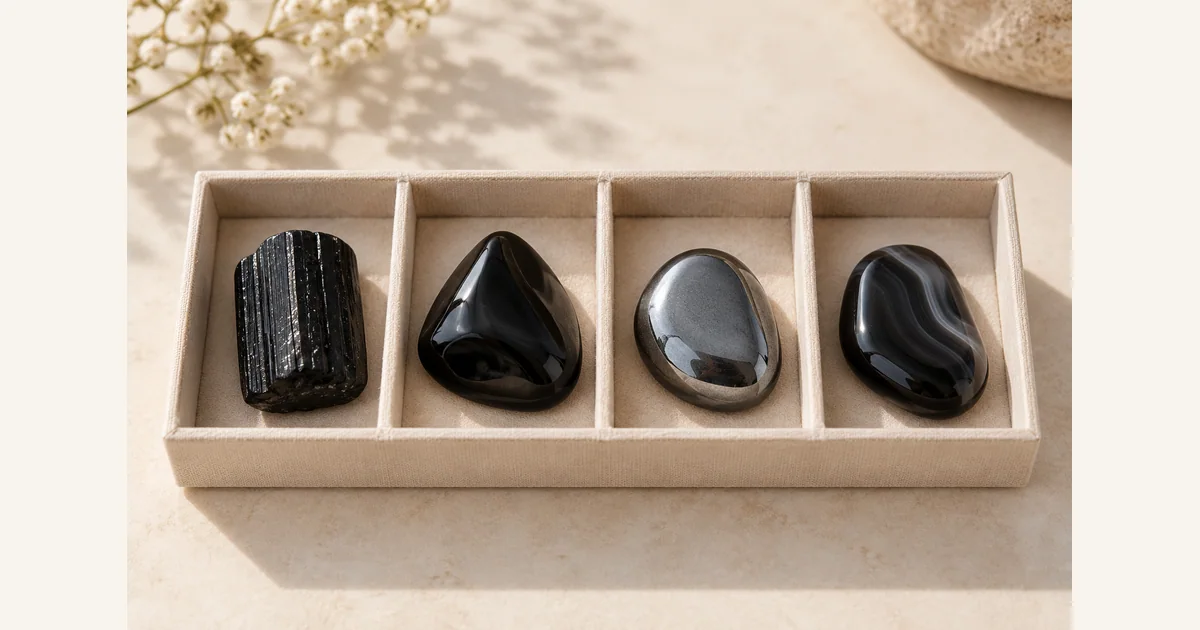
Place the stones in separate cells under diffuse daylight. They may all look almost black from a distance; the differences become apparent when you compare their reflection, visible structure, weight and known composition. The following chart is a useful starting reference for a seller, collector or Vastu consultant.
| Material on the label | What it is | Common visual clues | Approximate Mohs hardness | Most important buying question |
|---|---|---|---|---|
| Black tourmaline (schorl) | Iron-rich member of the tourmaline mineral group | Dark vitreous polish; in some pieces, longitudinal grooves or irregular internal features | About 7 | Is this actual schorl, not a different black mineral? |
| Black obsidian | Natural volcanic glass, not a crystalline gemstone species | Deep glassy shine; sometimes translucent at a thin edge, with conchoidal breakage | About 5–5.5 | Is it natural obsidian rather than manufactured black glass? |
| Black onyx | In modern trade, commonly black chalcedony or agate; often colour-treated | Uniform jet-black polished surface; bands can be hidden by treatment | About 6.5–7 | What is the base stone, and has its colour been treated? |
| Hematite | Iron oxide, chemical formula Fe₂O₃ | Steel-grey to black; often metallic lustre and noticeable weight | About 5–6 | Is it natural hematite or manufactured magnetic “hematine”? |
Hardness is resistance to scratching, not an assurance that an object cannot break. A hard tourmaline pebble may fracture at a pre-existing weakness. A softer obsidian pebble may chip to form a sharp edge. Natural hematite can be dense but brittle. When purchasing mixed sets, careful packing and accurate identification matter at least as much as how smooth the stones look.
1. Black tourmaline: the mineral called schorl
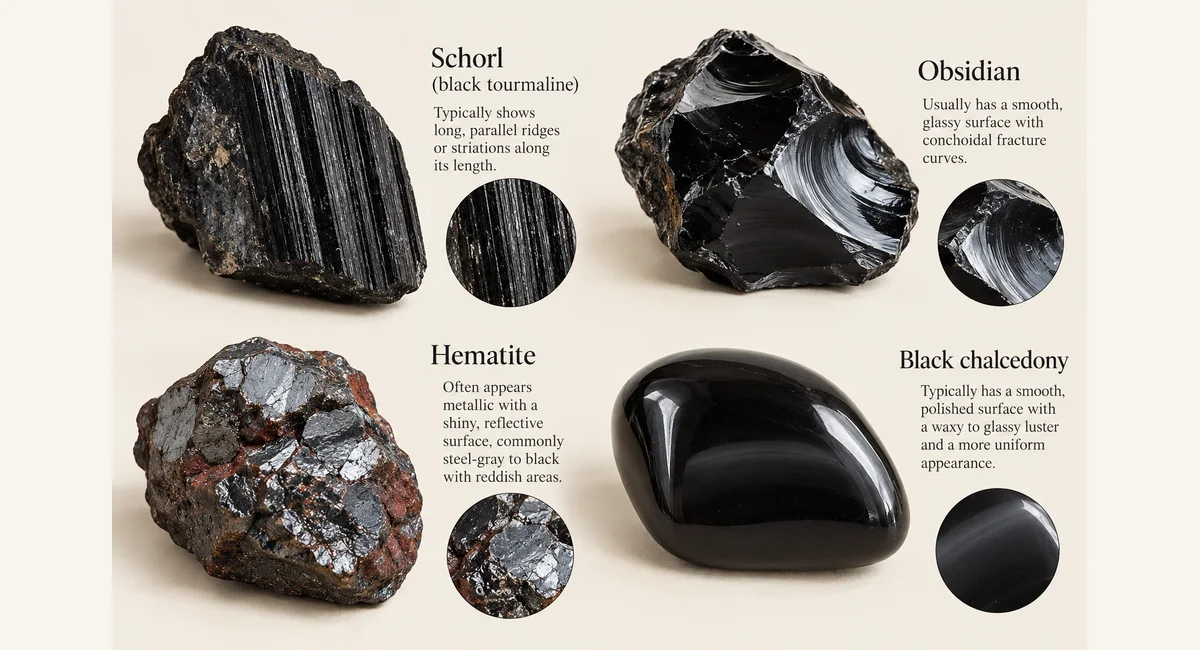
Black tourmaline sold in tumbled-stone sets usually refers to schorl, an iron-rich mineral within the tourmaline group. Tourmaline minerals contain complex borosilicate structures; their composition is entirely different from both black quartz-family stones and volcanic glass. Natural schorl is widely known from elongated prismatic crystals whose lengthwise striations may still be evident on rough pieces. Tumbling rounds those corners. Some polished pieces retain grooved, pitted or slightly irregular areas, while others become smooth and reflective.
A deep black surface alone cannot establish schorl. Its natural crystal features can support a preliminary identification, but a cut or polished pebble may not retain enough structure for a conclusive visual call. A supplier should be able to distinguish schorl from black glass, basalt, dark amphibole, synthetic-looking decorative items and other material offered under the broad name “black crystal”. In a showroom, a labelled raw specimen beside the tumbled stone provides better teaching value than one anonymous polished pebble.
Symbolic use: In contemporary crystal practice, black tourmaline is frequently selected as a reminder of steadiness, personal boundaries and protection. A single stone on a desk or an entrance console can work as a focal object for that intention. It is best described as a modern crystal association; there is no need to claim that every old Vastu text prescribes schorl at a specific compass point. A traditional Vastu discussion first considers the entrance, directions, room use, weight distribution, cleanliness and movement through the space.
Choosing a piece: Look for a stable polish and edges that do not snag fabric. Slight natural inclusions or surface texture may be acceptable if disclosed. For a pocket stone, select one without loose fragments or sharp cavities. For a teaching kit, keep a visibly striated rough sample and a smooth tumble together, clearly noting that neither appearance by itself certifies the identity.
2. Black obsidian: volcanic glass rather than tourmaline
Obsidian forms when silica-rich molten material cools so rapidly that it develops a glassy structure rather than the ordered crystals found in most named gemstones. Therefore obsidian is natural volcanic glass, not a variety of tourmaline and not black chalcedony. In hand, it may have a striking bright polish. Some pieces show brownish or smoky translucency along a thin edge when illuminated appropriately. Fresh broken obsidian can fracture in curved, shell-like surfaces; a polished tumble should not be deliberately chipped to check this property.
Not all obsidian is plain black. Snowflake obsidian has greyish or white radiating patches produced by crystallization within the volcanic glass. These patches are not literal snowflakes. Mahogany obsidian may display reddish-brown and black areas; sheen and rainbow varieties show optical effects caused by internal features. Natural varieties can be useful in an educational kit, but they should not be silently substituted for a customer ordering an entirely black obsidian stone.
Since black manufactured glass can resemble obsidian closely, neither a deep glossy shine nor translucency at an edge is a reliable standalone authenticity test. A reasonable supplier record gives the material name, any relevant variety name, provenance when known and whether the piece is natural glass or man-made glass. For expensive or disputed specimens, a gemologist can examine characteristics that a photograph cannot show.
Symbolic use: Modern meditation and crystal literature associates obsidian with reflection, boundaries and confronting habits honestly. Some people prefer it on a private study shelf or within a journalling space rather than in a prominent, busy living-room arrangement. Those personal associations are distinct from any universal Vastu command. The chosen position should serve the actual use of the room.
3. Black onyx: understand the name before buying
The name onyx historically describes banded chalcedony, generally with comparatively straight or parallel bands rather than the curved or concentric bands of many agates. In today's bead and tumbled-stone markets, however, “black onyx” frequently means uniformly black chalcedony, including material whose dark colour has been produced or intensified by a treatment. Natural solid-black material exists, but a perfectly consistent black colour should not be treated as proof of natural, untreated origin.
This makes black onyx a naming and disclosure issue as much as an identification issue. A product may genuinely be chalcedony and genuinely have been colour-treated; that does not make it an imitation. The clear description is “black onyx (dyed chalcedony)” or a comparably specific term when the supplier confirms it. It is misleading to present common dyed material as unusually rare untreated natural black onyx. Conversely, it is incorrect to insist that a dark stone must be artificial simply because its colour is very even.
The trade also uses Mexican onyx and onyx marble for banded calcite or related decorative stone. Those are not the same mineral material as chalcedony onyx. Likewise, a glossy black bead described only as “onyx” can be glass or another black stone unless its material is established. When purchasing a meaningful Vastu or spiritual jewellery set, material names should be precise enough that replacements can be sourced consistently.
Symbolic use: In contemporary gemstone jewellery, black onyx often represents self-discipline, composure and steadiness. Its smooth, uniform finish is particularly suitable for a minimal desk bowl, a small display card or matched jewellery pieces. The aesthetic quality can be valuable even when the treatment is disclosed. For a demonstration kit, include a written treatment note: it teaches buyers why a uniform colour is a commercial feature, not a mineral identification test.
4. Hematite: the heavy iron-oxide stone
Hematite is iron(III) oxide, with chemical formula Fe₂O₃. It can be steel-grey, dark metallic, reddish-brown or earthy red depending on its form. Dense metallic-looking tumbled hematite feels distinctly weighty compared with many similarly sized black glass or chalcedony pieces. A reliable geological clue is its characteristic red-brown streak, but creating a streak requires rubbing material against a suitable unglazed surface. That can mark, abrade or damage a finished item, so it belongs in a controlled educational demonstration using an appropriate specimen, not as a casual test on saleable jewellery.
The market contains strongly magnetic beads and pebbles sold as “magnetic hematite” or “hematine”. Many are manufactured magnetic materials, not natural hematite. Natural hematite has variable weak magnetic behaviour and can be affected by mineral associations; a magnet response alone does not settle identification. A seller should state whether the product is natural hematite or a manufactured magnetic imitation, and should not rely on the material's heft or its mirror-like polish as proof.
Symbolic use: Hematite's iron-rich composition and visual weight make it a popular modern symbol of resolve, grounded action and practical focus. It looks effective in a work-related or financial-document display because the visual message is restrained and solid. This is a cultural and personal symbolic choice, not a claim that placing iron oxide on a table changes income, health or planetary influences.
How to compare black stones without damaging them
Most shoppers only need a dependable labelled material, an undamaged polish and a credible description. More elaborate identification belongs to a trained gemologist. For a class or a shop demonstration, place one known specimen of each material under diffuse daylight on a light neutral card, preferably with an angled lamp to reveal differences in reflection. Compare similar-sized pieces; do not mix a large hematite with tiny tourmaline and call the weight difference a fair test.
| Observation | What it may suggest | What it cannot prove | Recommended next step |
|---|---|---|---|
| Lengthwise grooves or crystal remnants | Possible schorl on a partially rounded specimen | That every grooved black stone is tourmaline | Check supplier identification; compare a labelled raw schorl |
| Very glassy reflection, sometimes light at a thin edge | Possible obsidian or other glassy material | That the glass is natural volcanic obsidian | Ask whether natural or manufactured glass was supplied |
| Even, opaque black with a smooth waxy-to-vitreous polish | Could be treated black chalcedony or onyx | Untreated natural colour, or even chalcedony composition | Ask for base material and treatment disclosure |
| Steel-grey metallic polish and greater apparent heft | Possible hematite | That a bead is definitely natural hematite | Confirm natural versus manufactured magnetic material |
| Strong response to a small magnet | Possible manufactured magnetic “hematine” or other magnetic material | A complete identification of the material | Keep it in a separately labelled comparison tray |
Do not use acid, a sharp metal tool, an intentional break, flame or a household scratch test on polished customer stones. Such tests can alter the surface or destroy the piece without providing a sufficiently reliable answer. Magnification, comparison with known samples and, where needed, professional gem testing offer a better path.
Black stones in Vastu: tradition, directions and modern symbolism
Vastu Shastra considers the character and organization of a built space: the entrance, flow of movement, proportions, room functions, light, ventilation, cleanliness and the relative weight or openness of parts of the plan. The eight principal directions are also described through Ashta Dikpalas, the directional guardians. For instance, Nairritya is conventionally linked with the south-west, and Vayu with the north-west. That framework is older than the modern market for tumbled tourmaline, obsidian, onyx and hematite.
For this reason, a meaningful explanation separates three layers: the traditional Vastu direction, the material's known identity, and the owner's intended symbolism. Contemporary crystal arrangements may use black stones as grounding or boundary reminders. It is inaccurate to present all four as a compulsory remedy prescribed by a single classical text, or to claim that the same black stone must always sit in one corner regardless of the plan.
| Space or purpose | Possible modern display | Why it can be chosen | Traditional Vastu consideration |
|---|---|---|---|
| Entrance console or reception | One labelled schorl pebble in a stable dish | Symbol of an orderly threshold and personal boundaries | Keep the entrance accessible, illuminated and uncluttered |
| Study or work desk | A single hematite stone beside a notebook | Reminder of discipline, focus and deliberate work | Desk orientation, seat support, light and practical circulation matter first |
| Personal meditation shelf | Obsidian with a plain dark cloth or small tray | Contemplative visual focal point | Keep the prayer or meditation area clean and respectful; consider household custom |
| Simple home display | Black onyx in a low bowl with pale natural stones | Balanced contrast, a feeling of quiet and restraint | Do not create crowding, unstable shelves or blocked windows |
| South-west storage or furniture zone | A small stable four-stone comparison box, if appropriate | Symbolic stability in a heavier, quieter part of the plan | Weight and function are considered in many Vastu approaches; no single black stone is obligatory |
These are illustrative arrangements, not a list of verified effects. A practitioner may prefer a different placement after examining room use, actual compass orientation and family traditions. If a plan has problems with light, access or safe circulation, a decorative pebble should never take priority over correcting those ordinary conditions.
What about Shani, Rahu and gemstone astrology?
Black stones are sometimes marketed collectively as “Saturn stones”. This is too broad to be a precise Jyotisha statement. In common Navagraha gemstone traditions, blue sapphire (neelam) is associated with Shani (Saturn), hessonite (gomed) with Rahu and cat's-eye chrysoberyl (vaidurya/lehsunia) with Ketu. These specific gemstone names cannot be replaced just by matching a dark colour. A modern black tourmaline or onyx bracelet may be worn for its symbolism or appearance, but it is a different choice from a chart-based Navagraha gemstone recommendation.
The deeper traditional idea is that a remedy must be understood in its context: what planetary principle is being discussed, which school or lineage is followed, what the birth chart actually indicates, what method is prescribed, and whether a gemstone is appropriate at all. For customers who only want a dark desk stone or a decorative Vastu set, there is no need to turn the purchase into an implied astrological prescription. A clear product description is more useful than an unsupported “works for every Shani dosha” claim.
Four complete arrangements using the same materials
Example 1: compact apartment entry shelf
Suppose a Bengaluru apartment has a narrow entrance and space for a small shelf above shoe storage. Use a shallow dish, about the width of an adult hand, with one black tourmaline stone and one black onyx stone. Place the dish away from the edge and keep the entrance usable. Schorl contributes natural mineral texture, while polished onyx provides visual contrast. Write a small note such as “clarity at the threshold” if the household enjoys intention-setting. The practical goal is a neat, safe entrance; the stones are symbolic accents rather than barriers against unseen forces.
Example 2: home study or office desk
A person working with accounts or studying for examinations may prefer one heavier-looking hematite pebble beside a notebook, accompanied by a separate obsidian stone on the far side of the desk. The hematite represents steadiness in daily tasks, and the obsidian represents the habit of reviewing one's work without distraction. Keep the phone, lamp and writing area practical. If a stone is touched frequently, choose a rounded, unchipped piece; do not add so many stones that they become a distraction.
Example 3: jewellery showroom comparison display
Use four adjacent compartments labelled schorl / natural obsidian / black chalcedony (treatment stated) / natural hematite. Display one hand-sized reference sample and two smaller tumbles of each, for 12 stones in total. A magnifying lens and neutral light allow customers to compare natural texture, glassy gloss, a smooth chalcedony surface and metallic lustre. Beside the display, place a separate labelled manufactured magnetic bead to show why “magnetic hematite” requires special care in naming; that demonstration bead is not part of the 12-stone natural-material inventory.
Example 4: a professional Vastu demonstration kit
Prepare a small four-row reference tray with three pieces each of the four named materials: 3 schorl, 3 obsidian, 3 black onyx/chalcedony and 3 hematite. In each row, choose one ordinary representative sample, one piece showing a natural variation and one carefully labelled trade/treatment example where relevant. The total is again 12. The trainer can lay the stones beside a floor-plan sheet and explain why object placement should be based on the room and its use, not merely on colour. The kit demonstrates both traditional directional vocabulary and disciplined material identification.
| Row | Material and number | What a learner should observe | Information on the label |
|---|---|---|---|
| 1 | 3 black tourmaline / schorl | Vitreous finish; possible striations; surface variation | “Schorl (tourmaline group), natural” if confirmed |
| 2 | 3 black obsidian | Glassy polish; optional natural snowflake variety identified separately | “Natural volcanic glass; variety name where relevant” |
| 3 | 3 black onyx / chalcedony | Even colour, possible layering or differences in polish | “Chalcedony, dyed” when confirmed, or treatment status as supplied |
| 4 | 3 natural hematite | Metallic grey reflection, weight, grain differences | “Natural hematite (iron oxide)” if confirmed |
| Total | 12 labelled stones | Four genuinely distinct material families | Source, quantity, treatment status and date checked |
Choosing and buying black tumbled stones
Since four very different materials can share a black finish, evaluate each consignment by identity, completeness and disclosed processing. A glossy product photograph alone does not show whether a stone is schorl, obsidian, chalcedony or manufactured magnetic material. Ask a supplier for actual photos of the current batch, not just a catalogue picture. For mixed sets, request an item-by-item list instead of accepting a generic description such as “four protection crystals”.
| Question to ask | Why it matters | What a useful answer looks like |
|---|---|---|
| What is the exact base material? | Names such as onyx and magnetic hematite can be ambiguous | Schorl, natural volcanic obsidian, chalcedony, natural hematite, or specified manufactured material |
| Is the stone dyed, coated, reconstructed or otherwise altered? | Black colour can conceal treatment | Treatment disclosed by type where known; unknown status identified as such |
| Are all stones from the same lot? | Sets may vary in shade, finish and size | Count, approximate dimensions, lot reference and sample photos |
| Are there chips, cracks or sharp edges? | Obsidian and brittle pieces can be uncomfortable or unsafe to handle | Clear photos and a defined acceptance standard |
| Does the label distinguish natural and manufactured material? | A strongly magnetic black bead may not be natural hematite | Specific, non-misleading material name |
| Can a replacement match the original specification? | Useful for professional teaching and repeat orders | Repeatable item code and treatment/size information |
When inspecting a delivery, count the stones before mixing them; compare labels with the invoice; examine the polished edges in good light; and keep any questionable pieces separate until the material is clarified. A naturally irregular surface is not automatically a defect, but visible fractures, unstable polish and unmentioned treatment should be discussed before acceptance. In retail, honest descriptions increase confidence and help a buyer select the intended material for jewellery, display or demonstration.
Cleaning, storage and handling: one black colour does not mean one care routine
Black materials show dust, fingerprints and small scratches readily. For a mixed display, a soft dry cloth is the simplest routine. If an identified, untreated stone needs more cleaning, the correct method depends on its structure, finish and any setting or adhesive. Do not assume a cleaning method safe for one material is safe for a dyed or coated piece in another compartment. Avoid harsh household solvents, steam, ultrasonic cleaning and abrasive powders in an unidentified mixed lot.
| Material | Practical handling emphasis | Keep away from |
|---|---|---|
| Black tourmaline / schorl | Pad against collisions; inspect existing cracks and natural pits | Impact, tight loose-stone jars and rough abrasion |
| Obsidian | Use its own padded cell; check for edge chips | Hard impacts, scratching contact and handling chipped edges |
| Black onyx / treated chalcedony | Use gentle dry wiping; confirm treatment before any wet cleaning | Strong cleaners, solvents, abrasives and prolonged harsh exposure |
| Natural hematite | Store dry and separate from harder jewellery; wipe after handling | Repeated collisions, abrasive cleaning and unnecessary prolonged moisture |
Decorative “cleansing” instructions that prescribe long salt-water soaks, burying stones or prolonged strong sun exposure are not suitable as universal material-care guidance. A stone may carry personal ritual significance without needing to be soaked or physically stressed. For jewellery with metal settings, the setting may need even more careful handling than the gemstone itself. When a stone is loose in a consultation kit, use separate labelled sleeves or foam cells instead of placing all black pieces in one pouch.
Common buying mistakes and how to correct them
Mistake: “All polished black stones are black tourmaline.” The correction is to identify the mineral family. Schorl, obsidian and chalcedony may all be dark and polished but are not interchangeable. Surface texture may guide an initial comparison, never serve as a guarantee.
Mistake: “Magnetic hematite is always natural hematite.” The correction is to ask for an explicit natural-versus-manufactured declaration. Strong magnetism in a polished bead raises a question; it does not by itself answer every mineralogical detail.
Mistake: “Dyed onyx is fake.” Treated natural chalcedony can be genuine material sold in an enhanced colour. The important distinction is whether the treatment and underlying substance are described accurately. Natural, dyed, coated and glass products should not be mixed under a single vague label.
Mistake: “Obsidian and snowflake obsidian must have identical spots.” Plain obsidian and snowflake obsidian are commercially different visual varieties. The latter's pale spherulitic patterns are natural internal crystallization features; a customer's order should specify whether those markings are wanted.
Mistake: “Every black crystal is a traditional Shani remedy.” Modern black-stone symbolism and classical Navagraha gemstone choices are different systems. Colour similarity does not establish a Jyotisha prescription.
Frequently asked questions
Is black tourmaline the same as black onyx?
No. Black tourmaline most often means schorl, a tourmaline-group mineral. Black onyx in current jewellery trade usually means black chalcedony, which is a different silica material and often has colour treatment. Their visual resemblance should not conceal the distinction on a product label.
Which of the four stones is heaviest?
For equal volumes, dense natural hematite will generally feel heavier than obsidian or chalcedony and often heavier than schorl. Real tumbled pieces differ in size, so merely holding two unmatched pebbles is not a reliable measurement. A fixed-volume comparison is more meaningful for students.
Can a magnet prove a stone is hematite?
No. Many strongly magnetic items sold as magnetic hematite are manufactured. Natural hematite may exhibit weak or variable magnetic behaviour. A magnet is a limited observation, not a conclusive test or a substitute for supplier identification.
Can I place black obsidian at my home's entrance?
It can be used as a decorative or personal symbolic stone if it fits the household's preferences and the shelf is safe and uncluttered. No one placement is mandatory for every building. An actual Vastu assessment should consider the entrance's direction and physical layout rather than treating a stone as a universal correction.
Is black onyx always natural and untreated?
No. Many uniformly black chalcedony products are treated to obtain their colour. Ask for material and treatment disclosure. Disclosed colour treatment does not mean the underlying stone is synthetic; it does affect the accuracy of a claim that the item is untreated.
Is hematite an iron stone?
Yes, hematite is an iron oxide mineral, Fe₂O₃, but it should not be confused with a piece of pure metallic iron. Its metallic appearance does not mean it is made of metal in the ordinary jewellery sense.
Final comparison: choose by material, symbolism and purpose
If you want a naturally textured black mineral for a modern grounding-themed arrangement, black tourmaline may be suitable. If the goal is a glassy contemplative focal stone, natural obsidian offers a very different appearance and origin. If a smooth, matched black finish is most important for jewellery or display, correctly described onyx/chalcedony provides that look. If you want a dense, steel-grey mineral specimen for a work desk or educational tray, natural hematite provides a contrasting iron-oxide example.
A good set does not ask a customer to believe that all four are identical “protection crystals”. It clearly shows what each stone is, how it was presented, what symbolic role the owner has chosen and how it should be handled. That distinction respects traditional Vastu and Jyotisha terminology, supports better gemstone selection and helps OmmRudraksha customers use a labelled black-stone collection with confidence.
Continue reading
- Natural, Dyed, Heat-Treated and Reconstructed Stones
- Pyrite Tumbled Stones: Identifying Material and Safe Care
- Gemstone Identification Study Kits: What They Can and Cannot Prove
Explore the existing Vastu and gemstone collections for wider context.