Is a polished gemstone natural, dyed, heat-treated, reconstructed or synthetic? These are not competing names for a single quality grade. They answer different questions: where a material formed, what it actually is, whether its appearance has been modified and whether the object remains a single piece of that material. A genuinely natural quartz pebble can be heated; a genuine agate can be dyed; a piece sold as turquoise may instead be dyed howlite; and a reconstructed bead can contain real mineral fragments without being one continuous natural stone.
For tumbled stones, gemstone bracelets, crystal grids, professional Vastu sets and Jyotisha-related gemstone purchases, understanding these distinctions prevents unnecessary confusion. A treated stone may be an attractive and useful decorative object when correctly described, but a buyer who specifically requests an untreated specimen, a mineral-identification teaching set or a prescribed astrological gemstone needs a much more exact description. The following guide explains the terminology, recognition limits, care, traditional context and purchasing decisions with examples.
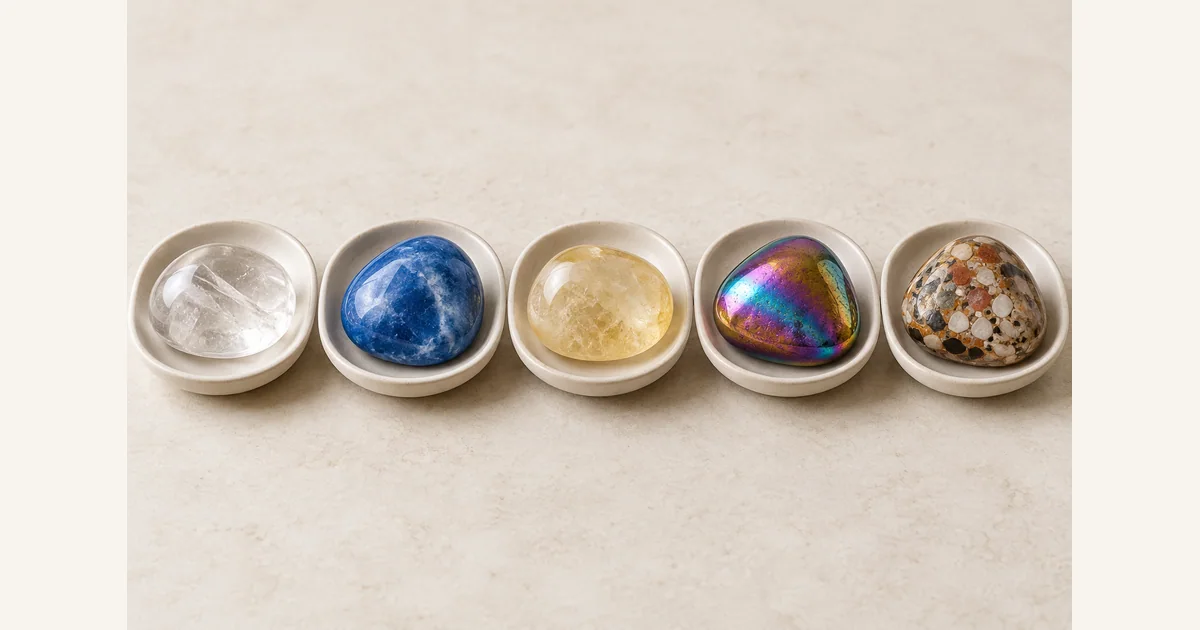
1. Begin with four separate questions
Before assessing a gemstone, write four answers in this order. Identity: is it quartz, chalcedony, howlite, jadeite, nephrite, glass, resin or a mixed composite? Origin: did the material form naturally, grow in a laboratory or consist of manufactured components? Treatment: was it heated, dyed, irradiated, coated, filled, bleached or impregnated? Construction: is the tumbled object one solid piece, glued layers, fragments in binder or a molded product? A seller can answer some of these questions while remaining uncertain about others.
For example, the description natural chalcedony, dyed black, polished is internally consistent: the underlying chalcedony formed naturally, its black colour was added later and its glossy surface resulted from polishing. Likewise, natural quartz, heat-treated to yellow, tumbled is more informative than simply saying “yellow natural crystal.” If the heat-treatment history is unknown, a careful description should say so rather than guessing from a photograph.
| Term | What it establishes | What it does not establish |
|---|---|---|
| Natural gemstone | The mineral or rock formed by natural geological processes. | That the stone is untreated, flawless or of a particular grade. |
| Untreated | No treatment is identified or represented for the relevant property, subject to the quality of evidence. | That a seller or photograph can prove the absence of every possible treatment. |
| Enhanced / treated | An intervention changed colour, apparent clarity or stability. | The specific process, permanence or material identity unless separately stated. |
| Reconstructed / reconstituted | Particles or fragments were formed into a new object, often with a binder. | That the object is one solid natural crystal of the named material. |
| Lab-grown / synthetic | A manufactured crystalline material corresponding to a natural mineral species. | That it is merely glass, plastic or an imitation. |
| Imitation / simulant | A different substance resembles a named stone. | That it has the same mineral composition or durability. |
2. Polishing and shaping are not the same as colour treatment
A tumbled stone passes through cutting, grinding and polishing. These mechanical processes alter size, shape and surface texture without necessarily changing its mineral identity or internal colour. A polished natural agate remains natural agate; a polished piece of laboratory-grown quartz remains synthetic quartz. Surface polishing can also conceal small pits or reveal colour patterns that were difficult to see on the rough piece. Therefore “unpolished” is not a synonym for “untreated,” and “tumbled” alone says nothing about dyeing or heat exposure.
Some stones are waxed or impregnated during finishing to improve the surface appearance. Those treatments are separate from ordinary mechanical polishing and should be described accurately. In a professional sample kit, retain a small rough specimen, when available, beside a polished example; it makes the distinction between natural structure and lapidary preparation much easier to teach.
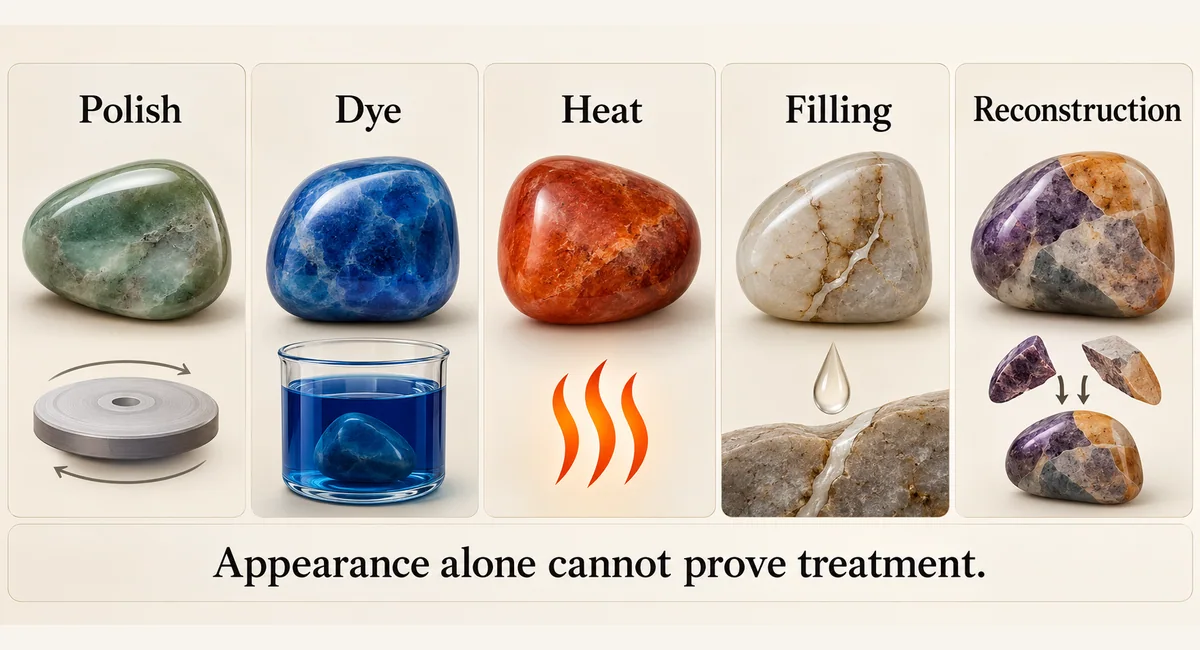
3. Eight major treatment and construction categories
The terminology below corresponds to widely used gemological disclosure categories. A single stone may undergo more than one process, such as heating followed by dyeing, or bleaching followed by polymer impregnation. The order of the processes can matter to its final appearance, but a casual visual inspection cannot reconstruct the full history.
| Process | What is changed | Typical materials or examples | Useful purchase question |
|---|---|---|---|
| Heating | Colour or clarity through controlled temperature. | Some quartz sold as citrine; many coloured gemstones. | Was the colour altered by heat? |
| Dyeing | Colour introduced into pores or fractures. | Howlite, chalcedony/agate, some lapis lazuli. | Is the colour natural or added? |
| Bleaching | Existing colour lightened or removed. | Certain gem materials; sometimes followed by filling. | Was there bleaching and subsequent impregnation? |
| Impregnation / stabilization | Porosity and appearance with wax, resin or polymer. | Porous turquoise, some jade and other opaque materials. | Was resin, wax or another stabilizer used? |
| Fracture filling | Visibility of fissures using oil, resin or glass. | Gemstones with surface-reaching fractures. | Are cracks filled, and does special care apply? |
| Coating | Surface colour, shine or optical effect. | Metallic or iridescent coated quartz and pebbles. | Is the effect on the surface rather than inside? |
| Irradiation / combined treatment | Colour altered by energy, sometimes followed by heat. | Some quartz and other coloured gemstones. | Is irradiation known or suspected from documentation? |
| Reconstruction | Fragments or powder bound into a formed piece. | Some turquoise-like and other composite ornaments. | Is this solid mineral, a composite or resin-bound fragments? |
Two useful distinctions: impregnation introduces a substance into a porous body, while a coating resides chiefly on the surface. Fracture filling affects openings within a stone, while reconstruction creates a new body from particles or pieces. In real products the boundaries can overlap. Use the supplier's precise technical statement rather than relying on broad adjectives such as “enhanced,” “pure,” or “premium.”
4. Natural citrine, heated quartz and smoky quartz
Citrine is a yellow-to-orange variety of quartz. Some citrine forms naturally with its colour, while a substantial part of the commercial yellow-quartz trade includes heat-treated amethyst or smoky quartz. The end product is still quartz, but its colour history matters if the customer requests natural-colour citrine. A heated specimen must not be presented as definitively untreated. On the other hand, an orange specimen cannot be proved heated solely because its colour looks intense; different deposits, colours and treatment histories overlap visually.
Smoky quartz obtains its smoky appearance from colour centres associated with its geological history. Artificial irradiation can also influence quartz colour. Clear quartz or Sphatik, smoky quartz and citrine share quartz chemistry but differ in appearance and traditional use. A collector should label them by confirmed material and declared treatment, not place every yellow stone into the same “natural yellow sapphire” or “Jupiter gemstone” category. Yellow sapphire (Pukhraj) is corundum and a different mineral from citrine; one should not silently substitute for the other in a formal Jyotisha recommendation.
For a practical three-stone comparison, arrange a clear quartz tumble, a smoky quartz tumble and a yellow quartz/citrine tumble under even neutral lighting. Record colour, transparency, fractures and the supplier's declared history. The display teaches genuine variety differences without making unprovable claims from appearance alone.
5. Blue howlite, turquoise, black onyx and coloured agate
Blue-dyed howlite is howlite. Natural howlite is commonly white to pale with grey or dark web-like veining and can accept dyes. Because dyed howlite may resemble turquoise, the distinction must appear on the label. Genuine turquoise is a different mineral, with its own geology, porosity and possible stabilization treatments. Magnesite can also be dyed to resemble turquoise. A vendor's term such as “turquoise colour” can describe a shade, but it should not displace the true mineral name.
Black onyx is another useful example. In everyday jewellery commerce, uniformly black chalcedony often owes its appearance to dyeing. The word onyx has also been applied inconsistently to various black stones, including other chalcedony or unrelated materials. Ask for both mineral identity and treatment. Red, green, blue and purple agates can be naturally coloured, dyed or otherwise enhanced; saturation and colour concentration near a fissure may suggest investigation, not a conclusive home diagnosis.
When the intended use is Vastu display, accurately labelled dyed blue howlite may provide a blue visual accent for a study tray or colour-based teaching board. When the intent is to own a genuine turquoise specimen, it is not equivalent. The appearance-based use and the mineral-identity use should never be confused. The same distinction applies when a client seeks a traditional astrological gem rather than simply a decorative colour.
6. Jade, stabilized turquoise, filled material and coated stones
The name jade principally covers jadeite and nephrite, two different minerals with established gemological identities. Some jadeite is sold untreated; other material may be bleached and polymer-impregnated or dyed. Trade descriptions of jadeite often distinguish A, B and C treatment categories, but the labels must be applied correctly to the relevant stone and should not be transferred casually to nephrite or lookalikes. Serpentine and aventurine may be commercially described with jade-like trade names, but they are not automatically jadeite or nephrite.
Turquoise may be stabilized with polymers to improve the durability of porous material. An adequately described natural turquoise, stabilized remains different from reconstructed turquoise fragments in binder and from dyed howlite resembling turquoise. All three can be attractive but their construction, expected wear and pricing logic differ. If a stone is lacquered, metallic-coated or “aura” coated, the decorative visual effect can be legitimate; the buyer should understand that the iridescent surface is an added layer rather than a naturally occurring internal colour.
Filled and coated stones are particularly sensitive to inappropriate cleaning. Heat, solvents, strong cleaners, abrasives or ultrasonic equipment may alter fillings and coatings. Opaque tumbled stones are not immune simply because they look solid. If composition or treatment is unknown, a soft dry cloth and separate storage are better initial choices than any chemical experiment.
7. Reconstructed, composite, synthetic, imitation: four different objects
Consider four objects offered for a classroom gemstone display. The first is a single polished turquoise pebble. The second consists of turquoise chips bound into an object with resin. The third is blue-dyed howlite. The fourth is opaque blue glass. The first is natural mineral, perhaps treated; the second is a composite or reconstructed material; the third is a different natural mineral that has been dyed; and the fourth is manufactured glass. Even when all four have similar colour, their mineralogical identity and appropriate label differ.
Synthetic has a narrower technical meaning than “artificial-looking.” Laboratory-grown quartz can have the same chemical composition and crystal structure as naturally grown quartz, but a different origin. By contrast, ordinary glass beads imitating a gemstone do not become synthetic examples of that gemstone. A molded resin object containing a little crystal powder is not a natural crystal specimen and should be described by its composite construction.
| Object on a seller's table | Appropriate wording when supported | Wording to avoid |
|---|---|---|
| Natural agate that was dyed blue | Blue-dyed natural agate, polished. | Untreated blue agate, unless verified. |
| Heat-treated quartz with yellow colour | Heat-treated citrine/quartz, if the specific origin is known. | Natural-colour citrine, without evidence. |
| White howlite coloured bright turquoise blue | Dyed howlite, turquoise blue. | Genuine turquoise. |
| Blue mineral fragments set in resin | Composite/reconstructed stone, with stated contents. | One solid natural turquoise crystal. |
| Laboratory-grown quartz | Lab-grown/synthetic quartz. | Earth-mined natural quartz. |
| Iridescent film applied to a quartz tumble | Coated quartz with iridescent finish. | Naturally iridescent quartz, as if untreated. |
8. What a buyer can inspect, and what requires advanced testing
A careful first inspection starts with a neutral light, a white paper background, a 10× loupe and a written record. Look at the distribution of colour, visible fractures, uniformity, surface patches, an obvious film, mould seams, coating wear and unusual textures. Note transparency and the nature of inclusions. Compare several pieces from the same lot; a single picture may hide differences evident in hand. This process helps formulate questions and can sometimes reveal a plainly wrong description, but it is not a definitive laboratory treatment test.
Some dyes can concentrate in cracks; some coatings can show abrasion at corners; some composites may reveal visible fragments and binder. Yet a natural band, inclusion or colour boundary can resemble an enhancement clue. Some treated gemstones show no obvious signs. No universal home scratch test, burn test, acetone test, saltwater experiment or UV-lamp shortcut proves that an unfamiliar stone is untreated. Destructive or chemical tests can reduce the value and condition of the material and may introduce safety concerns. A UV observation, if used by a trained examiner, is one piece of evidence rather than a verdict.
Professional identification may use microscopy, refractive index, specific gravity and appropriate spectroscopy or other tests, chosen for the specimen and the question. Mineral identity and treatment detection are separate tasks. A general authenticity certificate for a lot may not establish treatment for every stone unless the testing scope makes that clear. A laboratory report for one stone does not automatically cover ten visually similar stones stored in the same pouch.
9. Traditional significance: natural stones, Jyotisha and Vastu
Indian gemstone traditions distinguish precious gem identity, quality, suitability and ritual purpose. In Ratna Shastra and Jyotisha practice, the identity and quality of an astrological gemstone are materially significant; the prescribed species and supporting criteria cannot be replaced merely by a similar colour. The traditional Navaratna grouping links ruby with Surya, pearl with Chandra, red coral with Mangala, emerald with Budha, yellow sapphire with Guru, diamond with Shukra, blue sapphire with Shani, hessonite with Rahu and cat's eye with Ketu. Different traditions and practitioners may apply additional quality, weight and suitability rules.
Meanwhile, many contemporary tumbled-stone arrangements, chakra colour sets and crystal grids are modern adaptations used alongside Vastu concepts. Their stone correspondences often follow colour and symbolic association rather than a classical rule identifying a precise mineral treatment. For instance, a clear Sphatik object may be chosen for a puja or meditation setting, a yellow stone may be selected for a teaching display about brightness or abundance, and a black stone may be presented as a symbol of steadiness. This does not mean dyed howlite becomes lapis lazuli, or heat-treated yellow quartz becomes yellow sapphire.
For Vastu Purusha Mandala and the directional framework, the northeast is commonly associated with Ishana and prayer or contemplation, the east with Surya and illumination, and the north with Kubera and prosperity. A practitioner may use symbolic colour accents within those zones, but the architecture, use of space and family practice matter more than declaring that one manufactured gemstone finish is a mandatory classical rectifier. If the purpose is a specific consecrated object or an astrologer-prescribed ratna, confirm the desired mineral and treatment standard before purchase.
| Purpose | Material and treatment priority | What to ask first |
|---|---|---|
| Gemology teaching collection | Include verified examples of untreated, treated and composite materials, separately labelled. | Which distinction will each specimen demonstrate? |
| Colour-based Vastu shelf or tray | Accurate identity, colour stability and safe handling; a disclosed treatment may suit the decorative purpose. | Is appearance or mineral identity the main requirement? |
| Sphatik puja or meditation object | Confirm actual quartz identity, condition and how it will be handled or worshipped. | Is it genuine quartz or a lookalike? |
| Astrologically prescribed gemstone | Specific species, quality and treatment requirements under the chosen Jyotisha method. | What exactly did the practitioner prescribe? |
| Retail jewellery or resale stock | Disclosure, reliable lot records and customer-appropriate aftercare. | Can the supplier state treatments in writing? |
10. A reproducible twelve-specimen study and Vastu consultation kit
For workshops and showroom comparisons, use twelve individually labelled positions in a tray. It is a teaching set, not a universal twelve-gem astrological prescription. The essential feature is that genuine mineral identity and treatment information are visible without removing each stone from its compartment. If the exact treatment cannot be established, label it supplier declared or treatment not determined instead of filling the uncertainty with confident marketing.
| Slot | Suggested specimen | What visitors learn |
|---|---|---|
| 1 | Clear quartz / Sphatik | Colourless natural quartz and polished surface. |
| 2 | Smoky quartz | Natural smoky appearance versus colour-history questions. |
| 3 | Yellow quartz / citrine | Natural versus heat-altered yellow colour, with disclosed status. |
| 4 | Natural grey-white howlite | Natural matrix and mineral identity. |
| 5 | Dyed blue howlite | How a colour process affects appearance without changing howlite identity. |
| 6 | Natural agate or chalcedony | Microcrystalline quartz varieties and banding. |
| 7 | Dyed agate | Colour enhancement and disclosure. |
| 8 | Black onyx/chalcedony, treatment declared | Trade names versus mineral and colour-treatment description. |
| 9 | Nephrite or jadeite, identity confirmed | The precise meaning of the jade name. |
| 10 | Stabilized turquoise, if documented | Impregnation and durability considerations. |
| 11 | Coated quartz or iridescent pebble | External film versus natural interior colour. |
| 12 | Clearly marked reconstructed composite | Fragments plus binder versus a single natural stone. |
This kit has 12 positions and 12 specimens. If one example is unavailable, use a labelled photograph of the category rather than buying an uncertain specimen and describing it as verified. For a client consultation, the same set can explain why different blue or yellow stones cannot be interchanged simply because their colours match a chosen direction. Store any composite or coating-sensitive piece separately; the tray should not become a source of scratches from harder quartz rubbing against softer materials.
11. Three practical purchase and display examples
Example A: A Bengaluru jewellery showroom orders a blue-stone display
A supplier offers twenty bright-blue polished pieces at an attractive price and calls them “natural turquoise.” The showroom requests a written mineral identity and treatment statement. The seller clarifies that the material is dyed howlite. The showroom can still purchase it for an affordable blue-colour demonstration or bracelet component, but the invoice and display card must say blue-dyed howlite. The customer seeking genuine turquoise is shown an appropriately identified turquoise specimen instead. This is a better commercial decision than rejecting every treated gem or mislabelling inexpensive material as a premium mineral.
Example B: A Vastu practitioner assembles a nine-piece symbolic shelf
For a small consultation desk, the practitioner may choose a clear quartz centre and eight surrounding stones selected by symbolic colour and ease of care. Before ordering, the practitioner specifies whether the stones are for directional illustration, a client's personal meditation practice or a formally prescribed gem. A dyed blue example can be retained as a colour sample if disclosed; it must not be labelled natural lapis lazuli or substituted for an astrologically specified stone. The tray stays out of strong sunlight and away from water or incense ash, especially where unknown coatings or fillings are present.
Example C: A customer wants “natural untreated citrine”
The customer compares two yellow quartz tumbled stones. One is listed merely as “natural citrine”; the other has a clear supplier statement that it is heat-treated quartz. Because the buyer specifically prioritizes untreated colour, the second does not meet that preference even though the material is quartz. The first is not automatically proven untreated just because its label says natural. The right next step is to request reliable origin and treatment evidence or select a specimen with an appropriately scoped report. Where the objective is simply a yellow display stone, a clearly disclosed heat-treated piece may be suitable at a different budget.
12. Supplier questions, invoices and lot traceability
A useful product description begins with the specific material name, then notes colour or variety, the physical form, confirmed or declared treatments, and any important care limitation. Trade names such as “aura,” “rainbow,” “jade-like,” “onyx black” and “turquoise colour” can be retained as secondary design descriptions when the actual material is also stated. They should never overwrite the identity field. Record a lot or supplier reference when the stock is received, and use it on sample cards so that any later correction can reach the correct batch.
| Inventory field | Good example | Why it matters |
|---|---|---|
| Material identity | Howlite (not turquoise). | Prevents a colour-based substitution. |
| Form and dimensions | Tumbled, approximately 20–25 mm. | Clarifies how the object is supplied. |
| Treatment statement | Blue-dyed; supplier declared. | Distinguishes source claim from laboratory finding. |
| Construction | Single mineral pebble, or composite with binder. | Supports correct storage and handling. |
| Evidence level | Invoice declaration, lot certificate or individual laboratory report. | Shows exactly what was examined. |
| Care note | Avoid solvents, heat and prolonged soaking. | Protects coatings, dyes and stabilizers. |
| Lot reference | Supplier batch and receipt date. | Allows traceability and replacement. |
For purchasing, ask: What is the exact mineral? Does the colour occur naturally? Has heating, dye, irradiation, filling, coating, stabilization or reconstruction been used? Is the declaration for one sample or the entire shipment? What happens if an independently checked specimen contradicts the invoice? A trustworthy supplier can sometimes answer “unknown.” That is far more useful than promising that every polished stone in a mixed assortment is untreated.
13. Care, cleansing practices and long-term storage
Keep the physical-care routine separate from spiritual or devotional preparation. Dry dusting, soft individual pouches and protection from impact safeguard the object itself. Many treated stones should not be soaked, steam-cleaned, ultrasonically cleaned, exposed to acetone or left near heat. Quartz is relatively hard, but a coating on quartz can be much less durable than the underlying mineral. Malachite, fluorite, howlite and other softer or more sensitive stones need their own material-specific precautions. If a product has unknown treatment, handle it conservatively until identified.
Some families mark the placement of a stone with Sankalpa, prayer, mantra, meditation or the devotional process of shuddhi and pavitrikaran. These practices should not be confused with physical immersion or chemical cleaning. A gentle non-contact prayer or simply placing a clean, dry object at its chosen location avoids exposing dyed, resin-filled or coated surfaces to water, salt and strong substances. A Sphatik object used for puja can be maintained respectfully while still following its actual material-care requirements.
For a professional carrying kit, photograph each labelled compartment after packing, keep the supplier declarations with the inventory and inspect items after each demonstration. Replace a missing specimen with one of known identity rather than a superficially similar colour. If a previously unknown treatment becomes confirmed, update the card and any customer-facing description; the new information does not change the mineral's underlying geological origin, but it changes the accuracy of the representation.
14. Questions customers often ask
Does dyed natural stone stop being natural stone?
The mineral can still be naturally formed. The dye is an added treatment, so the complete description must include both facts. “Natural howlite, dyed blue” is a valid idea; “naturally blue untreated howlite” is a different and potentially unsupported claim.
Is heat-treated citrine synthetic?
No. Heating natural quartz changes its appearance; it does not make its original geological material laboratory-grown. Synthetic quartz concerns the growth origin, not simply the treatment of natural quartz.
Is reconstructed turquoise the same as solid turquoise?
No. A reconstructed or composite object may contain genuine mineral particles, but it is not necessarily a single natural turquoise pebble. Its binder and construction influence durability, care and representation.
Can I tell a treatment from a mobile photograph?
Sometimes photographs reveal a suspicious coating, apparent colour concentration or obvious composite texture. They usually cannot establish that a gemstone is untreated. For a significant purchase, obtain a treatment declaration and, where appropriate, identification on the actual piece.
Which is best for Vastu: natural or treated stones?
First identify the intended purpose. A decorative colour-based arrangement can use an openly disclosed treated stone; an educational mineral specimen must be labelled accurately; a traditional Jyotisha gemstone recommendation can require a precisely identified natural gem with particular quality and treatment conditions. Purpose, identity and provenance should determine the purchase—not a universal slogan.
15. A simple selection checklist
- Write the intended purpose: ornament, Vastu display, puja, workshop sample or astrologically prescribed gemstone.
- Record the exact mineral name, not only a colour or trade name.
- Separate natural origin from treatment, construction and polish.
- Ask about colour addition, heating, irradiation, filling, stabilization, coating and composite manufacture.
- Request the relevant evidence and retain uncertainty where evidence is incomplete.
- Choose care instructions for both the mineral and its treatment.
- Label the individual specimen and keep its lot details with the product.
- For high-value or prescription-sensitive purchases, seek appropriately scoped independent examination.
The main lesson: “natural,” “untreated,” “dyed,” “heat-treated,” “reconstructed,” “synthetic” and “imitation” describe different properties, not a single good-to-bad scale. Exact identification and transparent disclosure allow a customer to choose an attractive everyday tumbled stone, a meaningful Vastu arrangement, a reliable comparison kit or a properly specified traditional gemstone with confidence.
Continue reading
- How to Choose Genuine Tumbled Stones
- Citrine and Smoky Quartz: Appearance and Treatment Differences
- Howlite, Dyed Stones and Common Misidentification
Explore the existing Vastu and gemstone collections for wider context.
Explore the materials and sets
- Professional Gemstone Identification Study Kit
- Mixed Quartz Tumbled Stone Set
- Black Gemstone Tumbled Stone Set
- Mixed Blue Gemstone Set
- Clear Quartz (Sphatik) Tumbled Stone
- Citrine Tumbled Stone
- Smoky Quartz Tumbled Stone
- Red Aventurine Tumbled Stone
- Yellow Jasper Tumbled Stone
- Snowflake Obsidian Tumbled Stone
- Hematite Tumbled Stone
- Pyrite Tumbled Stone
- Lapis Lazuli Tumbled Stone
- Amazonite Tumbled Stone
- Labradorite Tumbled Stone
- Sunstone Tumbled Stone
- Green Nephrite Jade Tumbled Stone
- Howlite Tumbled Stone
- Black Onyx Tumbled Stone
- Malachite Tumbled Stone