Citrine and smoky quartz are two colour varieties of crystalline quartz, but they should not be judged, bought or displayed as though yellow and brown were simply two grades of the same stone. Citrine is commonly yellow, honey or orange-yellow; smoky quartz ranges from translucent grey and tea brown to deep smoke. Their mineral family is shared, while their colour-producing processes, trade treatments, prices and traditional associations deserve separate attention. A good tumbled-stone collection makes those differences visible rather than hiding them under a single label such as “healing crystal”.
These stones also answer different questions for a customer. Someone assembling a warm-toned Vastu display may value citrine’s golden colour; a professional making a gemstone comparison kit may want a pale smoky specimen where light can pass through its edge. A buyer searching for natural-colour citrine needs a treatment statement rather than a convincing photograph. This guide brings together gemstone identification, natural versus treated colour, traditional symbolism, Vastu placement, buying criteria and practical examples for both individual stones and coordinated sets.
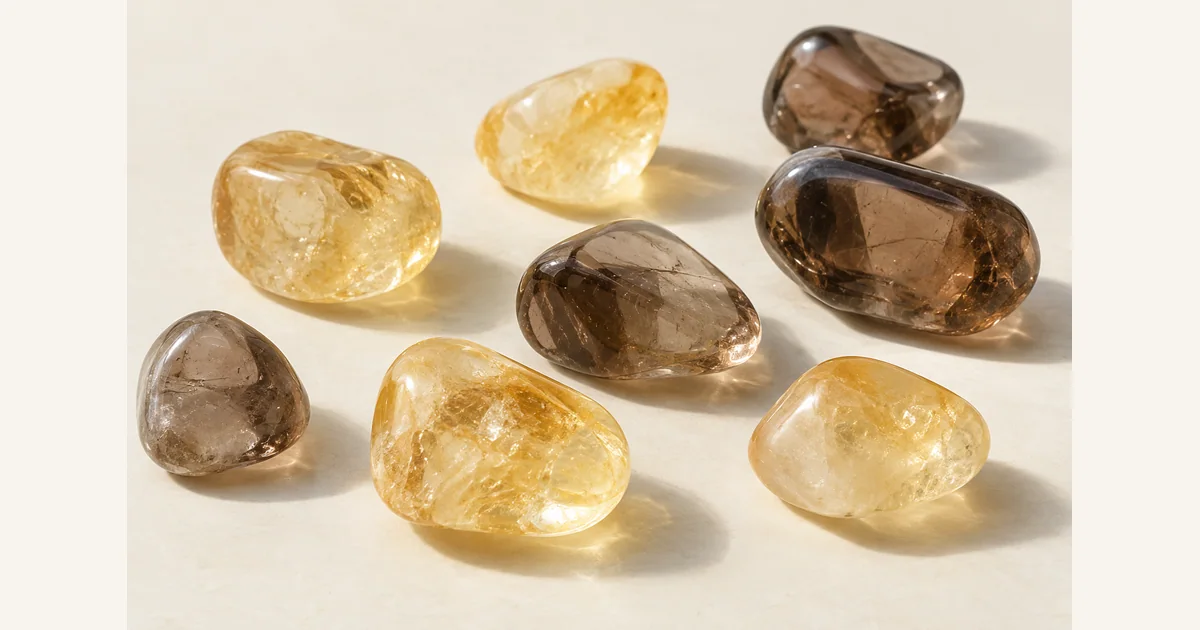
1. Citrine and smoky quartz: the same mineral, different colour identities
Quartz has the chemical formula SiO2 and a Mohs hardness of about 7. In a well-polished tumble, both varieties can have a smooth vitreous, or glass-like, shine. Quartz is common; a precise colour variety and a clearly disclosed treatment history are more specific claims. Citrine belongs to the yellow-to-orange range of crystalline quartz, while smoky quartz is grey, grey-brown or brown because of colour centres associated with trace aluminium and radiation. These are mineralogical colour descriptions, not measurements of spiritual value.
| Feature | Citrine tumbled stone | Smoky quartz tumbled stone |
|---|---|---|
| Mineral family | Crystalline quartz, SiO2 | Crystalline quartz, SiO2 |
| Typical colour | Pale lemon, yellow, honey, golden orange or brownish yellow | Light smoke, grey, tea brown, chocolate brown or very dark smoke |
| Look in transmitted light | Yellow to orange body colour is easier to observe through a thinner edge | Grey-brown or smoke-coloured light passes through less-dark sections |
| Common trade question | Is the colour natural or produced by heat treatment of another quartz variety? | Is the smoky shade naturally developed or enhanced by irradiation? |
| Common confusion | Yellow topaz, yellow glass, coloured quartz or an incorrectly named heated sample | Dark glass, brown glass, dark citrine, smoky glass or another brown gemstone |
| Most useful purchase detail | Identity, specific treatment disclosure, size, polish and colour consistency | Identity, irradiation disclosure if known, translucency, size and polish |
| Traditional or modern display vocabulary | Warm light, yellow colour, activity and a prosperous-looking display | Earthy colour, quiet contemplation, grounded visual composition |
The two stones can overlap in a brownish area of the colour spectrum. A golden-brown edge is not enough to establish a stone as citrine; a dark brown centre does not automatically make it smoky quartz. Colour labels require a material context, particularly when the merchandise is a mixed-lot collection photographed under warm store lighting.
2. Why quartz becomes yellow or smoky
Natural quartz is made of silicon and oxygen, but trace constituents, crystal defects and geological conditions can influence how it absorbs light. These tiny internal differences are why identical chemical formulas do not mean identical appearances. The smoky colour is especially associated with radiation-induced colour centres in quartz containing aluminium-related defects. Natural background radiation over geological time can produce the effect. Commercial treatment can also deepen smoky colour by controlled irradiation. Thus “smoky quartz” names a quartz variety, whereas “naturally smoky” or “irradiated” describes the history of its colour.
Citrine presents a different market situation. Natural-colour citrine exists, but a substantial share of citrine sold commercially is made by heating suitable amethyst or other quartz. This is an established gemstone treatment, not evidence that the polished stone is glass or resin. The important distinction is whether it is being represented honestly. A tumbled specimen can be genuine quartz and heat-treated at the same time. Likewise, a dealer may know a batch is treated without knowing its original mine. Mineral identity, colour treatment and country of origin are three distinct statements.
| Claim heard from a seller | What it actually tells you | What to request |
|---|---|---|
| “100% genuine citrine” | A claim about identity; does not establish untreated colour | Written material and treatment description |
| “Natural citrine” | Ambiguous: may mean natural quartz rather than natural-colour quartz | “Natural-colour, untreated citrine” only if that precise claim is supported |
| “Heat-treated citrine” | Quartz whose colour has been modified using heat | Confirmation that this is the actual lot being supplied |
| “Smoky quartz, natural” | Could describe naturally occurring quartz without proving naturally developed smoky colour | Separate statement on irradiation history, if known |
| “From Brazil” | An origin assertion, not a material or treatment test | Reliable provenance supporting the particular batch |
| “Crystal-cleared, energized or activated” | A spiritual or commercial preparation description | Do not substitute this for mineral identity, physical condition or treatment disclosure |
3. Natural citrine versus heat-treated citrine
One reason this topic causes confusion is that a well-polished heat-treated citrine may be attractive, durable and completely suitable for a gift, jewellery component or Vastu-themed tray. Treatment does not automatically make a specimen unsuitable. The issue is whether its identity and treatment are represented accurately. For a regular retail collection, honest heat-treated citrine can offer consistent golden shades and an accessible price. For an advanced study collection, documented natural-colour samples have a different educational purpose and may justify a different price.
Buyers often learn visual rules such as “pale yellow means natural” or “deep orange means heated”. Such shortcuts are unreliable. Strong warm orange is common among heated material, and a white-looking base may appear in some pieces cut from treated amethyst, but neither feature alone proves a process. Natural-colour citrine can vary, and lighting, cutting, polishing and colour editing all change the photograph. Even experienced gemologists may need appropriate supporting information or advanced testing for a specific treatment determination.
How to examine a citrine tumble without damaging it
- Use neutral daylight: Place the stone on a white or neutral-grey surface. Photograph it without a heavy warm filter and note whether the colour is lemon, honey, orange or brownish yellow.
- Rotate it slowly: Check whether yellow colour appears throughout or is concentrated in areas. Uneven colour may be perfectly natural in quartz; it is not a treatment certificate.
- Look through a thinner edge: Record whether the tumble is transparent, translucent or cloudy. A transparent-looking edge confirms an optical feature, not a mine origin.
- Compare the lot: Extremely uniform colour across a large commercial parcel warrants a treatment question, but natural lots can also be sorted for uniformity.
- Record the supplier's words exactly: If the invoice says “heat-treated,” keep that disclosure. If treatment is unknown, do not promote the lot later as untreated.
When buying a premium item specifically for its untreated-colour claim, written supplier documentation matters more than a home flashlight experiment. For an inexpensive decorative tumble, the sensible priority is a clearly named stone, good polish and a price proportionate to the disclosure.
4. Smoky quartz: from soft tea grey to deep brown
Smoky quartz is especially interesting in a teaching set because colour depth changes how much of the quartz interior a viewer can see. A light smoky specimen may reveal veils, cloudy zones and internal reflections; a very dark specimen may be visually dramatic but less useful for looking through. The deepest, nearly black specimens are sometimes marketed as morion; this is a descriptive name associated with very dark smoky quartz, not a guarantee of superior quality or special provenance.
Smoky quartz should be rotated against both pale and dark backgrounds. A brown tumble may appear almost black on a dark tray and noticeably translucent in the thin edge against a window. Strong LED lighting can make it look warmer than daylight. Deep colour should never be equated automatically with “more powerful”, older or rarer material. For a Vastu demonstration, a medium smoky stone can actually be more instructive because people can see the colour as well as the quartz texture.
Colour can be generated naturally by geological irradiation or enhanced commercially. An ordinary photograph cannot settle which occurred. Some sellers use the word “untreated” loosely for any crystal they did not personally alter, even when they did not receive documented treatment information from the wholesaler. In a professional kit, mark that field “treatment not verified” instead of converting uncertainty into a claim. Quartz is reasonably durable, but intense heat and abrupt temperature changes may affect colour or fracture a stone; there is no need to heat, scratch or strike it at home.
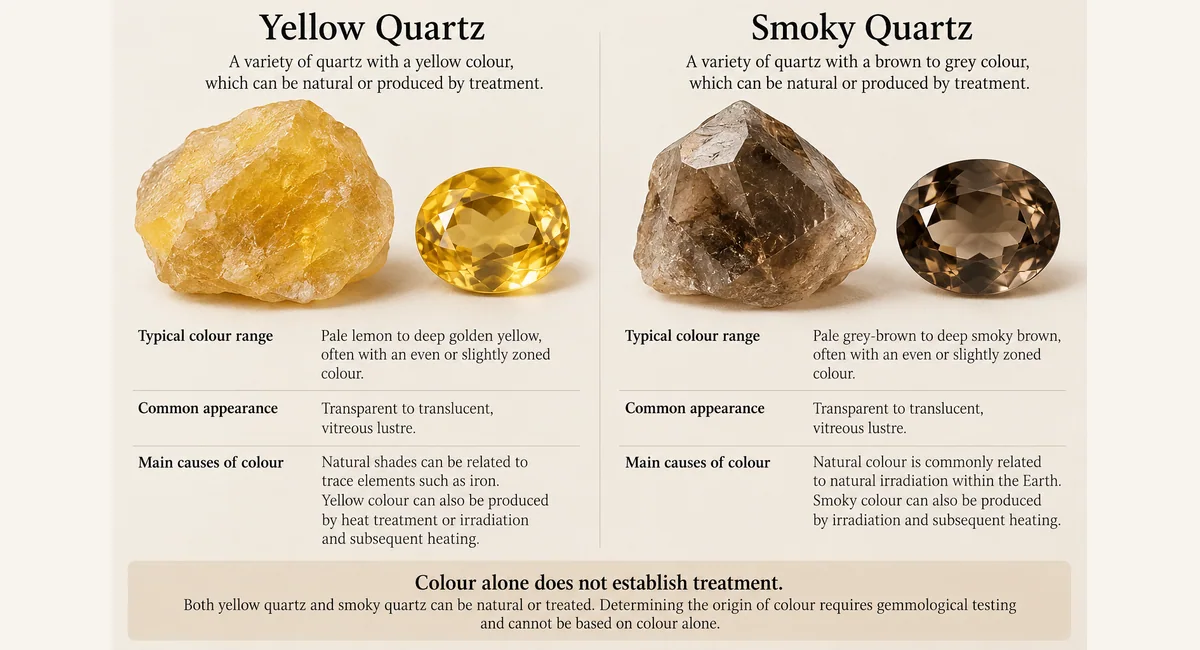
5. Citrine, smoky quartz, topaz and amethyst: avoid name substitutions
A yellow stone sold as “citrine topaz” deserves a second question. Citrine is quartz; topaz is a different mineral with a different chemical composition and properties. Historically the two have often been confused because of overlapping yellow colours. By contrast, amethyst is also crystalline quartz; heating suitable amethyst can produce yellow-to-orange quartz offered as citrine. A mixed tray can teach these distinctions simply by separating material families from colour families.
| Stone | Basic identity | Recognisable appearance | Question to ask |
|---|---|---|---|
| Citrine | Yellow–orange quartz | Transparent to translucent yellow, honey or golden orange | Natural colour, heated quartz or treatment unknown? |
| Smoky quartz | Grey–brown quartz | Smoke, tea or chocolate tones | Natural smoky colour or irradiation enhanced? |
| Amethyst | Purple quartz | Lavender to violet, sometimes zoned | Is this the original quartz material before any colour-altering treatment? |
| Clear quartz / sphatik | Colourless quartz | Clear to cloudy, with possible internal veils | Does the product description separate actual quartz from glass? |
| Yellow topaz | Topaz mineral, not quartz | Yellow or other colours, depending on variety and treatment | Is the name topaz backed by material identification? |
| Yellow glass or coated imitation | Manufactured or composite material | Can resemble quartz in colour or shine | Is it disclosed as glass, coated material or an imitation? |
Physical hardness is not a useful do-it-yourself shortcut. Scratching a polished gemstone can damage it and still give an ambiguous conclusion. A proper identity check may use optical behaviour, magnification, refractive properties and laboratory methods according to the value and purpose of the item. For a small educational set, purchase from a seller who identifies the lot and keeps its treatments separate from marketing descriptions.
6. Traditional meaning: quartz, colour symbolism and the limits of fixed correspondences
In Indian spiritual culture, sphatika or clear quartz is a familiar material used in certain malas, worship objects and contemplative settings. The broader language of Pancha Mahabhuta (five elements), directional deities and colour can also guide the arrangement of objects in a home or place of business. This does not mean that every modern commercial name for a yellow or brown quartz tumble appears as a fixed remedy in ancient Vastu texts. Modern citrine and smoky-quartz placements are best understood as contemporary gemstone practices interpreted through traditional ideas of colour, space and intention.
Yellow is widely used to evoke brightness, auspiciousness, generosity and teaching. Some modern crystal practitioners associate citrine with prosperity, self-confidence or a cheerful working environment. In Jyotisha, however, the important distinction is that Pukhraj (yellow sapphire) has its own established role in the conventional Navaratna and Jupiter/Brihaspati context. A citrine tumble should not be described as automatically interchangeable with a prescribed yellow sapphire. Birth-chart-based gemstone recommendations require their own rationale; a decorative object on a desk is a different decision from wearing a planetary gem.
Smoky brown and grey hues can suggest stillness, gravity, earthiness and the feeling of a stable base. Modern crystal books often call smoky quartz “grounding”, and that word describes an intention or aesthetic experience rather than a diagnostic mineral property. Brown quartz has no universally agreed direct mapping to a Navagraha. If a family follows a particular Vastu lineage, that lineage’s instructions deserve priority over a generic internet chart.
Pancha Mahabhuta in a two-stone display
Consider the contrast of a warm yellow sample and a translucent grey-brown one as a teaching device. The citrine can be used to illustrate the visual vocabulary of brightness and movement; smoky quartz can illustrate stability and restraint. Place them beside a small diagram of earth, water, fire, air and space, and ask visitors to explain the association they are interpreting. This keeps traditional elemental thinking alive without asserting that a quartz pebble physically alters the elements of a building.
7. Vastu placement ideas for citrine and smoky quartz
For a home or shop, first identify the actual purpose of the place. A prayer corner, study desk, billing counter, counselling room and decorative showcase are different environments. A balanced layout considers natural light, circulation, sightlines, furniture and the comfort of the people using it. Quartz can be a meaningful visual accent in those surroundings, but it is not a substitute for ventilation, structural maintenance or functional planning.
| Space and intention | Citrine arrangement | Smoky quartz arrangement | Practical detail |
|---|---|---|---|
| Study or work desk | Small yellow stone on a clean pen tray to mark an active work zone | One muted brown stone beside a notebook or reading lamp | Leave screen, keyboard and writing space unobstructed |
| Home prayer or meditation shelf | One warm-coloured sample with flowers or a simple diya display | One understated stone at the edge of a contemplative arrangement | Keep loose stones clear of flame and water offerings |
| North-facing business reception | Yellow display specimen beside clear signage or a welcome card | Neutral stone to balance a bright reception palette | Make the counter easy to clean and customer-friendly |
| Southeast-themed display | Golden stone for a symbolic warm-colour arrangement | Can serve as a contrasting darker specimen in a labelled kit | Do not place crystals directly on hot equipment |
| Southwest-inspired stable corner | Secondary accent if desired | Earth-toned stone in a low, secure display bowl | Prefer uncluttered, stable surfaces and consistent furniture layout |
| Jewellery showroom or teaching desk | Side-by-side treatment-labelled citrine samples | Light and dark smoky quartz references | Use consistent white lighting and accurate price labels |
The directional examples are options for themed displays, not exclusive rules. Some Vastu practitioners prioritise the northeast (Ishanya) for sacred and study functions, the southeast (Agneya) for fire-related activity, the north for commerce associated with Kubera, and the southwest for stability. The actual direction of a room does not determine whether a quartz sample is genuine; nor does the name of a stone dictate that it must be placed in one precise corner. If a consultation has already established a coherent plan, coordinate the display with that plan.
8. Worked example: an apartment study and a small business counter
Example A — A Bengaluru apartment with one shared work table
A family uses one table for homework, laptop work and evening planning. Rather than filling it with a large crystal grid, they select one pale citrine tumble and one medium smoky quartz tumble in a shallow, labelled wooden tray. The citrine sits next to a weekly task card, representing cheerful progress; smoky quartz sits near the reading journal, representing steady attention. Neither occupies the child’s writing area or the laptop vents. The tray can be moved for cleaning and is kept away from a window where prolonged strong sunlight can affect some coloured gemstones. This is a complete, intentional two-stone arrangement rather than an arbitrary scattering of crystals.
Example B — A jewellery showroom’s quartz comparison corner
A shop owner prepares four small labelled groups: natural-colour claim not established citrine, declared heat-treated citrine, light smoky quartz and dark smoky quartz. Each sample has an ID number, actual dimensions, gram weight and treatment statement as supplied. A clear quartz reference is added at the centre. Customers can compare how daylight-colour lamps affect perception without being asked to believe that a darker stone must be better. The display also shows why an affordable heated specimen can be a reasonable choice and why an untreated-colour premium requires evidence. A short “quartz family” card prevents confusion with yellow topaz.
Example C — A Vastu consultant’s demonstration kit
A consultant carries two citrine and two smoky-quartz samples into a home or office visit. One sample of each is a paler colour and the other is deeper. They demonstrate a warm-versus-earth-toned composition on a portable neutral mat while discussing the client’s preference for visibility, symbolism and maintenance. The consultant does not imply that the physical crystal identifies a Vastu defect, and the sample labels do not claim unsupported planetary equivalence. This distinction improves both the spiritual presentation and professional trust.
9. Build a ten-stone quartz reference kit with exact counts
A useful educational set should make visible differences without pretending to be a museum-standard laboratory series. The following ten-stone example is small enough for transport, rich enough for consultation, and clear enough to photograph. Each stone has a number and a material label; treatment status is entered from the supplier record rather than inferred from appearance.
| Slots | Material or comparison | Count | Teaching purpose |
|---|---|---|---|
| 1–3 | Citrine in pale yellow, medium golden and orange-yellow colour ranges | 3 | Compare colour without assuming a common treatment origin |
| 4–6 | Smoky quartz in light, medium and dark brown-grey shades | 3 | Compare transmitted light, translucency and shade depth |
| 7–8 | Clear quartz / sphatik reference specimens | 2 | Show the shared quartz foundation and natural internal veils |
| 9 | Amethyst reference sample | 1 | Explain the connection between amethyst and some treated citrine |
| 10 | Separately documented heat-treated citrine sample | 1 | Compare an explicitly disclosed treatment record with unknown-status colour samples |
| Total | 10 | All ten slots accounted for | |
The three citrines in slots 1–3 may themselves be heat-treated, natural colour or treatment-unknown; their different shades are observation categories, not claims of origin. If a specific sample with documented treatment cannot be obtained, leave slot 10 unfilled and label the kit nine stones rather than silently substituting a guessed specimen. Include a laminated observation card with colour, transparency, treatment disclosure, weight and date of receipt. This allows a customer to appreciate the appearance while giving a trainee a defensible learning method.
10. Choosing good-quality tumbled stones without overpaying
Quality for a tumbled display is not identical to grading a faceted gemstone. A collector may prefer intriguing internal veils; a minimalist gift buyer may prefer uniform colour; a consultant may deliberately choose contrasting specimens. Select for the stated use. A neat oval or rounded pebble that sits securely in its tray can be more useful than a highly polished but awkwardly shaped stone. Look for cracks that might weaken the piece, sharp chipped edges, excessive filler, sticky coatings or mismatch between the sample and the delivered lot.
For citrine, check whether the supplied pieces truly display the promised yellow range rather than drifting into colourless or nearly brown quartz. For smoky quartz, ensure the chosen sample is not so dark that its character disappears if it is intended for educational transmission-of-light comparisons. Strong polish is pleasant but not proof of treatment history. Do not assume that a price premium establishes an untreated origin. A treatment declaration on an invoice is more informative than adjectives such as “premium”, “AAA”, “rare”, “energized” or “Vastu grade”, since such grades are not one universal gemological scale across retail tumble assortments.
| Buying question | Good answer from the seller | Reason |
|---|---|---|
| What is the material? | Citrine quartz or smoky quartz, stated per product | Prevents quartz, topaz and glass names from being mixed |
| Is colour treated? | Declared heated, declared irradiated or explicitly unknown where applicable | Keeps the disclosure separate from colour adjectives |
| Do images show my lot? | Actual batch photos under normal lighting, or clearly marked representative photos | Sets appropriate expectations for colour variation |
| What size will arrive? | Measured length range, approximate weight and piece count | Makes display and kit design practical |
| Are chips or cracks allowed? | Clear quality tolerance and replacement terms | Protects polishing quality and presentation |
| Is origin guaranteed? | Specific provenance evidence, or no unsupported origin claim | Separates mine geography from material identity |
11. Care, cleaning and handling
Citrine and smoky quartz are both quartz, so ordinary care is similar. Wipe routine dust with a soft dry or slightly damp cloth. For a known, untreated solid quartz pebble, gentle washing with mild soap and water may be appropriate; rinse and dry well before returning it to a lined tray. Avoid steam, sudden heating, abrasive powder and deliberate temperature tests. If a product contains unknown coatings, adhesives, metal caps or mixed materials, follow the care instructions for the most sensitive component. A tumbled-stone bowl in a prayer space should be positioned away from oil lamps, incense embers and liquid offerings.
Store pieces in separate compartments or soft pouches when travelling so they do not rub together. Keep an inventory of the exact pieces in a professional kit, especially if different lots have different treatment disclosures. An earthy-toned smoky sample looks beautiful against cotton or uncoated wood; citrine shows its colour clearly against a pale neutral insert. Avoid permanent direct exposure to harsh sun or high heat, which can be undesirable for some coloured quartz. The best display is one the owner can maintain easily.
12. Frequently asked questions
Is heat-treated citrine fake?
No. Heat-treated citrine can be genuine crystalline quartz. The responsible description identifies it as heat-treated instead of making an unsupported natural-colour claim. Glass or resin sold as quartz is a different issue.
Does a dark smoky quartz tumble mean it is higher quality?
Not necessarily. Darkness is a visual characteristic, not a universal quality grade. A lighter stone may show more internal detail and be better for a teaching set; a darker one may suit a particular decorative palette.
Can colour alone identify natural citrine?
No. Pale and deep shades occur in different contexts, and colour by itself cannot certify treatment history. Supplier information and, where justified, appropriate testing are more useful.
Is citrine the same gemstone as yellow sapphire or topaz?
No. Citrine is quartz; yellow sapphire is corundum and yellow topaz is topaz. Their shared yellow appearance does not make their mineral identities, trade values or conventional Jyotisha roles identical.
Which stone belongs in the northeast or southwest?
Traditional Vastu gives those directions meanings that can guide room functions, but there is no single ancient rule assigning every modern quartz tumble to one compass bearing. Use the stone as a thoughtful symbolic accent within an already functional space, following a family’s or practitioner’s preferred method.
Can citrine and smoky quartz share one tray?
Yes. A small contrast tray can explain warm versus earthy colour, provide a pleasant decorative balance and make material comparisons easy. Secure the pieces so they do not roll, and label them separately when the display also serves an educational purpose.
13. Choosing between citrine and smoky quartz
Choose citrine when the goal is a warm yellow gemstone accent, a golden-colour comparison or a small gift whose treatment has been clearly stated. Choose smoky quartz when the goal is a quiet brown-grey composition, a translucent quartz observation sample or a contrast to brighter stones. Choose both for a teaching or consultation kit that explains why shared quartz chemistry does not imply shared colour origin. For an expensive purchase marketed as untreated or origin-specific, ask for documentation appropriate to that claim before deciding.
Above all, let the mineral name describe the material, the treatment statement describe its history, and the Vastu presentation describe a considered spiritual intention. Keeping these three ideas distinct makes the collection more useful, more beautiful and easier for customers to understand.
Continue reading
- Natural, Dyed, Heat-Treated and Reconstructed Stones
- Quartz Tumbled Stones: Clear Quartz, Rose Quartz and Amethyst
- How to Choose Genuine Tumbled Stones
Explore the existing Vastu and gemstone collections for wider context.