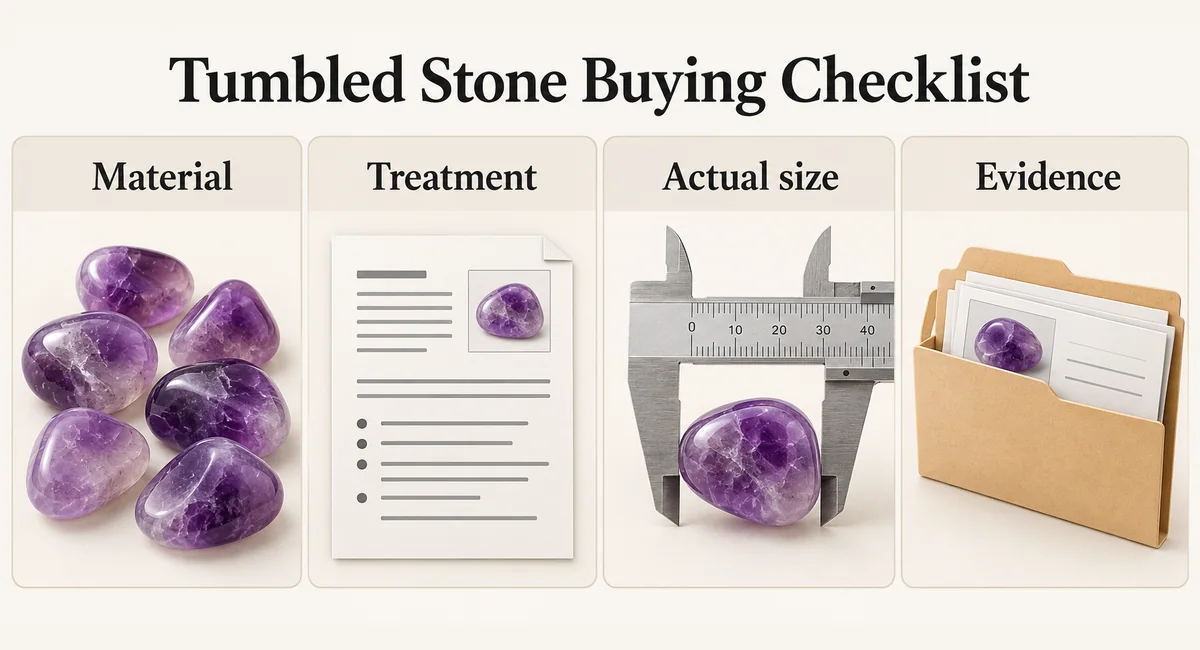
How can you choose genuine tumbled stones? Start by asking whether the material is identified correctly, whether its colour or surface has been altered, what quantity and size you will receive, and what evidence supports the seller's description. A genuine gemstone is not necessarily untreated: natural amethyst can be polished, quartz may be heat-treated to produce commercial citrine, and a correctly identified dyed agate remains agate. The important distinction is between natural identity, treatment, workmanship, condition and the exact item offered.
This buying guide is for individual gemstone collectors, OmmRudraksha shoppers, Vastu consultants, jewellery makers and anyone assembling a portable tumbled stone set. It covers physical inspection, gemstone trade terminology, genuine versus imitation stones, price and evidence, and how to select a stone for traditional Indian spiritual practice. It also gives practical case studies and seller questions that can be used for purchases in India or online.
1. What does “genuine tumbled stone” actually mean?
A tumbled stone is a rock, mineral or natural glass specimen whose edges are rounded and whose surface is usually polished. Tumbling describes the finish; it does not describe a particular species, place of origin or spiritual grade. Quartz, jade, jasper, agate, feldspar, lapis lazuli, natural obsidian and other materials may all be sold as tumbled stones. Some are individual minerals; others are rocks made of several minerals; obsidian is volcanic glass. They can all be genuine examples of their correctly named materials.
Four questions should never be merged into one vague claim of “100% original”: (1) Is the named material what the seller says? (2) Is it natural, laboratory-grown, assembled or an imitation? (3) Has it been dyed, heated, coated, stabilized, impregnated or otherwise enhanced? (4) Is the specimen's size, polish and physical condition acceptable? A seller may answer the first question correctly but omit the third. A natural stone can be inexpensive; an attractive dyed sample is not automatically poor quality; and a polished piece need not be rare to be worth owning.
| Term on a listing | What it can mean | What to confirm |
|---|---|---|
| Natural | Geologically formed material, as opposed to laboratory-grown or imitation | Exact mineral or rock identity; any subsequent enhancements |
| Untreated | No intentional colour or clarity enhancement beyond stated cutting/polishing | What testing or reliable batch information supports the assertion |
| Dyed | Natural or other material whose colour has been modified by colouring agents | Base material and whether dye is stable under ordinary use |
| Heat-treated | Material heated to modify colour or other appearance | Base material, treatment disclosure and care needs |
| Reconstituted / reconstructed | Fragments or powder bonded into a formed article | Composition, binder, and whether it is being mistaken for a solid natural piece |
| Lab-grown / synthetic | Manufactured material with relevant natural material's composition and structure | Transparent laboratory-grown disclosure, not “mined natural” |
| Imitation / simulant | Glass, polymer or another material resembling a named gemstone | Actual composition rather than resemblance alone |
2. Identify the mineral first, then examine the finish
Begin with the most precise name the seller can supply. “Blue crystal” is an appearance, not an identification; sodalite and lapis lazuli are very different materials. “Green jade” can refer to nephrite, jadeite or an unrelated stone marketed with a jade-like trade name. “Moonstone” is a feldspar-related gem designation, while “rainbow moonstone” commonly refers to a variety of labradorite. These distinctions affect price, care, education and suitability for a material-specific collection.
Ask for a written answer rather than relying on a beautiful photograph. Is the product a mineral species, a rock, or natural glass? Does the name identify colour, locality or treatment? Is “Indian agate,” “African jade,” “new jade,” “onyx,” “goldstone,” “turquoise howlite” or “citrine” used as a precise material name or as a trade label? The exact species may sometimes require a laboratory, but an informed seller should not treat unrelated names as interchangeable.
A real mineral need not be perfectly uniform. Some agates show bands, jasper can be mottled, unakite commonly displays green epidote with pink feldspar, and rhodonite may show black manganese-oxide markings. Conversely, some natural pieces really are uniform. Uniformity and irregularity are clues, not proof. Compare several specimens from the same lot, including their reverse sides, under neutral illumination.
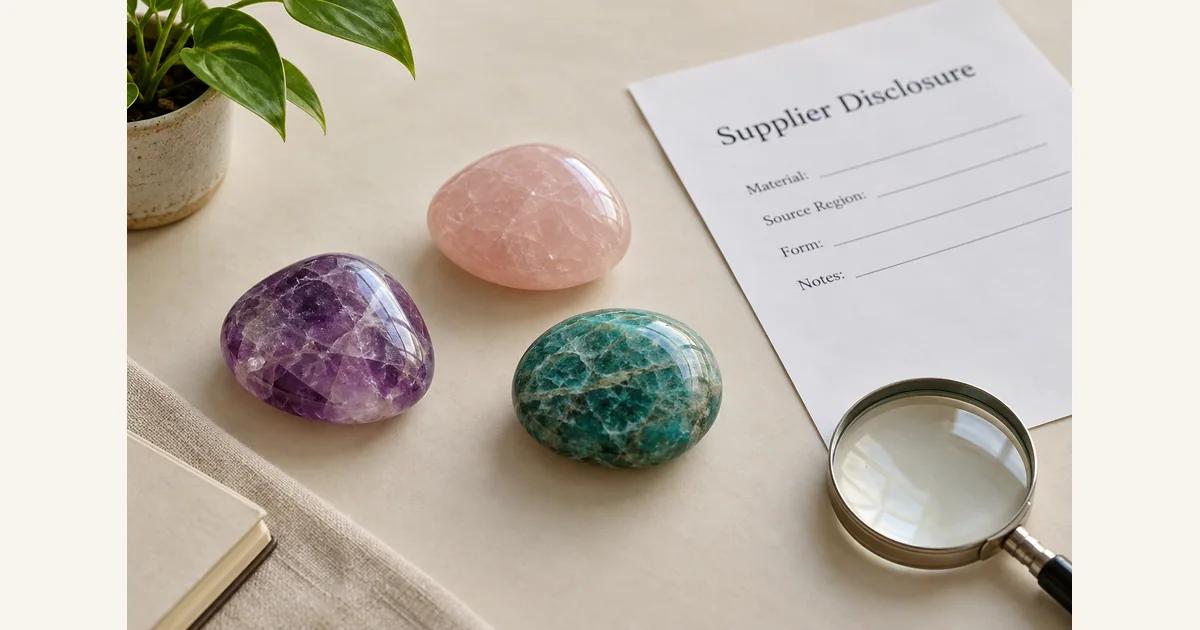
3. Eight common buying traps and how to approach them
These are common situations, not automatic verdicts. A particular stone may be genuine but treated, or accurately named but sold under an overly broad commercial label. The right response is a targeted question about composition or treatment.
| Stone or trade name | Potential confusion | Useful buyer question |
|---|---|---|
| Green jade | Nephrite or jadeite versus serpentine, aventurine or dyed substitutes | Is this nephrite, jadeite or another named material? Any impregnation or dye? |
| Turquoise-like blue tumble | Dyed howlite or magnesite versus natural turquoise | What is the base mineral, and is the blue colour added? |
| Black onyx | Black-dyed chalcedony, natural dark chalcedony or other black stones | Is it chalcedony, and is the colour natural or treated? |
| Citrine | Naturally yellow quartz versus commercially heated purple or smoky quartz | Is heat treatment disclosed? Is natural-colour origin actually documented? |
| Blue lapis | Genuine lapis lazuli rock versus sodalite, dyed stone or a composite | Is the sample lapis lazuli, and is colour enhancement known? |
| Hematite | Natural hematite versus strongly magnetic manufactured or other material | What is the mineral identity? Is it marketed as magnetic hematite? |
| Moonstone or labradorite | Feldspar varieties with different optical effects and names | What is the feldspar variety and does the listing show the actual flash? |
| Fluorite or malachite | Natural minerals versus coloured glass or reconstructed material | Is the material solid natural mineral? What are its handling precautions? |
When buying more than one piece, use a lot code and note whether the shown image is the exact specimen or only a representative example. A seller who displays one museum-quality piece while shipping variable commercial-grade material should state that clearly. For a Vastu practitioner creating uniform demonstration sets, the batch's size variation and consistency matter as much as a single ideal photograph.
4. Learn to read colour, polish, surface and inclusions
A sensible first inspection needs only clean hands, diffused daylight or a neutral-white light, a white background, a ruler and, optionally, a 10× jeweller's loupe. Begin with the colour of the whole stone, then observe any concentrations around surface-reaching fractures, pores, veins or seams. Vivid colour in such places can occur with dye penetration, but some natural stones also show pronounced zoning. If the question matters to price, document the observation for a gemologist instead of declaring a result from appearance alone.
Next inspect the polish. Run a fingertip gently along broad areas and note sharp chips, pits, tacky coatings and rough broken edges. A small natural cavity is not the same as a fresh chip. Some stones polish brilliantly, while porous or mixed-material rocks can polish unevenly. A “mirror finish” is not proof that the material is natural; glass, resin and manufactured composites also polish. A specimen with an intact surface and useful visible pattern can be a better purchase than an over-polished piece whose coating has altered the appearance.
Then look inside, where translucency permits. Quartz may show veils or mineral inclusions; agate can show fine banding; tiger eye may exhibit chatoyancy (a moving band of light); sunstone can show aventurescence from reflective inclusions; labradorite may show labradorescence at particular viewing angles. The absence of any one inclusion does not invalidate the stone. If a seller claims a rare variety based on a specific effect, ask for a short video moving the specimen under light.
Practical rule: take photographs from front, back, side and beside a scale. Record how observations change under diffuse light rather than using a dramatic colour filter. These images become evidence if the delivered specimen differs from the advertised lot.
5. What you should not infer from home tests
Home tests are frequently oversold. A stone feeling cool to the touch is not a unique sign of authenticity: temperature sensation depends on the object's temperature, thermal properties and surroundings. A heavy specimen may be dense, but density alone cannot settle an unknown trade name. A supposed “glass scratch test” may permanently damage a polished piece, and many natural gems share similar hardness ranges. A magnet is also an incomplete identification instrument; natural hematite, magnetite and manufactured magnetic products behave differently.
Do not use acid, flame, a hot pin, salt baths, boiling water, intentional scratching, hammering or acetone as an improvised authentication method. Besides potentially damaging a stone, such tests often answer the wrong question. A loupe and ordinary observation are useful for deciding which question to ask next; reliable gemological identification may require refractive-index measurements, specific-gravity methods, spectroscopy or microscopy performed by a competent professional. Some finished tumbles are poorly suited to particular standard instruments because of their irregular curved surfaces.
When an origin, untreated-colour or high-value identification claim matters financially, choose a laboratory service appropriate for that material. Check that any report describes the same physical specimen or explicitly identifies the tested lot. A photograph of an unrelated certificate cannot establish the identity of every stone in a multipack.
6. Treatments: the most important disclosure questions
The word genuine does not eliminate the need to disclose treatment. Natural quartz can undergo heating; chalcedony may be dyed; some jadeite is bleached and polymer-impregnated; some porous material is stabilized; and certain decorative pieces have surface coatings. Different treatments have different implications for price, long-term appearance and cleaning. Many treatments are legitimate when accurately described. What matters is whether the purchaser understands what is being offered.
| Treatment | Why it is used | What the buyer should know |
|---|---|---|
| Heat | Adjust colour, as with much commercial citrine | Natural quartz can still be genuine quartz; do not assume untreated colour |
| Dye | Intensify or change colours, especially in porous material | Ask about base stone, colour stability and cleaning instructions |
| Wax / oil / polymer impregnation | Alter surface appearance or fill pores and fissures | May affect appearance, value and response to solvents or heat |
| Coating | Add surface colour or iridescent effect | Ask whether the finish can abrade or flake during handling |
| Stabilization | Strengthen porous or friable material | Clarify the stabilizing agent and resulting maintenance needs |
| Reconstruction | Bind fragments or powders into a new shaped piece | Do not sell the composite as one solid natural crystal |
| Laboratory-grown | Grow a material in controlled conditions | Requires clear origin disclosure even when chemistry resembles natural material |
For example, most commercial citrine is heat-treated quartz; a yellow tumble cannot be called “natural untreated citrine” simply because it resembles yellow quartz. For jade, the distinction between nephrite and jadeite comes before evaluating any treatment category. A label such as “A jade” belongs to a particular jade-trade treatment convention and is not interchangeable with a generic seller-defined “AAA quality” grade. These distinctions protect buyers from paying untreated-stone prices for a differently described product.
7. Natural, genuine, premium, AAA and certified: five different promises
“Natural” speaks to formation. “Genuine” should speak to correct identity and representation. “Premium” is a marketing judgment. “AAA” may be an internal grading convention used by one retailer for colour, consistency and finish; it is not a universal laboratory grade for tumbled stone assortments. “Certified” should identify a specific issuing body, report number, material and specimen or lot. None of these words alone explains treatment, size, chip tolerance or the precise goods supplied.
For a low-cost assortment, a transparent invoice and a representative sample can be enough. For an expensive jade piece, claimed untreated fine material, rare locality or unusual mineral identity, stronger documentation is appropriate. Read the report scope: an identification report may verify material but not certify every claim about provenance, spiritual significance or batch consistency. If the seller has not obtained a report, a candid description of the uncertainty is better than presenting an unrelated screenshot as independent verification.
| Evidence offered | What it supports | What it does not automatically prove |
|---|---|---|
| Accurate product name and photographs | Listing transparency and approximate appearance | Mineral identity at laboratory confidence |
| Actual-item photograph with ruler and weight | Dimensions, visible condition and the item shown | Untreated colour or geographic origin |
| Supplier batch disclosure | Known treatments and source-chain information | Identity of every individual stone unless tested |
| Independent specimen report | Findings stated about that specimen | Unexamined stones from other batches |
| Retailer “AAA” or “premium” label | Retailer's declared selection standard | Universal gemological grade or ritual suitability |
| Return and replacement policy | Practical recourse for mismatch or damage | Gem authenticity by itself |
8. A ten-point checklist for genuine tumbled stone purchases
- Confirm material name: ask for the established gem, mineral or rock name, not only the colour or spiritual nickname.
- Ask about treatments: request a statement covering known dye, heat, coating, stabilization and reconstruction.
- Check the unit: single specimen, count-based pouch, weight-based parcel or mixed set; a photograph of ten stones does not necessarily mean ten are supplied.
- Get dimensions: ask for a length or size range in millimetres and the actual or approximate weight in grams.
- Understand grading: request the seller's definition of grade, chip tolerance, polish and colour variation.
- Inspect real photographs: confirm whether the pictured stone is the one you receive or only a representative.
- Review defects: visible cracks, chips, rough edges, coatings, holes, glued repairs or crumbling surfaces.
- Compare price fairly: use stone identity, size, quality, treatment, count, documentation and total delivery cost—not colour alone.
- Record the purchase: save the item description, invoice, packaging labels, order date and seller disclosures.
- Check returns: understand the process for wrong material, inaccurate count, breakage, inappropriate substitutes and materially different appearance.
For professional purchasing, keep a specimen log with the invoice line, vendor, lot code, number ordered, number accepted, size band, treatment declaration, identifying marks and storage compartment. It is easier to replace one correctly labelled tiger-eye pebble than to identify an anonymous brown stone after an entire tray has been mixed.
9. Choose the stone for Vastu and Jyotish without confusing the traditions
Gemstones have multiple roles in India: Ratna in traditional jewellery and astrology, Sphatik in certain devotional objects, and mineral or colour-based objects in contemporary Vastu interior arrangements. These uses are related through materials and symbolism but do not all share a single universal rulebook. In Jyotisha, a gemstone choice often concerns a specific planet, the person's horoscope, material quality and the manner of wearing it. In Vastu, attention centres on the building, directions and activity in a space. A tumbled-stone tray may illustrate or support a chosen tradition, but it is not automatically the same object as a prescribed mounted graha gemstone, Navaratna arrangement or consecrated Yantra.
Pancha Mahabhuta names the five elements—Prithvi (earth), Jala (water), Agni (fire), Vayu (air) and Akasha (space)—used in philosophical and Vastu interpretations. Ashta Dikpalas describes directional guardians in traditional cosmology. Colour-based gemstone associations in modern retail sets are often used to illustrate these principles. For example, a customer may select a green or earthy-coloured stone for a Prithvi-themed display, or a clear Sphatik sample for a devotional shelf. The material should still be named accurately; the chosen colour or symbolic purpose does not establish whether a stone is untreated.
If the purchase is intended for a Navagraha practice, do not substitute one gem for another simply because it looks similar. Traditional associations commonly include ruby with Surya, pearl with Chandra, red coral with Mangala, emerald with Budha, yellow sapphire with Guru, diamond with Shukra, blue sapphire with Shani, hessonite with Rahu and cat's-eye chrysoberyl with Ketu. A red aventurine tumble is not mineralogically ruby; yellow jasper is not yellow sapphire; and a polished purple amethyst cannot be relabelled as a blue sapphire. A consultant may recommend alternatives within a particular tradition, but substitutions should be named as such.
10. Material choices for a labelled Vastu and gemstone reference tray
For a teaching or showroom tray, choose a small number of well-identified specimens rather than collecting every possible colour with uncertain labels. Each stone can be assigned a physical study purpose and an optional symbolic topic. When using a direction-oriented Vastu display, mark the actual compass direction of the room separately from any symbolic arrangement so users understand what the layout represents.
| Material | What to verify when buying | Useful study or display theme |
|---|---|---|
| Clear quartz / Sphatik | Quartz identity, polish, clarity and any cracks | Devotional Sphatik context; comparison of transparent stones |
| Rose quartz | Natural quartz, soft pink colour, surface condition | Contemporary harmony-themed display and colour comparison |
| Amethyst | Quartz identity, purple zoning, fracture and colour stability | Contemplation-themed display; quartz family comparison |
| Tiger eye | Moving chatoyant band, fibre texture and finish | Optical-effect demonstration and modern personal-purpose sets |
| Green aventurine | Quartz variety, shimmering inclusions and treatment disclosure | Green-stone selection and earth/plant-colour arrangements |
| Black tourmaline | Actual tourmaline rather than another black mineral; cracks | Mineral comparison and contemporary protective symbolism |
| Lapis lazuli | Identified blue rock and any colour enhancement | Blue material comparison; craftsmanship and traditional lapis history |
| Nephrite jade | Nephrite identity, not just a jade-like green trade name | Jade varieties and durability comparison |
| Moonstone / labradorite | Actual feldspar variety and the observed optical effect | Changing sheen and directional-light demonstration |
| Fluorite | Mineral identity, easy scratching, cleavages and handling needs | Different hardness and crystal structure lessons |
This is an educational selection table, not an exclusive list of classical Vastu remedies. Where a family follows a particular traditional placement, document that practice and keep the mineral description separate. The purpose of a careful purchase is to make both the spiritual context and the object itself understandable.
11. Worked buying example: a 16-stone Vastu consultation kit
Suppose a professional wants a portable tray for eight-direction explanations, with two samples allocated to each directional position. The kit can contain 16 stones, held in eight labelled compartments. Before buying, specify a compact size band, for example approximately 20–30 mm, and ask the supplier for the actual range and average weight. The example selection below is one transparent teaching arrangement, not a universal prescriptive gemstone scheme.
| Compartment | Two example specimens | Procurement and teaching purpose |
|---|---|---|
| North | Green aventurine + nephrite jade | Compare two different green materials and correct names |
| Northeast | Clear quartz + amethyst | Transparent quartz versus purple quartz; Sphatik context |
| East | Carnelian + sunstone | Orange appearance from different material families |
| Southeast | Red jasper + tiger eye | Opaque stone versus moving optical band |
| South | Garnet + hematite | Deep-red gem versus metallic iron oxide |
| Southwest | Black tourmaline + black onyx | Tourmaline versus chalcedony; treatment questions |
| West | Sodalite + lapis lazuli | Different blue stones, rock versus mineral distinction |
| Northwest | Moonstone + labradorite | Feldspar variety and directional optical effects |
Count the allocation: 8 compartments × 2 stones = 16 specimens. Assign each a unique code such as N-1 and N-2, record material, treatment statement, approximate weight and actual delivered dimensions, and place it in a small nonabrasive sleeve. Use a compass or a verified floor-plan orientation when demonstrating room directions; the teaching tray itself is not a measurement instrument. If a requested mineral is unavailable, update the inventory explicitly rather than silently inserting a same-colour substitute.
To approve the kit, lay out every item under the same light, photograph all 16 with their codes, verify counts, check that their names match the invoice, and confirm the tray lid can close without grinding the stones together. This simple process makes the collection usable across visits, workshops and showroom demonstrations.
12. Worked buying example: evaluating three online gemstone offers
Imagine three listings with similarly attractive photographs. Offer A says “Natural premium healing crystals, 20 pieces,” but provides no mineral names or size band. Offer B says “20 assorted polished natural stones, identified by type, some dyed agate, 18–25 mm, representative photo, return allowed.” Offer C offers one individually photographed nephrite specimen with a named material, weight, treatment declaration and an independent report tied to that piece.
Offer B may be the better low-cost classroom assortment because its materials and treatments are explained, despite containing treated stones. Offer C may be suitable for someone specifically seeking a verified jade sample. Offer A lacks enough information for a buyer who cares about identity. There is no sensible single “best” choice until the purpose and budget are defined. Compare all three on a like-for-like basis, including count, average size, replacement policy, acceptable natural variation and evidence costs.
For professional kits, also estimate the per-usable-stone cost. If 20 stones are delivered but four cannot be used because the sizes or names do not match the kit, the usable cost is the price of the entire parcel divided by 16, not 20. This is why consistent grading and accurate labels can be more valuable than an impressive discount.
13. Worked buying example: a jewellery showroom serving a Jyotish customer
A customer asks for a yellow stone connected with Guru (Brihaspati), but the showroom displays polished citrine, yellow jasper and yellow sapphire. The correct first step is to show the actual differences: citrine is yellow quartz, jasper is opaque chalcedony-rich material, and yellow sapphire is corundum. All may be genuine materials, but they are not the same gem. In a classical planetary-gem context, Pukhraj (yellow sapphire) is the conventional major gemstone associated with Guru; a citrine tumble should not be labelled Pukhraj.
The jeweller should ask whether the customer wants a traditional astrological gemstone for wearing, a small study specimen or a decorative Vastu display. The correct buying criteria differ: a prescribed worn stone involves more than colour and requires suitability of material and mounting, while a display tumble needs correct naming, stable finish and clear treatment disclosure. This prevents attractive yellow objects from being marketed as interchangeable on the strength of colour alone.
14. How professional suppliers and retailers should document a lot
An accurate product page makes the customer confident because it tells them what will arrive. Record the product title, base material and trade-name explanation; form (tumbled, not raw); size band and estimated weight; treatment status as known or supplier-declared; actual-item or representative photography; variation policy; stone count; and clear care instructions. For a mixed collection, a contents table is more useful than a vague promise of “various energies.”
Keep colour-temperature and editing consistent across photographs. A backlit polished stone can appear more transparent than it does under room lighting. Where it matters, add a short rotating clip to show effects such as chatoyancy or labradorescence. Keep the packaging label, order documentation and inventory item code together so a customer can report an exact mismatch without having to guess which of several similar pieces is involved.
At the shop counter, state what is known, what comes from the supplier, and what remains unverified. It is reasonable to say “natural green aventurine; treatment not independently tested” where that reflects the evidence. It is not reasonable to claim an external laboratory examined every stone when only a sample was tested. Lab reports are most valuable when attached to their specific report scope.
15. Caring for genuine stones after purchase
Authentic stones do not all tolerate the same treatment. Clear quartz is relatively hard, but sharp collisions can still chip its edges. Fluorite is softer and has cleavage that makes it more vulnerable to breakage. Some malachite, treated stones and porous or composite materials should not be soaked. Pyrite specimens are best kept dry and monitored in humid conditions. Colour-sensitive materials, including some amethyst, should not be left in strong sunlight for long periods. Store stones separately or in lined compartments, with labels that remain associated with the specimen.
For a devotional or Vastu setting, routine Shuddhi or Pavitrikaran may be part of a household's practice, but the physical method should suit the material. A dry soft cloth and clean display surface are often simpler than immersing every specimen in water or salt. If an item is dyed, glued, coated, set in metal or used with other ritual objects, do not assume that burning incense near it, soaking it or exposing it to oils will be harmless. Care for the object does not diminish its traditional meaning.
16. Frequently asked questions
Can a tumbled stone be genuine even though it has been polished?
Yes. Tumbling is a shaping and finishing process. Genuine natural quartz, amethyst, agate and many other materials can be tumbled; the polished shape does not make a natural mineral synthetic. Check the base material and any colour or clarity enhancements separately.
Does a stone with visible inclusions prove natural origin?
No. Inclusions may provide useful evidence, but their presence or absence cannot settle every identification, and manufactured materials can sometimes contain internal features. Use the listing, a responsible seller and suitable testing for a high-value claim.
Are dyed tumbled stones fake?
A dyed stone can be a genuine natural base material with a disclosed enhancement. If dyed howlite is sold as genuine turquoise, the description is wrong; if it is sold accurately as dyed howlite, a buyer can knowingly choose it for a decorative purpose. The concern is identity and disclosure.
What is the difference between jade, green aventurine and serpentine?
They are different gem materials. Jade refers principally to nephrite and jadeite, while green aventurine is a quartz variety and serpentine refers to a mineral group. Similar green colour does not make them mineralogically interchangeable, so insist on the base-material name.
Is a high price or “AAA” label evidence of authenticity?
Not by itself. Ask the seller how the grade is assigned, which stone or lot it applies to, and whether the price includes individual documentation. Tumbled-stone grades are frequently retailer-defined; price reflects multiple commercial factors.
Do I need a laboratory report for every inexpensive pebble?
Usually the cost is disproportionate to a small decorative purchase. Accurate naming, documented disclosures, actual photographs and a fair return route are practical starting points. Independent testing becomes more relevant when a costly authenticity, locality or untreated claim changes the purchase decision.
Can I use polished gemstones in a Vastu arrangement?
Yes, contemporary Vastu displays often use polished stones for visual order and symbolism. Choose correct materials, document the meaning used by your tradition, orient the arrangement consistently and use a practical, safe shelf or tray. A decorative tumble is distinct from a prescribed Jyotish ring or an established ritual Yantra.
17. Final buying decision: identity, disclosure, purpose and value
The strongest way to choose genuine tumbled stones is to move from a vague promise to a precise description: identified material + known treatments + actual size and condition + quantity + credible evidence. Inspect specimens in ordinary light, compare like with like, ask questions about confusing trade names and keep purchase records. For a Vastu or Jyotish-related purchase, first determine which tradition and object form you need; then check that the stone actually is the material being named. Whether you buy one carefully selected Sphatik pebble or a complete professional tumbled gemstone set, informed identification and transparent labelling make the collection more useful and valuable over time.
Continue reading
- Natural, Dyed, Heat-Treated and Reconstructed Stones
- Green Jade and Its Common Gemstone Substitutes
- Howlite, Dyed Stones and Common Misidentification
Explore the existing Vastu and gemstone collections for wider context.
Explore the materials and sets
- Amethyst Tumbled Stone
- Citrine Tumbled Stone
- Tiger Eye Tumbled Stone
- Green Aventurine Tumbled Stone
- Red Aventurine Tumbled Stone
- Yellow Jasper Tumbled Stone
- Bloodstone (Heliotrope) Tumbled Stone
- Black Tourmaline Tumbled Stone
- Hematite Tumbled Stone
- Lapis Lazuli Tumbled Stone
- Sodalite Tumbled Stone
- Labradorite Tumbled Stone
- Moonstone Tumbled Stone
- Sunstone Tumbled Stone
- Fluorite Tumbled Stone
- Green Nephrite Jade Tumbled Stone
- Howlite Tumbled Stone
- Moss Agate Tumbled Stone
- Black Onyx Tumbled Stone
- Unakite Tumbled Stone
- Rhodonite Tumbled Stone