Is the blue stone turquoise, dyed howlite or dyed magnesite? It is one of the most useful questions for anyone buying tumbled stones, gemstone beads, pendulums or a professional Vastu reference kit. The difference is not simply the shade of blue. Each name refers to a different mineral identity, while dyeing is a separate description of what has been done to a material. Natural white howlite is a genuine mineral; blue-dyed howlite is also genuine howlite, but its blue colour is introduced. Neither description makes it genuine turquoise.
Howlite often reaches a shop as a small white stone with grey veins. The same attractive web pattern can make a dyed piece resemble more expensive turquoise. Magnesite and other pale stones may be dyed in similar colours. For an OmmRudraksha customer, a Vastu consultant or a jewellery maker, the important skill is to separate what the stone is, how it was treated, how it is being used and what its seller has actually verified. This guide provides a full working comparison, examples of truthful labels, ways to examine a batch without damaging it, and a practical study-kit method.
1. Understand natural howlite first
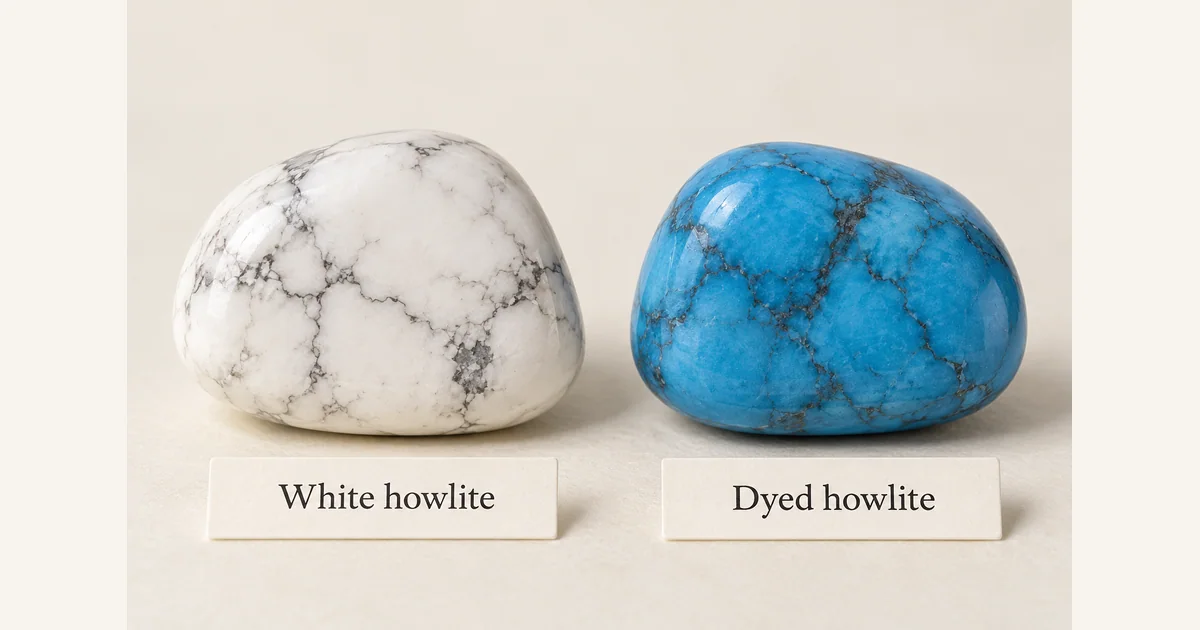
Howlite is a calcium borosilicate hydroxide mineral, commonly written as Ca2B5SiO9(OH)5. It generally occurs as white or off-white, fine-grained nodules. Thin grey, brown or nearly black lines may give the surface a marble-like or spiderweb appearance. The vein pattern is a convenient visual feature, but the exact appearance varies among stones, and a veined white pebble cannot be identified as howlite by sight alone.
The mineral was described scientifically in the nineteenth century and named in honour of Henry How. That history matters when discussing traditional usage: howlite is not an ancient, named Navagraha Ratna in classical Indian gemstone lists. Its present-day popularity in meditation, jewellery, crystal assortments and Vastu-inspired display is a modern application. It may still be chosen meaningfully, but the distinction prevents an attractive modern product description from turning into an unsupported historical claim.
Polished howlite is normally sold in small rounded tumbled pieces, drilled beads, cabochons and decorative objects. The material commonly encountered in trade is an aggregate, rather than a large single transparent crystal. Its porous or fine-grained structure makes the pale material receptive to colour treatment. For sorting and packing, the familiar massive material is relatively easy to mark or abrade, so individual pieces should not be rattled against quartz or other harder minerals.
Why published hardness figures can look inconsistent
A reference may give howlite a Mohs hardness around 3–3.5, while a mineral database describes individual howlite crystals as much harder. These numbers are not necessarily contradictory: the commonly handled massive aggregate can separate along its fine-grained structure more readily than an individual crystal scratches. For practical tumbled-stone handling, treat the aggregate as a comparatively delicate specimen. Do not attempt to resolve the terminology by scratching merchandise with a steel tool.
2. Howlite, magnesite and turquoise: the actual differences
Three names repeatedly appear together in gemstone listings, yet they are not interchangeable. Howlite is a calcium borosilicate; magnesite is a magnesium carbonate; turquoise is a copper-bearing hydrated aluminium phosphate. Their mineral structures are different even when polished pieces share white matrix, dark lines and a blue surface.
| Material | Mineral identity and typical appearance | What a buyer should check |
|---|---|---|
| Natural white howlite | Calcium borosilicate; white to cream base, sometimes irregular grey or dark veining | Actual batch identity, natural colour, condition and whether any coating or colouring is disclosed |
| Blue-dyed howlite | Howlite coloured by an added dye; turquoise-blue, green-blue or other fashion colours | Label must state dyed; blue colour is not proof of natural turquoise |
| Natural or dyed magnesite | Magnesium carbonate; commonly white, sometimes veined or granular; accepts colour treatment | Do not assume every white or blue veined bead is howlite; ask for its mineral identity |
| Natural turquoise | Hydrated copper–aluminium phosphate, naturally blue to green with variable matrix | Determine whether it is untreated, stabilised, impregnated, dyed or otherwise treated |
| Other turquoise-coloured imitations | May include dyed calcite, reconstructed mineral composites, glass or manufactured materials | Request a description naming the actual base material, not only a colour or style |
The same turquoise-coloured appearance may arise from at least four quite different product categories: naturally blue turquoise, treated natural turquoise, another mineral dyed blue, or an assembled/manufactured imitation. A responsible catalogue separates them. In fact, even a real piece of turquoise may have been stabilised or coloured, so the binary question “real or fake?” is often much less useful than “What mineral is this, and which treatments have been applied?”
How magnesite creates confusion
Magnesite commonly presents as white, creamy or pale material and may have attractive darker markings. When blue-dyed, it can closely resemble both blue-dyed howlite and turquoise. The problem is compounded by trading habits: a seller may repeat a supplier's label without verifying the mineral. Gemological reports have documented items traded under a howlite-related name that were actually dyed magnesite. A shop should therefore preserve the supplier's description as a claim, not convert it into an independent identification by repetition.
What about natural turquoise?
Turquoise has an established jewellery and ornamental history that is separate from howlite. It can occur in blue, greenish-blue and green tones, with or without darker matrix. Its porous nature also means treatments are commercially important: stabilisation or polymer impregnation may improve durability, while added dye can affect colour. The correct category can therefore be “treated natural turquoise” rather than “howlite” or “untreated turquoise.” A single polished photograph rarely answers those questions.
3. Why dyed howlite looks so convincing
White howlite makes a useful dyed imitation because the original stone already has features people associate with turquoise: a light opaque background and irregular grey webbing. When a blue or green-blue colourant enters the more accessible parts of the material, a vivid blue field can appear around the darker veins. The resulting product may be attractive, consistent and suitable for ordinary costume jewellery or decorative arrangements. It is not automatically a poor product; the critical question is whether the commercial name matches its real composition and treatment.
Some dyed specimens reveal greater colour concentration in open pores, cavities, fractures or around a drilled hole. Others have been processed sufficiently evenly that the blue looks natural at a glance. Variations in the network pattern are likewise not decisive. Suppliers can use different dyes and different host materials, and a material may also be coated or stabilised. None of these visual clues alone certifies the specimen.
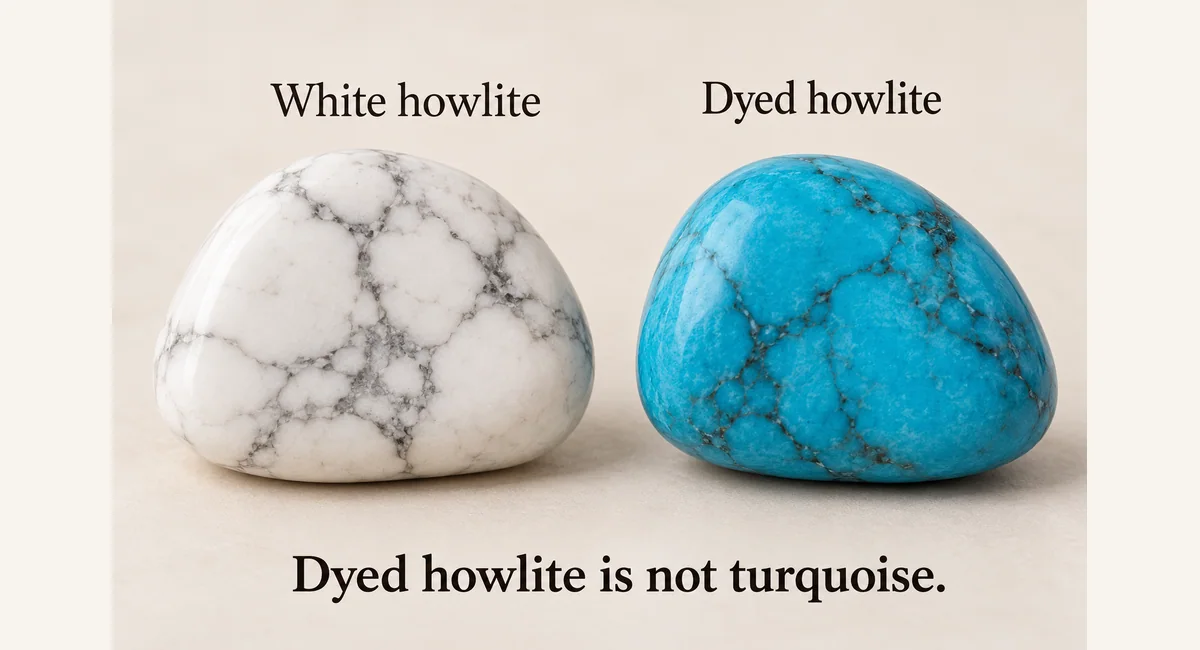
4. What can you learn from a non-destructive examination?
A careful visual examination is valuable because it improves the questions you ask and helps spot mixed batches. It does not perform the work of a gemological laboratory. Start with a clean table, white background, diffused daylight, a 10× loupe if available, and a record of the supplier's exact name. Examine several stones from the same batch; one unusual piece may not represent all the others.
| Observation | What it may suggest | What it does not prove |
|---|---|---|
| White stone with fine grey webbing | Howlite-like or magnesite-like appearance | Exact mineral identity |
| Very bright blue, matching across many stones | Consider added colour or controlled commercial processing | That every bright stone has been dyed |
| Blue pooling at a tiny recess or old drill hole | Possible local concentration of dye | Which base mineral was coloured |
| Contrasting paler area in a pre-existing chip | Possible surface-depth colour variation | Whether the item is specifically howlite rather than magnesite |
| Dark veins with uneven, natural-looking lines | Common in several mineral materials and some imitations | Authenticity as turquoise |
| Repetitive painted-looking veins or resin-filled gaps | Worth asking about artificial matrix or composite construction | The composition without analytical examination |
Record a photograph of the actual delivered stones rather than relying solely on listing images. Write down how many pieces have obvious dye concentration, chips, unpolished edges or mismatched appearance. If the shipment is meant to be a single identified product, a mixed material assortment should be treated as a supplier clarification issue before the stones are relabelled or displayed.
Why scratches, solvents, acids and heat are poor retail tests
Scratching a piece in front of a customer leaves a permanent mark and may only show how easily that aggregate abrades. Rubbing it with acetone or alcohol may remove a dye or dissolve a finishing product, yet lack of dye transfer does not establish a natural colour. Acid tests can damage carbonate minerals and other components, while heating can alter coatings, adhesives or colour. These procedures are not necessary for a showroom-level screening exercise. When identity materially affects price, use proper testing through a qualified gemological or mineral laboratory.
5. How professionals establish the material
A gemologist begins with visual examination, reliable reference specimens and appropriate gemological measurements. For some polished opaque materials, routine refractive-index or density readings are difficult to obtain or interpret. Laboratory methods such as Fourier-transform infrared spectroscopy (FTIR), Raman spectroscopy and, where warranted, X-ray diffraction can distinguish the mineral structures involved. Research reported by GIA describes infrared methods for separating turquoise from howlite or magnesite imitations and for examining some polymer treatments.
The professional goal is a defensible material-and-treatment description. A report identifying turquoise is not automatically a statement that the specimen is untreated; a result identifying howlite says what mineral is present but may still require consideration of colour treatment. For higher-value purchases or bulk gemstone supply, ask the testing provider which questions the report actually answers and whether its sample represents the entire shipment.
6. Natural, dyed, stabilised and reconstructed: do not confuse these terms
A stone can be naturally formed and still be treated. Equally, an attractive blue object can be made from another mineral or a composite. The following distinction belongs on every professional gemstone reference shelf.
| Term | Meaning | Clear example of a shop label |
|---|---|---|
| Natural mineral, untreated colour | Material formed in nature with no stated colouring treatment | “White howlite tumbled stone — natural white colour” when supported |
| Dyed natural mineral | Real natural mineral used as the base; dye added to produce or intensify colour | “Blue-dyed howlite tumbled stone” |
| Stabilised or impregnated mineral | Material reinforced through resin, wax or another introduced substance | “Stabilised turquoise” when the base mineral is confirmed |
| Reconstituted or composite product | Aggregated fragments or powders held together with a binder; composition may vary | “Turquoise-coloured mineral composite” with actual constituents disclosed |
| Manufactured imitation | Non-turquoise material made or coloured to give a turquoise-like appearance | “Turquoise-coloured glass bead” |
A supplier label such as “turquoise-style blue stone” can refer only to appearance. It is not enough for a catalogue's material field. In a gemstone shop, the product name, filter category, bill and care instructions should all agree on the material and treatment. A customer searching for turquoise should not find a dyed-howlite listing presented as though it were the same mineral.
7. Spiritual meaning: what belongs to tradition, and what is a modern association?
Howlite is frequently associated in modern crystal practice with patience, a quieter frame of mind, reflection and deliberate communication. Because white suggests visual simplicity and clarity, some people like it on a meditation shelf, in a study corner or beside their daily journal. Blue-dyed howlite is sometimes chosen as a reminder to communicate calmly or to maintain a steady intention. These are contemporary symbolic uses, not proof that an added blue dye gives the stone a newly prescribed classical planetary identity.
Traditional Indian frameworks have their own internal logic. Pancha Mahabhuta speaks of Prithvi (earth), Jala (water), Agni (fire), Vayu (air) and Akasha (space). Vastu uses directional and spatial concepts, while Jyotisha recognises planet–gemstone relationships in specific traditions. Those systems should not be collapsed into a colour chart where “white equals one planet” and “blue equals another” regardless of mineral. White howlite is not automatically a replacement for a pearl, and dyed-blue howlite is not thereby a traditional substitute for a sapphire.
How to use the symbolism responsibly in a Vastu-inspired display
Start with the actual purpose of a space, rather than promising that one pebble cures every architectural problem. The Ishanya (north-east) area is often approached in Vastu practice as an especially appropriate place for quietness, prayer or study; a small clean tray of white stones may function as an intentional accessory in such a setting. A communication or reading desk may use a blue-dyed howlite stone as a visual reminder of attentive speech, provided its label stays accurate. These are optional design decisions, not directions mandated by an ancient text for the nineteenth-century mineral howlite.
| Setting and intention | Reasonable symbolic choice | Practical arrangement |
|---|---|---|
| Meditation or prayer corner: calm attention | Natural white howlite for simplicity and quiet reflection | One to three labelled stones on a small dry tray, away from lamps and oil |
| Study desk: sustained focus | White howlite as a visual cue to pause, organise and continue | One stone beside a notebook; keep it separate from pens and hard quartz |
| Conversation or reception desk: thoughtful speech | Blue-dyed howlite as a declared decorative symbol | One piece with its material card; never describe the dye as natural turquoise colour |
| Vastu workshop: gemstone understanding | Natural howlite, dyed howlite and magnesite as comparison materials | Separate numbered cells, a specimen key and a note on treatment |
| Jewellery showroom: honest product education | Side-by-side samples showing mineral and colour treatment | Present distinct product names, not a single generic “turquoise” bin |
Someone following a specific guru, family tradition or astrologer's guidance for Navagraha remedies may have different instructions. In those cases, retain the prescribed material name rather than silently substituting a dyed look-alike. A decorative white or blue howlite stone can remain a valid choice for its stated purpose without claiming that it replaces an established Ratna.
8. Build a six-cell comparison kit for a professional consultation
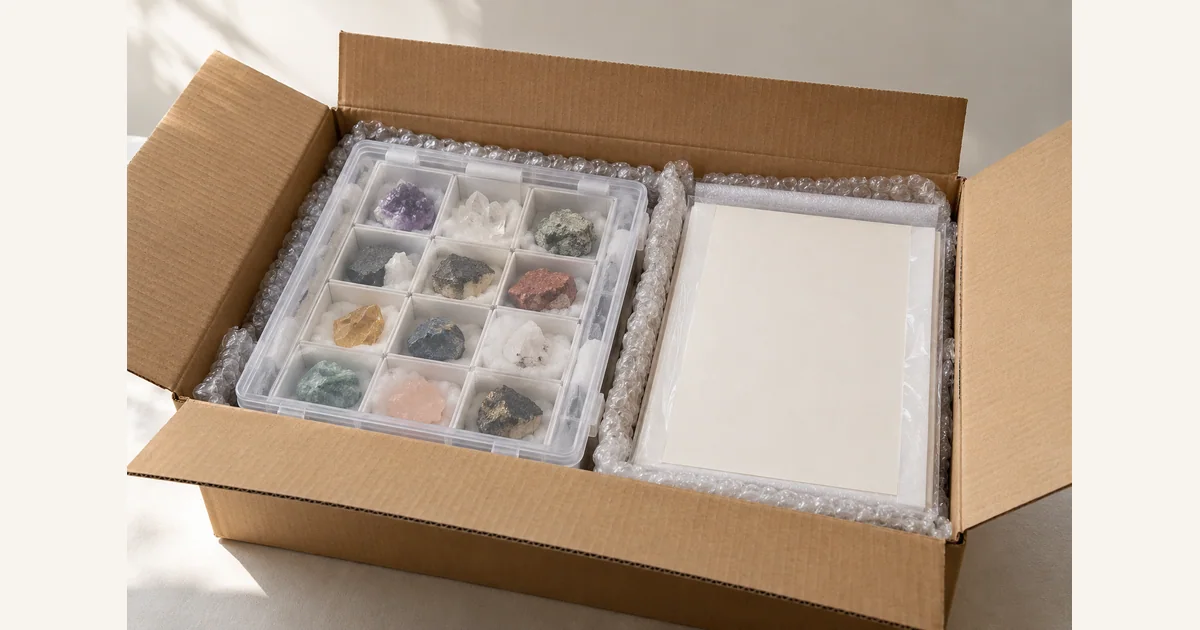
A small educational comparison kit is more effective than a large box containing twenty unlabelled stones. Set up six padded cells: 1. natural white howlite; 2. blue-dyed howlite; 3. natural white magnesite; 4. blue-dyed magnesite; 5. a verified turquoise reference specimen with its treatment status documented; 6. a known imitation such as turquoise-coloured glass or a mineral composite. Use a proven supplier or specialist to obtain material references; do not create a supposedly verified turquoise sample from an anonymous marketplace listing.
Keep each sample in its own compartment. A sticker reading only “blue stone” does not teach the distinction. Give every piece a unique reference such as HL-W01, HL-D02, MG-W03, MG-D04, TQ-R05 and IM-C06. Put the full key in the box lid and an electronic inventory. For each sample record the declared mineral, treatment, supplier, purchase date, batch reference, visual notes, and independent verification status if applicable. That record allows different consultants in a shop to give the same explanation.
Worked example: showing a customer the difference in under five minutes
Suppose a customer brings a vivid blue bead and asks whether it is turquoise. First, place it on a white card beside the reference samples and ask for its purchase description. Second, compare the webbing, sheen, pores and drilling marks without damaging the bead. Third, explain how dyed howlite and dyed magnesite can resemble turquoise even when the bead is genuinely mineral rather than plastic. Fourth, show the actual supplier or laboratory record for your reference piece. Finally, state the level of certainty: “Its appearance is consistent with several materials; identification is not confirmed from appearance.” If the purchase value depends on its being turquoise, recommend material confirmation rather than guessing.
9. Three real buying and display situations
Example A: selecting an economical blue stone for a jewellery design
A jewellery maker wants forty matching blue beads for a fashion bracelet. Blue-dyed howlite may be entirely suitable if the colour, cut and size are consistent and the jewellery listing says dyed howlite. The maker should test the design for normal wear, check for dye transfer under ordinary handling only if the supplier has an approved procedure, and ask about exposure to skin oils, fragrances and water. Requiring “natural turquoise” would change both the procurement requirement and potentially the price. The choice depends on the product's promise, not on a blanket ranking of stones.
Example B: ordering white howlite for a Vastu gemstone collection
A consultant orders twenty white howlite tumbled stones for a teaching and display kit. The delivery contains some cream-coloured pebbles with grey webbing and others with noticeably granular patches. The consultant should not relabel the entire delivery as proven howlite from appearance alone. Count and photograph each subgroup, compare it with the supplier's batch description, request clarification on possible magnesite substitution, and retain only correctly identified or clearly qualified pieces in the demonstration box. Material accuracy improves the consultation even though the proposed display use is symbolic.
Example C: comparing a turquoise listing at a showroom
A customer sees two blue stones with similar dark lines. One listing claims “natural turquoise”; another states “blue-dyed howlite.” There can be legitimate reasons for a price difference, but the visual comparison is not enough to verify the first listing. Ask whether the turquoise is untreated or stabilised, whether the stone itself has been identified, and what the return conditions are. For an expensive piece, independent testing is more valuable than a confident verbal assurance. The cheaper dyed howlite can still be an attractive, honestly sold accessory.
10. Receiving and quality-control checklist for a batch
When buying wholesale tumbled stones, ask for the base mineral name, colour-treatment status, approximate piece size and weight range, batch photographs, permitted natural variation, and any return threshold for broken or wrongly described material. On receipt, count the stones before mixing them with older stock. Use a neutral light to compare colour; inspect several pieces with magnification; and separate obvious defects from normal natural patterns. A high polish does not turn dyed howlite into turquoise, while a low polish does not prove that a white stone is magnesite.
For stock control, keep product identity and treatment in separate fields. A useful basic inventory looks like this:
| Stock field | Example for an honestly described product | Why it matters |
|---|---|---|
| Mineral | Howlite | Distinguishes it from magnesite and turquoise |
| Colour | Blue | Describes the visible appearance |
| Treatment | Dyed | Explains why this mineral is blue |
| Shape and finish | Tumbled, polished | Distinguishes a stone from rough, bead or carved product |
| Supplier claim | Howlite, dyed blue | Retains the source description without overstating certainty |
| Verification | Supplier declaration; laboratory not performed | Keeps a commercial claim separate from a tested result |
| Care note | Dry cloth; avoid long soaking and harsh solvents | Matches the material and treatment |
11. Care for natural and dyed howlite
Wipe ordinary fingerprints with a soft, dry cloth and store stones away from direct extended sunlight, excess humidity and household chemicals. For a piece with uncertain treatment, avoid long soaking, ultrasonic cleaning and harsh cleaning solutions. Some colours or surface finishes may be affected by friction, solvents or strong light. A padded pouch or compartmentalised box reduces abrasion when howlite is carried beside harder stones such as quartz. Do not place it where repeated contact with keys, metal or rough beads will damage the polish.
For home Vastu displays, a clean dry tray is easier to maintain than an open bowl of water. A shop may refresh the display by dusting the tray and checking labels rather than relying on rituals that immerse dyed stones. If a stone is used during prayers, keep it away from oils, incense residue and flame. These simple practices preserve the actual mineral object and the clarity of its product description.
12. Frequently asked questions
Is dyed howlite a fake gemstone?
No: the base howlite can be a genuine naturally occurring mineral. Its colour is treated. The description becomes misleading only when it is represented as natural turquoise or when a relevant colour treatment is concealed. A proper label is “dyed howlite,” not “untreated turquoise.”
Can natural howlite be blue?
The ordinary commercial white material is widely known for being dyed blue. An intensely turquoise-blue howlite listing should prompt a treatment question. Do not use colour alone to certify either treatment or mineral identity; verify the material and disclosure.
Does dark spiderweb matrix prove turquoise?
No. Dark lines occur in multiple pale minerals and can be introduced or emphasised in imitations. The shape, pattern and depth of veining may provide clues, but they are not a substitute for mineral analysis.
Is “white turquoise” another name for howlite?
The phrase has appeared in trade, but it can confuse the mineral identity. Where the stone is howlite, call it white howlite. If the product is magnesite, state magnesite. Avoid using the word turquoise as the principal mineral name unless it truly is turquoise.
Can blue-dyed howlite replace pearl or blue sapphire in Jyotisha?
No automatic equivalence follows from colour. Jyotisha gemstone selection is a separate subject that depends on the tradition and recommendation being followed. A modern decorative crystal can be used for a personal intention without being advertised as a classical substitute for a prescribed planetary gem.
Can a phone photograph identify dyed howlite?
A photograph can show colours, patterns and possible dye distribution, but it cannot establish the precise mineral. Even live viewing may not settle closely similar materials. Treat visual comparison as a screening aid, not a certificate.
What should I do if my delivery is labelled turquoise but looks like dyed howlite?
Keep the packaging, photographs and invoice; do not run destructive home tests. Ask the seller for the precise mineral name and treatment disclosure. If the price or use depends on authenticity, arrange an appropriate professional test or resolve the description with the seller before combining the stock.
How to choose the right stone for its intended purpose
For a simple white display or modern meditation practice, natural white howlite may suit the visual and symbolic intention very well. For an affordable blue decorative bead, blue-dyed howlite may be a transparent, practical choice. For a specifically turquoise purchase, buy turquoise with an appropriate statement of material identity and any stabilisation or colour treatment. For educational work, keep howlite, magnesite and turquoise as separate references. This is the most useful conclusion: choose a stone because its real material, visible character and intended role match the description—not because a familiar colour has been given a more valuable name.
Continue reading
- How to Choose Genuine Tumbled Stones
- Natural, Dyed, Heat-Treated and Reconstructed Stones
- Green Jade and Its Common Gemstone Substitutes
Explore the existing Vastu and gemstone collections for wider context.