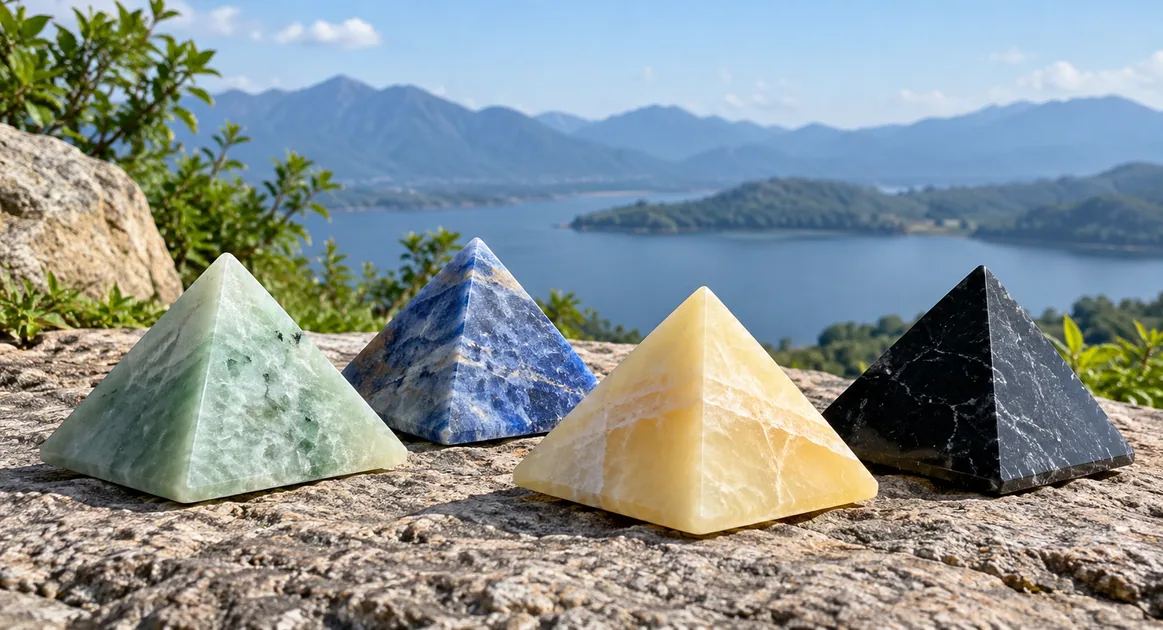
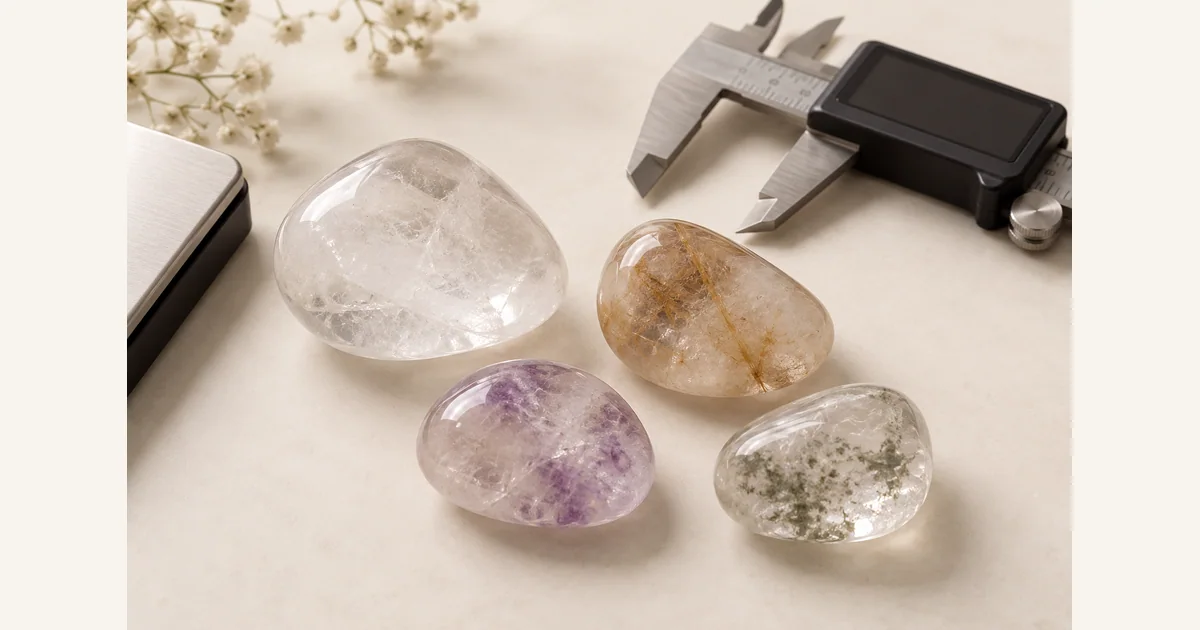
A professional crystal or Vastu gemstone kit must do more than look impressive when its lid opens. It needs to travel from the showroom to a client's home or office, preserve each stone's identity, support a repeatable Vastu or Jyotish demonstration, and return with all specimens and reference cards intact. The kit's case, labels and layout sheets are therefore part of the teaching system, not merely packaging.
Consider a practitioner carrying a sixteen-stone reference tray to a Bengaluru apartment. At the location, the client asks why a yellow stone is shown in a prosperity-oriented arrangement, why a dark stone is kept as a separate protective-symbolism reference, and how an eight-direction layout differs from a Navagraha set. If the stones have shifted into the wrong cells, those explanations become uncertain before the lesson begins. A well-constructed kit protects the gemstones and preserves the intended associations, numbers and positions.
This guide covers selecting a case, organising specimens, protecting different minerals, documenting traditional associations, preparing professional layouts, travelling and shipping, and maintaining accurate replacement records.
1. First identify the kind of kit being packed
A gemstone box can serve several different teaching or consultation purposes. Those purposes determine which stones belong inside, how they should be numbered, and what accompanying documents are necessary. Do not assume a seven-chakra kit, an eight-direction Vastu reference and a Navaratna demonstration use the same arrangement simply because they contain colourful stones.
| Kit type | What the practitioner demonstrates | What to pack with the stones |
|---|---|---|
| Eight-direction Vastu kit | North, North-East, East, South-East, South, South-West, West, North-West and their traditional Ashta Dik associations | Compass-labelled eight-direction board, orientation instructions and stone-to-zone legend |
| Pancha Mahabhuta kit | Prithvi, Jala, Agni, Vayu and Akasha; traditional elemental language and contemporary gemstone teaching correspondences | Five-element card, colour/material explanations and sample-selection notes |
| Navagraha / Navaratna study kit | Surya, Chandra, Mangala, Budha, Guru, Shukra, Shani, Rahu and Ketu; customary gemstone associations | Nine-Graha chart, original material names and notes distinguishing a symbolic teaching sample from jewellery-quality Ratna |
| Seven-chakra reference kit | Colour-based symbolic arrangements from Muladhara to Sahasrara | Seven-position visual, pronunciation/meaning cards and specimen labels |
| Crystal-grid arrangement kit | A centre stone, repeated positions, a chosen Sankalpa and geometric arrangement | Grid board, numbered layout diagram and exact component-count sheet |
For example, a yellow citrine tumble may appear in contemporary prosperity-oriented crystal practice, while yellow sapphire (Pukhraj) is the classical Guru-related gem in common Navagraha correspondence tables. The two are not interchangeable simply because both are yellow. Record both the material identity and the system in which it is being used.
2. Design the case around the largest and most delicate specimens
Begin with the actual stones laid out in their intended order—not with a catalogue photograph of a case. Measure the width, length and height of each specimen. A nominal 25 mm tumbled stone can have a projecting ridge; a long crystal point, raw black tourmaline or pyrite cluster needs different protection from a rounded polished quartz.
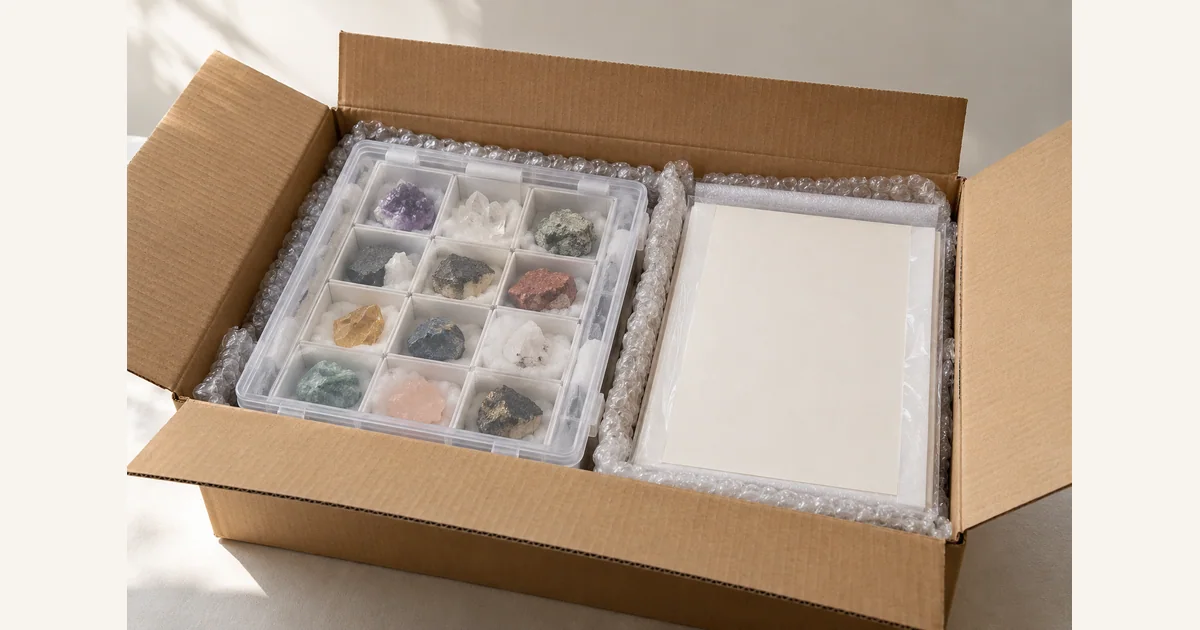
- Choose individually separated compartments. Two loose stones sharing a compartment can rub, chip or exchange labels during travel. Use a soft divider or individual pouch as appropriate to the material.
- Allow lifting clearance. A practical starting allowance is roughly 5–10 mm around a rounded 25–30 mm specimen, then adjust for its actual shape and padding. This is a design example, not a universal case dimension.
- Support the stone from below and around the sides. A fitted foam or inert tray is generally better than allowing a stone to roll against a hard wooden divider. Make sure the chosen lining does not shed dye, leave residue or adhere to the mineral.
- Prevent lid pressure. Close the case with a sheet of clean protective material first and check for impressions or movement; no crystal tip should be pressed by the lid.
- Separate the layout board. A compass board or grid plate often fits better in a flat sleeve or an independent padded section than over the stones.
- Use a durable outer case. The case needs a working latch, carrying grip, stable base and space for a compact printed inventory. If the kit will be carried on a motorcycle or couriered, treat vibration as a normal use condition.
A plain 16-cell case that keeps every specimen in position is more useful to a professional than an elaborate presentation box in which the stones become mixed. Appearance can support a premium experience, but traceability and dependable opening are the real tests.
3. Build a numbered inventory that survives travel
Numbers should appear in three matching places: the compartment, the inventory sheet and the reference card. Write a stable code such as VG-01, not only a handwritten colour name. Product names, trade terms and stones can be confused; a stable code allows an exact replacement request later.
The following is an illustrative sixteen-specimen professional reference set. The real inventory supplied with a commercial kit must list its actual contents; this table does not assert that every OmmRudraksha kit contains these particular stones.
| Code / specimen | Teaching significance | Packing and label note |
|---|---|---|
| VG-01 · Sphatik / clear quartz | Clarity, purity, meditation and Sattva-oriented symbolism | Record clear versus milky specimen; padded individual cell |
| VG-02 · Rose quartz | Affection, relationships, gentleness and contemporary crystal practice | Identify as rose quartz, not simply “pink stone” |
| VG-03 · Amethyst | Contemplation, mental focus and meditation symbolism | Protect from hard knocks and prolonged strong light |
| VG-04 · Citrine | Prosperity, commerce and abundance intentions in modern crystal arrangements | Document any supplier treatment declaration |
| VG-05 · Green aventurine | Growth, opportunity and renewal symbolism | Distinguish from jade-type materials or dyed stones |
| VG-06 · Tiger's eye | Resolve, confidence and protective intentions | Record characteristic shifting light band |
| VG-07 · Carnelian | Activity, initiative and Agni-like symbolic themes | Mark translucent carnelian versus opaque jasper |
| VG-08 · Red jasper | Stability, grounding and Prithvi-oriented symbolism | Label actual stone variety, not merely colour |
| VG-09 · Lapis lazuli | Wisdom, thoughtful expression and deep blue symbolism | Keep free of abrasive contact and harsh liquids |
| VG-10 · Sodalite | Reflection, expression and colour-comparison education | Do not relabel it as lapis |
| VG-11 · Black tourmaline | Protective symbolism and boundary-oriented crystal practices | Pad brittle/raw points independently |
| VG-12 · Black obsidian | Grounding and protective intention in contemporary practice | Record that it is volcanic glass, not tourmaline |
| VG-13 · Hematite | Steadiness, grounding and concentration themes | Separate from easily scratched stones |
| VG-14 · Moonstone | Chandra-related imagery, receptivity and introspection | Protect cleavage-sensitive feldspar from impacts |
| VG-15 · Labradorite | Introspection and iridescent light-play in modern crystal use | Protect edges, label the actual material |
| VG-16 · Pyrite | Golden appearance and commerce/prosperity symbolism | Check moisture sensitivity; keep separately protected |
Each inventory line should also record size, count, photograph reference, supplier batch, known treatment, condition at packing and the permitted substitution rule. A professional doesn't need a lengthy paragraph on the compartment itself; the detailed meaning belongs on the corresponding card or guide.
4. Protect different minerals differently
All crystals are not equally suited to the same storage and cleaning routine. A tumbled quartz and a friable mineral cluster may have very different handling needs. The common instruction “wash all stones and leave them in sunlight” is not a good maintenance procedure for a mixed professional kit.
| Material or condition | Special consideration | Recommended packing approach |
|---|---|---|
| Polished quartz varieties | Generally durable, but still susceptible to chipping from contact with harder edges | Individual padded cells and soft wiping |
| Moonstone, labradorite and fluorite | Cleavage or comparatively vulnerable edges; avoid unnecessary knocks | Snug padded cavity; no heavy object above |
| Lapis lazuli, malachite and turquoise | Some pieces are porous, treated or sensitive to cleaning agents | Dry padded storage; material-specific cleaning guidance |
| Selenite or gypsum specimens | Soft and easily marked; prolonged water contact is unsuitable | Separate dry sleeve/cell; keep away from harder stones |
| Pyrite or marcasite | Some specimens are particularly sensitive to humid conditions | Separate dry environment, regular inspection and no shared damp storage |
| Raw crystal points / fragile clusters | Projections break if pressed or shaken | Custom recess with full support; rigid tip clearance |
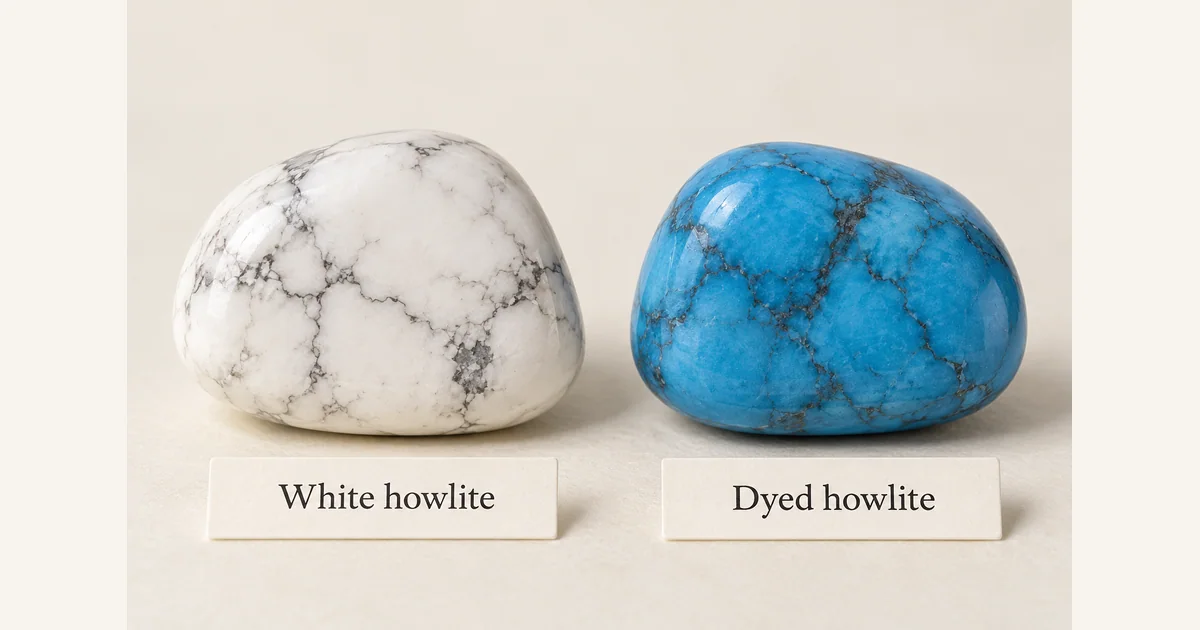
| Dyed, coated or stabilised stones | Treatment may be affected by solvents, heat or abrasion | Preserve treatment information; avoid generic chemical cleaning |
When a stone's mineral identity or treatment is uncertain, record that explicitly and ask the supplier before specifying cleaning. For valuable or delicate pieces, appropriate gemological care takes precedence over a one-size-fits-all ritual cleaning instruction. Physical care and spiritual practice are different tasks; one need not erase the other.
5. Keep the Vastu interpretation with the kit, not only in someone's memory
In an eight-direction demonstration, a compass-labelled board has North at the actual North reference, not simply “up” in every room. The practitioner should orient the board according to the site's measured direction and explain the traditional Ashta Dik structure. The board is an educational layout: it does not independently diagnose a property's Vastu without its floor plan, entrances, activity zones and the specific tradition being followed.
| Direction | Classical directional deity | Commonly discussed theme | What the reference card should clarify |
|---|---|---|---|
| North (Uttara) | Kubera | Resources and prosperity | Whether the selected stone belongs to a modern prosperity grouping |
| North-East (Ishanya) | Ishana | Knowledge, prayer and sacred attention | Why a clear or light specimen has been selected for the teaching set |
| East (Purva) | Indra | Beginnings, light and activity | Which colour/stone convention the kit is using |
| South-East (Agneya) | Agni | Fire, transformation and cooking/activity | How red/orange stones are being used symbolically |
| South (Dakshina) | Yama | Discipline and order | That a specific gemstone placement depends on the method used |
| South-West (Nairritya) | Nirriti | Stability and boundaries | Why a heavier/earth-coloured specimen may be shown |
| West (Pashchima) | Varuna | Water and regulation | Difference between classical association and contemporary crystal colour matching |
| North-West (Vayavya) | Vayu | Movement, circulation and exchange | Why the chosen reference may change with the practitioner's school |
Put a small statement on the board such as “Directional deities are traditional; gemstone correspondences in this demonstration are identified separately.” This helps a knowledgeable customer understand what is rooted in Vastu Shastra and what is a contemporary application using crystals or tumbled stones. It does not reduce the meaning of either.
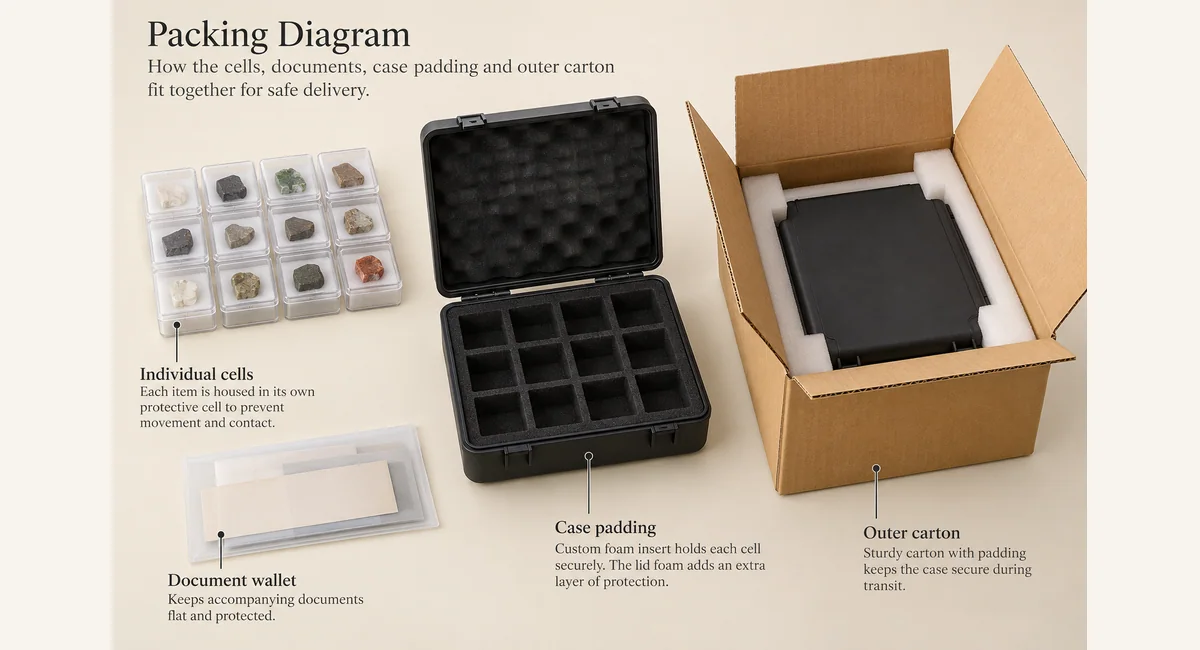
6. A three-layer packing design for a working case
For repeated visits, it is practical to divide the kit into three physical layers. This is an example design, not a specification for a particular OmmRudraksha product.
| Layer | Contents | Why it matters |
|---|---|---|
| Top document wallet | Inventory sheet, Ashta Dik or chakra board, replacement log, brief purpose cards, compass-use instructions | Prevents the meaning and arrangement information from being separated from the stones |
| Middle specimen tray | Numbered individual stone cavities, fixed dividers and protective padding | Maintains identification and prevents contact damage |
| Bottom/side utility space | Cleaning cloth, spare blank label, pencil, small measuring tape, sealed small-item pouch | Supports accurate setup and repacking between client visits |
If the kit includes a crystal-grid board, a large metal Vastu pyramid, a delicate Yantra or a compass, store each according to its shape and fragility. A compass should be kept away from magnets and strong magnetic items. An engraved Yantra or a consecrated ritual object deserves its own appropriate cover, rather than being dropped in amongst loose mineral pieces.
7. Field procedure: open, demonstrate and repack consistently
The best case design still fails if the practitioner uses no standard opening and closing sequence. A repeatable procedure allows a second staff member to prepare the same kit accurately.
- Before leaving: Cross-check the inventory code and count; photograph the closed case, then the open packed tray. Confirm all teaching cards and boards are present.
- At the site: Choose a clean, steady and dry surface. Keep food, cleaning sprays and liquids away from the specimens. Unpack the layout board before lifting the stones.
- Confirm orientation: For a Vastu direction exercise, show the compass reference and explain the distinction between a room's actual North and the top of a printed board.
- Demonstrate in numbered order: Put each stone on its marked position. As it is placed, refer to the code and its traditional or contemporary symbolic description.
- Photograph the completed layout: Include the full arrangement and its orientation label. This is more useful than an uncaptioned close-up of attractive gemstones.
- Return each stone to its numbered compartment: Tick off the inventory while repacking. Do not substitute “another purple stone” for a labelled amethyst without a recorded change.
- Inspect on return: Note any chips, wetness, lost pieces or damaged labels promptly; update the replacement register before the next visit.
8. Three practical scenarios
Example A — A Bengaluru jewellery showroom consultation
A showroom owner wants to discuss traditional Vastu zones for the cash counter, entrance and prayer area. The consultant carries a sixteen-stone reference case and an eight-direction layout board. First, the consultant identifies the actual directions on the floor plan. Next, the kit is laid out to explain North/Kubera prosperity symbolism, North-East/Ishanya prayer and South-East/Agni activity. Citrine, Sphatik and carnelian may be brought into the demonstration as illustrative contemporary crystal associations; the board makes clear these are not a universal, compulsory combination.
The consultant photographs each numbered stone in its demonstration position, then repacks by code. The follow-up note identifies which items were shown, their stated materials and the purpose of the demonstration. This prevents the owner from later confusing an orange carnelian demonstration sample with a yellow prosperity stone or assuming the entire teaching tray is one prescribed remedy.
Example B — A home consultation followed by a return trip
In a family apartment, the practitioner uses one set to discuss a study area, a puja space and a contemporary harmony-oriented crystal grouping. Several loose specimens are brought out and compared: Sphatik for devotional clarity, amethyst for contemplation, and rose quartz for relationship-themed symbolism. The actual choices depend on the client, space and practice being followed.
After the session, the case is closed with each sample in its numbered recess. If the family wants one product later, the consultant can reference the recorded code, name and product variant—not merely recall that it was “a pink polished stone.”
Example C — A travelling professional teaching workshop
A teacher sets up three separate demonstrations on the same day: Ashta Dik directions, Pancha Mahabhuta and a Navagraha comparison. Using interchangeable cards, the teacher reuses some physical stones without claiming the three systems have identical correspondences. The teacher keeps separate legends for each display, logs the checked-out specimen count, and restores the tray before the next class.
If a stone is chipped at the workshop, the code directs the correct replacement. If a replacement changes the stone type, the teaching card and inventory are updated before the kit is used again.
9. Courier packing: protect the inner kit and the records
A professional presentation case is not automatically a parcel-shipping carton. During shipment, the case can turn upside down, experience vibration or be compressed by other parcels.
- Check and record the contents of the inner case, including stones, board, cards and any separate accessories.
- Immobilise the stones within the tray. If the contents can move when the closed inner case is gently tilted, improve the internal protection before outer packing.
- Protect the case itself with suitable cushioning inside a rigid outer carton; avoid hard contact with the outer wall.
- Place rigid boards and crystal points in their own protective sleeves or partitions.
- Add the inventory/packing list to a protected document pocket, not loose against the stones.
- Seal the carton and label it according to the carrier's requirements. Photograph the complete inner pack and final sealed carton for the shipment record.
- On receipt, compare the supplied inventory to the actual contents before discarding packing material.
Rain and high humidity are practical considerations in many Indian delivery routes. Protect paperwork and packaging appropriately; certain minerals, especially vulnerable pyrite specimens, need additional thought about moisture conditions. On the other hand, do not prescribe a single ultra-dry storage environment for every mineral or organic gem: different materials can have different requirements.
10. Replacement policy: match identity first, appearance second
Natural tumbled stones differ in size, inclusions, veining and colour distribution. A replacement procedure should distinguish exact identity, functional equivalence for a lesson, and appearance. These are different standards.
| Change request | Acceptable process | What must be revised |
|---|---|---|
| Same material; different natural pattern | Verify declared stone identity, dimensions and physical fit | Specimen photograph/condition and replacement date |
| Different specimen size | Check the cavity, safety and layout visibility before approval | Inventory measurement and case-fit note |
| Different mineral under the same colour name | Do not silently substitute; seek informed approval for a changed teaching sample | Stone name, symbolic reference, image, label and possibly article/product description |
| Replacement with different treatment | Record dye, heating, coating or treatment information when known | Disclosure and care instructions |
| Updated layout from 16 to 18 pieces | Create a new revision and update every corresponding numbered position | Kit contents, product page, cards, board and packing list |
For example, if VG-09 Lapis Lazuli is lost, it should not quietly be replaced with VG-10 Sodalite. Both may appear blue in a photograph, but they have different mineral identities, different reference characteristics and distinct associated descriptions. If the kit's purpose is teaching identification, that difference is central. If an alternative is deliberately selected for an updated teaching exercise, issue a new labelled card and revision.
11. A useful revision and audit record
A modest spreadsheet is sufficient for many small professional operations. A larger team can use the same fields in its inventory software. The key is that someone other than the original packer can open the record and understand it.
| Field | Illustrative entry |
|---|---|
| Kit code | VG-PRO-016 |
| Document revision | R02 · 04 Nov 2026 |
| Specimen code | VG-09 |
| Declared material | Lapis lazuli tumble |
| Number and size | 1 piece · approx. 28 × 23 mm |
| Purpose/teaching system | Mineral identity and blue-stone comparison |
| Condition | Checked, no visible chip |
| Action taken | Replaced after loss during workshop |
| Evidence | Supplier batch, photograph, packing sign-off |
Replace this sample information with actual kit records before using it in a customer fulfilment or inventory system. Version numbers are especially valuable when a product has been assembled over months and different staff members have handled replacements.
12. What a professional crystal kit listing should tell the buyer
A customer deciding between a hobby assortment and a professional Vastu study set needs concrete information. A complete listing should name the actual gemstones and number of pieces, explain the intended teaching system, show the case and any board, and distinguish items included from items pictured only for illustration.
- What is included: precise piece count, individual specimen names and number of reference cards/boards.
- What it is for: Vastu demonstration, chakra learning, Navagraha comparison, sacred geometry, mineral identification or a clearly specified combination.
- Material notes: natural colour range, known treatments where relevant, and whether specimens are polished tumblestones or raw pieces.
- Case: dimensions, separator and padding style, carrying and shipping suitability.
- After-purchase use: how to follow the layout, orient the board, clean appropriately, and record replacements.
- Replenishment: whether individual codes can be reordered and how a replacement may differ naturally in appearance.
A professional customer might also want separate photographic views of the open case, numbered tray, each layout and the complete set with its documentation. Such images have value beyond decoration: they help the buyer know exactly which reference product will arrive.
13. Frequently asked questions
Can all crystals travel together in a drawstring pouch?
For a brief personal use, a pouch may be convenient for selected robust stones. For a professional identified reference kit, separate labelled compartments are better because stones can rub together and their identities may become confused.
Should a Vastu kit be arranged permanently according to North, South and the other directions inside its travel case?
The transport case needs a reliable inventory order; the demonstration board carries the directional placement. Keep the two clearly connected by specimen code. The case should not be mistaken for a fixed room-orientation diagram.
Is an eight-direction set the same as a nine-gem Navaratna set?
No. The first is organised around spatial directions and directional deities; the second concerns the nine Grahas and traditional Ratna associations. Some materials may overlap, but neither the number of positions nor the interpretive purpose is the same.
How do I replace one missing gemstone?
Use the inventory code to check the declared material, approximate size, treatment information and the lesson for which the sample was selected. Update the photograph and the revision log. If the new material differs, change the card and kit description rather than quietly reusing the old label.
Can the stones be cleaned by putting them all in saltwater or direct sunlight?
A mixed kit can include porous, treated, moisture-sensitive or light-sensitive specimens. Check each material before applying any physical cleaning method. A soft dry cloth and careful individual handling may be preferable for many pieces; more specialised care varies by stone.
How many stones should a professional Vastu reference kit contain?
There is no universal professional count. An eight-direction teaching arrangement may have eight positions, while a sixteen-stone tray allows side-by-side comparisons; five-element, seven-chakra, nine-Graha and larger grid systems have different structures. The purpose and the accuracy of the supplied guide are more important than a larger advertised count.
What if a buyer uses the kit only at home?
The same numbered stones, clear explanations and careful packing are useful. A home user may need fewer specialist forms but should still know how to identify each stone, which tradition its symbolism comes from, and how to reproduce the intended layout.
14. Related guides and OmmRudraksha collections
For step-by-step inventory systems, read the guides on gemstone labels and replacement records. For parcel dispatch, see the shipping guide. If choosing materials for a new study tray, compare bulk consistency and the current gemstone collections before finalising your kit contents.
Continue reading
- How to Label and Organize a Tumbled Stone Reference Collection
- How to Pack and Ship Tumbled Stone Sets Safely
- Buying Tumbled Stones in Bulk: Quality and Consistency
Explore the existing Vastu and gemstone collections for wider context.