How do you ship a tumbled-stone set so the receiver can use it exactly as intended? The answer is not simply “add more bubble wrap.” A Vastu eight-direction assortment, a Navagraha teaching kit, a display tray and a loose gemstone gift set each have a different packing challenge. The stones may be dense, individually small, and polished; the display vessel may be fragile; and, for a consultant or student, the identification labels and arrangement can be as important as the stones themselves. A parcel can arrive without a broken stone yet still be unusable if the specimen codes have become mixed or the directional chart has been lost.
This guide follows the entire journey: checking each mineral, recording the intended traditional arrangement, wrapping according to stone sensitivity, protecting the presentation accessories, packing a rigid carton, documenting dispatch and checking the set at delivery. It includes worked examples for an OmmRudraksha-style Vastu reference kit, a Navagraha set and a gemstone gift arrangement. The objective is simple: the same identified pieces should reach the customer in the same usable condition and with the same instructions that were packed at the workshop.
1. Identify the type of gemstone set before choosing a box
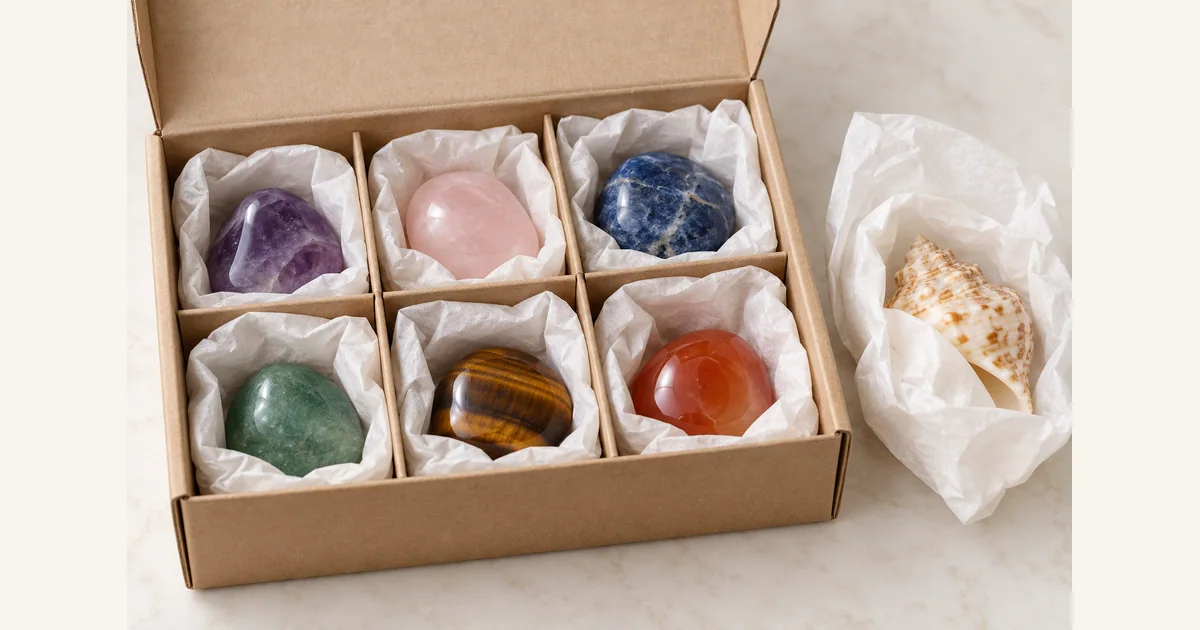
Start with the purpose of the order, not the outer carton. A single pouch of mixed pebbles can be packed differently from a complete directional demonstration set. Here is how the requirements change:
| Set type | What matters most | What to pack separately |
|---|---|---|
| Loose mixed tumbled stones | Correct material identity, chip-free polish, agreed quantity/weight | Stone groups by species or SKU, identification card |
| Eight-direction Vastu set | Eight zone labels, placement guide, correct specimen inventory | Numbered stones and orientation board |
| Navagraha reference set | Each Graha correctly matched to its gem or labelled representative material | Nine labelled pouches and the Graha association sheet |
| Chakra crystal set | Seven positions, corresponding stone labels and intended sequence | Individual compartments and chakra reference chart |
| Decorative shell or wooden tray set | Protecting the vessel, corners and finish as well as the minerals | Every loose stone, shell or tray, instruction card |
| Professional study/consultation kit | Repeatable inventory, replacement tracking, neat transport and reassembly | Specimens, code sheet, layout board, reusable case |
Traditional meanings belong in the reference material that accompanies the kit. For example, an eight-direction layout relates to the Ashta Dik framework; a Navagraha kit relates to the nine Grahas of Jyotish; a seven-chakra collection uses a different spiritual map. They should not be packed as though they were interchangeable arrangements. The shipping plan must protect both the physical objects and their traditional identification and intended use.
2. Prepare a complete dispatch inventory before wrapping
Count and check every specimen while the kit is still assembled. Record a short code on a paper label or compartment, not directly on the gemstone. If the set has a prescribed layout, photograph it from above with the labels visible and place a copy of that layout inside the parcel. Include the exact material name recorded at selection; a colour description alone is not reliable identification. Rose quartz, rhodonite, dyed agate and pink glass can all be pink, yet they are not the same material.
A practical inventory row can contain: Kit ID, specimen code, gemstone name, count, approximate weight, appearance/finish, intended placement, reference-sheet version and replacement code. For retail gifts, that is more documentation than the customer normally needs, but it is useful for the seller. A concise customer card can present the gemstone name, its traditional association and suggested placement.
| Sample code | Specimen | Traditional purpose noted on card | Packing instruction |
|---|---|---|---|
| VS-01 | Clear quartz / Sphatik | Clarity, meditation and puja use | One padded pocket; avoid contact with other stones |
| VS-02 | Rose quartz | Harmony and affectionate intentions | Separate soft wrap; protect polished surfaces |
| VS-03 | Amethyst | Calm, reflection and spiritual practice | Dry padded cell; avoid sustained heat/light |
| VS-04 | Citrine | Prosperity-related intentions in contemporary crystal practice | Separate cell; retain treatment/identity notes |
| VS-05 | Pyrite | Prosperity and protective symbolism in modern crystal sets | Dry individual pocket; prevent prolonged damp exposure |
This table illustrates a packing and labelling system, not a rule that these five stones must be placed in fixed Vastu directions. For a consultant-created eight-direction arrangement, reproduce the actual direction mapping supplied with that particular kit. Where a kit uses substitute stones for traditional Navaratna gems, say so on the card rather than presenting substitutes as identical to the principal gemstones.
3. Inspect the stones before they enter the package
A good shipment starts with condition control. Spread the stones on a clean padded mat, check them under neutral light and compare them with the packing list. Look for chipped edges, weak points, uneven polish, loose coating, unstable drilling and cracks. Natural colour bands, matrix and inclusions are not automatically defects; the important question is whether the supplied material is accurately described and fit for its intended use.
Never wash an unfamiliar mixed lot as a single group before shipping. Some materials tolerate gentle water cleaning, while others are porous, coated, water-sensitive or susceptible to thermal shock. For ordinary clean stones, a dry soft cloth or the care method already established for that material is generally the safer approach. Pack everything thoroughly dry.
| Material or group | Shipping concern | Practical handling choice |
|---|---|---|
| Quartz varieties: clear quartz, rose quartz, amethyst, citrine | Surface rubbing, edge chips; some colours may be sensitive to excess light or heat | Individual soft sleeves; avoid a hot windowsill or vehicle dashboard |
| Agate, carnelian, jasper, tiger eye | Heavy pieces striking each other and chipping softer neighbours | Separate compartments; prevent rolling |
| Obsidian | Conchoidal fractures may leave sharp chipped edges | Extra protection around edges; do not mix loosely with harder stones |
| Fluorite, calcite, gypsum/selenite | Relatively delicate; edges and cleavage surfaces can be damaged | Soft fitted support, a rigid inner compartment and minimal pressure |
| Malachite, turquoise, lapis lazuli | Variable toughness, treatments and surface sensitivity | Keep dry; avoid adhesive, chemicals and abrasive wraps |
| Pyrite, metal-finished components and hematite items | Surface marks or changes under prolonged damp storage; dense pieces can shift | Separate dry compartments; moisture control suited to material and transit |
Hardness and toughness are different. A quartz pebble may resist many scratches but still chip if it falls onto a hard surface. Conversely, an apparently soft specimen may have a sound polished finish but abrade when shipped against harder pieces. This is why simply grouping stones by size or colour is not enough. When the identity or treatment is uncertain, isolate the piece and label the uncertainty for internal review.
4. Wrap individual specimens, then secure the inner case
Place each stone into its own smooth, non-abrasive tissue pocket, fabric sleeve or lined cell. Use additional padding around a fragile corner or a large specimen. Avoid tape directly on the mineral; adhesive residue can be difficult to remove and may affect coatings or softer materials. A zip pouch is useful for retaining a specimen code, but a pouch alone is not impact protection. The pouch should still sit in a fitted compartment or be surrounded by cushioning.
For a numbered kit, arrange the packets in the case in the same numerical order as the inventory: VS-01 through VS-16, for example. Place the paper layout above the protective layer or in a separate sleeve, not loose between stones. Foam slots or dividers must hold each packet securely while avoiding pressure that could fracture delicate specimens. Close the case and move it gently from side to side; the contents should not slide, knock or rattle. Do not deliberately shake a delicate kit hard to test it.
Different packing for a shell, tray or display board
Never ship a completed decorative shell with heavy polished stones loose inside. Remove the stones, count and pack them individually. Protect a shell's rim and fragile points; protect wooden-tray corners, inlays and surface finish. Cushion the vessel separately in the inner carton. If a display board has directional markings, put a flat protective backing behind it and isolate it from the weight of the mineral packets so the board cannot bend.
5. Build a strong parcel around the finished specimen case
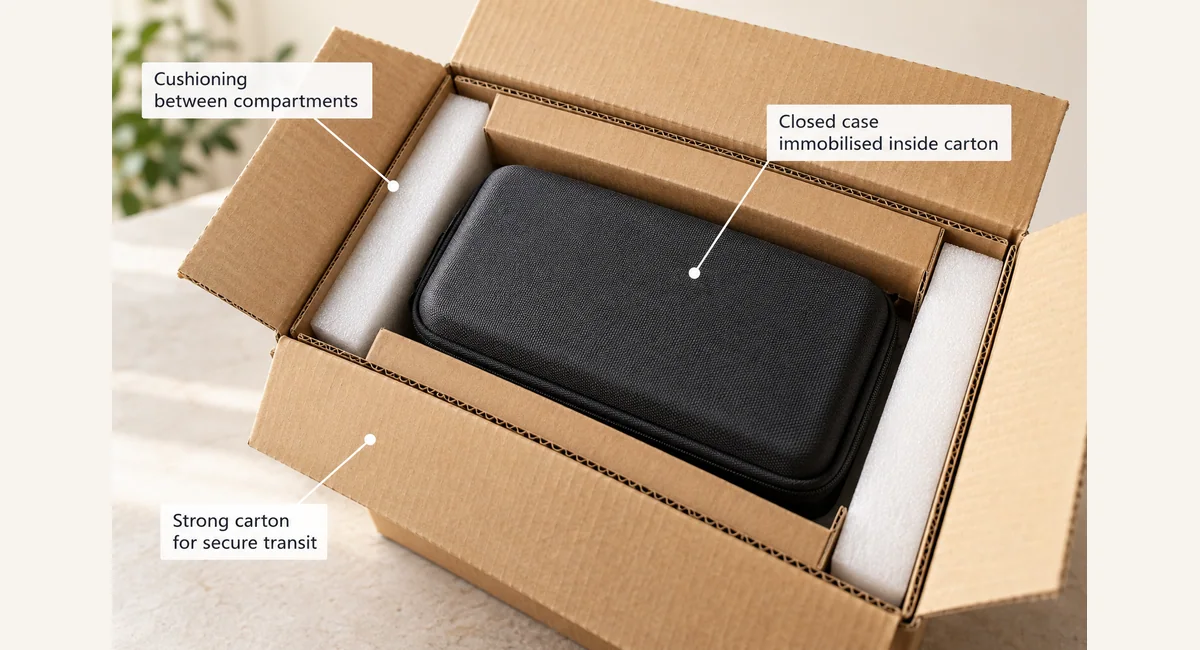
The outer carton has one job: absorb ordinary handling shocks without transferring them to the stones and presentation pieces. Use a clean, adequately rated corrugated box; avoid a weak reused carton for a heavy parcel. Put cushioning under the inner case, position the case centrally, fill the sides and cover the top so it cannot move when handled. For fragile or valuable kits, use a box-in-box arrangement with a protective gap and cushioning between the inner and outer cartons. Courier packaging guides commonly recommend ample cushioning on all sides and securing the inner box against movement.
- Weigh the actual contents. Include stones, tray, case, instructions and cushioning; a collection of small tumbled stones can be unexpectedly heavy.
- Choose a rigid inner case. Close, latch or secure it so individual compartments remain sealed.
- Provide a cushioned base. Do not set the inner case directly against the outer carton floor.
- Fill side voids. Use purpose-suited foam or air-cell cushioning; packing peanuts alone may migrate around heavy objects.
- Protect the top. Keep the case from contacting the outer carton lid during compression.
- Seal properly. Tape the centre seam and carton edges, then place the address label on a broad flat surface.
- Record the packed condition. A photo of the inventory, closed inner case and sealed carton supports a factual dispatch record.
There is no universal centimetre value that makes every mineral shipment safe. Box dimensions, weight, shape, courier handling and specimen fragility all matter. For very fragile goods, double-boxing and substantial all-round cushioning are preferable to merely writing “FRAGILE” on a carton. A fragile label is a handling request, not physical protection.
6. Preserve the Vastu or spiritual arrangement through transit
A crystal collection for spiritual use is not just an anonymous batch of pebbles. Its arrangement may be prepared around a Sankalpa (intention), an eight-direction Vastu exercise, a seven-chakra practice, or a Navagraha reference chart. The seller need not ship an assembled grid in a way that risks physical damage. Instead, ship the labelled components safely and give the customer a clear reassembly guide.
Eight-direction Vastu demonstration set
For an educational arrangement, first mark the compass frame used by the practitioner: North, North-East, East, South-East, South, South-West, West and North-West. If the stone selection expresses directional deities, elements or colour correspondences, include the particular interpretation used. Traditional Ashta Dikpalas include Kubera (North), Ishana (North-East), Indra (East), Agni (South-East), Yama (South), Nirriti (South-West), Varuna (West) and Vayu (North-West). Modern gemstone-to-zone correspondences vary; they are a separate layer of interpretation.
Write down which exact specimen belongs to each marked position. A compass symbol on the layout helps the receiver orient the card; the actual direction in the room must be checked locally, rather than inferred from the top edge of a photograph.
| Directional label | Traditional Dikpala | What the kit card should state |
|---|---|---|
| North / Uttara | Kubera | Specimen code and the kit's prosperity/finance symbolism, if included |
| North-East / Ishanya | Ishana | Specimen code and puja/clarity association used by this system |
| East / Purva | Indra | Specimen code and the kit's renewal or vitality symbolism |
| South-East / Agneya | Agni | Specimen code and the fire/Agni interpretation |
| South / Dakshina | Yama | Specimen code and the discipline/structure interpretation |
| South-West / Nairritya | Nirriti | Specimen code and the grounding/stability interpretation |
| West / Pashchima | Varuna | Specimen code and the water/flow interpretation |
| North-West / Vayavya | Vayu | Specimen code and the movement/communication interpretation |
The directional labels are not themselves a list of compulsory gemstones. They are the map that makes a customised set reproducible. A Vastu consultant may select stones differently from a crystal practitioner; packing must faithfully preserve the choice already made rather than substitute a generic “lucky stone for each direction.”
Navagraha and chakra sets
In a Navagraha study set, distinguish each Graha from a generic colour. A traditional Navaratna association may refer to ruby (Surya), pearl (Chandra), red coral (Mangala), emerald (Budha), yellow sapphire (Guru), diamond (Shukra), blue sapphire (Shani), hessonite (Rahu) and cat's eye (Ketu). Some educational tumbled-stone sets use representative substitutes because the traditional gems are not sold in inexpensive polished-pebble assortments. The card should identify the exact material actually supplied, followed by any intended teaching association.
For chakra sets, keep the seven labelled positions and sequence separately documented; not all systems choose the same stone for the same chakra. Do not pack an unlabelled mix of colourful pebbles and expect the customer to reconstruct the correct scheme from colour alone.
7. Three worked examples: from preparation to unpacking
Example A — A Bengaluru shop sends a 16-stone professional Vastu reference kit
The order contains sixteen individually identified tumbled stones, a reusable divider case, a laminated eight-direction board and a two-page guide. At the packing desk, the team checks VS-01 through VS-16 against the product listing, marks the intended placement scheme on the board and photographs the complete set. Each piece is placed in a labelled soft sleeve and then in its numbered compartment. The compass board is packed flat above a rigid backing. The compartment case is closed and immobilised inside a cushioned outer carton. The customer receives a one-page inventory and a separate direction sheet; these let the consultant reproduce the same arrangement at the client's premises without guessing which stone belongs where.
Example B — A Navagraha reference collection goes to an astrology student
The order has nine labelled teaching specimens rather than nine certified fine-jewellery gemstones. Each pouch includes the exact stone name plus the Graha represented in that kit. A printed Navagraha table accompanies the arrangement, with any substitute clearly identified. Before dispatch, the seller checks all nine pouches against the invoice and photographs the numbered layout. The student can use the chart to study Graha associations and compare gemstone names, without confusing a tumbled teaching sample with a jewellery-grade Navaratna gemstone.
Example C — A gift set includes polished stones and a decorative shell
A customer orders a shell display with a mixed gemstone assortment. Shipping the assembled shell would allow dense pebbles to strike its rim. Instead, the stones are separated into labelled packets, while the shell is wrapped independently and supported by a rigid insert. The parcel includes a small placement photograph, a list of stone names and a brief note about the traditional themes represented. The receiver opens the shell first, checks the rim, then adds the stones one by one according to the guide. The display remains easy to assemble without compromising transit protection.
8. Handle moisture, heat and privacy deliberately
Dryness matters for cardboard, printed guides, metal components and several mineral specimens. Allow cleaned items to dry completely before sealing. If moisture control is needed, use a suitable enclosed desiccant packet separated from the specimens and clearly marked not to open; its usefulness depends on packaging conditions and duration. Do not place loose desiccant granules among stones. In humid or monsoon shipping conditions, a water-resistant document sleeve can protect the inventory but cannot compensate for an unsealed or wet carton.
Do not leave the packed kit for prolonged periods in direct sunlight or in a parked vehicle exposed to heat. Some coloured gemstones, treatments, adhesives and printed materials can be affected by intense light, heat or sudden temperature changes. Avoid scented tissue, oily paper, loose glitter and cleaning liquids inside the package.
If the order follows an individual Jyotish or Vastu consultation, the parcel usually needs only the order reference and the stone-placement card. There is no reason to print the customer's full birth chart or sensitive personal concerns on the outside of the box. Keep individual consultation records in the appropriate customer workflow; the physical parcel needs only shipping information and the agreed product documentation.
9. Receiving checklist for customers and professional users
Open the outer carton over a clear table or soft mat. Retain the packaging while you compare the contents to the invoice. Count each specimen and check the names against the inventory. Inspect the display case, tray or shell separately before assembling the arrangement. Photograph any chipped edge, crack, missing specimen or damaged label as you find it, and keep the affected pouch and order reference together for a replacement enquiry.
| Receiving check | What to verify | If something is wrong |
|---|---|---|
| Outer carton | No serious crushing, soaking or broken seals | Photograph before discarding the carton |
| Specimen count | Every code on the inventory is present | Record the missing code, not just the colour |
| Stone condition | No new chips, fragments or unstable finish | Isolate the piece; photograph front and back |
| Shell, tray or board | Rims, corners, surface and markings intact | Photograph damage before assembling |
| Reference material | Gem names, traditional associations and placement chart readable | Request the missing or corrected sheet |
| Arrangement | Specimens can be matched to intended zones/positions | Do not guess; verify codes with the seller |
For professional use, keep a simple arrival record: kit code, received date, specimen count, condition notes and any replacements. If a particular stone must be substituted later, update the inventory and the accompanying direction or Graha reference card together. A partial replacement without updating the documentation can confuse the next consultation.
10. Mistakes that cause avoidable damage or confusion
- Pouring mixed stones into one cloth bag. Harder stones abrade softer ones, and labels become disconnected from specimens. Use individual sleeves or dividers.
- Shipping a shell already full of stones. The loose minerals may damage the shell or each other. Separate and reassemble on receipt.
- Using a beautiful gift box as the only shipping box. Presentation boxes usually need an additional protective outer carton.
- Relying only on the words “fragile” or “handle with care.” Physical cushioning and restricted movement are essential.
- Using only stone colour as an identification code. Several unrelated minerals may share a colour; retain correct material names.
- Mixing Navagraha, chakra and direction labels. These are different classification systems; include a separate layout or legend for each.
- Placing tape directly on a polished face. Tape can leave residue and interfere with finishes. Tape the wrap or pouch instead.
- Ignoring shipping weight. Small stones are dense; choose the carton based on actual packed mass.
- Discarding the packing list before the receiving check. Inventory codes make shortage and replacement requests accurate.
- Publishing the customer's private birth details on packing paperwork. Keep sensitive consultation data separate from ordinary transport labels.
11. Frequently asked questions
Can I ship a finished crystal grid or Vastu arrangement without dismantling it?
For a loose-stone grid, it is usually safer to dismantle it, pack each labelled piece and include a reconstruction photograph. If stones are permanently fixed into an item, protect the complete assembly with a rigid support and assess the risk of movement or detachment separately.
Is bubble wrap safe for every gemstone?
It can provide useful cushioning, but avoid direct contact between rough bubble-wrap seams or adhesive and delicate, treated or soft surfaces. Put a clean non-abrasive layer around the specimen first, then add impact cushioning outside that layer.
Does every gemstone need a separate box?
No. Separate contact and movement is the essential principle. A well-designed rigid divider case can carry many individually wrapped pebbles in one inner box, provided the compartments are properly sized and protected.
Can the recipient assemble a Vastu set after delivery?
Yes. Send the correct compass-oriented diagram, specimen codes and intended interpretation. Physical transport does not require keeping loose stones assembled throughout the journey; the customer can reconstruct the arrangement using the supplied plan.
What should the invoice say for a professional crystal set?
Use truthful product descriptions and counts, such as “16-piece labelled polished mineral reference kit” or “mixed tumbled gemstone display set,” followed by the actual material descriptions used for the order. Check the chosen carrier's current commodity declarations and any insurance or high-value shipment conditions before dispatch.
Should a Navagraha teaching kit be described as a complete Navaratna jewellery set?
No. If it contains polished educational substitutes rather than the traditional principal gems, list the actual material in each position. Traditional Graha associations can still be taught accurately without confusing sample-stone kits with fine Navaratna jewellery.
What if one stone arrives chipped?
Keep the stone in its labelled packet, photograph the damage and the packaging, and provide the kit/stone code to the seller. The replacement should match the documented material and size requirements, and the inventory should record the change.
Final dispatch checklist
- Confirm actual mineral names and complete piece count.
- Keep the traditional purpose/placement guide matched to the kit.
- Photograph numbered positions before disassembly.
- Wrap each specimen so stones cannot touch or strike one another.
- Protect shells, trays, corners and paper guides separately.
- Use a sturdy case and fully cushioned outer carton; check actual packed weight.
- Include a concise customer inventory and reconstruction chart.
- Record the sealed parcel condition and tracking reference.
- Ask the receiver to inspect the kit before assembling or discarding its packaging.
Good shipping is part of a good Vastu or gemstone product. When the materials, traditional interpretation and identification system all arrive intact, the customer can use the set for its intended practice, rather than having to reconstruct it from guesswork.
Continue reading
- Cleaning, Storing and Handling Tumbled Gemstones
- Professional Crystal Kit Packaging, Transport and Replacement
- Buying Tumbled Stones in Bulk: Quality and Consistency
Explore the existing Vastu and gemstone collections for wider context.