Buying tumbled stones in bulk is not simply a question of price per kilogram. A shop may need 200 attractive pieces of rose quartz, a Vastu consultant may require 16 different named gemstones in matched sets, and an astrology practitioner may need a carefully identified Navagraha reference assortment. These three orders require different sorting, documentation and acceptance rules. A bulk lot can look impressive in a supplier photograph yet leave you short of the exact stones, colours or sizes needed for the final set.
This guide explains how to choose the right bulk format, evaluate gemstone identity and polish, understand traditional Vastu uses, calculate usable cost, inspect a delivery and assemble sale-ready or professional kits. It also gives sample purchase specifications that you can adapt for OmmRudraksha-style tumbled-stone collections, shops, workshops and consultations.
1. Decide what the stones will become before you buy
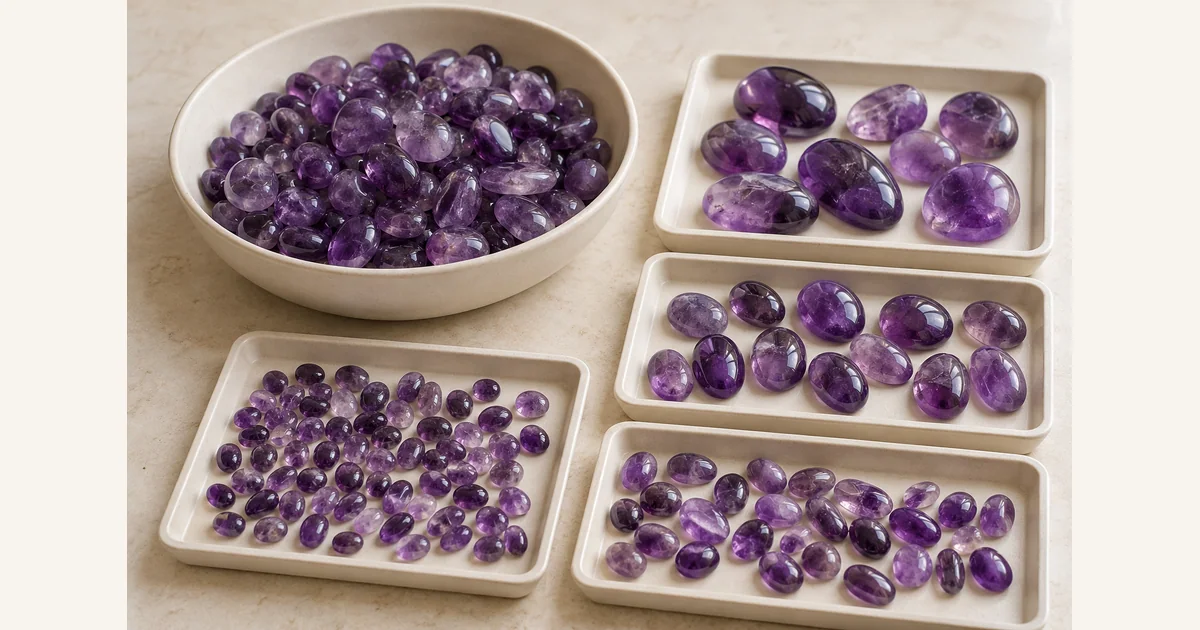
A loose tumbled-stone assortment, a fixed 16-stone Vastu reference kit and a Navagraha presentation set are not the same product. Begin with the end use, then create a bill of materials. Otherwise the final product is determined by whatever happened to arrive in the carton.
| Buying purpose | What must be specified | What usually matters most |
|---|---|---|
| Single-stone retail assortment | One named mineral or variety; piece-size range; count or net weight | Consistent identity, appeal and treatment disclosure |
| Colour-themed Vastu collection | Stone names, colour families and intended placement or purpose | Recognisable colours, thoughtful combination and readable labels |
| Eight-direction teaching kit | One or two stones per direction; exact zone chart; sufficient repeats | Complete eight-zone assortment without missing components |
| Five-element / Pancha Mahabhuta kit | Five designated element groups; product's own association guide | Coherent symbolism and distinguishable specimens |
| Navagraha / Jyotish reference set | Nine Graha names; gemstone correspondence; specimen identity | Correct labels and distinctions between demonstration and jewellery grades |
| Professional 16-stone reference kit | Exact 16-material list and one matched piece of each per kit | Completeness, repeatable sorting and documented substitutions |
Example: If you need 20 kits containing one amethyst, one rose quartz and one green aventurine each, ordering 60 assorted stones is risky. The supplier could send 40 rose quartz, 18 amethyst and only 2 aventurine. You need a per-material quantity, not just a total piece count.
2. Buying units: pieces, kilograms, mixed lots and matched kits
Wholesale quotations are commonly expressed by weight, count, size range or lot. These formats are not interchangeable. Ask whether weight means net gemstones only, whether packaging is excluded, and whether each piece is expected to fall within a size band.
| Quotation format | Advantage | Main risk | Best suited for |
|---|---|---|---|
| By net kilogram | Convenient for large stock quantities | Piece count varies with size and density | Loose display bowls and re-sorting stock |
| By fixed count | Easy to plan packaging and kit output | Weight and visual size may vary | Retail multipacks and workshop handouts |
| By size band | More consistent appearance | May not guarantee species mix or finish | Matched presentation trays |
| By named material | Clearer inventory and product descriptions | Commercial names may be ambiguous | Educational, Vastu and Jyotish kits |
| As a pre-packed kit | Fast assembly and easier counting | One wrong or absent stone can spoil the set | Ready-to-sell curated collections |
For repeat orders, agree to a sample or approved reference tray. Record the accepted size, appearance and treatment statement. “Same as photo” alone is not enough for natural gemstones because each piece differs in colour, banding and inclusions.
3. Match the stone to its Vastu or spiritual purpose
Traditionally, Vastu examines directional balance, spatial use, the Pancha Mahabhuta and the relationship between an occupant and a built environment. Gemstones are also used in contemporary Vastu-inspired, crystal and Jyotish practices. A useful collection explains the specific stone, its traditional or commonly adopted association, its intended role and its suggested use. It should not offer sixteen unlabelled colours as if they were interchangeable.
The following is a practical selection framework for bulk assortments. Associations differ by practice and should be kept consistent within the guide supplied with the kit.
| Stone / trade name | Commonly taught association | Where it fits in a collection | Buying check |
|---|---|---|---|
| Sphatik / Clear Quartz | Clarity, sattva, puja and meditation | General spiritual reference; centre or puja grouping | Check whether material is natural quartz, glass or another material |
| Amethyst | Calm, reflection and contemplation | Meditation, study and quiet spaces | Inspect zoning and colour variation |
| Rose Quartz | Affection, harmony and relationships | Family, relationship and bedroom-oriented sets | Expect natural variation in pink saturation |
| Green Aventurine | Growth, renewal and abundance intentions | Green/wood or prosperity-themed collections | Confirm the stone; avoid treating “green stone” as identification |
| Citrine / Yellow Quartz | Prosperity, enterprise and solar-colour symbolism | Office and business intention sets | Ask whether natural, heated or otherwise treated |
| Carnelian | Motivation, initiative and action | Activity-oriented and creative-work collections | Check dye or heat-enhancement disclosures |
| Red Jasper | Grounding, steadiness and earth symbolism | Stability-oriented Vastu collections | Verify jasper identity rather than a generic red pebble |
| Tiger Eye | Courage, confidence and practical focus | Professional, study or business sets | Look for its characteristic chatoyant effect |
| Black Tourmaline | Protection and boundary symbolism | Entrances and grounding-themed kits | Polished stones may show pits; inspect for cracks |
| Hematite | Stability, steadiness and grounded attention | Training and grounding kits | Distinguish mineral hematite from marketed substitutes |
| Lapis Lazuli | Wisdom and thoughtful communication | Learning and traditional planetary study | Check whether dyed material is being substituted |
| Moonstone | Chandra / lunar symbolism and emotional sensitivity | Jyotish demonstration and lunar-themed sets | Confirm actual stone type and optical effect |
Important kit-design choice: A Navaratna ring, a Navagraha educational tray and a mixed tumbled-stone Vastu kit have different aims. Do not promise that a low-cost tumbled sample is equivalent to a jewellery-grade astrological gemstone. A reference kit may teach the names and associations; a chart-based gemstone recommendation is a separate selection process.
4. Build the bill of materials: a worked 16-stone professional kit
Suppose a Vastu practitioner wants 20 professional reference kits with 16 different specimens in each. A sample list could comprise Sphatik, Amethyst, Rose Quartz, Green Aventurine, Citrine, Carnelian, Red Jasper, Tiger Eye, Black Tourmaline, Hematite, Lapis Lazuli, Moonstone, Amazonite, Sodalite, Fluorite and Yellow Jasper. This is an illustrative contemporary professional assortment, not a fixed classical prescription.
The requirement is 20 acceptable pieces of every named material, or 320 accepted stones overall. If you expect losses from chips, weak identification or size mismatch, order a modest contingency for each material. For example, purchasing 22 pieces of each would provide 352 pieces in total, but still inspect every material separately: a surplus of amethyst does not compensate for missing moonstone.
Specify the intended size, such as a supplier-agreed approximate 20–30 mm length band, but do not equate length with equal weight. Dense hematite pieces and lower-density quartz pieces can differ substantially at the same dimensions. The receiving checklist should show ordered / received / accepted / reserved / rejected counts for every stone.
5. Recognise the difference between stone names, trade names and treatments
A bulk-buying specification must name what the supplier is selling. “Green crystal,” “yellow prosperity stone” and “turquoise-colour stone” describe appearance, not necessarily mineral identity. A blue-dyed howlite piece is not the same material as natural turquoise. “Citrine” in wholesale assortments may describe yellow quartz produced or enhanced by heat treatment; the supplier should state the treatment category that applies to the lot.
When comparing quotations, request written information for the actual batch rather than relying on a catalogue description. Natural gemstones vary, treatments occur in the trade, and a high-resolution photograph cannot by itself establish origin or treatment. This is why professional identification examines optical and physical properties in addition to appearance.
| Supplier statement | Question to ask before purchase |
|---|---|
| “Natural stone” | Which mineral or rock is it? Any dye, heat, coating, resin or other enhancement? |
| “AAA quality” | What written size, colour, polish and defect criteria does that grade represent? |
| “Mixed semi-precious stones” | Which species are included, and in what minimum quantities? |
| “Exact kit of 16” | Are all 16 materials present in every box, with a per-stone list? |
| “Gemstone certification” | Does a report identify the exact delivered lot or merely a sample? |
| “Same as sample” | What differences in size, finish, colour and inclusions are acceptable? |
Where origin, treatment or identity is central to a premium product, obtain suitably specific supporting documentation and keep the batch identifier with the stock. For low-cost teaching kits, honest identification and a clear statement of what the specimens represent are more useful than vague premium grades.
6. Set acceptance rules before ordering
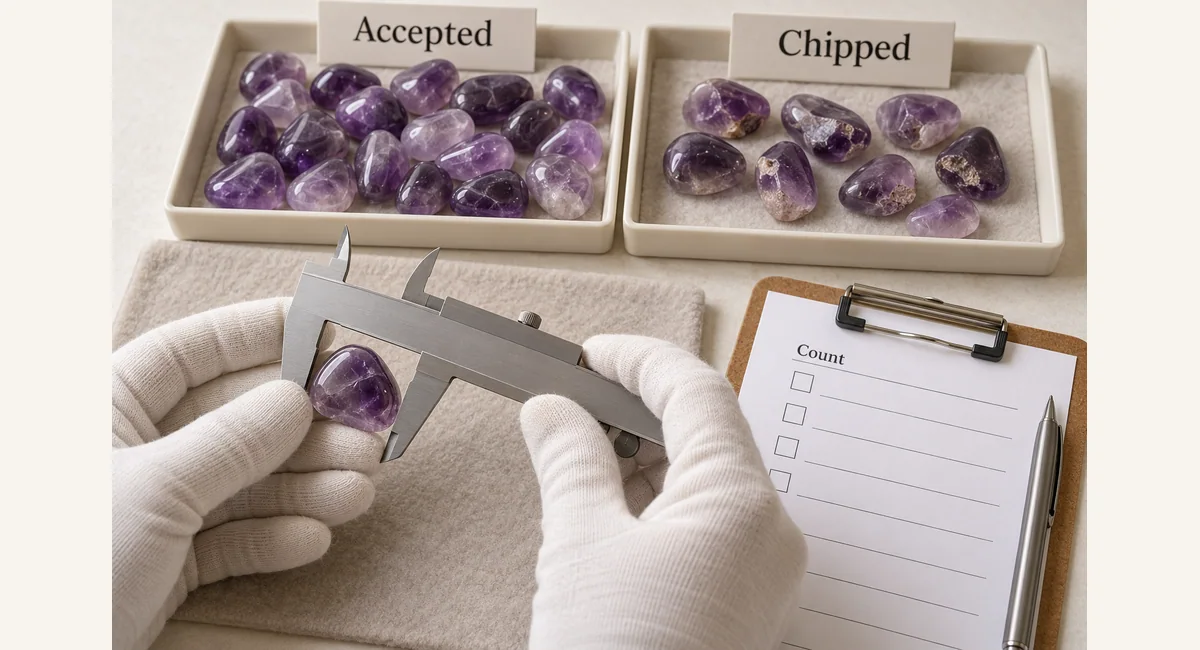
Bulk purchasing becomes predictable only when buyer and supplier agree what counts as an acceptable piece. For a consumer-ready professional kit, the acceptance standard may be stricter than for a loose decorative mixed bag. Write the tolerances into the order so both sides know what to inspect.
- Identity: correct named species or agreed variety; no unapproved substitutions.
- Completeness: all required materials present in each set; a missing material means an incomplete set.
- Size: stated measurement band and acceptable variation for the application.
- Condition: no sharp edges, loose fragments or open fractures that make the piece unsuitable for its intended use.
- Polish: sufficient to show the material's characteristic appearance; not necessarily identical shine across all minerals.
- Colour: the supplier's actual range, with natural zoning and banding understood.
- Treatment: correct description of dyes, coatings, resins or heating where known.
- Packaging: each material labelled and isolated sufficiently to reduce transit damage.
Example receiving decision: You order 100 rose quartz pieces of an agreed size. On receipt, 92 meet the standard, five are too small and three have unacceptable chips. Record 92 accepted pieces, eight exceptions and photographic evidence. The commercial outcome—replacement, credit or regrading—should follow the agreed purchase terms, not an invented industry-wide rejection percentage.
7. Calculate the real cost of usable stones
Bulk prices should be compared using usable cost, not simply supplier price per kilogram. The delivered cost includes merchandise, shipping, taxes or other charges, sorting labour, packaging and the cost of pieces rejected or unsuitable for your intended product. Taxes should be calculated according to the actual invoice and business circumstances.
Illustrative calculation (not a market quotation): A mixed lot costs ₹7,000, delivery costs ₹850 and the batch contains 240 stones. After sorting, 216 are suitable. Labelling and packaging cost ₹18 per accepted piece and handling costs ₹12 per accepted piece. Total allocated cost is ₹7,000 + ₹850 + (216 × ₹18) + (216 × ₹12) = ₹14,330. The cost per accepted piece is approximately ₹66.34 before any additional applicable expenses. The simple purchase-cost calculation of ₹7,000 ÷ 240 = ₹29.17 per piece would greatly understate the cost of preparing a sale-ready item.
For a 16-stone kit, the true number of complete kits is limited by whichever named material has the fewest accepted pieces. If each of 15 varieties has 20 acceptable stones but one has only 14, you can assemble only 14 complete kits until that shortage is addressed.
8. A step-by-step receiving inspection
- Record the shipment: note invoice, supplier, date, batch reference, total packages and received quantities.
- Open one material at a time: prevent mixing before identification and count.
- Compare the approved reference: check stone name, size band, finish and colour range against the written specification.
- Separate exceptions: place chipped, wrongly labelled and size-mismatched specimens in clearly marked trays.
- Check treatments and labels: align the supplier's written description with your eventual product description.
- Count kit-ready pieces by material: use the lowest accepted material count to calculate assembly capacity.
- Photograph representative specimens: keep a visual record for repeat supply and dispute resolution.
- Allocate stock: distinguish retail pieces, professional teaching specimens, reserves and rejects.
9. Example: buying for a Vastu consultation practice
A practitioner preparing eight-direction teaching trays should decide the meaning of the layout before buying. In a typical classroom demonstration, the Ashta Dikpalas provide an established directional framework: East–Indra, Southeast–Agni, South–Yama, Southwest–Nirriti, West–Varuna, Northwest–Vayu, North–Kubera and Northeast–Ishana. The selected gemstone for each zone can then reflect the practitioner's documented Vastu or crystal-therapy approach.
For example, a teaching tray might use warm red/orange specimens to discuss Agni in the southeast, green stones to discuss growth or enterprise-oriented symbolism in the north, and a Sphatik specimen in the northeast for puja or clarity symbolism. These are interpretive gemstone choices within a teaching system, not an instruction to buy any red or green pebble and label it as a prescribed remedy.
Order each stone variety independently and prepare a printed layout key. If a supplier substitutes dyed glass for Sphatik or an unnamed yellow stone for citrine, the teaching content and inventory label no longer match. Material integrity matters as much as attractive packaging.
10. Example: buying for a retail jewellery showroom
A Bengaluru jewellery showroom may wish to offer small ready-made gemstone arrangements for desks, cash counters or home puja spaces. It might stock a prosperity-themed set with green aventurine, citrine and tiger eye; a relationship-themed set with rose quartz and amethyst; and a grounding-themed set with red jasper, hematite and black tourmaline.
In this case, the buyer needs consistent presentation across repeat cartons, clear wording explaining the traditional or contemporary associations, and a known replacement path for each component. Different material costs should not be hidden inside an ambiguous “mixed crystals” price. The sale label should accurately describe the contents and any treatment information supplied.
11. Example: buying for a workshop or housewarming kit
For a 30-person Vastu workshop, the organizer may need one compact five-element selection per attendee. First decide which five named stones illustrate Prithvi, Jala, Agni, Vayu and Akasha within the chosen teaching method. Then order at least 30 acceptable pieces of each designated stone, plus practical reserves for losses. A generic 150-piece assorted parcel cannot ensure 30 complete five-element sets.
Give attendees a small card showing stone identity, element association, intended symbolic meaning and a simple method of arranging or remembering the five components. This makes the kit educational and usable after the workshop rather than a bag of anonymous coloured pebbles.
12. Questions to send the wholesale supplier
A clear enquiry produces more comparable quotations. Adapt the following as a purchase specification:
We require a tumbled-stone lot for named gemstone/Vastu reference sets. Please quote by material and accepted piece count, with stone names, approximate size range, natural variation expected, known treatments, photographs of the actual batch or an approved reference sample, packing method, lead time, shipping charges, replacement/shortage policy and applicable taxes. Where a material is unavailable, please list the proposed substitution separately for approval; do not substitute automatically.
Ask for two prices where useful: loose, identified stones and the same stones individually sorted and labelled. The difference reveals the cost of the supplier's preparation work and helps you decide what to do in-house.
13. Storage, replenishment and the next purchase
Keep accepted stones in labelled compartments rather than mixing them into a single container after inspection. The label should record the material, batch, accepted size range and supplier. Store especially delicate, soft or coated stones separately and follow care suitable for that material. A replenishment sheet should show the number of pieces required for the next 10, 20 or 50 complete sets and highlight the limiting materials.
When a customer buys a professional reference kit, a consistent inventory card can describe the 16 stones and their Vastu, Navagraha or chakra context. When one stone must be replaced later, the team can identify the correct material and reasonable size band without reconstructing the whole purchase history.
Frequently asked questions
Is buying tumbled stones by kilogram cheaper than buying by piece?
It can be cheaper for bulk stock, but only after allowing for actual accepted piece count, sorting, packaging and rejects. A kilogram of larger or denser specimens may contain fewer usable pieces than expected.
How many stones should I order for twenty 16-stone kits?
You need at least 20 acceptable pieces of each of the 16 named materials, not merely 320 arbitrary stones. Add a small per-material reserve based on supplier consistency and your quality standard.
Can I use an inexpensive mixed lot for an astrology kit?
For informal colour demonstration it may be useful. For a labelled Navagraha or Jyotish reference kit, identify the specific nine gemstones and explain the difference between teaching specimens and gemstones chosen for personal astrological wearing.
What if the supplier calls every stone “AAA”?
Ask for the actual inspection specification. There is no single universal AAA grade that conveys equal meaning across all tumbled-stone materials and suppliers.
Are dyed or heat-treated stones always unsuitable?
Not necessarily. Their suitability depends on the product's intended description, customer expectation and correct disclosure. Never treat colour alone as proof of a mineral's identity.
Does an eight-direction Vastu kit require one fixed gemstone list?
The directional framework has traditional names and guardians; gemstone lists vary across contemporary practices. The accompanying teaching material should explain the chosen mapping clearly and consistently.
What should I do when a stone variety is unavailable?
Keep the set composition stable or explicitly revise it and its documentation. Substituting an unrelated stone without changing the label weakens the quality of a professional reference product.
Continue reading
- Single Stones, Multipacks and Mixed Sets Compared
- Tumbled Stone Sizes, Weights and Quality Grades
- How to Pack and Ship Tumbled Stone Sets Safely
Explore the existing Vastu and gemstone collections for wider context.