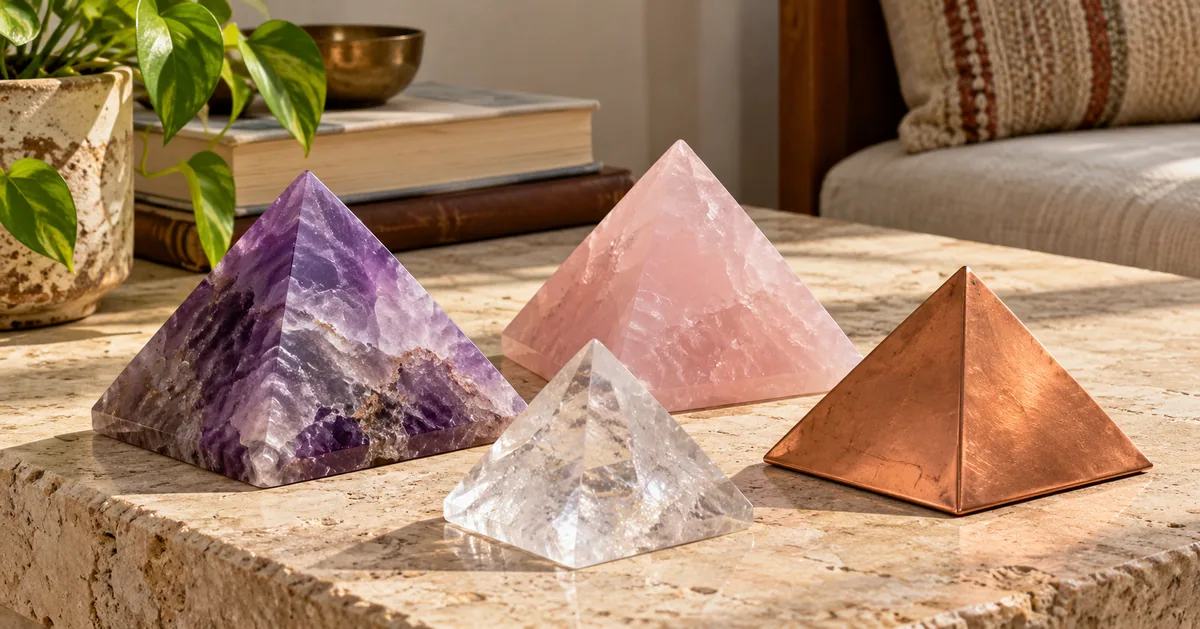
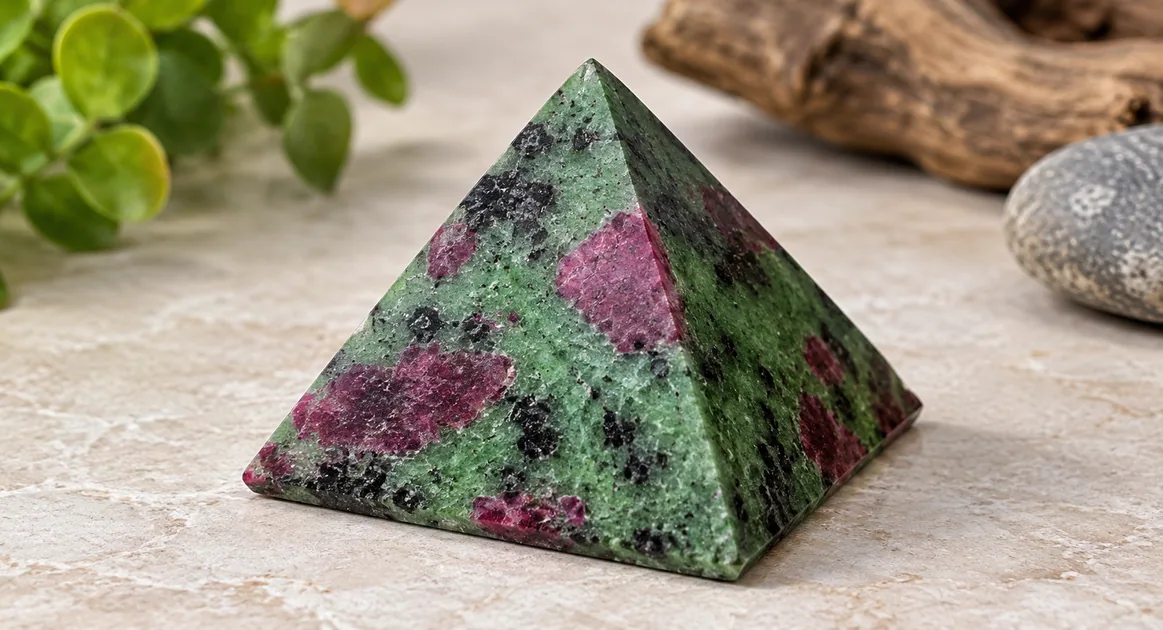
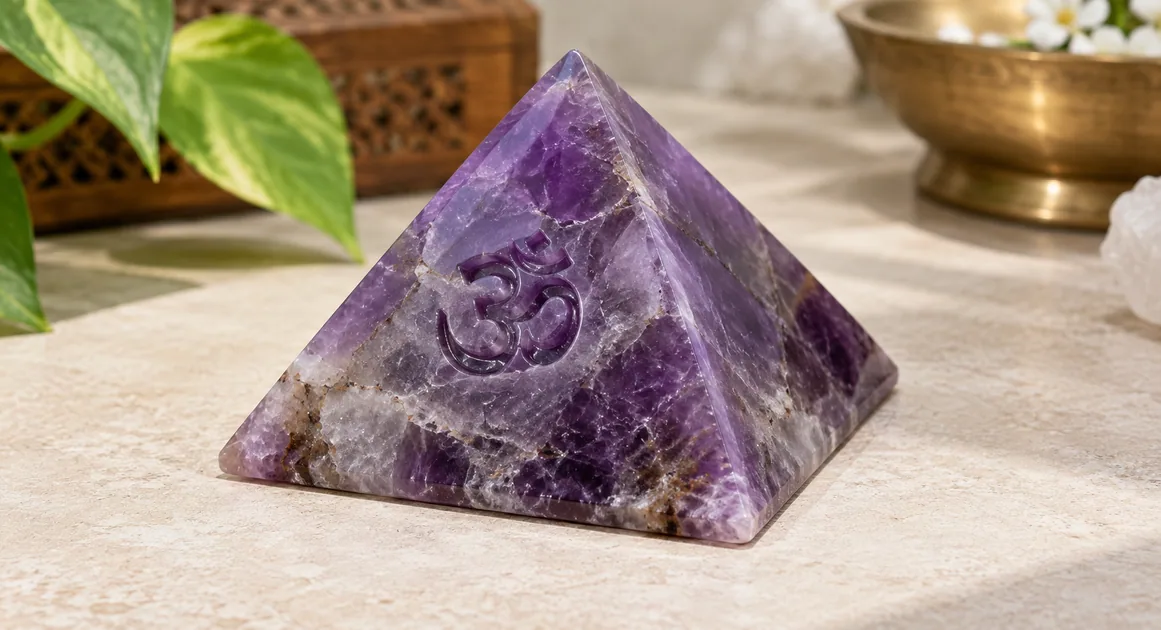
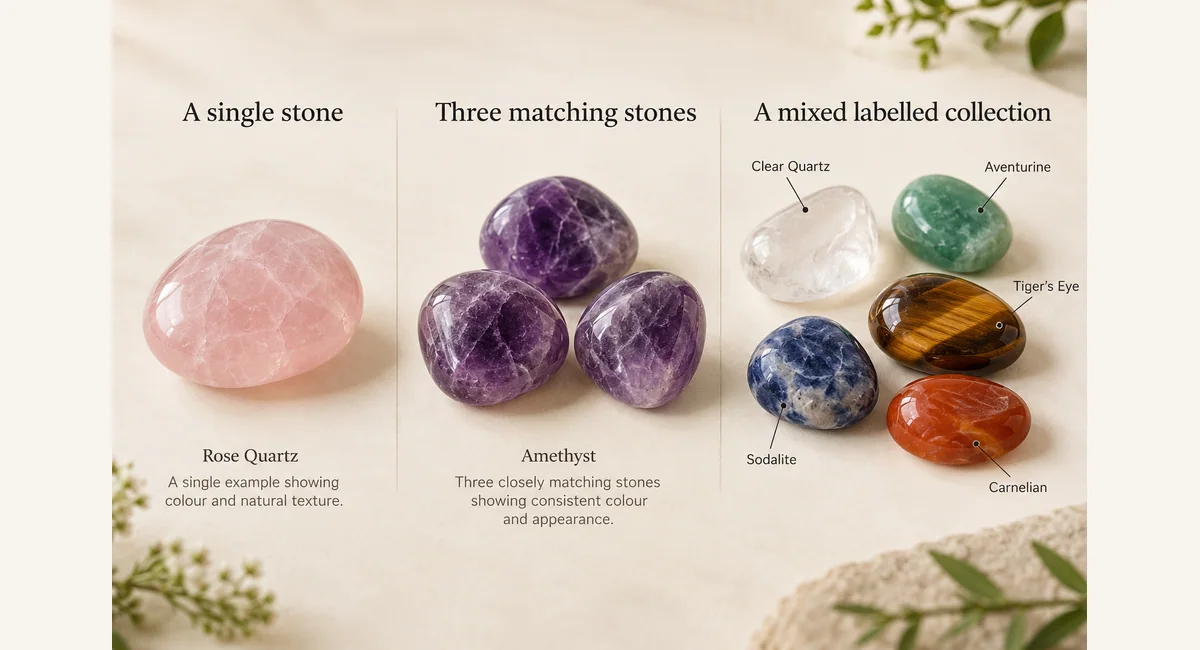
Should you buy one tumbled gemstone, three matching stones, or an entire mixed crystal set? The answer depends on what the stones must accomplish. A single piece is ideal when you want to inspect a mineral, place a gemstone in a small spiritual corner or choose a specific gift. Matching multipacks serve symmetrical Vastu displays, repeated classroom exercises and uniform jewellery or decorative arrangements. Mixed sets are most useful when the purpose is learning, comparing mineral varieties, creating a seven-chakra collection or preparing a professional eight-direction Vastu demonstration kit. Count, material identity, treatment, size and the function of the packaging matter more than the attractive word “collection” on a listing.
This guide explains the differences among single tumbled stones, gemstone multipacks, assorted crystal packs, labelled reference kits and intention-based sets. It also shows how to calculate the actual price per usable stone, how to specify a repeatable assortment and how to select a set for a home, showroom, Vastu practitioner or traditional spiritual practice. Each example names what is being purchased, so a reader can decide whether to order one specimen, several matching stones or a structured set rather than accumulating overlapping products.
1. Understand the five offers before comparing prices
Retail descriptions sometimes use “set,” “pack,” “kit,” “assortment” and “collection” interchangeably, even though they describe quite different products. Start with the number and identity of stones, not the quantity printed on the front of the box.
| Offer | What a buyer receives | Strongest use | What must be disclosed |
|---|---|---|---|
| Single gemstone | One individual stone, identified by material and size band | Personal selection, gifting or checking a mineral before buying more | Actual specimen versus representative image; dimensions or weight; treatment |
| Matching multipack | Three, five, ten or another fixed number of the same named material | Repeat placements, balanced layouts, workshop quantities | Exact count, acceptable colour and size variation, piece replacement policy |
| Mixed loose assortment | Several materials or colours in a pouch, sometimes sold by net weight | Exploratory collecting or casual decorative use | Guaranteed varieties or lack of guarantee; approximate count; possible duplicates |
| Named purpose set | Specified stones arranged around a purpose such as chakra study or desk display | Ready-to-use meditation, classroom or Vastu themes | Each stone name, quantity, intended layout and whether alternatives may be substituted |
| Professional reference kit | Identified specimens, labels, compartments, layout sheet and inventory list | Teaching, consultation and repeat demonstrations | Exact inventory, identification standard, materials, replaceability and storage method |
A matched five-pack of rose quartz is not equivalent to a five-material quartz-family study set. One contains five pieces of the same variety; the other contains five distinct references. Nor is a 100 g mixed packet automatically a ten-piece pack: large stones, differences in mineral density and natural variation affect the number of pieces. Ask the seller to define the offer in ordinary words before paying.
2. When a single stone is the right purchase
A single tumbled gemstone is valuable because you can pay attention to one particular mineral. For instance, clear quartz or Sphatik has a longstanding place in Indian spiritual material culture, whereas rose quartz has become popular in contemporary meditation and heart-centred arrangements. If you intend to keep one tumbled piece beside a book, in a small tray or in a private prayer space, a full mixed assortment may bring little additional value. Choose one stone with an appropriate size, visible finish and clear identity rather than buying a pack merely to reduce the price per piece.
For a personal stone, inspect the actual specimen when available. Notice the overall colour, natural patterns, polish, fractures, chips and suitability for carrying or displaying. A tiger eye pebble may show a moving band of light, called chatoyancy, that changes with orientation; two pieces of the same size can look quite different. An agate may carry distinctive banding, while a red jasper may be comparatively opaque and uniform. The listing should identify the mineral instead of relying on the colour alone.
Buy one first when a stone is unfamiliar, when a child or new collector wants an educational specimen, when you need to confirm a matching colour for an existing display, or when you are comparing a new supplier. A sample purchase is especially helpful for treated or dyed goods because online photographs cannot establish treatment history. Request any known treatment disclosure and correct material naming before a bulk order; dyed howlite, for example, must not be presented as natural turquoise.
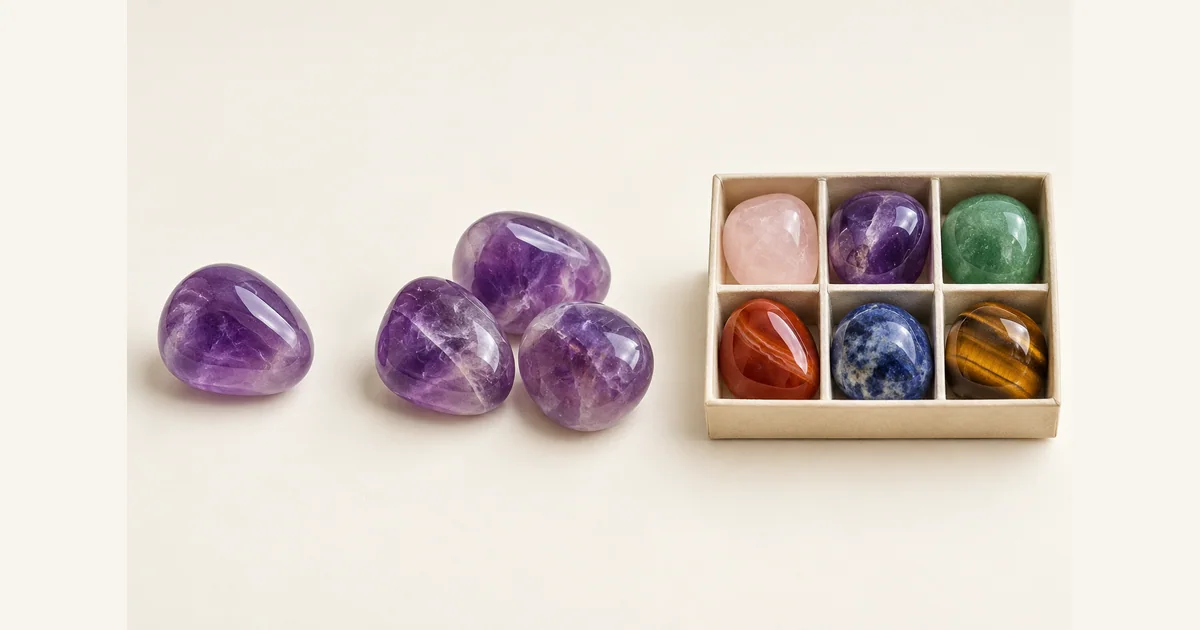
3. What counts as a genuine matching multipack?
A matching pack contains a fixed number of pieces of one stated material, usually selected within a defined range for length, weight or visual appearance. It does not require absolutely identical stones: natural minerals commonly show different inclusions, bands, colours and outlines. But “natural variation” should not excuse receiving fewer pieces, the wrong mineral or a grade completely different from the description. For a symmetrical arrangement, ask whether the seller will select pieces of approximately comparable size. If your aim is classroom comparison, some visible variation within one mineral is actually useful.
Three, five and ten-piece variants work well as quantity options on an existing product page. A product should tell you whether the quantity is selected by the customer, whether the pieces are randomly picked or individually matched, and how an unavailable size is handled. If the seller offers several diameter bands, such as approximately 18–25 mm and 25–35 mm, the variation should be explained in millimetres rather than by unsupported “large” and “premium” labels. Tumbled stones have irregular outlines, so a size range is usually more meaningful than a single exact measurement.
Choose multipacks for a repeated line of stones along a display shelf, several study desks, identical lesson stations, replacing used samples in a Vastu consultant's case or a showroom arrangement that needs balanced visual rhythm. A pack of three tiger eye stones may be placed in three separate decorative settings; a set of ten clear quartz pieces can supply a group workshop. If all ten pieces need to look closely alike for a photographed display, request matched photographs or a written matching tolerance; a random ten-pack is not sufficient evidence.
Matching does not mean the same treatment history
Matching by colour is not matching by material. Blue-dyed howlite, lapis lazuli and sodalite may all read as “blue stones” at a glance but differ chemically, in structure, value and care needs. Similarly, green aventurine, dyed agate and serpentine should not be bundled under “green jade” unless their identities have been established. A professional pack should identify each material accurately and state any known colour treatments. Lapidary polishing and shaping are normal manufacturing steps; heating, dyeing, coating or impregnation may require separate disclosure.
4. Mixed sets: diversity must be specified, not assumed
A mixed tumbled-stone set is attractive because it introduces multiple minerals in one purchase. However, two packages labelled “mixed gemstones” may be entirely different. A seller may supply ten individually named materials with one of each; another may provide a random mix of quartz, agate and dyed stones by the kilogram. Both can be legitimate offers if clearly described, but only the first is suited to a reference collection when each identity matters. A bag of ten stones may include six varieties and four duplicates unless a minimum number of distinct materials is guaranteed.
For a learning set, the simplest standard is a named inventory with stone, count, specimen size, known treatment and replacement rule. An unlabelled mixture can be enjoyable as a gift, yet it requires extra identification work before being used to explain gemstone properties or traditional correspondences. A partitioned box helps protect the identification process: the label should travel with the specific specimen, not merely be printed on a general leaflet that can be separated from the stones.
| Example mixed set | Recommended inventory rule | Why it is useful | Potential misunderstanding |
|---|---|---|---|
| Quartz family teaching set | One each of clear quartz, rose quartz, amethyst, citrine, smoky quartz; specify treatment where known | Compare related varieties and colour effects | Not every commercial citrine is naturally coloured |
| Agate and jasper study set | Named agate and jasper varieties with labels; avoid unknown “assorted agate” substitutions | Contrast chalcedony patterns and opaque material | Commercial varieties are not all separate mineral species |
| Seven-chakra set | Seven identified stones, one for each named chakra in the supplied modern layout | Meditation and chakra symbolism | Many alternative stones are marketed for each chakra |
| Eight-direction Vastu set | Eight labelled positions, one or two identified stones per direction | Teach directional arrangements on a compass-labelled plan | The gemstone-to-direction mapping is not a single universal ancient rule |
| Black gemstone comparison set | Black tourmaline, obsidian, black onyx and hematite named separately | Distinguish appearances and material families | Not every black polished pebble is tourmaline or onyx |
Mixed collections should also disclose whether the tray, fabric pouch, reference cards and compartments are included. Those components can make a professional kit meaningfully more useful, but they are not gemstones and should not be counted toward the number of stones. A “15-piece kit” that contains ten pebbles, three cards, a pouch and a box is different from a kit containing 15 gemstones.
5. Selecting tumbled stones through Vastu principles
Vastu Shastra begins with the arrangement and use of space. Its directional language includes Ishanya (northeast), Agneya (southeast), Nairrtya (southwest) and Vayavya (northwest), together with the cardinal directions and the central Brahmasthana. The Pancha Mahabhuta—Prithvi, Jala, Agni, Vayu and Akasha—offer a traditional vocabulary for earth, water, fire, air and space. Tumbled-stone trays use those themes to organise contemporary gemstone displays and teaching demonstrations. They do not replace the fundamentals of room function, movement, cleanliness, light or orientation.
When choosing between a single stone and a set, begin with the space and the purpose. An unobtrusive single Sphatik piece may fit a modest meditation shelf. A matching trio can provide a coherent decorative display on a console. A full directional kit makes sense only when the practitioner needs to show eight distinct compass zones on a floor plan or portable tray. Purchasing eight stones merely because a room has eight directions does not automatically give each stone a traditional prescription.
Illustrative 16-stone eight-direction Vastu teaching tray
This example uses two identified stones per direction, making 8 × 2 = 16 pieces. It is a modern instructional arrangement using common colour, elemental and gemstone associations; it is not a rule that every home must follow. Label the compass points accurately and add the corresponding Sanskrit direction names. The centre may remain clear so that the Brahmasthana can be discussed independently from the specimens.
| Direction | Stone pair (2 pieces) | Display theme | Teaching note |
|---|---|---|---|
| North — Uttara | Green aventurine + pyrite | Growth, work and resources | Associations popular in contemporary gemstone displays; identify pyrite correctly and store it dry |
| Northeast — Ishanya | Clear quartz + amethyst | Stillness, study and worship | Discuss Sphatik separately from modern amethyst meditation associations |
| East — Purva | Moss agate + green aventurine | Freshness and learning | Recognise moss agate as chalcedony with inclusions, not a true plant |
| Southeast — Agneya | Carnelian + red jasper | Agni, activity and initiative | Use warm colours as a visual teaching aid |
| South — Dakshina | Red jasper + tiger eye | Strength and purposeful action | Show opaque jasper beside chatoyant tiger eye |
| Southwest — Nairrtya | Smoky quartz + black tourmaline | Steadiness and grounding | Keep the specimens safely within a shallow tray |
| West — Paschima | Sodalite + lapis lazuli | Reflection and learning | Compare blue appearances without equating mineral identities |
| Northwest — Vayavya | Howlite + moonstone | Movement, change and calm presentation | Label natural howlite and genuine feldspar moonstone distinctly |
Because several materials repeat, the physical inventory here comprises 16 pieces but fewer than 16 distinct stone types. That is a deliberate demonstration of the difference between piece count and variety count. If a client needs one stone in each of eight directions rather than 16, make a smaller fixed set and do not advertise the larger inventory. For a professional consultation, the eight-direction tray should include a compass illustration, material labels and a brief explanation of which associations are classical Vastu terminology and which belong to contemporary gemstone practice.
6. Chakra, Navagraha and devotional sets are three different categories
Not every spiritually named assortment follows the same knowledge system. A seven-chakra set, a Navagraha set and a Vastu directional kit all use stones but organise them around different ideas. Chakra discussions commonly refer to Muladhara, Svadhishthana, Manipura, Anahata, Vishuddha, Ajna and Sahasrara. Modern sellers often select seven tumbled stones in a rainbow-like progression, yet the exact mineral correspondence varies across schools and product ranges. A clear label should identify the stones supplied rather than implying there is only one established seven-stone list.
In Jyotisha, the classical Navaratna correspondences are ruby for Surya, pearl for Chandra, red coral for Mangala, emerald for Budha, yellow sapphire for Guru, diamond for Shukra, blue sapphire for Shani, hessonite for Rahu and cat's-eye chrysoberyl for Ketu. In a casual mixed-tumble collection, similar colours or less expensive decorative minerals cannot silently replace those materials and still be sold as an equivalent traditional Navaratna set. For example, blue sodalite is not blue sapphire, and red jasper is not red coral.
A devotional Sphatik item may instead be selected for its connection with crystal objects used in worship, with appropriate personal practice and established household customs. Such a single-object purchase does not require the buyer to order an arbitrary matching chakra or planetary pack. Keeping these categories clearly separated improves both spiritual accuracy and customer confidence.
| Spiritual or educational purpose | Quantity approach | Correct specification | Do not imply |
|---|---|---|---|
| Single meditation or puja display | One clearly named piece | Material, size and intended display location | That buying more pieces is intrinsically more effective |
| Seven-chakra teaching set | Seven named pieces | Seven chakra labels and the particular chosen gemstone mapping | All schools use exactly the same gems |
| Eight-direction Vastu kit | Eight or 16 pieces | Compass labels, stone inventory and layout diagram | Modern tumbled-stone choices are mandatory Vastu rules |
| Traditional Navaratna collection | Nine specified gemstone categories | Accurate Navaratna identities and relevant quality information | Colour-matched tumbled substitutes are the same gems |
| Material identification lesson | As many distinct specimens as the syllabus requires | Species/variety, known treatments, examples and labels | More pieces automatically mean greater mineral diversity |
7. Use a clear price-per-stone calculation
The cheapest-looking packet can be expensive when it contains duplicates you cannot use. Conversely, the price per piece of a carefully curated labelled assortment can be higher because the package supplies different minerals, compartments and instructional information. Calculate the delivered cost per usable stone instead of comparing the printed count alone. This is a worked illustration, not a current OmmRudraksha price list.
| Illustrative offer | Gemstone count | Delivered price | Arithmetic | Price per stone |
|---|---|---|---|---|
| Six individual stones | 6 | ₹900 | ₹900 ÷ 6 | ₹150 |
| Matching six-pack | 6 | ₹720 | ₹720 ÷ 6 | ₹120 |
| Eight-variety mixed study kit | 8 | ₹1,200 | ₹1,200 ÷ 8 | ₹150 |
| Weight-based assorted bag | Not fixed | ₹850 | Cannot determine until count is known | Not stated |
In this example the matching six-pack saves ₹180 relative to buying six singles, but the saving is useful only if you actually need six of the same material and accept the seller's selection. The eight-variety kit has a higher total price because it addresses a different purpose. If two of its stones are unsuitable duplicates for the intended lesson, the useful price per stone becomes ₹1,200 ÷ 6 = ₹200. And if a courier charge, packaging fee or tax is excluded from a headline price, include it before calculating. The true comparison is the complete delivered offer, including returns and damaged-piece replacement terms.
When checking bulk packs, ask whether the sale is by piece, fixed weight, mixed weight or minimum guaranteed count. A 250 g assortment is not a 25-piece assortment. Dense hematite or pyrite contributes more mass than a similarly sized low-density piece, while larger pebbles reduce the number of pieces per bag. A supplier who promises a minimum number of distinct varieties should list that figure separately from total weight.
8. Quantity planning for home, gift and professional kits
A practical method is to define the final arrangement before choosing the pack size. Draw the shelf, desk or tray to scale; mark where each stone will sit, and count those positions. Allow a small margin only for pieces that must be handled repeatedly or if the supplier's replacement lead time is long. Do not order a large random mix hoping that it will happen to contain the exact specimens needed for a structured set.
| Situation | Useful buying format | Example inventory | Reason |
|---|---|---|---|
| Small home meditation space | One to three individual stones | One clear quartz, one optional amethyst, one optional rose quartz | Modest display with clear identity and simple care |
| Housewarming or personal gift | Named small mixed set | Three to five labelled stones plus a short material card | Recipient can identify and use every piece |
| Office reception or desk display | Matching trio or themed four-piece set | One tiger eye, one green aventurine and one clear quartz, or three matched stones | Defined layout and coherent appearance |
| Eight-direction Vastu workshop | Purpose-built 16-piece kit | Two identified stones per direction, eight compass labels | Repeatable teaching demonstration |
| Professional mineral comparison | Compartmented mixed reference set | Named minerals, treatment notes and stock codes | Restocking and identification accuracy |
9. Real-world example: a Bengaluru apartment
Consider a family setting aside a narrow shelf for personal prayers and a separate study desk. The goal is not to cover every wall with gemstones. The family chooses one identified clear quartz piece for the spiritual shelf and one small, labelled amethyst for a private meditation corner. That is a two-single-stone purchase; it avoids paying for an assorted pack containing materials the family will not display. The available space, heat from lamps, tendency of stones to roll and ease of cleaning matter more than an arbitrary set size.
Later, if the family wants to learn how Vastu compass zones are named, a small eight-direction learning tray is a separate educational purchase. It should not be confused with remedial alterations to building layout. A good guide can explain Ishanya, Agneya, Nairrtya and Vayavya while indicating that the particular tumbled-stone colours selected for the demonstration are contemporary illustrative choices. This makes the added purchase meaningful rather than a redundant accumulation of pebbles.
10. Real-world example: jewellery showroom and gifting
Imagine a Bengaluru jewellery showroom displaying coloured tumbled stones next to gemstone bracelets. Customers frequently confuse black tourmaline, onyx, obsidian and hematite, or blue sodalite and lapis lazuli. The shop should buy one well-identified specimen of each relevant material for its comparison desk, instead of one hundred assorted black stones whose identities cannot be demonstrated. A neat tray, identification cards and recorded stock codes support better customer conversations.
Gift packs have a different specification. A five-stone introductory set might include rose quartz, amethyst, tiger eye, carnelian and green aventurine, each labelled. The box can explain the cultural or contemporary symbolism and care needs of each stone without pretending it is a strict Navaratna set. If a buyer wants five matching rose quartz stones for wedding favours, that becomes a separate fixed-count pack of one mineral, not the five-material gift product. The product name should make the difference visible before the buyer reaches the checkout.
11. Real-world example: a professional Vastu consultation kit
A Vastu consultant may need to visit different properties, show the same teaching arrangement at every session and replace a specimen when it becomes lost or chipped. A professional 16-piece kit should therefore have a labelled compartment map, a fixed inventory, recorded material names and a simple ordering reference for each replacement. The consultant can photograph the set before leaving the shop and check each compartment after a session. Replacements should match the material and approximate size; the availability of identical natural patterns should never be guaranteed.
For a demonstration kit, a matching pack of four carnelian stones can be useful as an internal replenishment supply, while a mixed reference box remains the main product. These are complementary purchases. A supplier can maintain the same stone SKU across a single piece, multipack and larger set without presenting three different names for the same physical material. Replacement details should state whether the customer can reorder one missing stone or must purchase the entire box again.
12. Identity, colour treatment and material quality
Whether purchasing a single or a hundred stones, identify the material correctly. The commercial names “green jade,” “turquoise stone,” “black onyx” and “citrine” may be used inconsistently across the market. Nephrite and jadeite are both genuine jade materials, but dyed serpentine or green aventurine should not be called genuine jade. Dyed howlite is not naturally coloured turquoise. Commercial citrine may be heat-treated amethyst or other quartz; the description should distinguish what is known. A single low-cost tumbled pebble rarely justifies an individual laboratory report, but that does not remove the seller's responsibility to describe it accurately and disclose known treatments.
Examine polish under ordinary daylight. Natural inclusions are expected in many stones; sharp edges, unstable cracks, chips and severe pitting may make a pebble unsuitable for frequent handling or a premium display. Different minerals vary in hardness and care needs. Keep easily scratched or moisture-sensitive material in individual compartments, and do not put every mixed specimen through the same water, salt or cleaning routine. For example, pyrite benefits from dry storage, while soft or porous materials may be damaged by unsuitable soaking.
Before ordering a multipack for business use, obtain a sample from the same supply lot when possible. Compare the sample with the final lot for material appearance, dimensions, polish and packaging. A buyer of twelve identical teaching trays should not assume that the unlabelled stones delivered across separate shipments will always come from the same lot or look identical.
13. What every product description should show
A clear listing answers a prospective buyer's questions before checkout: What is it? How many actual gemstones are there? Is the photograph of the exact goods or a representative example? What does the buyer receive besides the stones? Are substitutions possible? What known treatments or fragility considerations affect the materials? The label “natural” by itself does not tell the reader whether a gemstone has been dyed, heated or otherwise enhanced.
| Listing field | Single stone | Matching multipack | Mixed professional set |
|---|---|---|---|
| Material | One named material or variety | One stated material for every piece | Itemised material for each compartment |
| Quantity | Exactly one stone | Exact number of gemstones | Total count and distinct-variety count |
| Size / weight | Actual or stated tolerance | Piece range and optional total net weight | Individual or group ranges; no ambiguous total-only size |
| Known treatments | Disclosure for the individual material | Disclosure for the lot where known | Per-material notes when relevant |
| Image policy | Exact-item photo or representative notice | Representative pieces plus matching tolerance | Actual type inventory and layout photograph |
| Included accessories | Pouch or no accessory specified | Clearly stated packing | Tray, labels, cards, dividers and inventory sheet |
| Replacement terms | Wrong-item or damage procedure | Count shortage and damaged-piece procedure | Individual replacement and possible alternatives |
It also helps if the site distinguishes product options from fundamentally different products. Buying one, three or ten of the same named rose quartz stone can be a quantity option. A rose quartz single, seven-chakra assortment, eight-direction tray and professional identification kit are substantively different products, each needing its own accurate contents, instructions and relevant articles. This avoids multiple near-identical pages that provide little extra information.
14. Checklist for choosing the right format
- State the purpose: one personal specimen, repeated display, gifting, chakra demonstration, directional Vastu training or mineral identification.
- Specify the units: number of stones, number of distinct materials, size bands and net stone weight; do not count cards or boxes as stones.
- Check identities: ask for named minerals and known treatments; avoid descriptions based only on colour.
- Calculate delivered value: count shipping and accessories, divide by the number of useful stones and account for duplicates.
- Plan placement: measure the shelf or tray, check the compass orientation when using a directional display, and leave room for cleaning.
- Plan storage and replacement: ask if a missing specimen can be ordered individually, especially for professional kits.
- Keep traditions distinct: a contemporary chakra-colour set, a Vastu demonstration tray and a classical Navaratna collection are not interchangeable.
The simplest purchasing rule: choose a single stone when one identified piece meets the need; a matching multipack when you need repeats of that same material; and a specified mixed kit when named variety, traditional context, instruction or demonstration is the reason for the purchase. A useful gemstone set makes its contents and purpose easier to understand, not harder.
Continue reading
- Tumbled Stone Sizes, Weights and Quality Grades
- How to Label and Organize a Tumbled Stone Reference Collection
- Buying Tumbled Stones in Bulk: Quality and Consistency
Explore the existing Vastu and gemstone collections for wider context.
Explore the materials and sets
- Seven Chakra Tumbled Stone Set
- Office Desk Gemstone Display Set
- Meditation Tumbled Stone Set
- Mixed Quartz Tumbled Stone Set
- Mixed Agate Tumbled Stone Set
- Black Gemstone Tumbled Stone Set
- Mixed Green Gemstone Set
- Mixed Blue Gemstone Set
- Mixed Tumbled Stone Gift Set
- Rose Quartz Tumbled Stone
- Tiger Eye Tumbled Stone
- Red Jasper Tumbled Stone
- Sodalite Tumbled Stone
- Unakite Tumbled Stone