How large should a tumbled gemstone be, how many grams should it weigh, and does an “AAA” grade mean it is better? These are three different questions. Size describes the stone's physical dimensions; weight tells you its mass; quality describes its material, finish and suitability for a particular use. A small dense hematite pebble can weigh more than a visibly larger quartz piece. A bright, glossy dyed stone may look attractive while a naturally coloured stone has subtler patterns. Neither weight nor polish alone establishes identity, treatment status or spiritual significance.
This guide is for people buying tumbled stones in India as single gemstones, mixed crystal sets, Vastu demonstration kits, meditation arrangements or jewellery-shop stock. It explains measurements in millimetres and grams, how to compare piece-count and weight-based offers, what to inspect in a polished surface, and how to write a realistic specification before placing an order. It also shows where size matters practically in Vastu Shastra, Pancha Mahabhuta and Navagraha educational displays without mistaking a commercial grade for a traditional rule.
1. Size, weight, quantity and grade: four independent specifications
The first improvement to any product listing is to stop using these terms as if they mean the same thing. Two stones labelled “25 mm” may have very different shapes. Two equal-sized stones made from different minerals can have different masses. Two pieces of equal size and weight can differ in surface finish or colour treatment.
| Specification | What it actually answers | How to record it | What it does not prove |
|---|---|---|---|
| Size | How much physical space the stone occupies | Length × width × thickness in mm, or a clearly defined size band | Weight, mineral identity or gemstone quality |
| Net weight | How much the stone itself weighs | Measured grams per piece or per lot, excluding packing | Dimensions, beauty, purity or treatment |
| Quantity | How many usable pieces are supplied | Exact piece count, with replacement or tolerance terms | Uniform size or equal weight |
| Quality description | How closely the batch meets agreed appearance and condition requirements | Material identity, colour, finish, chips, cracks and treatment disclosure | An internationally certified “AAA” grade |
| Origin and treatment | What the material is and what processes may have changed its appearance | Named mineral or trade variety; natural, dyed, heated or other treatment where known | That a stone is suitable for a specific astrological prescription |
For a household bowl, a slightly varied assortment can look natural and pleasing. For a numbered training kit, consistency and clear labels matter more. For a display tray, actual width and thickness decide whether each compartment works. Therefore, the correct specification begins with the intended use, not with the biggest advertised grade.
2. How to measure an irregular tumbled stone correctly
Tumbled stones are polished by abrasion; they are not cut to fixed geometric proportions like calibrated jewellery stones. A piece may be oval, flattened, triangular, curved, asymmetrical or almost spherical. The most useful measurement is often its maximum length, but length on its own is insufficient when fitting the stone into a ring display, a recessed tray or a protective compartment.
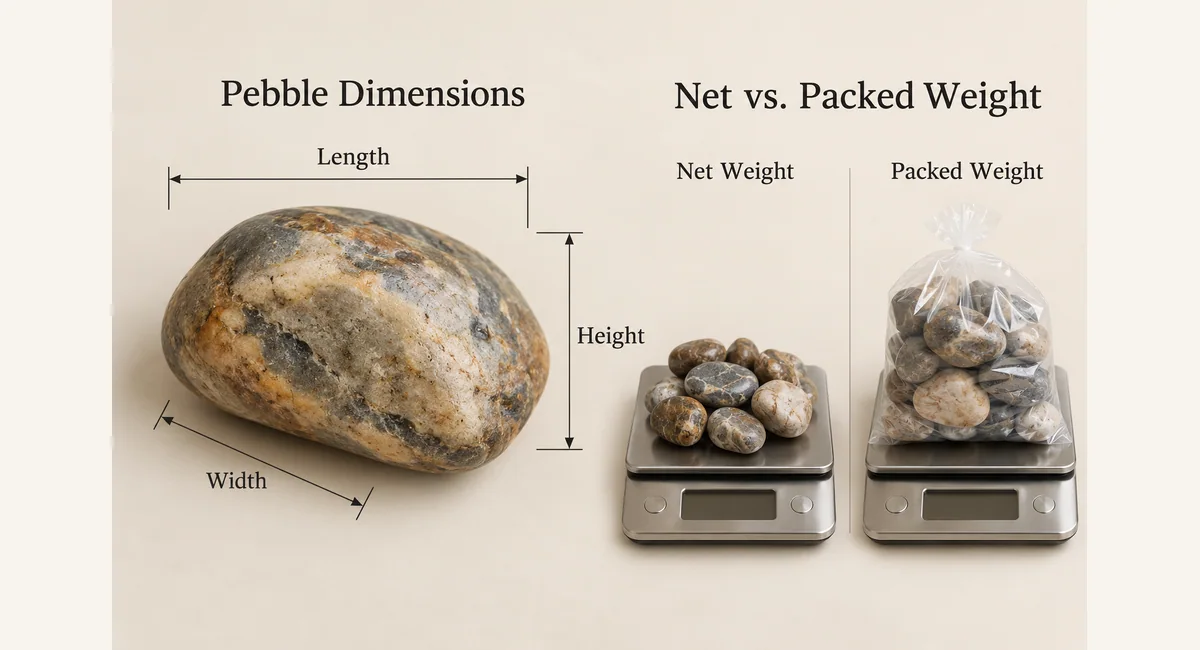
Measure the stone in three orientations:
- Length (L): its greatest end-to-end distance.
- Width (W): the largest measurement across the stone when viewed from its broad face, approximately perpendicular to length.
- Thickness (T): its depth from front to back, measured at the thickest point.
For example, a piece recorded as 28 × 20 × 11 mm is quite different from a rounded pebble measuring 28 × 25 × 23 mm, even though both have the same maximum length. These are hypothetical dimensions illustrating notation, not measurements from OmmRudraksha stock. Neither figure is enough to calculate exact mass because the outline and internal structure vary.
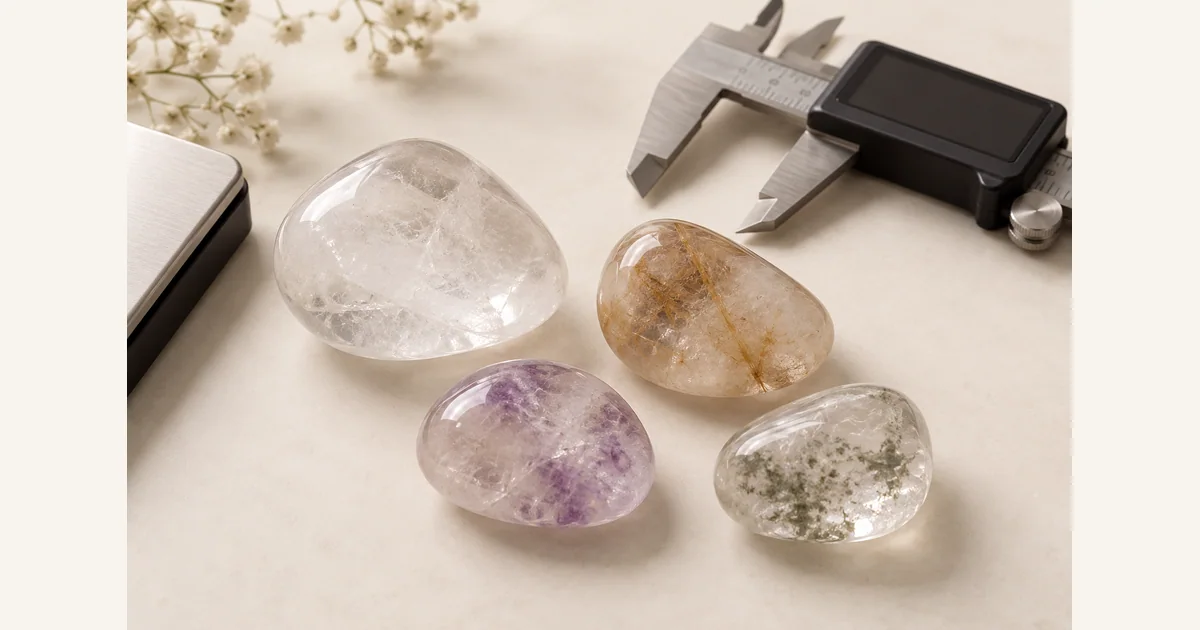
Use a digital calliper with clean jaws, but close it gently: pressing hard on fragile minerals, polished ridges or thin pointed ends can cause damage. When precision is not required, a millimetre ruler against a plain background can be adequate. For cataloguing, photograph the broad face and side profile alongside a ruler; do not estimate physical size from an enlarged website image.
Practical size bands for planning
The following bands are illustrative purchasing categories, not universal trade standards. A seller may use different terminology, and different minerals may tumble into different typical shapes.
| Maximum length | Convenient internal description | Typical planning use | What to check |
|---|---|---|---|
| Under 15 mm | Small chips / mini pebbles | Small bowls, educational sorting and miniature display fields | Whether the offer counts chips or distinct pebbles; choking risk around small children |
| 15–25 mm | Small individual tumblestones | Compact compartments, labels and portable example kits | Actual thickness, legible labels and comfortable handling |
| 25–35 mm | Medium display pebbles | Desk trays, meditation arrangements and teaching demonstrations | Shape variation and available tray clearance |
| 35–50 mm | Larger hand-display stones | Individual focus pieces or feature bowls | Extra weight, surface stability and protection in transport |
| Over 50 mm | Large tumbled / palm-sized piece | Feature specimen or standalone display | Whether it is truly tumbled rather than cut or carved, and its actual weight |
In listings, write “approximately 20–30 mm long” only if that is the dimension actually being controlled. If the listing says “20–30 mm size,” ask whether the band means maximum length, average of three dimensions or a seller's visual category. A 30 mm long but only 8 mm thick slice may not look similar to a full rounded pebble in an otherwise uniform set.
3. Weight: grams, carats, net weight and packed weight
For tumbled stones, grams (g) are generally the easiest unit for practical inventory and parcel preparation. Jewellers may also use carats (ct): one metric carat is exactly 0.2 g, so 1 g equals 5 ct. Carat is a unit of mass, not a measurement of physical size and not a quality rating. A 10 g decorative tumble is 50 ct in mass, but describing everyday mixed tumblestones in carats can be less useful to a household buyer than a simple gram measurement.
Net weight and packed weight must be kept separate:
- Net stone weight: stones only, without individual pouches, tray, paper, shell, box or carton.
- Set weight: specify whether this includes the container or labels; “set weight” by itself is ambiguous.
- Gross/shipping weight: the assembled packed shipment; important for courier planning but not a fair comparison of gemstone quantity.
- Piece count: independent from mass. A seller can supply exactly 25 stones that vary substantially in total net weight.
Example: In a hypothetical parcel, 16 individual stones together weigh 192 g, their presentation tray weighs 110 g, and the protective carton and filler weigh 148 g. The stones' net weight is 192 g; the shipment weighs 450 g. This is an illustration of correct accounting, not a statement about an actual product or expected stones of that size. Recording only “450 g gemstone set” could mislead a buyer into thinking that the parcel contains 450 g of mineral material.
Why similarly sized gemstones weigh differently
Mass depends on both actual volume and density. Quartz is commonly around 2.65 g/cm³, while hematite is markedly denser, often around 5.2–5.3 g/cm³ for typical mineral material. A compact hematite pebble may therefore feel unexpectedly heavy next to quartz of a visually similar size. Pyrite, too, is substantially denser than quartz. A porous, fractured or internally mixed piece may not behave like an ideal single-mineral reference specimen. These mineral values help explain differences; they do not identify a stone reliably by touch alone.
A quick demonstration: a hypothetical solid volume of 5 cm³ would weigh approximately 13.25 g if entirely quartz at 2.65 g/cm³, but around 26.25 g if entirely hematite at 5.25 g/cm³. Real pebbles are irregular, and length × width × thickness is a bounding box rather than their true volume. Do not use this arithmetic as a substitute for weighing an actual stock piece or as a seller's guaranteed specification.
Weighing procedure for a repeatable record
- Place the calibrated or verified digital scale on a level, stable surface, away from direct fan airflow.
- Check that the scale is set to grams, and use the accuracy appropriate to the stone size.
- Position an empty container on the scale and press tare so the container is excluded.
- Record each specimen separately for an individually numbered kit. Note both count and combined net weight for a bulk lot.
- For mixed lots, count the pieces and log any broken fragments separately rather than silently including fragments in the complete-stone count.
- Record the date, batch ID, material name, measured mass and any calibration check; do not copy an old supplier weight into a new stock record.
Some minerals are porous, fragile or water-sensitive. Professional density testing may use specific-gravity equipment, but it is not appropriate to immerse every polished specimen simply to estimate whether it should weigh more. In particular, pyrite and delicate or treated materials are better handled according to their actual conservation needs.
4. What A, AA, AAA and premium grades really mean
Labels such as A, AA, AAA, AAAA, extra grade, premium, collector quality appear in crystal and gemstone trade descriptions. They are often seller-defined commercial categories, not a universal independent certification system for mixed tumbled stones. The Gemological Institute of America notes that there is no broadly accepted universal coloured-stone grading scale, and even named gemstone varieties may be sold under company-specific letter grades. The label may be useful within one supplier's documented sorting system, but “AAA” from two different suppliers may describe different products.
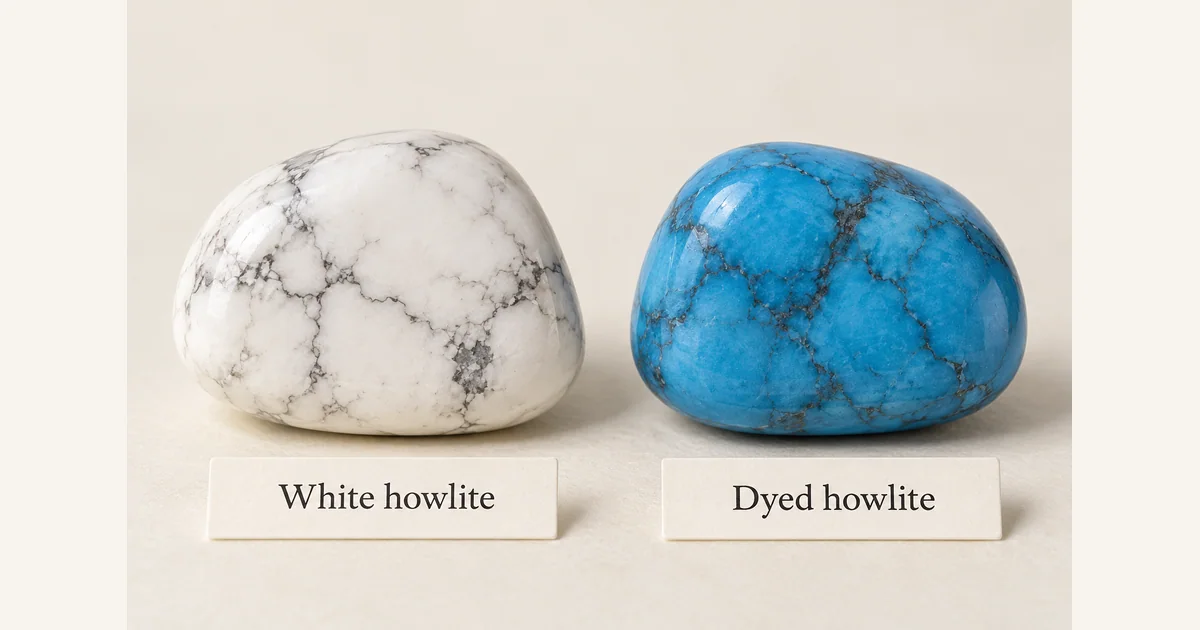
A robust grade description should say what was actually checked. Colour intensity, pattern and translucency are not interchangeable with identity or treatment. A highly saturated dyed agate can be attractive for a particular display, but if a customer orders untreated agate, bright colour is not enough to satisfy that requirement.
| Inspection dimension | Good evidence | Potential problem | Why it matters |
|---|---|---|---|
| Material identity | Named mineral/variety supported by credible supplier information | Trade name mistaken for a different mineral | Correct labels and purchase expectations |
| Surface finish | Even, suitable polish; smooth intended edges | Rough pits, sharp chips, peeling coating | Comfort, handling and display quality |
| Colour and pattern | Appearance within the stated lot description | Unexpected colour mismatch or overly selective sample photos | Uniform presentation or deliberate variety |
| Open cracks and stability | No loose fragments or spreading cracks on delivery | Open fractures, crumbly corners, visible deterioration | Reliability during use and transport |
| Shape and dimensional fit | Measured pieces fit the agreed tray and size band | Over-thick specimens or thin slices in a rounded-stone lot | Kit consistency and packaging |
| Treatment disclosure | Known dye, heat, filling, coating or stabilization described | “Natural” used without distinguishing natural origin from later treatment | Accurate product and educational labels |
Do not grade all species against the same visual ideal. Clear quartz naturally allows different inclusion and transparency assessments from jasper, which is commonly opaque and valued for patterns. Botswana agate may show bands; bloodstone may be appreciated for its dark green ground and red markings; carnelian has orange-to-reddish tones. Comparing all these by “clarity” alone creates misleading results. A correctly identified, polished patterned jasper is not a lower-quality stone just because light does not pass through it.
A simple internal sorting method
For a workshop, describe a batch in plain language rather than issuing an unqualified AAA label. For example: “Named carnelian, 20–30 mm maximum length, smooth polished surface, natural variation in orange/red colour accepted, no loose fragments or chipped sharp edges, treatment details supplied when known.” If a shop wants three internal appearance groups, record Standard / Selected / Feature together with their explicit definitions. These are shop sorting descriptors, not laboratory grades.
For a teaching kit, an unusual inclusion can make a stone more valuable as an educational example even if a decorative seller would downgrade it visually. Similarly, a small stone with a perfect fit may be more suitable for a numbered Vastu tray than a huge “premium” pebble that blocks its label.
5. A material-by-material quality checklist
Different tumbled-stone varieties deserve different questions during inspection. The table below is a buyer's practical checklist, not a certification of every specimen sold under that name. Material identity sometimes requires professional gemological testing, particularly when trade names overlap.
| Stone or group | Useful observations | Ask before buying | Handling note |
|---|---|---|---|
| Clear quartz / Sphatik | Transparency, internal veils, polish and edges | Natural quartz? Any coatings or altered surface? | Store separately from softer specimens |
| Rose quartz | Evenness of pink tone, cloudiness, rounded finish | Are colour and translucency representative of the batch? | Protect from prolonged harsh light and knocks |
| Amethyst | Purple distribution, inclusions, chips at thinner ends | Has the colour been altered or enhanced? | Prevent abrasion against harder surfaces |
| Carnelian and agate | Colour, natural banding where present, polish quality | Is it dyed or heated? What exactly is the mineral/trade variety? | Keep treatment records with the batch |
| Jasper / bloodstone | Pattern, rounded edges, complete-piece count | What variation in red, green or patterned areas is expected? | Natural patterns should not be mistaken for defects |
| Tiger eye | Direction of chatoyancy (moving silky band) and surface finish | Are colours treated; will flash vary by orientation? | Check appearance under diffuse and directional light |
| Hematite | Metallic grey appearance and relatively heavy feel | Natural hematite or marketed magnetic/engineered material? | Avoid confusing appearance or weight with laboratory identification |
| Pyrite, fluorite or malachite | Chips, surface stability, mineral-specific finish | Is the material suitable for repeated handling or a fixed display? | Use separate dry storage and species-appropriate care |
Quality inspection is a combination of correct naming and suitability. A bright display set, a hands-on mineral teaching kit, an altar tray and an inventory sample set may have different preferred shapes. Do not import the quality expectations of a faceted sapphire or ruby directly into a bag of polished quartz, agate and jasper.
6. How sizes affect Vastu, meditation and Navagraha display kits
Vastu Shastra primarily addresses space, directions, orientation, proportion and use. In many traditional frameworks, the eight directions are associated with the Ashta Dikpalas; Pancha Mahabhuta describes the five elements. Modern gemstone bowls, tumbled stones and crystal-grid arrangements use these ideas in contemporary decorative or devotional practice. There is no single classical rule that every “north-east quartz” must be 25 mm or every planetary display stone must be AAA grade. Their dimensions are practical design choices.
A household meditation shelf benefits from a stable base, enough space around a diya, and specimens large enough to recognise without crowding. A shop's Vastu demonstration board benefits from similar-looking sizes so visitors can compare colours and materials fairly. A Navagraha demonstration kit needs nine clearly labelled specimens and should distinguish traditional Jyotisha gemstone prescriptions from convenient coloured alternatives used for illustration. A tumbled stone's colour alone does not make it interchangeable with a prescribed ratna.
Worked example: a 16-stone, eight-direction reference tray
A practitioner can arrange two labelled specimens for each of eight directions. The following is an illustrative contemporary gemstone teaching display, not a historically fixed gem-to-direction prescription. The physical instruction is to choose stones that fit the same 25–35 mm reference compartments, then document each actual piece's measurements instead of assuming they will weigh equally.
| Direction | Traditional directional association | Two illustrative display materials | What the pair helps teach |
|---|---|---|---|
| North-east (Ishanya) | Ishana | Clear quartz + amethyst | Transparency compared with coloured quartz |
| East | Indra | Rose quartz + carnelian | Soft pink versus saturated orange-red |
| South-east | Agni | Carnelian + red jasper | Translucent chalcedony and opaque patterned silica |
| South | Yama | Red jasper + tiger eye | Pattern versus directional silky optical effect |
| South-west | Nirriti | Smoky quartz + black tourmaline | Transparent dark quartz versus black prismatic mineral |
| West | Varuna | Sodalite + lapis lazuli | Two blue materials with distinct identities |
| North-west | Vayu | Amethyst + banded agate | Colour zoning versus banded patterns |
| North | Kubera | Green aventurine + green jade sample | Different materials that can share a green appearance |
This table describes 16 specimens even where a stone name appears in more than one direction; each tray location receives its own physical piece. Before making the tray, measure internal slot clearances. A compartment measuring 35 mm across needs extra clearance for irregular ends; a stone with a 35 mm maximum length may still scrape or sit at an angle. Record the actual width and thickness, then decide whether the stone can be lifted out safely. Label the tray with the mineral name, not just a supposed planetary or directional benefit.
For a Navagraha educational board, distinguish Surya, Chandra, Mangala, Budha, Brihaspati, Shukra, Shani, Rahu and Ketu with their conventional traditional names and, where appropriate, traditional ratna associations. A polished display pebble can illustrate colour or mineral families, but size and “AAA” advertising do not replace proper gemstone identification, chart-specific reasoning or a qualified selection process.
7. Buying stones singly, by count, by pack or by kilogram
A common buying error is comparing a low per-kilogram figure with a higher per-piece figure while ignoring variation in size, number of usable stones, treatments, quality and packaging. The right unit depends on whether the user wants one named specimen, an exact 16-stone set, a 25-stone crystal grid or a decorative bowl filled by net weight.
| Sale basis | Best suited to | Question to ask | Common oversight |
|---|---|---|---|
| Single named piece | Individual specimen or replacement | Will I receive this pictured stone or a representative example? | Photographed piece differs from delivered stock |
| Exact-count pack | Chakra, Navagraha, Vastu and teaching kits | Which stones, how many of each, and what size tolerance? | Correct count but inconsistent material or dimensions |
| Named mixed set | Gift and demonstration assortment | Is the contents list fixed or subject to substitution? | Species repeated or substituted without notice |
| Net weight (g/kg) | Bulk bowls, refilling a selection display or craft stocks | Approximate count and size distribution per lot? | Mass looks economical but usable pieces are too small |
| Professional labelled kit | Repeated consultancy or workshop use | Are labels, slot map, inventory and replacement rules included? | Pack is visually appealing but difficult to reassemble |
Worked price example: compare usable pieces, not just offer price
Suppose two imaginary suppliers offer mixed polished stones. Supplier A offers 100 pieces for ₹1,800; on sample inspection, 90 meet your defined no-chip and size requirements. Supplier B offers 80 pieces for ₹1,600, but only 60 meet the same requirements. The effective cost per acceptable piece is ₹20 for A (₹1,800 ÷ 90) and approximately ₹26.67 for B (₹1,600 ÷ 60). Supplier B has a lower invoice total but a higher usable-piece cost. These numbers are a teaching example, not actual OmmRudraksha prices or real suppliers.
For an expensive individual gemstone, identity and treatment documentation often matter more than such arithmetic. For low-priced bulk decorative tumblestones, consistent acceptance criteria and a transparent count are especially useful.
8. How to write a professional purchase and acceptance specification
A short written specification protects both the shop and the supplier. It should describe the physical lot and what happens if a stone does not match. Avoid promising a measured stock size band before physically checking the stones to be dispatched.
Illustrative purchase specification for a 16-piece demonstration set:
- Purpose: portable eight-direction Vastu materials comparison, two specimens per direction.
- Identity: named stone inventory approved in advance; no unannounced substitution of lookalikes or coloured glass.
- Count: 16 complete stones; fragments and loose chips excluded from piece count.
- Dimensions: preferred maximum length 25–35 mm, subject to actual tray clearance and written exception approval.
- Shape: naturally variable rounded tumbles accepted; prohibit extremely thin shards or sharp breakage edges.
- Surface quality: acceptable polish appropriate to each mineral, no loose flakes or active deterioration.
- Treatments: known dye, heat, coatings or reconstruction stated; unexpected substitutes require approval.
- Weights: each specimen weighed in grams after sorting; total stones-only net mass recorded separately from packing.
- Labelling: mineral name, specimen number, dimensions and any known treatment documented on an inventory sheet.
- Replacement: missing or broken specimens replaced by the same correctly named mineral with suitable fit, not only by a matching colour.
If the lot contains fragile minerals such as fluorite, they may need a different size band or a larger compartment to reduce edge impacts. A client making a tray for a specific display location should approve a prototype before ordering a complete batch. For compact crystal grids, equally sized stones can make geometric spacing cleaner; a feature stone may deliberately be larger, but the plan should specify it as such.
9. Three buying situations, three different definitions of “best”
Example A: a bowl for a family home
A family wants a shallow gemstone bowl in a prayer or meditation corner. A naturally mixed assortment of smooth, visually distinct stones may be attractive; exact matching dimensions are not essential. What matters is stability of the bowl, comfortable handling, proper identification, and keeping pieces away from lamp flames, water bowls or areas where children can pick up small objects. A few larger specimens might be easier to see than many tiny chips. A “premium AAA” label adds little without a meaningful description of the actual stones.
Example B: a Bengaluru jewellery showroom
A shop wants a board for comparing quartz, carnelian, tiger eye, jasper and hematite. Here, photographs under repeatable lighting and measured dimensions matter. If two stones have the same apparent length but one is much denser, the salesperson can demonstrate the difference without claiming it is proof of identity. The board should label natural mineral, variety and known treatment and leave room to show both broad and edge profiles. For visual fairness, choose one approximate size band but record each stone's real mass separately.
Example C: a practitioner travelling with a Vastu set
A consultant carries a numbered 16-stone tray between appointments. The stones should remain in position after transport, and labels should be legible without removing every specimen. A lower-cost moderate-size pebble that securely fits its slot is preferable to a larger display piece that must be wrapped separately and repeatedly handled. Keep the inventory, protective padding and replacement plan with the kit. The spiritual purpose and directional symbolism are discussed during consultation; the measured size is primarily a practical aid to presentation and handling.
10. Common mistakes to avoid
- Comparing “25 mm stones” without knowing the measured axis. A long thin slice and a rounded pebble can share the same longest length.
- Assuming heavier means better or more authentic. Density differs across real minerals, and heavy synthetic or engineered items exist.
- Treating AAA as a universal certificate. Ask for the seller's exact criteria, identity statement and treatment disclosure.
- Confusing net mineral mass with shipping weight. Always separate stones, containers and protective filler.
- Rejecting every inclusion. Natural bands, cloudy zones and mineral patterns can be desirable or educational.
- Assuming all specimens tolerate the same cleaning. Quartz, malachite, fluorite, pyrite and treated stones can require very different handling.
- Judging the entire lot from one hero photograph. Ask for representative batch photos and the sorting criteria.
- Buying by colour alone for a traditional planetary purpose. Similar colours do not establish the same species or Jyotisha role.
11. Frequently asked questions
What is the best size for a tumbled stone?
There is no single universal best size. For a portable labelled kit, pieces around a seller-defined small-to-medium band may be convenient; a household display can use larger stones. Measure your tray and decide how often the stone will be handled. Check both width and thickness, not only the longest length.
Does a larger crystal have stronger Vastu effects?
Size mainly changes visibility, handling, weight and how a piece sits in a space. Classical Vastu direction principles do not establish a universal rule that a 35 mm tumble has more effect than a 20 mm tumble of the same mineral. If a practitioner follows a specific lineage or prescribed ritual, document that tradition rather than converting a retail size grade into spiritual authority.
How much should a 25 mm tumbled stone weigh?
There is no reliable fixed answer from one dimension alone. Width, thickness, irregular outline, porosity and mineral density all affect mass. Weigh the actual piece or request a measured range for the exact batch.
Is an AAA tumbled stone always natural and untreated?
No. A supplier may use AAA to describe colour or polish. A natural-origin stone may still be dyed, heated, coated or otherwise treated. Identity, treatment and appearance grade must be stated separately.
Can quartz, hematite and pyrite be compared by weight?
Their weight differences can be educational because density varies, but a simple hand-feel comparison cannot securely identify them. Use credible material identification, visual features and, for significant purchases, appropriate professional gemological assessment.
Should a mixed Vastu gemstone kit have identical weights?
Not usually. Different species have different densities and tumble into different shapes. A professionally designed kit can aim for consistent visible size and comfortable tray fit while recording actual weights individually.
Should I buy tumbled stones by kilogram or by piece?
Buy by piece when exact identities, counts and replacement positions matter. Buy by net weight for decorative refill material when size distribution and approximate yield are agreed. For mixed bulk orders, ask for both an estimated piece-count distribution and the actual stones-only mass.
What should I check immediately after receiving a set?
Count complete pieces, confirm labels and material names, inspect for chips or loose fragments, record representative or individual dimensions, weigh the stones separately from packaging, photograph any discrepancy, and compare against the agreed acceptance sheet before placing the stones in the final tray.
Conclusion: buy for purpose, specify what can be checked
Good tumbled-stone buying begins with a correct material name, clear dimensions, honest net weight and a written description of finish and treatment. An easy-to-lift piece that fits a Vastu demonstration tray can be a better choice than a bigger, heavier stone. A naturally patterned specimen may be more useful for teaching than one sorted only for visual uniformity. A letter grade is helpful only when its criteria are explained. Measure the actual batch, distinguish practical sizing from traditional symbolism, and build your gemstone set around its real intended use.
Continue reading
- Single Stones, Multipacks and Mixed Sets Compared
- Buying Tumbled Stones in Bulk: Quality and Consistency
- How to Pack and Ship Tumbled Stone Sets Safely
Explore the existing Vastu and gemstone collections for wider context.