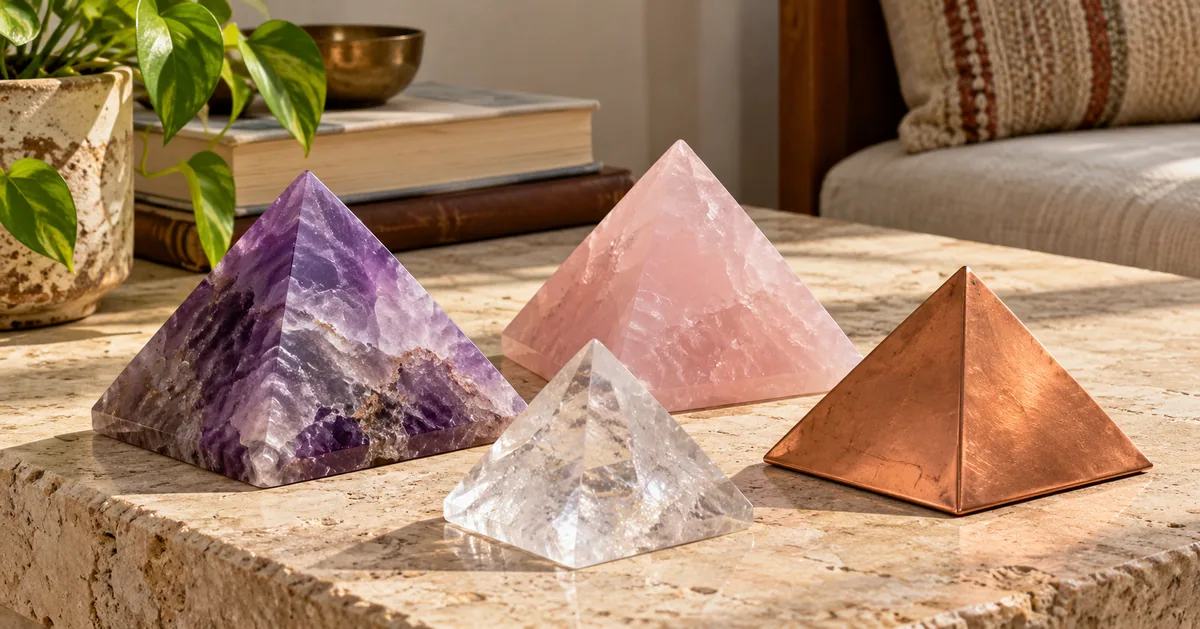
A well-labelled gemstone reference kit can do much more than identify polished stones. In a Vastu consultation or a Jyotish teaching session, the same specimen may be discussed by its mineral identity, colour, traditional symbolism, direction, Pancha Mahabhuta (five elements), chakra association or Graha correspondence. An organised reference collection keeps those different meanings understandable without mixing them up. This guide explains how to build a working tumbled-stone library, how to write useful spiritual reference cards, and how to demonstrate a selection to a client or student.
The central principle is simple: give every physical stone one permanent identification code, but let its educational card contain several kinds of interpretation. A piece of clear Sphatik, for example, can be catalogued as colourless quartz, used to explain clarity in spiritual practice, and referenced in a northeast-focused Vastu demonstration. It does not need to be renamed every time the subject changes.
Why a Vastu gemstone reference kit needs more than colour labels
Imagine laying out sixteen tumbled stones before someone asking about a work desk, a home puja space or a shop's prosperity area. Labels such as green stone, blue stone and lucky crystal are not enough. They do not tell the customer whether the green sample is aventurine, dyed quartz or another material, nor why a practitioner associates a particular stone with a Vastu intention.
Every professional card should therefore answer three separate questions: What is this stone? What is its traditional or contemporary spiritual association? How can it be used in a particular demonstration or setting? Keep those answers visible in the case and in a master register. The result is a teaching tool with genuine interpretive value, not merely a collection of coloured pebbles.
1. Create a permanent identification system
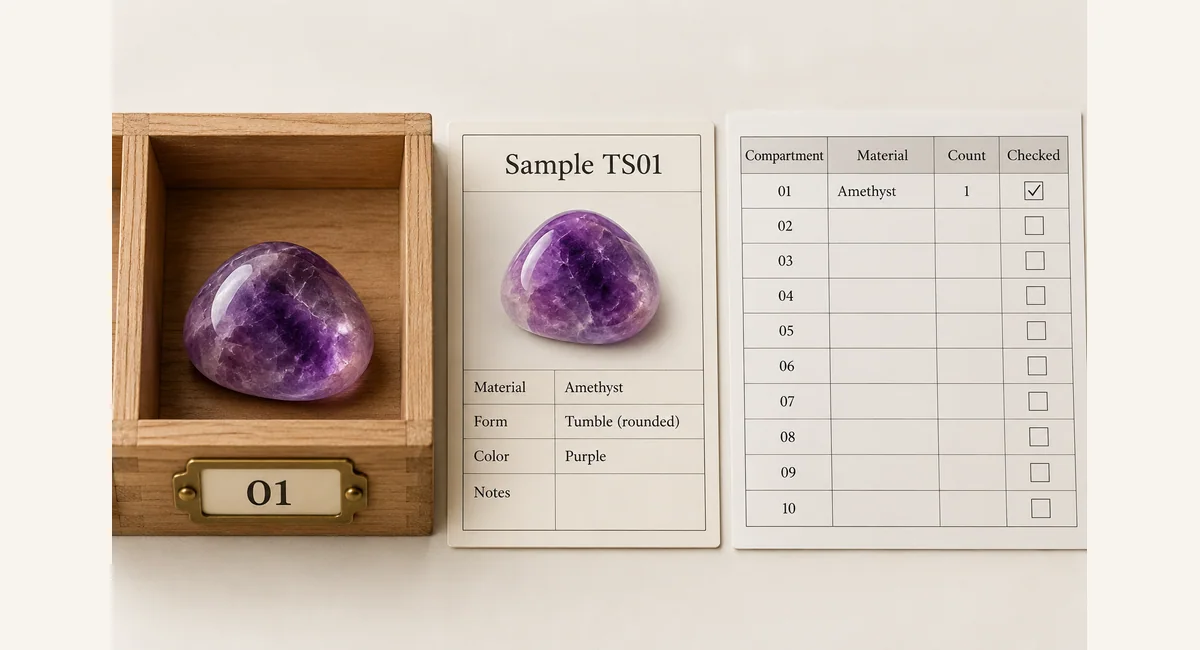
Use a permanent specimen code and a separate storage location. For example, TS-014 identifies the physical tumbled stone; CASE-A / C07 identifies its present compartment. If you replace the carrying case, its code remains TS-014 while the compartment changes. If that specimen is lost and replaced by another, assign a new specimen code and update the kit register rather than silently attaching old notes to a different material.
For a working demonstration kit, a clear format is:
- Specimen: TS-014 (unique, permanent code)
- Case location: A-C07 (physical compartment)
- Material: Green aventurine, supplier-stated identification
- Purpose tags: Prosperity, growth, north-zone example
- Framework: Vastu-inspired contemporary gemstone practice
- Record version: 2026-11, with specimen photograph and replacement history
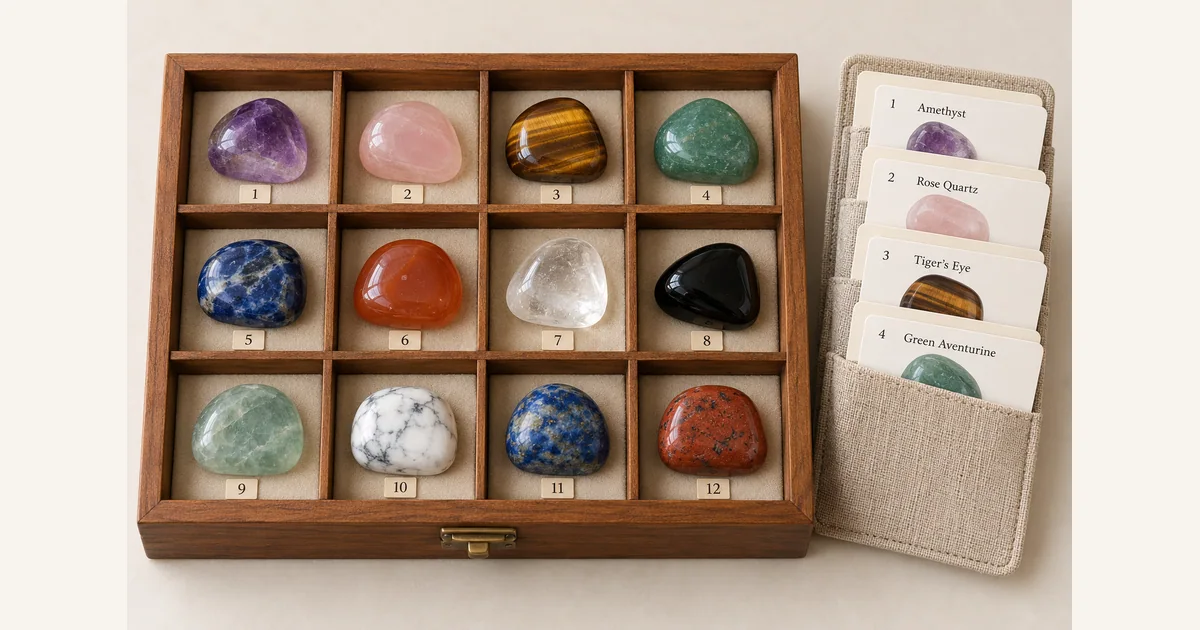
Number the compartment divider, a cloth pouch or a removable insert; avoid placing permanent adhesive directly on a polished stone. For tiny specimens, use a small labelled envelope inside the cell. Label the lid and the register consistently. For a kit used by several staff members, make the index readable even when a person has not assembled the kit before.
2. Record the mineral name and the spiritual application separately
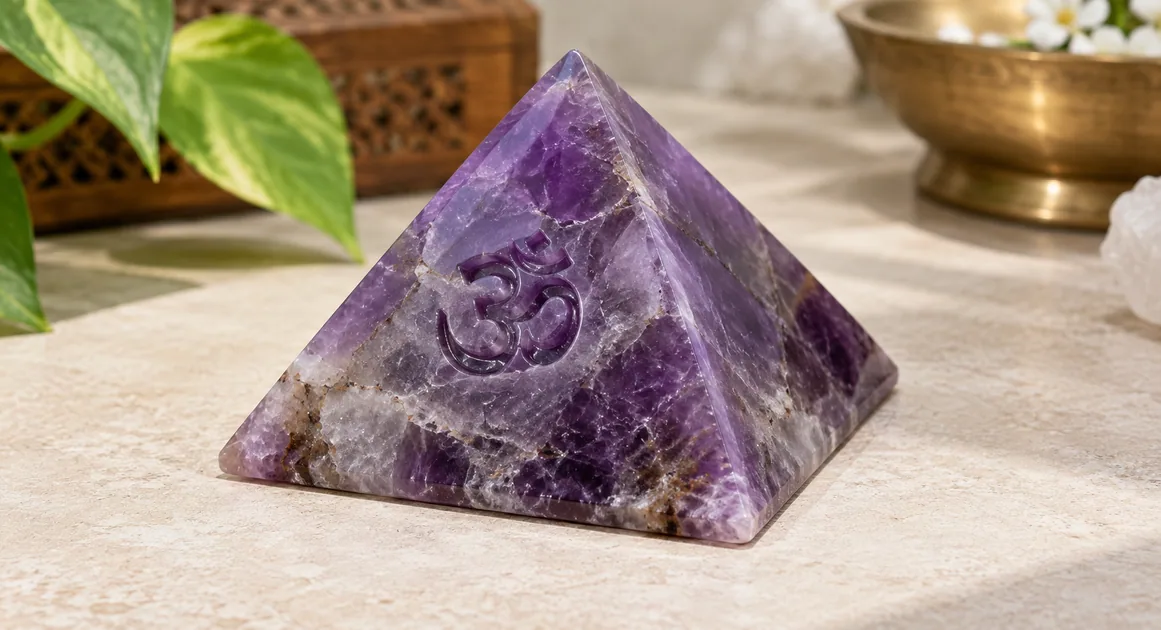
Material names matter. Sphatik is commonly used for clear rock crystal (quartz); amethyst is purple quartz, while citrine refers to yellow-to-orange quartz. A polished stone's visible colour alone does not settle its identity. Some trade names cover different materials, and common products may be dyed or heat-treated. If a material is supplied as "jade", ask whether it is jadeite, nephrite or a different stone sold under a trade name.
But a reference card should not stop at mineral identification. Give the next line to its spiritual significance. For example, an amethyst card may discuss meditation, introspection and Ajna or Sahasrara associations in modern chakra practice. A carnelian card may explain its warm-orange symbolism of motivation and active intention. A green aventurine card can discuss growth, opportunities and abundance in contemporary Vastu- and crystal-inspired use.
Do not force all these relationships into a single fixed ancient prescription. Traditional Jyotish has well-established Navaratna correspondences; an eight-direction crystal kit and a seven-chakra demonstration are different interpretive systems. Label the system being used so a customer understands why the same stone may appear in more than one discussion.
3. A practical sixteen-stone master reference table
The following is an example collection for a professional Vastu discussion or an advanced home reference kit. It combines widely used tumbled stones with their practical study themes. The code is an example; record the actual material received in your own inventory.
| Specimen | Stone | Traditional or contemporary association | Useful demonstration |
|---|---|---|---|
| TS-001 | Clear Quartz / Sphatik | Purity, clarity, spiritual focus | Puja or northeast intention layout |
| TS-002 | Amethyst | Meditation, calm, contemplation | Study and meditation areas |
| TS-003 | Rose Quartz | Affection, harmony, compassion | Family and relationship intentions |
| TS-004 | Citrine | Abundance, optimism, enterprise | Shop or business-intention display |
| TS-005 | Green Aventurine | Growth, opportunity, renewal | Prosperity or north-zone teaching set |
| TS-006 | Carnelian | Vitality, purposeful action, initiative | Agni / southeast themed layout |
| TS-007 | Tiger Eye | Confidence, resolve, attentiveness | Professional decision-making theme |
| TS-008 | Black Tourmaline | Grounding, boundaries, protection | Entrance or southwest themed study |
| TS-009 | Hematite | Steadiness, discipline, stability | Earth element / grounding discussion |
| TS-010 | Red Jasper | Stability, perseverance, earth symbolism | South or southwest intentions |
| TS-011 | Moonstone | Lunar symbolism, reflection, receptivity | Chandra and water-element teaching |
| TS-012 | Lapis Lazuli | Insight, wisdom, contemplation | Learning or communication theme |
| TS-013 | Sodalite | Understanding, communication, order | Teamwork and study-space discussion |
| TS-014 | Amazonite | Balance, expression, harmonious exchange | Vayu / communication theme |
| TS-015 | Pyrite | Prosperity, enterprise, business intention | Shop counter or business set |
| TS-016 | Fluorite | Order, learning, concentration | Study desk or professional teaching |
These are reference themes, not interchangeable mineral names. A gold-coloured pyrite sample is not a yellow sapphire, and a red jasper sample is not red coral. The spiritual use of one sample as a teaching aid does not convert it into another gemstone. Where a product set substitutes a lower-cost colour analogue, call it a colour or teaching analogue and record the actual material.
4. Add an eight-direction (Ashta Dik) cross-reference card
A Vastu reference kit becomes much more useful when the practitioner can connect the stones to the eight directions. The traditional Ashta Dikpala framework associates each direction with a guardian deity; the choice of a particular modern tumbled stone for that direction is an additional practice-based selection. Keep those two columns distinct in your card set.
| Direction | Traditional guardian and theme | Example kit samples | Demonstration intention |
|---|---|---|---|
| East (Purva) | Indra; beginning, light, activity | Sphatik, sun-toned stone | Fresh starts, clarity and welcoming light |
| Southeast (Agneya) | Agni; fire, transformation | Carnelian, red jasper | Activity, initiative and focused work |
| South (Dakshina) | Yama; discipline, restraint | Red jasper, hematite | Boundaries, responsibility and steadiness |
| Southwest (Nairritya) | Nirriti; stability and containment in modern planning | Black tourmaline, hematite | Grounded family or organisational routines |
| West (Paschima) | Varuna; water and reflection | Moonstone, sodalite | Reflection, thoughtful communication |
| Northwest (Vayavya) | Vayu; movement, exchange | Amazonite, fluorite | Communication and changing activities |
| North (Uttara) | Kubera; resources and prosperity | Green aventurine, citrine, pyrite | Enterprise, business and financial intentions |
| Northeast (Ishanya) | Ishana; auspiciousness and spiritual focus | Sphatik, amethyst | Meditation, prayer and contemplation |
These gemstone pairings are examples of contemporary Vastu-inspired selection, not a universal table mandated by every classical text. For a client, first determine the room's actual compass orientation and the intended function of each zone. Then use the kit to explain why an object might be chosen for a given purpose. An eight-compartment teaching board labelled N, NE, E, SE, S, SW, W and NW can demonstrate the concept clearly; its tabletop orientation is not by itself a diagnosis of the building.
5. Use a separate Pancha Mahabhuta card
The five-element vocabulary—Prithvi (earth), Jala (water), Agni (fire), Vayu (air) and Akasha (space)—adds a second way to discuss why a practitioner selects colour and material. Prepare a small reference strip rather than rewriting the permanent specimen label.
| Mahabhuta | Meaning explored in a lesson | Sample stones |
|---|---|---|
| Prithvi / Earth | Support, stability, rootedness | Red jasper, hematite, black tourmaline |
| Jala / Water | Flow, receptivity, adaptability | Moonstone, sodalite |
| Agni / Fire | Initiative, transformation, energy | Carnelian, citrine |
| Vayu / Air | Movement, communication, circulation | Amazonite, fluorite |
| Akasha / Space | Openness, contemplation, awareness | Sphatik, amethyst |
One stone can appear in more than one element discussion. That is why its mineral ID should remain separate from its meaning tags. The table is useful for matching themes to a customer's question: a person arranging a meditation corner may be interested in Akasha themes, while a shop owner may focus on the resource-oriented northern zone.
6. Keep Navagraha, Navaratna and chakra classifications clear
Some professional gemstone kits combine Vastu demonstrations with Jyotish and chakra lessons. These are related traditions but not the same classification. Make a separate card for each, using different coloured header bands or letter prefixes in your binder—for example, V for Vastu, G for Graha and C for chakra.
The classical Navaratna correspondences used in Jyotish are:
| Graha | Traditional Ratna | Teaching reminder |
|---|---|---|
| Surya | Ruby / Manikya | Solar symbolism; leadership and vitality |
| Chandra | Natural pearl / Mukta | Mind, receptivity and lunar qualities |
| Mangala | Red coral / Moonga | Action, courage and initiative |
| Budha | Emerald / Panna | Intellect, communication and discrimination |
| Guru | Yellow sapphire / Pukhraj | Wisdom, knowledge and expansion |
| Shukra | Diamond / Heera | Beauty, relationships and refinement |
| Shani | Blue sapphire / Neelam | Discipline, duty and endurance |
| Rahu | Hessonite / Gomed | Rahu-related chart interpretation |
| Ketu | Chrysoberyl cat's eye / Lehsunia | Ketu-related chart interpretation |
A tumbled-stone sample case may illustrate colours used in this discussion, but a blue sodalite is not automatically a blue sapphire and a clear quartz is not a diamond. If you offer a dedicated nine-planet teaching kit, print the genuine Ratna name alongside the actual sample name and identify whether it is a traditional gemstone, an alternative material or only an educational stand-in. A personal Jyotish gemstone recommendation takes more than choosing a stone by colour: the chart, Lagna, house lordships and other considerations belong in that separate analysis.
For chakra teaching, keep a seven-row insert identifying Muladhara, Svadhisthana, Manipura, Anahata, Vishuddha, Ajna and Sahasrara. Common modern teaching sets use red, orange, yellow, green, blue, indigo and violet/white themes, respectively. One possible line-up is red jasper, carnelian, citrine, green aventurine, sodalite, lapis lazuli and amethyst or Sphatik. Record the actual stones used rather than listing generic colour names alone.
7. A complete specimen-card template: what to print
A professional reference card should fit on a small laminated card or folding insert while directing the reader to a fuller register. Use the same fields consistently across the collection:
| Card field | Example for specimen TS-005 |
|---|---|
| Primary name | Green aventurine (tumbled) |
| Code and location | TS-005 · Case A, cell C05 |
| Appearance / material | Green quartz-family material with subtle sparkle; confirm trade description |
| Traditional-use theme | Growth, opportunity, prosperity intentions |
| Vastu reference | North / Kubera theme in this modern crystal-selection system |
| Five-element reference | Growth and balance discussion; see kit's Prithvi/Vayu study card |
| Suggested demonstration | Retail desk and north-zone concept board |
| Care | Soft dry cloth; protect polish from abrasion |
| Record | Supplier, batch, photograph, date and replacement version |
On the back, include a short description that a staff member can actually say to a customer: “Green aventurine is often selected in contemporary gemstone and Vastu-inspired practices for growth and opportunity. In this kit it helps demonstrate prosperity-related intentions, particularly when discussing the northern zone associated with Kubera. Actual placement is considered along with the layout and purpose of the space.” This is far more educational than a label reading only green stone.
8. Three working examples of a properly labelled kit
Example A: a Bengaluru jewellery showroom
Imagine a showroom owner asking how to create a small prosperity-themed display near the accounts or consultation desk. The practitioner first draws a simple floor plan and notes north and northeast. From the case, they take TS-004 citrine, TS-005 green aventurine and TS-015 pyrite. The three cards describe different meanings—optimism and enterprise, growth and opportunity, and business-related prosperity symbolism. The owner can compare the colours, materials and intended themes rather than buying three unnamed yellow and green stones. The record notes which was selected and where it is placed so the same conversation can be resumed later.
Example B: a family apartment with a prayer corner
A family wishes to arrange a calm prayer or meditation area. The reference card set provides TS-001 Sphatik, TS-002 amethyst and TS-011 moonstone. The practitioner explains Sphatik's place in spiritual focus and purity, amethyst's contemporary contemplative association, and moonstone's lunar symbolism. The family can select based on their own practice and space, with clear instructions about the exact sample chosen. The case remains organised because the stones return to their permanent numbered cells.
Example C: a practitioner teaching eight directions
Place a compass sheet under an empty eight-position tray. Label north, northeast, east, southeast, south, southwest, west and northwest. Students choose from coded specimens rather than unlabeled bowls, then place an index card showing guardian, colour, sample stone, intended purpose and placement rationale beneath each position. For the southeast, a student might select TS-006 carnelian to discuss the Agni or fire principle; for the northeast, TS-001 Sphatik may be chosen for prayer and clarity. At the end, students compare their choices to the reference matrix and discuss why another practitioner may choose a different stone for the same theme.
9. Assemble, transport and maintain the collection
- Make a master inventory: assign each specimen a stable ID, record actual material, quantity and a photograph.
- Choose the case: use divided cells, padded pouches or individual small containers; keep softer stones and easily scratched minerals apart.
- Print two levels of labels: short physical compartment labels and detailed cards showing traditional significance and application.
- Add index tabs: alphabetical by stone, plus Vastu direction, Pancha Mahabhuta, Navagraha and chakra tabs.
- Check every sample: photograph the case before travel; count stones against the checklist when packing and unpacking.
- Record changes: when a specimen is replaced, its label and photograph must change too. Preserve the previous record as history.
- Review contents periodically: confirm names, trade terms, treatment notes, application labels and current product references.
Keep polished stones dry and cushioned. Do not use one universal cleaning method for every mineral: fluorite, malachite, pyrite and other materials have different care needs. A dry soft cloth and material-specific care guidance are better defaults for a mixed professional kit. Store the printed cards in sleeves; if a card becomes damp or unreadable, replace it before an appointment.
10. Common errors that make a reference collection less useful
- Only recording colour: colour may help with a chakra or directional demonstration, but it does not identify the mineral.
- Mixing different traditions on one unlabelled chart: Vastu directions, Navagraha Ratna and chakra stones require their own headings.
- Using trade names as if they were mineral species: document the actual material and any uncertainty in the supplier description.
- Hard-coding one direction into the specimen ID: a stone may feature in multiple lessons; keep its permanent ID neutral.
- Forgetting the intended purpose: a practical card explains why a specimen was selected, not just where to put it back.
- Replacing a sample without updating the register: even stones that look alike may differ in source, composition and finish.
Frequently asked questions
Should a Vastu reference kit have eight stones, sixteen stones or more?
Eight can illustrate the directional framework; sixteen gives a broader range of colours, minerals and meanings; a larger kit can cover Panchabhuta, Navagraha and chakra demonstrations separately. Choose the count according to teaching purpose and the time available during consultation, rather than treating one number as mandatory for every practitioner.
Can the same gemstone be listed under two Vastu directions?
Yes, as an educational association, provided the reference sheet explains the framework and intention. Sphatik may be discussed for spiritual clarity and also appear in a general purification-themed arrangement. The physical specimen keeps one code even when its index has multiple tags.
Do the traditional nine planetary gemstones have to be tumbled stones?
No. A Navaratna reference relates to the identity and planetary symbolism of the Ratna, not to polishing a low-cost stone into the shape of a pebble. A tumbled-stone kit can support colour teaching, but it should not mislabel substitute minerals as ruby, emerald, yellow sapphire or other classical Ratnas.
What should I write on a specimen card used by a Vastu consultant?
At minimum: exact sample code, supplied mineral name, appearance, traditional-use theme, relevant direction or element, the purpose of the demonstration, care, supplier/batch and date. For a professional kit, add a specimen photograph and replacement history.
How do I link physical stone labels to the corresponding products online?
Keep a short printed product name and, where practical, a QR code or concise internal URL in the master register—not a long web address on a tiny stone label. When a product or category changes, update the register while keeping the specimen ID stable. OmmRudraksha's relevant kits and gemstone collections are linked below for further selection.
In summary: an excellent Vastu gemstone reference collection is an organised system of materials, traditional meanings, practical applications and accurate records. A kit labelled in this way helps a customer understand not merely which stone is green or yellow, but why a particular specimen was chosen for a Vastu, Jyotish or spiritual discussion.
Continue reading
- What Should a Professional Vastu Gemstone Reference Kit Contain?
- Gemstone Identification Study Kits: What They Can and Cannot Prove
- Professional Crystal Kit Packaging, Transport and Replacement
Explore the existing Vastu and gemstone collections for wider context.