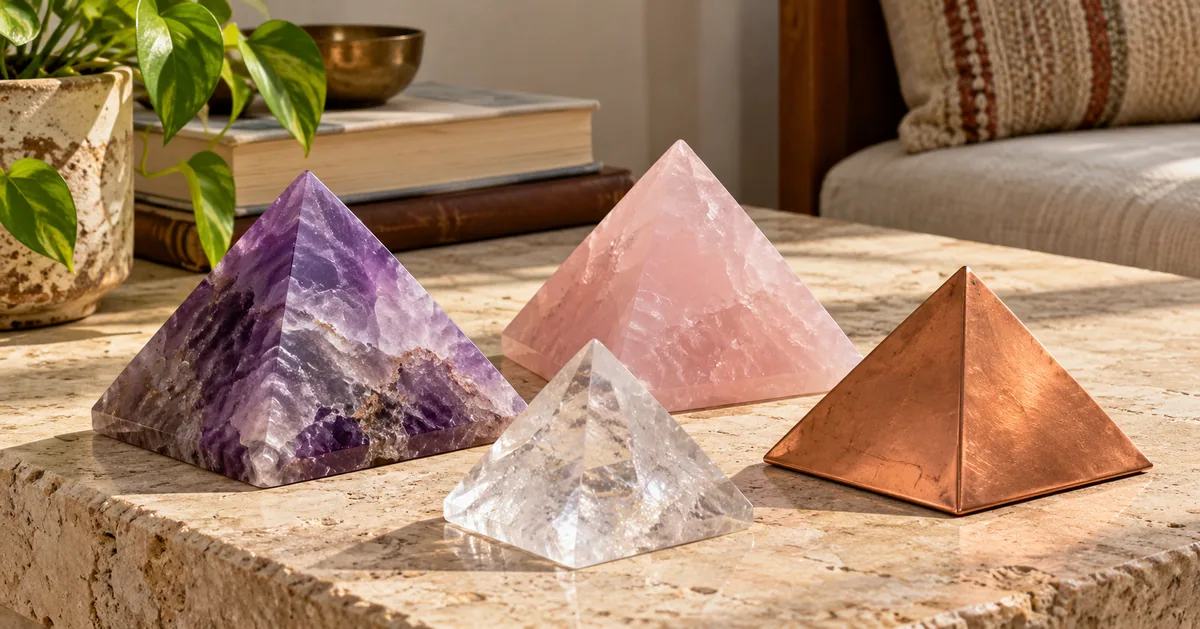
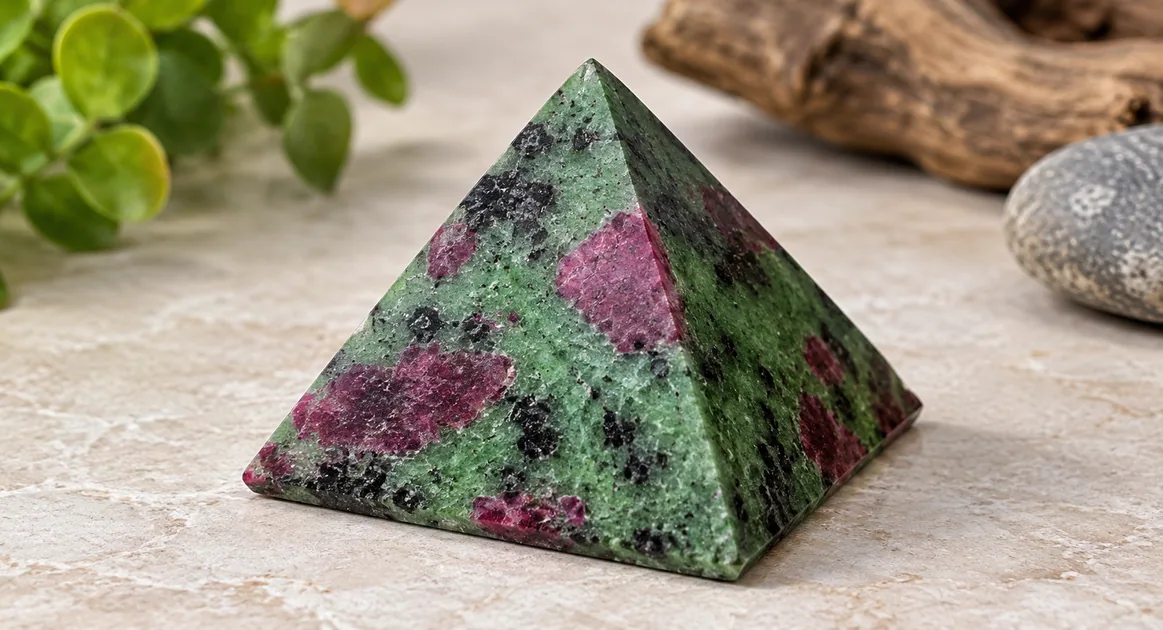
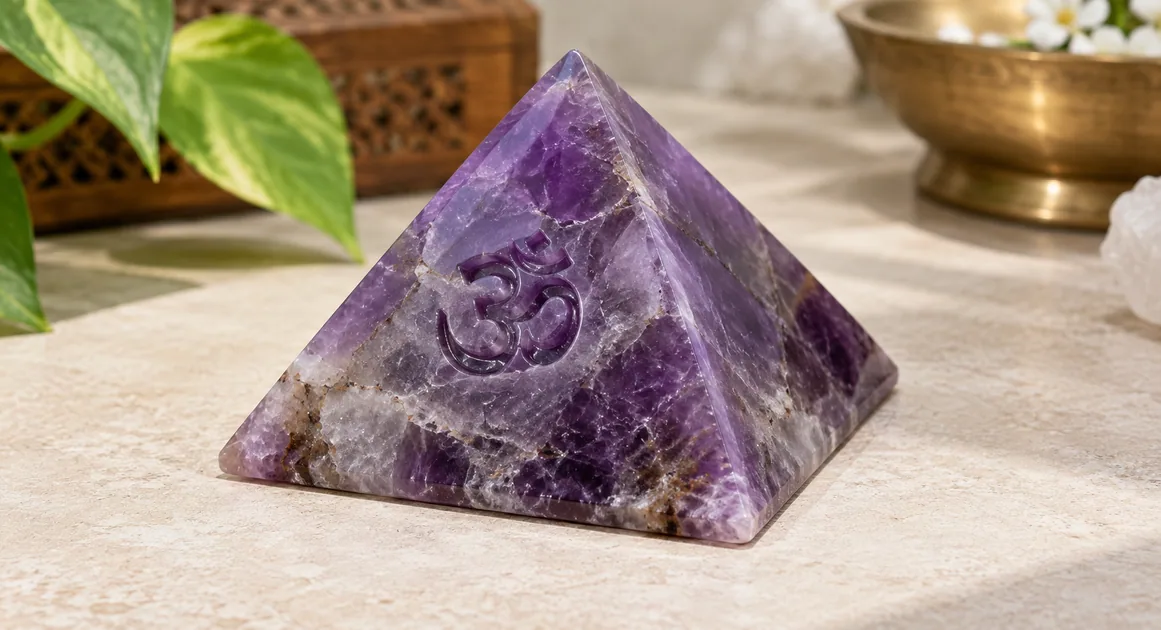
Two green polished stones can look almost identical in a photograph yet belong to different minerals. One may be green aventurine quartz with a fine glimmer, another dyed howlite, while a third may be sold under a broad trade name such as "green jade." For a jeweller, Vastu consultant, gemstone learner or customer, the useful question is not merely "What colour is this stone?" It is: What is it made of, how was it identified, what treatment or trade name has been declared, and why was it selected for its intended purpose?
A well-designed gemstone identification study kit teaches these distinctions through labelled examples that can be handled side by side. It is also valuable for understanding the traditional associations of Ratna, Uparatna, Navagraha gems, chakra stones and contemporary Vastu crystal sets. The same blue or yellow colour does not make two minerals interchangeable in either gem identification or a tradition-specific selection.
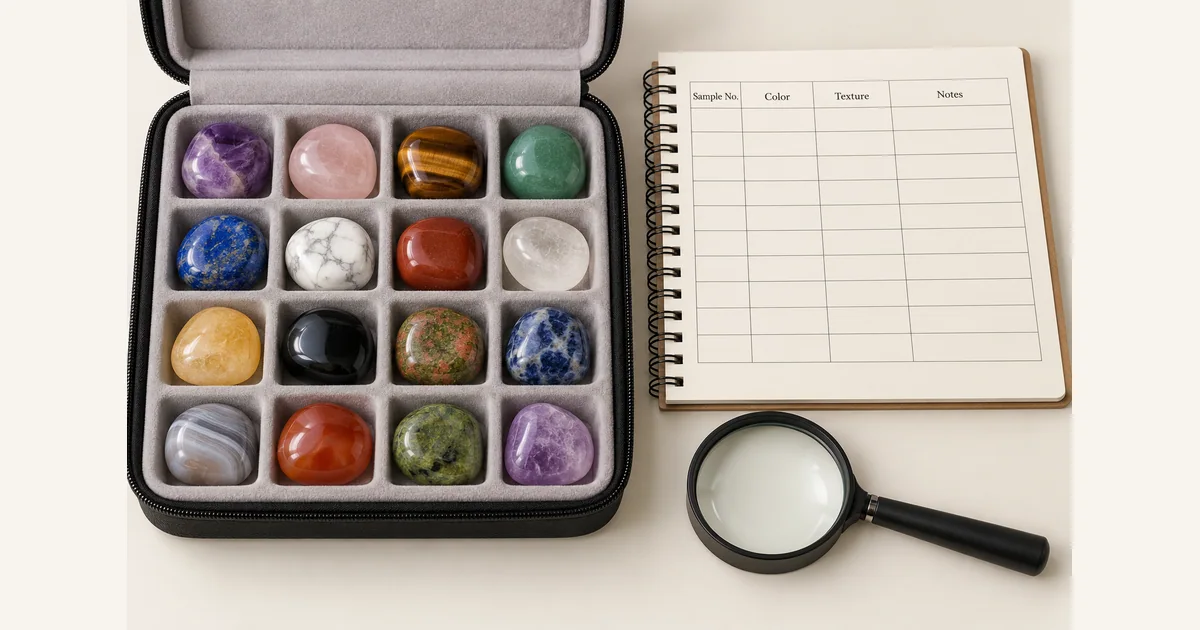
This guide shows how to assemble and use a professional study collection, compare sixteen illustrative specimens, create reproducible observation records, and connect mineral identification to meaningful Vastu and Jyotish discussions. The sixteen stones below form a suggested teaching curriculum, not a claim that every commercially sold kit contains exactly these pieces; always consult the chosen product's stated inventory.
1. What makes a gemstone identification kit useful?
Beginners often start by memorising a photograph: "purple equals amethyst" or "black equals onyx." Real mineral specimens vary. A cut, polish, light source, inclusion, dye or different stone type may change the appearance. Studying known comparison stones improves the ability to ask informed questions and to describe a specimen consistently. It also introduces a distinction that matters in the OmmRudraksha catalogue: a gemstone identification set teaches material identity; a professional Vastu set groups stones by an intended spatial or symbolic framework; and a Navagraha set groups traditionally associated gemstones by Graha.
They may overlap in their stones, but their objectives are different. A good professional collection tells the user which learning framework is being followed instead of confusing them.
| Kind of kit | Main learning question | Example exercise | What must be documented |
|---|---|---|---|
| Identification reference kit | Which mineral or rock variety is represented? | Compare aventurine, jade-type materials and dyed white stone | Declared material, trade name, appearance, treatment notes |
| Vastu gemstone reference kit | How are stones grouped by purpose, colour, element and direction? | Compare stones chosen for a study room, North zone and puja area | Traditional/contemporary association and proposed placement |
| Navagraha study set | Which Ratna is associated with each Graha? | Distinguish a ruby sample from red glass or a red jasper teaching sample | Graha, traditional gem, material identity, substitute status if any |
| Chakra colour set | How does a seven-colour symbolic system organise stones? | Compare lapis, sodalite and amethyst in different colour positions | Chakra scheme used and exact stones rather than colours alone |
2. Sixteen teaching specimens: what to look for and why they matter
The best comparison collection is not simply sixteen different colours. It includes families that overlap and materials with distinctive optical features. The following is a balanced illustrative arrangement for a tumbled-stone training tray. The observations help distinguish candidates; they are not by themselves a laboratory determination.
| Teaching specimen | Family / useful observation | Common comparison question | Traditional or contemporary context |
|---|---|---|---|
| 1. Sphatik / clear quartz | Quartz; transparent to translucent, glassy lustre; internal veils possible | How does clear quartz differ from glass? | Purity, clarity and prayer/Japa associations in Indian spiritual use |
| 2. Rose quartz | Quartz; pink, usually cloudy or translucent rather than very clear | Does pink colour alone prove rose quartz? | Affection and relationship harmony in modern crystal practice |
| 3. Amethyst | Quartz; purple, sometimes colour-zoned | What does colour zoning look like? | Contemplation, meditation and calm in crystal traditions |
| 4. Citrine | Quartz; yellow to orange; colour origin and heating history may differ | Natural citrine or heated amethyst? | Abundance and business intention in contemporary prosperity sets |
| 5. Green aventurine | Quartz-rich aggregate; fine reflective mica-like sparkles may be visible | Aventurine, green glass or another green stone? | Growth, opportunity and flourishing in Vastu-inspired sets |
| 6. Carnelian | Orange-red chalcedony; often translucent at thin edges | How does carnelian differ from opaque red jasper? | Activity, courage and Agni-like colour symbolism |
| 7. Red jasper | Opaque fine-grained silica-rich material; earthy red, may be mottled | Jasper or bright translucent carnelian? | Stability and grounding in modern gemstone arrangements |
| 8. Tiger's eye | Chatoyant quartz; moving golden-brown band under a shifting light | Does the light band move when the stone is turned? | Confidence and protective symbolism in contemporary practices |
| 9. Sodalite | Usually royal blue, often with white patches, rarely gold-coloured flecks | Sodalite or lapis lazuli? | Thoughtful speech and clear thinking in crystal traditions |
| 10. Lapis lazuli | Blue rock containing lazurite and other minerals; calcite and sometimes pyrite flecks | Are white calcite areas or metallic pyrite specks present? | Wisdom and refined expression in modern spiritual collections |
| 11. Labradorite | Feldspar; flashes of blue/green/gold at certain viewing angles | Is the sheen an angular flash or simply painted colour? | Introspection and transformative symbolism in crystal practice |
| 12. Moonstone | Feldspar; soft floating sheen (adularescence) in suitable specimens | How is the glow different from labradorite's flash? | Moon/Chandra associations in some modern gemstone selections |
| 13. Black obsidian | Volcanic glass; glassy lustre, may show conchoidal fracture on unpolished edges | Is this glassy black material the same as tourmaline? | Shielding and boundary symbolism in modern crystal systems |
| 14. Hematite | Iron oxide; metallic-to-submetallic grey surface, substantial heft | Hematite or another heavy polished dark material? | Grounding and steadiness in crystal sets |
| 15. Black tourmaline | Tourmaline group; raw examples often show longitudinal striations | Can polished black pieces be distinguished by eye alone? | Protective placement in contemporary Vastu/crystal practice |
| 16. Howlite | Usually white with grey web-like veining; may be dyed blue or other colours | Is a vivid blue specimen natural or dyed? | Useful for learning honest material declarations and stone substitution |
Why these sixteen? The first five teach variation within quartz-rich stones; carnelian and jasper teach translucency versus opacity; tiger's eye introduces chatoyancy; sodalite and lapis build blue-stone comparison skills; labradorite and moonstone demonstrate feldspar optical effects; obsidian, hematite and tourmaline challenge the assumption that all black stones are alike; howlite introduces common colour enhancement and trade-name questions.
Each specimen needs a stable number, a descriptive label and a supplier record. If the actual kit contains, for example, yellow jade, black onyx, fluorite or amazonite instead, update the specimen table to match the items actually supplied. A professional educational kit should never depend on generic stock pictures alone.
3. Eight observations every learner should record
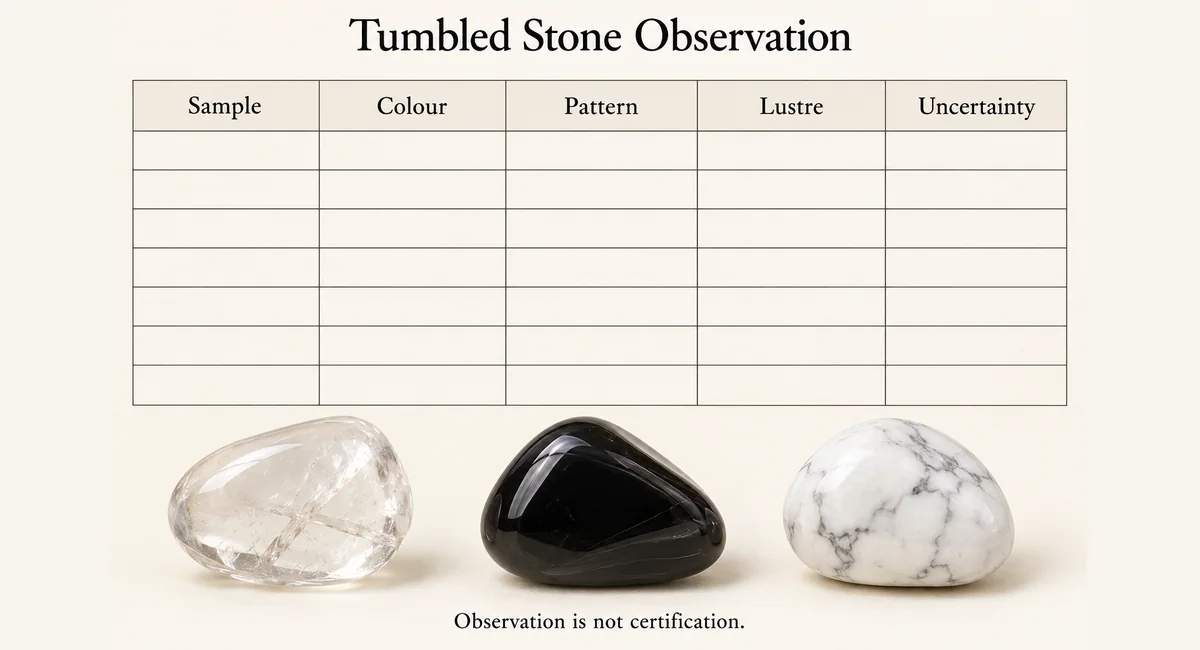
Make the first lesson observational. Place the numbered stone on a neutral background, use a steady white light, rotate it slowly, and describe what is visible. Keep the language factual rather than jumping straight to a stone name.
- Body colour and distribution: Is the colour uniform, banded, spotted, mottled or concentrated along cracks? Record more than "blue" or "green."
- Transparency: Can light travel through the centre, only through a thin edge, or not at all? A highly polished surface can still cover an opaque interior.
- Lustre: Does the polished surface look glassy, waxy, pearly or metallic? Do not confuse a coating's gloss with the specimen's underlying material.
- Patterns and inclusions: Note veins, sparkles, colour bands, specks, fibres or internal veils. A 10× loupe helps document these.
- Optical effect: Turn tiger's eye, labradorite or moonstone under the same light. Record whether a band, flash or glow appears and at what angle.
- Shape, polish and edges: Record rounded versus faceted form, chips, fractures and whether the material appears assembled from pieces.
- Weight impression and dimensions: Use a digital scale to record mass and a ruler for size. Heaviness relative to size suggests questions, but is not a measured specific gravity.
- Declared treatment and source: Record whether supplier information describes dyeing, heating, impregnation, coating or reconstruction. Mark unknowns as unknown instead of silently assuming untreated material.
A useful worksheet has separate columns for Observation, Candidate identity and Basis for that candidate. This avoids confusing "I saw a moving sheen" with "I have conclusively identified tiger's eye." The ability to report uncertainty precisely is part of professional training, not a failure.
4. A printable training-card format
Each item in the case should receive a code such as GI-01 through GI-16. Use one card per specimen and a master spreadsheet or printed booklet that follows the same codes. The number stays with the specimen even if it is moved into a Vastu demonstration tray.
| Field | Example for GI-08 | Why it matters |
|---|---|---|
| Declared name | Tiger's eye quartz | Names what the reference sample is intended to represent |
| Category | Quartz; chatoyant variety | Connects appearance to a mineral family |
| Observed features | Golden-brown stripes; travelling light band | Teaches the actual diagnostic-looking observation |
| Light and photo | White LED; face-on, then rotated 45° | Makes later comparisons reproducible |
| Supplier record | Batch/date/reference label | Creates a traceable link to material disclosure |
| Treatment declaration | As supplied; further information requested if absent | Prevents unsupported untreated claims |
| Spiritual reference | Protective and confidence-related symbolism | Separates a traditional use from mineral identity |
| Use / zone notes | Contemporary workspace or personal intention set | Shows how the item might be taught in a Vastu session |
Keep a separate field for lab report number if an individual stone has genuinely been tested. A study-kit label, supplier assurance, trade name and individual laboratory report are different kinds of documents. Record the right one.
5. Four comparison exercises worth doing
Exercise A: Lapis lazuli or sodalite?
Put both blue references side by side against the same neutral background. In many lapis specimens, blue is accompanied by whitish calcite and sometimes tiny pyrite flecks; sodalite often has a rich blue ground with irregular white areas and typically lacks the distinct pyrite flecks. But not every specimen shows the textbook appearance. Write down the differences you actually observe. Do not conclude a stone is lapis just because it is vivid royal blue.
Teaching application: If an article discusses lapis for symbolic wisdom or expression, the reference card must specify the actual material. A sodalite tumble can be sold and discussed on its own merits; substituting it without naming it removes information the customer needs.
Exercise B: Carnelian or red jasper?
Place the two red-orange stones over a white card and shine light gently through their edges. Carnelian is commonly translucent chalcedony with orange-red colour; red jasper is generally opaque and may show earthy, irregular patterns. Draw a small diagram of where light passes. Both can appear smooth and shiny after tumbling, so the polished surface alone is a weak distinction.
Teaching application: Explain to Vastu learners why two fiery-looking stones need not be the same product. Carnelian is often chosen for activity-oriented and Agni-like intentions; jasper is more often used for steadiness and grounding in modern stone sets. The exact association depends on the system taught.
Exercise C: Moonstone or labradorite?
Darken the surrounding reflections, point a single diffuse light at each reference stone and rotate slowly. A suitable moonstone specimen can show an apparently floating, softer sheen called adularescence. Labradorite may display vivid angular flashes called labradorescence, often blue or green. Record whether the effect appears only from a narrow direction, and photograph the angle. The names are related to feldspar, but the optical displays are not identical.
Teaching application: Do not choose an item solely because a website photograph looks iridescent. The specimen's actual effect, trade name and desired symbolic association all matter.
Exercise D: Obsidian, tourmaline or hematite?
These can all be sold as black polished stones. Obsidian is natural volcanic glass and tends toward glassy reflections. Hematite can appear metallic and feel notably heavy for its size. Tourmaline may reveal striations in rough crystals, although polished tumbles can hide them. Make three separate notes: surface appearance, weight and any visible structure. For an unknown highly polished black stone, visual comparison alone may leave more than one candidate.
Teaching application: In contemporary crystal and Vastu discussions, black tourmaline and obsidian are both associated with protective intention, yet their materials and stories are different. A professional catalogue should reflect that distinction.
6. What professional gem identification actually measures
The study tray trains the eye. In a gemological laboratory or equipped training setting, additional measurements can help establish mineral identity and treatments. Understanding their purpose makes learners better buyers and better communicators.
| Method | What it can show | How it fits the study kit |
|---|---|---|
| 10× loupe and microscope | Internal features, inclusions, colour zoning and surface treatments | Appropriate for observing known reference stones without damage |
| Refractive index (RI) | How light bends through a suitable polished gem surface | Specialist measurement, not something inferred from colour |
| Specific gravity (SG) | Density relative to water under a controlled procedure | Useful for separating some possible materials; more than feeling that one is heavy |
| Polariscope / dichroscope | Optical behaviour of suitable transparent-to-translucent gemstones | Demonstrates why different mineral families behave differently |
| Spectroscope / UV observation | Absorption or fluorescence clues in appropriate cases | Supporting evidence, not universal home authentication |
| Advanced lab analysis | Further details about selected treatments, composition or origin | Relevant when the stone's identity or commercial value requires it |
The choice of method depends on the stone. Opaque tumbled rocks often cannot be tested with the same simple optical methods as transparent faceted gems. A polished specimen may also be too small or irregular for a particular measurement. A trained gemologist combines evidence instead of treating a single reading as a complete verdict.
7. Connecting identification with Vedic Jyotish and Vastu selection
For OmmRudraksha customers, material identification is not separate from spiritual significance. Ratna Shastra and modern gemstone traditions use particular materials and names for particular purposes. Identifying what a stone actually is helps preserve the meaning of the recommendation.
Navagraha: gemstone identity comes before astrological interpretation
In the traditional nine-gem Navaratna framework, the principal correspondences are: Surya–ruby, Chandra–pearl, Mangala–red coral, Budha–emerald, Guru/Brihaspati–yellow sapphire, Shukra–diamond, Shani–blue sapphire, Rahu–hessonite and Ketu–cat's-eye chrysoberyl. A study kit can teach these names and material families alongside photographs or labelled comparison pieces. An everyday coloured tumble, however, is not automatically the same as the named Ratna simply because its colour resembles it.
For example, a yellow citrine tumble and a yellow sapphire both fit a yellow-colour discussion, but they are different gemstone species, with different pricing, properties and places in astrological practice. Similarly, red jasper is not ruby and a blue sodalite tumble is not blue sapphire. If a practitioner discusses an Uparatna (secondary gem), that should be labelled as such, including the selection tradition used.
A chart-based consultation brings additional questions: which Graha is being considered, what is the Lagna, what houses does the Graha own, what is its dignity and strength, and is the intended practice gemstone wearing or a devotional display? A coloured reference kit by itself answers none of those chart questions. It can, however, ensure the practitioner correctly distinguishes the gemstones being discussed.
Vastu: identity, purpose and direction belong on separate lines
A Vastu reference table should record three fields for every specimen: material, traditional/contemporary association and intended room or directional context. For example, Sphatik may accompany clarity and puja-focused practice; green aventurine may be chosen in contemporary prosperity or growth sets; black tourmaline may be part of a protective-intention arrangement. Directional choices should be connected to the home's actual orientation and the particular Vastu approach, not assigned from a stone's colour alone.
Keeping these fields separate makes the reference kit practical for professional use: the material can be verified or re-labelled without erasing a discussion of traditional symbolism, and a spiritual association can be explained without misidentifying the mineral.
8. Three worked examples: showroom, client visit and home study
Example 1 — Jewellery showroom with a mixed green-stone tray
A Bengaluru gemstone shop receives a tray marked only "Green Crystals." Staff need to distinguish aventurine, howlite dyed green and a third unidentified polished stone before preparing product descriptions. The assistant assigns GI codes, makes matched-light photographs, notes any sparkle, translucency or veins, and compares them with known references. The supplier is asked for the exact material and treatment declaration. The final tray has separate cards, not one misleading category label.
Then the shop can discuss the green stones' colour symbolism or contemporary Vastu applications with customers. The identity and the spiritual association appear on separate lines of the card. The result is a clearer product description and a more useful conversation about what to select.
Example 2 — Professional Vastu consultation for an office
A consultant preparing an office visit needs a compact teaching set. Rather than placing sixteen unlabeled stones around the floor plan, the consultant first identifies the site's North, North-East, South-East and other zones with a compass and sketch. On the table, the stones are grouped into teaching families: clear/white, green, red/orange, blue, yellow and dark. The client can handle identified samples and discuss traditional intention, colour and zone together.
For an office prosperity discussion, the consultant might compare a green aventurine sample and a citrine sample, explain their distinct contemporary symbolic associations, and then discuss the actual space and goal. The set supports transparent education rather than a one-colour-fits-all rule. The consultant records which individual stone the customer selected, instead of writing only "green stone" in the notes.
Example 3 — Student builds a real identification notebook
A learner takes six known stones from the case: clear quartz, rose quartz, amethyst, carnelian, red jasper and tiger's eye. Before reading their labels, they record transparency, patterns and optical effects, then compare the notes to the reference booklet. The first session tests recognition; the second asks which observations truly distinguish the materials. The learner photographs each under identical lighting and adds corrected notes where appearances overlap.
Over four sessions, this becomes a visual training collection that is much more valuable than memorising product photographs. It can also be extended into a traditional gemstone notebook: one page on mineral identity, one on the stone's symbolic meaning in the system being studied, and one on product quality and care.
9. What a complete study-kit purchase should include
Whether the buyer is a retailer, Vastu consultant or independent learner, look beyond the quantity printed on the box. A practical kit should make the learning sequence possible from the first day.
- Numbered samples: Each specimen has a code and a physical compartment or pouch matching the printed inventory.
- Material names: Mineral or rock names are distinguished from retail trade names, with treatment disclosures where known.
- Reference photographs: At least one neutral-lit photograph per specimen; additional rotated-light photos for chatoyant or iridescent stones.
- Comparison exercises: Provide several pairs likely to be confused, not merely sixteen isolated descriptions.
- Traditional-reference cards: Where the kit serves Vastu or Jyotish education, show which system is being used and distinguish Ratna, Uparatna and modern colour-based selections.
- Observation worksheet: Colour, pattern, translucency, lustre, effects, candidate identity and evidence should be easy to fill in.
- Storage and care: Cushioned cells, stable labels and clean/dry storage protect the polished examples.
- Clear scope: The set teaches gemstone observation and comparison. Commercial certification or origin determination requires appropriately documented professional testing.
For the physical samples, avoid scratch, acid, flame or solvent exercises. Finished polished stones can be damaged, and damaging them rarely provides a useful first lesson. Use a dry soft cloth, careful handling, and additional light or magnification instead. Protect softer or porous materials and keep them separate from harder stones where rubbing might scratch surfaces.
10. Frequently asked questions
Can a gemstone identification study kit help me select a Vastu stone?
Yes. It helps you recognise and compare the materials used in a Vastu selection. The next step is to study the particular Vastu framework, direction, purpose and placement. Identity and traditional use support each other; they are not the same question.
Is a 16-stone kit enough for a professional?
It is a strong introductory comparison tray when the examples are chosen carefully and documented. A professional may need more specimens, a broader treatment library, appropriate instruments or specialist reports depending on the work involved. Sixteen well-explained references are more useful for learning than a larger unlabelled assortment.
Can a gemstone be natural and still be treated?
Yes. "Natural" generally describes how the material formed; some naturally formed gemstones are subsequently heated, dyed, impregnated or otherwise treated. The name, treatment and any lab evidence should be described distinctly.
How does a Jyotish gemstone differ from an ordinary crystal tumble?
A Jyotish recommendation may specify a traditional Ratna or Uparatna with particular quality and wearing conventions, evaluated within the person's Kundali. A coloured tumbler is often used for collection, Vastu demonstration, meditation or symbolic intention and should be sold under its true material name.
Should I use one reference photograph to identify an expensive unknown stone?
No single reference photograph can settle an expensive or ambiguous identification. Photos are useful for documenting comparisons; important identity, treatment and value questions can call for suitable professional gemological testing.
11. Key takeaway
A high-quality identification kit connects three things: correctly named materials, carefully observed features and meaningful context for their use. A customer should come away knowing what is in the box, what makes two similar stones different, and how gemstones relate to larger Vastu or Jyotish traditions. That is a much richer learning experience than a collection of attractive coloured pebbles with generic labels.
Continue reading
- Natural, Dyed, Heat-Treated and Reconstructed Stones
- How to Label and Organize a Tumbled Stone Reference Collection
- Buying Tumbled Stones in Bulk: Quality and Consistency
Explore the existing Vastu and gemstone collections for wider context.