What should a professional Vastu gemstone reference kit contain? It should help a practitioner interpret a property plan, demonstrate the eight directions and five elements, compare the traditional meanings of different gemstones, and communicate a clearly reasoned recommendation. A collection of polished stones is useful only when its arrangement, teaching cards and selection method make the knowledge visible. A well-planned kit is therefore both a Vastu learning tool and a practical consultation companion.
Consider the difference between placing sixteen attractive stones in a box and presenting sixteen identified stones linked to a Vastu Purusha Mandala worksheet, directional references, colour symbolism, Pancha Mahabhuta, client objectives and placement examples. The second approach allows a visitor to understand why Sphatik might be discussed for an Ishanya meditation space, why Carnelian appears in an Agneya example, or why green stones are commonly chosen for a north-facing business study. Those connections are the heart of an educational Vastu reference kit.
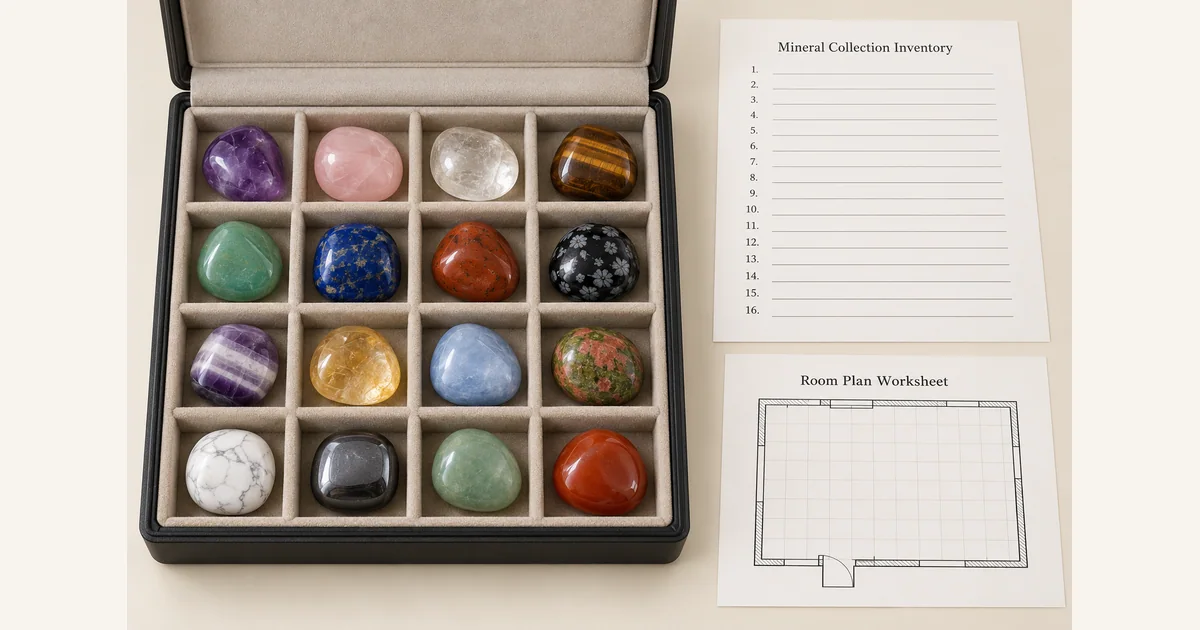
This guide explains a complete working method for home consultations, shops, offices and training sessions. The sixteen-stone arrangement below is an example reference library; it is not a statement that every kit sold includes precisely these specimens. Confirm the current contents of a particular product before ordering.
1. Understand what the kit is meant to demonstrate
Vastu Shastra studies the relationship between a space, its direction, functions, arrangement and the people who use it. The four cardinal directions and the four intercardinal directions form a practical foundation for discussing a floor plan. In traditional directional terminology, the east is Purva, southeast Agneya, south Dakshina, southwest Nairitya, west Paschima, northwest Vayavya, north Uttara and northeast Ishanya. The centre is commonly discussed as the Brahmasthan.
Stones add a visual and tactile layer to such discussions. Their colours, natural patterns and customary spiritual associations help illustrate intentions such as prosperity, stability, concentration, harmony and meditation. Contemporary Vastu practitioners may use crystals as supplementary objects alongside a larger assessment of entrances, room functions, directions and spatial balance. Some colour-and-gemstone maps are modern combinations of Vastu, gemstone symbolism and crystal traditions rather than one universal classical prescription. A professional kit should identify the system it is using, rather than silently mixing different systems.
Begin every session by deciding whether the set is being used as (a) a teaching reference, (b) a working demonstration for a particular room, (c) a Navagraha or chakra comparison, or (d) a proposed gemstone placement for a specific purpose. These are related but different uses. One kit can support all four if the cards are clearly organised.
2. The essential parts of a complete kit
| Component | What it should contain | Why it matters during a consultation |
|---|---|---|
| Gemstone sample library | Numbered stones, with full mineral or trade name and representative colours | Lets a visitor compare actual materials rather than guess from photographs |
| Direction worksheet | North arrow, eight directions, centre point, room names and a simple floor-plan grid | Connects the discussion to the client's real property |
| Pancha Mahabhuta cards | Prithvi, Jala, Agni, Vayu and Akasha with key meanings and examples | Explains why an element is relevant to a particular function or space |
| Stone reference cards | Name, appearance, symbolic themes, common placements and care | Allows two similar-coloured minerals to be compared meaningfully |
| Client purpose sheet | Home or workplace, room, concern, intended use and suggested options | Prevents a generic list from replacing an individual explanation |
| Storage and replenishment record | Numbered compartments, sample count, condition and replacement notes | Keeps the professional set usable and consistent over time |
A compact working set may use a cushioned four-by-four case, but the sequence of materials matters more than the shape of the box. Number the compartments on the lid diagram and on each reference card. The card for sample 05 should always correspond to the stone stored in compartment 05. During a client session, remove only the samples needed for that demonstration and return them immediately afterward.
3. A sixteen-gemstone working library: names, meanings and possible uses
For teaching purposes, the following selection spans the major colours and several mineral families. Where an association appears in contemporary Vastu-and-crystal practice, it is presented as such. The same stone can serve more than one thematic purpose; the objective is to teach the reasoning, not impose a single compulsory map.
| No. | Stone | Common traditional or spiritual theme | Demonstration idea |
|---|---|---|---|
| 01 | Clear Quartz / Sphatik | Purity, clarity, meditation and sacred focus | Ishanya puja corner; a neutral reference for colourless stones |
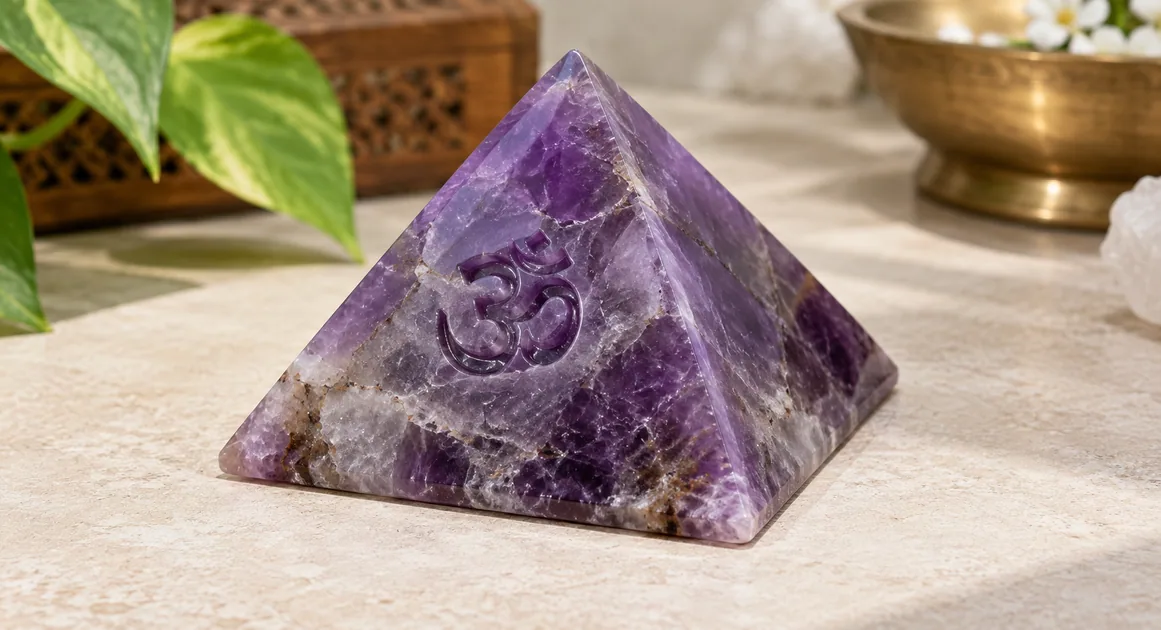
| 02 | Amethyst | Calm, reflection, meditation and inward attention | Study or meditation desk; compare with Sphatik |
| 03 | Rose Quartz | Affection, compassion, emotional harmony | Family living area or relationship-themed arrangement |
| 04 | Citrine | Abundance, confidence, optimism and enterprise | Business counter or north-zone prosperity discussion |
| 05 | Green Aventurine | Growth, new opportunities, prosperity and renewal | North or east work/study example |
| 06 | Carnelian | Initiative, courage, creativity and activity | Agneya / southeast fire-themed demonstration |
| 07 | Red Jasper | Steadiness, physical grounding, determination | Compare an earth-themed display with an activity-themed one |
| 08 | Tiger's Eye | Discernment, confidence, protective intention | Entrepreneur's desk or decision-making discussion |
| 09 | Black Tourmaline | Protection, boundary-setting and grounding | Entrance-area symbolic arrangement |
| 10 | Hematite | Stability, structure, focus and discipline | Organised workstation or southwest stability example |
| 11 | Black Obsidian | Introspection and symbolic protection | Compare black volcanic glass with black tourmaline |
| 12 | Lapis Lazuli | Wisdom, learning, truthful expression | Education and communication-themed arrangement |
| 13 | Sodalite | Clear thinking, dialogue and study | Northwest communication or meeting-room example |
| 14 | Yellow Jasper | Steadiness, patience and earth-colour symbolism | Compare warm earth colours with citrine |
| 15 | Smoky Quartz | Grounding, composure and stability | Southwest or organised-space demonstration |
| 16 | Amazonite | Balance, expression, calm and flowing-water imagery | West/water-theme or communication comparison |
Here is a useful teaching distinction: citrine and yellow jasper are not interchangeable merely because both are yellow. Citrine is a yellow quartz variety and is widely associated with abundance in contemporary crystal practice. Yellow jasper is generally an opaque jasper material with earth-toned associations. Likewise, a dark stone may be black tourmaline, hematite or obsidian: different physical materials, different visible features and different symbolic themes. Identify the actual material on the card before discussing placement.
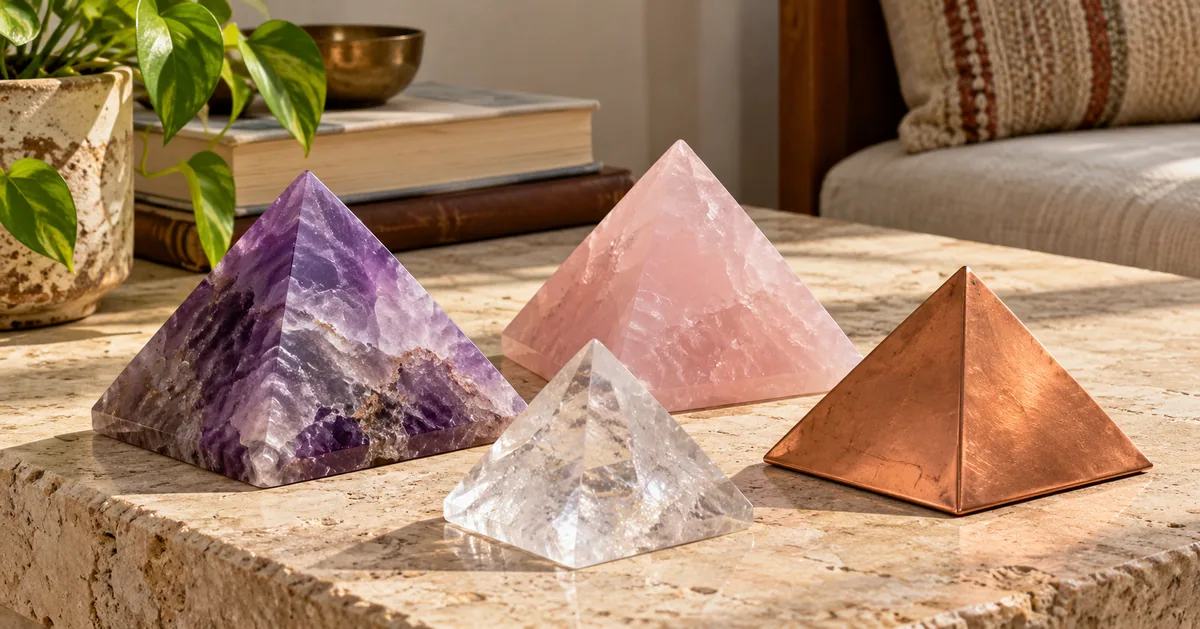
For a smaller starter set, retain a cross-section: Sphatik, amethyst, rose quartz, green aventurine, carnelian, tiger's eye, black tourmaline and hematite. For a larger professional collection, add the other eight specimens plus separate references for gemstone trees, pyramids, clusters and Yantra-oriented products. Different shapes are not simply duplicates of loose tumbled stones: a pyramid, tree and individual stone may be selected for different ritual, symbolic or presentation purposes.
4. The eight directions: use the kit with an actual floor plan
A reference kit becomes especially useful when the client can see how the eight directions apply to their own home, office or showroom. Mark the true orientation used for the assessment on a clear plan before discussing gemstones. A mobile phone compass can help as an initial aid; check it against the setting and avoid nearby metal or electronics that may disturb the reading. On a complicated property, the practitioner may need to confirm the orientation and the correct centre of the assessed footprint.
| Direction | Classical directional association | Common contemporary gemstone demonstration | Client discussion |
|---|---|---|---|
| North — Uttara | Kubera, wealth and resources | Green aventurine, citrine | Cash counter, accounts desk, business development |
| Northeast — Ishanya | Ishana / Shiva, sacred focus | Sphatik, amethyst | Puja, meditation, quiet reflection |
| East — Purva | Indra, beginnings and growth | Green aventurine, carnelian | Learning, new initiatives, fresh starts |
| Southeast — Agneya | Agni, the fire principle | Carnelian, red jasper | Activity, kitchen, purposeful effort |
| South — Dakshina | Yama, restraint and order | Red jasper, hematite | Discipline, boundaries, responsibilities |
| Southwest — Nairitya | Nirriti, weight and stability | Smoky quartz, tiger's eye | Continuity, stability, fixed responsibilities |
| West — Paschima | Varuna, water symbolism | Amazonite, sodalite | Adaptability, reflection, communication |
| Northwest — Vayavya | Vayu, movement and exchange | Sodalite, lapis lazuli | Communication, meetings, transitions |
This table combines recognised traditional directional names with example gemstone associations used in contemporary practice. Classical architectural Vastu texts discuss the directions, deities and functions of spaces; a single mandatory list assigning sixteen modern tumbled stones to those directions is not universal across all Vastu schools. A good consultant can explain both the classical directional principle and the reason for suggesting a particular modern gemstone.
For the Brahmasthan, many Vastu practitioners emphasise openness and an uncluttered central area. If demonstrating a central focal stone on a study model, place the Sphatik specimen on the worksheet rather than assuming that a large object belongs permanently in the physical middle of every house.
5. Pancha Mahabhuta: five elements and the gemstone teaching set
The Pancha Mahabhuta — Prithvi (earth), Jala / Ap (water), Agni / Tejas (fire), Vayu (air) and Akasha (space or ether) — provide another language for describing a place and its functions. The element cards should not be confused with the five phases of Chinese Wu Xing, nor with a nine-Graha gemstone chart. All three are legitimate subjects for separate comparisons, but they are structured differently.
| Element | Theme | Example stones for a teaching card | Question to ask |
|---|---|---|---|
| Prithvi | Foundation, steadiness, support | Red jasper, smoky quartz, hematite | Which activities need continuity and reliable routines? |
| Jala | Flow, connection, receptivity | Amazonite, rose quartz | Where should the room encourage comfort and harmonious exchange? |
| Agni | Action, confidence, transformation | Carnelian, citrine | Which part of the space represents initiative or active work? |
| Vayu | Movement, communication, change | Sodalite, green aventurine | Where do people collaborate, circulate or exchange ideas? |
| Akasha | Openness, sound, contemplation | Sphatik, amethyst | Where is a clear and undistracted area most valuable? |
These are example contemporary teaching correspondences. They help a visitor make sense of colour and symbolism without presenting them as the only possible choices. The same Sphatik sample can support a northeast puja discussion or a broader Akasha-themed explanation, depending on the question being explored.
6. A simple professional consultation workflow
- Identify the property: Is it a rented apartment, independent house, office, shop, workshop or puja space? Note which portion of the property is being assessed.
- Understand the objective: Ask whether the person is exploring prosperity, concentration, harmony, meditation, stability, protection symbolism, a festival arrangement or a traditional directional study.
- Orient the plan: Mark north, identify the other directions and locate relevant rooms or work zones. Keep the original plan separate from any interpretive notes.
- Explain the Vastu foundation: Identify the traditional direction, its deity or elemental associations, and how the area is currently used.
- Compare suitable examples: Show two or three gemstone samples and explain how their customary meanings differ. Do not overwhelm the client with all sixteen stones.
- Discuss form and placement: Would a small tumbled stone, gemstone tree, pyramid, arranged tray or puja object fit the person's intended practice and available space?
- Record the rationale: Write down the direction, objective, stones discussed, suggested arrangement, and whether the recommendation is for learning, devotion or an intended remedial practice.
- Provide a clear next step: Give the person the relevant product reference, maintenance guidance and a short explanation they can revisit later.
The consultation record could be as compact as: "Office, north side of room, accounts workstation; purpose: prosperity-themed arrangement; samples compared: green aventurine and citrine; proposed placement: small labelled tray on a stable desk shelf; reason: north/Kubera symbolism and the gemstones' commonly used prosperity associations." Such a record gives the customer a clear explanation rather than a vague instruction to "keep a green stone somewhere".
7. Worked example: a Bengaluru jewellery showroom
Scenario: A retailer wants a Vastu-themed gemstone arrangement for a small showroom that also sells gemstone jewellery. The entrance is near the east side of the unit, the cash/accounts counter sits in the northern portion, and a small consultation table is toward the west. These are illustrative details for an example layout, not a site-specific assessment.
Step 1 — North and the cash counter. The consultant begins by explaining Kubera's association with the north. Two samples are shown: green aventurine, often connected with growth and opportunity, and citrine, commonly connected with abundance and enterprise. The shop owner prefers a warm golden theme; a modest citrine display is selected for the north-area counter. The consultant records why the material was chosen and confirms that it will not obstruct payment equipment or daily work.
Step 2 — Consultation table. For discussions requiring calm concentration, amethyst and Sphatik are compared. Their meanings differ: amethyst is often associated with reflection and composure, while clear quartz is commonly used as a meditation or sacred-focus symbol. The shop owner chooses a small clear quartz piece beside the consultation notebook, not a large heavy object in the middle of the table.
Step 3 — Product explanation. Because customers may ask why a gemstone tree, pyramid and tumbled stone have different prices, the team uses the samples to explain the underlying gemstone, the form, the craft and the intended traditional application. The kit doubles as a training resource: staff can answer specific questions without replacing the teaching with empty promises or generic labels.
What the client receives: A one-page layout note, the specific specimens considered, placement location and reasons for the choice. The professional value lies in the clarity of the interpretation and the ability to explain it consistently.
8. Worked example: a compact family apartment
Scenario: A family has a puja shelf in the northeast corner of its living room, a children's study desk on the eastern side and a shared family area toward the southwest. They want three different arrangements rather than one gemstone set placed everywhere.
For the puja shelf, the consultant demonstrates Sphatik and the Ishanya association. For the study desk, the kit compares amethyst, sodalite and green aventurine, explaining the themes of focus, learning and growth. For a family harmony arrangement, rose quartz is discussed as a contemporary symbol of affection and compassion. These are three different intentions; accordingly the proposed stones need not match.
The room worksheet records the shelf positions and any practical constraints, such as small children, pets, busy surfaces or fragile furnishings. The family can then select a safe, stable location and a size that suits the space. The explanation stays connected to the Vastu context rather than becoming a catalogue of colour options.
9. Worked example: a professional Vastu training session
Suppose eight students are learning the directions and their guardians. Arrange an eight-direction compass sheet in the centre of the table and place one numbered stone sample at a time in each directional position. Begin with east/Indra and move clockwise through Agneya/Agni, south/Yama, Nairitya/Nirriti, west/Varuna, Vayavya/Vayu, north/Kubera and Ishanya/Ishana. Ask students to match the relevant directional card to each position.
In the second round, have each learner suggest a gemstone for a specific intention, such as a northern business desk or northeast puja corner, and explain the selection. Different answers may be reasonable if they use a coherent traditional framework and make the reasoning clear. Finally, give the learners a blank property plan and ask them to transfer the direction labels and proposed arrangement to that plan. This moves the lesson from memorising stone colours to understanding how a direction, a purpose and a chosen object relate.
10. Professional sets are not all the same
| Set type | Primary framework | Typical contents | Best use |
|---|---|---|---|
| Vastu gemstone reference kit | Directions, space, elemental symbolism, intended applications | Varied stones, compass worksheet, colour and usage cards | Property consultations and directional training |
| Navagraha / nine-planet reference kit | Surya through Ketu and Jyotish associations | Nine identified gemstone references with Graha cards | Teaching planetary gemstone correspondences |
| Pancha Mahabhuta set | Five Indian elements | Five examples with element-symbolism cards | Elemental interpretation and comparative learning |
| Seven-chakra set | Chakra symbolism and meditation systems | Seven colour or stone references with chakra cards | Chakra-oriented spiritual teaching |
| Mineral identification kit | Gemological and material properties | Labelled mineral specimens, appearance and care notes | Material comparison and basic gemstone education |
The Navagraha distinction matters. A nine-colour tumbled-stone collection is not automatically the classical Navaratna jewellery combination of ruby, pearl, red coral, emerald, yellow sapphire, diamond, blue sapphire, hessonite and cat's eye. If teaching Jyotish, the cards should identify whether each sample is an actual traditional gem or a colour-based substitute used for illustration. House lordship, planetary condition and Dasha are relevant when discussing personal gemstone recommendations from a Kundali, but a Vastu direction set and a birth-chart set are not interchangeable.
Similarly, the practitioner may want a separate Five Elements and Gemstones guide or an Eight Directions Gemstone Arrangements guide for deeper study. The reference kit then supports multiple learning modules without forcing all of them into one chart.
11. How to arrange, label and care for the kit
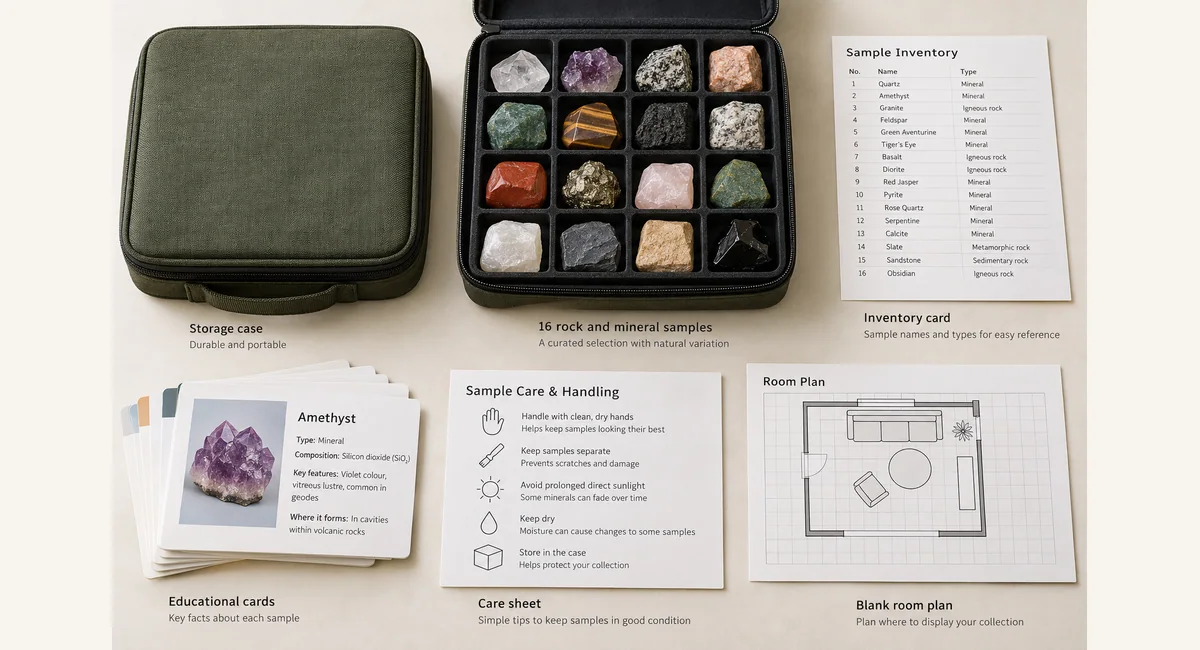
Storage: Put the samples in individual padded compartments. Keep the reference cards in their own sleeve. Soft or fragile materials deserve protective handling; a scratched sample is less helpful as a teaching tool. Photograph the correctly filled box and keep a numbered inventory so a missing specimen can be recognised quickly.
Identification: Write the material name accurately. For example, the name "citrine" should refer to a yellow quartz variety, while "rose quartz" and "amethyst" identify other quartz varieties. Lapis lazuli is a rock made from several minerals, unlike single-mineral quartz. Black obsidian is volcanic glass rather than a quartz or tourmaline variety. Such distinctions are valuable to customers asking detailed gemstone questions.
Treatment: Record known treatments, dyeing or trade descriptions accurately. Do not infer untreated origin from attractive colour alone. For replacement pieces, try to match the named material, suitable size and intended appearance, not simply an approximate hue.
Placement and care: Keep the display clear of food preparation areas, heat sources, exposed electrical equipment and walkways. If a client uses water, incense, oil or flowers in devotional practice, choose a location and handling method appropriate to the actual stone and its finish. Not every mineral tolerates prolonged water exposure, abrasive cleaning or direct sun equally well.
Use in the consultation: The case is a reference library, not a substitute for asking questions. A well-trained staff member can show sample 04 for a prosperity theme, explain why sample 05 is also considered, and then move to the property plan and the client's preference. That makes the gemstone's significance understandable.
12. Questions customers ask about professional Vastu gemstone kits
How many gemstones should a professional Vastu kit contain?
There is no single compulsory count. Eight samples can illustrate eight directions; five can teach the five elements; nine can illustrate the Navagraha; sixteen offers broader comparisons of colours, materials and meanings. Select the count according to the framework being taught, then ensure every included stone has a clear purpose and reference card.
Can one kit be used for homes, shops and offices?
Yes, as a working reference. The same stones and direction cards can be used to discuss different layouts. The questions and recommendations should be tailored to the specific property: a cash counter, puja corner, bedroom and meeting room have different functions.
Is a gemstone reference kit the same as a Vastu rectification kit?
Not exactly. A reference kit helps compare and explain options. A rectification-oriented set is selected for a particular situation or tradition and may include a specified number of stones, pyramids, Yantras or other objects. The terminology and intended application should be clear on the product page.
Can a Vastu kit replace a Kundali-based gemstone consultation?
No. A Vastu worksheet concerns the property, directions and room functions; a Jyotish gemstone consultation concerns the individual's birth chart, Graha and house lordships, Dasha and purpose. Some traditional systems connect the two, but they do not use identical methods.
Which stones are useful for a showroom demonstration?
A practical eight-stone starter selection could contain Sphatik, citrine, green aventurine, rose quartz, carnelian, smoky quartz, sodalite and black tourmaline. The aim is to provide contrasting materials and clearly different customary meanings. A larger sixteen-stone set makes comparison easier for educational articles and consultations.
What should be supplied with the gemstone samples?
At minimum, a numbered inventory, material names, colour and theme cards, a north-oriented room-plan sheet, care notes and a simple consultation worksheet. Product-specific components must match the actual contents listed for that kit.
Conclusion: from a stone collection to a useful Vastu teaching tool
A professional Vastu gemstone reference kit is valuable because it brings knowledge, demonstration and application together. Its stones should introduce the language of directions, Ashta Dikpalas, Pancha Mahabhuta, traditional and contemporary gemstone meanings, room functions and meaningful selection. A customer should leave understanding why a stone was discussed, where it may be considered and how the choice relates to their purpose.
For further study, compare the existing Tumbled Stones for Vastu guide with the Navagraha Gemstone Sets article. Explore the existing products through the links below.
Continue reading
- How to Label and Organize a Tumbled Stone Reference Collection
- Gemstone Identification Study Kits: What They Can and Cannot Prove
- Professional Crystal Kit Packaging, Transport and Replacement
Explore the existing Vastu and gemstone collections for wider context.