Why do nine gemstones appear together in a Navagraha set? In Jyotish, the nine Grahas are the language through which a birth chart is interpreted: the seven visible luminaries and planets used in the tradition, together with Rahu and Ketu, the two lunar nodes. Nava means nine, graha refers to the astrological influences, and ratna means gem. A Navagraha or Navaratna collection brings these nine planetary associations into one arrangement. It may be worn as jewellery, kept as a reference for astrology study, or used during a devotional practice, depending on its construction and purpose.
Imagine a customer visiting a gemstone showroom and asking for a "nine-planet stone set". Three quite different products could satisfy that description: a ring set with the nine traditionally named gems; an affordable teaching tray holding nine colour-coded stones; or a small arrangement intended for a home shrine. They share the Navagraha theme, but their gemstone identities, use and selection rules are not interchangeable. This guide explains the traditional correspondences first, then shows how to understand and choose each kind of set.
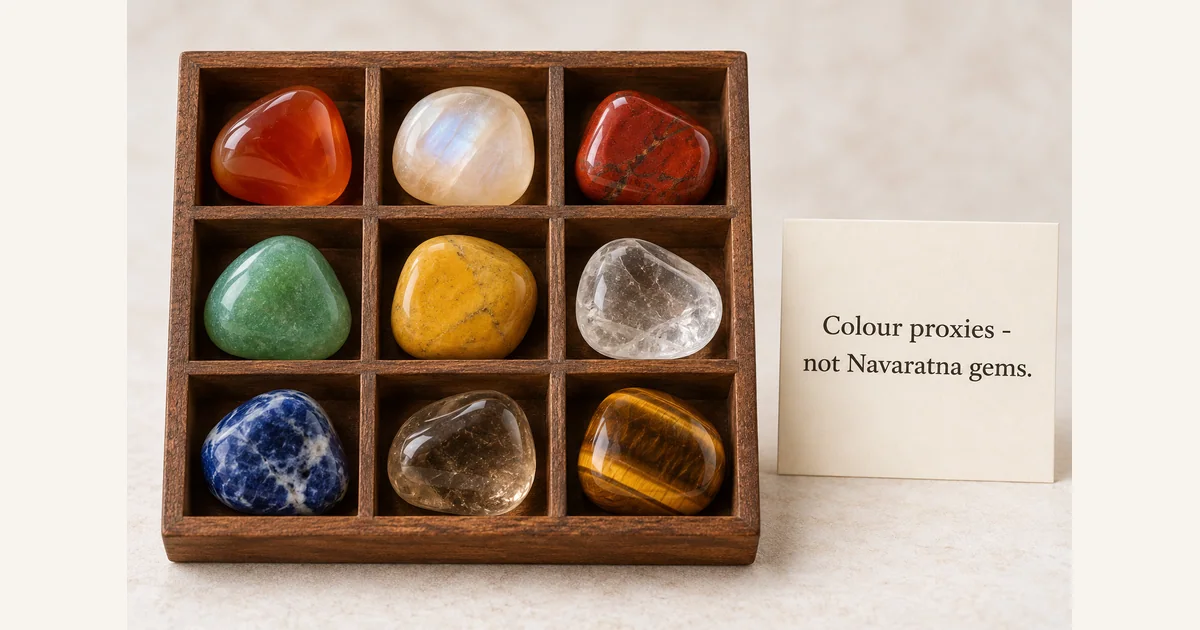
Navagraha and Navaratna: the important distinction
Navagraha names the nine Grahas—Surya, Chandra, Mangala, Budha, Brihaspati, Shukra, Shani, Rahu and Ketu. The Grahas appear in Jyotish, temple worship, stotras, mantras, yantras and planetary remedy traditions. Rahu and Ketu are chhaya grahas, often called shadow Grahas; astronomically they are lunar nodes rather than physical planets.
Navaratna means the nine-gem combination associated with those Grahas. In jewellery, the stones are commonly arranged around a central ruby. In a teaching kit, the same nine associations may instead be displayed as a labelled grid. In Vastu-oriented practice, people may place a Navagraha-themed set in a puja or consultation space. The word "Navaratna" on its own does not tell you whether all nine classic gems are physically present, so the material list matters.
In Indian gem traditions, a frequently cited Sanskrit correspondence is Manikya for Surya, Mukta for Chandra, Vidruma/Pravala for Mangala, Marakata for Budha, Pushparaga for Brihaspati, Vajra for Shukra, Nila for Shani, Gomeda for Rahu and Vaidurya (cat's-eye chrysoberyl in modern gemstone commerce) for Ketu. These are the foundation for understanding both classical gems and contemporary reference sets.
The complete nine-graha gemstone chart
| Graha | Traditional gem | Indian trade name | Traditional themes | Common colour |
|---|---|---|---|---|
| Surya (Sun) | Ruby | Manikya / Manik | Authority, confidence, vitality, father, self-expression | Red |
| Chandra (Moon) | Pearl | Mukta / Moti | Mind, emotions, nourishment, mother, receptivity | White or cream |
| Mangala (Mars) | Red coral | Pravala / Moonga | Courage, initiative, discipline, land, action | Red or orange-red |
| Budha (Mercury) | Emerald | Marakata / Panna | Learning, analysis, communication, trade | Green |
| Brihaspati (Jupiter) | Yellow sapphire | Pushparaga / Pukhraj | Knowledge, dharma, teachers, counsel, expansion | Yellow |
| Shukra (Venus) | Diamond | Vajra / Heera | Beauty, relationships, art, refinement, comforts | Colourless or white |
| Shani (Saturn) | Blue sapphire | Neelam | Endurance, duty, work, patience, time | Blue |
| Rahu | Hessonite garnet | Gomed / Gomedakam | Ambition, unfamiliar environments, disruption, worldly desires | Honey-orange or brown |
| Ketu | Cat's-eye chrysoberyl | Vaidurya / Lehsunia | Detachment, insight, introspection, liberation | Yellow-green, grey or brown with a bright eye |
The chart gives the primary traditional correspondences. It is not the same thing as a personalised recommendation from a Kundali. A person may study all nine Grahas while a practitioner advises only a particular gemstone—or none—after considering the full chart. Traditions also discuss uparatna, or secondary stones, but these should be labelled separately from the nine principal gems.
What each planetary gemstone traditionally represents
1. Surya and ruby — Manikya
Surya represents selfhood, light, authority, the father and the capacity to stand confidently in a chosen role. Ruby's vivid red is its familiar traditional correspondence. In Jyotish-oriented conversations, a Sun-related assessment may involve the Sun's sign, house, dignity, its connections with Lagna and the tenth house, and relevant Dasha periods. A ruby therefore has a specific astrological context beyond being a red stone. Ruby is red corundum, and the description "ruby" should refer to that gemstone rather than red glass, dyed agate or carnelian.
2. Chandra and pearl — Mukta
Chandra describes the Manas—the experiential mind—as well as moods, memory, care, home and the mother. Pearl, with its soft white lustre, is the best-known traditional gem of the Moon. Pearl is an organic gem formed by a mollusc; it is not merely any white bead. A white moonstone or milky quartz can be useful for demonstrating Moon colour symbolism, but it has a different gemological identity. The Moon's Rashi, Nakshatra, Paksha and relationship with the Lagna may enter an astrological discussion.
3. Mangala and red coral — Pravala
Mangala is linked with energy, action, courage, technical ability, brothers and land-related matters. Its traditional gem is red coral, also called Moonga. The source of coral makes it materially different from red jasper or carnelian, which may appear in economical learning kits. Astrologers examine Mars as a house lord and look at its dignity and associations before discussing a Mars remedy. For example, Mars as the ninth lord for Pisces Lagna has a different functional role from Mars as the third and eighth lord for Virgo Lagna.
4. Budha and emerald — Marakata
Budha is associated with speech, mathematics, reasoning, accounts, writing, learning and commercial exchange. Emerald—green beryl—is the recognised primary gem. This is why emerald frequently appears in discussions of students, merchants and communication; however, Budha must still be interpreted in the individual's chart. Green aventurine, malachite or green agate may be used in colour-based displays, but their identity should not be confused with emerald. A shop reference kit can show emerald and a clearly labelled green teaching stone side by side.
5. Brihaspati and yellow sapphire — Pushparaga
Guru or Brihaspati signifies wisdom, teachers, dharma, counsel, knowledge and expansion. Yellow sapphire, traditionally called Pukhraj, is yellow corundum. Its association is especially important in discussions of Lagna lordship and auspicious houses. In contemporary trade, some yellow stones are loosely marketed with names resembling Pukhraj; a citrine, yellow topaz and yellow sapphire are three distinct gem materials. For a nine-graha chart, identify the sapphire by its proper name and identify substitutes or colour samples separately.
6. Shukra and diamond — Vajra
Shukra is connected with beauty, artistic expression, pleasure, design, partnerships and material refinement. Diamond is the familiar primary correspondence. A transparent quartz crystal, zircon or cubic zirconia may look similar in a display, but it is not diamond. Astrological discussion of Venus also involves its house ownership and associations: a Venus gemstone considered in one chart should not be recommended merely because the wearer likes white stones. In a presentation tray, the diamond position can be explained even if a budget teaching specimen uses another clearly named material.
7. Shani and blue sapphire — Neelam
Shani represents responsibility, service, perseverance, structure, time and the consequences of sustained work. Its gemstone is blue sapphire, a blue variety of corundum. In the astrological tradition Neelam receives particular attention because Saturn may be a Yogakaraka for certain Lagnas but have a very different functional role in others. For Taurus Lagna, for example, Saturn rules the ninth and tenth houses, a classic reason Jyotish discussions call it a Yogakaraka. Blue sodalite, blue agate and lapis lazuli can belong in a themed teaching set, but they should not be identified as blue sapphire.
8. Rahu and hessonite — Gomed
Rahu is the north lunar node in Jyotish. Its symbolism includes foreign settings, novelty, ambition, sudden changes, unconventional paths and fascination with what is unfamiliar. The traditional gemstone is hessonite, a honey-coloured variety of grossular garnet, commonly called Gomed. Its colour can overlap with other brown-orange stones, so colour alone cannot establish identity. A useful lesson distinguishes Rahu's symbolism from a decision to prescribe Gomed; in chart analysis, its house, sign dispositor, conjunctions and Dasha period matter.
9. Ketu and cat's-eye chrysoberyl — Vaidurya
Ketu, the south lunar node, is associated with introspection, detachment, spiritual inquiry, separation and subtle perception. Its recognised primary gemstone is cat's-eye chrysoberyl. The bright travelling line across a well-cut stone is an optical phenomenon called chatoyancy. Tiger's eye and some quartz varieties can also show a cat's-eye-like band, but they are not chrysoberyl. For a professional set, label the actual species clearly. Ketu analysis considers its placement, dispositor, conjunctions and the relevant period rather than colour alone.
Navaratna arrangement: how the traditional nine-stone grid is understood
A widely used jewellery arrangement places ruby for Surya at the centre, with eight other planetary gemstones surrounding it. One commonly published directional convention is shown below with North at the top. Read it as a labelled teaching diagram, not as a command to position jewellery according to the compass whenever it is worn.
| North-West | North | North-East |
|---|---|---|
| Ketu Cat's eye | Guru Yellow sapphire | Budha Emerald |
| West Shani / Blue sapphire | Centre Surya / Ruby | East Shukra / Diamond |
| South-West Rahu / Hessonite | South Mangala / Red coral | South-East Chandra / Pearl |
Jewellery designs, family customs and temple representations may use different arrangements or orientations, particularly when a pendant or ring is rotated. A practitioner should identify which arrangement is being used rather than presenting every layout as identical. A Navagraha Yantra, a Navaratna ring and a nine-stone Vastu reference board are related through their Graha associations, but they are different objects with different usage conventions.
Classical Navaratna gems, Uparatna and colour-reference stones
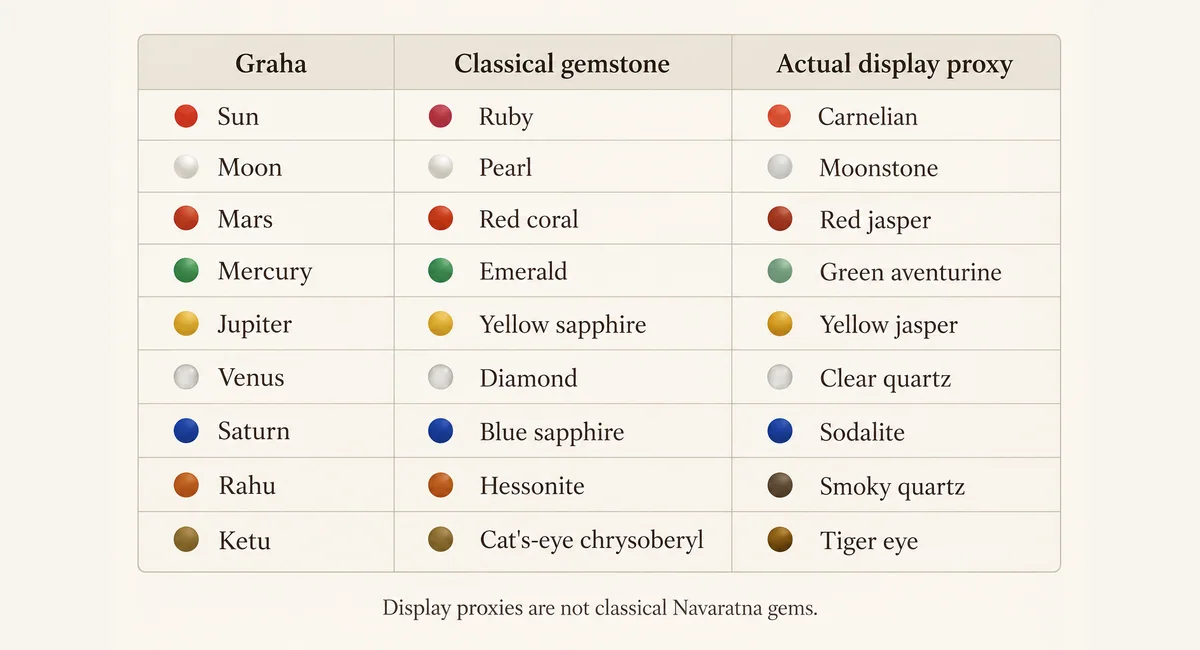
One reason buyers become confused is the word substitute. In traditional gem discussions, an uparatna is a secondary gemstone associated with a graha in a particular practice or lineage. Separately, modern educational kits may use a coloured specimen to illustrate the graha's colour. Those two meanings are not the same. A green aventurine sample demonstrates a green Mercury colour in a teaching tray; it does not become emerald by being placed in Budha's slot.
| Graha | Primary gem | Possible modern teaching colour sample | What to label on the tray |
|---|---|---|---|
| Surya | Ruby | Red garnet or carnelian | Actual garnet/carnelian; red teaching sample |
| Chandra | Pearl | White moonstone | Actual moonstone; white teaching sample |
| Mangala | Red coral | Red jasper | Actual red jasper; red teaching sample |
| Budha | Emerald | Green aventurine | Actual aventurine; green teaching sample |
| Guru | Yellow sapphire | Citrine or yellow jasper | Actual citrine/jasper; yellow teaching sample |
| Shukra | Diamond | Clear quartz | Actual quartz; clear teaching sample |
| Shani | Blue sapphire | Sodalite | Actual sodalite; blue teaching sample |
| Rahu | Hessonite | Smoky quartz | Actual smoky quartz; brown teaching sample |
| Ketu | Cat's-eye chrysoberyl | Tiger's eye | Actual tiger's eye; patterned teaching sample |
This chart describes illustrative materials used in contemporary teaching arrangements, not a universal list of secondary astrological gemstones. If a product is offered as a genuine nine-gem Navaratna set, its nine materials should be listed by their actual gemological names. If it is a teaching set, explain what it teaches and name every specimen. Transparency about the physical stone makes the cultural explanation stronger, not weaker.
How a Jyotish practitioner connects Grahas, gemstones and a Kundali
In a personalised gemstone consultation, the nine-graha chart is only the starting reference. A practitioner first examines the Lagna (ascendant), the Grahas' house lordships, Rashi placements, Uchcha and Neecha conditions (exaltation and debilitation), aspects or Drishti, conjunctions, and current Dasha and Antardasha. Different schools may also use divisional charts and measures of strength such as Shadbala.
Worked teaching example — a hypothetical Pisces Lagna: Suppose a learner is examining a chart with Meena Lagna (Pisces rising) and Jupiter located in Sagittarius, its own sign and the chart's tenth house in a whole-sign reading. For Pisces Lagna, Jupiter rules both the first and tenth houses. The combination gives the astrologer a concrete reason to study Guru, rather than simply choosing a yellow stone because Jupiter appears on the Navagraha chart. The tenth house is associated with Karma and public work; the first house concerns the native's constitution and life direction.
Next, the astrologer examines other placements, Jupiter's aspects and associations, and the running Dasha to understand the wider pattern. The gemstone conversation may then turn to Pukhraj (yellow sapphire), but the decision remains a chart-specific one. This is a constructed chart configuration for teaching, not a computed horoscope for a real person. The point is the method: the same set of nine planetary names can lead to different gemstone discussions for different Lagnas and planetary configurations.
Compare the same exercise with a Taurus Lagna chart: Shani owns the ninth and tenth houses and is traditionally called a Yogakaraka, making the discussion of Neelam very different. With another Lagna, the same Shani can own quite different houses. The familiar slogan "Saturn means blue sapphire" describes a basic correspondence; it does not explain the full reasoning that a customer expects from chart-based guidance.
Navagraha gemstone sets in Vastu, puja and a study room
A Navagraha reference arrangement can be used in a Jyotish study, a gemstone showroom, a puja area or an educational Vastu consultation. In worship, Navagraha symbols, images or yantras may accompany prayer and planetary stotras. In professional teaching, nine labelled stones make the Sanskrit names and their colour associations easier to remember. A Vastu practitioner may additionally compare the board with directional and Panchabhuta themes, while recognising that the nine-Graha system is not identical to the eight-direction Ashta Dikpala system.
Example 1 — family puja corner: A family keeps a labelled nine-Graha diagram near the home shrine and reads a simple Navagraha stotra during a chosen observance. The board acts as a focus for remembering the nine names and associations. Its position should respect the household's puja arrangement and the practice being followed; the nine stones need not be individually spread around the house.
Example 2 — professional astrology desk: A Jyotish practitioner keeps a 3-by-3 reference tray with a title card naming each graha, its primary Ratna and the actual teaching sample, if different. During a consultation, the practitioner uses it to explain why Jupiter's Pukhraj and Venus's diamond belong to different Graha traditions. The tray supports learning; the birth chart supplies the interpretation.
Example 3 — a Bengaluru gemstone shop: The showroom displays a genuine Navaratna jewellery example separately from a low-cost educational tumbled-stone set. A sign beside the jewellery lists ruby, pearl, red coral, emerald, yellow sapphire, diamond, blue sapphire, hessonite and cat's-eye chrysoberyl. A sign beside the teaching tray lists the nine actual mineral specimens and the Grahas they illustrate. Customers can now compare appearance, purpose, composition and budget without mistaking one type for another.
Buying or assembling a nine-planet gemstone set
Begin by deciding its role: jewellery, personal Jyotish practice, puja presentation, professional reference or Vastu-oriented educational display. Then choose materials and arrangement accordingly.
- Check the nine identities. Ask for a complete inventory, with the actual names of the stones—not only colour labels or the Graha names.
- Clarify whether the set is Navaratna or a study set. If the item contains jasper, aventurine, quartz or other colour examples, describe it as a reference arrangement unless the seller explicitly specifies a recognised tradition of secondary stones.
- Check natural material and treatments. Ask about natural versus laboratory-grown stones, dyes, enhancement and known treatments when they affect the purchase. Ruby and sapphire belong to corundum; pearl and coral are organic gems; cat's-eye chrysoberyl is distinct from tiger's eye.
- Read the arrangement card. A central ruby arrangement is common in Navaratna jewellery, but a training chart needs to state its own north-up or graha-sequence convention.
- Choose an appropriate form. A gemstone ring has a different construction and wearing consideration from a boxed tumbled-stone display. Tiny teaching chips are adequate for identification lessons; an heirloom jewellery commission requires separate gemstone-quality assessment.
- Preserve names and care instructions. Keep mineral species, trade terms, origin or treatment notes, if supplied, and any related article/product references together. Store softer materials carefully; pearl and coral require more delicate handling than hard corundum.
Navagraha mantras and weekday associations
Traditional planetary worship also uses the seven weekdays named after the corresponding Grahas, with Rahu and Ketu addressed through their own mantras and stotras. A simple way to learn the sequence is through the commonly used name-mantras below. Pronunciation and ritual procedures differ by lineage, so a family or temple tradition may use fuller invocations and different repetition counts.
| Graha | Commonly used simple name-mantra | Weekday association |
|---|---|---|
| Surya | Om Suryaya Namah | Sunday |
| Chandra | Om Chandraya Namah | Monday |
| Mangala | Om Mangalaya Namah | Tuesday |
| Budha | Om Budhaya Namah | Wednesday |
| Guru | Om Gurave Namah | Thursday |
| Shukra | Om Shukraya Namah | Friday |
| Shani | Om Shanaishcharaya Namah | Saturday |
| Rahu | Om Rahave Namah | Not one of the seven weekdays |
| Ketu | Om Ketave Namah | Not one of the seven weekdays |
Wearing a Navaratna ornament, reciting a stotra, keeping a reference board and receiving a Kundali-based selection are different practices. An informative article should explain each on its own terms rather than present a single method as mandatory for all.
Common questions about Navagraha gemstones
Are Navagraha and Navaratna the same?
Not exactly. Navagraha refers to the nine Grahas of Jyotish; Navaratna refers to the nine-gem grouping used to represent them. They are closely connected, but a Navagraha illustration, temple image and Navaratna ring are different formats.
Which nine gemstones belong in a classical Navaratna set?
Ruby, pearl, red coral, emerald, yellow sapphire, diamond, blue sapphire, hessonite garnet and cat's-eye chrysoberyl are the widely recognised primary list. Local spellings and trade names vary.
Is Gomed the same as any brown gemstone?
No. Gomed in the usual Navaratna list refers to hessonite garnet. Smoky quartz, tiger's eye and agate have their own material identities even when the colour looks similar.
Is every cat's-eye stone Lehsunia?
No. "Cat's eye" describes an optical look shared by several materials. The primary Ketu gemstone in the common Navaratna list is cat's-eye chrysoberyl; tiger's eye is not the same gem.
Can nine different tumbled stones be used for a study set?
Yes, if the purpose is explicitly educational or symbolic and the stones are individually identified. A study set can be valuable for learning graha names, colour themes and arrangements without pretending every sample is its corresponding primary gem.
Does a nine-stone set replace reading a Kundali?
No. A Navagraha display introduces the nine planetary associations. A chart-based gemstone recommendation interprets house lordship, planetary condition, Dasha and the specific objective of the consultation.
Where can a Navagraha reference tray be kept?
Common choices include a puja shelf, astrology desk, learning corner or gemstone showroom display. Use a clean, stable space and label the arrangement. If following a specific puja or Vastu lineage, follow that tradition's prescribed arrangement.
How is a nine-planet set different from a five-element set?
A Navagraha set is organised around Surya through Ketu. A Pancha Mahabhuta set is organised around Prithvi, Jala, Agni, Vayu and Akasha. They overlap in some contemporary gemstone symbolism but use different organising principles.
In summary: The Navagraha tradition provides a rich language of planets, gemstones, mantras, Jyotish interpretation and ritual symbolism. The useful question is not merely "Which colour is for which planet?" but "Is this a classical Navaratna collection, a clearly labelled reference kit, or a gemstone chosen through a particular birth-chart method?" Knowing the difference makes the knowledge more useful and the product choice more meaningful.
Continue reading
- Tumbled Stones for Vastu: Traditional Uses and Practical Display
- Five Elements and Gemstones: Traditional Classification Systems
- What Should a Professional Vastu Gemstone Reference Kit Contain?
Explore the existing Vastu and gemstone collections for wider context.