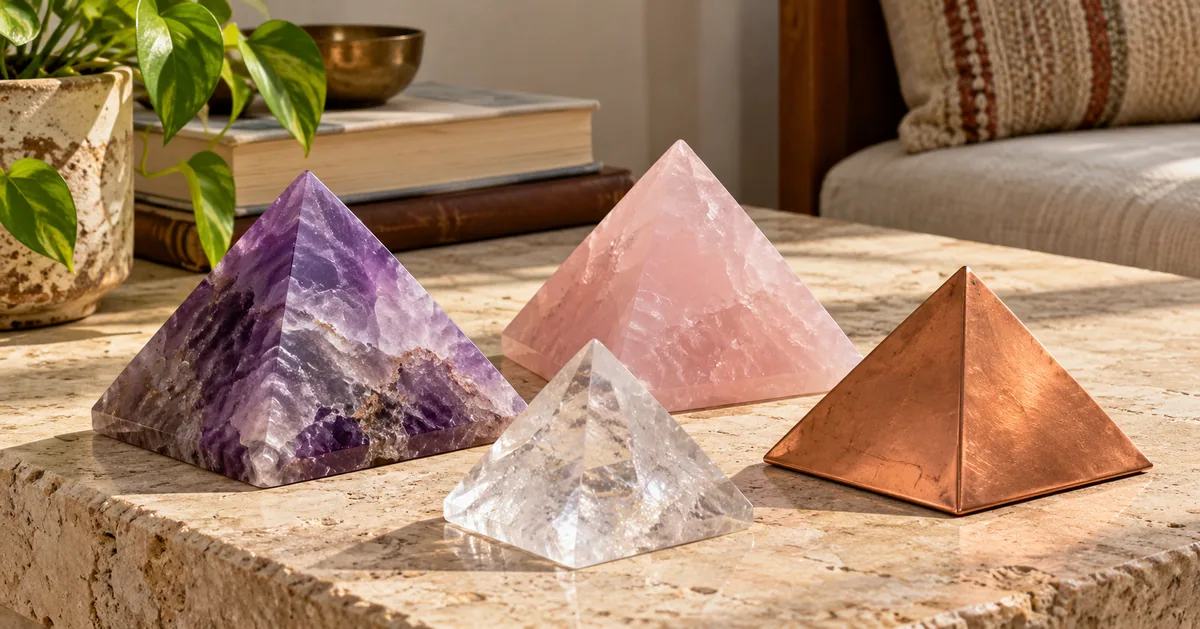
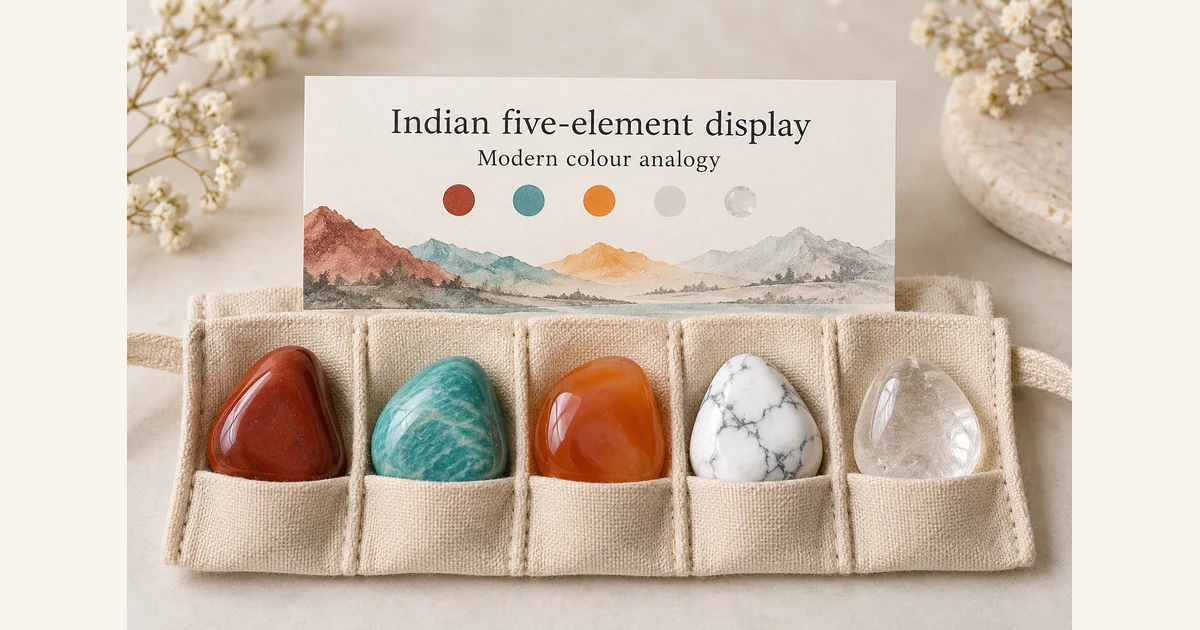
Why are five different stones placed together in a Vastu set? The answer begins with Pancha Mahabhuta (also written Panchamahabhuta or Pancha Tattva): the five great elements of the Indian tradition—Prithvi (Earth), Jala (Water), Agni or Tejas (Fire), Vayu (Air) and Akasha (Space). In Vastu Shastra, these elements offer a way to understand stability, movement, heat, flow and openness within a home or workplace. A five-element gemstone arrangement makes those qualities visible through colour, texture, location and intention.
Customers often ask which crystal belongs to which element, whether five stones should be kept together or in separate Vastu zones, and whether a five-element set is the same as a Navagraha or seven-chakra set. This guide answers those questions with a practical selection method, a direction chart and examples for homes, shops and professional consultations.
1. What are the five elements in Indian Vastu?
Pancha means five, maha means great and bhuta refers to a fundamental element or mode of existence. In Indian philosophical and spiritual traditions, the elements describe qualities of the experienced world. The traditional sequence from subtle to tangible is often given as Akasha, Vayu, Agni, Jala and Prithvi. In a Vastu discussion, the same five provide a useful language for examining a building.
Prithvi suggests support and steadiness; Jala suggests nourishment and flow; Agni suggests vitality and transformation; Vayu suggests movement and communication; and Akasha suggests openness and the space in which all activities occur. None is treated as unimportant: a well-considered dwelling needs places for stability, activity, circulation, water-related functions and quiet openness.
The Vastu Purusha Mandala offers a directional framework. In many contemporary Indian Vastu interpretations, Earth is discussed in relation to the South-West, Water to the North or North-East, Fire to the South-East, Air to the North-West and Space to the open centre or Brahmasthan. Different schools, building traditions and remedies can interpret details differently. These are useful starting points for studying a plan, rather than a substitute for studying the complete premises.
| Pancha Mahabhuta | Traditional qualities | Common Vastu zone | Colour family used in modern gemstone sets | Example stones for a symbolic set |
|---|---|---|---|---|
| Prithvi — Earth | Grounding, support, continuity, stability | South-West | Brown, ochre, earthy red | Red jasper, tiger's eye, smoky quartz |
| Jala — Water | Flow, receptivity, freshness, emotional ease | North / North-East | Blue, pale blue, silver-white | Aquamarine, moonstone, blue agate |
| Agni — Fire | Energy, will, clarity, transformation | South-East | Red, orange, golden yellow | Carnelian, garnet, citrine |
| Vayu — Air | Movement, exchange, flexibility, expression | North-West | Light green, pale blue, lavender | Green aventurine, fluorite, amazonite |
| Akasha — Space | Openness, awareness, stillness, connectedness | Central open zone / Brahmasthan | Clear, white, violet | Clear quartz, amethyst, selenite |
How to read this chart: The element names and their wider symbolic qualities come from Indian traditions. The individual gemstone examples are contemporary ways of representing these qualities; they are not a compulsory one-stone-per-element list from a single ancient Vastu manual. This matters when comparing two sets that use different stones but follow the same five-element intention.
2. Prithvi Tattva: Earth and the significance of grounding stones
Earth represents sthira, or steadiness. In traditional space planning, this quality is relevant wherever continuity, support and a sense of security are desired. The South-West is widely discussed as the substantial, settled zone: bedrooms, heavier storage and stable furnishings are often considered in that context.
Red jasper is a familiar choice in modern five-element crystal sets because its earthy red-brown body visually expresses solidity. Tiger's eye, with its golden-brown bands, is commonly chosen when the theme is practical judgement, confidence or stability. Smoky quartz offers an earth-toned alternative in sets that emphasise calm and steadiness. These are distinct minerals or varieties; their material identities should always be labelled correctly.
Example: A couple setting up a new home might keep a small tiger's eye or jasper in a secure cabinet in the South-West, together with their intention for stability and long-term planning. A consultant may use the same stone on a floor-plan board to mark the Earth zone. The stone serves a traditional symbolic purpose; the room's actual use, weight distribution and layout remain part of the Vastu assessment.
Choosing between two Earth stones: Select jasper for a simple, easily recognisable earthy representation; tiger's eye when the buyer also values its traditional association with steadiness and confident decision-making; smoky quartz for a subdued neutral palette. Check that the stone is truly the named material, especially when the set contains dyed or imitation pieces.
3. Jala Tattva: Water, flow and receptive gemstone symbolism
Water is associated with movement that nourishes rather than scorches. In many Vastu approaches, the North and North-East are considered important for water-related qualities, clarity, prayer or thoughtful beginnings. Traditional placement discussions often consider the position of water bodies, clean water storage or water features alongside the broader plan.
Aquamarine, with its blue-green colour, naturally evokes clear water; moonstone is frequently selected in Indian gemstone and spiritual traditions for lunar symbolism, softness and reflection; and blue agate may be used where a more affordable pale-blue representation is desired. They are not interchangeable mineral specimens. A five-element kit might use any one of them if its legend explains the chosen association.
Example: In a family home where a quiet reading or prayer area is toward the North-East, a moonstone or aquamarine can represent the Water theme on a small shelf. This need not involve adding an actual fountain. The choice is especially useful when the household prefers a compact, low-maintenance symbolic arrangement.
When selecting a Water stone, compare authentic material, appearance and maintenance. Aquamarine is beryl; moonstone is a feldspar-group gemstone; agate is chalcedony. A seller should name the real material rather than rely only on a blue colour label.
4. Agni Tattva: Fire, action and the South-East
Agni is the principle of heat, transformation and directed activity. It is central to many Indian ritual and philosophical traditions. The South-East is traditionally associated with the fire zone, and kitchens or fire-related activities are commonly considered in that area during a Vastu discussion.
In gemstone arrangements, carnelian is often chosen for its orange-red warmth and associations with initiative and vitality. Garnet provides a deeper red alternative, while citrine is popular in modern spiritual merchandise for golden colour, confidence and prosperity intentions. An orange agate or sunstone can also be used in a well-labelled contemporary set.
Example: A shop owner planning a new display may use a small carnelian in an element-board demonstration to identify the South-East Fire zone. If the objective is a ritual or intention-setting arrangement for initiative, a carnelian or citrine may be selected. That is separate from physically assessing the kitchen, electrical loads, ventilation or fire safety of the property.
When to choose citrine instead of carnelian: Citrine suits a golden-yellow prosperity and enterprise theme; carnelian gives a stronger visual link with flame and action. Where a supplier labels heat-treated amethyst as citrine, the material and treatment should be disclosed according to the seller's actual product details.
5. Vayu Tattva: Air, circulation and the North-West
Vayu represents breath, movement, circulation and the exchange that makes a space feel active. In commonly used Vastu mappings, the North-West is linked with movement, visitors, travel and temporary activity. These ideas are relevant when planning guest areas, customer movement or a workspace requiring collaboration.
Green aventurine is a versatile choice in contemporary crystal sets for growth and flexibility; fluorite is often selected where clarity and mental organisation are themes; amazonite is used for soothing blue-green colour and communication symbolism. Some sets use howlite or a light-coloured agate instead. There is no need to pretend that all five-element sets must have the same stone.
Example: A small office receives visitors in a North-West-facing waiting area. A labelled green aventurine on a reception shelf can represent the Air element in a simple Vastu-inspired arrangement. The meaningful questions remain: does the area allow comfortable movement, are entrances clear, and does the space support communication?
If buying fluorite, remember that many pieces are softer and more easily marked than quartz. Choose stable holders and avoid high-traffic positions where a loose polished stone could be knocked down.
6. Akasha Tattva: Space, awareness and the Brahmasthan
Akasha is often described as the subtlest of the five. It is not simply empty room area: it represents the capacity to contain, connect and make other activities possible. In Vastu discussions, the Brahmasthan—the central zone of a plan—is associated with openness, light and unimpeded circulation. Many practitioners prefer to keep it uncluttered.
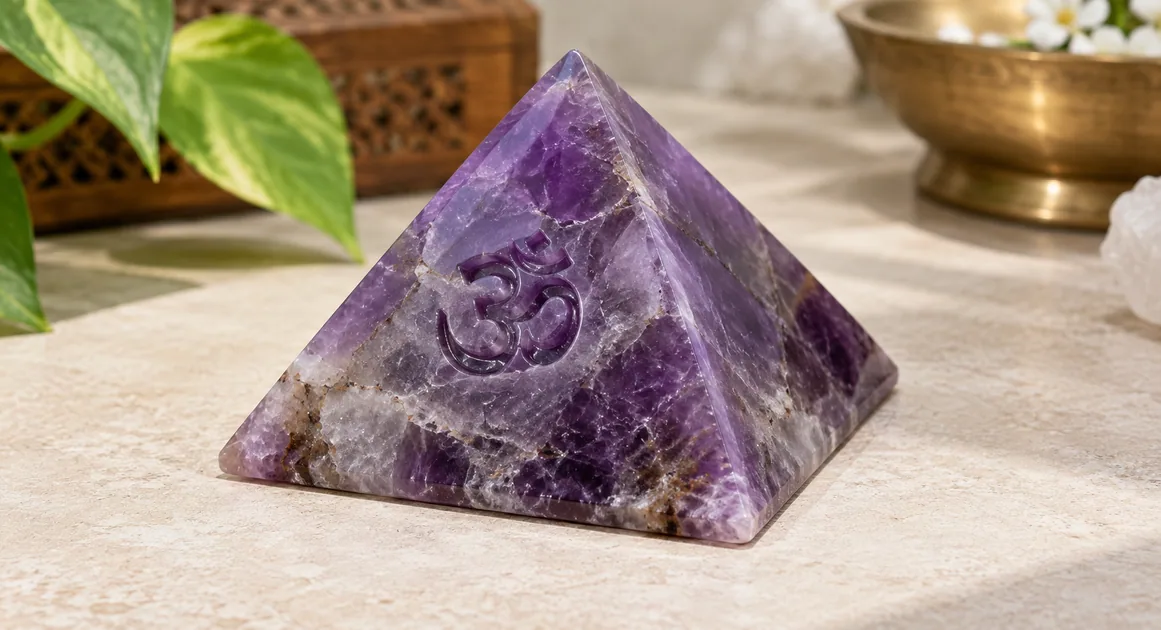
Clear quartz (Sphatik) is an intuitive symbolic choice because its transparent appearance conveys clarity; amethyst is frequently chosen for meditation and reflective practice; and selenite may represent pale, quiet spaciousness in contemporary crystal arrangements. These are modern gemstone correspondences, while Akasha itself is an older Indian concept.
Example: Rather than putting a large crystal sculpture in the centre of a room, a practitioner might mark the Brahmasthan with a clear-quartz symbol on a paper plan, while keeping the actual central passage open. A household that wants a physical crystal can place a modest piece on a nearby stable shelf rather than obstructing circulation.
For meditation: A small, clean Sphatik or amethyst on an altar can serve as a focus for an Akasha-oriented reflection. The ritual is the practice; the gemstone is the chosen symbol within that practice.
7. Five-element gemstone comparison: how to select a set
A meaningful set is more than five attractive colours. Before buying, identify its purpose. Are you building a compact home arrangement, a teaching kit for explaining Pancha Mahabhuta, or a practitioner's portable Vastu reference? The answer determines the stone sizes, labels, arrangement and supporting material.
| Set style | Best for | What it should contain | Main selection question |
|---|---|---|---|
| Five loose tumbled stones | Small home or personal altar | Five named minerals, one per labelled element | Can I identify each stone and its meaning? |
| Five-element board or tray | Teaching and demonstration | Five stones, an Indian element legend and reading order | Are all element names and placements clearly marked? |
| Professional reference kit | Vastu consultation at multiple sites | Five labelled stones, storage roll, compass guide and floor-plan template | Can the consultant explain both the symbols and zone mapping? |
| Mixed chakra or Navagraha set | Separate chakra or planetary practice | Materials selected for that particular system | Am I accidentally buying another system under a five-element name? |
Five elements do not require five identical shapes or sizes, but the stone identity should be clear. A set with a natural blue stone, a dyed orange stone and a transparent stone is not necessarily inferior for symbolic teaching; it simply needs accurate inventory information. If customers are buying named gemstones, authenticity and treatment disclosure matter.
8. Where to place a five-element gemstone set in a home
There are two sensible layouts. The first keeps all five stones together as a complete Pancha Mahabhuta arrangement on an altar, shelf or dedicated teaching board. The second uses individual stones as directional markers to illustrate particular zones in a floor plan. Choose one method intentionally rather than scattering stones without a plan.
Method A: A single five-stone arrangement
- Choose a secure, clean shelf or small wooden tray where the stones will be undisturbed.
- Place a card naming Prithvi, Jala, Agni, Vayu and Akasha in that order, or use an agreed subtler-to-denser teaching order.
- Set one properly identified stone beside each element name.
- Explain why that stone was selected—for example, carnelian's warm colour for Agni or clear quartz for Akasha.
- Use the group for daily reflection, teaching or ritual practice without needing to move the household's furniture.
Method B: Separate stones in the corresponding zones
- Take a simple floor plan and identify true North using a reliable compass or trusted map orientation.
- Mark the approximate North-East, South-East, South-West, North-West and central area.
- Select a stable location for one suitable stone in each relevant zone; it does not need to sit on the floor.
- Use the Space stone as a symbol on the diagram if keeping a physical stone at the centre would obstruct movement.
- Note the placement choices in a short legend so that the reason for each stone remains understandable.
Directional example: Place a jasper in a secure South-West cabinet, a moonstone in a North-East prayer shelf, a carnelian in a South-East display, a green aventurine in a North-West study area and a clear quartz near—not blocking—the central zone. This is a contemporary Vastu-inspired illustration of the five themes, not a fixed layout required for every property.
9. Three worked applications
Example A: A Bengaluru apartment with limited shelf space
A two-bedroom apartment has a compact living room, an open kitchen and no dedicated puja room. The owners want a meaningful five-element set without filling the home with many objects. Begin with a small labelled tray on the living-room shelf: Earth as jasper, Water as moonstone, Fire as carnelian, Air as aventurine and Space as clear quartz. Add a one-line explanation for each stone. If the owners prefer directional placement later, mark the apartment plan first rather than assuming every corner is available or suitable.
The useful educational result is that household members learn the meaning of Pancha Mahabhuta and can discuss how the living space reflects steadiness, water, activity, air and openness.
Example B: Jewellery showroom and retail counter
A jewellery showroom wants an attractive display that also explains Vastu stones to visitors. Build a professional five-compartment presentation with the element names in English and Sanskrit, genuine stone names, and a separate compass card. The display can show carnelian for Agni and tiger's eye for Prithvi, but should not mix this five-element explanation with a nine-graha Navaratna sales claim.
Make a small information card answering common visitor questions: 'Why is clear quartz used for Space?', 'Is blue agate a substitute for aquamarine?', and 'Is the five-element board the same as a Vastu floor plan?' A knowledgeable explanation makes the display valuable to customers and staff.
Example C: Professional Vastu reference kit
A practitioner visits a house and a small office on the same day. The kit contains five individually labelled stones, a washable roll, a directional reference card and blank floor-plan sheets. At each site, the practitioner marks the building orientation, identifies the key zones and explains the symbolic role of each stone in the five-element framework. The chosen stones do not need to be installed or gifted; they can remain demonstration pieces.
This is different from a remedial recommendation following a full Vastu assessment. The kit supplies a consistent vocabulary and portable illustrations, while the professional assessment considers the actual room uses, entrances, circulation and site conditions.
10. Indian Pancha Mahabhuta and Chinese Wu Xing: do not mix the charts
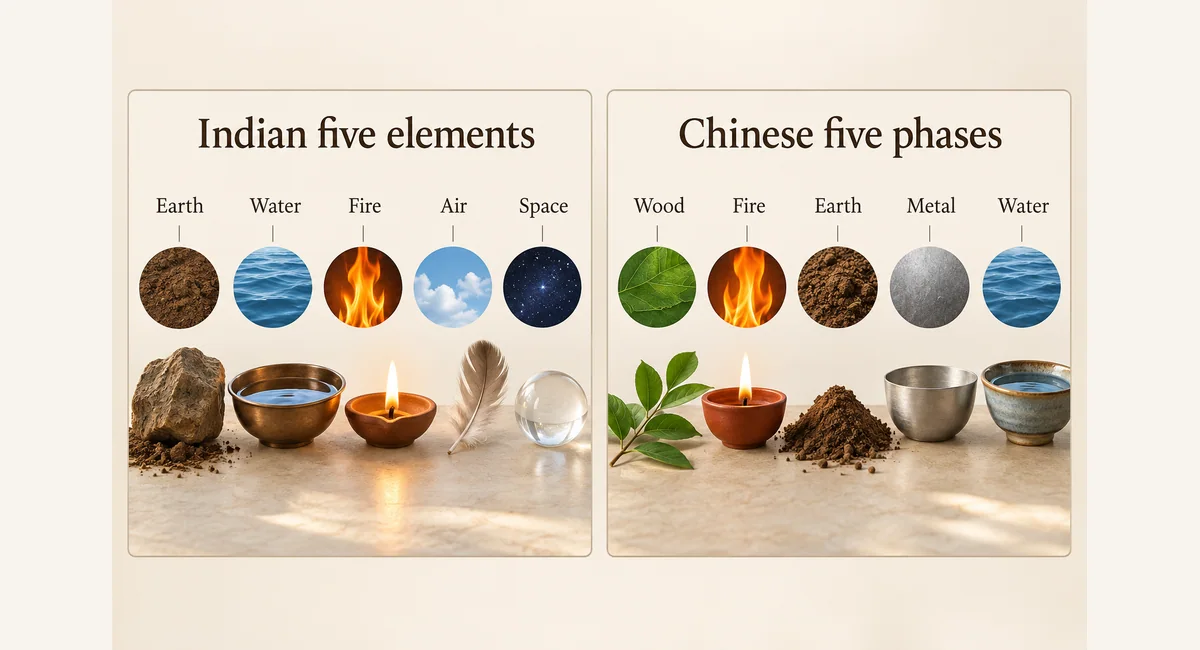
Many online listings use 'five elements' for two quite different systems. Indian Pancha Mahabhuta refers to Earth, Water, Fire, Air and Space. Chinese Wu Xing, important in Feng Shui and Chinese philosophy, refers to Wood, Fire, Earth, Metal and Water, and is often described as five phases or processes. Both have rich traditional meanings, but they are not a translation of the same list.
| Indian Pancha Mahabhuta | Chinese Wu Xing | Important difference |
|---|---|---|
| Prithvi — Earth | Wood | Wood is a distinct Chinese phase, not the Indian Earth element. |
| Jala — Water | Fire | The two systems arrange and relate qualities differently. |
| Agni — Fire | Earth | Matching an item by its row number would be misleading. |
| Vayu — Air | Metal | Air appears in the Indian five; Metal appears in Wu Xing. |
| Akasha — Space | Water | Space is a named Indian element but not a Wu Xing phase. |
These two columns are a side-by-side inventory, not a set of one-to-one correspondences. The generative and controlling cycles in Wu Xing belong to that tradition; they should not be copied into an Indian Vastu gemstone layout as though they were the Pancha Mahabhuta model. A seller should state which system its product follows.
11. How five-element stones differ from chakra and Navagraha sets
Five-element, chakra and Navagraha sets can contain overlapping gemstones, yet their organising principles differ. A five-element set illustrates Prithvi, Jala, Agni, Vayu and Akasha. A seven-chakra set generally follows seven named centres and their colour associations in contemporary chakra practice. A Navagraha set concerns nine grahas and their specific traditional gemstone correspondences.
A red gemstone in a chakra set is not automatically a Fire stone, and a yellow gemstone in a five-element set is not automatically the gemstone a Jyotish practitioner would recommend for Jupiter. When working from an actual birth chart, graha strength, house lordship, Dasha and the purpose of selection may matter. A five-element household set is not a replacement for that chart-based procedure.
For deeper comparisons, read Seven Chakra Tumbled Stone Sets: Material and Colour Guide and Navgraha Gemstone Sets: Traditional Correspondences. For zone-based applications, see Tumbled Stones for Vastu: Traditional Uses and Practical Display.
12. Buying, care and common questions
Are there five compulsory gemstones for the five elements?
No single five-stone list is used by every practitioner or contemporary seller. Compare the chosen tradition, the explanation for each stone, the actual mineral names and whether the set is intended for teaching, puja or Vastu placement. The element meaning comes first; the stone is selected to represent that meaning within a stated approach.
Should all five stones be kept together?
They may be kept together in a labelled tray or placed separately as directional symbols. A combined set suits an altar or educational board. Separate placement is more suitable when a practitioner is demonstrating how element themes relate to actual Vastu zones.
Can I use a clear quartz stone for all five elements?
Clear quartz can serve as a general symbolic focus, especially in meditative practice, but a teaching set usually benefits from five distinguishable stones and visible labels. If your goal is to understand the different qualities, a mixed set is easier to explain.
Is a five-element set only for homes?
No. It may be used in a shop, office, showroom, classroom or professional consultation kit. A business setting often benefits from a tidy, labelled presentation that customers can understand at a glance.
Which element should I focus on first?
Start with the actual intention: steadiness and long-term planning suggest an Earth discussion; clear flow and reflection suggest Water; action and enterprise suggest Fire; communication and movement suggest Air; and meditation or openness suggest Space. Then consider the relevant zone and whether the stone is meant for a permanent place or a portable demonstration.
How should the stones be maintained?
Keep them clean, stable and out of locations where they can fall. Use a dry soft cloth for routine care. Do not assume that every stone tolerates soaking, salt water, prolonged sunlight or abrasive cleaning. Softer and layered materials may require extra care; follow the instructions for each actual mineral.
What should a professional set label include?
Include the element name, the gemstone's actual identity, its traditional or contemporary symbolism, any recommended direction used by the chosen Vastu approach, and the reference layout. A printed legend makes the set far more useful than a box of unlabelled stones.
13. Explore five-element sets and related Vastu articles
Browse the Five Elements Gemstone Set to compare the actual materials and contents, or explore the wider Tumbled Stones collection. The Vastu section covers other product families, while the gemstone collections can help you understand the materials themselves.
The most useful five-element arrangement is one you can explain: five names, five distinct qualities, accurately named gemstones and a thoughtful placement or practice. That is what turns a small set of stones into a meaningful Pancha Mahabhuta guide.