Which seven gemstones belong in a chakra stone set, and how should you use them? A meaningful seven-chakra collection is not simply seven attractive colours. It brings together the Indian idea of cakra (a wheel or subtle centre), the vocabulary of Yoga and Tantra, and a selected group of stones used for contemplation, Sankalpa (intention), devotional practice and chakra-oriented meditation. The value of a thoughtfully prepared set is that every stone has a name, a place, a reason for being chosen and a method of use.
The familiar rainbow sequence—red, orange, yellow, green, blue, indigo and violet—is now widespread in crystal practice. The chakras themselves belong to much older Indian spiritual traditions; the precise rainbow-to-gemstone mapping is a later, widely adopted teaching convention. Understanding both allows us to respect the original spiritual framework while making the stone set useful today.
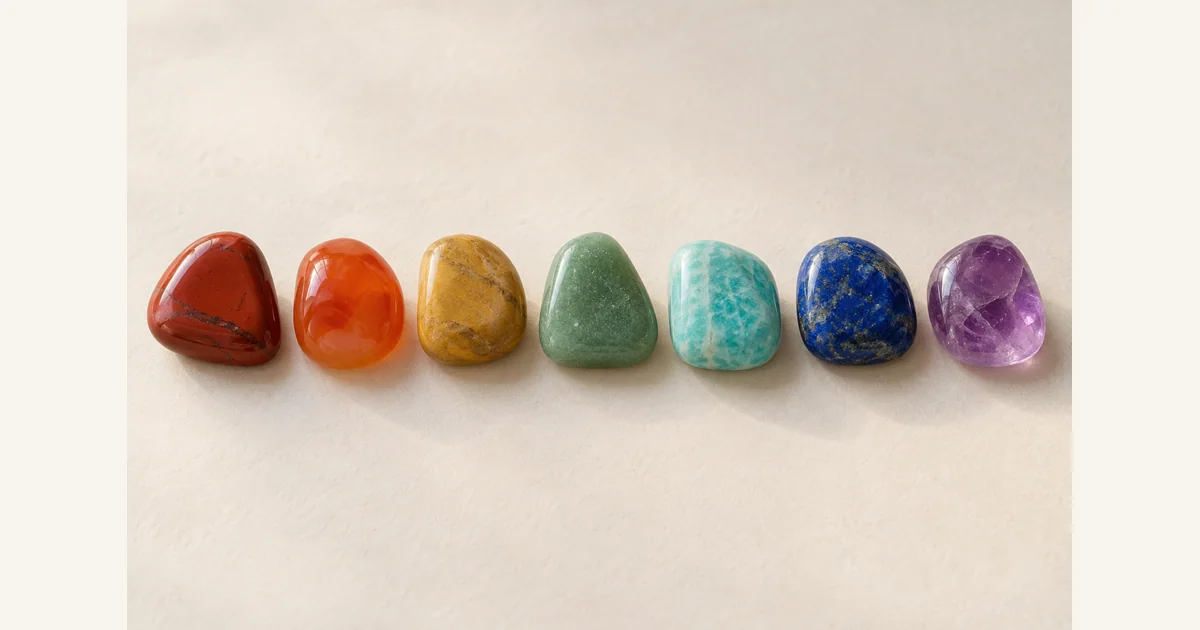
1. The seven chakras: Sanskrit names, elements, mantras and intentions
Different Yoga and Tantra lineages describe subtle centres in different numbers and arrangements. The widely taught sequence of six centres with Sahasrara at the crown is one influential model. In these traditions, the chakras are not merely colour labels: they are associated with lotus imagery, prana, sound, deities, meditation and the movement of awareness. A gemstone set is a material aid to understanding and practising with that map.
| Chakra | Traditional emphasis | Element and common Bija | Modern colour and sample stone |
|---|---|---|---|
| 1. Muladhara — Root | Foundation, steadiness, support and the beginning of the subtle ascent | Prithvi (earth); Lam (लं) | Red — Red Jasper |
| 2. Svadhisthana — Sacral | Flow, creative expression and the water principle | Jala (water); Vam (वं) | Orange — Carnelian |
| 3. Manipura — Navel/Solar Plexus | Fire, transformation, determination and disciplined action | Agni (fire); Ram (रं) | Yellow — Yellow Jasper |
| 4. Anahata — Heart | Breath, compassion, devotion and openness | Vayu (air); Yam (यं) | Green — Green Aventurine |
| 5. Vishuddha — Throat | Space, sound, truthful expression and attentive listening | Akasha (space); Ham (हं) | Blue — Amazonite |
| 6. Ajna — Brow/Third Eye | Inner attention, discernment, contemplation and insight | Beyond the five gross elements; often Om (ॐ) | Indigo — Lapis Lazuli |
| 7. Sahasrara — Crown | Awareness, surrender and the thousand-petalled lotus | Beyond elemental Bija; silence or Om in many modern practices | Violet — Amethyst |
How to read this table: the chakra names and elemental Bija associations come from established Sanskrit yogic and tantric descriptions; the seven sample gemstones are a contemporary crystal-set selection. The crown centre is not traditionally assigned a sixth physical element. Some lineages use different mantras or visualisations, especially for Ajna and Sahasrara. Follow the practice of your teacher or lineage where applicable.
2. A carefully chosen seven-stone reference set
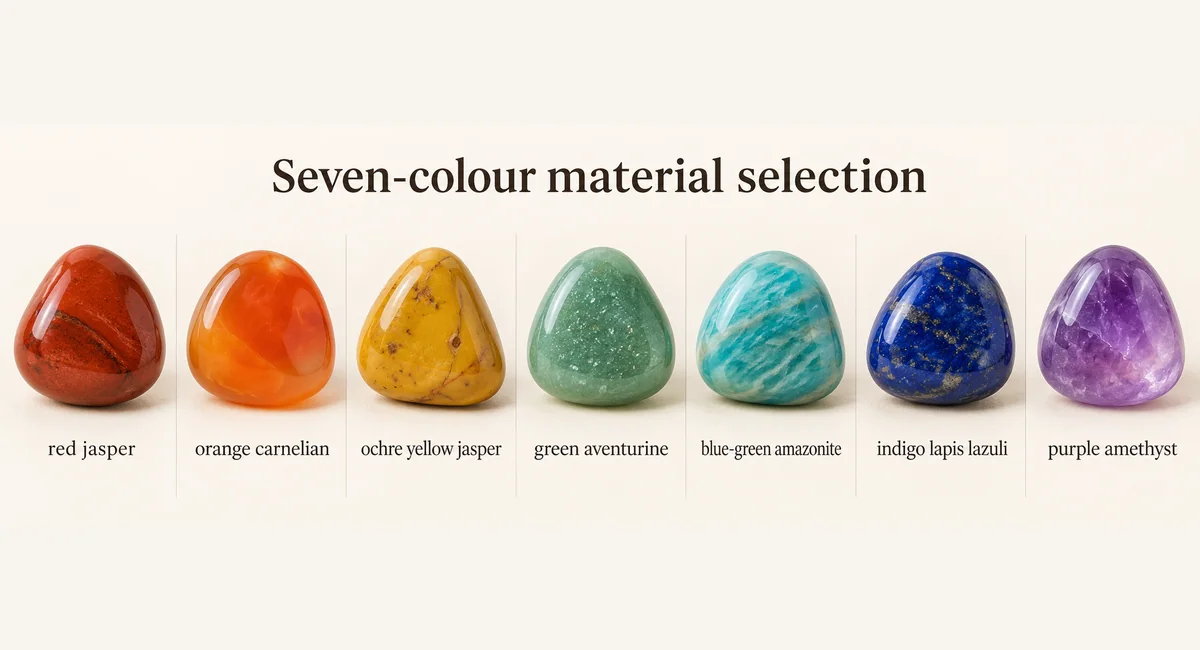
For a practical OmmRudraksha-style teaching set, a coherent sequence is Red Jasper, Carnelian, Yellow Jasper, Green Aventurine, Amazonite, Lapis Lazuli and Amethyst. This is an example of named gemstones matched to the seven modern chakra colours—not a rule that every collection must use exactly these stones. Each mineral or rock has a distinct appearance, cultural meaning and selection consideration.
Muladhara — Red Jasper: stability and grounding
Red Jasper is an opaque variety of silica-rich material with a warm, earthy appearance. In modern chakra and crystal practice it represents a firm base: reliability, grounded effort and steady habits. For Muladhara, its rust-red colour makes the symbolism immediate. In a meditation arrangement, place it at the first position and reflect on the foundations of daily life—home, routine and responsibility. Look for a properly named red jasper rather than assuming every bright-red pebble is jasper; dyed agate and glass may look similar in photographs.
Svadhisthana — Carnelian: fluidity and creative intention
Carnelian is orange to reddish-orange chalcedony. Its translucent glow is especially suitable for the water and movement themes often discussed with Svadhisthana. Practitioners commonly connect it with creative work, enthusiasm and the ability to begin again after stagnation. A writer, artist or craftsperson might keep this stone alongside a short Sankalpa for their creative project. Orange colour alone is not proof of carnelian identity; sellers should name the material and disclose significant colour enhancement.
Manipura — Yellow Jasper: Agni and determined action
Manipura is associated with the fire principle, transformation, digestion in the symbolic yogic sense, self-command and the capacity to carry intention into action. Yellow Jasper provides an opaque yellow example. Some sets instead use Citrine, Yellow Aventurine or Tiger Eye. These are different materials and should not be silently substituted under the same product name. Use the third stone as a prompt for a concrete daily commitment—such as maintaining a study timetable or completing an important piece of work—rather than merely admiring its colour.
Anahata — Green Aventurine: an open heart and compassionate conduct
Green Aventurine is a variety of quartz containing tiny inclusions that can create subtle sparkle. In contemporary crystal use, the green colour is associated with renewal, emotional harmony, friendship and generous action. Anahata is also central to contemplation of breath, care and devotion. During a practice, hold the green stone and reflect on one relationship or responsibility that would benefit from kindness. Rose Quartz is a popular pink alternative for the heart centre; pink is a later stone-colour choice, not a reason to rename green aventurine.
Vishuddha — Amazonite: speech, listening and Akasha
Amazonite is a blue-green microcline feldspar. Its soft colour has made it a familiar choice for throat-centre sets, particularly when the intended focus is communication and listening. Vishuddha is associated with Akasha, sound and the refinement of expression. A useful exercise is to choose one difficult conversation, write three truthful but considerate sentences, and sit quietly with the stone before speaking. Sodalite, Blue Lace Agate or Aquamarine may also appear at this position; each is a different material with a different look and care profile.
Ajna — Lapis Lazuli: discrimination and inner attention
Lapis Lazuli is a blue metamorphic rock that can include the blue mineral lazurite, pale calcite and metallic-looking pyrite. Its deep indigo-blue appearance makes it a frequent choice for the brow centre. In contemporary chakra practice, the stone represents clarity, attentive observation and good judgement. An Ajna exercise can involve observing the breath, noticing a repeated mental assumption and asking whether that assumption is well founded. Natural lapis may show irregular white areas or flecks; it need not be perfectly uniform. Dyed material and substitutes exist, so request clear material identification.
Sahasrara — Amethyst: contemplation, devotion and stillness
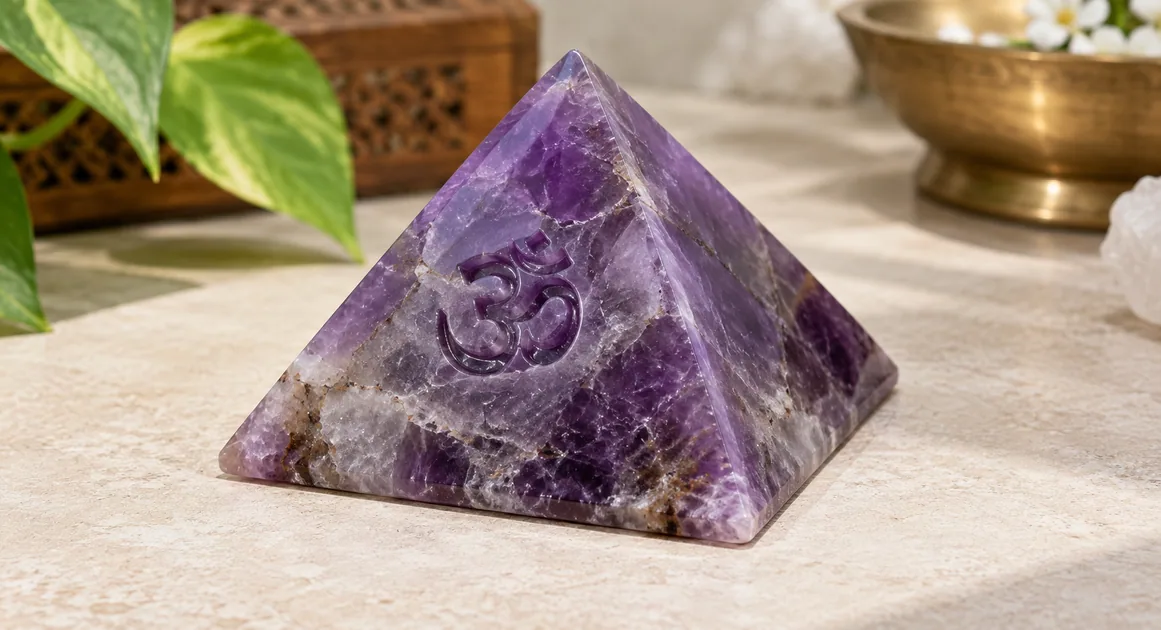
Amethyst is the purple variety of quartz. It is a natural fit for the violet end of a seven-colour arrangement and is popularly used during meditation and reflective spiritual practice. Sahasrara symbolises the crown of the subtle map and is often treated differently from the six centres below it. The stone can act as a gentle visual focus while a practitioner sits in silence or recites a familiar mantra. Some sets choose Sphatik (clear quartz) instead, reflecting the crown's associations with clarity and luminosity. Both versions can be described accurately without claiming that one mineral is the universal rule.
3. Seven stones do not mean seven identical materials
The colour-to-chakra assignment is a starting point, not a mineral-identification system. A serious kit should carry an actual list of stones: the person buying it should know whether position three is yellow jasper or citrine, and whether position six is lapis lazuli or sodalite. This matters because the stones vary in texture, opacity, inclusions, hardness and sensitivity to cleaning.
| Chakra position | Example in this article | Frequently used alternative | What changes when substituted? |
|---|---|---|---|
| Root | Red Jasper | Garnet or Hematite | Colour, density, polish and traditional interpretation |
| Sacral | Carnelian | Orange Calcite or Sunstone | Transparency, softness and mineral identity |
| Navel | Yellow Jasper | Citrine or Tiger Eye | Quartz variety, optical effect and colour source |
| Heart | Green Aventurine | Rose Quartz or Jade | Colour convention and specimen identity |
| Throat | Amazonite | Sodalite or Aquamarine | Mineral type and sensitivity to abrasion |
| Brow | Lapis Lazuli | Sodalite or Blue Sapphire | Price, authenticity checks and meaning |
| Crown | Amethyst | Sphatik (Clear Quartz) | Violet versus clear presentation; both suit meditation |
Example: Two sets can both be labelled “seven chakras” but have different prices because one uses natural, individually identified stones and the other uses dyed mixed pebbles selected by colour alone. Compare the actual inventory, not only the product photograph. The choice of a more expensive stone does not automatically mean a more suitable spiritual practice.
4. How to arrange and use the seven stones for meditation
A seven-stone collection works best when the sequence is written down and easy to repeat. Use a clean cloth, low tray or labelled card. Place the stones in an ascending row from Muladhara to Sahasrara. The row can be vertical, or arranged as an arc around a central diya or meditation journal if the setting is safe and practical. Avoid allowing the gemstones to touch a burning lamp.
- Prepare your space: select a quiet, clean spot. Set the seven stones on a soft cloth with the root stone nearest you and the crown stone farthest away.
- Establish Sankalpa: choose an intention that concerns action within your own life, such as cultivating steadiness, better communication or disciplined study.
- Begin with Muladhara: notice your posture and natural breathing while gently resting attention on the red stone. If you use Bija mantras, Lam belongs to the familiar earth-centre sequence.
- Move upward: work through orange, yellow, green and blue, acknowledging each chakra's traditional element and intention. Recite the Bija only if that is part of your chosen practice.
- Pause at Ajna: observe thoughts without chasing them. The blue stone is a reminder to practise attention and discernment.
- Rest at Sahasrara: end with a quiet interval. In many contemplative approaches, silence is more suitable here than inventing a new elemental mantra.
- Close deliberately: record one action or insight in a short journal entry. Return the stones to the correct pockets.
This practice can be completed in a few quiet minutes or incorporated into a longer meditation, prayer or mantra routine. The important part is consistency and meaningful reflection. You do not need a complicated ritual or an expensive equipment list to use the stones thoughtfully.
5. The difference between chakra stones, Navagraha gemstones and Vastu sets
OmmRudraksha covers several traditional subjects, and buyers frequently encounter overlapping stone colours. The underlying selection method, however, is not identical.
| System | Main organizing principle | Typical reference materials | Useful question to ask |
|---|---|---|---|
| Seven Chakra set | Subtle centres, symbolic sequence and meditation | Seven named stones or seven representative colours | Which centre and practice does each specimen represent? |
| Navagraha/Navaratna | Nine Grahas and their traditional Jyotish gemstone associations | Ruby, Pearl, Red Coral, Emerald, Yellow Sapphire, Diamond, Blue Sapphire, Hessonite, Cat’s Eye | Are these the traditional gems or a symbolic teaching alternative? |
| Pancha Mahabhuta | Prithvi, Jala, Agni, Vayu and Akasha | Five-element teaching specimens, labelled by symbolism | What element is being demonstrated, and in which tradition? |
| Eight Directions Vastu | Dik, Dikpalas, house orientation and spatial purpose | Directional pairs or a labelled floor-plan arrangement | What direction or room function is under discussion? |
A seven-colour chakra kit should not be relabelled as a complete nine-planet set simply because it contains red and blue stones. Likewise, a Vastu direction arrangement does not automatically require one chakra stone in every corner. These systems can be studied together, but the selected stones and interpretation should follow the actual topic.
For further comparison, read Five Elements and Gemstones: Traditional Classification Systems, which explores Panchabhuta more closely.
6. Choosing a seven-stone set or a professional reference kit
For a home meditation routine, a compact set containing seven accurately identified stones is sufficient. A professional or educational set may contain fourteen or more specimens, with a representative and an alternate at each position. That supports teaching: a learner can compare Amethyst with Clear Quartz at the crown, or Amazonite with Sodalite at the throat, and discuss why different teachers use different choices.
Example A: a compact seven-stone personal set
Choose one medium-sized stone per chakra, about the same general handling size but not necessarily identical in weight. Include a clearly printed sequence card with all seven stone names, Sanskrit chakra names and simple practice prompts. A person with limited desk space can arrange them on one long strip of fabric; when the practice ends, the stones return to seven labelled pockets.
Example B: a fourteen-stone learning kit
Prepare two stones per position: red jasper and hematite; carnelian and orange calcite; yellow jasper and tiger eye; green aventurine and rose quartz; amazonite and sodalite; lapis lazuli and a second clearly identified blue specimen; amethyst and sphatik. The kit has 14 specimens in total. Each pair illustrates variation within an interpretive position, not a ranking of spiritual effectiveness. A small two-column comparison card makes the lesson repeatable.
Example C: a Bengaluru yoga and meditation workshop
An instructor has ten students and wants to demonstrate the seven centres without circulating loose, unlabelled stones. Prepare one numbered teaching tray, one enlarged chart and a participant handout. Begin with the Sanskrit name and relevant Bija, discuss the traditional element, then show the selected material and its modern association. Finish with a guided reflection and questions about how the different systems arose. This allows students to learn the tradition and the modern stone convention without confusing the two.
What to verify before purchasing
| Check | Why it matters | What to look for |
|---|---|---|
| Exact material inventory | Different minerals are often sold under a common colour label | Seven written stone names matching the photographed set |
| Natural versus treated | Dye and enhancements can change colour | Clear treatment disclosure and honest photographs |
| Complete count | Teaching sequences require one identifiable specimen per position | 7, 14 or another stated number, counted before packing |
| Usable sizes | Very tiny chips are difficult to handle individually | Dimensions and weight range where available |
| Surface and finish | Sharp edges and damaged polish hinder handling | Smooth surfaces with natural variations described |
| Reference card | Positions and meanings otherwise become ambiguous | Chakra name, colour, material and intended use per position |
| Appropriate container | Separate stones can rub or chip in transit | Soft pouches or divided tray, especially for delicate specimens |
7. Three situations: selecting stones for a home, desk and spiritual space
Family meditation corner
A family keeps a small prayer and meditation shelf. They want the seven chakras represented but do not have room for a large installation. Use seven individual stones laid out on a narrow cream cloth with a short Sanskrit label card. A northeast prayer corner may be meaningful in the family's Vastu tradition, but the chakra sequence itself does not mandate that every stone occupy a different room direction. Keep the full set together so its educational order remains clear.
Student's study desk
A student wants a simple contemplative routine before studying. Rather than placing all seven stones across valuable desk space, keep them in a small pouch and select one or two reflection prompts for the day. Yellow Jasper can symbolise disciplined effort; Amazonite can represent clear communication; Amethyst can accompany a quiet closing meditation. At the end of the session, return the stones to the pouch so they are not confused with other loose gemstones.
Jewellery showroom or consultation counter
At a gemstone showroom, a labelled seven-stone strip helps visitors understand why a seller calls one arrangement a chakra set and another a Navagraha set. Display the actual stone names with magnified photographs of representative inclusions. Keep a separate set of nine traditional Navaratna labels for astrology discussions, and a Vastu compass chart for directional consultation. This is clearer for the customer and makes follow-up product recommendations more precise.
8. Care: keep the meditation set useful for years
Handle tumbled stones over a soft surface. Dry-clean gently with a soft cloth after normal handling; avoid soaking a mixed set because softer or treated stones may respond differently to water, cleaning agents and temperature. Lapis Lazuli can contain calcite and treatments; Amazonite is a feldspar and may chip if struck; quartz-family stones are comparatively robust but still scratch when packed together with harder edges or metal fittings.
Store each specimen in a labelled compartment or a separate cloth pocket. Avoid prolonged harsh sunlight for light-sensitive materials, and avoid chemical “cleansing” methods intended for unrelated minerals. For a spiritual practice, some devotees choose prayer, mantra, incense nearby or quiet intention as part of their personal routine; keep the stones away from direct flame, oily smoke and wet offerings. If a specimen is replaced, update its name on the reference card instead of silently substituting a new mineral.
9. Frequently asked questions
Must every chakra set contain exactly these seven minerals?
No. Seven named, suitable stones can be assembled in different ways. The sample set in this article is deliberately consistent with the two existing illustrations. What matters for selection is the combination of tradition, intended use and correctly identified materials.
Is a seven-chakra gemstone set the same as a Kundali-based gemstone remedy?
No. Chakra sets are arranged by subtle centres and contemplative symbolism. A Jyotish gemstone consultation examines the Janma Kundali, Lagna, Graha strength, house lordships, Dasha and relevant traditional practices before recommending a planetary gemstone. That is a different method.
Can I use Sphatik instead of Amethyst for Sahasrara?
Yes. Clear Sphatik is widely valued in Indian devotional contexts and commonly used for the crown in crystal practice. If you use it, label the crown stone as clear quartz rather than retaining “Amethyst” on the card.
Are chakra colours the same in all Indian texts?
No. Historical Sanskrit descriptions include lotus petals, deities, sounds and varied visualisations. The familiar red-to-violet sequence is a widely adopted modern arrangement. The distinction enriches the study rather than reducing its spiritual value.
Do I need to keep all stones on my body while meditating?
No. A table or cloth layout is sufficient for reflective and devotional use. Some modern practices place stones near the corresponding symbolic body positions, but no such placement is necessary for learning the sequence, chanting or keeping a meditation journal.
What is the difference between a seven-stone and fourteen-stone set?
The seven-stone set introduces one material for each position. A fourteen-stone kit adds a second labelled example at each chakra and is more useful for comparison, teaching and professional demonstrations. The higher count mainly adds flexibility and learning value.
10. Continue exploring OmmRudraksha's gemstone guides
The set belongs naturally beside the wider gemstone collections, Vastu guides and practical articles about different types of tumbled stones.
- Single Stones, Multipacks and Mixed Sets Compared — choosing a kit size
- How to Label and Organize a Tumbled Stone Reference Collection — maintaining accurate reference cards
Explore the materials and sets
Final selection principle: choose a collection whose seven positions you can explain. Name each gemstone, understand its traditional or contemporary chakra association, practise with a clear Sankalpa, and keep the stones well labelled. A thoughtful seven-chakra set is both a useful meditation companion and a practical gateway into the deeper spiritual vocabulary of Indian Yoga and Tantra.